Permission to Use Copyrighted Material Template

Free Word download • Edit online • Save & share with Drive • Export to PDF

1 page20–30 min to fillDifficulty: StandardSignature requiredLegal review recommended
Learn more ↓
FreePermission to Use Copyrighted Material Template

At a glance

What it is
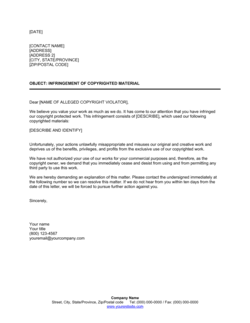
A Permission To Use Copyrighted Material is a legally binding agreement in which a copyright owner (the licensor) grants a third party (the licensee) specific, defined rights to reproduce, distribute, display, or adapt protected content — text, images, music, video, software, or other creative works. This free Word download covers scope of use, territory, duration, attribution requirements, royalties, and termination in a single concise document you can edit online and export as PDF.
When you need it
Use it whenever you want to reproduce someone else's protected content in a publication, website, course, marketing material, film, or product — or whenever you are the rights holder granting someone else permission to use your work. Without written permission, using copyrighted material exposes both parties to infringement liability.
What's inside
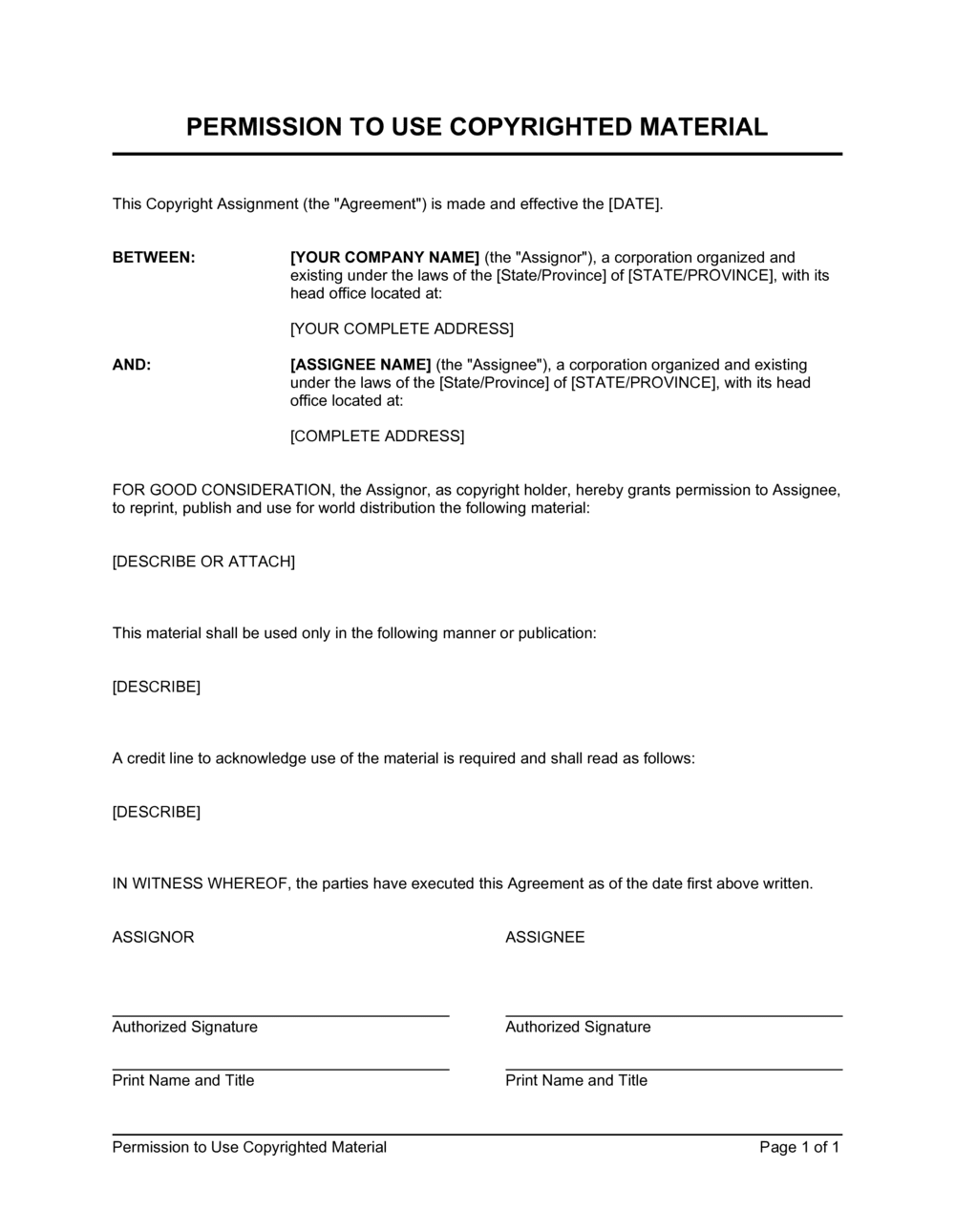
Identification of the parties and the protected work, a precise description of the permitted use and scope, territory and duration of the license, attribution and credit requirements, royalty or fee terms, representations and warranties by the rights holder, and termination and remedies clauses.

What is a Permission To Use Copyrighted Material?

A Permission To Use Copyrighted Material is a legally binding agreement in which a copyright owner authorizes another party to reproduce, display, distribute, or adapt a protected work — such as a photograph, article, piece of music, video clip, or software — under precisely defined conditions. Because copyright attaches automatically to original works at the moment of creation, no one else has the right to use that work commercially without the owner's consent. This agreement documents that consent, establishes the scope of permitted use, sets any compensation or royalty terms, and gives both parties a clear contractual framework if a dispute arises.

Why You Need This Document

Using copyrighted content without written permission — even with attribution, even for a limited run, even with good intentions — constitutes infringement in most jurisdictions and exposes your business to statutory damages, injunctions, and legal fees that can far exceed the cost of clearing rights upfront. A verbal agreement or an email exchange is rarely enforceable and leaves both parties arguing about what was actually agreed. Without a signed permission agreement, you have no defense if the rights holder changes ownership, changes their mind, or disputes the scope of what was authorized. This template gives licensors a clear record of what they granted and to whom, and gives licensees documented proof that their use is authorized — eliminating the ambiguity that makes copyright disputes so costly to resolve.

Which variant fits your situation?

If your situation is…Use this template
Granting a one-time, non-commercial reprint of an article or excerptPermission To Use Copyrighted Material
Licensing music or sound recordings for commercial video or broadcastMusic License Agreement
Licensing software or code under defined commercial termsSoftware License Agreement
Transferring all rights in a work permanently to another partyCopyright Assignment Agreement
Allowing broad reuse of your content by multiple licensees under standard termsContent License Agreement
Granting a photographer or illustrator limited rights to use commissioned workWork For Hire Agreement
Licensing a trademark alongside or instead of copyrighted contentTrademark License Agreement

Common mistakes to avoid

❌ Relying on fair use as a substitute for written permission

Why it matters: Fair use is a defense to an infringement claim, not a pre-clearance mechanism. Its application depends on four factors evaluated after the fact by a court — the outcome is never guaranteed. Businesses that rely on fair use for commercial publications routinely face demand letters and litigation costs that dwarf the cost of obtaining permission upfront.

Fix: Obtain written permission for any use that is commercial, that reproduces a substantial portion of the work, or that could substitute for the original in the market. Reserve fair use arguments for genuinely transformative, non-commercial, or clearly commentary-based uses.

❌ Assuming a Creative Commons license covers commercial use

Why it matters: Many Creative Commons licenses — specifically CC BY-NC and CC BY-NC-SA — explicitly prohibit commercial use. Using NC-licensed content in paid products, advertising, or monetized platforms is infringement regardless of attribution.

Fix: Check the specific CC license type before use. For any commercial application, only CC BY, CC BY-SA, or CC0 works without additional written permission. When in doubt, contact the rights holder directly.

❌ No territory restriction when the licensor's rights are geographically limited

Why it matters: A licensor who grants a worldwide license but only holds North American rights is warranting something they cannot deliver. If the licensee distributes in the UK or EU and a third party holds rights there, the licensee faces infringement claims with no contractual recourse.

Fix: Confirm the full chain of title before agreeing to any territory. Limit the license to the territories where the licensor's rights are unambiguous, and require the licensor to disclose any known limitations in the warranty clause.

❌ Granting an exclusive license without a minimum revenue or use commitment

Why it matters: An exclusive license prevents the licensor from licensing to anyone else — if the exclusive licensee underperforms or abandons the work, the licensor is locked out of the market with no recourse.

Fix: For exclusive licenses, include a minimum annual royalty guarantee and a 'use it or lose it' reversion clause: if the licensee fails to distribute or publish the work within a defined period, the license reverts to non-exclusive or terminates.

❌ No cure period or immediate termination right for unauthorized use

Why it matters: A standard 30-day cure period applied to copyright infringement effectively gives the infringing party a month of ongoing infringement before the licensor can act. By the time the cure period runs, the infringing content may have been indexed, shared, or incorporated into downstream products.

Fix: Include an immediate termination trigger specifically for unauthorized use or use beyond scope, separate from the general cure-period mechanism for other breaches.

❌ Vague attribution requirements

Why it matters: Credit lines buried in footnotes, collapsed into metadata, or reduced to initials fail the spirit of the attribution requirement and in some jurisdictions breach the licensor's moral rights — potentially creating liability even where the economic license is valid.

Fix: Specify the exact credit text verbatim, minimum display size, and required placement (e.g., immediately adjacent to the work, not in a general credits page) and require the licensee to provide a sample for approval before publication.

The 10 key clauses, explained

Identification of parties and the protected work

In plain language: Names the licensor and licensee as legal entities and describes the copyrighted work precisely enough that both parties agree on exactly what is being licensed.

Sample language
This Agreement is entered into on [DATE] between [LICENSOR LEGAL NAME] ('Licensor'), owner of copyright in the work described in Schedule A, and [LICENSEE LEGAL NAME] ('Licensee'). The Work is identified as: [TITLE / DESCRIPTION OF WORK], first published [YEAR], registration number [COPYRIGHT REG. NUMBER IF ANY].

Common mistake: Describing the work vaguely — for example, 'the photograph' or 'the article' — rather than with a title, publication date, and registration number. Ambiguity about what is licensed creates disputes when the licensee reproduces a similar but technically different work.

Grant of license and exclusivity

In plain language: States exactly what rights are being granted — reproduction, distribution, adaptation, display — whether the license is exclusive or non-exclusive, and whether sublicensing is permitted.

Sample language
Licensor hereby grants to Licensee a [non-exclusive / exclusive], non-transferable, [non-sublicensable / sublicensable] license to [reproduce / display / distribute / adapt] the Work solely for the Permitted Use described in Schedule B.

Common mistake: Granting a broad 'use' license without specifying the medium, format, or purpose. A licensee who receives permission to 'use' a photograph may interpret that as covering social media, print advertising, and merchandise — far beyond what the licensor intended.

Permitted use and restrictions

In plain language: Defines precisely how the licensee may use the work — the specific publication, platform, product, or campaign — and lists what is explicitly prohibited.

Sample language
The Permitted Use is: reproduction of the Work in [PUBLICATION NAME / URL / PRODUCT] in [FORMAT]. Licensee shall not modify, crop, colorize, or combine the Work with other materials without prior written consent from Licensor. Use in advertising or commercial endorsement is prohibited unless expressly stated.

Common mistake: Omitting a list of prohibited uses. Without explicit restrictions, licensees routinely expand use into adjacent contexts — such as repurposing editorial content for paid advertising — and claim the license was broad enough to cover it.

Territory

In plain language: Specifies the geographic area in which the licensee is authorized to exploit the work.

Sample language
The license granted herein applies solely within [TERRITORY — e.g., the United States and Canada / worldwide]. Any use outside the Territory requires a separate written agreement.

Common mistake: Granting a worldwide license when the licensor has only cleared rights for certain territories — for example, when the underlying content includes third-party elements licensed for North America only.

Term and duration

In plain language: States when the license begins, how long it lasts, and what happens to existing uses when it expires — for example, whether the licensee must remove distributed copies.

Sample language
This license is effective as of [START DATE] and expires on [END DATE] unless terminated earlier under Section [X]. Upon expiration, Licensee shall cease all new use of the Work. Copies of the Work distributed prior to expiration may remain in circulation for [X] days after the expiration date.

Common mistake: No end date or renewal mechanism — a 'perpetual' license with no exit clause leaves the licensor unable to renegotiate terms as the work's value changes or as the licensee's use expands beyond the original intent.

Fees, royalties, and payment terms

In plain language: Sets out the total license fee or royalty rate, payment schedule, and any audit rights the licensor holds to verify royalty calculations.

Sample language
In consideration of this license, Licensee shall pay Licensor a one-time fee of $[AMOUNT] / a royalty of [X]% of Net Revenue, payable within [30] days of each [quarter / calendar year]. Licensor may audit Licensee's royalty records upon [30] days' written notice, no more than once per year.

Common mistake: Using a royalty-only structure with no minimum guarantee and no audit right. Without a floor payment and audit mechanism, licensors routinely under-collect on commercially successful uses.

Attribution and credit requirements

In plain language: Specifies the exact credit line the licensee must display whenever the work appears, including the format, placement, and size requirements.

Sample language
Licensee shall display the following credit line adjacent to each reproduction of the Work: '[CREATOR NAME] / [PUBLICATION / SOURCE], [YEAR]. Used with permission.' The credit line shall appear in a font size no smaller than [X]pt and shall not be cropped or obscured.

Common mistake: Requiring credit 'in a reasonably prominent location' without specifying exact placement. In print, this ambiguity produces credits buried in footnotes; online it produces credits hidden in metadata.

Representations and warranties

In plain language: The licensor confirms they own or control the rights being granted and that the licensed work does not infringe a third party's rights — giving the licensee a recourse if the title turns out to be defective.

Sample language
Licensor represents and warrants that: (a) Licensor is the sole owner of copyright in the Work or has the authority to grant this license; (b) the Work does not infringe the copyright, trademark, privacy, or other rights of any third party; and (c) Licensor has not previously granted rights that would conflict with this Agreement.

Common mistake: Omitting the warranty that no conflicting licenses have been granted. If the licensor has already sold an exclusive license to another party, the licensee's permission is worthless — and without this warranty, the licensee has no contractual remedy.

Indemnification

In plain language: Allocates responsibility for third-party infringement claims — typically the licensor indemnifies the licensee against claims arising from defects in the licensor's title, while the licensee indemnifies the licensor against unauthorized uses.

Sample language
Licensor shall indemnify and hold harmless Licensee from any third-party claim arising from a breach of Licensor's representations in Section [X]. Licensee shall indemnify Licensor from any claim arising from Licensee's use of the Work beyond the scope of this license.

Common mistake: One-sided indemnification that only protects one party. A licensor who grants a warranty of title but takes no indemnification from the licensee's unauthorized expansion of use bears all litigation risk.

Termination and remedies

In plain language: Specifies the events that allow either party to terminate — including breach, insolvency, or non-payment — the cure period, and what happens to existing uses after termination.

Sample language
Either party may terminate this Agreement upon [30] days' written notice if the other party materially breaches and fails to cure within that period. Licensor may terminate immediately upon Licensee's unauthorized use of the Work. Upon termination, Licensee shall immediately cease all use and, upon request, certify destruction of all copies.

Common mistake: No immediate termination right for unauthorized use. A standard cure-period clause applied to copyright infringement gives the infringing party 30 days of free infringement — courts and practitioners uniformly recommend an immediate termination trigger for misuse.

How to fill it out

  1. 1

    Identify the parties with their full legal names

    Enter the licensor's and licensee's complete legal entity names — not trade names or abbreviations. For individuals, use the full legal name as it appears on government-issued ID.

    💡 If the licensor is a company that acquired the copyright from another party, confirm the chain of title before executing — licensing rights you don't cleanly own voids the warranty clause.

  2. 2

    Describe the copyrighted work with precision

    Identify the work by title, creator, date of first publication, and copyright registration number if registered. For images or designs, attach a copy or reference a Schedule A with a thumbnail and caption.

    💡 The more specifically the work is identified, the narrower the license — which protects the licensor from inadvertently granting rights to an entire catalog when only one piece was discussed.

  3. 3

    Define the permitted use and all restrictions

    State the exact medium, format, platform, and purpose for which the work may be used. Then list at least three to five explicit prohibitions — modification, sublicensing, commercial endorsement, and out-of-territory use are the most common.

    💡 Draft the permitted use as narrowly as the licensee genuinely needs. It is easier to expand a license by amendment than to enforce a restriction against a licensee already distributing at scale.

  4. 4

    Set the territory and duration

    Enter the geographic territory and the specific start and end dates of the license. Add a clause governing what happens to copies already distributed when the term expires.

    💡 If territory is worldwide, confirm the licensor actually holds worldwide rights — many licenses for photographs, music, and archival content are territory-restricted at the source.

  5. 5

    Complete the fees and royalty block

    Enter the one-time flat fee, per-unit fee, or royalty percentage and the payment schedule. If royalties apply, add an audit right and specify the reporting period.

    💡 For one-time flat-fee licenses, include a use-escalation clause that triggers a renegotiation if the licensee's distribution exceeds a defined threshold — for example, a print run above 10,000 copies.

  6. 6

    Specify the exact attribution credit line

    Write out the full credit line text verbatim, including the creator's name, the source, the year, and the 'used with permission' notice. Specify minimum font size and placement.

    💡 For digital use, require the credit to appear as visible on-screen text — not just in alt text or metadata — to ensure it survives screenshots and reposts.

  7. 7

    Review warranties, indemnification, and governing law

    Confirm the licensor's warranty of title is present, that indemnification runs both ways, and that the governing law matches the licensor's primary jurisdiction. For cross-border licenses, consider adding a dispute resolution clause specifying arbitration rather than court.

    💡 For licenses involving works with underlying third-party elements — for example, a photograph that includes a trademarked logo — the warranty clause should explicitly list any known limitations on title.

  8. 8

    Execute before any use begins

    Both parties must sign before the licensee reproduces or distributes the work. Using a work while the agreement is still under negotiation constitutes infringement — there is no grace period.

    💡 Use a dated eSign solution to timestamp execution and store the fully-executed agreement in a central rights management file alongside proof of payment.

Frequently asked questions

What is a permission to use copyrighted material?

A permission to use copyrighted material is a written agreement in which the copyright owner authorizes a specific party to reproduce, display, distribute, or adapt a protected work under defined conditions. It establishes the scope of permitted use, the territory, the duration, any fees or royalties, and attribution requirements. Without such an agreement, any use beyond what the law's fair use or fair dealing exceptions permit constitutes copyright infringement.

Do I need written permission to use copyrighted material?

Yes, in almost all commercial contexts. Copyright attaches automatically to original works the moment they are fixed in a tangible form — no registration is required. Using someone else's text, images, music, or video without permission exposes you to statutory damages that in the US range from $750 to $150,000 per work infringed. Written permission defines exactly what you are allowed to do and gives you a contractual defense if a dispute arises. Verbal permission is generally unenforceable and not worth relying on.

Can I use copyrighted material if I give credit to the author?

Attribution does not substitute for permission. Crediting the author is a courtesy and in some jurisdictions a legal requirement, but it does not transfer any rights or cure an infringement. You must obtain written permission from the rights holder regardless of whether you credit them. Attribution is a requirement of the license, not a condition that replaces the need for one.

What happens if I use copyrighted material without permission?

Using copyrighted material without permission constitutes infringement and exposes you to civil liability. In the US, a registered copyright owner can claim statutory damages between $750 and $30,000 per work — or up to $150,000 per work if the infringement is found to be willful. The rights holder can also seek an injunction requiring you to immediately stop using the work and remove all copies. Internationally, similar remedies apply under the Berne Convention, which most countries have ratified.

What is fair use, and does it apply to my situation?

Fair use (US) and fair dealing (UK, Canada, Australia) are legal defenses that permit limited use of copyrighted material without permission for purposes such as criticism, commentary, news reporting, education, or parody. Whether a use qualifies is evaluated on a case-by-case basis using multiple factors — the commercial nature of the use, the amount reproduced, and the effect on the market for the original work all weigh heavily. Businesses using content commercially should not rely on fair use without legal advice; obtaining written permission is safer and typically less expensive than defending an infringement claim.

What is a Creative Commons license and when does it replace a permission agreement?

A Creative Commons license is a standardized public license the copyright owner applies to their work, pre-authorizing certain uses without a separate written agreement. The specific CC license type determines what is permitted: CC BY allows commercial use with attribution; CC BY-NC prohibits commercial use; CC0 dedicates the work to the public domain. For non-commercial uses that match the license terms, no separate permission agreement is needed. For commercial uses, or any use that falls outside the specific CC license terms, a written permission agreement is still required.

Does this permission agreement need to be registered or notarized?

No registration or notarization is required for a copyright permission agreement to be legally binding in most jurisdictions. A signed written agreement between the parties is sufficient. However, if an exclusive license is granted, US copyright law requires that the transfer be in writing and signed by the copyright owner to be enforceable. Recording the agreement with the US Copyright Office is optional but provides public notice and is recommended for exclusive licenses of significant commercial value.

How this compares to alternatives

vs Copyright Assignment Agreement

A copyright assignment permanently transfers ownership of the copyright from the original creator to another party — the assignor retains no further rights. A permission to use copyrighted material grants defined usage rights while the original owner retains the copyright. Use an assignment when the commissioning party needs to own the work outright; use a permission agreement when you only need specific, time-limited, or scope-limited rights.

vs Software License Agreement

A software license agreement is a specialized instrument governing the use, installation, and distribution of software code — typically covering versions, updates, support, and technical restrictions not relevant to other creative works. A general copyright permission agreement covers non-software creative content such as text, images, music, and video. Use the software-specific template when licensing any executable code or SaaS product.

vs Non-Disclosure Agreement

An NDA protects confidential information from unauthorized disclosure but does not grant any right to use, reproduce, or distribute content. A copyright permission agreement grants specific usage rights. The two documents address different risks and are often needed together — when sharing unpublished copyrighted material during negotiations, you may need both an NDA to protect confidentiality and a permission agreement to govern any authorized use.

vs Work For Hire Agreement

A work for hire agreement is used when commissioning the creation of new content, with copyright vesting in the commissioning party from the outset. A permission to use copyrighted material is used when the work already exists and the copyright belongs to someone else. If you need to own the copyright in newly created content, use a work for hire agreement. If the content already exists and belongs to a third party, you need a permission agreement.

Industry-specific considerations

Publishing and Media

Clearing excerpts, photographs, charts, and archival material for inclusion in books, magazines, and digital publications — often involving rights held by multiple parties including estates and stock agencies.

Education and E-learning

Licensing journal articles, textbook excerpts, software, and audiovisual content for use in accredited courses and paid online platforms where fair dealing exceptions are narrow.

Marketing and Advertising

Obtaining explicit commercial-use clearance for stock photography, music tracks, and branded content in campaigns — standard stock licenses often exclude advertising and broadcast use.

Film and Television

Securing synchronization rights for music, clearance for archival footage, and reproduction rights for artwork or text appearing on screen — each element requires a separate, format-specific agreement.

Jurisdictional notes

United States

Copyright in the US is governed by the Copyright Act of 1976. Registration with the US Copyright Office is not required for copyright to exist, but it is a prerequisite to filing an infringement lawsuit for US works and enables statutory damages up to $150,000 per work. Exclusive licenses must be in writing and signed by the copyright owner to be enforceable. The work-made-for-hire doctrine and the fair use defense are distinct US features that affect how permission agreements should be structured.

Canada

Canadian copyright is governed by the Copyright Act (R.S.C. 1985, c. C-42). Copyright generally lasts for the life of the author plus 70 years following legislative amendments effective December 2022, up from 50 years. Canada's fair dealing exception is narrower than US fair use — it is tied to enumerated purposes and applies more restrictively to commercial uses. Quebec's civil law tradition does not alter copyright law, which is federal, but may affect how contracts are interpreted and enforced provincially.

United Kingdom

UK copyright is governed by the Copyright, Designs and Patents Act 1988. The UK recognizes moral rights, including the right of attribution and the right to object to derogatory treatment of a work — these rights are separate from economic copyright and cannot be licensed away without a specific waiver. Post-Brexit, the UK no longer follows EU copyright directives automatically, though most provisions remain aligned. Fair dealing in the UK is more narrowly defined than US fair use.

European Union

EU copyright law has been significantly harmonized by the 2019 Copyright in the Digital Single Market Directive, which introduces upload filter obligations for large platforms and new rights for press publishers and performers. Moral rights are strongly protected across EU member states and cannot typically be waived by contract. GDPR intersects with copyright permission agreements when the licensed content includes personal data — such as photographs of identifiable individuals. Duration is generally life plus 70 years, with member state variations for certain categories.

Template vs lawyer — what fits your deal?

PathBest forCostTime
Use the templateNon-exclusive licenses for standard commercial uses — reproducing a photograph, quoting a text excerpt, or using a piece of music in a single publication or platformFree15–30 minutes
Template + legal reviewExclusive licenses, cross-border licenses involving multiple territories, or licenses with significant royalty structures$300–$800 for a 1–2 hour attorney review2–5 days
Custom draftedHigh-value content acquisitions, entertainment industry synchronization or adaptation rights, or licenses involving works with complex chains of title$1,500–$5,000+1–3 weeks

Glossary

Copyright
A set of exclusive legal rights automatically granted to the creator of an original work — covering reproduction, distribution, adaptation, and public display.
Licensor
The party who owns the copyright and grants permission for its use — typically the original author, publisher, or rights holder.
Licensee
The party receiving permission to use the copyrighted work under the terms stated in the agreement.
Scope of Use
The specific ways the licensee may use the work — such as print reproduction, digital display, broadcast, or adaptation — beyond which use is not permitted.
Exclusive vs. Non-Exclusive License
An exclusive license grants rights to only one licensee; a non-exclusive license allows the licensor to grant the same rights to multiple parties simultaneously.
Territory
The geographic area in which the licensee is permitted to use the copyrighted work — for example, worldwide, North America only, or a single country.
Royalty
A recurring payment made by the licensee to the licensor, typically calculated as a percentage of revenue or a flat fee per unit, in exchange for the right to use the work.
Attribution
A requirement that the licensee credit the original creator in a specified format whenever the work is reproduced or displayed.
Moral Rights
Rights recognized in many jurisdictions — particularly the UK and EU — that protect an author's right to be credited and to object to distortion of their work, separate from economic copyright.
Fair Use / Fair Dealing
A legal doctrine permitting limited use of copyrighted material without permission for purposes such as criticism, commentary, news reporting, or education — the boundaries vary by jurisdiction and are not a substitute for a written license.
Work Made for Hire
A work created by an employee within the scope of employment, or by a contractor under a written agreement, where copyright vests in the employer or commissioning party rather than the individual creator.

Part of your Business Operating System

This document is one of 3,000+ business & legal templates included in Business in a Box.

  • Fill-in-the-blanks — ready in minutes
  • 100% customizable Word document
  • Compatible with all office suites
  • Export to PDF and share electronically

Create your document in 3 simple steps.

From template to signed document — all inside one Business Operating System.
1
Download or open template

Access over 3,000+ business and legal templates for any business task, project or initiative.

2
Edit and fill in the blanks with AI

Customize your ready-made business document template and save it in the cloud.

3
Save, Share, Send, Sign

Share your files and folders with your team. Create a space of seamless collaboration.

Save time, save money, and create top-quality documents.

★★★★★

"Fantastic value! I'm not sure how I'd do without it. It's worth its weight in gold and paid back for itself many times."

Managing Director · Mall Farm
Robert Whalley
Managing Director, Mall Farm Proprietary Limited
★★★★★

"I have been using Business in a Box for years. It has been the most useful source of templates I have encountered. I recommend it to anyone."

Business Owner · 4+ years
Dr Michael John Freestone
Business Owner
★★★★★

"It has been a life saver so many times I have lost count. Business in a Box has saved me so much time and as you know, time is money."

Owner · Upstate Web
David G. Moore Jr.
Owner, Upstate Web

Run your business with a system — not scattered tools

Stop downloading documents. Start operating with clarity. Business in a Box gives you the Business Operating System used by over 250,000 companies worldwide to structure, run, and grow their business.

Start free · No credit card required