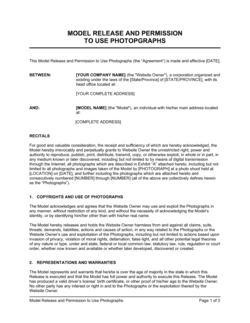
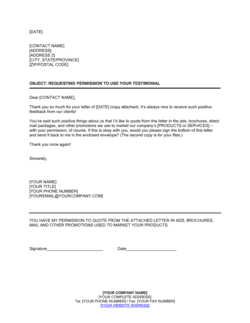
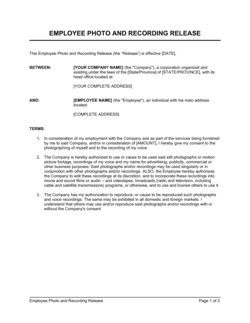
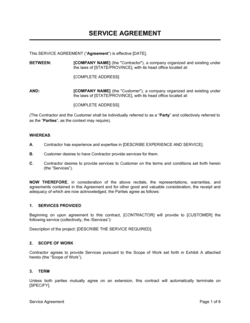
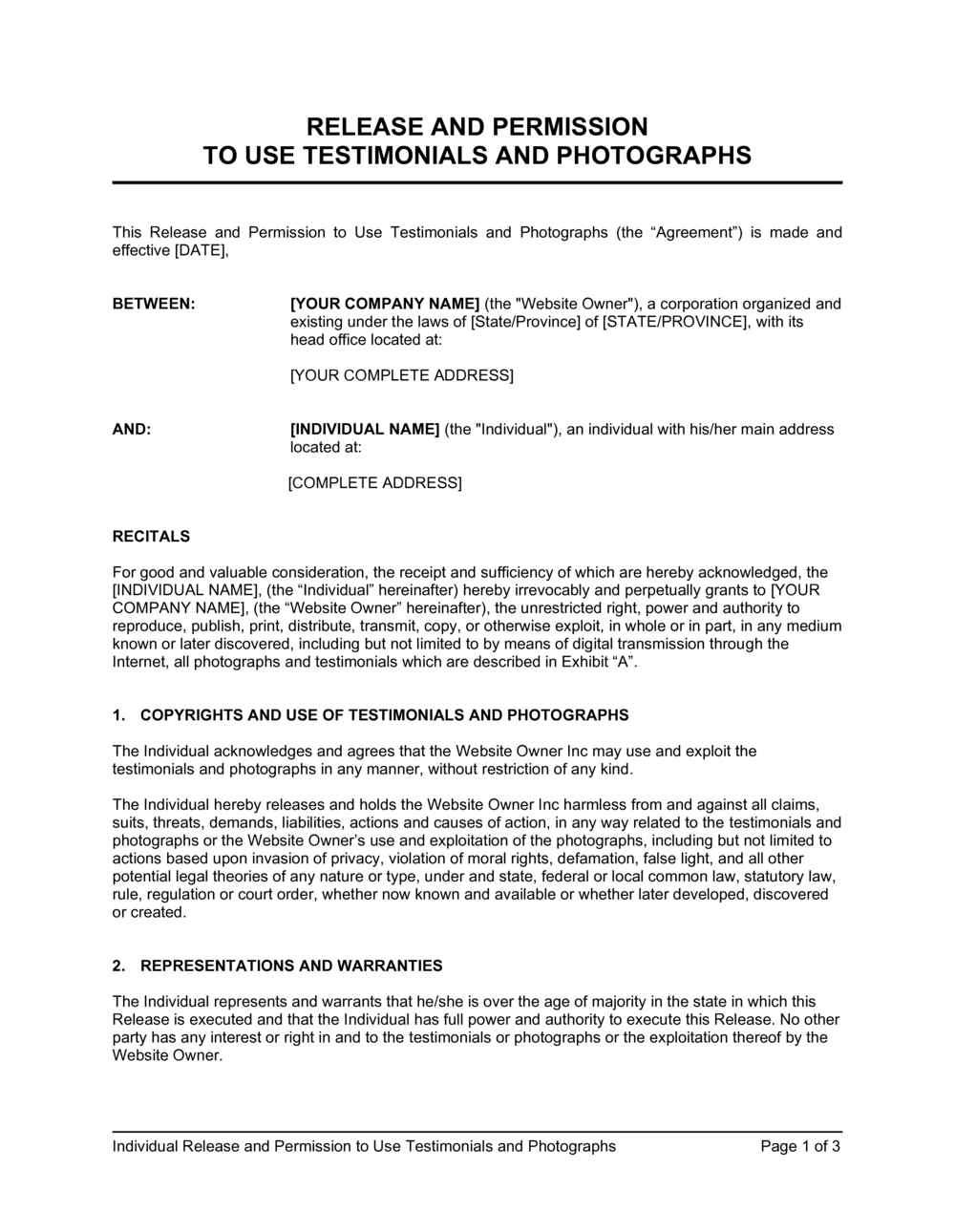
Release and Permission to Use Testimonial and Photographs Template

Free Word download • Edit online • Save & share with Drive • Export to PDF

3 pages20–30 min to fillDifficulty: StandardSignature requiredLegal review recommended
Learn more ↓
FreeRelease and Permission to Use Testimonial and Photographs Template

At a glance

What it is
A Release and Permission to Use Testimonial and Photographs is a legally binding document in which an individual grants a business the right to reproduce, publish, and distribute their written or spoken testimonial, photographs, and likeness across specified media channels. This free Word download gives you a structured, attorney-informed starting point you can edit online and export as PDF for signature before any content goes live.
When you need it
Use it before publishing a customer quote on your website, featuring a client's photo in a case study, running a testimonial-based ad campaign, or including a customer's image in printed marketing collateral. Obtaining signed permission before publication prevents right-of-publicity claims, privacy disputes, and costly content takedowns.
What's inside
Identification of both parties, a description of the specific content being released, the scope of permitted uses and channels, compensation terms, a warranty of originality, a liability waiver, moral rights provisions, and the governing law clause.

What is a Release and Permission to Use Testimonial and Photographs?

A Release and Permission to Use Testimonial and Photographs is a legally binding document in which an individual — typically a customer, client, or event participant — grants a business the written right to reproduce, publish, and distribute their testimonial, photographs, and likeness across specified media channels. The document identifies the exact content being released, defines the scope of permitted uses, states what consideration the releasor receives in exchange, and includes a waiver of claims arising from the authorized use. Unlike a verbal agreement or an implied consent, a signed release creates an enforceable record that the business can rely on if the releasor later disputes the use of their image or quote.

Why You Need This Document

Publishing a customer's photograph or testimonial without a signed release exposes your business to right-of-publicity claims, privacy complaints, and FTC enforcement action — all of which can require urgent and expensive content takedowns across every channel where the material appeared. In states like California and New York, statutory damages for unauthorized commercial use of a person's likeness can reach thousands of dollars per instance, and EU GDPR violations can trigger regulatory fines. Beyond legal liability, the operational disruption of pulling live ad campaigns, reprinting collateral, or removing indexed web pages mid-campaign far exceeds the cost of collecting a release upfront. This template gives you a structured, attorney-informed starting point that covers testimonial accuracy, editing rights, moral rights waivers for international subjects, and a GDPR-compatible removal process — so your marketing assets are protected before they go live.

Which variant fits your situation?

If your situation is…Use this template
Using photos and testimonials from paid customers in commercial advertisingRelease and Permission to Use Testimonial and Photographs
Hiring a photographer to shoot images for your brand exclusivelyPhotography Services Agreement
Licensing images from a stock photographer for ongoing commercial useImage Licensing Agreement
Featuring an employee's likeness in internal and external company materialsEmployee Photo and Media Release
Publishing video interviews or recorded testimonials on digital channelsVideo Release Form
Running a user-generated content campaign on social mediaUser-Generated Content Release Agreement
Retaining broad rights to all creative content produced by a contractorWork for Hire Agreement

Common mistakes to avoid

❌ Publishing content before obtaining a signed release

Why it matters: Using a person's testimonial or photograph without written consent exposes the company to right-of-publicity claims, privacy lawsuits, and FTC enforcement for unsubstantiated endorsements. Retroactive releases are harder to obtain and provide weaker protection.

Fix: Build a release-before-publication gate into your content workflow. No testimonial or image goes live in any channel without a signed, filed release linked to the specific asset.

❌ Omitting channels that are actually used

Why it matters: A release that covers website use but not paid social advertising is worthless the moment the company boosts a post featuring the releasor. Courts read scope clauses narrowly — unlisted channels are excluded.

Fix: Audit your current and planned content channels before drafting the scope clause and list every one of them, including paid advertising on each major platform.

❌ Leaving consideration blank or writing 'no compensation'

Why it matters: A release without consideration may be challenged as unenforceable in jurisdictions that require a bargained-for exchange. The releasor can argue they received nothing and the contract never formed.

Fix: State a specific form of consideration — even $1.00 — and confirm its receipt in writing. Many companies offer a modest gift card, which doubles as a thank-you and satisfies the legal requirement.

❌ Skipping the moral rights waiver for international subjects

Why it matters: In Canada, the UK, and EU member states, moral rights exist by statute and are not surrendered by a general waiver of claims. Editing a Canadian customer's photo or shortening their testimonial without a specific moral rights waiver can give rise to a valid infringement claim.

Fix: Add a jurisdiction-specific moral rights waiver clause for every releasor located outside the United States, and have a lawyer confirm the language meets the statutory standard in the releasor's country.

❌ Using a blanket 'all photos ever taken' description

Why it matters: Overly broad content descriptions invite disputes when the releasor claims only certain images were discussed. Courts enforce the agreement as written — but broad language can also backfire if the releasor later argues the release was unconscionable.

Fix: Reference specific files, dates, and locations. Attach the actual photographs as a numbered exhibit and have the releasor initial each page.

❌ Failing to obtain parental consent for a minor

Why it matters: A release signed by a person under 18 is voidable by the minor upon reaching adulthood in most jurisdictions, meaning the company's right to use the content can be revoked years after publication.

Fix: For any releasor under 18, require the parent or legal guardian to sign the release as the legally capable party, identifying their relationship to the minor in the signature block.

The 10 key clauses, explained

Identification of parties

In plain language: Names the business receiving the rights and the individual granting them, including contact details and, where the releasor is a minor, the parent or guardian's information.

Sample language
This Release is entered into by [RELEASOR FULL NAME] ('Releasor'), residing at [ADDRESS], and [COMPANY LEGAL NAME], a [STATE/PROVINCE] [ENTITY TYPE] ('Company'), as of [DATE].

Common mistake: Using a nickname or trade name instead of the individual's legal name and the company's registered entity name. A mismatch between the release and payroll or corporate records creates enforcement gaps if the release is later disputed.

Description of content

In plain language: Specifically identifies the testimonial text, photographs, or other materials being released — including the date taken, subject matter, and any reference numbers or file names.

Sample language
Releasor grants permission to use the following content: testimonial dated [DATE] ('Testimonial') and photographs taken on [DATE] at [LOCATION], including but not limited to files [FILE NAMES / REFERENCE IDs] ('Photographs').

Common mistake: Describing content in vague terms like 'any photos taken at the event.' Broad descriptions are contested when only specific images were discussed — always reference identifiable file names, dates, or written excerpts.

Grant of rights and scope of use

In plain language: States exactly what the company is permitted to do with the content — which channels, formats, geographies, and purposes — and whether the grant is exclusive or non-exclusive.

Sample language
Releasor grants Company a [non-exclusive / exclusive], royalty-free, worldwide, perpetual license to reproduce, publish, distribute, and display the Testimonial and Photographs in print, digital, broadcast, and social media advertising, including but not limited to [LIST CHANNELS].

Common mistake: Omitting social media or paid digital advertising from the scope list when those are the primary intended channels. Courts interpret unlisted channels as excluded, forcing the company to seek a new release before running ads.

Compensation and consideration

In plain language: States what the releasor receives in exchange for signing — money, a free product, a discount, or nominal consideration — to ensure the contract is binding.

Sample language
In consideration for this Release, Company agrees to provide Releasor with [DESCRIPTION OF CONSIDERATION — e.g., a $[X] gift card / complimentary [PRODUCT OR SERVICE] / the sum of $1.00 USD, receipt of which is hereby acknowledged].

Common mistake: Leaving the consideration field blank or writing 'no compensation.' In several jurisdictions, a release without any stated consideration may be unenforceable. Even nominal consideration ($1) satisfies the legal requirement.

Warranty and accuracy of content

In plain language: The releasor warrants that the testimonial reflects their genuine experience, that they own the rights to any content they contribute, and that their statements do not infringe third-party rights.

Sample language
Releasor warrants that the Testimonial reflects their honest, firsthand experience; that they own or control all rights in any content provided; and that the use of such content as authorized herein does not infringe any third-party rights.

Common mistake: Skipping the warranty clause entirely. Without it, the company has no contractual recourse if a testimonial turns out to be plagiarized, fabricated, or the subject of a competing endorsement agreement.

Right to edit and modify

In plain language: Grants the company the right to crop, retouch, resize, caption, or otherwise adapt the photographs and testimonial for different formats, without altering the fundamental meaning.

Sample language
Company may crop, resize, retouch, and reformat the Photographs and may edit the Testimonial for length and clarity, provided that the edited Testimonial does not materially alter its meaning or create a false impression of Releasor's views.

Common mistake: Granting an unlimited right to alter the testimonial without the 'material meaning' safeguard. Altering a testimonial in a misleading way may violate FTC endorsement guidelines and consumer protection law regardless of what the release says.

Moral rights and attribution

In plain language: Addresses whether the releasor's name will appear with the content (attribution) and, in jurisdictions that recognize moral rights, whether the releasor waives the right to object to alterations.

Sample language
Releasor [consents to / waives] attribution by [first name and last initial / full name / anonymous] as Company determines appropriate. To the extent permitted by applicable law, Releasor waives any moral rights in the Photographs and Testimonial in favor of Company.

Common mistake: Ignoring moral rights entirely for content involving Canadian, UK, or EU residents. In those jurisdictions, moral rights exist by statute and must be explicitly waived in writing to be surrendered — an oversight that limits the company's editing flexibility.

Liability waiver and indemnification

In plain language: The releasor waives claims against the company for the approved use of the content and agrees to indemnify the company if a third-party claim arises from a breach of the releasor's warranties.

Sample language
Releasor releases and discharges Company from any and all claims arising from the authorized use of the Testimonial and Photographs. Releasor shall indemnify Company against any losses, damages, or costs (including legal fees) resulting from a breach of Releasor's warranties herein.

Common mistake: Drafting the waiver as mutual — having the company also waive claims against the releasor for all purposes. This undermines the company's ability to pursue the releasor if the warranty of accuracy proves false.

Revocation and term

In plain language: States whether the releasor may withdraw consent and under what conditions, and specifies whether the license is perpetual or expires after a defined period.

Sample language
This Release is [perpetual and irrevocable / effective for [X] years from the date of signing]. Releasor may request removal of the content by written notice to [CONTACT], and Company shall use commercially reasonable efforts to comply within [30] days for newly published materials, but has no obligation to recall materials already in distribution.

Common mistake: Granting a fully irrevocable license with no removal process at all. Under GDPR and similar privacy laws, individuals retain the right to request deletion of personal data — a blanket irrevocability clause does not override statutory rights and may expose the company to regulatory risk.

Governing law and dispute resolution

In plain language: Specifies which jurisdiction's law governs the agreement and how disputes will be resolved — arbitration, small claims court, or civil litigation.

Sample language
This Release shall be governed by the laws of [STATE / PROVINCE / COUNTRY]. Any dispute arising hereunder shall be resolved by binding arbitration in [CITY] under the rules of [AAA / JAMS], except that either party may seek injunctive relief in a court of competent jurisdiction.

Common mistake: Choosing a governing law with no connection to the releasor's location. Some jurisdictions — particularly in the EU — apply local privacy and publicity law regardless of the choice-of-law clause, making the wrong governing-law selection actively misleading to the releasor.

How to fill it out

  1. 1

    Identify both parties accurately

    Enter the releasor's full legal name and address. For the company, use the registered legal entity name, not a trade name or brand. If the releasor is under 18, add the parent or guardian's name and relationship.

    💡 Ask for a government-issued ID or confirm the name against the customer's account record before finalizing — a misspelled name can complicate enforcement.

  2. 2

    Describe the specific content being released

    List the testimonial by date and a short excerpt, and identify photographs by file name, reference number, or shoot date and location. Avoid generic references like 'all photos from the event.'

    💡 Attach a copy of the exact photograph files or the full testimonial text as Exhibit A so there is no ambiguity about which content is covered.

  3. 3

    Define the scope of permitted use

    Check every channel and format you plan to use — website, paid social ads, email newsletters, print brochures, trade show displays, broadcast TV — and list them explicitly in the grant-of-rights clause.

    💡 If you are unsure which channels you will use in the next two to three years, list them all now. Returning to a releasor for an expanded release is awkward and not always possible.

  4. 4

    State the consideration

    Enter the exact form of compensation — gift card value, product description, or nominal amount — and confirm that the releasor received it at or before signing.

    💡 Even $1 of stated consideration is sufficient in most jurisdictions. Document the delivery of consideration (e.g., gift card redemption email) in your records in case the release is later contested.

  5. 5

    Address editing rights and attribution

    Specify the extent to which you may crop, retouch, or edit the content, and decide whether attribution will use the releasor's full name, first name and last initial, or remain anonymous.

    💡 Many customers prefer first name and city only — offering this option increases willingness to sign and reduces hesitation over privacy concerns.

  6. 6

    Include the moral rights waiver for international releasors

    For any releasor in Canada, the UK, or an EU member state, explicitly include the moral rights waiver clause. Without it, the releasor retains the statutory right to object to alterations or require attribution.

    💡 Keep a jurisdiction flag in your CRM for each releasor so your template automatically includes the correct clauses based on the signatory's location.

  7. 7

    Set the term and revocation process

    Decide whether the license is perpetual or time-limited, and include a commercially reasonable removal process for newly published digital content. Do not draft a clause that purports to override statutory data-deletion rights.

    💡 For GDPR-covered releasors, link the removal process to your privacy policy's data-subject-access-request workflow so the two are consistent.

  8. 8

    Execute before publication

    Both parties sign the release before any content goes live. File the signed original — or the eSign timestamp record — linked to the specific content files in your digital asset management system.

    💡 Date-stamp the execution in your DAM or CRM against the asset file. If content is published before a signed release exists, you are relying on implied consent — which is not a defense against a right-of-publicity claim.

Frequently asked questions

What is a testimonial and photo release form?

A testimonial and photo release form is a signed legal document in which an individual grants a business the right to reproduce, publish, and use their written or spoken testimonial, photographs, and likeness in specified marketing and promotional materials. It protects the business from right-of-publicity claims and privacy disputes by creating a clear, written record of the releasor's consent before any content is published.

Do I legally need a release before publishing a customer's photo or testimonial?

In most jurisdictions, yes — using an identifiable individual's photograph or testimonial for commercial purposes without consent can violate right-of-publicity statutes, privacy laws, and in some cases the FTC's endorsement guidelines. The specific legal requirements vary by country and US state, but the safest practice in every jurisdiction is to obtain a signed written release before any content goes live. Verbal consent is difficult to prove and rarely sufficient for commercial advertising.

What is the difference between a photo release and a model release?

A photo release grants permission to use specific photographs of an individual in defined channels. A model release is a broader commercial agreement — typically used in professional photo shoots — that covers the use of a model's likeness across all media, often in exchange for a fee and with detailed usage rights. For most business testimonial and marketing use cases, a photo release is the appropriate document. A full model release is warranted when the individual is the primary subject of a commercial campaign or the images will be licensed to third parties.

Can a testimonial and photo release be revoked after signing?

A release can be drafted as perpetual and irrevocable for the uses specified, which is generally enforceable in the US as a contractual matter. However, under GDPR in the EU and similar privacy laws in Canada and the UK, individuals retain certain statutory rights to request deletion of personal data — including photographs — regardless of what the contract says. Including a commercially reasonable removal process for digital content is the best practice to balance contractual rights with regulatory obligations.

Is nominal consideration (such as $1) sufficient to make the release enforceable?

In most common-law jurisdictions — including the United States, Canada, and the United Kingdom — nominal consideration such as $1 is generally sufficient to satisfy the legal requirement for a binding contract, provided both parties acknowledge its receipt. Courts do not typically evaluate the adequacy of consideration in a freely negotiated agreement. What matters is that some form of consideration is explicitly stated and documented, not that it equals the value of what is being released.

What happens if I publish a testimonial or photo without a signed release?

Publishing without a release exposes the company to several legal risks: a right-of-publicity claim in states with strong statutes (California, New York, Indiana, and others), a privacy or data protection complaint in Canada or the EU, and potential FTC enforcement if the testimonial is used in advertising without proper substantiation. In addition to legal liability, content published without consent may need to be taken down urgently — including from third-party platforms where it has already been shared — at significant operational cost.

Does a release need to be notarized?

Notarization is not required for a testimonial and photo release to be enforceable in most jurisdictions. A witnessed or electronically signed document is generally sufficient. Notarization adds an extra layer of authentication that can be useful if the releasor's identity or signature is likely to be disputed — for example, in high-value commercial campaigns or when the releasor is located in a jurisdiction with strict identity verification requirements.

How should I handle releases for minors?

A release signed by a person under the age of majority (18 in most jurisdictions, 19 in some Canadian provinces) is voidable by the minor upon reaching adulthood. To obtain a durable release for content featuring a minor, the parent or legal guardian must sign the document as the legally capable party. The release should identify the minor by name, confirm the guardian's legal relationship to the child, and include all the standard clauses — scope, consideration, and waiver — that apply to adult releases.

Can the same release cover both the testimonial text and photographs?

Yes — a single well-drafted release can and should cover both the written or verbal testimonial and the associated photographs in the same document. Covering both in one release reduces the administrative burden of obtaining multiple signatures, ensures consistent scope terms for both asset types, and avoids situations where a photograph is authorized but the accompanying quote is not (or vice versa). Each content type should be described separately in the content description clause so the scope is unambiguous.

How this compares to alternatives

vs Model Release Form

A model release is a commercial agreement used in professional photo shoots where the subject's likeness is the primary product — typically involving a modeling fee and broad rights across all media. A testimonial and photo release is narrower, covering a specific customer's existing photographs and quotes in defined marketing contexts. Use a model release for campaign shoots; use this release for customer-generated content.

vs Non-Disclosure Agreement

An NDA restricts the sharing of confidential information between parties — it flows in the opposite direction from a release. A testimonial and photo release grants rights to publish information outward; an NDA prevents information from flowing outward. They serve different purposes and are not interchangeable, though some marketing partnerships require both.

vs Video Release Form

A video release specifically covers recorded footage, voice, and moving image — with additional considerations for sync rights, background music clearance, and platform-specific video terms. A testimonial and photo release covers static images and written or quoted testimonials. If you are publishing video interviews or testimonial clips, use a video release instead of or alongside this form.

vs Media Release (Press Release)

A media release (or press release) is a one-way outbound announcement distributed to journalists and publications — it contains no signatures and confers no rights. A release and permission form is a bilateral signed contract granting specific rights. The two documents share the word 'release' but are entirely different in legal function and use case.

Industry-specific considerations

Marketing and Advertising

Paid ad campaigns featuring customer photos and quotes require airtight scope clauses covering each specific platform and ad format, including boosted posts and programmatic display.

Healthcare and Wellness

Patient and client testimonials are subject to HIPAA in the US and equivalent health-data regulations in other jurisdictions — releases must be layered with privacy authorizations and cannot override statutory health-data rights.

Education and Training

Student and participant testimonials often involve minors requiring parental consent, and FERPA in the US adds restrictions on using student likenesses without explicit directory-information waivers.

Retail and E-commerce

User-generated content campaigns and review-based advertising require releases at scale — many retailers use embedded consent language at the point of review submission, supplemented by a short formal release for featured content.

Nonprofit and Charitable Organizations

Beneficiary stories and images used in donor appeals or grant applications require sensitive handling — releases should address dignity, anonymization options, and the releasor's right to withdraw consent without affecting their access to services.

Hospitality and Events

Event photographers capture hundreds of guests, requiring efficient release workflows — venue-wide notice combined with individual releases for featured subjects is the standard approach to managing consent at scale.

Jurisdictional notes

United States

Right-of-publicity law varies significantly by state — California (Civil Code §3344) and New York (Civil Rights Law §§50–51) impose the strictest requirements, with statutory damages for unauthorized commercial use of a person's name or likeness. The FTC's Endorsement Guides require that testimonials reflect the honest opinion of the endorser and that material connections be disclosed. Indiana, Tennessee, and several other states extend publicity rights posthumously.

Canada

Privacy legislation at both federal (PIPEDA) and provincial levels (notably Quebec's Law 25 and British Columbia's PIPA) restricts the collection and commercial use of personal information, including photographs. Quebec requires that consent be explicit and informed and that the language of the release be in French for Quebec residents. Moral rights under the Copyright Act cannot be assigned but can be waived in writing — a specific waiver clause is required.

United Kingdom

The UK GDPR and the Data Protection Act 2018 treat photographs of identifiable individuals as personal data, requiring a lawful basis for processing — consent being the most appropriate for marketing use. Moral rights under the Copyright, Designs and Patents Act 1988 must be explicitly waived in writing. The Advertising Standards Authority (ASA) also requires that testimonial advertising be genuine, substantiated, and not misleading.

European Union

Under the EU GDPR, consent to use personal data — including photographs — must be freely given, specific, informed, and unambiguous, and individuals retain the right to withdraw consent and request erasure. A testimonial and photo release must be structured as a valid GDPR consent mechanism, not just a contractual waiver. Moral rights vary by member state but are recognized across the EU; Germany and France impose particularly strong protections that require explicit waiver language.

Template vs lawyer — what fits your deal?

PathBest forCostTime
Use the templateSmall businesses and marketing teams using customer testimonials and photos in standard digital and print channelsFree10–15 minutes per release
Template + legal reviewCompanies running paid advertising campaigns, collecting releases at scale, or featuring subjects in jurisdictions with strong privacy or moral-rights laws$200–$500 for a one-time lawyer review of the template1–3 days
Custom draftedNational broadcast campaigns, healthcare or education contexts with regulatory overlay, or releases involving minors in high-value commercial settings$800–$2,500+1–2 weeks

Glossary

Release
A signed relinquishment of specific legal rights, here authorizing the business to use the releasor's testimonial and images without further consent.
Releasor
The individual granting permission — typically the customer, client, or subject featured in the photograph or testimonial.
Releasee
The business or organization receiving the rights to use the testimonial and photographs.
Right of Publicity
A person's legal right to control the commercial use of their name, likeness, image, and identity, recognized in most US states and equivalent laws in other jurisdictions.
Likeness
A visual or audio representation of a person — including photographs, video footage, illustrations, and voice recordings — that is recognizable as that individual.
Moral Rights
Rights protecting the personal and reputational connection between a creator and their work, including the right to attribution and the right to object to derogatory treatment — recognized in Canada, the UK, and the EU.
Perpetual License
A grant of rights with no expiration date, allowing the releasee to continue using the content indefinitely unless revoked under the contract's specific terms.
Consideration
The exchange of value that makes a contract binding — in a release, often nominal (e.g., $1) or expressed as access to services, a discount, or a gift card.
Scope of Use
The specific media, platforms, geographies, and purposes for which the releasee is permitted to use the testimonial and photographs.
Indemnification
A contractual obligation requiring one party to compensate the other for losses, claims, or legal costs arising from a breach of the agreement.
Waiver
The voluntary surrender of a known right — here, the releasor waives claims related to the approved use of their likeness and testimonial.
Minor's Release
A release signed by a parent or legal guardian on behalf of a subject under 18, required for the document to be valid when a child's image or testimonial is used.

Part of your Business Operating System

This document is one of 3,000+ business & legal templates included in Business in a Box.

  • Fill-in-the-blanks — ready in minutes
  • 100% customizable Word document
  • Compatible with all office suites
  • Export to PDF and share electronically

Create your document in 3 simple steps.

From template to signed document — all inside one Business Operating System.
1
Download or open template

Access over 3,000+ business and legal templates for any business task, project or initiative.

2
Edit and fill in the blanks with AI

Customize your ready-made business document template and save it in the cloud.

3
Save, Share, Send, Sign

Share your files and folders with your team. Create a space of seamless collaboration.

Save time, save money, and create top-quality documents.

★★★★★

"Fantastic value! I'm not sure how I'd do without it. It's worth its weight in gold and paid back for itself many times."

Managing Director · Mall Farm
Robert Whalley
Managing Director, Mall Farm Proprietary Limited
★★★★★

"I have been using Business in a Box for years. It has been the most useful source of templates I have encountered. I recommend it to anyone."

Business Owner · 4+ years
Dr Michael John Freestone
Business Owner
★★★★★

"It has been a life saver so many times I have lost count. Business in a Box has saved me so much time and as you know, time is money."

Owner · Upstate Web
David G. Moore Jr.
Owner, Upstate Web

Run your business with a system — not scattered tools

Stop downloading documents. Start operating with clarity. Business in a Box gives you the Business Operating System used by over 250,000 companies worldwide to structure, run, and grow their business.

Start free · No credit card required