Agreement for Permission to Sublet Template

Free Word download β€’ Edit online β€’ Save & share with Drive β€’ Export to PDF

2 pagesβ€’20–30 min to fillβ€’Difficulty: Standardβ€’Signature requiredβ€’Legal review recommended
Learn more ↓
FreeAgreement for Permission to Sublet Template

At a glance

What it is
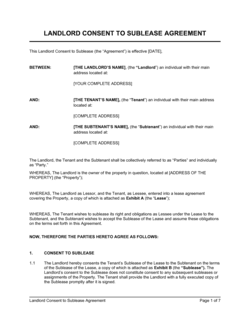
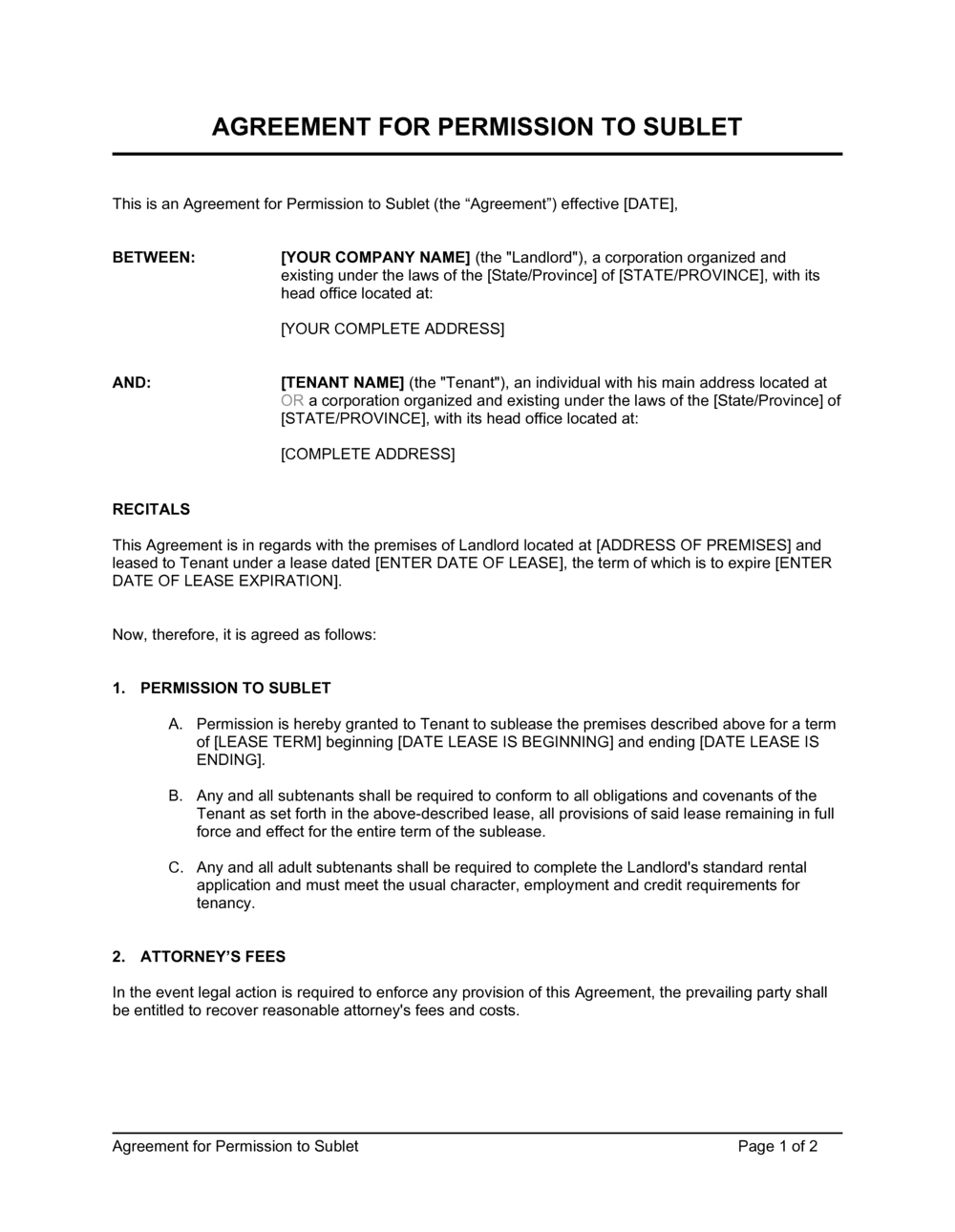
An Agreement for Permission to Sublet is a legally binding document in which a landlord grants a tenant formal written consent to sublet the leased premises to a third party (the sublessee). This free Word download covers the approved sublessee's identity, the sublet term, rent arrangement, permitted use, and the original tenant's continued liability β€” giving all three parties a clear, enforceable record of the approved arrangement.
When you need it
Use it whenever a tenant wants to sublet all or part of a rented property and the underlying lease requires landlord consent before doing so. It protects the landlord by formalizing conditions, and it protects the tenant by documenting that consent was properly obtained.
What's inside
Identification of all three parties (landlord, tenant, and sublessee), the premises and sublet term, rent and payment terms, permitted use conditions, the original tenant's ongoing liability, sublessee obligations, termination rights, and governing law.

What is an Agreement for Permission to Sublet?

An Agreement for Permission to Sublet is a legally binding document in which a landlord formally grants a tenant written consent to rent the leased premises β€” in whole or in part β€” to a third party known as the sublessee. It records the specific conditions under which that consent is given, the approved sublet term, the rent arrangement, permitted use of the premises, and the original tenant's continuing obligations under the master lease. Unlike an informal email or verbal agreement, this document creates an enforceable record that protects all three parties: the landlord retains control over who occupies the property and under what conditions; the tenant has documented proof that subletting was properly authorized; and the sublessee has a clear statement of the terms governing their occupancy.

Why You Need This Document

Subletting without a written permission agreement exposes every party to serious risk. For the tenant, proceeding without documented landlord consent is typically a material breach of the master lease β€” grounds for termination of the tenancy and eviction of both the tenant and the sublessee, regardless of how cooperative the landlord appeared verbally. For the landlord, an undocumented consent provides no enforceable conditions, no mechanism to hold the sublessee to house rules, and no clear basis to revoke approval if the arrangement goes wrong. For the sublessee, paying rent without a formal agreement leaves them with no documented right to occupy the premises and no recourse if the original tenant disappears mid-term. A properly completed Agreement for Permission to Sublet closes all three gaps in a single document β€” specifying the term, the permitted use, the deposit, the insurance requirements, and the original tenant's undiminished liability to the landlord β€” giving everyone involved a clear, enforceable foundation before a single key is handed over.

Which variant fits your situation?

If your situation is…Use this template
Subletting a residential apartment with landlord consentAgreement for Permission to Sublet
Creating a full standalone sublease agreement between tenant and sublesseeSublease Agreement
Subletting commercial office or retail spaceCommercial Sublease Agreement
Assigning the entire lease to a new tenant permanentlyLease Assignment Agreement
Adding a new roommate without formally sublettingRoommate Agreement
Short-term sublet for a defined period under six monthsShort-Term Sublease Agreement
Documenting landlord's refusal of a sublet request in writingSublet Denial Letter

Common mistakes to avoid

❌ Subletting without obtaining written consent first

Why it matters: Subletting without the landlord's written consent typically constitutes a material breach of the master lease, giving the landlord grounds to terminate the tenancy and evict both the tenant and sublessee.

Fix: Always secure the signed Agreement for Permission to Sublet before the sublessee takes possession or pays any money. A verbal indication of approval is not sufficient in most jurisdictions.

❌ Setting a sublet term that outlasts the master lease

Why it matters: If the master lease expires or is terminated before the sublet end date, the sublessee has no legal right to remain, and the tenant may face damages claims from the sublessee for breach of the sublease.

Fix: Confirm the master lease expiry date before filling in the sublet term, and end the sublet at least two days before the master lease terminates.

❌ Failing to keep the original tenant liable under the master lease

Why it matters: Some tenants assume subletting transfers their obligations to the sublessee. It does not β€” the landlord can pursue the original tenant for unpaid rent or damages caused by the sublessee, regardless of whether the sublessee is at fault.

Fix: Include a clear continuing-liability clause and make sure the tenant understands it before signing. For significant financial exposure, the tenant should require the sublessee to post an adequate security deposit.

❌ Not attaching master lease obligations for the sublessee

Why it matters: A sublessee who was never shown the master lease rules can successfully argue they were not bound by restrictions they violated, leaving the original tenant liable to the landlord for the breach.

Fix: Attach the relevant sections of the master lease as a schedule, have the sublessee initial each page, and include a clause in the agreement confirming the sublessee has read and agreed to those terms.

❌ Ignoring local security deposit limits and trust account rules

Why it matters: Charging a sublessee a deposit that exceeds the statutory cap, or failing to hold it in a required trust account, exposes the tenant to statutory penalties β€” often double or triple the deposit amount β€” payable to the sublessee.

Fix: Research the deposit rules in the property's jurisdiction before setting the amount, and hold the funds in compliance with local law throughout the sublet term.

❌ Using a vague permitted-use clause

Why it matters: A sublessee who operates a business from a residentially zoned unit, or uses commercial space for a purpose outside the master lease, can trigger the landlord's right to terminate the master lease β€” affecting the original tenant directly.

Fix: Mirror the exact permitted-use language from the master lease and specify any additional restrictions that apply during the sublet term.

The 10 key clauses, explained

Identification of parties and premises

In plain language: Names the landlord, original tenant, and sublessee as legal entities or individuals, and precisely describes the property being sublet β€” including address, unit number, and any areas excluded from the sublet.

Sample language
This Agreement is entered into on [DATE] between [LANDLORD FULL NAME / ENTITY] ('Landlord'), [TENANT FULL NAME / ENTITY] ('Tenant'), and [SUBLESSEE FULL NAME / ENTITY] ('Sublessee'). The premises subject to this Agreement are located at [FULL PROPERTY ADDRESS], Unit [UNIT NUMBER] ('Premises').

Common mistake: Using a tenant's nickname or informal business name instead of the full legal name. Enforcement action becomes complicated when the named party cannot be precisely identified.

Grant of consent and conditions

In plain language: States that the landlord grants permission for the specific sublet described, and lists any conditions the tenant or sublessee must satisfy for the consent to remain valid β€” such as maintaining renters insurance or keeping the unit in good repair.

Sample language
Landlord hereby grants Tenant permission to sublet the Premises to Sublessee, subject to the following conditions: (a) Sublessee shall maintain renters insurance of no less than $[AMOUNT]; (b) the Premises shall be used solely for [PERMITTED USE]; (c) Tenant remains fully responsible for all obligations under the Master Lease.

Common mistake: Granting consent with no conditions attached. An unconditional consent removes the landlord's leverage to enforce property standards or insurance requirements against the sublessee's occupancy.

Sublet term

In plain language: Specifies the exact start and end date of the sublet, whether it can be renewed, and what happens if the sublessee remains in occupation past the end date.

Sample language
The sublet term shall commence on [START DATE] and terminate on [END DATE] ('Sublet Term'). Sublessee shall vacate the Premises no later than [END DATE]. Any holdover beyond the Sublet Term requires prior written approval from Landlord and Tenant.

Common mistake: Setting a sublet end date that extends beyond the master lease expiry. This creates an obligation the tenant cannot fulfill and may expose them to damages.

Rent and payment obligations

In plain language: States the rent the sublessee pays to the tenant, the due date, and accepted payment methods. Clarifies that the tenant's obligation to pay the landlord under the master lease is unaffected.

Sample language
Sublessee shall pay Tenant rent of $[AMOUNT] per month, due on the [DAY] of each month by [PAYMENT METHOD]. Tenant's obligation to pay Landlord $[MASTER LEASE RENT] per month under the Master Lease continues independently and is not contingent on Sublessee's payment.

Common mistake: Setting the sublessee's rent higher than the master lease rent without checking whether the master lease or local law prohibits profit from subletting β€” a violation that can void the consent.

Permitted use and occupancy

In plain language: Restricts what the sublessee may use the premises for, mirroring or narrowing the permitted use in the master lease, and specifies the maximum number of occupants.

Sample language
Sublessee shall use and occupy the Premises solely for [RESIDENTIAL / COMMERCIAL] purposes as described in the Master Lease. No other use is permitted without prior written consent. Maximum occupancy: [NUMBER] person(s).

Common mistake: Omitting an occupancy limit for residential sublets. Without one, the original tenant has no contractual basis to object if the sublessee moves in additional people who damage the property.

Original tenant's continuing liability

In plain language: Confirms that the original tenant remains fully liable to the landlord for all lease obligations β€” including rent, repairs, and compliance β€” regardless of the sublessee's conduct.

Sample language
Tenant acknowledges that this Agreement does not release Tenant from any obligations under the Master Lease. Tenant shall remain primarily liable to Landlord for rent, property maintenance, and all other covenants set out in the Master Lease for the duration of the Sublet Term.

Common mistake: Tenants misreading this clause as shifting responsibility to the sublessee. The sublessee is liable to the tenant, not to the landlord β€” the tenant cannot escape primary liability through subletting.

Sublessee's obligations and house rules

In plain language: Binds the sublessee to the relevant terms of the master lease β€” including noise, pet, and alteration restrictions β€” and makes the sublessee directly responsible to the tenant for any breach.

Sample language
Sublessee agrees to comply with all terms of the Master Lease applicable to occupancy, including but not limited to: no pets policy, no structural alterations, noise restrictions set out in Schedule A, and [ANY OTHER SPECIFIC RULES]. Sublessee shall indemnify Tenant for any losses arising from Sublessee's breach.

Common mistake: Not attaching a copy of the relevant master lease provisions as a schedule. Without it, the sublessee can claim they were unaware of specific restrictions they violated.

Termination rights

In plain language: Sets out the circumstances under which the landlord or tenant may revoke consent or terminate the sublet early β€” such as sublessee breach, non-payment of rent, or unauthorized use.

Sample language
Landlord or Tenant may terminate this consent upon [X] days' written notice if Sublessee: (a) fails to pay rent for more than [X] days after the due date; (b) breaches any condition of this Agreement; or (c) uses the Premises for any unauthorized purpose. Termination of the sublet does not release Tenant from the Master Lease.

Common mistake: Failing to specify a notice period for early termination. Without a defined period, any dispute about how much warning was required becomes a factual dispute resolved by a court.

Damage, deposit, and insurance

In plain language: States the security deposit the sublessee pays to the tenant, the conditions for its return, and any insurance requirements imposed on the sublessee.

Sample language
Sublessee shall pay Tenant a security deposit of $[AMOUNT] upon execution of this Agreement, refundable within [X] days of the end of the Sublet Term less deductions for damage beyond normal wear and tear. Sublessee shall maintain renters insurance with minimum coverage of $[AMOUNT] and name Tenant as an additional interested party.

Common mistake: Tenant collecting a deposit from the sublessee without understanding local laws capping deposit amounts or mandating separate trust accounts β€” exposing the tenant to statutory penalties.

Governing law and entire agreement

In plain language: Specifies the jurisdiction whose law governs the agreement and confirms that this document, together with the master lease, constitutes the entire agreement between the parties on the subject of the sublet.

Sample language
This Agreement is governed by the laws of [STATE / PROVINCE / COUNTRY]. This Agreement, together with the Master Lease, constitutes the entire agreement between the parties regarding the subletting of the Premises and supersedes all prior oral or written representations.

Common mistake: Choosing a governing law different from the location of the property. Courts in most jurisdictions apply the law of the place where the real property is situated, regardless of what the contract says.

How to fill it out

  1. 1

    Review the master lease for subletting conditions

    Before completing the template, locate the subletting clause in the master lease. Note any restrictions β€” approval criteria, profit-sharing prohibitions, or notice requirements β€” that must be reflected in this agreement.

    πŸ’‘ Many leases require the landlord to respond to a sublet request within a specific number of days. Missing this deadline can constitute deemed consent in some jurisdictions.

  2. 2

    Identify all three parties accurately

    Enter the full legal name of the landlord, tenant, and proposed sublessee. For entities, use the registered corporate name. For individuals, use the name as it appears on government-issued ID.

    πŸ’‘ If the landlord is a corporate entity managed by a property manager, confirm who has authority to execute consent β€” the property manager may need a power of attorney.

  3. 3

    Describe the premises with precision

    State the full civic address, unit number, and any portions of the property excluded from the sublet β€” such as a parking stall the tenant is retaining or a storage locker.

    πŸ’‘ For commercial sublets, attach a floor plan sketch marking the exact sublet area to prevent boundary disputes later.

  4. 4

    Set the sublet term with specific dates

    Enter the exact start and end dates. Confirm that the end date falls on or before the master lease expiry date. Add a holdover clause specifying what happens if the sublessee does not vacate on time.

    πŸ’‘ Build in a one- to two-day buffer before the master lease expires so the tenant has time to inspect and return possession to the landlord.

  5. 5

    Enter rent and confirm compliance with local law

    State the monthly rent the sublessee will pay, the due date, and payment method. Check whether local rent control or the master lease restricts the sublessee's rent to the amount in the master lease.

    πŸ’‘ In rent-controlled jurisdictions like New York City or San Francisco, charging the sublessee more than the regulated rent is a legal violation β€” not just a lease breach.

  6. 6

    Attach the relevant master lease provisions

    As Schedule A, attach the pages of the master lease covering permitted use, property rules, and tenant obligations that the sublessee must comply with. Have the sublessee initial each page.

    πŸ’‘ A sublessee who has initialled the master lease provisions cannot later claim ignorance of rules they violated β€” this protects the tenant in any dispute with the landlord.

  7. 7

    State the security deposit amount and return conditions

    Enter the deposit amount, the trust account or holding arrangement, and the timeline for return after the sublet ends. Confirm the amount complies with local maximum deposit limits.

    πŸ’‘ In most Canadian provinces and several US states, residential security deposits are capped at one to two months' rent β€” exceeding the cap can void the deposit clause entirely.

  8. 8

    Execute before the sublessee takes possession

    All three parties β€” landlord, tenant, and sublessee β€” should sign the agreement before the sublessee moves in or takes keys. Date the signatures and retain a signed copy for each party.

    πŸ’‘ Use Business in a Box eSign to timestamp execution and store the fully executed copy in a secure location accessible to all parties.

Frequently asked questions

What is an agreement for permission to sublet?

An agreement for permission to sublet is a written document in which a landlord formally grants a tenant consent to rent the leased premises β€” or part of them β€” to a third party called the sublessee. It records the conditions of that consent, the sublet term, rent arrangements, and the original tenant's continuing obligations under the master lease. Without this document, a tenant who sublets typically violates their lease and risks eviction.

Does a landlord have to give permission to sublet?

In most jurisdictions, if the lease contains a clause requiring landlord consent, the landlord must respond to a written sublet request within a specified period β€” commonly 14 to 30 days. The landlord can refuse on reasonable grounds, such as the proposed sublessee's inability to pay rent or a poor rental history. An unreasonable refusal may entitle the tenant to sublet without consent in some jurisdictions, including parts of Canada and the UK. Always check local tenancy law before proceeding.

What is the difference between subletting and assigning a lease?

Subletting creates a new tenancy between the original tenant and the sublessee for part of the remaining lease term or space β€” the original tenant retains their obligations under the master lease. An assignment transfers the entire remaining lease term and the tenant's rights and obligations to a new party permanently. In a sublease, the landlord has no direct contract with the sublessee; in an assignment, the new tenant typically becomes directly liable to the landlord.

Can a tenant profit from subletting?

Whether a tenant can charge the sublessee more than the master lease rent depends on the master lease terms and local law. In rent-controlled jurisdictions β€” New York City, San Francisco, and many European cities β€” charging the sublessee more than the regulated rent is prohibited and can result in penalties. In unregulated markets, the master lease may still contain a no-profit clause. Check both sources before setting the sublessee's rent.

Is the original tenant still responsible if the sublessee damages the property?

Yes. The original tenant remains primarily liable to the landlord for all lease obligations β€” including property damage, unpaid rent, and rule violations β€” regardless of the sublessee's conduct. The tenant's remedy is to seek reimbursement from the sublessee under the sublease agreement or to draw on the sublessee's security deposit. The landlord does not need to pursue the sublessee first.

Does a sublessee have the same rights as a tenant?

A sublessee's rights derive from the sublet agreement and the portions of the master lease incorporated into it β€” not directly from the landlord. In most jurisdictions, a sublessee has no direct legal relationship with the landlord and cannot enforce rights against them. However, some jurisdictions β€” particularly in Canada and the EU β€” extend statutory tenant protections to sublessees regardless of the contractual structure.

What happens if the original tenant's lease is terminated while the sublease is active?

If the master lease is terminated β€” due to the original tenant's breach or the landlord's decision not to renew β€” the sublease typically terminates automatically at the same time, since the sublease cannot survive the master lease. The sublessee may have a claim against the original tenant for breach of the sublease agreement. Some jurisdictions allow sublessees to apply to the landlord to become a direct tenant in these circumstances.

Does an agreement for permission to sublet need to be notarized?

Notarization is generally not required for a sublet permission agreement to be legally valid in most jurisdictions. Proper execution by all three parties β€” landlord, tenant, and sublessee β€” with dated signatures is typically sufficient. Some commercial leases may require notarization or witnessing for any amendment or consent; review the master lease for such requirements before signing.

How this compares to alternatives

vs Sublease Agreement

A sublease agreement is the contract directly between the tenant and the sublessee β€” it governs rent, term, deposit, and sublessee obligations in detail. An agreement for permission to sublet is the landlord's formal consent to the arrangement. Both are needed: the permission document authorizes the sublet; the sublease agreement governs how it operates.

vs Lease Assignment Agreement

A lease assignment permanently transfers the original tenant's entire interest in the lease to a new party. An agreement for permission to sublet is temporary β€” the original tenant retains their obligations and the tenancy reverts to them at the end of the sublet term. Use assignment when the tenant is leaving permanently; use a sublet when the departure is temporary or partial.

vs Residential Lease Agreement

A residential lease agreement creates the original tenancy between the landlord and tenant. An agreement for permission to sublet modifies or supplements the lease by authorizing a secondary occupant for a defined period. The original lease continues in force throughout; the sublet permission document sits on top of it.

vs Roommate Agreement

A roommate agreement governs the relationship between co-tenants who are all named on the master lease, covering shared expenses, chores, and occupancy rules. An agreement for permission to sublet involves a third party who is not on the master lease and who occupies under a separate arrangement with the named tenant. The two documents address fundamentally different occupancy structures.

Industry-specific considerations

Residential Real Estate

Landlords processing sublet requests from tenants relocating temporarily for work, study, or travel, where the master lease requires written consent.

Commercial Real Estate

Corporate tenants subletting unused office or retail space to reduce occupancy costs, with commercial lease conditions and permitted-use restrictions that vary significantly from residential arrangements.

Hospitality and Short-Term Rentals

Tenants seeking landlord approval before listing a unit on short-term rental platforms, where platform-based subletting raises distinct regulatory and insurance issues in most jurisdictions.

Technology / SaaS Startups

Fast-growing or downsizing tech companies subletting surplus leased office space to other startups or service providers, often on month-to-month or short fixed-term arrangements.

Jurisdictional notes

United States

Subletting rules vary significantly by state. California, New York, and New Jersey have tenant-friendly statutes limiting a landlord's ability to unreasonably withhold consent. Rent-stabilized units in New York City are subject to specific subletting procedures under the Rent Stabilization Code, including caps on sublessee rent. Several states β€” including Texas and Florida β€” give landlords broad discretion to refuse consent if the lease so provides. Always check both state law and local ordinances.

Canada

Most provincial Residential Tenancy Acts allow tenants to sublet with landlord consent, and require landlords to respond within a set period β€” typically 7 to 14 days β€” and not to refuse unreasonably. Ontario's Residential Tenancies Act specifically prohibits landlords from charging a fee for consent. In Quebec, French-language lease forms are required for provincially regulated residential tenancies. Commercial subletting is governed by the lease and common law, with no provincial statutory overlay in most provinces.

United Kingdom

In England and Wales, most assured shorthold tenancies prohibit subletting without landlord consent, and a landlord is not legally required to grant it unless the tenancy agreement creates an obligation to consider requests reasonably. The Landlord and Tenant Act 1988 requires commercial landlords to respond to subletting requests within a reasonable time and not to withhold consent unreasonably. Scotland and Northern Ireland have their own tenancy regimes under the Private Housing (Tenancies) (Scotland) Act 2016 and relevant Northern Irish legislation respectively.

European Union

Subletting rules vary substantially across EU member states. Germany's BGB grants tenants a right to request subletting consent, and landlords may refuse only on limited grounds such as personal hardship. France requires written landlord consent and limits how much above the original rent the sublessee can be charged. The Netherlands and Scandinavian countries have tenant-protective regimes that often restrict landlords from unreasonably refusing sublet requests. GDPR considerations apply when processing the sublessee's personal data as part of a rental application.

Template vs lawyer β€” what fits your deal?

PathBest forCostTime
Use the templateStandard residential sublet requests in a single jurisdiction where the master lease already addresses sublettingFree15–30 minutes
Template + legal reviewCommercial sublets, long-term arrangements, rent-controlled properties, or situations where the master lease is silent on subletting$200–$500 for a one-hour solicitor or attorney review1–3 days
Custom draftedHigh-value commercial sublets, multi-jurisdictional arrangements, or cases where the original lease contains complex subletting restrictions or profit-sharing requirements$800–$3,000+1–2 weeks

Glossary

Subletting
The act of a tenant renting out all or part of their leased premises to a third party while the original lease remains in force.
Sublessee
The third party who occupies the premises under the sublet arrangement, paying rent to the original tenant rather than directly to the landlord.
Original Tenant (Sublessor)
The person or entity named in the master lease who sublets the premises and remains responsible to the landlord for all lease obligations.
Master Lease
The primary lease agreement between the landlord and the original tenant that governs the overall tenancy and typically contains subletting conditions.
Landlord Consent
Formal written approval from the property owner permitting the tenant to sublet, as required by most residential and commercial leases.
Privity of Contract
The legal relationship that exists only between the parties to a contract β€” in a sublet, the landlord typically has no direct contractual relationship with the sublessee.
Holdover Tenancy
A situation where a sublessee continues to occupy the premises after the approved sublet term has expired, creating potential liability for the original tenant.
Permitted Use
A clause specifying the purposes for which the sublet premises may be used, typically mirroring the restrictions in the master lease.
Assignment vs. Sublease
An assignment transfers the entire remaining lease term and all obligations to a new party; a sublease retains the original tenant's obligations and covers only part of the remaining term or space.
Indemnification
A contractual obligation requiring one party to compensate another for losses, damages, or legal costs arising from specified events or conduct.
Notice Period
The minimum advance warning one party must give another before terminating or modifying the sublet arrangement, as specified in the agreement.

Part of your Business Operating System

This document is one of 3,000+ business & legal templates included in Business in a Box.

  • Fill-in-the-blanks β€” ready in minutes
  • 100% customizable Word document
  • Compatible with all office suites
  • Export to PDF and share electronically

Create your document in 3 simple steps.

From template to signed document β€” all inside one Business Operating System.
1
Download or open template

Access over 3,000+ business and legal templates for any business task, project or initiative.

2
Edit and fill in the blanks with AI

Customize your ready-made business document template and save it in the cloud.

3
Save, Share, Send, Sign

Share your files and folders with your team. Create a space of seamless collaboration.

Save time, save money, and create top-quality documents.

β˜…β˜…β˜…β˜…β˜…

"Fantastic value! I'm not sure how I'd do without it. It's worth its weight in gold and paid back for itself many times."

Managing Director Β· Mall Farm
Robert Whalley
Managing Director, Mall Farm Proprietary Limited
β˜…β˜…β˜…β˜…β˜…

"I have been using Business in a Box for years. It has been the most useful source of templates I have encountered. I recommend it to anyone."

Business Owner Β· 4+ years
Dr Michael John Freestone
Business Owner
β˜…β˜…β˜…β˜…β˜…

"It has been a life saver so many times I have lost count. Business in a Box has saved me so much time and as you know, time is money."

Owner Β· Upstate Web
David G. Moore Jr.
Owner, Upstate Web

Run your business with a system β€” not scattered tools

Stop downloading documents. Start operating with clarity. Business in a Box gives you the Business Operating System used by over 250,000 companies worldwide to structure, run, and grow their business.

Start freeΒ Β·Β No credit card required