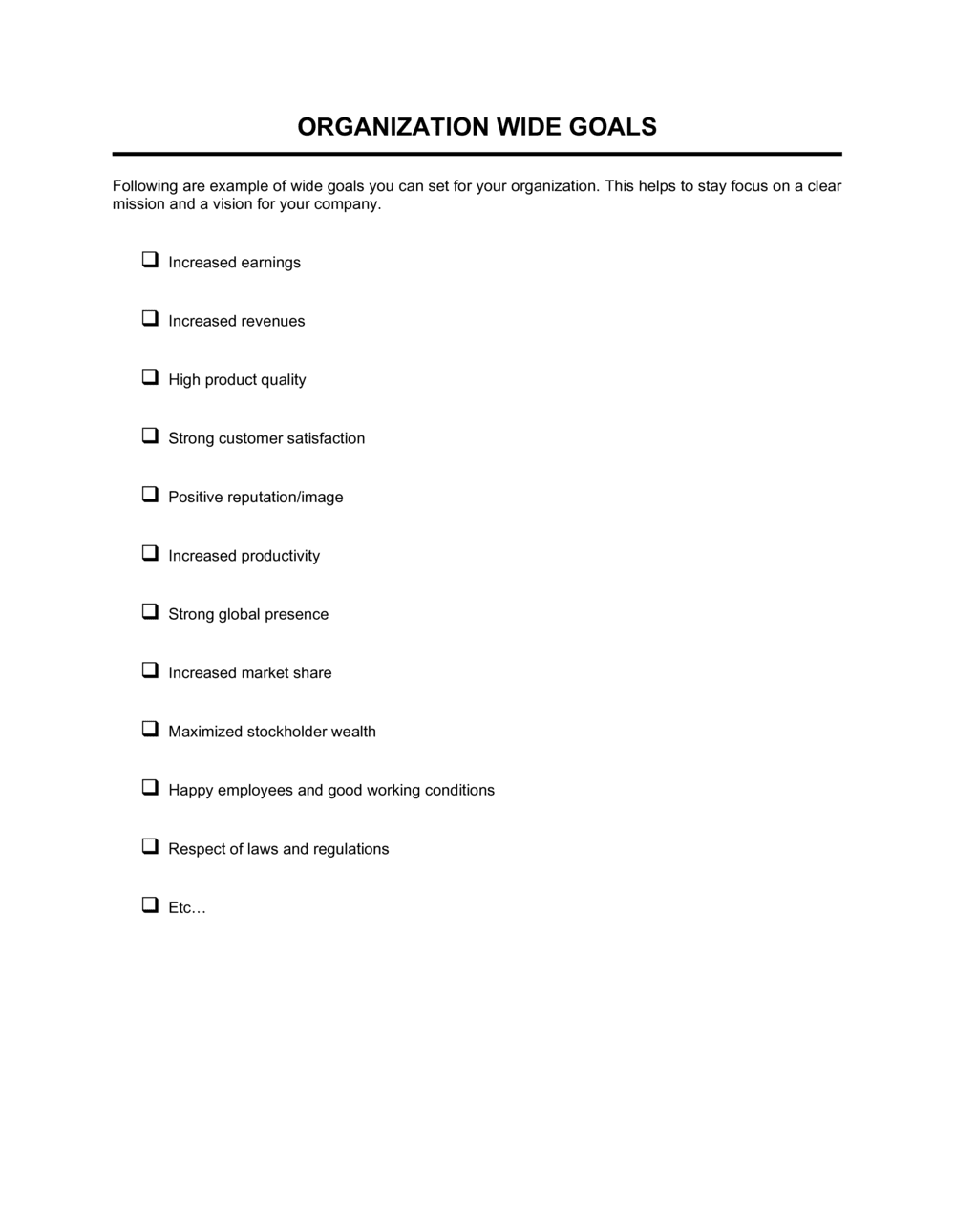
Organization Wide Goals Template

Free download • Use as a template • Print or share

1 page20–30 min to useDifficulty: StandardSignature requiredLegal review recommended
Learn more ↓
FreeOrganization Wide Goals Template

At a glance

What it is
An Organization Wide Goals document is a formally adopted, binding internal governance record that codifies a company's strategic objectives, measurable targets, accountable owners, and review cadence for a defined planning period. This free Word download provides a structured, boardroom-ready template you can edit online and export as PDF to circulate to executives, department heads, and board members.
When you need it
Use it at the start of each fiscal year, before a new strategic planning cycle, or whenever leadership needs to align the entire organization around a documented set of shared priorities with clear ownership and deadlines.
What's inside
Mission and vision alignment preamble, strategic priority areas, individual goal statements with SMART criteria, assigned owners and accountability structures, key performance indicators, review and reporting cadence, amendment procedures, and executive sign-off.

What is an Organization Wide Goals Document?

An Organization Wide Goals document is a formally adopted, signed governance record that translates a company's strategic direction into specific, measurable commitments for a defined planning period. It identifies each goal's outcome, numeric target, baseline value, accountable owner, key performance indicator, and review cadence — transforming a leadership team's intentions into an auditable record that can be evaluated, reported on, and held to account. Unlike a slide deck or an informal goal list, a properly executed organization wide goals document carries the signatures of the company's authorized officers, is governed by an amendment procedure, and is referenced in board, investor, and performance management processes throughout the year.

Why You Need This Document

Without a formally documented, signed goals record, strategic priorities exist only in presentations and verbal agreements — both of which are routinely reinterpreted, quietly revised, or simply forgotten as the year unfolds. The consequences are concrete: ownership disputes emerge at quarterly reviews because no one agreed in writing who was responsible, KPIs are calculated differently by different teams because the data source was never specified, and year-end performance evaluations become contested because the original targets were never formally recorded. For investor-backed companies, the absence of a goals document raises due diligence red flags about management discipline. For board-governed organizations, it creates a governance gap that auditors and directors will flag. A signed organization wide goals document closes all of these gaps before the planning period begins — giving every executive, department head, and board member a single, authoritative source of truth for what the company committed to achieve and exactly how progress will be measured.

Which variant fits your situation?

If your situation is…Use this template
Setting quarterly tactical targets below the annual strategic levelQuarterly Goals Template
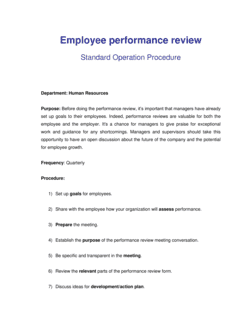
Cascading company goals into individual employee performance objectivesEmployee Performance Review Template
Documenting department-specific objectives linked to company goalsDepartment Goals Template
Structuring goals using the OKR (Objectives and Key Results) frameworkOKR Planning Template
Capturing a 3–5 year strategic direction beyond annual goal cyclesStrategic Planning Template
Tracking goal progress and status across teams in a live dashboardKPI Dashboard Template
Aligning goals with a formal balanced scorecard frameworkBalanced Scorecard Template

Common mistakes to avoid

❌ Writing activity-based goals instead of outcome-based goals

Why it matters: A goal stated as 'launch a customer feedback program' cannot be evaluated at year end — you either launched it or you did not, regardless of whether it changed anything.

Fix: Reframe every goal as a measurable outcome: 'Increase NPS from 32 to 50 by December 31' gives the organization a clear target and a clear evaluation standard.

❌ Assigning multiple accountable owners to a single goal

Why it matters: Shared ownership is diffused ownership. When two executives are equally accountable, both assume the other is driving progress and the goal stalls.

Fix: Designate exactly one accountable owner per goal. Use the RACI matrix to involve other parties — but only one person carries accountability.

❌ No amendment clause or informal goal changes mid-year

Why it matters: Without a formal amendment procedure, goals get quietly revised in project management tools or dropped from review decks, making the signed document irrelevant by Q3.

Fix: Require written, signed approval for any change to a goal, metric, deadline, or owner, and attach the amendment as a dated addendum to the original document.

❌ Setting more than 20 organization-wide goals

Why it matters: Executives cannot hold 20+ goals in active focus. Research on organizational goal-setting consistently shows that priority counts above 15 produce lower achievement rates than focused sets of 8–12.

Fix: Audit the goal list before signing. Anything that belongs to a single department rather than the whole organization should be moved to a department-level document.

❌ No confidentiality designation on the document

Why it matters: A document containing revenue targets, market entry plans, and headcount growth figures is commercially sensitive. An undated, unmarked copy forwarded outside the organization creates real competitive and reputational risk.

Fix: Add a confidentiality header and a distribution clause that names the specific roles authorized to receive the document.

❌ Executing signatures after the planning period has already started

Why it matters: In regulated industries and for board-governed entities, a governance document signed after the period it covers is of questionable enforceability and may be flagged during an audit or investor review.

Fix: Complete sign-off before the first day of the planning period. If circumstances require a later signature, note the effective date explicitly in the document and in board minutes.

The 10 key clauses, explained

Parties, Scope, and Effective Date

In plain language: Identifies the legal entity adopting the goals, the planning period covered, and the date the document takes effect.

Sample language
These Organization Wide Goals are adopted by [LEGAL ENTITY NAME], a [STATE/PROVINCE] [ENTITY TYPE] ('Company'), for the period [START DATE] through [END DATE], effective as of [EFFECTIVE DATE].

Common mistake: Using a trade name instead of the registered legal entity name, which creates a mismatch with board resolutions and investor reporting documents.

Mission and Vision Alignment Preamble

In plain language: Anchors the goal document to the company's stated mission and vision so that all objectives can be tested for strategic relevance.

Sample language
The following goals are adopted in furtherance of the Company's mission to [MISSION STATEMENT] and its vision of [VISION STATEMENT]. Any goal in conflict with this mission may be amended pursuant to Section [X].

Common mistake: Copying a marketing tagline as the mission statement. A governance preamble needs a mission that is specific enough to test goals against — not a slogan.

Strategic Priority Areas

In plain language: Groups all goals under three to six high-level themes, making it easy to check that the goal portfolio is balanced and not over-concentrated in a single area.

Sample language
For the planning period, the Company has identified the following Strategic Priority Areas: (a) [PRIORITY 1]; (b) [PRIORITY 2]; (c) [PRIORITY 3]. All Organization Wide Goals shall be assigned to one or more Priority Areas.

Common mistake: Listing more than six priority areas, which typically signals that the organization has not made real trade-offs and is attempting to pursue everything simultaneously.

Individual Goal Statements with SMART Criteria

In plain language: Each goal is written with a specific outcome, a numeric target, a named owner, and a deadline — making it objectively assessable at review time.

Sample language
Goal [NUMBER]: [GOAL TITLE]. Objective: [COMPANY NAME] will [SPECIFIC OUTCOME] by [DATE], as measured by [METRIC]. Baseline: [BASELINE VALUE] as of [DATE]. Target: [TARGET VALUE]. Owner: [TITLE/NAME].

Common mistake: Writing goals as activities ('conduct quarterly reviews') rather than outcomes ('increase employee engagement score from 62 to 75 by Q4'). Activity-based goals cannot be objectively evaluated at year end.

Key Performance Indicators and Measurement Methodology

In plain language: Defines the exact data source, calculation method, and reporting tool for each KPI so that progress measurement is consistent across reporting periods.

Sample language
KPI: [METRIC NAME]. Data Source: [SYSTEM/TOOL]. Calculation: [FORMULA OR DESCRIPTION]. Reported by: [ROLE]. Frequency: [MONTHLY / QUARTERLY]. Baseline: [VALUE]. Target: [VALUE].

Common mistake: Naming a KPI without specifying the data source or calculation method. Different teams often pull the same metric from different systems and arrive at conflicting numbers, derailing review meetings.

Accountable Owners and RACI Matrix

In plain language: Assigns a single accountable owner per goal and identifies who is responsible, consulted, and informed — eliminating the ambiguity that allows goals to fall through the cracks.

Sample language
Goal [NUMBER] Owner: [TITLE/NAME]. Responsible: [TEAM OR ROLE]. Consulted: [TEAM OR ROLE]. Informed: [TEAM OR ROLE]. Escalation: If progress falls below [THRESHOLD] at any review date, Owner shall notify [ESCALATION CONTACT] within [X] business days.

Common mistake: Assigning multiple accountable owners to a single goal. When two people are equally accountable, neither one is, and ownership disputes emerge at review time.

Review and Reporting Cadence

In plain language: Establishes when goal progress is formally assessed, who chairs the review, what output is produced, and where the record is stored.

Sample language
Progress against Organization Wide Goals shall be reviewed [MONTHLY / QUARTERLY] by the [LEADERSHIP TEAM / BOARD]. Each review shall produce a written status report within [X] business days. Annual review shall be conducted no later than [DATE] prior to the end of the planning period.

Common mistake: Setting a review cadence without specifying who produces the status report and where it is stored. Reviews happen verbally but no written record is created, defeating the governance purpose of the document.

Amendment Procedure

In plain language: Specifies the formal process for modifying a goal, metric, deadline, or owner after the document has been signed — requiring documented approval to prevent informal drift.

Sample language
Any amendment to these Organization Wide Goals requires written approval of [CEO / BOARD / EXECUTIVE COMMITTEE] and shall be documented in a signed Amendment to this Agreement dated as of the amendment effective date.

Common mistake: No amendment clause at all. Goals are then quietly changed in project management tools without any governance record, making year-end evaluation meaningless.

Confidentiality and Internal Distribution

In plain language: Restricts circulation of the document to named roles or levels, protecting commercially sensitive targets from disclosure to competitors, press, or unauthorized employees.

Sample language
These Organization Wide Goals are designated [CONFIDENTIAL / INTERNAL USE ONLY] and shall be distributed only to [EXECUTIVE TEAM / BOARD MEMBERS / NAMED ROLES]. Recipients shall not disclose target metrics to external parties without prior written approval of the [CEO / BOARD].

Common mistake: No confidentiality designation on a document that contains revenue targets, headcount plans, and market entry timelines. Inadvertent disclosure to a competitor or the press can be commercially damaging.

Governing Law, Signatures, and Adoption

In plain language: Records the formal adoption of the document by authorized signatories and specifies the jurisdiction whose law governs any dispute over interpretation or enforcement.

Sample language
These Organization Wide Goals are hereby adopted by the undersigned authorized representatives of [COMPANY NAME] as of [DATE]. This document shall be governed by the laws of [STATE / PROVINCE / COUNTRY]. [SIGNATURE BLOCKS FOR CEO, CFO, BOARD CHAIR].

Common mistake: Circulating the document for acknowledgment via email without a signed adoption record. Without signatures and a governing law clause, the document is an internal memo, not a governance instrument.

How to fill it out

  1. 1

    Enter the legal entity name, planning period, and effective date

    Use the company's full registered name, not a brand or trading name. Define the planning period with specific start and end dates, and record the date on which leadership formally adopts the document.

    💡 Align the planning period to your fiscal year, not the calendar year, so goal review cycles match financial reporting cycles.

  2. 2

    Write the mission and vision alignment preamble

    Insert the company's current, board-approved mission and vision statements. Then write one sentence confirming that all goals in the document serve those statements.

    💡 If the company does not have a formally approved mission statement, use this document as the trigger to adopt one — a goals document anchored to a vague preamble loses its strategic coherence.

  3. 3

    Define three to six strategic priority areas

    Identify the broad themes that will organize your goals — typically revenue growth, operational excellence, talent, customer experience, and product. Limit yourself to six; more than that signals a failure to prioritize.

    💡 Run the priority areas past your board or advisory group before finalizing — they often surface blind spots in how leadership is balancing growth against risk.

  4. 4

    Write each goal using the SMART criteria fields

    For every goal, complete all five SMART fields: specific outcome, numeric target, baseline value, deadline, and owner. Leave no field blank — a goal without a baseline or a deadline is not assessable.

    💡 Aim for 8–15 organization-wide goals total. Fewer than 6 often means important areas are unaddressed; more than 20 typically means department goals have been confused with company-level goals.

  5. 5

    Define the KPI and data source for each goal

    Name the specific metric, identify where the data comes from (CRM, HRIS, financial system, survey tool), and write out the calculation formula so that two different people running the same report arrive at the same number.

    💡 If a KPI cannot be pulled from an existing system today, note the data infrastructure work required as a dependency — otherwise you will reach the first review date with nothing to report against.

  6. 6

    Assign owners and complete the RACI matrix

    Assign exactly one accountable owner per goal — never two. Complete the Responsible, Consulted, and Informed columns for each goal so that cross-functional dependencies are visible before the planning period begins.

    💡 If you cannot identify a single accountable owner for a goal, the goal is either too broad or ownership is genuinely contested — resolve that before signing the document.

  7. 7

    Set the review cadence and sign-off process

    Choose a review frequency (monthly for operational goals, quarterly for strategic ones), name the person who chairs each review, and specify that a written status report is produced and stored within a defined number of days.

    💡 Schedule all review dates in leadership calendars on the day the document is signed — reviews that are not pre-calendared consistently slip.

  8. 8

    Execute signatures and distribute to named recipients

    Collect signatures from the CEO, CFO, and board chair or equivalent authorized officers before the start of the planning period. Distribute only to the roles specified in the confidentiality clause.

    💡 Use a timestamped e-signature tool so you have a dated execution record that can be produced during board or investor diligence.

Frequently asked questions

What is an organization wide goals document?

An organization wide goals document is a formally adopted internal governance record that captures a company's strategic objectives, measurable targets, accountable owners, and review cadence for a defined planning period. Unlike an informal goal list, it is signed by authorized executives, assigned to specific owners, and referenced in board and performance management processes. It creates an auditable record of what the organization committed to achieve and by when.

Why should organization wide goals be documented formally?

Formally documented goals create accountability in ways that verbal commitments and slide decks do not. A signed document with named owners, numeric targets, and a review cadence gives leadership a clear basis for evaluating performance, allocating resources, and making mid-year corrections. Investors, boards, and lenders also routinely request documented goal frameworks during due diligence to assess how management operates.

What is the difference between organization wide goals and a strategic plan?

A strategic plan covers a 3–5 year directional vision, market positioning, and investment priorities. Organization wide goals translate that vision into specific, measurable commitments for the current fiscal year. The strategic plan answers where the company is going; the goals document answers what the company will accomplish this year to get there. Both documents should be cross-referenced and consistent.

How many goals should an organization wide goals document contain?

Between 8 and 15 goals is the most effective range for a company-level document. Fewer than 6 typically means important strategic areas are unaddressed. More than 20 usually means department-level objectives have been elevated to the company level, diluting focus. The goals should represent the full organization's priorities, not any single function's agenda.

Who should sign an organization wide goals document?

At minimum, the CEO and any co-founders or executive partners should sign. For board-governed companies, the board chair or a designated board representative should also execute the document to confirm alignment between management and the board. In regulated industries or investor-backed companies, the CFO signature is also standard given that many goals carry financial implications.

How often should organization wide goals be reviewed?

Most organizations use a quarterly review cadence for strategic goals and a monthly cadence for operational targets. The review cadence should be specified in the document itself, with a named person responsible for preparing the status report. At minimum, a formal mid-year and year-end review are required to satisfy board and investor reporting norms.

Can organization wide goals be changed after the document is signed?

Yes, but only through the amendment procedure specified in the document. Significant changes to goals, metrics, or owners typically require written approval from the CEO and, for board-governed companies, a board resolution. Informal changes made in project management tools without a signed amendment undermine the document's governance value and create confusion at year-end evaluation.

Do organization wide goals need to be shared with all employees?

Distribution depends on your confidentiality strategy. Many companies share high-level goals broadly to drive alignment but restrict access to detailed KPI targets and baselines that are commercially sensitive. A tiered approach — public goal summaries for all staff, detailed metrics only for leadership — balances transparency against competitive exposure. The confidentiality clause in the document should specify exactly who receives which version.

What frameworks work best for structuring organization wide goals?

The three most commonly adopted frameworks are SMART goals (Specific, Measurable, Achievable, Relevant, Time-bound), OKRs (Objectives and Key Results), and the Balanced Scorecard (which distributes goals across financial, customer, internal process, and learning perspectives). This template uses SMART criteria as the default because it is universally understood and requires no additional framework training. If your organization already uses OKRs or a Balanced Scorecard, the template's goal statement fields can be relabeled accordingly.

How this compares to alternatives

vs Strategic Planning Template

A strategic plan sets a 3–5 year directional vision, market positioning, and investment priorities. Organization wide goals translate that vision into specific, measurable annual commitments. The strategic plan is the map; the goals document is the year's itinerary. Companies need both — the goals document is meaningless without the strategic context, and the strategic plan has no teeth without annual goal commitments.

vs Employee Performance Review Template

A performance review evaluates an individual employee's contributions against their personal objectives. Organization wide goals sit one level above — they define what the company as a whole will achieve, and individual performance objectives should cascade from them. The company-level document is drafted first; individual reviews then measure how each employee contributed to it.

vs KPI Dashboard Template

A KPI dashboard is a live reporting tool that tracks metric performance over time. Organization wide goals define what the company is committing to achieve and why. The dashboard reports on progress toward those goals but does not replace the governance record that formalizes ownership, baselines, and amendment procedures. Both are needed — the goals document is the source of truth; the dashboard is the real-time tracking tool.

vs Business Plan Template

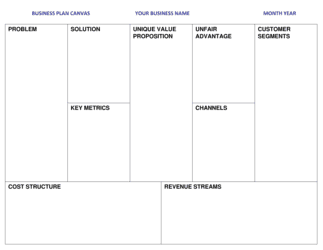
A business plan is an external-facing document used to raise capital, covering market analysis, competitive positioning, and financial projections. Organization wide goals are an internal governance document used to manage execution. A business plan describes what the company could achieve; a goals document records what leadership has committed to achieving and how progress will be measured and enforced.

Industry-specific considerations

Technology / SaaS

Goals typically cover ARR growth, churn rate, product release milestones, and engineering headcount, with monthly KPI reporting tied to the CRM and financial system.

Professional Services

Goals center on billable utilization rates, client retention percentages, revenue per employee, and new service line launches within the planning period.

Healthcare

Goals must align with regulatory compliance timelines, patient outcome metrics, accreditation requirements, and staffing ratios governed by licensing bodies.

Nonprofit

Goals are framed around program impact metrics, grant deliverables, fundraising targets, and donor retention rates, with board approval required before the document takes effect.

Jurisdictional notes

United States

In the US, organization wide goals documents are typically internal governance instruments rather than externally regulated filings. However, for publicly traded companies, material goal disclosures may trigger SEC Regulation S-K obligations. Delaware corporations should ensure goal documents align with board resolutions adopted under the Delaware General Corporation Law. Employment-related goals (headcount reductions, compensation changes) may have implications under the WARN Act if they trigger workforce reductions above statutory thresholds.

Canada

Canadian federally incorporated companies under the Canada Business Corporations Act should ensure that any goals with compensation or equity implications align with director approval requirements. In Quebec, internal governance documents distributed to employees may have French-language obligations under the Charter of the French Language. Provincial securities regulators may require disclosure of material strategic goals for reporting issuers under National Instrument 51-102.

United Kingdom

UK companies governed under the Companies Act 2006 should ensure that goals with material financial implications are approved by the board and recorded in board minutes. For companies subject to the UK Corporate Governance Code, formal goal-setting and performance monitoring processes are an expected element of compliance. Goals related to workforce changes may trigger collective consultation obligations under TUPE or the Trade Union and Labour Relations (Consolidation) Act 1992.

European Union

EU companies operating across multiple member states should note that goals referencing employee data, performance metrics, or workforce planning may engage GDPR obligations when personal data is processed as part of goal tracking. Works council consultation requirements in Germany, France, and the Netherlands may require advance notice of company-wide goals that affect working conditions. ESG-related goals are increasingly subject to disclosure obligations under the Corporate Sustainability Reporting Directive (CSRD) for qualifying entities.

Template vs lawyer — what fits your deal?

PathBest forCostTime
Use the templateSMBs and early-stage companies setting internal annual goals with leadership team sign-offFree2–4 hours
Template + legal reviewBoard-governed companies, investor-backed startups, or organizations in regulated industries where the document feeds into compliance reporting$300–$8001–3 days
Custom draftedPublic companies, PE or VC-backed entities with contractual goal obligations in investment agreements, or multinationals requiring jurisdiction-specific governance language$1,500–$5,000+1–3 weeks

Glossary

SMART Goal
A goal that is Specific, Measurable, Achievable, Relevant, and Time-bound — the most widely adopted standard for writing organizational objectives.
Key Performance Indicator (KPI)
A quantifiable metric used to evaluate progress toward a specific organizational goal over a defined period.
Strategic Priority Area
A broad theme — such as revenue growth, operational efficiency, or talent development — under which multiple related goals are grouped.
Accountable Owner
The named individual or role formally responsible for achieving a specific goal and reporting on its progress.
OKR (Objectives and Key Results)
A goal-setting framework pairing a qualitative objective with three to five quantitative key results that define what success looks like.
Review Cadence
The scheduled frequency — monthly, quarterly, or annually — at which goal progress is formally assessed and documented.
Amendment Procedure
The formal process by which a goal, metric, or deadline in the document may be changed after initial sign-off, including who must approve the change.
Baseline Metric
The current-state measurement recorded at the start of the planning period against which progress toward a goal is evaluated.
Cascade
The process of translating organization-wide goals into department-level and individual-level objectives that collectively add up to the company target.
Governance Record
A formally adopted, signed document that creates an auditable record of organizational decisions and commitments for board, investor, or regulatory review.

Part of your Business Operating System

This document is one of 3,000+ business & legal templates included in Business in a Box.

  • Fill-in-the-blanks — ready in minutes
  • 100% customizable Word document
  • Compatible with all office suites
  • Export to PDF and share electronically

Create your document in 3 simple steps.

From template to signed document — all inside one Business Operating System.
1
Download or open template

Access over 3,000+ business and legal templates for any business task, project or initiative.

2
Edit and fill in the blanks with AI

Customize your ready-made business document template and save it in the cloud.

3
Save, Share, Send, Sign

Share your files and folders with your team. Create a space of seamless collaboration.

Save time, save money, and create top-quality documents.

★★★★★

"Fantastic value! I'm not sure how I'd do without it. It's worth its weight in gold and paid back for itself many times."

Managing Director · Mall Farm
Robert Whalley
Managing Director, Mall Farm Proprietary Limited
★★★★★

"I have been using Business in a Box for years. It has been the most useful source of templates I have encountered. I recommend it to anyone."

Business Owner · 4+ years
Dr Michael John Freestone
Business Owner
★★★★★

"It has been a life saver so many times I have lost count. Business in a Box has saved me so much time and as you know, time is money."

Owner · Upstate Web
David G. Moore Jr.
Owner, Upstate Web

Run your business with a system — not scattered tools

Stop downloading documents. Start operating with clarity. Business in a Box gives you the Business Operating System used by over 250,000 companies worldwide to structure, run, and grow their business.

Start free · No credit card required