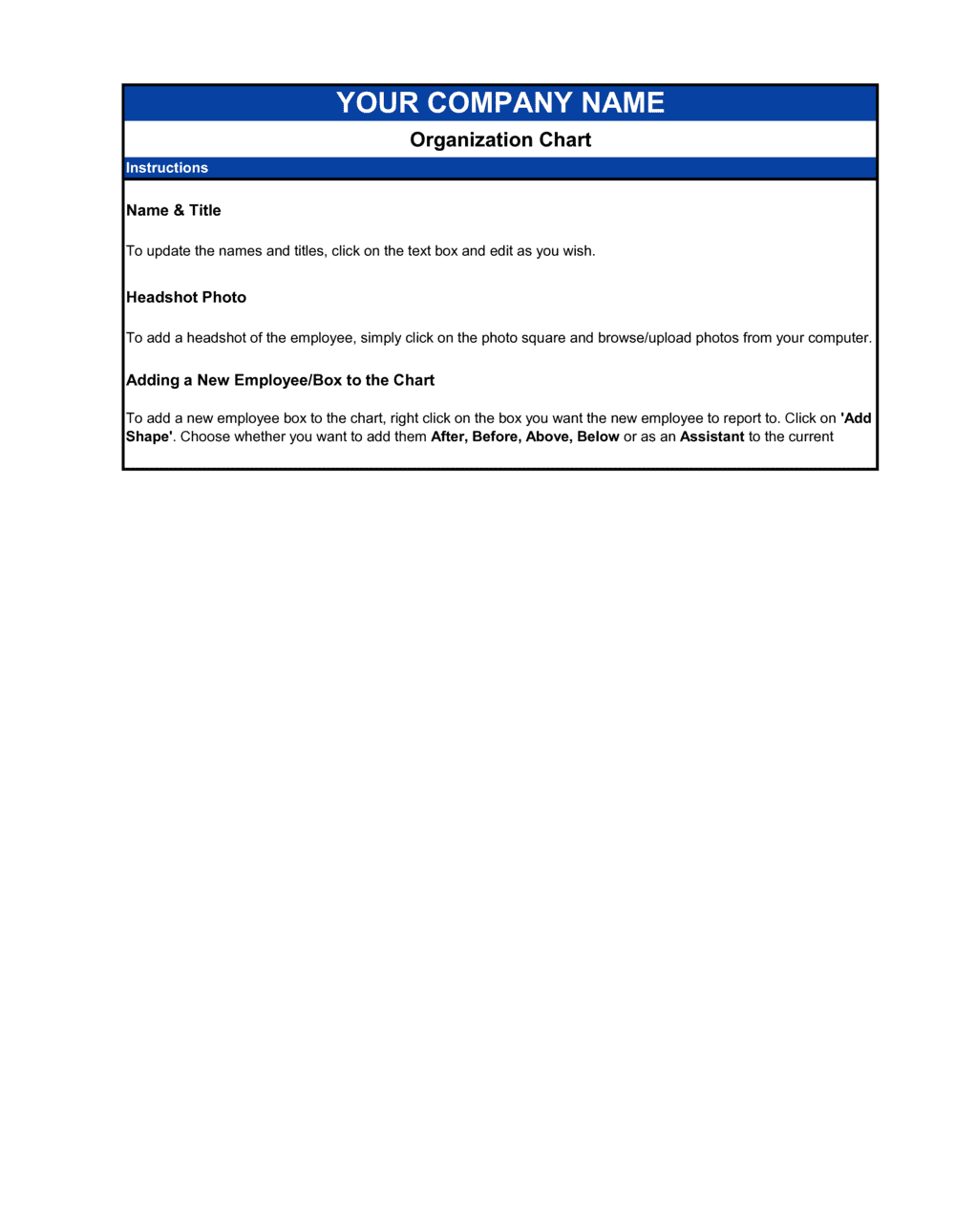
Organization Chart Template

Free Excel download β€’ Edit online β€’ Save & share with Drive β€’ Export to PDF

2 pagesβ€’20–30 min to fillβ€’Difficulty: Standardβ€’Signature requiredβ€’Legal review recommended
Learn more ↓
FreeXLSOrganization Chart Template

At a glance

What it is
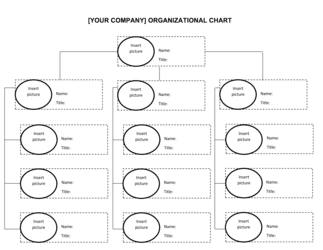
An Organization Chart is a formal document that visually and structurally maps a company's reporting relationships, authority levels, and functional roles from the board and executive team down to individual departments and positions. This free Word download gives you an editable, governance-ready starting point you can update as your company grows and export as PDF for HR files, investor data rooms, and regulatory submissions.
When you need it
Use it when onboarding new employees who need to understand the chain of command, when presenting your management structure to investors or lenders, or when your company undergoes a reorganization, merger, or acquisition that requires a formal record of the new reporting structure.
What's inside
Board and executive leadership tiers, departmental hierarchy with reporting lines, position titles and incumbents, span-of-control annotations, and effective date notation. The document also includes a governance legend and signature block for HR or executive sign-off.

What is an Organization Chart?

An Organization Chart is a formal governance document that maps a company's reporting relationships, authority levels, and functional roles in a structured visual hierarchy β€” from the board of directors and executive leadership team down through departments, team leads, and individual positions. Unlike an informal diagram sketched for a presentation, a properly executed organization chart carries a signature block, version history, and effective date, making it an authoritative record of organizational structure that can be used in HR processes, investor due diligence, regulatory submissions, and employment disputes. It documents not just who holds each role, but who has the authority to direct, evaluate, and terminate β€” the chain of command that governs day-to-day operations.

Why You Need This Document

Without a signed, current organization chart, your company's reporting structure exists only in people's heads β€” and heads change. When an employee is terminated and the formal chain of command is unclear, wrongful-dismissal claims become harder to defend. When a regulator requests your organizational structure during a licensing review or examination, an unsigned diagram from a pitch deck is not an acceptable substitute. When an acquirer opens your data room, a missing or outdated org chart signals governance gaps that translate directly into lower valuations and longer diligence cycles. The cost of maintaining a current, signed org chart is measured in hours; the cost of not having one surfaces at the worst possible moments β€” audits, disputes, and closings. This template gives you a governance-ready starting point that you can update in minutes and export as a certified PDF whenever your structure changes.

Which variant fits your situation?

If your situation is…Use this template
Documenting the full corporate hierarchy from board to individual contributorOrganization Chart (Full Corporate)
Mapping a single department's internal structure and reporting linesDepartmental Org Chart
Illustrating a matrix structure where employees report to multiple managersMatrix Organization Chart
Showing the legal ownership chain across subsidiaries and parent companiesCorporate Structure Chart
Outlining governance roles for a nonprofit board and committeesNonprofit Organizational Chart
Presenting a project team's roles and reporting lines for a specific engagementProject Organization Chart
Documenting a post-merger combined organizational structurePost-Merger Integration Org Chart

Common mistakes to avoid

❌ Using informal reporting relationships instead of authorized ones

Why it matters: When a termination or authority dispute arises, courts and HR investigators look at the formal org chart β€” if it reflects who people actually talk to rather than who they formally report to, the document creates more confusion than it resolves.

Fix: Map the structure as authorized in employment contracts and board resolutions, then update the contracts if the formal structure has drifted from reality.

❌ Skipping the signature and approval block

Why it matters: An unsigned org chart is a working document, not a certified record. It cannot be used as evidence of reporting structure in litigation, regulatory filings, or M&A due diligence without an authorized signature.

Fix: Require CEO or CPO sign-off on every version before distribution, and archive the signed PDF separately from working drafts.

❌ Failing to update the chart after a reorganization

Why it matters: An outdated org chart actively misleads new hires, investors, and regulators. If an employee is terminated and the org chart still shows them as a department head, it creates evidentiary problems in wrongful-dismissal claims.

Fix: Assign a named owner β€” typically the Chief People Officer or a senior HR business partner β€” with a standing obligation to update and re-sign the chart within 30 days of any structural change.

❌ Omitting vacancies and interim roles

Why it matters: Presenting a fully staffed chart when key roles are vacant misrepresents the company's operational capacity to investors and acquirers β€” a material misrepresentation in a funding or M&A context.

Fix: Use explicit vacancy and interim notations on every version of the chart, and update them as positions are filled or interim appointments change.

❌ No version control or supersession notation

Why it matters: Without version numbers and supersession dates, multiple versions circulate simultaneously in HR files, data rooms, and board folders β€” creating conflicting records of who reports to whom.

Fix: Adopt a versioning convention (v1.0, v1.1, v2.0) and include a 'supersedes version [X] dated [DATE]' line on every updated chart before distribution.

❌ Listing only titles without incumbent names for senior roles

Why it matters: An org chart that shows 'Chief Financial Officer' with no name attached gives investors and regulators no way to assess the team's experience or verify employment claims made elsewhere in due diligence materials.

Fix: Require incumbent names for all director-level and above roles. For roles below director, using titles only is acceptable and reduces the maintenance burden of a large chart.

The 9 key clauses, explained

Company Identification and Effective Date

In plain language: States the full legal name of the company, its registration jurisdiction, and the date the chart becomes the official record of organizational structure.

Sample language
This Organization Chart represents the authorized reporting structure of [COMPANY LEGAL NAME], a [STATE/PROVINCE] [ENTITY TYPE], effective [EFFECTIVE DATE].

Common mistake: Using a trade name instead of the registered legal entity name β€” when the org chart is attached to a regulatory filing or merger document, the name mismatch can invalidate or delay processing.

Board of Directors Tier

In plain language: Identifies the board members and any standing committees (audit, compensation, governance) that sit above the executive leadership team.

Sample language
Board of Directors: [CHAIR NAME] (Chair), [DIRECTOR NAME], [DIRECTOR NAME]. Standing Committees: Audit Committee (Chair: [NAME]), Compensation Committee (Chair: [NAME]).

Common mistake: Omitting board committees from the chart entirely β€” auditors and investors expect to see the full governance structure, not just the operating hierarchy.

Executive Leadership Tier

In plain language: Lists the C-suite and senior executive roles, their incumbents, and their direct report relationship to the CEO or President.

Sample language
[CEO NAME], Chief Executive Officer β€” Direct reports: CFO, COO, CTO, General Counsel, Chief People Officer.

Common mistake: Listing titles without incumbents, or incumbents without titles β€” both create ambiguity about who holds authority and who is responsible during disputes or audits.

Departmental Structure and Reporting Lines

In plain language: Maps each department, its head, and the direct-report relationships flowing downward through team leads and individual contributors.

Sample language
Finance Department: [CFO NAME] (CFO) β†’ [VP FINANCE NAME] (VP Finance) β†’ [CONTROLLER NAME] (Controller) β†’ [ANALYST NAME] (Financial Analyst).

Common mistake: Drawing reporting lines based on current informal practice rather than the formally authorized structure β€” the chart then contradicts employment contracts and creates confusion during terminations or disputes.

Dotted-Line and Functional Authority Relationships

In plain language: Documents secondary reporting or functional authority relationships using dashed lines, with an explanatory legend so readers interpret them correctly.

Sample language
Dotted lines indicate functional authority only. [COMPLIANCE OFFICER NAME] holds functional authority over compliance activities across all departments, reporting directly to the Audit Committee on compliance matters.

Common mistake: Using dotted lines without a legend or explanatory note β€” readers, auditors, and new employees interpret them inconsistently, undermining their purpose.

Position Titles, Incumbents, and Vacancies

In plain language: Lists each role by its official title, names the current incumbent, and clearly marks any vacant positions with a standard notation.

Sample language
[POSITION TITLE] β€” [INCUMBENT NAME] | [POSITION TITLE] β€” VACANT (as of [DATE]) | [POSITION TITLE] β€” [INTERIM INCUMBENT NAME] (Interim)

Common mistake: Leaving vacancies off the chart or marking interim holders as permanent β€” this misrepresents headcount and authority to investors, regulators, and prospective employees.

Span of Control Notation

In plain language: Indicates the number of direct reports for each manager-level position, enabling readers to assess organizational layers and decision-making load.

Sample language
[MANAGER TITLE] ([INCUMBENT NAME]) β€” Direct Reports: [NUMBER] | Total Headcount Overseen: [NUMBER]

Common mistake: Omitting span-of-control data entirely β€” without it, investors and acquirers cannot assess management leverage or identify organizational bottlenecks during due diligence.

Version Control and Amendment History

In plain language: Records the document version number, the date of each revision, and the name of the approving authority so the current chart is always distinguishable from prior versions.

Sample language
Version: [X.X] | Effective: [DATE] | Supersedes: Version [X.X] dated [DATE] | Approved by: [NAME, TITLE] on [DATE]

Common mistake: Distributing an updated org chart without updating the version number or supersession note β€” outdated charts circulate in data rooms and HR files, creating conflicting records of authority.

Signature and Approval Block

In plain language: Provides a formal sign-off by the CEO or Chief People Officer certifying that the chart is accurate and authorized as of the effective date.

Sample language
I certify that this Organization Chart accurately reflects the authorized reporting structure of [COMPANY LEGAL NAME] as of [EFFECTIVE DATE]. Signed: [NAME] | Title: [TITLE] | Date: [DATE]

Common mistake: Treating the org chart as an informal visual and skipping the signature block β€” without it, the document cannot be used as certified evidence of reporting structure in litigation, regulatory filings, or M&A due diligence.

How to fill it out

  1. 1

    Enter the company's legal name and effective date

    Use the full registered legal entity name and set an effective date that corresponds to when this structure formally takes effect β€” not necessarily today's date.

    πŸ’‘ Cross-check the entity name against your corporate registry filing. A mismatch between the org chart and your articles of incorporation can create problems in regulatory submissions.

  2. 2

    Map the board of directors and standing committees

    List all board members by name and title, then attach standing committees (audit, compensation, governance) below the board tier with their chairs identified.

    πŸ’‘ If your board has not yet formed formal committees, note that committees are 'to be established' with a target date rather than leaving the tier blank.

  3. 3

    Place the executive leadership team

    Enter each C-suite and senior executive role directly below the CEO, with the incumbent's name, official title, and the date they assumed the role if recently appointed.

    πŸ’‘ Confirm titles against employment contracts before adding them β€” 'VP of Engineering' and 'Chief Technology Officer' carry different authority levels and affect how the chart reads to investors.

  4. 4

    Build out departmental hierarchies

    For each department, start with the department head and draw reporting lines downward through team leads to individual contributors. Use the template's solid-line connectors for direct reports.

    πŸ’‘ Limit the chart to position titles for large departments β€” listing every individual contributor by name creates a maintenance burden and privacy considerations in jurisdictions with personal data rules.

  5. 5

    Add dotted-line relationships with a legend

    Identify any functional authority or secondary reporting relationships and represent them with dashed lines. Add a legend box defining what solid and dashed lines mean in your specific structure.

    πŸ’‘ Functional authority relationships are particularly common in compliance, legal, and finance roles β€” document them explicitly to avoid disputes about decision-making scope.

  6. 6

    Mark vacancies and interim appointments

    Use a consistent notation β€” for example, 'VACANT (as of [DATE])' or '[NAME] (Interim)' β€” for any unfilled or temporarily filled positions.

    πŸ’‘ Investors and acquirers pay close attention to vacancies at the VP level and above β€” a chart with multiple key vacancies without a hiring plan will prompt questions, so be prepared to address them.

  7. 7

    Record version number and supersession information

    Assign a version number (e.g., v1.0, v2.1), note the date this version supersedes, and record the name and title of the approving authority.

    πŸ’‘ Store all prior versions in a dated archive folder. M&A due diligence teams routinely request historical org charts to understand how the company has evolved.

  8. 8

    Obtain signatures and distribute

    Have the CEO or Chief People Officer sign and date the approval block. Then distribute the signed PDF to HR files, the board's governance folder, and any active data rooms.

    πŸ’‘ Never distribute an unsigned draft as the current org chart β€” even internally. The signed version is the authoritative record; the draft is a working document.

Frequently asked questions

What is an organization chart?

An organization chart is a formal document that maps a company's reporting relationships, authority levels, and functional roles in a visual hierarchy. It identifies who reports to whom at every level β€” from the board of directors and executive team down to individual departments and positions. Beyond its role as a communication tool, a signed and versioned org chart serves as an authoritative governance record used in HR management, investor due diligence, regulatory filings, and litigation.

Why does an organization chart need to be signed?

A signature block transforms an org chart from an informal visual into a certified governance document. Without an authorized signature, the chart cannot be used as evidence of reporting structure in employment disputes, regulatory audits, or M&A due diligence β€” any party can argue it is a draft or an outdated version. The CEO or Chief People Officer signature, combined with an effective date and version number, establishes the document as the official record of organizational authority at a specific point in time.

How often should an organization chart be updated?

Best practice is to update and re-sign the org chart within 30 days of any material structural change β€” a reorganization, key hire, executive departure, or change in reporting relationships. Many companies also conduct a full annual review aligned to their fiscal year. In regulated industries such as financial services and healthcare, regulators may require a current org chart on file at all times, making quarterly reviews standard.

What is the difference between a solid line and a dotted line on an org chart?

A solid line indicates a direct reporting relationship β€” the lower position reports to and is primarily accountable to the higher position for performance, compensation decisions, and day-to-day direction. A dotted line indicates a secondary or functional authority relationship β€” the lower position takes direction from the higher position on specific subject-matter areas (such as compliance or legal) but reports to a different primary manager for all other purposes. Both types of lines should be defined in a legend on the chart to prevent misinterpretation.

Is an organization chart required by law?

No jurisdiction universally mandates an org chart as a standalone document, but many regulatory frameworks effectively require one in practice. Financial regulators in the US (FINRA, OCC), UK (FCA), and EU (EBA) routinely request current organizational charts during licensing applications, examinations, and change-of-control filings. In M&A transactions, a signed org chart is standard in the data room. For healthcare organizations in the US, Joint Commission accreditation standards reference organizational structure documentation.

How do I document a matrix organization on an org chart?

In a matrix structure, most employees have two reporting lines β€” a functional manager (e.g., VP of Engineering) and a project or business-unit manager (e.g., Director of Product). Represent the primary reporting line with a solid line and the secondary line with a dashed line, then add a legend explaining the distinction. Include a written note on the chart clarifying which manager has authority over compensation and performance reviews, since this is the most common source of ambiguity in matrix organizations.

Should an organization chart list individual names or just titles?

For director-level and above roles, include both the position title and the incumbent's name β€” investors, regulators, and board members need to know who holds authority, not just that the role exists. For roles below director, using titles only is acceptable and makes the chart far easier to maintain in organizations with high turnover or large teams. Mark any senior role that is vacant or held by an interim appointee with an explicit notation rather than leaving it blank or misrepresenting it as filled.

Can an organization chart be used as evidence in an employment dispute?

Yes, and this is one of the most important reasons to maintain a signed, versioned org chart. In wrongful-dismissal, constructive-dismissal, and workplace-harassment cases, the formal reporting structure at the time of the incident is a central factual question. A signed org chart with a clear effective date establishes the authorized chain of command as of a specific date. An unsigned or outdated chart, or one that conflicts with employment contracts, weakens the employer's position and can support the employee's claim that reporting relationships were ambiguous.

What governance documents should accompany an organization chart?

An org chart is most effective when paired with a set of supporting governance documents: the corporate bylaws or articles of association (defining board authority), individual employment contracts (confirming titles and reporting lines), a delegation-of-authority matrix (specifying spending and approval limits by role), and a RACI or responsibility assignment matrix (clarifying who is responsible, accountable, consulted, and informed on key decisions). Together, these documents create a complete and defensible governance record.

How this compares to alternatives

vs Corporate Structure Chart

A corporate structure chart maps the legal ownership relationships between a parent company, subsidiaries, holding entities, and joint ventures β€” it shows who owns what, not who reports to whom. An organization chart maps internal reporting and authority relationships within a single legal entity. Regulated industries and M&A transactions typically require both documents in the data room.

vs RACI Matrix

A RACI matrix assigns Responsible, Accountable, Consulted, and Informed roles to specific tasks, decisions, or processes β€” it defines who does what on a workflow level. An org chart defines structural authority and reporting relationships at the position level. They answer different questions and are most useful when used together: the org chart establishes who holds authority; the RACI clarifies how that authority is exercised on specific decisions.

vs Delegation of Authority Matrix

A delegation-of-authority matrix specifies spending limits, contract-signing authority, and approval thresholds by role β€” it answers how much authority each position holds. An org chart establishes the reporting relationships between those positions but does not specify financial or approval limits. Both are typically required for SOX compliance in public companies and for governance reviews in private-equity-backed businesses.

vs Employee Handbook

An employee handbook describes company policies, procedures, and culture β€” it explains the rules of the workplace. An org chart is a governance document that defines formal reporting relationships and authority levels. The handbook may reference the org chart as the authoritative source of reporting-line information, but the two documents serve distinct purposes and should be maintained separately.

Industry-specific considerations

Financial Services

Regulators including FINRA, OCC, and the FCA require current org charts during licensing applications, examinations, and change-of-control notifications β€” charts must identify compliance and risk reporting lines separately from business lines.

Healthcare

Joint Commission and CMS accreditation standards reference organizational structure documentation; org charts must distinguish clinical authority from administrative authority and show medical staff governance separately from the corporate hierarchy.

Technology / SaaS

Venture-backed companies routinely include signed org charts in Series A and later data rooms; investors specifically examine engineering and product reporting lines, the gap between the org chart and the cap table, and whether key roles are filled or still vacant.

Professional Services

Law firms, accounting firms, and consulting practices use org charts to establish partner and engagement-manager authority levels, which determine client-billing authority, conflict-check responsibilities, and regulatory registration requirements in licensed professions.

Jurisdictional notes

United States

No federal statute mandates a standalone org chart, but FINRA Rule 4370, OCC Handbook guidelines, and SEC examination procedures routinely request current organizational charts from regulated entities. SOX-compliant public companies typically maintain board-approved org charts as part of their internal controls documentation. State labor laws in California and New York may affect how reporting relationships are documented in the context of joint-employer and co-employment claims.

Canada

OSFI guidelines for federally regulated financial institutions require current organizational charts as part of corporate governance filings. Provincial securities regulators (OSC, AMF) request org charts during registration and examination processes. In Quebec, any org chart distributed internally must comply with the Charter of the French Language β€” position titles and chart labels in a provincially-regulated employer context should be available in French.

United Kingdom

The FCA and PRA require regulated firms to maintain and submit current organizational charts identifying Senior Managers under the Senior Managers and Certification Regime (SMCR). Each Senior Manager must be mapped to a specific prescribed responsibility on the chart. The Companies Act 2006 does not mandate org charts, but they form part of the corporate governance documentation reviewed during FCA authorization and in-scope change-of-control notifications.

European Union

The European Banking Authority (EBA) and European Securities and Markets Authority (ESMA) require organizational charts in authorization and supervisory review applications. GDPR compliance is relevant when org charts include personal data such as employee names and contact information β€” charts distributed externally or stored in shared data rooms should be reviewed for data minimization compliance. Member states including Germany and France impose works-council consultation obligations when a restructuring reflected in a new org chart constitutes a material change to working conditions.

Template vs lawyer β€” what fits your deal?

PathBest forCostTime
Use the templateSmall businesses, startups, and internal HR teams documenting a straightforward reporting structure for onboarding or internal alignmentFree1–3 hours
Template + legal reviewCompanies preparing for a Series A or Series B data room, regulated-industry licensing applications, or post-reorganization governance documentation$300–$800 (HR consultant or corporate attorney review)1–3 days
Custom draftedPublic companies, heavily regulated entities (banks, healthcare systems), or organizations undergoing a merger requiring a certified organizational structure filing$1,000–$5,000+1–3 weeks

Glossary

Reporting Line
The direct supervisory relationship between a position and the role to which it reports, typically shown as a solid line on an org chart.
Dotted-Line Relationship
A secondary, indirect reporting or functional authority relationship between two roles, shown as a dashed line to distinguish it from a primary reporting line.
Span of Control
The number of direct reports a single manager oversees β€” a key factor in determining organizational layers and delegation capacity.
Chain of Command
The unbroken line of authority from the most senior executive to the most junior position, establishing who has decision-making power at each level.
Functional Authority
The right of a specialist or department head to direct activities in their domain across the organization, even over employees who report to a different manager.
Flat Organization
A structure with few or no middle management layers between executives and individual contributors, used to speed decision-making in small or agile companies.
Hierarchical Organization
A traditional top-down structure with multiple management tiers, clear authority levels, and narrow spans of control β€” common in large corporations and regulated industries.
Matrix Structure
An organizational design where employees have two reporting lines β€” one functional and one project-based β€” creating shared authority between department heads and project managers.
Governance Structure
The formal framework of roles, authority, and accountability β€” including the board, committees, and executive team β€” that directs and controls a company.
Incumbent
The individual currently holding a specific position on the org chart, as distinguished from the position title itself.
Effective Date
The date on which the organizational structure shown in the chart formally takes effect, which may differ from the date the document was created or signed.

Part of your Business Operating System

This document is one of 3,000+ business & legal templates included in Business in a Box.

  • Fill-in-the-blanks β€” ready in minutes
  • 100% customizable Word document
  • Compatible with all office suites
  • Export to PDF and share electronically

Create your document in 3 simple steps.

From template to signed document β€” all inside one Business Operating System.
1
Download or open template

Access over 3,000+ business and legal templates for any business task, project or initiative.

2
Edit and fill in the blanks with AI

Customize your ready-made business document template and save it in the cloud.

3
Save, Share, Send, Sign

Share your files and folders with your team. Create a space of seamless collaboration.

Save time, save money, and create top-quality documents.

β˜…β˜…β˜…β˜…β˜…

"Fantastic value! I'm not sure how I'd do without it. It's worth its weight in gold and paid back for itself many times."

Managing Director Β· Mall Farm
Robert Whalley
Managing Director, Mall Farm Proprietary Limited
β˜…β˜…β˜…β˜…β˜…

"I have been using Business in a Box for years. It has been the most useful source of templates I have encountered. I recommend it to anyone."

Business Owner Β· 4+ years
Dr Michael John Freestone
Business Owner
β˜…β˜…β˜…β˜…β˜…

"It has been a life saver so many times I have lost count. Business in a Box has saved me so much time and as you know, time is money."

Owner Β· Upstate Web
David G. Moore Jr.
Owner, Upstate Web

Run your business with a system β€” not scattered tools

Stop downloading documents. Start operating with clarity. Business in a Box gives you the Business Operating System used by over 250,000 companies worldwide to structure, run, and grow their business.

Free Forever PlanΒ Β·Β No credit card required