Occupational Therapy Code Of Ethics Template

Free Word download • Edit online • Save & share with Drive • Export to PDF

3 pages25–30 min to fillDifficulty: StandardSignature requiredLegal review recommended
Learn more ↓
FreeOccupational Therapy Code Of Ethics Template

At a glance

What it is
An Occupational Therapy Code of Ethics is a binding governance document that establishes the professional, ethical, and legal standards of conduct for occupational therapists and occupational therapy assistants employed or contracted by an OT practice, clinic, or healthcare organization. This free Word download gives you a structured, jurisdiction-aware starting point you can edit online and export as PDF for staff acknowledgment and policy compliance.
When you need it
Use it when onboarding new OT practitioners, updating clinic governance documents to reflect current AOTA or regulatory standards, or responding to a licensing board's request for a formal ethics policy. It is also required when credentialing practitioners with hospitals, insurers, or managed care organizations.
What's inside
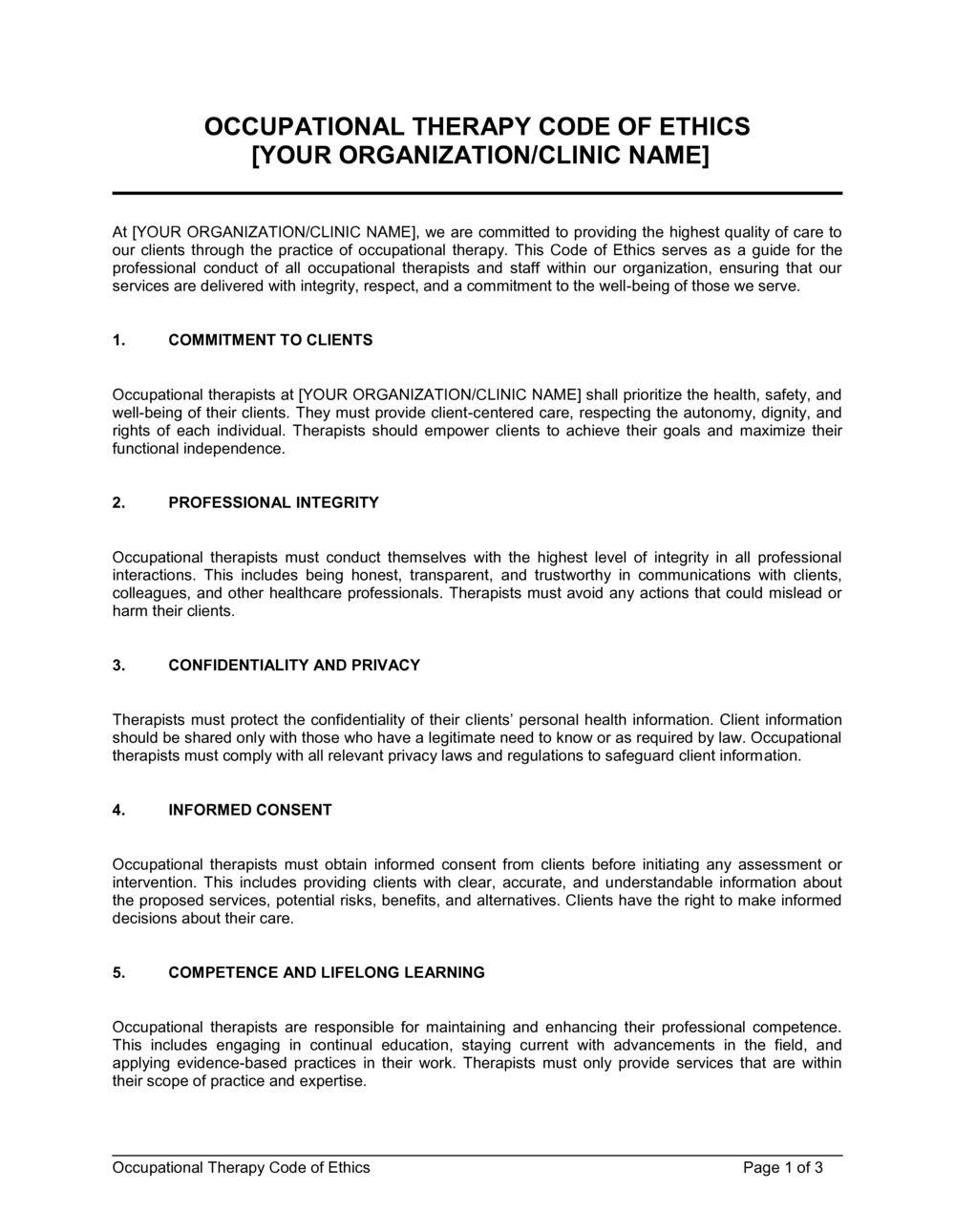
Core ethical principles (beneficence, nonmaleficence, autonomy, justice, veracity, and fidelity), practitioner duties to clients and colleagues, confidentiality and informed consent obligations, scope-of-practice boundaries, conflict-of-interest disclosures, reporting obligations for ethical violations, and disciplinary procedures with signature acknowledgment.

What is an Occupational Therapy Code of Ethics?

An Occupational Therapy Code of Ethics is a binding governance document that establishes the professional conduct standards, ethical obligations, and legal duties applicable to occupational therapists, occupational therapy assistants, and affiliated practitioners working within a specific organization or clinical setting. It operationalizes the six core ethical principles recognized by the American Occupational Therapy Association — beneficence, nonmaleficence, autonomy, justice, veracity, and fidelity — into enforceable organizational rules covering client rights, informed consent, confidentiality, scope of practice, conflict of interest, mandatory reporting, documentation integrity, and disciplinary procedures. Unlike the general AOTA standards, an organizational code includes signatures, jurisdiction-specific legal references, and a graduated disciplinary framework that makes it actionable in employment and licensing contexts.

Why You Need This Document

Without a signed, organization-specific code of ethics, an OT practice has no enforceable conduct standard to reference when a practitioner exceeds their scope of practice, fails to obtain informed consent, alters documentation, or is observed in an apparent ethics violation. State and provincial licensing boards treat the absence of a written ethics policy as an aggravating factor in disciplinary proceedings — and managed care credentialing organizations routinely require one before granting provider status. For practices billing Medicare or Medicaid, a documented compliance framework that includes an ethics code is effectively required under OIG guidance. A practitioner who causes client harm in the absence of a formal ethics framework can expose the organization to licensing sanctions, civil liability, and federal fraud investigations simultaneously. This template gives you a structured, jurisdiction-aware starting point that closes those gaps — requiring only customization to your practice setting and a legal review where the regulatory stakes warrant it.

Which variant fits your situation?

If your situation is…Use this template
Setting ethics standards for a multi-practitioner private OT clinicOccupational Therapy Code of Ethics
Establishing general healthcare employee conduct expectationsHealthcare Employee Code of Conduct
Documenting ethics obligations for contracted or per-diem OT staffIndependent Contractor Agreement (Healthcare)
Outlining patient rights and practitioner duties at the point of carePatient Rights and Responsibilities Policy
Creating a confidentiality agreement for a new OT hireNon-Disclosure Agreement (Employee)
Governing OT assistant supervision and scope-of-practice boundariesSupervision Agreement (OTA)
Establishing a broad ethics framework for an allied health group practiceAllied Health Professional Code of Ethics

Common mistakes to avoid

❌ Applying the code only to full-time employees

Why it matters: Per-diem staff, students in clinical placements, and contracted OT providers interact with clients under the organization's name and licensure umbrella. An ethics violation by an uncovered contractor still triggers organizational liability.

Fix: Explicitly list every practitioner category in the scope clause and require signed acknowledgment from contractors and students before their first client contact.

❌ Using only verbal informed consent

Why it matters: Oral consent is unverifiable when a client files a licensing board complaint or initiates litigation. The organization cannot demonstrate the disclosure occurred or what was actually communicated.

Fix: Require written, dated informed consent for every evaluation and intervention episode, with the signed form retained in the clinical record for the jurisdiction's minimum retention period.

❌ Omitting a graduated disciplinary scale

Why it matters: A policy that jumps directly from violation to termination discourages internal reporting — staff assume any report will end a colleague's career, so minor violations go unreported until they escalate.

Fix: Build a four-tier disciplinary ladder (verbal warning, written warning, suspension with investigation, termination and licensing referral) with clear criteria for each level.

❌ Not updating the code when the AOTA standards or practice act changes

Why it matters: The AOTA Occupational Therapy Code of Ethics is revised periodically. A clinic operating under an outdated version may impose standards below the current regulatory floor, creating liability exposure in disciplinary proceedings.

Fix: Assign a named compliance owner to review the code annually against the current AOTA standards, state practice act, and any relevant licensing board guidance, and re-execute acknowledgments after any substantive revision.

❌ No internal reporting pathway for colleague ethics violations

Why it matters: Without a confidential internal channel, practitioners who observe a colleague's ethical lapse either report directly to the licensing board (triggering formal investigation) or stay silent. Neither outcome benefits clients or the organization.

Fix: Designate a compliance officer or ethics committee as the internal recipient and specify that reports made in good faith will not result in retaliation — with anti-retaliation language included in the document.

❌ Failing to address documentation and billing integrity explicitly

Why it matters: When OT services are billed to Medicare, Medicaid, or a commercial payer, fraudulent or inaccurate documentation exposes the organization to False Claims Act liability, OIG exclusion, and individual practitioner prosecution.

Fix: Include an explicit clause prohibiting billing for services not rendered, upcoding, and retrospective documentation alteration — and cross-reference your compliance program and billing audit procedures.

The 10 key clauses, explained

Preamble and Scope of Application

In plain language: Identifies the issuing organization, the practitioners covered (OTs, OTAs, students, and contractors), and the authority under which the code is adopted.

Sample language
This Code of Ethics ('Code') is adopted by [ORGANIZATION NAME] and applies to all occupational therapists, occupational therapy assistants, students, and contracted practitioners ('Practitioners') engaged by [ORGANIZATION NAME] in any capacity as of [EFFECTIVE DATE].

Common mistake: Limiting the scope to full-time employees only. Per-diem staff, contractors, and students in clinical placements are equally capable of ethical violations and must be explicitly covered.

Core Ethical Principles

In plain language: Enumerates the foundational principles — beneficence, nonmaleficence, autonomy, justice, veracity, and fidelity — and defines how each applies to OT practice in this organization.

Sample language
Practitioners shall: (a) promote the health and well-being of clients (Beneficence); (b) refrain from actions that cause harm (Nonmaleficence); (c) respect each client's right to self-determination (Autonomy); (d) ensure equitable access to services (Justice); (e) provide truthful and accurate information (Veracity); and (f) honor professional commitments (Fidelity).

Common mistake: Listing principles without defining how they apply operationally. Abstract principles with no behavioral examples are unenforceable in a disciplinary hearing.

Client Rights and Informed Consent

In plain language: Requires practitioners to obtain documented informed consent before initiating evaluation or intervention, and to respect the client's right to refuse or withdraw from services.

Sample language
Prior to initiating any evaluation or intervention, Practitioner shall obtain written informed consent from the client or authorized representative, documenting the nature of services, expected benefits and risks, alternatives, and the client's right to withdraw at any time without penalty.

Common mistake: Treating verbal consent as sufficient. Oral consent is unverifiable in a complaint or litigation context — written consent with a dated signature is the enforceable standard.

Confidentiality and Privacy

In plain language: Prohibits unauthorized disclosure of client information and specifies permissible disclosures — including mandatory reporting and treatment coordination — consistent with HIPAA and applicable law.

Sample language
Practitioner shall maintain strict confidentiality of all client information and may disclose protected health information only: (a) with written client authorization; (b) as required by applicable law or mandatory reporting obligations; or (c) to healthcare team members directly involved in the client's care, to the minimum extent necessary.

Common mistake: Referencing HIPAA as the sole confidentiality standard. State privacy laws and provincial legislation (e.g., PIPEDA in Canada, GDPR in the EU) frequently impose stricter obligations that supersede HIPAA's minimums.

Scope of Practice and Competence

In plain language: Restricts practitioners to services within their licensed scope and requires them to acknowledge and disclose competency limitations, seek supervision where needed, and pursue continuing education.

Sample language
Practitioner shall provide only those services within their current scope of licensure and documented competency. Practitioner shall promptly disclose to [SUPERVISOR TITLE] any situation in which their knowledge, skills, or condition may impair safe and effective practice, and shall not perform services beyond their competence without direct supervision.

Common mistake: No obligation to self-disclose competency gaps. Practitioners working at the edge of their competence without supervision is the leading cause of OT licensing board complaints.

Conflict of Interest and Dual Relationships

In plain language: Requires practitioners to disclose potential conflicts of interest and dual relationships and to recuse themselves when objectivity or client welfare cannot be assured.

Sample language
Practitioner shall promptly disclose in writing to [ORGANIZATION NAME] any financial interest, personal relationship, or other circumstance that creates or may appear to create a conflict of interest with their professional duties. Practitioner shall not enter into a dual relationship with a client where the secondary relationship could impair professional judgment.

Common mistake: No disclosure mechanism specified. A disclosure obligation without a designated recipient and timeline is unenforceable — specify who receives the disclosure and within how many days.

Relationships with Colleagues and Supervisees

In plain language: Sets standards for professional conduct toward colleagues and OTAs under supervision, including prohibitions on harassment, discrimination, and improper delegation.

Sample language
Practitioners shall treat colleagues and supervisees with respect and professionalism. OTs supervising OTAs shall delegate only tasks that fall within the OTA's scope of practice and documented competency, shall provide supervision at the frequency required by [STATE/PROVINCE] law, and shall document all supervision contacts in accordance with [ORGANIZATION NAME] policy.

Common mistake: Not specifying the required supervision frequency for OTAs. Every US state and Canadian province sets a minimum — leaving this blank exposes the supervising OT and the organization to licensing violations.

Mandatory Reporting Obligations

In plain language: Requires practitioners to report suspected abuse, neglect, or exploitation of clients and to report known or suspected ethical violations by colleagues to the appropriate authority.

Sample language
Practitioner shall immediately report suspected abuse, neglect, or exploitation of any client to [STATE/PROVINCIAL CHILD/ADULT PROTECTIVE SERVICES] as required by law. Practitioner who has direct knowledge of a colleague's violation of this Code shall report the violation to [COMPLIANCE OFFICER / LICENSING BOARD] within [X] business days.

Common mistake: Omitting an internal reporting pathway. If practitioners can only report externally, organizations learn about violations from regulators rather than from their own staff — eliminating the opportunity for early corrective action.

Documentation and Billing Integrity

In plain language: Requires accurate, timely, and complete clinical documentation and prohibits fraudulent billing, upcoding, or documentation of services not rendered.

Sample language
Practitioner shall document all client contacts accurately and contemporaneously in accordance with [ORGANIZATION NAME] policy and payer requirements. Practitioner shall not bill for services not rendered, misrepresent the nature or duration of services, or alter documentation after the fact except through a properly noted correction.

Common mistake: No explicit prohibition on retrospective documentation alteration. Backdated or altered records are a federal fraud offense under the False Claims Act when Medicare or Medicaid is the payer — the prohibition must be explicit.

Disciplinary Procedures and Acknowledgment

In plain language: Sets out the process for investigating alleged ethics violations, the range of disciplinary sanctions, and the practitioner's right to respond before a decision is made. Includes a signature block.

Sample language
Violations of this Code may result in disciplinary action up to and including termination of employment and referral to the [STATE/PROVINCIAL] occupational therapy licensing board. Practitioner acknowledges receipt, review, and understanding of this Code. Signature: ______________________ Date: [DATE].

Common mistake: No graduated disciplinary framework. An all-or-nothing termination policy discourages internal reporting because reporters fear triggering an outcome disproportionate to the violation.

How to fill it out

  1. 1

    Identify all covered practitioners and your governing authority

    Enter your organization's legal name and confirm the scope of coverage — full-time OTs, OTAs, per-diem staff, students, and contractors. Reference the specific licensing board and state or provincial occupational therapy practice act that governs your jurisdiction.

    💡 If your organization operates in more than one state or province, list every applicable licensing body — a single-jurisdiction reference creates compliance gaps for practitioners who hold multiple licenses.

  2. 2

    Customize the core principles with operational examples

    For each ethical principle (beneficence, nonmaleficence, autonomy, justice, veracity, fidelity), add one to two practice-specific behavioral examples drawn from your setting — pediatric, geriatric, acute care, or community-based OT each generate different common scenarios.

    💡 Concrete examples drawn from your actual caseload make training and disciplinary conversations significantly more productive than abstract definitions.

  3. 3

    Insert your informed consent and confidentiality procedures

    Reference your organization's consent forms and document retention policy. Specify which disclosures require written client authorization versus which are permissible without consent under HIPAA's treatment, payment, and operations exceptions.

    💡 If you treat minors or adults with diminished capacity, add a specific paragraph on authorized representative consent — this is a frequent gap cited in licensing board audits.

  4. 4

    Define scope-of-practice and supervision requirements

    Enter the specific supervision ratio and contact frequency required by your state or provincial OT practice act for OTAs. Include the method of supervision (direct, indirect, or telehealth) and the documentation format.

    💡 State supervision requirements change with legislative cycles — assign a named staff member to review this clause against current law annually.

  5. 5

    Establish your conflict-of-interest disclosure mechanism

    Name the compliance officer or designated recipient for disclosures, set a timeline (typically within 5 business days of becoming aware), and specify the form the disclosure must take — written memo, email to HR, or a formal disclosure form.

    💡 A disclosure form with a checkbox for 'recusal requested' speeds processing and creates a paper trail that protects both the disclosing practitioner and the organization.

  6. 6

    Set your mandatory reporting and internal escalation pathways

    Insert the correct mandatory reporting agency for your jurisdiction (e.g., Adult Protective Services, Child Protective Services) and the internal escalation chain. Specify the timeline for internal reporting of colleague ethics concerns.

    💡 Confirm your state's mandatory reporter category for OTs — in many states, OTs are designated mandatory reporters for both child and adult abuse, and the reporting timeline is 24–72 hours, not 'promptly'.

  7. 7

    Align the disciplinary framework with your HR policies

    Define the graduated sanctions — verbal warning, written warning, suspension, termination, and licensing board referral — and confirm they are consistent with your employee handbook and any applicable collective bargaining agreement.

    💡 Have your employment attorney review the disciplinary clause alongside your at-will or notice-period employment terms to prevent the code from inadvertently creating a just-cause termination standard.

  8. 8

    Obtain signed acknowledgments before the practitioner's first client contact

    Collect a dated signature from every covered practitioner before they treat their first client. Store executed copies in the personnel file and the compliance file. Redistribute and re-execute after any substantive revision.

    💡 A digital signature with a timestamp is legally equivalent to a wet signature in all US states and Canadian provinces — use eSign to automate tracking and eliminate unsigned-copy gaps.

Frequently asked questions

What is an occupational therapy code of ethics?

An occupational therapy code of ethics is a formal governance document that defines the professional conduct standards, ethical principles, and legal obligations applicable to OT practitioners within a specific organization or practice. It operationalizes the principles established by the American Occupational Therapy Association (AOTA) — or equivalent national body — into enforceable workplace rules, covering client rights, confidentiality, scope of practice, conflict of interest, mandatory reporting, and disciplinary procedures.

Is an occupational therapy code of ethics legally required?

A formal written code is not universally mandated by statute, but it is effectively required in practice. Most state and provincial occupational therapy licensing boards require that practitioners adhere to established ethical standards — and will cite the absence of a written policy as an aggravating factor in disciplinary proceedings. Hospitals and managed care organizations typically require a signed ethics acknowledgment as part of credentialing. In regulated settings billing Medicare or Medicaid, a documented compliance program — of which an ethics code is a central component — is expected.

How does this code relate to the AOTA Code of Ethics?

The AOTA Occupational Therapy Code of Ethics (most recently revised in 2020) is the national professional standard for OT practice in the United States. An organizational code of ethics should align with and reference the AOTA standards while adding jurisdiction-specific legal obligations, organizational procedures, and disciplinary mechanisms that the AOTA document does not provide. The organizational code can be stricter than the AOTA standards but should never fall below them.

Who must sign the occupational therapy code of ethics?

Every practitioner who interacts with clients under the organization's umbrella should sign — full-time OTs, part-time OTs, occupational therapy assistants, per-diem staff, contracted practitioners, and students in clinical placements. Signatures should be obtained before the practitioner's first client contact and re-obtained after any substantive revision to the document. Store signed copies in both the personnel file and a compliance file.

What ethical principles must an OT code of ethics address?

The six core principles drawn from the AOTA framework are beneficence (act in the client's best interest), nonmaleficence (do no harm), autonomy (respect client self-determination), justice (provide equitable access), veracity (communicate honestly), and fidelity (honor professional commitments). An organizational code should operationalize each of these with specific behavioral standards relevant to the practice setting.

How often should an occupational therapy code of ethics be reviewed?

Review the document annually and whenever the AOTA Code of Ethics is revised, your state or provincial practice act changes, or a significant regulatory development occurs (such as updated HIPAA guidance or new mandatory reporting requirements). After any substantive revision, re-distribute the updated code to all covered practitioners and collect fresh signatures.

What happens when an occupational therapist violates the code of ethics?

Depending on the severity and the applicable jurisdiction, consequences range from an internal written warning to license suspension or revocation. Organizational consequences run parallel to licensing board proceedings — both can occur simultaneously. In cases involving billing fraud or client abuse, criminal prosecution and exclusion from Medicare and Medicaid participation are additional risks. A graduated internal disciplinary framework, documented in the code itself, allows proportionate responses before escalating to external authorities.

Can an occupational therapy code of ethics be used as an employment document?

Yes — when it includes a signed acknowledgment clause, the code functions as both a governance policy and an employment document. It establishes enforceable conduct standards that support disciplinary action, including termination. However, the acknowledgment should not inadvertently create a just-cause termination standard in at-will states. Have your employment attorney review the disciplinary clause alongside your employment agreements to confirm the documents are consistent.

Are there differences in ethical requirements for OTs practicing via telehealth?

Telehealth OT practice adds several layers of ethical complexity: practitioners must be licensed in every state where the client is physically located at the time of service, informed consent must address telehealth-specific risks and technology limitations, and confidentiality obligations extend to the security of the telehealth platform used. Many state boards have issued specific telehealth practice standards that must be reflected in the ethics code for organizations delivering remote OT services.

How this compares to alternatives

vs Employee Code of Conduct

An employee code of conduct sets general workplace behavior standards applicable to all staff regardless of profession — covering attendance, communication, conflict of interest, and disciplinary process. An occupational therapy code of ethics is profession-specific, addressing clinical obligations, scope of practice, informed consent, mandatory reporting, and AOTA standards that a general conduct policy does not reach. Healthcare organizations typically need both documents operating in parallel.

vs Non-Disclosure Agreement (Employee)

An NDA focuses narrowly on preventing unauthorized disclosure of confidential business information, trade secrets, and proprietary data. An OT code of ethics addresses confidentiality as one component of a much broader professional ethics framework that includes client care obligations, scope of practice, and disciplinary standards. The NDA is a bilateral contract; the code of ethics is a unilateral professional governance document requiring practitioner acknowledgment.

vs Healthcare Compliance Policy

A healthcare compliance policy addresses regulatory obligations — HIPAA, anti-kickback, billing integrity, and OIG compliance — as a matter of legal risk management. An OT code of ethics is grounded in professional values and client welfare, and encompasses ethical obligations that extend beyond legal minimums. Organizations benefit from both: the compliance policy manages legal exposure; the ethics code builds professional culture and guides discretionary clinical decisions.

vs Independent Contractor Agreement (Healthcare)

An independent contractor agreement defines the commercial terms of an engagement — scope of work, compensation, IP ownership, and termination. An OT code of ethics establishes the professional conduct standards the contractor must meet while performing that work. For contracted OT practitioners, both documents are needed: the contractor agreement governs the business relationship; the ethics code governs professional behavior within it.

Industry-specific considerations

Healthcare and Rehabilitation

Hospital-based and outpatient OT departments use the code as part of credentialing packets, Joint Commission compliance documentation, and CMS Conditions of Participation requirements.

Education and School-Based Services

School district OT programs must address IDEA obligations, mandatory reporting for child abuse, and the specific ethical issues arising from dual roles as both clinician and educational team member.

Home Health and Community Care

Home health OT providers face heightened conflict-of-interest and safety risks given isolated practice settings, requiring stricter supervision documentation and incident reporting protocols.

Telehealth and Digital Health Platforms

Multi-state telehealth OT platforms must address licensure portability, platform security standards, and jurisdiction-specific informed consent requirements for every state where services are delivered.

Jurisdictional notes

United States

OT practice in the US is regulated at the state level; all 50 states and DC require licensure. The AOTA Occupational Therapy Code of Ethics (2020) is the national professional standard and is incorporated by reference into many state practice acts. Non-compete enforceability for OTs varies by state — California prohibits them almost entirely. Mandatory reporting obligations differ by state for both child and adult protective services. Organizations billing Medicare or Medicaid must align their ethics code with the OIG Compliance Program Guidance for individual and small group physician practices, which broadly covers allied health providers.

Canada

Occupational therapy in Canada is regulated provincially through bodies such as the College of Occupational Therapists of Ontario (COTO) and the College of Occupational Therapists of British Columbia (COTBC). Each college publishes its own code of ethics and standards of practice that provincial practitioners must meet. Federal privacy obligations under PIPEDA (and Quebec's Law 25) apply to private-sector OT organizations and are generally stricter than HIPAA in scope. Mandatory reporting requirements for child and adult abuse are set by provincial legislation and vary in threshold and timeline.

United Kingdom

OT practice in the UK is regulated by the Health and Care Professions Council (HCPC), which publishes Standards of Conduct, Performance and Ethics applicable to all registered OTs. The Royal College of Occupational Therapists (RCOT) publishes supplementary professional standards. An organizational code of ethics must align with both the HCPC standards and the RCOT guidelines to be defensible in a fitness-to-practise proceeding. UK GDPR governs client data privacy and imposes data protection obligations that exceed HIPAA requirements in several areas, including breach notification timelines.

European Union

OT regulation in the EU varies by member state — there is no single pan-EU licensing body. Most member states require registration with a national professional body or competent authority under the EU Professional Qualifications Directive. GDPR applies to all processing of client health data and classifies it as a special category requiring explicit consent and a Data Protection Impact Assessment for high-risk processing. Member states including Germany, France, and the Netherlands impose additional mandatory reporting obligations for specific vulnerable populations that must be reflected in the ethics code for OT organizations operating locally.

Template vs lawyer — what fits your deal?

PathBest forCostTime
Use the templatePrivate OT practices, outpatient clinics, and school-based programs establishing or updating their ethics policy for staff onboardingFree1–2 hours to customize
Template + legal reviewMulti-state practices, telehealth platforms, and organizations billing Medicare or Medicaid where regulatory alignment is critical$400–$900 for a healthcare attorney or compliance consultant review3–5 business days
Custom draftedHospital systems, large rehabilitation networks, or organizations under active licensing board scrutiny requiring a fully bespoke compliance-integrated ethics framework$2,000–$6,000+2–4 weeks

Glossary

Beneficence
The ethical obligation to act in the best interest of the client, actively promoting their health, well-being, and functional independence.
Nonmaleficence
The duty to avoid causing harm to clients, including physical, psychological, financial, and social harm resulting from professional actions or omissions.
Informed Consent
The process by which a practitioner discloses the nature, risks, benefits, and alternatives of a proposed intervention and obtains voluntary agreement from the client or their legal representative.
Scope of Practice
The specific range of services, interventions, and professional activities an occupational therapist is trained, educated, and licensed to perform under applicable law.
Veracity
The ethical principle requiring practitioners to provide honest, accurate, and complete information to clients, colleagues, payers, and regulatory bodies.
Fidelity
The duty to honor professional commitments, maintain confidentiality, and act loyally toward clients, colleagues, and the occupational therapy profession.
Conflict of Interest
A situation in which a practitioner's personal, financial, or professional interests could improperly influence their clinical judgment or client care decisions.
Dual Relationship
A situation where an OT practitioner holds more than one type of relationship with a client simultaneously — such as therapist and employer — creating a risk of impaired objectivity.
Mandatory Reporting
A legal and ethical obligation to report suspected abuse, neglect, or exploitation of vulnerable clients to the appropriate authority, regardless of confidentiality obligations.
Disciplinary Action
A formal response by a practice, employer, or licensing board to a practitioner's violation of ethical standards, ranging from written warning to license revocation.
AOTA Standards
The professional conduct guidelines issued by the American Occupational Therapy Association, which serve as the authoritative reference for ethical practice in the United States.

Part of your Business Operating System

This document is one of 3,000+ business & legal templates included in Business in a Box.

  • Fill-in-the-blanks — ready in minutes
  • 100% customizable Word document
  • Compatible with all office suites
  • Export to PDF and share electronically

Create your document in 3 simple steps.

From template to signed document — all inside one Business Operating System.
1
Download or open template

Access over 3,000+ business and legal templates for any business task, project or initiative.

2
Edit and fill in the blanks with AI

Customize your ready-made business document template and save it in the cloud.

3
Save, Share, Send, Sign

Share your files and folders with your team. Create a space of seamless collaboration.

Save time, save money, and create top-quality documents.

★★★★★

"Fantastic value! I'm not sure how I'd do without it. It's worth its weight in gold and paid back for itself many times."

Managing Director · Mall Farm
Robert Whalley
Managing Director, Mall Farm Proprietary Limited
★★★★★

"I have been using Business in a Box for years. It has been the most useful source of templates I have encountered. I recommend it to anyone."

Business Owner · 4+ years
Dr Michael John Freestone
Business Owner
★★★★★

"It has been a life saver so many times I have lost count. Business in a Box has saved me so much time and as you know, time is money."

Owner · Upstate Web
David G. Moore Jr.
Owner, Upstate Web

Run your business with a system — not scattered tools

Stop downloading documents. Start operating with clarity. Business in a Box gives you the Business Operating System used by over 250,000 companies worldwide to structure, run, and grow their business.

Free Forever Plan · No credit card required