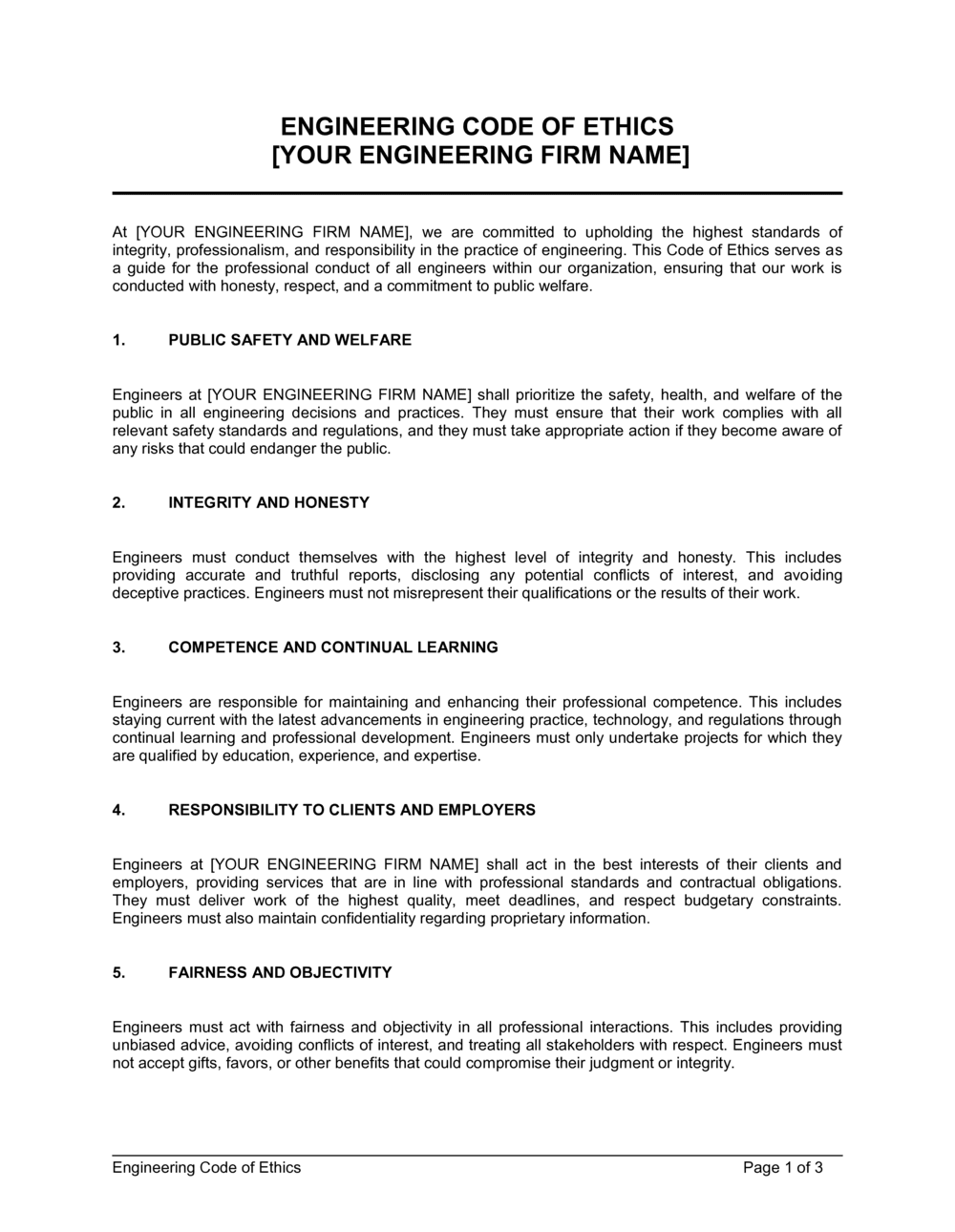
Engineering Code Of Ethics Template

Free Word download • Edit online • Save & share with Drive • Export to PDF

3 pages25–30 min to fillDifficulty: StandardSignature requiredLegal review recommended
Learn more ↓
FreeEngineering Code Of Ethics Template

At a glance

What it is
An Engineering Code of Ethics is a binding policy document that defines the professional, ethical, and legal obligations of engineers and technical staff working within or on behalf of an engineering organization. This free Word download gives firms a structured, editable starting point covering safety, integrity, confidentiality, conflict of interest, and professional competence — ready to export as PDF and execute with new hires or existing staff.
When you need it
Use it when onboarding engineers and technical professionals, when pursuing licensure or accreditation that requires a documented ethics framework, or when formalizing professional conduct standards across a growing engineering team. It is also required in many government and public-sector procurement contracts.
What's inside
Obligations to public safety and welfare, professional competence standards, conflict-of-interest disclosure requirements, confidentiality obligations, honest representation of qualifications and work, reporting duties for unethical conduct, intellectual property handling, and enforcement and disciplinary procedures.

What is an Engineering Code of Ethics?

An Engineering Code of Ethics is a binding policy and conduct document that defines the professional, ethical, and legal obligations of engineers and technical staff working within or on behalf of an engineering organization. It establishes the primacy of public safety over client and commercial interests, restricts engineers to work within their demonstrated competence, requires disclosure of conflicts of interest, and creates enforceable standards for confidentiality, honest representation, seal use, and professional development. Unlike a general employee conduct policy, an engineering code of ethics is grounded in the specific regulatory framework governing licensed professional engineering — supplementing licensing board requirements with firm-level procedures for disclosure, reporting, and discipline.

Why You Need This Document

Without a documented and signed engineering code of ethics, a firm has no enforceable internal standard to invoke when an engineer oversteps their competence, discloses proprietary client designs, or fails to report a known safety risk. Licensing board investigations — and civil litigation following structural failures, environmental breaches, or design defects — routinely examine whether the firm had written ethics standards in place and whether engineers acknowledged them. Government and public-sector procurement contracts increasingly require a documented ethics framework as a condition of bidding. Beyond compliance, a well-drafted code reduces the ambiguity that leads to ethics failures: engineers who understand exactly where the line is drawn — on conflict disclosure, seal use, and external reporting — make better decisions under commercial pressure. This template gives engineering firms a professionally structured, jurisdiction-aware starting point that can be executed with new hires and existing staff in a single review session.

Which variant fits your situation?

If your situation is…Use this template
Adopting ethics standards for an entire engineering firmEngineering Code of Ethics (Organizational)
Formalizing conduct requirements for an individual engineer at hiringEmployee Code of Conduct
Covering broader professional conduct beyond engineering-specific obligationsProfessional Code of Ethics
Addressing confidentiality obligations for engineers working with proprietary client designsNon-Disclosure Agreement (NDA)
Documenting conflict-of-interest disclosures for a specific projectConflict of Interest Disclosure Form
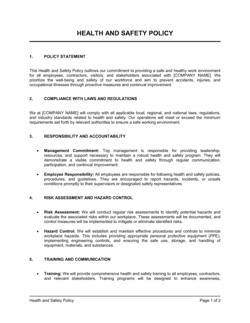
Establishing safety obligations for a construction or infrastructure projectHealth and Safety Policy
Engaging an independent engineering consultant under defined conduct obligationsIndependent Contractor Agreement

Common mistakes to avoid

❌ Using aspirational language instead of binding obligations

Why it matters: Phrases like 'engineers are encouraged to' or 'should consider' are not enforceable obligations. When a safety violation occurs, the firm cannot rely on a clause that reads as a suggestion.

Fix: Replace 'should' and 'encouraged to' with 'shall' throughout the document. Reserve permissive language only for genuinely discretionary conduct.

❌ No external reporting pathway for safety violations

Why it matters: When a safety concern involves management or leadership, an internal-only reporting channel is useless. Engineers who cannot escalate externally may remain silent, leaving the firm exposed to larger liability.

Fix: Include a specific external escalation clause naming the applicable licensing board or regulatory authority, and explicitly prohibit retaliation against engineers who use it.

❌ Omitting post-engagement confidentiality duration

Why it matters: A confidentiality clause with no defined end date is interpreted inconsistently by courts — some jurisdictions treat it as perpetual, others as reasonable in duration, creating unpredictable enforcement outcomes.

Fix: Specify a fixed post-engagement confidentiality period — 3–5 years is standard for most commercial engineering work — and align it with the applicable statute of limitations for professional negligence claims.

❌ No carve-out for pre-existing engineer IP in the work product clause

Why it matters: A broad assignment of all work product to the client or employer can inadvertently capture calculation tools, design templates, and proprietary methods the engineer developed before the engagement — courts have awarded ownership of these to clients on this basis.

Fix: Add a Schedule B listing pre-existing tools and methodologies the engineer retains ownership of, and confirm the work product assignment applies only to new deliverables created specifically for the engagement.

❌ Applying the code only to licensed PEs and excluding support staff

Why it matters: Technicians, drafters, and engineering interns produce work that PEs sign and stamp. Conduct failures at the support level create liability for the PE and the firm regardless of whether those staff were covered by the code.

Fix: Expand the scope clause to cover all personnel whose work contributes to licensed engineering deliverables, including unlicensed staff, interns, and subcontractors.

❌ No defined disciplinary timeline after a complaint is filed

Why it matters: An ethics code without procedural timelines creates indefinite uncertainty for the accused engineer and exposes the firm to claims of bad faith or constructive dismissal if the process drags on without resolution.

Fix: Specify a maximum investigation period — typically 20–30 business days — with defined milestones: acknowledgment within 5 days, initial findings within 15 days, and final determination within 30 days.

The 10 key clauses, explained

Public safety and welfare

In plain language: States that the engineer's first obligation is to protect the safety, health, and welfare of the public — overriding client or employer instructions where a genuine safety risk exists.

Sample language
[ENGINEER NAME / FIRM NAME] acknowledges that the safety, health, and welfare of the public is the paramount obligation of all engineering practice and shall not be compromised by employer, client, or commercial interests.

Common mistake: Framing this clause as aspirational rather than binding. Courts and licensing boards treat public safety obligations as mandatory — using 'should' instead of 'shall' weakens enforceability and can expose the firm to regulatory liability.

Scope of professional competence

In plain language: Restricts engineers to performing only work within their area of expertise, education, and experience, and requires them to disclose any competence gaps before accepting an assignment.

Sample language
[ENGINEER] shall only practice engineering in areas of their demonstrated competence, and shall disclose to [EMPLOYER / CLIENT] any limitations in their qualifications before undertaking any assignment outside their established expertise.

Common mistake: Omitting a disclosure mechanism. Without a clear process for engineers to flag competence gaps, the clause has no operational effect and liability falls entirely on the firm when underqualified work causes harm.

Conflict of interest disclosure

In plain language: Requires engineers to identify and disclose any financial, personal, or professional interest that could influence their professional judgment on a project, and to obtain written consent before proceeding.

Sample language
[ENGINEER] shall promptly disclose in writing to [EMPLOYER / CLIENT] any actual or reasonably apparent conflict of interest and shall not proceed with the affected work without written consent from all affected parties.

Common mistake: Requiring disclosure only for financial conflicts. Conflicts arising from personal relationships, outside employment, or professional affiliations are equally common and should be explicitly included in the definition.

Honest representation of qualifications

In plain language: Prohibits engineers from misrepresenting their qualifications, experience, credentials, or the nature and results of their work to employers, clients, or licensing bodies.

Sample language
[ENGINEER] shall not misrepresent their professional qualifications, experience, affiliations, or prior work in any proposal, application, resume, or professional communication.

Common mistake: Limiting this clause to formal credentials and missing misrepresentation in project deliverables — inflated performance claims in reports and specifications are a common liability source that requires equal coverage.

Confidentiality of client and employer information

In plain language: Obligates the engineer to protect proprietary designs, specifications, financial data, and technical information belonging to clients or employers, both during and after the engagement.

Sample language
[ENGINEER] shall treat all technical, financial, and commercial information obtained in the course of professional duties as confidential and shall not disclose it to any third party without prior written authorization from [CLIENT / EMPLOYER].

Common mistake: No post-engagement duration. Engineers who leave a firm or project can disclose formerly confidential information with no recourse unless the clause specifies a retention period — typically 2–5 years after engagement ends.

Reporting of unsafe or unethical conduct

In plain language: Requires engineers to report known or reasonably suspected safety violations, code breaches, or unethical conduct to appropriate internal or external authorities, and prohibits retaliation against those who report in good faith.

Sample language
[ENGINEER] shall report to [DESIGNATED AUTHORITY / LICENSING BOARD] any practice that creates a risk to public safety or violates applicable laws or professional standards. No adverse action shall be taken against any engineer who makes such a report in good faith.

Common mistake: Designating only internal reporting channels. When the unsafe conduct involves management, engineers need a clear path to an external licensing board or regulator — internal-only reporting clauses suppress legitimate disclosures.

Use of the professional seal or stamp

In plain language: Restricts use of the professional engineer's seal or stamp to work the engineer has personally prepared or directly supervised, and prohibits lending the seal to work the engineer has not reviewed.

Sample language
[ENGINEER] shall apply their professional seal only to engineering documents prepared by them or prepared under their direct supervision, and shall not permit any other person to use their seal or license number on documents they have not reviewed and approved.

Common mistake: No supervision definition. 'Direct supervision' means different things across jurisdictions — some boards require in-person review; others accept remote oversight. Leaving the term undefined creates ambiguity the firm cannot defend.

Intellectual property and work product ownership

In plain language: Clarifies that engineering work product — designs, drawings, specifications, reports, and software created during the engagement — belongs to the employer or client, and that the engineer retains no independent right to reuse it.

Sample language
All engineering work product created by [ENGINEER] in the performance of their duties, including designs, calculations, specifications, and reports, shall be the sole property of [EMPLOYER / CLIENT] and may not be reproduced or reused without prior written consent.

Common mistake: No carve-out for pre-existing tools and methods. Engineers commonly bring standard calculation templates, design tools, or proprietary methodologies they developed independently — without a carve-out, a broad IP clause may inadvertently assign ownership of those to the client.

Continuing professional development obligations

In plain language: Requires engineers to maintain and update their professional knowledge through ongoing education, and to comply with the CPD requirements of their licensing body.

Sample language
[ENGINEER] shall maintain professional competence through participation in continuing education, technical training, and professional development activities sufficient to meet the requirements of their applicable licensing body, including a minimum of [X] hours per calendar year.

Common mistake: No minimum hour commitment. Vague CPD obligations without a quantified floor are rarely met — most licensing boards specify 30–60 hours per year, and the contract should mirror the applicable regulatory minimum.

Disciplinary procedure and consequences

In plain language: Establishes the process for investigating alleged ethics violations, the range of disciplinary outcomes, and the engineer's right to respond before any sanction is imposed.

Sample language
Alleged violations of this Code shall be investigated by [DESIGNATED AUTHORITY] within [X] business days of written notice. [ENGINEER] shall have the right to respond in writing before any disciplinary action is taken. Sanctions may include formal warning, suspension of duties, or termination, depending on the severity of the violation.

Common mistake: Skipping the right-to-respond step. Imposing discipline without giving the engineer an opportunity to provide their account creates exposure to wrongful termination claims and undermines the fairness the code is meant to establish.

How to fill it out

  1. 1

    Identify the governing party and applicable licensing body

    Enter the firm or organization name, the engineer's legal name and license number, and the licensing body whose standards the code supplements — e.g., NSPE (US), Engineers Canada, Engineering Council (UK).

    💡 Reference the licensing body by full legal name, not acronym — different jurisdictions have overlapping abbreviations that create ambiguity in enforcement proceedings.

  2. 2

    Define the scope of covered personnel

    Specify whether the code applies to licensed PEs only, to all engineering staff including interns and technicians, or to contractors and consultants engaged by the firm. Define each category explicitly.

    💡 Engineering interns and EITs are frequently omitted from ethics documents — but they produce work that licensed PEs stamp, making their conduct equally material to the firm's liability.

  3. 3

    Customize the conflict-of-interest definition

    List the specific categories of conflict your firm encounters — outside employment, equity stakes in suppliers, personal relationships with clients, board memberships — and include each in the disclosure requirement.

    💡 A checklist-style disclosure form attached as Schedule A is more effective than a narrative clause — it prompts engineers to actively consider each conflict category rather than self-assess broadly.

  4. 4

    Set the confidentiality retention period

    Enter the number of years after engagement end during which confidentiality obligations survive — typically 2–5 years for standard project work, or the life of the project for infrastructure and defense work.

    💡 For projects involving national infrastructure or classified government work, align the retention period with the applicable security classification framework rather than a fixed calendar term.

  5. 5

    Define 'direct supervision' for seal use

    Specify what review and oversight activities qualify as direct supervision before a PE applies their seal — including whether remote review is acceptable and what documentation of that review is required.

    💡 Some state licensing boards publish guidance on minimum supervision standards — cite the applicable board rule by number so the clause is automatically updated if the regulation changes.

  6. 6

    Set the CPD minimum hours and documentation requirement

    Enter the annual CPD hour minimum consistent with the engineer's licensing board requirement, and specify how completion must be documented — certificates, board transcripts, or employer records.

    💡 If your firm employs engineers licensed in multiple jurisdictions, set the CPD minimum to the highest applicable requirement — typically 30–60 hours — to ensure compliance across all boards.

  7. 7

    Establish the reporting chain and external escalation path

    Name the internal authority for ethics complaints and specify the external escalation path — licensing board, regulatory body, or government agency — available when internal reporting is not appropriate.

    💡 Include the licensing board's complaint portal URL and phone number directly in the clause. Engineers under pressure are more likely to report if the next step requires no additional research.

  8. 8

    Execute before the engineer begins work

    Both the engineer and the authorized representative of the organization must sign before the engineer's first billable day or first project assignment. Retain a fully executed copy in the personnel file.

    💡 In common-law jurisdictions, a code signed after employment begins requires fresh consideration — a documented benefit such as a salary adjustment or additional PTO — to be fully enforceable as a binding contract.

Frequently asked questions

What is an engineering code of ethics?

An engineering code of ethics is a binding policy document that defines the professional obligations of engineers and technical staff — covering public safety, competence, conflict of interest, confidentiality, honest representation, and professional conduct. It supplements licensing board requirements and creates firm-level enforceable standards that govern individual engineer behavior on projects and in client relationships.

Is an engineering code of ethics legally required?

Engineering licensing boards in the US (NSPE), Canada (Engineers Canada), the UK (Engineering Council), and the EU generally require licensed engineers to adhere to published codes of ethics as a condition of licensure. While most boards do not require firms to maintain their own written code, many government procurement contracts and ISO certification frameworks do. Firms without a documented code also face greater difficulty defending negligence or misconduct claims in litigation.

Who should sign an engineering code of ethics?

Typically, all personnel who contribute to licensed engineering deliverables should sign — including licensed professional engineers, engineering interns, technicians, drafters, and any subcontractors or consultants whose work is incorporated into stamped documents. Limiting signatures to licensed PEs leaves the firm exposed to conduct failures by supporting staff whose work the PE certifies.

What is the difference between an engineering code of ethics and a general code of conduct?

A general code of conduct covers workplace behavior, anti-discrimination, social media use, and similar employment conduct issues. An engineering code of ethics specifically addresses the professional and legal obligations unique to engineering practice — public safety primacy, competence boundaries, seal use, and reporting duties to regulatory bodies. Firms typically need both documents, with the engineering code governing technical and professional conduct and the general code governing workplace behavior.

Can I adapt a licensing board's published code of ethics as my firm's document?

You can reference a licensing board's published code as the baseline standard, but a firm-specific document should add the operational detail the board's code omits — specific conflict disclosure procedures, your internal reporting chain, confidentiality retention periods, IP ownership, and disciplinary timelines. Board codes are written for individual licensees; firm-level codes govern the organization's policies and procedures for enforcing those standards internally.

How does an engineering code of ethics interact with whistleblower protection laws?

In most jurisdictions, engineers who report safety violations to licensing boards, environmental agencies, or occupational safety regulators are protected from retaliation under whistleblower statutes regardless of what any private contract says. The code should align with those protections — specifically prohibiting retaliation and providing an external reporting pathway — rather than attempting to channel all disclosures through internal processes, which courts have found to undermine statutory whistleblower rights.

What happens if an engineer violates the code of ethics?

Consequences operate on two tracks simultaneously. At the firm level, the code's disciplinary clause governs — outcomes typically range from a formal warning to suspension or termination, depending on severity. Separately and independently, the engineer's licensing board may investigate and impose sanctions including license suspension or revocation, civil penalties, or — for gross negligence involving public harm — referral to criminal authorities. A firm's disciplinary decision does not bind or preempt the licensing board's independent process.

Should an engineering code of ethics be reviewed by a lawyer?

Yes, particularly for firms operating across multiple jurisdictions, handling government contracts, or employing engineers licensed in regulated sectors such as nuclear, aerospace, or civil infrastructure. A lawyer familiar with professional licensing law can confirm the code meets applicable regulatory standards, aligns with whistleblower protection statutes, and includes defensible disciplinary procedures. For smaller domestic firms, a template review at a cost of $400–$800 is generally sufficient.

How often should an engineering code of ethics be updated?

Review the code annually and update it when your licensing board revises its published ethics standards, when applicable legislation changes (particularly whistleblower or data protection law), when the firm expands into new jurisdictions, or following any internal ethics investigation that exposes a gap in the current document. A code that is more than three years old without review is likely out of step with current regulatory expectations in at least one jurisdiction.

How this compares to alternatives

vs Employee Code of Conduct

An employee code of conduct governs general workplace behavior — anti-harassment, social media use, expense policies, and attendance. An engineering code of ethics governs the technical and professional obligations specific to engineering practice, including public safety primacy, competence boundaries, and licensing board reporting duties. Engineering firms typically need both documents, covering different dimensions of employee conduct.

vs Non-Disclosure Agreement

An NDA is a standalone bilateral contract protecting specific confidential information shared between two parties for a defined purpose. An engineering code of ethics includes confidentiality obligations as one clause among many, covering the broader professional context. For high-stakes client engagements involving sensitive designs, both documents should be used — the NDA governs the specific exchange, the code governs ongoing professional conduct.

vs Independent Contractor Agreement

An independent contractor agreement covers the commercial terms of an engagement — scope, fees, deliverables, and IP ownership — for a self-employed engineer. An engineering code of ethics governs the professional and ethical standards that apply regardless of employment status. Firms engaging engineering consultants should require both: the contractor agreement for commercial terms and the code for professional conduct obligations.

vs Health and Safety Policy

A health and safety policy addresses workplace injury prevention, hazard identification, and regulatory compliance under occupational safety law. An engineering code of ethics addresses the engineer's professional duty to protect public safety through the quality and integrity of their technical work — a distinct obligation that operates beyond the physical workplace. Both documents address safety but from fundamentally different legal and professional frameworks.

Industry-specific considerations

Civil and Infrastructure Engineering

Public safety primacy is most acute here — bridge, dam, and road failures have direct fatality risk, and licensing boards scrutinize ethics compliance most rigorously in this sector.

Environmental Engineering

Confidentiality obligations must be balanced against mandatory reporting duties under environmental statutes — the code should explicitly address when regulatory disclosure overrides client confidentiality.

Technology and Software Engineering

IP ownership of algorithms, embedded software, and simulation tools requires a precise carve-out clause distinguishing pre-existing engineer IP from project-specific deliverables.

Defense and Aerospace

Security classification requirements, export control obligations (ITAR/EAR in the US), and government contractor ethics regulations layer additional obligations onto the standard professional code.

Healthcare and Medical Device Engineering

FDA and CE mark regulatory requirements impose specific documentation and design-control obligations that must be reflected in the competence and reporting clauses of the code.

Oil, Gas, and Energy

Environmental reporting duties, process safety obligations under OSHA PSM and equivalent international standards, and conflict-of-interest rules around contractor relationships are sector-specific priorities.

Jurisdictional notes

United States

The National Society of Professional Engineers (NSPE) publishes the most widely referenced US engineering code of ethics, and most state licensing boards adopt or reference it. State boards — not the federal government — regulate licensure, so conduct obligations vary by state. California, Texas, and New York have their own board-specific ethics rules that firms with licensed PEs in those states must reconcile with any internal code. Non-compete clauses embedded in engineering codes are unenforceable in California regardless of how they are framed.

Canada

Professional engineering in Canada is regulated provincially by bodies such as Professional Engineers Ontario (PEO), Engineers and Geoscientists BC (EGBC), and Ordre des ingénieurs du Québec (OIQ). Each provincial association has its own code of ethics with binding force as a condition of licensure. Firms with engineers licensed across multiple provinces should align their internal code with the most stringent applicable provincial standard. Quebec's OIQ code has distinct civil law underpinnings and requires additional attention for firms operating there.

United Kingdom

The Engineering Council publishes the UK Standard for Professional Engineering Competence (UK-SPEC) and a Statement of Ethical Principles that all licensed Chartered Engineers (CEng) and Incorporated Engineers (IEng) are expected to follow. Compliance is overseen by licensed professional engineering institutions such as the Institution of Civil Engineers (ICE) and the Institution of Engineering and Technology (IET). Post-Brexit, UK and EU engineering qualifications are no longer mutually recognized, so firms operating in both jurisdictions must address each separately.

European Union

There is no single EU-wide engineering licensing body; regulation is handled at the member-state level. FEANI (European Federation of National Engineering Associations) administers the European Engineer (EUR ING) title across member states. GDPR obligations are particularly relevant for engineering firms handling client data in connection with project design and specifications — the confidentiality clause should explicitly reference GDPR Article 5 data minimization and storage limitation principles. Engineers providing services across EU member states must comply with the Professional Qualifications Directive (2005/36/EC as amended).

Template vs lawyer — what fits your deal?

PathBest forCostTime
Use the templateSmall engineering firms with domestic staff operating under a single licensing board's jurisdictionFree1–2 hours to customize
Template + legal reviewFirms with engineers licensed in multiple states or provinces, government contractors, or firms in regulated sectors$400–$800 for a professional licensing lawyer review3–5 business days
Custom draftedLarge multi-jurisdictional engineering firms, defense contractors, or firms pursuing ISO 9001 or sector-specific accreditation requiring a bespoke ethics framework$2,000–$6,000+2–4 weeks

Glossary

Professional Engineer (PE / P.Eng)
A licensed engineer who has met education, examination, and experience requirements set by a state or provincial licensing board, and who bears legal accountability for stamped work.
Public Safety Obligation
The paramount duty of engineers to hold the safety, health, and welfare of the public above all other considerations, including client or employer instructions.
Conflict of Interest
A situation in which an engineer's personal, financial, or professional interests could compromise — or appear to compromise — their professional judgment.
Competence
The requirement that engineers only undertake work for which they have the education, training, and experience to perform safely and effectively.
Whistleblower Protection
Legal or contractual provisions that protect an engineer from retaliation when they report safety violations, unethical conduct, or regulatory breaches in good faith.
Informed Consent
Disclosure of all relevant facts — including limitations, risks, and conflicts — to a client or employer before they authorize engineering work or decisions.
Stamp or Seal
The official mark a licensed professional engineer applies to plans, drawings, and reports to certify they were prepared under their responsible supervision.
Fiduciary Duty
An obligation to act in the best interests of a client or employer, placing their interests above the engineer's own personal or financial gain.
Continuing Professional Development (CPD)
Ongoing education and training activities required by most engineering licensing bodies to maintain licensure and ensure technical competence stays current.
Gross Negligence
A serious failure to exercise even basic professional care — beyond ordinary mistake — that exposes an engineer to disciplinary action, civil liability, or criminal charges.
Proprietary Information
Client, employer, or project data — including designs, specifications, and financial information — that the engineer is obligated to protect from unauthorized disclosure.

Part of your Business Operating System

This document is one of 3,000+ business & legal templates included in Business in a Box.

  • Fill-in-the-blanks — ready in minutes
  • 100% customizable Word document
  • Compatible with all office suites
  • Export to PDF and share electronically

Create your document in 3 simple steps.

From template to signed document — all inside one Business Operating System.
1
Download or open template

Access over 3,000+ business and legal templates for any business task, project or initiative.

2
Edit and fill in the blanks with AI

Customize your ready-made business document template and save it in the cloud.

3
Save, Share, Send, Sign

Share your files and folders with your team. Create a space of seamless collaboration.

Save time, save money, and create top-quality documents.

★★★★★

"Fantastic value! I'm not sure how I'd do without it. It's worth its weight in gold and paid back for itself many times."

Managing Director · Mall Farm
Robert Whalley
Managing Director, Mall Farm Proprietary Limited
★★★★★

"I have been using Business in a Box for years. It has been the most useful source of templates I have encountered. I recommend it to anyone."

Business Owner · 4+ years
Dr Michael John Freestone
Business Owner
★★★★★

"It has been a life saver so many times I have lost count. Business in a Box has saved me so much time and as you know, time is money."

Owner · Upstate Web
David G. Moore Jr.
Owner, Upstate Web

Run your business with a system — not scattered tools

Stop downloading documents. Start operating with clarity. Business in a Box gives you the Business Operating System used by over 250,000 companies worldwide to structure, run, and grow their business.

Start free · No credit card required