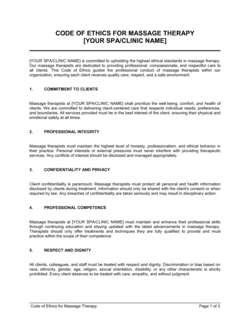
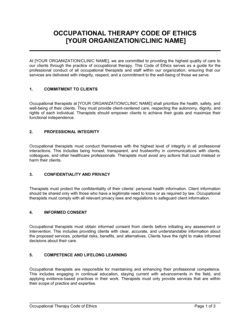
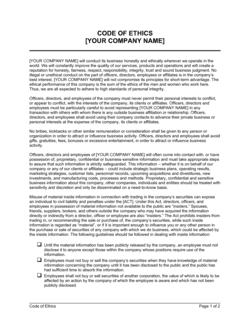
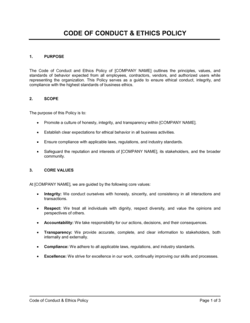
Physical Therapy Code Of Ethics Template

Free Word download • Edit online • Save & share with Drive • Export to PDF

Learn more ↓
FreePhysical Therapy Code Of Ethics Template

At a glance

What it is
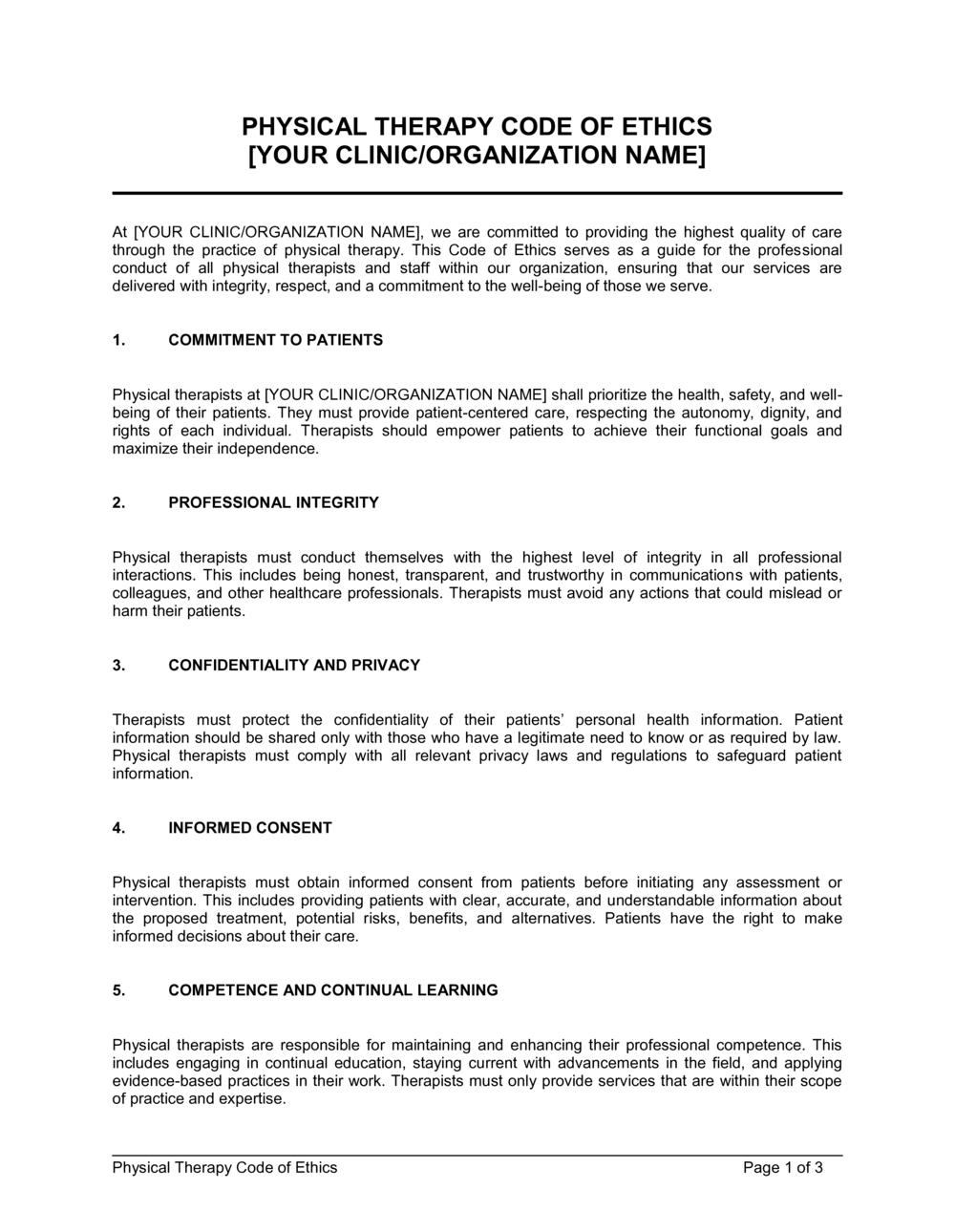
A Physical Therapy Code of Ethics is a binding policy document that defines the professional conduct standards, ethical obligations, and disciplinary procedures governing physical therapists and support staff within a practice or healthcare organization. This free Word download is fully editable online and exportable as PDF — ready to be signed by all clinical and administrative personnel as a condition of employment or ongoing engagement.
When you need it
Use it when onboarding new therapists or support staff, when establishing a new PT practice, or when updating existing conduct policies to align with current licensing board standards and applicable healthcare regulations. It is also required documentation for accreditation applications and payer credentialing processes.
What's inside
Patient rights and dignity standards, confidentiality and HIPAA obligations, professional competence requirements, conflict-of-interest provisions, scope-of-practice boundaries, reporting and whistleblower protections, social media and public communications conduct, and a structured disciplinary procedure with escalation steps.

What is a Physical Therapy Code of Ethics?

A Physical Therapy Code of Ethics is a binding policy document that defines the professional conduct standards, ethical obligations, and disciplinary procedures governing physical therapists, PT assistants, aides, and support staff within a practice or healthcare organization. It translates the ethical principles published by licensing bodies — including the American Physical Therapy Association (APTA) in the US and provincial physiotherapy colleges in Canada — into specific, enforceable internal rules that every covered employee or contractor must sign before providing or supporting patient care. The document covers patient rights, confidentiality and HIPAA compliance, scope-of-practice boundaries, professional relationships, conflict-of-interest disclosures, mandatory reporting obligations, and a structured process for investigating and resolving alleged violations.

Why You Need This Document

Without a signed, practice-specific code of ethics, a physical therapy organization faces compounding exposure on multiple fronts. Payer credentialing audits and accreditation reviews — including Joint Commission and CARF — routinely request documented ethics policies; missing one can stall or void credentialing. Licensing boards investigating patient complaints look for evidence that the practice had clearly communicated ethical standards in place; the absence of a signed code removes the strongest procedural defense available. Staff who violate boundaries, share patient data, or accept improper referral arrangements cannot be disciplined effectively without a documented standard they were required to acknowledge. A comprehensive, properly executed physical therapy code of ethics closes these gaps, establishes the foundation for consistent disciplinary action, and demonstrates to regulators, insurers, and patients that ethical practice is a formal organizational commitment rather than an assumed one.

Which variant fits your situation?

If your situation is…Use this template
Establishing ethics standards for an independent PT private practicePhysical Therapy Code of Ethics
Governing conduct for a multi-discipline allied health teamHealthcare Employee Code of Conduct
Documenting HIPAA-specific privacy obligations for clinical staffHIPAA Confidentiality Agreement
Formalizing the relationship with a contracted PT consultantIndependent Contractor Agreement
Setting conduct expectations for a PT intern or clinical rotation studentIntern Agreement
Outlining patient rights and informed consent proceduresPatient Rights and Responsibilities Policy
Addressing social media conduct for licensed healthcare professionalsSocial Media Policy

Common mistakes to avoid

❌ Applying the code only to licensed therapists

Why it matters: PT assistants, aides, and front-desk staff have direct patient contact and access to protected health information. Excluding them leaves the practice without enforceable conduct standards for a significant portion of the workforce.

Fix: Explicitly list every job category covered by the Code in the scope clause — including administrative, billing, and student roles — and collect a signed acknowledgment from each.

❌ Omitting a specific gift value threshold

Why it matters: Vague language like 'nominal value' or 'reasonable gifts' invites inconsistent interpretation and creates anti-kickback exposure, particularly for practices that receive referrals from physicians or insurers.

Fix: State a specific dollar cap — typically $25 — aligned with federal anti-kickback safe harbor guidance, and prohibit cash and cash-equivalent gifts entirely regardless of amount.

❌ Not re-obtaining signatures after material updates

Why it matters: A staff member who signed an earlier version is technically bound only to that version. New provisions — such as a revised social media policy or updated breach reporting timeline — are unenforceable against them without a fresh acknowledgment.

Fix: Establish a policy of re-issuing the Code for re-signature whenever substantive changes are made, and record the revision date prominently on the document.

❌ Referencing only federal privacy law and ignoring state or provincial requirements

Why it matters: Several states — including California, Texas, and New York — impose stricter patient privacy obligations than HIPAA. Canadian practices face PIPEDA plus provincial health information acts. A code that cites only federal law creates compliance gaps that regulators and plaintiffs will exploit.

Fix: Have a healthcare attorney confirm applicable state or provincial privacy laws for each jurisdiction where you operate and reference all applicable statutes in the confidentiality clause.

❌ No internal reporting channel named for whistleblower concerns

Why it matters: Without a named internal contact and a clear external escalation path, staff who observe ethical violations may not report them — or may go directly to a regulatory authority without giving the practice a chance to self-correct.

Fix: Name a specific supervisor title for internal reports and list the applicable external authorities (licensing board, APS, OSHA) for each category of concern, with the relevant contact information.

❌ Disciplinary procedure that conflicts with at-will employment language

Why it matters: A progressive discipline policy that implies termination only after documented warnings can be interpreted as a contractual promise, undermining at-will status in states where that matters.

Fix: Include explicit language that the disciplinary procedure is a guideline, not a contract, and that the organization reserves the right to skip steps or terminate employment at will for serious violations.

The 10 key clauses, explained

Purpose and scope

In plain language: Defines who the code applies to — licensed PTs, PT assistants, aides, students, and administrative staff — and states the overarching ethical principles the practice upholds.

Sample language
This Code of Ethics applies to all employees, contractors, and students of [PRACTICE NAME] ('Organization') who provide or support physical therapy services. All covered individuals are required to read, understand, and sign this Code as a condition of employment or engagement.

Common mistake: Limiting the scope to licensed therapists only and omitting PT assistants, aides, and front-desk staff — leaving the practice exposed for conduct violations by non-clinical employees who have direct patient contact.

Patient rights and dignity

In plain language: Establishes that every patient has the right to respectful, non-discriminatory care and that staff must honor patient autonomy, cultural differences, and informed consent at all times.

Sample language
All personnel shall treat patients with dignity, respect, and cultural sensitivity. No patient shall be discriminated against on the basis of [PROTECTED CHARACTERISTICS]. Informed consent shall be obtained and documented prior to initiating any treatment plan.

Common mistake: Using generic anti-discrimination language without referencing the specific protected characteristics mandated by federal, state, or provincial law — creating gaps that fail licensing board audits.

Confidentiality and privacy

In plain language: Requires staff to protect patient health information in compliance with applicable privacy law, limits disclosure to authorized purposes, and specifies breach reporting procedures.

Sample language
All patient health information shall be held in strict confidence and used only for purposes of treatment, payment, or healthcare operations as permitted under [HIPAA / PIPEDA / applicable law]. Any suspected breach of patient information must be reported to [PRIVACY OFFICER / TITLE] within [24] hours of discovery.

Common mistake: Referencing only HIPAA without accounting for applicable state privacy laws or, for Canadian practices, PIPEDA and provincial health information acts — which may impose stricter obligations than the federal floor.

Professional competence and continuing education

In plain language: Requires each therapist to practice only within their scope of licensure, maintain required continuing education credits, and self-report any lapse in licensure status.

Sample language
Each licensed physical therapist shall maintain an active, unrestricted license in [STATE / PROVINCE] and complete a minimum of [X] continuing education hours per [licensing cycle]. Any suspension, restriction, or lapse in licensure must be reported to [SUPERVISOR TITLE] within [48] hours.

Common mistake: Omitting the self-reporting requirement for licensure issues. Discovering a lapsed license during a payer audit or adverse event investigation — rather than through proactive disclosure — creates significantly greater regulatory exposure.

Professional boundaries and therapeutic relationships

In plain language: Prohibits sexual, romantic, financial, and exploitative relationships with patients and defines the limits of appropriate physical contact, communication, and gift acceptance.

Sample language
No covered individual shall engage in sexual, romantic, or exploitative conduct with any current or former patient. Acceptance of gifts from patients is limited to items of nominal value not exceeding $[25]. All patient communications shall be maintained through [ORGANIZATION-APPROVED CHANNELS] only.

Common mistake: Setting a high gift threshold (e.g., $100 or 'reasonable value') without a specific dollar cap — leaving the policy open to interpretation and creating fraud and abuse exposure under anti-kickback statutes.

Conflict of interest and financial integrity

In plain language: Requires disclosure of any financial or personal interest that could influence clinical decisions, referral patterns, or equipment recommendations, and prohibits self-referral arrangements prohibited by law.

Sample language
Covered individuals must disclose in writing to [COMPLIANCE OFFICER / TITLE] any financial interest in a company whose products or services they recommend to patients. Referral arrangements that violate the Stark Law, Anti-Kickback Statute, or applicable provincial law are strictly prohibited.

Common mistake: Treating conflict-of-interest disclosures as a one-time onboarding step rather than an ongoing obligation — missing subsequent financial interests acquired during employment that arise when staff take on consulting or ownership roles outside the practice.

Mandatory reporting and whistleblower protections

In plain language: Obligates staff to report suspected patient abuse, neglect, or unsafe clinical practices to the appropriate authority, and prohibits retaliation against anyone who makes a good-faith report.

Sample language
Any covered individual who reasonably suspects patient abuse, neglect, or a pattern of unsafe clinical practice shall report the concern to [DESIGNATED SUPERVISOR / EXTERNAL AUTHORITY] within [48] hours. The Organization prohibits retaliation of any kind against an individual who makes a report in good faith under this policy.

Common mistake: Including a whistleblower protection clause but not specifying the external reporting channel (state licensing board, Adult Protective Services, etc.) — leaving staff unclear on what to do when the concern involves a supervisor or owner.

Social media and public communications

In plain language: Defines what therapists may and may not share about patients, the practice, or colleagues on personal or professional social media accounts, and requires compliance with patient privacy obligations in all digital communications.

Sample language
Covered individuals shall not post, share, or comment on patient cases, identifiable patient images, or confidential organizational information on any personal or professional social media platform. Posting on behalf of [PRACTICE NAME] requires prior written approval from [AUTHORIZED TITLE].

Common mistake: Applying the social media clause only to patient information and omitting the prohibition on posting disparaging comments about colleagues or competitors — a source of defamation claims and licensing board complaints.

Disciplinary procedure and enforcement

In plain language: Sets out the escalating consequences for code violations — verbal warning, written warning, suspension, and termination — and describes the investigation process, including the right to respond.

Sample language
Violations of this Code will be addressed through the following progressive steps: (1) verbal warning documented in personnel file, (2) written warning with corrective action plan, (3) suspension with or without pay pending investigation, (4) termination for cause. The accused individual shall have the opportunity to respond in writing within [5] business days of receiving a written warning or notice of investigation.

Common mistake: Omitting the employee's right to respond before a final disciplinary decision. Skipping this step creates wrongful termination and due process exposure, particularly in Canadian and UK employment law contexts.

Acknowledgment and signature

In plain language: Documents the covered individual's confirmation that they have read, understood, and agreed to comply with the Code, with a signed and dated signature block.

Sample language
I, [EMPLOYEE / CONTRACTOR FULL NAME], acknowledge that I have read, understand, and agree to comply with the [PRACTICE NAME] Physical Therapy Code of Ethics. I understand that violation of this Code may result in disciplinary action up to and including termination of employment or engagement. Signature: __________________ Date: __________________

Common mistake: Collecting signatures at onboarding but not re-obtaining them when the Code is materially updated — meaning staff are technically bound only to an earlier version and not to new provisions added after their original signature date.

How to fill it out

  1. 1

    Enter the practice name and covered personnel scope

    Replace [PRACTICE NAME] throughout the document with the registered legal name of the organization. In the scope clause, list every category of covered individual — licensed PTs, PT assistants, aides, students, and administrative staff — by job title or role.

    💡 Use the exact registered business name, not a trade name or DBA, so the document aligns with your licensing board filings and payer contracts.

  2. 2

    Align protected characteristics with applicable law

    In the patient rights clause, list all protected characteristics required by federal and state or provincial anti-discrimination law — race, color, religion, sex, national origin, disability, age, and any additional categories mandated in your jurisdiction.

    💡 Several states and provinces include sexual orientation and gender identity as required protected classes; confirm your jurisdiction's current list before finalizing.

  3. 3

    Specify privacy law references and breach timelines

    In the confidentiality clause, name the specific law governing your practice — HIPAA for US practices, PIPEDA or applicable provincial health information act for Canadian practices. Set a specific breach-reporting window, typically 24 hours internally.

    💡 If your practice operates in multiple states or provinces, reference the most stringent applicable law — not just the federal floor.

  4. 4

    Set the continuing education hours and licensure reporting window

    Enter the minimum continuing education hours required per licensing cycle for your jurisdiction and a specific timeframe (typically 24–48 hours) within which staff must report any licensure change to a named supervisor title.

    💡 Check your state or provincial PT licensing board's current CEU requirements before finalizing — these change periodically and vary by license type.

  5. 5

    Define the gift value threshold and communication channels

    Enter a specific dollar cap for acceptable patient gifts (typically $10–$25) and list the approved communication channels for patient contact — practice EMR messaging, organization email only, or specific platforms.

    💡 A specific dollar amount eliminates disputes over what 'nominal value' means; $25 is the most commonly defensible threshold under federal anti-kickback safe harbors.

  6. 6

    Name the compliance officer and external reporting authorities

    In the conflict-of-interest and whistleblower clauses, insert the title or name of the internal compliance contact, and list the relevant external reporting authorities — state PT licensing board, Adult Protective Services, or OSHA — for each category of concern.

    💡 For small practices without a dedicated compliance officer, designate the practice owner or senior PT by title, not by personal name, to avoid needing to update the document when personnel changes.

  7. 7

    Tailor the disciplinary procedure to your employment policies

    Ensure the disciplinary steps and timelines in this Code align with your employee handbook and any applicable collective bargaining agreements. Set a specific number of business days for the employee's written response — five is standard.

    💡 Confirm that the disciplinary procedure in this Code does not conflict with at-will employment language in your employment contracts — if it implies cause-based termination, it can limit your ability to terminate at will in US jurisdictions.

  8. 8

    Collect signatures before the first day of patient contact

    Have every covered individual sign and date the acknowledgment block before they have any patient contact. Store signed copies in each person's personnel file and a centralized compliance folder.

    💡 Re-obtain signatures any time the Code is materially revised. Note the revision date on the updated document and retain prior versions to show the audit trail.

Frequently asked questions

What is a physical therapy code of ethics?

A physical therapy code of ethics is a formal policy document that defines the professional conduct standards, ethical obligations, and disciplinary procedures that govern physical therapists and their support staff. It covers areas including patient dignity, confidentiality, scope of practice, professional boundaries, conflict of interest, and mandatory reporting. Unlike general employee handbooks, a PT-specific code of ethics is aligned with licensing board standards and healthcare regulatory requirements, making it both an internal governance tool and an external compliance document.

Is a written code of ethics legally required for physical therapy practices?

In most US states and Canadian provinces, a formal written code of ethics is not explicitly mandated by statute for private PT practices, but licensing boards — including those affiliated with the American Physical Therapy Association (APTA) and the Canadian Physiotherapy Association (CPA) — publish ethical standards that practitioners are bound to follow. Accreditation bodies such as CARF and Joint Commission typically require documented ethics policies as a condition of accreditation. Having a signed, documented code is also the single strongest defense in a licensing board complaint or patient litigation.

Does every staff member need to sign the code of ethics?

Yes. While the ethical obligations are most detailed for licensed physical therapists, PT assistants, aides, administrative staff, and clinical students all have patient contact or access to protected health information. Collecting a signed acknowledgment from every covered individual creates an enforceable record, satisfies payer and accreditation audit requirements, and ensures that disciplinary action for conduct violations has a documented foundation.

How does a PT code of ethics differ from an employee handbook?

An employee handbook covers general employment policies — benefits, leave, workplace safety, and HR procedures. A code of ethics focuses specifically on professional conduct standards tied to clinical practice, patient rights, licensure obligations, and healthcare-specific legal requirements such as HIPAA, anti-kickback statutes, and mandatory reporting laws. Both documents are needed; the code of ethics supplements, rather than replaces, the handbook.

What HIPAA obligations should a PT code of ethics address?

At minimum, the code should require staff to use and disclose patient health information only for treatment, payment, and healthcare operations purposes; prohibit unauthorized access to patient records; require reporting of suspected breaches within a defined timeframe; and mandate participation in HIPAA training. For practices subject to state privacy laws stricter than HIPAA — such as California's CMIA or Texas HB 300 — those obligations should be referenced explicitly alongside the federal standard.

Can a physical therapy code of ethics be used as a standalone contract?

A signed code of ethics creates enforceable obligations and can be referenced in disciplinary proceedings, licensing board complaints, and employment litigation. However, it is generally used alongside — not instead of — an employment contract or independent contractor agreement, which governs compensation, termination, IP, and broader employment terms. The code of ethics specifically governs professional conduct and does not replace a comprehensive employment agreement.

How often should a physical therapy code of ethics be updated?

Review the code at least annually and whenever there is a material change in applicable law, licensing board standards, or accreditation requirements. The APTA updates its Code of Ethics periodically; practices should align their internal document with the current version. Any time a substantive update is made, re-issue the document for re-signature by all covered individuals and retain the prior version on file with a clear revision date.

What happens if a physical therapist violates the code of ethics?

Internally, violations are addressed through the disciplinary procedure outlined in the code — typically a progressive process from verbal warning through termination for cause. Externally, serious violations may be reportable to the state or provincial PT licensing board, which can impose sanctions ranging from formal reprimand and mandatory continuing education to suspension or revocation of licensure. Patient complaints can also trigger civil litigation, making documented adherence to an ethics code a critical element of the practice's risk management.

Do I need a lawyer to implement a physical therapy code of ethics?

For most private practices, a well-drafted template is sufficient when aligned with current APTA ethical standards and applicable state or provincial law. Legal review is advisable when the practice operates across multiple states or provinces with different privacy and employment laws, when preparing for Joint Commission or CARF accreditation, or when a past licensing board complaint has created specific compliance obligations. A healthcare attorney review typically costs $400–$800 and is worthwhile for any practice with five or more clinical staff.

How this compares to alternatives

vs Employee Code of Conduct

A general employee code of conduct governs workplace behavior — attendance, dress, anti-harassment, and technology use — for all staff regardless of role. A physical therapy code of ethics focuses specifically on clinical conduct, patient rights, HIPAA obligations, licensure maintenance, and healthcare-specific legal requirements. PT practices need both: the code of conduct handles general employment standards; the ethics code governs professional clinical obligations.

vs HIPAA Confidentiality Agreement

A HIPAA confidentiality agreement covers only the use and protection of patient health information. A physical therapy code of ethics addresses confidentiality as one clause among many — also covering professional boundaries, scope of practice, conflict of interest, mandatory reporting, and disciplinary procedures. For practices where regulatory audit is a concern, a standalone HIPAA agreement and a full code of ethics together provide stronger, layered documentation.

vs Employment Contract

An employment contract governs the commercial terms of the working relationship — compensation, benefits, IP, non-compete, and termination. A code of ethics governs professional conduct and clinical standards. A signed employment contract does not create ethics obligations, and a signed code of ethics does not govern pay or benefits. Both documents are required for a complete, enforceable onboarding package.

vs Patient Rights and Responsibilities Policy

A patient rights and responsibilities policy is a patient-facing document explaining what patients can expect from the practice and what responsibilities they hold. A physical therapy code of ethics is a staff-facing governance document that binds clinicians and employees to specific conduct standards. The patient rights policy is displayed in waiting rooms and handed to patients; the ethics code is signed by staff and retained in personnel files.

Industry-specific considerations

Private PT practices

Owner-operated clinics need a signed code to satisfy payer credentialing audits, licensing board requirements, and professional liability insurer requests — often a precondition for coverage.

Hospital and health system rehab departments

Large organizations require the PT code to align with system-wide compliance programs, Joint Commission accreditation standards, and medical staff bylaws governing allied health professionals.

Home health and mobile PT services

Therapists working in patient homes without direct supervision face heightened boundary and mandatory-reporting obligations; a clear written code establishes the standards that govern unsupervised patient encounters.

Physical therapy education and clinical training programs

Academic programs and clinical affiliates require students to sign a code of ethics before any patient contact, satisfying accreditation body requirements and limiting institutional liability for student conduct.

Jurisdictional notes

United States

The APTA Code of Ethics for the Physical Therapist is the national professional standard; state PT licensing boards enforce it directly and reference it in disciplinary proceedings. HIPAA sets the federal floor for patient privacy, but California (CMIA), Texas (HB 300), and several other states impose stricter obligations. Non-compete enforceability for clinical staff varies significantly by state — California bans most post-employment restrictions while many other states enforce them if reasonable in scope.

Canada

Physiotherapy practice in Canada is governed provincially; each college of physiotherapists (e.g., College of Physiotherapists of Ontario, College of Physical Therapists of BC) publishes its own standards of practice and code of ethics. Patient privacy is governed by PIPEDA federally and by provincial health information legislation — Ontario's PHIPA, Alberta's HIA, and BC's PIPA impose requirements that may exceed the PIPEDA baseline. French-language requirements apply in Quebec for any patient-facing and employee-facing documentation.

United Kingdom

Physiotherapists in the UK are regulated by the Health and Care Professions Council (HCPC), which publishes Standards of Conduct, Performance and Ethics that all registrants must meet. The Chartered Society of Physiotherapy (CSP) also publishes a professional code. Patient data is governed by the UK GDPR and the Data Protection Act 2018. Employment law protections — including whistleblower rights under the Public Interest Disclosure Act 1998 — must be reflected in the disciplinary and reporting clauses.

European Union

Physiotherapy regulation is member-state specific, but EU GDPR applies to all patient data processing and imposes stricter requirements than HIPAA — including a 72-hour breach notification window to supervisory authorities. Several EU countries require financial compensation for post-employment non-compete restrictions to be enforceable. The European Region of the World Confederation for Physical Therapy (ER-WCPT) publishes a framework of ethical principles that member-state associations incorporate into their national standards.

Template vs lawyer — what fits your deal?

PathBest forCostTime
Use the templateSingle-location private PT practices onboarding staff and meeting standard payer credentialing requirementsFree30–60 minutes to customize and deploy
Template + legal reviewMulti-state or multi-province practices, those pursuing Joint Commission or CARF accreditation, or practices with a prior licensing board complaint$400–$800 for a healthcare attorney review3–7 days
Custom draftedLarge health systems, hospital-based PT departments with medical staff bylaw integration, or practices operating under a corporate integrity agreement$1,500–$4,000+2–4 weeks

Glossary

Scope of Practice
The procedures, actions, and processes a physical therapist is permitted to perform based on their specific education, experience, and state or provincial license.
Informed Consent
The process of a patient voluntarily agreeing to a proposed treatment after receiving a clear explanation of its purpose, risks, benefits, and alternatives.
Therapeutic Relationship
The professional, trust-based relationship between a physical therapist and a patient that must remain free from exploitation, dual roles, or personal boundary violations.
Duty of Candor
The ethical obligation to be honest with patients, colleagues, and regulators — including disclosing errors or adverse events that affect patient care.
Conflict of Interest
A situation where a therapist's personal, financial, or professional interests could inappropriately influence clinical decision-making or referral practices.
Mandatory Reporting
The legal obligation to report suspected patient abuse, neglect, or unsafe practices to the appropriate regulatory or child/adult protection authority.
Professional Boundary
The limits that define the appropriate scope of the therapist-patient relationship and prevent personal relationships, financial arrangements, or physical contact beyond clinical necessity.
Whistleblower Protection
Legal and policy protections preventing retaliation against a staff member who reports suspected ethical violations, unsafe practices, or regulatory non-compliance in good faith.
Continuing Competence
The ongoing obligation of a licensed physical therapist to maintain and advance their clinical skills through continuing education, self-assessment, and professional development.
Dual Relationship
A situation where a therapist holds more than one role with a patient simultaneously — such as therapist and employer, family member, or business partner — creating a risk of exploitation or compromised objectivity.
Supervisory Responsibility
The obligation of a licensed physical therapist to ensure that physical therapist assistants and support staff under their direction practice within appropriate scope and competency limits.

Part of your Business Operating System

This document is one of 3,000+ business & legal templates included in Business in a Box.

  • Fill-in-the-blanks — ready in minutes
  • 100% customizable Word document
  • Compatible with all office suites
  • Export to PDF and share electronically

Create your document in 3 simple steps.

From template to signed document — all inside one Business Operating System.
1
Download or open template

Access over 3,000+ business and legal templates for any business task, project or initiative.

2
Edit and fill in the blanks with AI

Customize your ready-made business document template and save it in the cloud.

3
Save, Share, Send, Sign

Share your files and folders with your team. Create a space of seamless collaboration.

Save time, save money, and create top-quality documents.

★★★★★

"Fantastic value! I'm not sure how I'd do without it. It's worth its weight in gold and paid back for itself many times."

Managing Director · Mall Farm
Robert Whalley
Managing Director, Mall Farm Proprietary Limited
★★★★★

"I have been using Business in a Box for years. It has been the most useful source of templates I have encountered. I recommend it to anyone."

Business Owner · 4+ years
Dr Michael John Freestone
Business Owner
★★★★★

"It has been a life saver so many times I have lost count. Business in a Box has saved me so much time and as you know, time is money."

Owner · Upstate Web
David G. Moore Jr.
Owner, Upstate Web

Run your business with a system — not scattered tools

Stop downloading documents. Start operating with clarity. Business in a Box gives you the Business Operating System used by over 250,000 companies worldwide to structure, run, and grow their business.

Start free · No credit card required