Code Of Ethics Massage Therapy Template

Free Word download • Edit online • Save & share with Drive • Export to PDF

3 pages25–30 min to fillDifficulty: StandardSignature requiredLegal review recommended
Learn more ↓
FreeCode Of Ethics Massage Therapy Template

At a glance

What it is
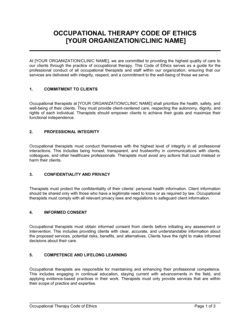
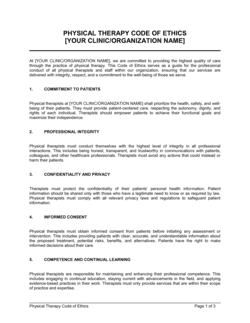
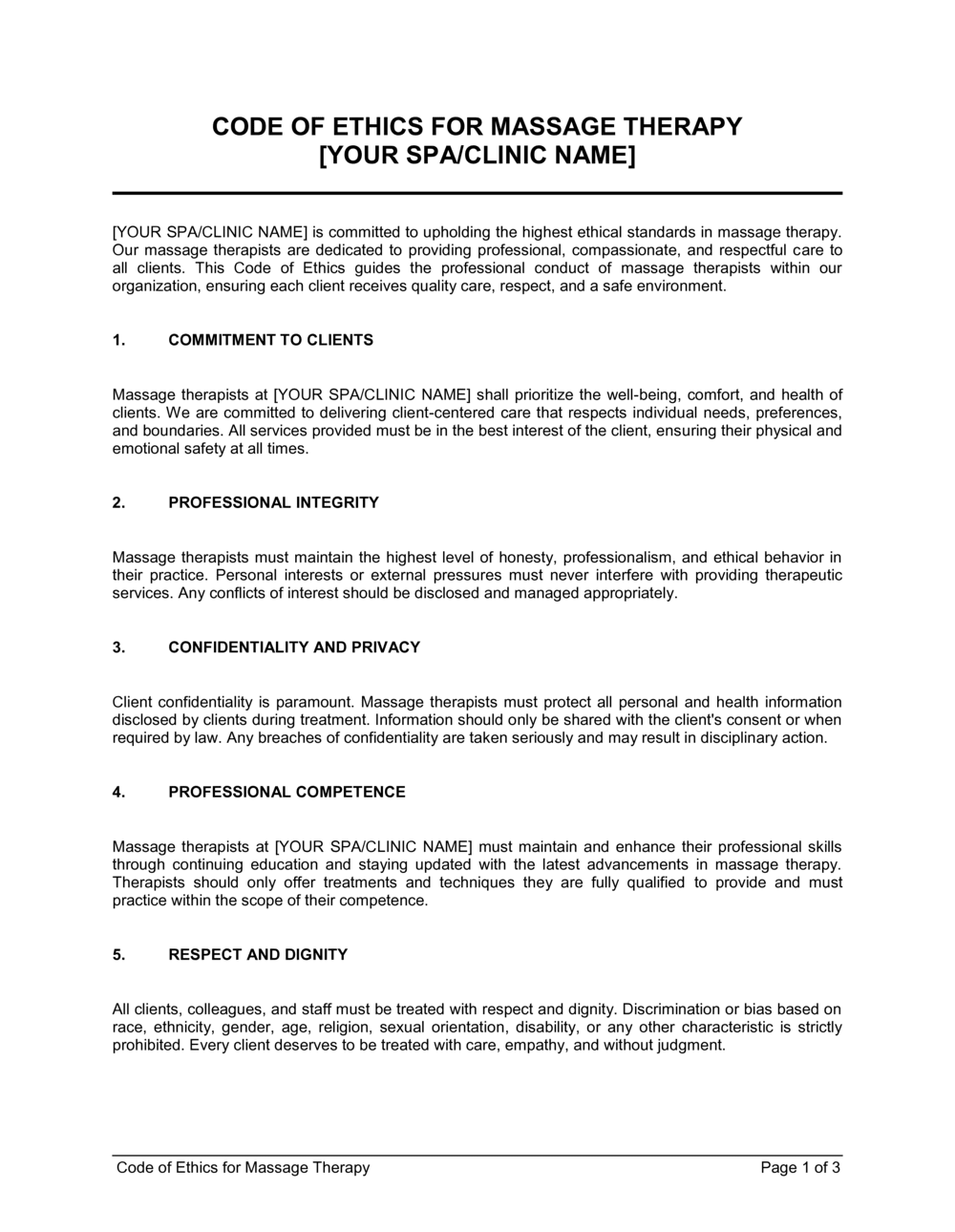
A Code of Ethics for Massage Therapy is a binding professional conduct document that establishes the ethical standards, client-relationship boundaries, confidentiality obligations, and scope-of-practice limits governing a massage therapist or practice. This free Word download gives clinics, spas, and independent practitioners a structured, signable policy they can customize and distribute to staff or include in client intake packages.
When you need it
Use it when onboarding new massage therapists, opening a new practice, responding to a licensing board's conduct requirements, or formalizing professional standards across a multi-therapist spa or clinic. It is also appropriate when renewing practitioner agreements annually or following any client complaint or regulatory inquiry.
What's inside
The document covers professional boundaries and dual-relationship prohibitions, informed consent and client autonomy, confidentiality and HIPAA-aligned data handling, scope of practice and referral obligations, non-discrimination, continuing education commitments, conflict-of-interest disclosures, and the consequences of violations — all in a single signable policy.

What is a Code of Ethics for Massage Therapy?

A Code of Ethics for Massage Therapy is a formal, binding professional conduct document that defines the ethical standards, client-relationship boundaries, clinical scope limits, and confidentiality obligations that govern a massage therapist's practice. It records the practitioner's explicit commitment to uphold those standards — covering informed consent, draping protocols, dual-relationship prohibitions, health data handling, and the duty to refer clients outside the therapist's competence. Unlike a general workplace policy, a massage therapy ethics code is anchored to the regulatory frameworks of licensing boards and professional associations, making it a recognized measure of the standard of care in licensing investigations, civil claims, and employer discipline proceedings.

Why You Need This Document

Operating without a documented, signed code of ethics exposes a practice to significant regulatory and legal risk. When a licensing board investigates a client complaint, one of the first documents requested is evidence of the professional standards the therapist committed to — the absence of a signed code signals that no standard was set. For employers, an unsigned ethics policy means a therapist who violates client boundaries or discloses confidential health information cannot be disciplined under a clear, pre-agreed framework. For individual practitioners, it removes the most straightforward way to demonstrate professional intent if a complaint is filed. Licensing boards in regulated jurisdictions can suspend or revoke a license based on conduct that falls below the published standard of care; a practice-specific code that meets or exceeds that standard provides a documented defense. This template gives independent therapists, clinics, and wellness brands a structured, jurisdiction-aware starting point — signed before the first session, reviewed annually, and defensible if it ever needs to be.

Which variant fits your situation?

If your situation is…Use this template
Sole practitioner operating an independent practiceCode of Ethics — Massage Therapy (Individual Practitioner)
Multi-therapist spa or wellness clinicStaff Code of Conduct Policy
Allied-health clinic with multiple disciplinesHealthcare Professional Code of Ethics
Massage therapy school or training programStudent Clinical Conduct Agreement
Franchised wellness brand standardizing across locationsEmployee Code of Conduct
Therapist working under a chiropractor or physiotherapistIndependent Contractor Agreement (Healthcare)
Mobile or outcall practitioner establishing client safety standardsService Agreement — Wellness Services

Common mistakes to avoid

❌ Using a generic business code of conduct instead of a therapy-specific document

Why it matters: A generic code omits therapy-specific obligations — draping standards, contraindication screening, scope-of-practice limits — that licensing boards and courts expect to see documented.

Fix: Use a massage-therapy-specific code that addresses clinical boundaries, informed consent protocols, and the referral obligation. Supplement with a general staff code of conduct for non-clinical conduct.

❌ Failing to specify which professional association standards apply

Why it matters: Without a named governing body, the code has no external benchmark — a licensing board investigation has nothing to compare the practice's standards against.

Fix: Name the specific association (AMTA, ABMP, CMTO, etc.) and confirm the code meets or exceeds that body's published ethics standards.

❌ Leaving CEU requirements as a blank or generic placeholder

Why it matters: Blank fields signal to a regulator that the practice has not actually reviewed its licensing obligations — and a therapist who doesn't know their CEU requirement is likely to fall out of compliance.

Fix: Research and insert the exact CEU requirement for every jurisdiction in which the therapist is licensed before the code is signed.

❌ Treating informed consent as a one-time intake event

Why it matters: If a therapist introduces a new technique mid-session without fresh consent, any resulting harm triggers both a licensing complaint and potential civil liability — and the one-time intake form provides no defense.

Fix: Train therapists to verbally confirm consent before each session and to document any scope changes in SOAP notes. Update the intake form annually to reflect current treatment offerings.

❌ No self-reporting obligation for licensing board complaints

Why it matters: Without a contractual self-reporting requirement, a practice owner may not learn of a board complaint until a public record is issued — preventing early intervention and coordinated response.

Fix: Add a clause requiring therapists to notify the practice owner within 5 business days of receiving any licensing board complaint, criminal charge, or civil claim related to professional practice.

❌ Omitting post-termination dual-relationship restrictions

Why it matters: Defining prohibited dual relationships only as those occurring 'during the therapeutic relationship' leaves the period immediately after the last session unregulated — the period most often cited in ethics complaints.

Fix: Specify a defined post-termination prohibition period (6–12 months is standard) and reference your professional association's guidance as the source of that timeframe.

The 10 key clauses, explained

Purpose and scope of the code

In plain language: States that the code governs all professional conduct by the named therapist or practice staff, identifies the authoritative professional bodies whose standards it reflects, and confirms that it is binding upon signature.

Sample language
This Code of Ethics applies to [THERAPIST NAME / PRACTICE NAME] ('Practitioner') in all professional capacities. It reflects the standards of [PROFESSIONAL ASSOCIATION, e.g., AMTA / RMTBC] and is binding from the date of signature.

Common mistake: Omitting reference to the governing professional association. Without it, the code is disconnected from enforceable licensing standards and loses credibility with regulators.

Scope of practice and modality limits

In plain language: Defines the specific massage modalities the practitioner is licensed to perform, prohibits the practice of any technique for which they are not credentialed, and requires written disclosure to clients before introducing new modalities.

Sample language
Practitioner shall provide only those services within their licensed scope of practice, including [LIST MODALITIES]. Practitioner shall not diagnose, prescribe, or perform techniques for which they hold no current credential without prior written client disclosure.

Common mistake: Using vague language like 'all standard massage techniques' without listing licensed modalities. Vague scope clauses provide no defense if a client alleges harm from an unauthorized technique.

Informed consent and client autonomy

In plain language: Requires the practitioner to explain the treatment plan, expected outcomes, and risks before each session and to obtain documented consent — and affirms the client's right to withdraw consent and stop the session at any time.

Sample language
Before each session, Practitioner shall explain the proposed treatment, its benefits, risks, and alternatives. Client may withdraw consent at any time without penalty. Practitioner shall document consent in the client intake form or SOAP notes.

Common mistake: Treating consent as a one-time intake form rather than an ongoing requirement. Session scope changes — such as adding a new technique — require fresh verbal consent documented in SOAP notes.

Professional boundaries and dual-relationship prohibition

In plain language: Explicitly prohibits the therapist from entering any romantic, sexual, or exploitative relationship with a current client and requires disclosure and management of any pre-existing personal relationship before accepting that individual as a client.

Sample language
Practitioner shall maintain strict professional boundaries with all clients. Practitioner shall not engage in romantic, sexual, or exploitative relationships with current clients. Any pre-existing personal relationship with a prospective client must be disclosed in writing and managed per [ASSOCIATION] guidelines before treatment begins.

Common mistake: Failing to address former clients. Many licensing boards define the prohibited period as extending 6–12 months after the last session — not just during active treatment.

Confidentiality and health information handling

In plain language: Requires the practitioner to keep all client health and personal information confidential, specifies the conditions under which disclosure is permitted (client consent, legal compulsion, or imminent safety risk), and — for US practitioners — confirms HIPAA-aligned data handling practices.

Sample language
All client health, contact, and session information is confidential and shall not be disclosed to any third party without written client consent, except as required by law or where disclosure is necessary to prevent serious harm. Practitioner shall handle all client records in compliance with [HIPAA / applicable provincial health privacy law].

Common mistake: Not specifying the retention and destruction policy for SOAP notes and intake forms. Most jurisdictions require records to be kept for a minimum of 5–7 years; destroying them prematurely violates licensing rules.

Non-discrimination and accessibility

In plain language: Commits the practitioner to provide services without discrimination on the basis of race, ethnicity, gender identity, sexual orientation, disability, religion, age, or national origin, and to make reasonable accommodation for clients with accessibility needs.

Sample language
Practitioner shall not refuse service or alter the quality of service based on race, ethnicity, gender identity, sexual orientation, disability, religion, age, or national origin. Practitioner shall make reasonable accommodations for clients with mobility or sensory needs consistent with applicable law.

Common mistake: Listing only federally protected categories while ignoring additional protected classes under state or provincial law. Several jurisdictions add body size, source of income, and housing status to anti-discrimination protections.

Referral and collaboration obligations

In plain language: Requires the practitioner to refer clients to a qualified healthcare professional when a condition falls outside their scope, prohibits accepting referral fees or commissions that could influence clinical judgment, and mandates disclosure of any financial relationship with a referral partner.

Sample language
When a client presents with a condition outside Practitioner's scope of practice, Practitioner shall provide a written referral to an appropriate healthcare provider. Practitioner shall not accept any fee, commission, or benefit in exchange for referrals without written disclosure to the client.

Common mistake: Providing referrals only verbally and not documenting them in session notes. Undocumented referrals leave the practitioner exposed if a client later alleges they were not advised to seek further care.

Continuing education and competency maintenance

In plain language: Commits the practitioner to maintain their license in good standing, complete the minimum CEUs required by their licensing jurisdiction within each renewal period, and stay current with evidence-based practices relevant to their modalities.

Sample language
Practitioner shall maintain an active, unrestricted license and complete a minimum of [X] CEUs per [LICENSE RENEWAL PERIOD] as required by [STATE BOARD / PROVINCIAL COLLEGE]. Practitioner shall seek additional training before introducing any new modality to clients.

Common mistake: Leaving the CEU count blank or using a generic placeholder. The minimum varies by jurisdiction (e.g., 24 CEUs per 2 years in many US states vs. 30 in others) — insert the correct number for your licensing body.

Conflict of interest and product promotion

In plain language: Requires disclosure of any financial interest in products or services recommended to clients and prohibits recommending products primarily for personal financial benefit rather than the client's therapeutic interest.

Sample language
Practitioner shall disclose any financial interest in products or services recommended during or following a session. Practitioner shall not recommend any product or supplementary service unless it serves the client's therapeutic interest, independent of any personal financial benefit.

Common mistake: Not disclosing retail product commissions to clients. In several jurisdictions, undisclosed financial incentives in a health-services context can constitute a deceptive trade practice.

Violations, reporting, and consequences

In plain language: Specifies the consequences for breaching any provision of the code — including internal disciplinary action, mandatory self-reporting to the licensing board, and potential termination — and establishes a good-faith reporting channel for colleagues to raise ethics concerns.

Sample language
Violation of any provision of this Code may result in written warning, suspension, or termination of employment or contract. Practitioner shall self-report any licensing board complaint or criminal charge to [PRACTICE OWNER / CLINIC MANAGER] within [5] business days of receipt. Reports of potential violations may be submitted confidentially to [CONTACT / EMAIL].

Common mistake: Omitting self-reporting obligations. Many licensing boards independently require practitioners to disclose complaints — embedding the same requirement in the practice's code ensures internal awareness and a coordinated response.

How to fill it out

  1. 1

    Identify the governing professional association and licensing board

    Insert the name of the relevant association (e.g., AMTA, ABMP in the US; RMTBC, CMTO in Canada) and the applicable state or provincial licensing board. These references anchor the code to enforceable standards.

    💡 Check your licensing body's website for any mandated code of ethics language — some boards require specific clauses verbatim.

  2. 2

    List all licensed modalities and credentials

    In the scope of practice clause, enumerate every modality the practitioner is currently licensed or certified to perform — Swedish, deep tissue, hot stone, lymphatic drainage, etc. Attach credential copies as an appendix.

    💡 If a therapist is actively pursuing a new credential, list the modality as 'pending certification as of [DATE]' rather than leaving it out or including it without qualification.

  3. 3

    Insert the correct CEU and license renewal requirements

    Enter the minimum CEU count and renewal period mandated by the practitioner's licensing jurisdiction. For multi-state or multi-province practices, list each jurisdiction separately.

    💡 Set a calendar reminder 6 months before each license renewal date — CEU shortfalls are the most common reason therapists face licensing board action.

  4. 4

    Define boundaries and dual-relationship timeframes

    Specify the post-termination period during which dual relationships with former clients are prohibited — typically 6 to 12 months after the last session, depending on your association's guidelines.

    💡 Use the stricter of your professional association's standard and your state or provincial licensing board's rule — courts and regulators apply whichever is more protective of the client.

  5. 5

    Align confidentiality provisions with applicable privacy law

    For US practitioners, confirm that client record handling references HIPAA. For Canadian practitioners, reference PIPEDA or the applicable provincial health information act. For UK practitioners, reference UK GDPR and the Data Protection Act 2018.

    💡 If you use practice-management software that stores client records in the cloud, confirm the software vendor is a HIPAA Business Associate (or equivalent) and reference that agreement in your records policy.

  6. 6

    Complete the violations and reporting section

    Insert the name and contact details of the reporting contact (practice owner, clinic manager, or ethics officer), the self-reporting timeframe for licensing board complaints, and the range of disciplinary outcomes.

    💡 For solo practitioners, name your professional association's ethics committee as the external reporting channel so there is always an escalation path.

  7. 7

    Have each therapist sign and date before their first client session

    Both the therapist and the practice owner or authorized representative should sign and date the document. Store a copy in the therapist's personnel file and provide a copy to the therapist.

    💡 Re-execute the code annually or whenever a material change is made — dated signatures create a clear record of what standards were in effect at any given time.

  8. 8

    Integrate with client intake forms and staff onboarding packets

    Reference the code of ethics in your client intake form so clients know that the practice operates under a formal ethics standard. Include the code in new-hire onboarding alongside the employment or contractor agreement.

    💡 Post a one-page summary of your core ethical commitments in the treatment room — visible client-facing ethics standards reinforce trust and reduce complaints before they start.

Frequently asked questions

What is a massage therapy code of ethics?

A massage therapy code of ethics is a formal document that defines the professional standards, client-relationship boundaries, confidentiality obligations, and scope-of-practice limits that govern a massage therapist's conduct. It is typically required by state or provincial licensing boards, professional associations such as the AMTA or CMTO, and employers or contracting practices as a condition of operating. When signed, it creates a binding commitment to those standards.

Is a code of ethics legally binding for massage therapists?

Yes, when signed by the therapist it is generally enforceable as a contractual commitment between the practitioner and their employer, practice, or professional association. Beyond contract law, many licensing boards incorporate a code of ethics into their regulatory requirements — meaning a violation can trigger disciplinary action, license suspension, or revocation independent of any private legal claim. It is advisable to have the document reviewed by a lawyer familiar with health-profession regulation in your jurisdiction.

Does every massage therapist need a signed code of ethics?

In most US states and Canadian provinces, the licensing board or mandatory professional college requires therapists to adhere to a published code of ethics as a condition of licensure. Even where board membership is voluntary, employers and contracting practices typically require a signed code as part of onboarding. Solo practitioners who do not work under an employer still benefit from a documented code as evidence of professionalism if a client complaint or regulatory inquiry arises.

What is the difference between a code of ethics and a scope of practice policy?

A code of ethics addresses broad professional values and behavioral standards — boundaries, confidentiality, non-discrimination, and conflict of interest. A scope of practice policy specifically defines the clinical techniques and client conditions a therapist is authorized to address under their license. The two are complementary: a complete ethics framework addresses scope of practice as one of several clauses, while a standalone scope policy provides more granular clinical detail. Many practices maintain both documents.

How often should a massage therapy code of ethics be updated and re-signed?

Best practice is annual re-execution, timed to coincide with license renewal or the start of a new employment term. The code should also be updated whenever a therapist adds a new modality credential, whenever the governing professional association revises its ethics standards, or whenever applicable privacy or anti-discrimination law changes. Each re-signing should be dated and stored separately from prior versions so there is a clear record of what standards were in effect at any given time.

What professional associations set massage therapy ethics standards in the US and Canada?

In the United States, the American Massage Therapy Association (AMTA) and the Associated Bodywork and Massage Professionals (ABMP) both publish member codes of ethics. State licensing boards — such as the Texas Department of Licensing and Regulation or the Florida Department of Health — publish their own mandatory standards. In Canada, regulated provincial colleges such as the College of Massage Therapists of Ontario (CMTO) and the Registered Massage Therapists' Association of British Columbia (RMTBC) publish binding codes as conditions of registration.

Can a client use a massage therapist's code of ethics in a complaint or lawsuit?

Yes. A signed code of ethics is admissible evidence of the professional standard the therapist committed to. If a client alleges a boundary violation, unauthorized technique, or confidentiality breach, the code establishes the therapist's own articulation of the standard of care — making deviation from it easier to prove. This is one reason having a well-drafted, jurisdiction-specific code is important: vague or generic language provides less protection than specific, enforceable commitments.

Does a massage therapy code of ethics need to reference HIPAA?

US massage therapists who bill insurance are typically classified as covered entities under HIPAA and must comply with its privacy and security rules. Those who operate on a cash-only basis may not be covered entities, but they are still subject to state health privacy laws. Including HIPAA-aligned language in the code signals to clients and regulators that the practice meets federal standards — and causes no harm if the therapist is ultimately not a covered entity. Canadian practitioners should reference PIPEDA or the applicable provincial health information act instead.

What happens if a massage therapist violates their code of ethics?

Consequences depend on the severity of the violation and the forum in which it is raised. An employer can issue a written warning, suspend, or terminate the therapist. A professional association can revoke membership. A licensing board can suspend or revoke the license, impose conditions on practice, or require supervised remediation. In cases involving client harm, the violation can also support a civil negligence or assault claim in court. Documenting the code, training therapists on it, and requiring annual re-signing reduces the likelihood of violation and demonstrates good-faith compliance efforts if a complaint is made.

How this compares to alternatives

vs Employee Code of Conduct

An employee code of conduct addresses general workplace behavior — attendance, harassment, social media, and conflicts of interest — applicable to any employee regardless of role. A massage therapy code of ethics is specific to clinical practice: client boundaries, draping standards, scope of practice, and health data confidentiality. Most practices need both; the general code governs workplace conduct while the ethics code governs professional practice.

vs Independent Contractor Agreement

An independent contractor agreement defines the commercial relationship between a practice and a self-employed therapist — services, fees, IP ownership, and termination. A code of ethics defines the professional and clinical standards the therapist must meet regardless of employment classification. The two documents are complementary: the contractor agreement governs the business relationship; the ethics code governs how the therapist performs their work.

vs Client Intake Form

A client intake form collects health history, consent, and session preferences from the client before treatment. A code of ethics is a practitioner-facing document that records the therapist's professional commitments. The intake form is part of client records; the code of ethics is part of the therapist's personnel or licensing file. Both are needed — the intake form captures client consent, the code captures practitioner accountability.

vs Service Agreement — Wellness Services

A service agreement defines the commercial terms of the client-therapist transaction — pricing, cancellation policy, and liability limitations. A code of ethics is not a client contract; it is an internal professional standards document signed by the therapist. Some practices attach a client-facing ethics summary to the service agreement, but the two documents serve distinct legal and operational purposes.

Industry-specific considerations

Spa and wellness centers

Multi-therapist environments require a uniform code to manage client boundary incidents, staff conduct standards, and licensing board compliance across a diverse practitioner pool.

Chiropractic and physiotherapy clinics

Massage therapists working in allied-health clinics must align their ethics code with broader clinical governance frameworks, referral protocols, and shared HIPAA or health privacy obligations.

Massage therapy schools and colleges

Student-facing ethics codes govern clinical practicum conduct, supervised treatment of volunteer clients, and the transition from student to licensed practitioner status.

Franchised wellness brands

Standardizing an ethics code across dozens or hundreds of franchise locations reduces brand liability, ensures consistent client-safety standards, and supports licensing compliance in multiple jurisdictions simultaneously.

Jurisdictional notes

United States

Massage therapy is regulated at the state level — 46 states and the District of Columbia require licensure, each with its own code of ethics or professional conduct requirements. The AMTA and ABMP codes are widely recognized but are not universally mandated. HIPAA applies to therapists who bill insurance as covered entities; state privacy laws (e.g., California CMIA) impose additional obligations. Non-compete and dual-relationship rules in the code should be reviewed against state-specific employment law.

Canada

In regulated provinces — Ontario, British Columbia, Newfoundland, New Brunswick, and Prince Edward Island — massage therapy is a regulated health profession and the provincial college (e.g., CMTO, RMTBC) publishes a mandatory code of ethics that supersedes any employer-drafted document. In unregulated provinces, professional association membership (e.g., MTAM in Manitoba) sets the applicable standard. PIPEDA and provincial health information acts (e.g., PHIPA in Ontario, HIA in Alberta) govern client record handling. Quebec employers must ensure French-language versions are available.

United Kingdom

Massage therapy is not currently a statutorily regulated profession in the UK, but voluntary registers — such as the Complementary and Natural Healthcare Council (CNHC) and the Federation of Holistic Therapists (FHT) — require members to adhere to a published code of ethics. UK GDPR and the Data Protection Act 2018 govern client health data. Employers should ensure the code references the Equality Act 2010 for non-discrimination obligations and addresses safeguarding responsibilities, particularly when treating vulnerable adults.

European Union

Regulation of massage therapy varies significantly by member state — Germany, France, and the Netherlands have established professional frameworks, while others treat it as an unregulated complementary therapy. GDPR classifies health data as a special category requiring explicit consent for processing, making client intake and SOAP note handling a data-protection compliance issue in every EU jurisdiction. Practitioners marketing services across borders must comply with both their home country's professional standards and the EU Services Directive requirements for transparency about qualifications and complaints procedures.

Template vs lawyer — what fits your deal?

PathBest forCostTime
Use the templateIndependent practitioners and small clinics meeting standard licensing board ethics requirements in a single jurisdictionFree20–30 minutes
Template + legal reviewMulti-location practices, clinics billing insurance, or practitioners who have received a prior licensing complaint$300–$600 for a health-law attorney review2–5 days
Custom draftedFranchised wellness brands operating across multiple states or provinces, or practices facing active regulatory scrutiny$1,000–$3,000+1–3 weeks

Glossary

Scope of Practice
The specific techniques, modalities, and client conditions a licensed massage therapist is legally and professionally authorized to address.
Informed Consent
A client's documented, voluntary agreement to receive a specific treatment after being told what it involves, its potential risks, and any alternatives.
Dual Relationship
A situation where a therapist holds two distinct roles with the same person — for example, serving as both a massage therapist and a romantic partner — which creates a conflict of interest or power imbalance.
Draping Standards
The professional protocols for covering the client's body with sheets or towels during a session to ensure modesty, comfort, and consent.
SOAP Notes
Structured session records documenting Subjective (client report), Objective (therapist observations), Assessment (findings), and Plan (treatment approach) — the standard clinical documentation format.
Contraindication
A medical condition or circumstance that makes a particular massage technique inadvisable or potentially harmful for a specific client.
Referral Obligation
The professional duty to direct a client to another qualified healthcare provider when their condition falls outside the therapist's scope of practice.
HIPAA
The U.S. Health Insurance Portability and Accountability Act, which sets national standards for protecting identifiable patient health information held by covered entities and their business associates.
Continuing Education Units (CEUs)
Structured learning credits that licensed massage therapists must accumulate within each license renewal period to maintain their certification and stay current with professional standards.
Therapeutic Relationship
The professional, trust-based connection between a therapist and client, defined by clear boundaries, mutual respect, and the understanding that the therapist's role is solely to serve the client's health and wellbeing.

Part of your Business Operating System

This document is one of 3,000+ business & legal templates included in Business in a Box.

  • Fill-in-the-blanks — ready in minutes
  • 100% customizable Word document
  • Compatible with all office suites
  • Export to PDF and share electronically

Create your document in 3 simple steps.

From template to signed document — all inside one Business Operating System.
1
Download or open template

Access over 3,000+ business and legal templates for any business task, project or initiative.

2
Edit and fill in the blanks with AI

Customize your ready-made business document template and save it in the cloud.

3
Save, Share, Send, Sign

Share your files and folders with your team. Create a space of seamless collaboration.

Save time, save money, and create top-quality documents.

★★★★★

"Fantastic value! I'm not sure how I'd do without it. It's worth its weight in gold and paid back for itself many times."

Managing Director · Mall Farm
Robert Whalley
Managing Director, Mall Farm Proprietary Limited
★★★★★

"I have been using Business in a Box for years. It has been the most useful source of templates I have encountered. I recommend it to anyone."

Business Owner · 4+ years
Dr Michael John Freestone
Business Owner
★★★★★

"It has been a life saver so many times I have lost count. Business in a Box has saved me so much time and as you know, time is money."

Owner · Upstate Web
David G. Moore Jr.
Owner, Upstate Web

Run your business with a system — not scattered tools

Stop downloading documents. Start operating with clarity. Business in a Box gives you the Business Operating System used by over 250,000 companies worldwide to structure, run, and grow their business.

Start free · No credit card required