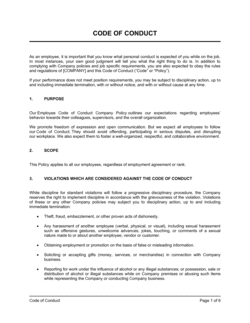
Code Of Ethics For Educators Template

Free Word download • Edit online • Save & share with Drive • Export to PDF

3 pages25–30 min to fillDifficulty: StandardSignature requiredLegal review recommended
Learn more ↓
FreeCode Of Ethics For Educators Template

At a glance

What it is
A Code of Ethics for Educators is a binding professional conduct document that sets out the ethical obligations, behavioral standards, and accountability expectations for teachers, instructors, tutors, and educational staff. This free Word download covers student relationships, confidentiality, professional integrity, conflicts of interest, and disciplinary procedures in a single structured document you can edit online and export as PDF.
When you need it
Use it when onboarding new teaching staff, formalizing conduct expectations across a school or training organization, or updating an existing policy to reflect current professional standards and legal obligations. It is also required when accreditation bodies, licensing authorities, or parent bodies request documented ethical standards.
What's inside
Core professional obligations, student welfare and protection standards, confidentiality and data privacy requirements, conflict of interest rules, social media and communications guidelines, professional development expectations, reporting obligations, and disciplinary consequences for breaches — all with signature and acknowledgment blocks.

What is a Code of Ethics for Educators?

A Code of Ethics for Educators is a binding professional conduct document that defines the ethical obligations, behavioral standards, and accountability expectations governing teachers, instructors, tutors, and all educational staff in their relationships with students, colleagues, families, and the broader community. It establishes enforceable obligations — not aspirational guidelines — covering student welfare and safeguarding, professional boundaries, confidentiality of student records, conflict of interest disclosure, social media and digital communication rules, mandatory reporting of suspected harm, and the consequences of breach. Unlike a general employee handbook, a properly drafted code of ethics for educators is specific to the unique responsibilities and legal duties that arise from working with learners, including the duty of care and, in many contexts, in loco parentis obligations. This template is a free Word download that can be edited online and exported as PDF, with full placeholder guidance and a signature block for acknowledgment before duties begin.

Why You Need This Document

Without a documented and signed code of ethics, an educational institution has no enforceable standard against which to measure educator conduct — and no defensible basis for disciplinary action when that conduct falls short. The consequences are concrete: a teacher who violates student privacy, communicates privately with a minor through personal social media, or fails to report suspected abuse cannot be reliably disciplined under a policy they never acknowledged. Accreditation bodies, licensing authorities, and insurers increasingly require documented professional standards as a precondition for approval or coverage. In jurisdictions with statutory teacher licensing, educators who breach professional conduct standards face deregistration — but only if the institution has documented what those standards are. A signed code also creates the paper trail that protects the institution when complaints are escalated to regulators or courts. This template closes all four gaps — safeguarding, data privacy, professional boundaries, and disciplinary procedure — in a single document that takes under an hour to complete and is ready for signature on day one.

Which variant fits your situation?

If your situation is…Use this template
Setting conduct standards for K-12 classroom teachers in a public schoolCode of Ethics for Educators (K-12)
Establishing ethical guidelines for university or college facultyFaculty Code of Professional Conduct
Documenting conduct expectations for all staff across an organizationCode of Ethics
Setting behavioral standards for support staff and teaching assistantsEmployee Code of Conduct
Creating a student-facing behavioral expectations documentStudent Code of Conduct
Establishing social media and communications policies for staffSocial Media Policy
Documenting safeguarding and child protection obligations specificallyChild Protection Policy

Common mistakes to avoid

❌ Using aspirational rather than binding language throughout

Why it matters: Phrases like 'educators should' or 'it is expected that' are interpreted as guidelines, not obligations. In disciplinary proceedings, this distinction can make the entire document unenforceable.

Fix: Replace 'should,' 'encouraged,' and 'expected' with 'shall' and 'must' for every core obligation. Reserve permissive language only for non-binding guidance sections.

❌ Omitting the external mandatory reporting authority

Why it matters: If educators only report to an internal lead and the code does not name the external statutory authority, the institution may face regulatory action for failing to fulfill its legal safeguarding obligations.

Fix: Name both the internal safeguarding lead and the external child protection or welfare authority in the mandatory reporting clause, with reference to the applicable statute.

❌ Failing to address private tutoring conflicts of interest

Why it matters: Educators who tutor their own students privately have a financial incentive to underperform in class to drive demand. Without a specific rule, this conflict goes unmanaged and creates liability.

Fix: Add an explicit clause requiring disclosure and written approval before any educator provides paid tutoring to a student currently in their class or program.

❌ Applying the code only to permanent employees and not contractors

Why it matters: Contractors, visiting instructors, and volunteers interact with students in the same capacity as employees and carry the same duty of care. Gaps in coverage create safeguarding blind spots.

Fix: State in the scope clause that the code applies to all individuals providing educational services on behalf of the institution, regardless of employment status.

❌ Not requiring a fresh signature when the code is materially updated

Why it matters: An educator who signed an earlier version may not be bound by new obligations added in a revision. In disciplinary proceedings, they can argue they were unaware of the updated standard.

Fix: Establish a reissue procedure requiring signed acknowledgment of any material update, with a defined window (e.g., 14 days) for compliance.

❌ Referencing the disciplinary procedure by title without versioning

Why it matters: If the disciplinary procedure is updated after the code is signed, the cross-reference becomes ambiguous — staff and institutions may disagree on which version applies.

Fix: Reference the disciplinary procedure by title and version number, or include a clause stating 'the disciplinary procedure as amended from time to time' to keep the reference evergreen.

The 10 key clauses, explained

Purpose and scope

In plain language: States what the code covers, who it applies to, and the institution's commitment to upholding professional ethical standards in education.

Sample language
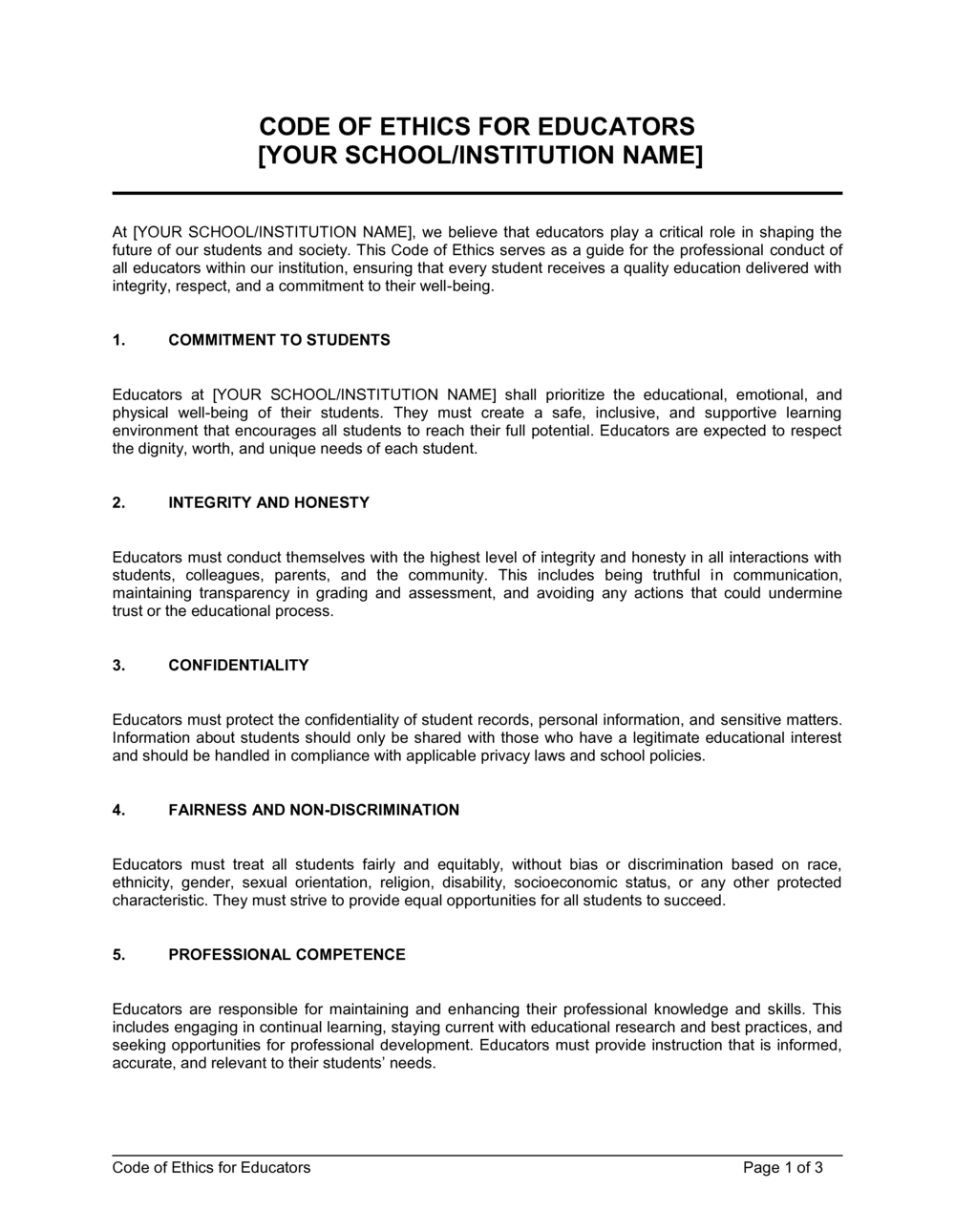
This Code of Ethics applies to all educators employed by or contracted with [INSTITUTION NAME], including full-time teachers, part-time instructors, tutors, and teaching assistants, effective [DATE]. Its purpose is to establish the professional, ethical, and behavioral standards expected of all education staff.

Common mistake: Limiting scope to 'employees' and inadvertently excluding contractors, volunteers, and adjunct instructors — who carry the same duty of care but fall outside a narrow definition.

Student welfare and duty of care

In plain language: Establishes the educator's primary obligation to protect student physical and emotional wellbeing and to act in the best interests of learners at all times.

Sample language
Educators shall prioritize the safety, health, and wellbeing of all students. No educator shall engage in conduct that places a student at physical or emotional risk, and each educator is obligated to report any known or reasonably suspected threat to student welfare to [DESIGNATED OFFICER / TITLE] within [X] hours.

Common mistake: Using aspirational language ('should prioritize') instead of binding language ('shall prioritize') — weakening enforceability and creating ambiguity in disciplinary proceedings.

Professional conduct and integrity

In plain language: Requires educators to act honestly, maintain professional competence, and uphold the dignity of the teaching profession in all interactions.

Sample language
Educators shall conduct themselves with honesty, fairness, and respect in all professional interactions. Educators shall not misrepresent their qualifications, experience, or the outcomes of student work, and shall not engage in academic dishonesty, plagiarism, or fraudulent grading practices.

Common mistake: Omitting academic dishonesty and fraudulent grading from this clause — leaving a gap that makes it difficult to discipline educators who manipulate student records or assessments.

Professional boundaries and student relationships

In plain language: Defines appropriate limits on educator–student interactions, prohibiting personal relationships, favoritism, and any conduct that could be construed as grooming or abuse.

Sample language
Educators shall maintain appropriate professional boundaries with all students at all times. No educator shall engage in a romantic, sexual, or otherwise inappropriately personal relationship with any student. One-on-one meetings with students under [AGE] shall take place in visible, accessible spaces or with another adult present.

Common mistake: Failing to specify physical environment requirements (visible spaces, open-door rules) for one-on-one interactions — leaving institutions exposed to safeguarding complaints with no documented standard.

Confidentiality and data privacy

In plain language: Prohibits unauthorized disclosure of student records, personal information, and family data, and aligns with applicable data protection law.

Sample language
Educators shall not disclose personally identifiable information about students or their families to any unauthorized party without prior written consent of the student's parent or guardian (or the student, if aged [AGE] or over), except where required by law or mandatory reporting obligations. All student records shall be handled in accordance with [APPLICABLE LAW — e.g., FERPA / GDPR / PIPEDA].

Common mistake: Referencing general confidentiality without naming the applicable data protection law. This leaves staff uncertain about their specific legal obligations and creates compliance risk during audits.

Conflict of interest

In plain language: Requires educators to disclose and manage situations where personal interests could compromise their professional judgment or create unfair advantages.

Sample language
Educators shall disclose to [DESIGNATED OFFICER] any personal, financial, or familial relationship with a student or prospective student that could constitute a conflict of interest. Educators shall not provide private paid tutoring to students currently enrolled in their classes without prior written approval from [TITLE].

Common mistake: Ignoring the paid-tutoring conflict scenario entirely — one of the most common undisclosed conflicts in K-12 and higher education settings, with clear financial incentive to underperform in class.

Use of technology, social media, and communications

In plain language: Governs how educators use digital tools, social media, and personal devices to interact with students, and prohibits inappropriate or unsupervised digital contact.

Sample language
Educators shall not communicate with students through personal social media accounts, private messaging applications, or personal email addresses. All digital communications with students shall occur through [INSTITUTION'S APPROVED PLATFORM]. Educators shall not record, photograph, or share images of students without documented parental or guardian consent.

Common mistake: Applying the social media policy only to public posts and ignoring direct messaging — the channel where most boundary violations in educator–student communications occur.

Mandatory reporting and safeguarding

In plain language: Sets out the educator's legal and institutional obligation to report suspected abuse, neglect, or harm to the designated safeguarding lead and relevant authorities.

Sample language
In accordance with [APPLICABLE LAW], all educators are mandatory reporters. Any educator who has reasonable grounds to suspect that a student is experiencing abuse, neglect, exploitation, or harm shall report their concern immediately to [DESIGNATED SAFEGUARDING LEAD] and, where legally required, to [CHILD PROTECTION AUTHORITY / NAME OF AGENCY]. Failure to report is a serious breach of this Code.

Common mistake: Naming only the internal reporting channel and omitting the external statutory authority — meaning staff follow internal process but miss the external legal reporting obligation.

Professional development and continuous learning

In plain language: Establishes the educator's obligation to maintain and update professional competence and to comply with mandatory training requirements.

Sample language
Educators shall maintain current knowledge of curriculum developments, pedagogical best practices, and relevant legal obligations. All educators shall complete [INSTITUTION]-mandated safeguarding training within [X] days of hire and renewal training every [X] months thereafter.

Common mistake: Stating professional development is 'encouraged' rather than required — leaving the institution unable to discipline staff who skip mandatory safeguarding or compliance training.

Breach, disciplinary procedure, and consequences

In plain language: Defines what constitutes a breach, the process for investigation, and the range of sanctions — from formal warning through termination and referral to a licensing authority.

Sample language
A breach of this Code may result in disciplinary action up to and including termination of employment or contract. Serious breaches — including abuse, boundary violations, or failure to report — will be reported to [RELEVANT LICENSING / REGULATORY BODY] and may result in removal of the educator's license or registration. All investigations shall follow [INSTITUTION]'s Disciplinary Procedure [REFERENCE].

Common mistake: Not referencing the regulatory or licensing body by name. Staff may not know that a breach can trigger professional deregistration, which is often a stronger deterrent than internal sanctions alone.

How to fill it out

  1. 1

    Identify all covered roles and set the scope

    Define exactly who the code applies to — teachers, tutors, teaching assistants, coaches, volunteers, and contractors. Insert the institution's legal name and the effective date.

    💡 List covered roles explicitly in the scope clause rather than using 'all staff' — courts and tribunals give effect to plain language, and an exhaustive list prevents evasion.

  2. 2

    Insert applicable data protection law references

    Replace the [APPLICABLE LAW] placeholders in the confidentiality and mandatory reporting clauses with the correct statute for your jurisdiction — FERPA and state equivalents for the US, PIPEDA or provincial privacy law in Canada, the UK GDPR in the UK, and the EU GDPR for European institutions.

    💡 If your institution operates across multiple jurisdictions, list each statute and the specific student group it covers.

  3. 3

    Name the designated safeguarding lead and reporting contacts

    Replace all [DESIGNATED OFFICER] and [DESIGNATED SAFEGUARDING LEAD] placeholders with named roles (not personal names) so the document remains current when staff change.

    💡 Use titles rather than individuals' names throughout — 'Head of Safeguarding' rather than 'Jane Smith' — so the document does not require amendment at every personnel change.

  4. 4

    Set professional boundary rules for your environment

    Specify the physical and digital environment rules relevant to your setting — open-door policies, visible meeting spaces, approved communication platforms, and consent requirements for recording or photography.

    💡 One-on-one rules should vary by student age: stricter physical presence requirements for under-18 settings, more flexible rules for adult learners.

  5. 5

    Define the disciplinary procedure reference

    Link the breach clause to your institution's formal disciplinary procedure document by title and version number so the code and the process are aligned.

    💡 Confirm the disciplinary procedure has been reviewed by an employment lawyer recently — a code of ethics is only as enforceable as the procedure it references.

  6. 6

    Add mandatory training timelines

    Insert specific timeframes for mandatory safeguarding training completion (e.g., within 30 days of hire, renewal every 24 months) and any other required compliance training.

    💡 Tie training deadlines to continued employment — 'failure to complete mandatory training by [DATE] may result in suspension of duties' creates a concrete enforcement mechanism.

  7. 7

    Obtain signed acknowledgment before duties begin

    Have every educator sign and date the acknowledgment block before their first day of teaching or contact with students. Retain the signed copy in their personnel file.

    💡 Obtain a fresh signature whenever a materially updated version of the code is issued — verbal acknowledgment of changes is not sufficient in disciplinary or legal proceedings.

Frequently asked questions

What is a code of ethics for educators?

A code of ethics for educators is a formal document that sets out the professional, ethical, and behavioral standards expected of teachers, instructors, and educational staff. It covers obligations such as student welfare, confidentiality, professional boundaries, mandatory reporting, and conduct in digital environments. Unlike an informal policy statement, a signed code creates enforceable obligations and provides the basis for disciplinary action if standards are not met.

Is a code of ethics for educators legally required?

In many jurisdictions and sectors, a documented code of ethics is required by law, accreditation bodies, or teacher licensing authorities. In the US, most state education departments maintain official teacher codes of ethics that licensed educators are bound by. In the UK, the Department for Education and teacher standards frameworks effectively mandate documented professional conduct standards. For private schools, tutoring businesses, and online platforms, the code is typically not mandated by statute but is considered best practice and is often required by insurers and accreditors.

Does a code of ethics for educators need to be signed?

Yes — for a code of ethics to be enforceable as a binding professional obligation, it should be signed and dated by every educator before they begin teaching or working with students. An unsigned code is effectively an aspirational statement with limited disciplinary weight. Retain signed copies in each educator's personnel file and obtain fresh signatures when the document is materially updated.

What is the difference between a code of ethics and a code of conduct for educators?

A code of ethics sets out the underlying values and professional principles that guide educator behavior — integrity, student welfare, fairness. A code of conduct translates those principles into specific behavioral rules and prohibited actions. In practice, the two terms are often used interchangeably, and many institutions combine both in a single document. The key test is whether the document contains enforceable obligations with defined consequences, not whether it is labeled as ethics or conduct.

What happens when an educator breaches the code of ethics?

A breach triggers the institution's disciplinary procedure, which typically involves investigation, a formal hearing, and a range of sanctions from written warning through to termination. Serious breaches — such as abuse, boundary violations, or failure to report suspected harm — are also typically reported to the relevant teacher licensing or regulatory body, which can result in professional deregistration. The code should cross-reference the disciplinary procedure to make this escalation pathway explicit.

Can a code of ethics apply to contractors and volunteers, not just employees?

Yes, and it should. Any individual who works with students in an educational capacity — whether employed, contracted, or volunteering — carries the same duty of care and should be bound by the same ethical standards. The scope clause of the code should explicitly name contractors, volunteers, adjunct instructors, and visiting educators. Many safeguarding failures occur precisely because contractors were excluded from conduct frameworks that applied only to direct employees.

How often should a code of ethics for educators be updated?

Review the code at least every two years, and immediately following any change in applicable law, regulatory guidance, or a significant incident at the institution. Specific triggers for review include new data protection legislation, updated safeguarding guidance from a government department, changes to teacher licensing standards, or the adoption of new technology platforms used for student communication. Staff should sign an acknowledgment of any material update within a defined timeframe.

Does the code of ethics need to address social media specifically?

Yes. Social media and direct digital messaging are among the most common channels through which professional boundary violations occur in education. The code should prohibit personal social media contact with students, specify the approved communication platforms for educator–student interaction, and address photography and recording of students without consent. Generic confidentiality clauses do not adequately cover digital conduct risks.

How is a code of ethics for educators different from a safeguarding policy?

A safeguarding policy is a standalone document specifically focused on protecting students from abuse, neglect, and exploitation — it details reporting pathways, risk assessment procedures, and the institution's response protocols. A code of ethics is broader, covering all aspects of professional conduct including integrity, conflicts of interest, and communications, with safeguarding obligations incorporated as one component. Most institutions need both documents: the code sets the professional standards, and the safeguarding policy provides the operational detail.

How this compares to alternatives

vs Employee Code of Conduct

An employee code of conduct governs workplace behavior broadly — attendance, dress, use of company resources, and general professionalism — for all staff regardless of role. A code of ethics for educators is specific to the educational context, with detailed obligations around student welfare, safeguarding, mandatory reporting, and professional boundaries. Schools typically need both: the employee code for general HR governance and the educator code for the professional standards specific to teaching.

vs Code of Ethics (General)

A general organizational code of ethics sets values and principles for all employees across any industry — typically covering honesty, fairness, and legal compliance. A code of ethics for educators adds sector-specific obligations that are absent from a general code: duty of care to students, mandatory reporting of abuse, in loco parentis responsibilities, and professional boundary rules. Educational institutions should not rely on a general code alone to meet safeguarding and accreditation standards.

vs Non-Disclosure Agreement

An NDA protects specific confidential information — proprietary curriculum, business strategy, or personnel data — through a standalone contractual obligation. The confidentiality clause in a code of ethics for educators covers student privacy and record protection as part of a broader professional conduct framework. Both documents may be needed: the NDA for sensitive institutional information, and the code for the ongoing professional obligation to protect student data.

vs Employment Contract

An employment contract governs the commercial and legal terms of the working relationship — salary, notice periods, IP assignment, and termination. A code of ethics for educators is a separate professional conduct document that is incorporated by reference into the contract or issued alongside it. The contract creates the legal employment relationship; the code defines the professional standards that govern conduct within that relationship. Relying on the contract alone leaves safeguarding and professional conduct standards undefined.

Industry-specific considerations

K-12 Education

Strict safeguarding clauses, mandatory reporting requirements, physical boundary rules for one-on-one interactions with minors, and parental consent requirements for all digital communications.

Higher Education

Academic integrity and anti-plagiarism obligations, research ethics, faculty–student relationship boundaries, and FERPA-aligned data privacy requirements for student records.

Online Learning and EdTech

Platform-specific communication rules, cross-jurisdictional data privacy compliance (GDPR, FERPA, PIPEDA), age verification obligations, and recording consent for virtual sessions.

Vocational Training and Professional Development

Accreditation body compliance requirements, competency assessment integrity rules, and conflict of interest disclosures where instructors also operate in the industry they teach.

Jurisdictional notes

United States

Most US states maintain official educator codes of ethics administered by the state department of education or professional standards commission, which licensed teachers are bound by as a condition of licensure. FERPA governs student record privacy at the federal level, with additional state-specific student privacy laws in California (SOPIPA), New York, and others. Mandatory reporting obligations for suspected child abuse are defined by state statute and vary in scope — confirm the applicable reporting authority for every state where the institution operates.

Canada

Teacher conduct in Canada is governed provincially — each province's College of Teachers or equivalent licensing body maintains its own professional standards and ethical guidelines that licensed educators must comply with. PIPEDA applies to personal information in federally regulated contexts; provincial privacy laws (PIPA in Alberta and BC, Act respecting the protection of personal information in Quebec) govern most school boards. Quebec's Law 25 imposes particularly stringent consent and transparency requirements for student data. Mandatory reporting requirements for child abuse are defined in provincial child welfare legislation.

United Kingdom

In England, the Teachers' Standards published by the Department for Education set the statutory framework for teacher conduct and are incorporated into employment contracts. The Teaching Regulation Agency (TRA) has authority to prohibit teachers from the profession for serious misconduct. UK GDPR and the Data Protection Act 2018 govern student data privacy. Keeping Children Safe in Education (KCSIE) is statutory guidance that all schools and colleges in England must follow, requiring documented safeguarding procedures and mandatory reporting to the Local Authority Designated Officer (LADO) for allegations against staff.

European Union

EU GDPR applies to all processing of student personal data by educational institutions, with data protection impact assessments required for high-risk processing activities involving minors. Teacher licensing and professional conduct standards are determined at the member state level — Germany, France, and the Netherlands each maintain distinct regulatory bodies and professional standards frameworks. Several member states require that codes of ethics be filed with or approved by the national education authority as a condition of operating a recognized educational institution. Child protection reporting obligations are defined by national law and vary significantly across member states.

Template vs lawyer — what fits your deal?

PathBest forCostTime
Use the templatePrivate tutoring businesses, small independent schools, and online learning platforms establishing conduct standards for the first timeFree30–60 minutes
Template + legal reviewSchools subject to state or provincial licensing requirements, institutions handling student data across jurisdictions, or organizations with prior safeguarding incidents$300–$8002–5 days
Custom draftedLarge school districts, university systems, regulated training providers, or institutions operating under multiple national regulatory frameworks$1,500–$5,000+2–4 weeks

Glossary

Duty of Care
The legal and professional obligation of an educator to take reasonable steps to protect students from foreseeable harm.
Conflict of Interest
A situation where an educator's personal, financial, or professional interests could improperly influence their judgment or actions toward students or colleagues.
Mandatory Reporting
A legal obligation in many jurisdictions requiring educators to report suspected child abuse, neglect, or harm to the relevant authorities.
Confidentiality Obligation
The requirement to protect personally identifiable information about students, their families, and colleagues from unauthorized disclosure.
Professional Boundaries
The limits that define appropriate interactions between educators and students, distinguishing professional relationships from personal or social ones.
In Loco Parentis
A Latin term meaning 'in the place of a parent,' describing the legal responsibility schools and educators carry for student welfare during school hours.
Disciplinary Procedure
The formal process by which an institution investigates and responds to alleged breaches of professional conduct, which may result in sanctions, suspension, or termination.
Informed Consent
Permission given by a student, parent, or guardian after being provided with sufficient information to understand the nature and purpose of an activity or disclosure.
Whistleblower Protection
Legal or policy safeguards that protect an educator who reports unethical conduct, abuse, or legal violations from retaliation by their employer.
FERPA
The Family Educational Rights and Privacy Act — a US federal law that protects the privacy of student education records and governs who may access them.
Safeguarding
The policies, practices, and procedures an educational institution implements to protect children and vulnerable students from abuse, neglect, exploitation, and harm.

Part of your Business Operating System

This document is one of 3,000+ business & legal templates included in Business in a Box.

  • Fill-in-the-blanks — ready in minutes
  • 100% customizable Word document
  • Compatible with all office suites
  • Export to PDF and share electronically

Create your document in 3 simple steps.

From template to signed document — all inside one Business Operating System.
1
Download or open template

Access over 3,000+ business and legal templates for any business task, project or initiative.

2
Edit and fill in the blanks with AI

Customize your ready-made business document template and save it in the cloud.

3
Save, Share, Send, Sign

Share your files and folders with your team. Create a space of seamless collaboration.

Save time, save money, and create top-quality documents.

★★★★★

"Fantastic value! I'm not sure how I'd do without it. It's worth its weight in gold and paid back for itself many times."

Managing Director · Mall Farm
Robert Whalley
Managing Director, Mall Farm Proprietary Limited
★★★★★

"I have been using Business in a Box for years. It has been the most useful source of templates I have encountered. I recommend it to anyone."

Business Owner · 4+ years
Dr Michael John Freestone
Business Owner
★★★★★

"It has been a life saver so many times I have lost count. Business in a Box has saved me so much time and as you know, time is money."

Owner · Upstate Web
David G. Moore Jr.
Owner, Upstate Web

Run your business with a system — not scattered tools

Stop downloading documents. Start operating with clarity. Business in a Box gives you the Business Operating System used by over 250,000 companies worldwide to structure, run, and grow their business.

Start free · No credit card required