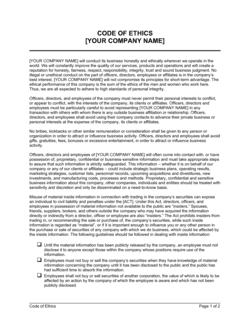
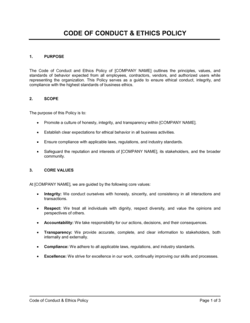
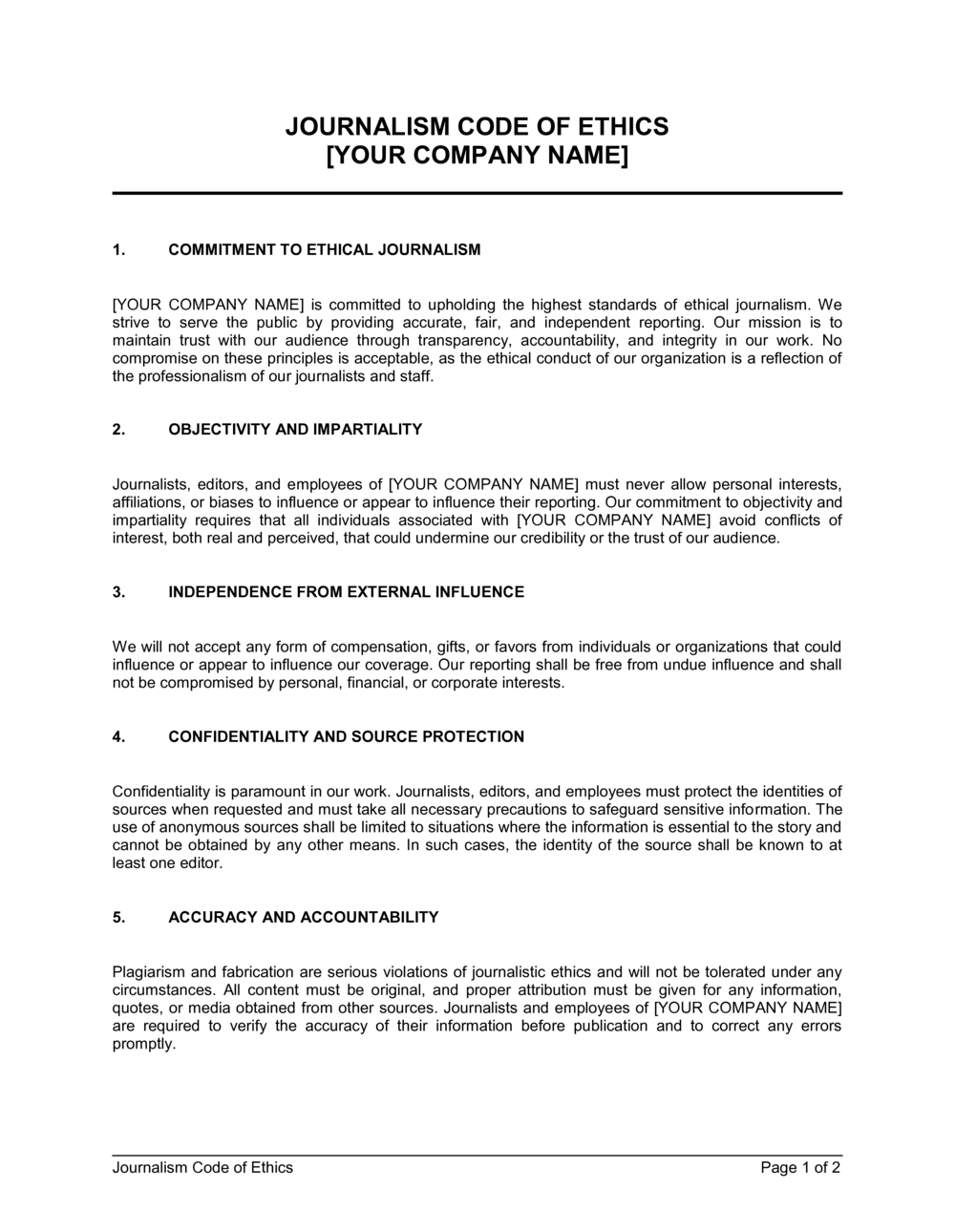
Journalism Code Of Ethics Template

Free Word download • Edit online • Save & share with Drive • Export to PDF

2 pages20–30 min to fillDifficulty: StandardSignature requiredLegal review recommended
Learn more ↓
FreeJournalism Code Of Ethics Template

At a glance

What it is
A Journalism Code of Ethics is a binding policy document that establishes the professional and ethical standards every journalist, editor, and contributor at a news organization must follow. This free Word download gives editors-in-chief, publishers, and media directors a structured, signable framework covering accuracy, independence, conflict of interest, source protection, and corrections — ready to edit online and export as PDF.
When you need it
Use it when onboarding new journalists or freelance contributors, when establishing a new publication or news outlet, or when formalizing previously informal editorial standards into a binding signed policy that can be enforced and referenced in disciplinary proceedings.
What's inside
Core editorial principles, accuracy and verification standards, independence and conflict-of-interest rules, source confidentiality obligations, corrections and clarifications procedures, social media conduct standards, gifts and freebies policies, and enforcement and disciplinary consequences for violations.

What is a Journalism Code of Ethics?

A Journalism Code of Ethics is a binding policy document that defines the professional and ethical obligations every journalist, editor, and editorial contributor at a news organization must uphold. It establishes enforceable standards across the full editorial workflow — from how facts are verified before publication to how errors are corrected afterward, and from how confidential sources are protected to how personal conflicts of interest are disclosed. Unlike a general statement of values, a signed code creates a contractual obligation between the journalist and the publication, providing a documented basis for disciplinary action, termination for cause, and — in some circumstances — a defense against defamation claims by demonstrating that the organization maintained and enforced reasonable editorial standards.

Why You Need This Document

Without a formal, signed journalism code of ethics, a news organization operates on institutional memory and informal expectations that are inconsistent, unenforceable, and invisible to new hires and freelancers. When a fabrication is discovered, a source is burned, or a journalist's undisclosed financial interest surfaces in their reporting, the organization has no documented standard to point to, no defined disciplinary process to invoke, and no paper trail demonstrating that reasonable editorial care was exercised. The legal and reputational consequences are immediate: defamation plaintiffs use the absence of standards as evidence of actual malice or reckless disregard; wrongful termination claims become harder to defend without a written policy the journalist signed; and advertisers, funders, and audiences withdraw trust. This template gives publishers and editors-in-chief a structured, attorney-reviewable starting point that closes those gaps — covering verification standards, source protection, conflict disclosure, social media conduct, corrections procedures, and a functional enforcement mechanism — in a single signable document.

Which variant fits your situation?

If your situation is…Use this template
Establishing ethics standards for a digital-only news publicationJournalism Code of Ethics (Digital Media)
Setting social media conduct rules for journalists specificallySocial Media Policy for Journalists
Binding freelance contributors to editorial standardsFreelance Contributor Agreement with Ethics Clause
Documenting conflict-of-interest rules for editorial staffConflict of Interest Policy
Establishing a broader staff code of conduct beyond journalismEmployee Code of Conduct
Creating source confidentiality protections for investigative reportersSource Confidentiality Agreement
Governing editorial independence for nonprofit or public-interest journalismEditorial Independence Policy

Common mistakes to avoid

❌ Excluding freelancers from the scope

Why it matters: Freelance contributors frequently break ethics standards — fabrication, conflicts, and undisclosed relationships — but if they never signed the code, the organization has no contractual basis for removing their bylines or seeking damages.

Fix: Include all contributors who publish under your masthead in the code's scope and make signing a precondition of first publication, regardless of employment classification.

❌ Using aspirational rather than obligatory language

Why it matters: Phrases like 'journalists should strive to' or 'we encourage' create no enforceable standard and cannot support disciplinary action or a termination for-cause decision.

Fix: Replace aspirational language with direct obligations: 'Covered Persons shall,' 'is required to,' or 'must.' Retain aspirational language only for principles that genuinely cannot be quantified.

❌ Omitting an enforcement mechanism

Why it matters: A code with no disciplinary process is a statement of values, not a binding policy. Without defined consequences and a clear investigation procedure, organizations face inconsistent enforcement and potential wrongful termination claims.

Fix: Add a dedicated enforcement clause that specifies who investigates, what timeline applies, what sanctions are available, and how the journalist may appeal — then follow it consistently.

❌ Overpromising unconditional source protection

Why it matters: Shield laws vary by jurisdiction and do not protect all categories of information in all circumstances. Promising absolute confidentiality that the organization cannot legally deliver exposes both the journalist and the outlet to liability.

Fix: State that the organization will provide legal support and will resist compelled disclosure to the extent permitted by applicable law — and specify the governing jurisdiction's shield law protections by name.

❌ Not addressing AI-generated and AI-assisted content

Why it matters: Generative AI tools can produce plausible-sounding fabrications, misattributed quotes, and hallucinated citations. A code that does not address AI use leaves a significant accuracy and attribution gap.

Fix: Add explicit language requiring journalists to independently verify all factual claims in AI-assisted drafts and to disclose AI use in the editorial workflow where required by the publication's transparency policy.

❌ Setting no nominal-value threshold for gifts

Why it matters: Without a specific dollar figure, the gifts policy is unenforceable — journalists and managers will disagree on what constitutes 'nominal' and the policy becomes meaningless in practice.

Fix: Set a specific dollar threshold (industry standard is $25–$50 for most news organizations) and list specific categories that are always prohibited regardless of value, such as paid travel or event tickets.

The 10 key clauses, explained

Scope and binding nature

In plain language: Identifies who is covered by the code — full-time staff, part-time employees, freelancers, and contributors — and confirms that signing constitutes a binding professional obligation.

Sample language
This Code of Ethics applies to all editorial staff, freelance contributors, and any individual who produces content published under the [PUBLICATION NAME] masthead ('Covered Persons'). Each Covered Person must sign this Code prior to publication of their first piece. Violation may result in disciplinary action up to and including termination or contract cancellation.

Common mistake: Limiting scope to full-time staff only. Freelancers and contributors produce a significant share of content at most outlets — excluding them creates an unenforceable double standard that undermines the entire code.

Accuracy and verification

In plain language: Requires journalists to verify facts through a minimum number of independent sources before publication and to distinguish clearly between established fact and allegation.

Sample language
All factual claims must be verified through at least [NUMBER] independent sources before publication. Allegations against named individuals must be put to the subject for response at least [X] hours before publication. Unverified claims must be labeled as 'alleged' or 'according to [SOURCE TYPE]'.

Common mistake: Setting the verification standard vaguely as 'where reasonably practicable.' Courts and editors interpret this inconsistently — specify a minimum number of sources and a response window.

Independence and editorial separation

In plain language: Prohibits editorial staff from allowing advertiser relationships, ownership interests, or external political affiliations to influence news coverage decisions.

Sample language
No Covered Person shall allow the interests of advertisers, sponsors, or the [PUBLICATION NAME]'s commercial partners to influence editorial decisions. News coverage decisions are made exclusively by the editorial team. The editorial team shall not consult commercial or advertising departments before making publication decisions.

Common mistake: Describing editorial independence as an aspiration rather than an obligation. Aspirational language ('should strive to') creates no enforceable standard and provides no basis for disciplinary action.

Conflict of interest

In plain language: Requires journalists to disclose personal, financial, or familial relationships that may affect the objectivity of their reporting and to recuse themselves from related assignments.

Sample language
Covered Persons must disclose to their editor any personal, financial, familial, or political relationship with a subject they are assigned to cover. Disclosure must occur before reporting begins. The assigning editor shall determine whether reassignment or disclosure to readers is required. Outside employment, investments in covered industries, and political party membership must be disclosed in writing upon hire and updated annually.

Common mistake: Requiring disclosure only when the journalist believes a conflict exists. Subjective self-assessment is unreliable — require annual blanket disclosure and disclosure before every new assignment involving a potentially affected relationship.

Source confidentiality and protection

In plain language: Obligates journalists to honor confidentiality agreements with sources, explains the limits of legal protection under applicable shield laws, and prohibits editors from pressuring staff to reveal protected sources.

Sample language
Covered Persons who have granted source confidentiality shall not disclose the source's identity to any third party, including editors and management, without the source's express consent. [PUBLICATION NAME] will provide legal support to Covered Persons facing compelled disclosure in legal proceedings, subject to the applicable shield law in [JURISDICTION]. No manager shall pressure a Covered Person to identify a protected source.

Common mistake: Promising unconditional source protection without acknowledging that shield laws vary by jurisdiction and may not protect all categories of information. Overpromising exposes both the journalist and the organization to liability.

Corrections and clarifications

In plain language: Establishes the procedures for identifying, escalating, and publishing corrections to published content — including timelines, placement, and the distinction between minor corrections and significant errors.

Sample language
Factual errors identified after publication must be reported to the assigning editor within [X] hours of discovery. Corrections must be published within [X] hours of verification, labeled clearly as 'Correction,' and placed [at the top of the original article / in a dedicated corrections section]. Errors affecting the fundamental thrust of a story require an editor's note and, where appropriate, a follow-up article.

Common mistake: Having a corrections policy that only covers obvious factual errors and ignores misleading framing, selective omission, or errors of context — all of which can cause as much harm as an incorrect date or name.

Social media and personal conduct

In plain language: Sets rules for how journalists may use personal social media accounts, requiring that conduct outside the newsroom does not undermine the publication's credibility or the journalist's perceived impartiality.

Sample language
Covered Persons must not post content on personal social media accounts that expresses partisan political opinions on subjects they actively cover, discloses unpublished reporting, or brings [PUBLICATION NAME] into disrepute. Personal accounts must include a disclaimer that views are personal and do not represent [PUBLICATION NAME] where the Covered Person's employer is publicly associated with the account.

Common mistake: Applying social media rules only to journalists who cover politics. Reporters in business, sports, and culture can equally compromise perceived impartiality through social media conduct related to their beats.

Gifts, hospitality, and freebies

In plain language: Prohibits or limits acceptance of gifts, free travel, complimentary products, and hospitality from sources, subjects, or entities covered by the journalist.

Sample language
Covered Persons shall not accept gifts, meals, travel, accommodations, or other items of value from any person or organization they cover, except items of nominal value (under $[AMOUNT]) that cannot reasonably be seen as influencing coverage. Review products provided for editorial evaluation must be disclosed in published content and returned or disclosed as given away after review.

Common mistake: Setting the nominal-value threshold too high or failing to define it at all. A $250 threshold invites gaming; industry standard is typically $25–$50 for standard publications.

Plagiarism and fabrication prohibition

In plain language: Explicitly prohibits reproducing others' work without attribution and inventing or materially altering quotes, facts, or sources — with fabrication listed as grounds for immediate termination.

Sample language
Covered Persons shall not reproduce the work of another journalist or publication without attribution, even in paraphrase. Fabrication of quotes, sources, events, or facts is prohibited and constitutes grounds for immediate termination without notice. Where AI-assisted tools are used in drafting, the Covered Person is responsible for verifying all factual claims as if written from scratch.

Common mistake: Not addressing AI-assisted content at all. As generative AI tools become standard in newsrooms, failing to address the accuracy and attribution obligations for AI-generated text creates a significant editorial gap.

Enforcement and disciplinary procedure

In plain language: Describes the process for investigating alleged violations, the range of disciplinary outcomes, the appeals mechanism, and how decisions are documented.

Sample language
Alleged violations of this Code shall be reported to [ROLE — e.g., Managing Editor or Ethics Committee]. The [ROLE] shall conduct an initial review within [X] business days and notify the Covered Person in writing. Disciplinary outcomes range from a formal warning to suspension or termination, depending on severity and recurrence. Covered Persons may appeal to [APPEALS BODY] within [X] days of written notice of the outcome.

Common mistake: Publishing an ethics code with no enforcement mechanism. A code without consequences is a statement of aspiration, not a binding obligation — and provides no protection for the organization in a wrongful termination claim.

How to fill it out

  1. 1

    Identify all covered persons and publication scope

    Define exactly who must sign the code — staff journalists, part-time contributors, regular freelancers, and editorial interns. Specify whether the code covers content published under the main masthead only or subsidiary publications and social channels as well.

    💡 Create a coverage matrix listing each contributor category and whether they are subject to the full code or a condensed version — this prevents enforcement ambiguity later.

  2. 2

    Set your verification and sourcing standard

    Decide on the minimum number of independent sources required before publication, the minimum response window for subjects of allegations, and how anonymous sourcing must be disclosed to editors.

    💡 Major wire services use a minimum of two independent sources as the default standard — calibrate up or down based on the severity of the claim and the stakes of the reporting.

  3. 3

    Define your conflict-of-interest disclosure requirements

    List the categories of relationship, investment, and affiliation journalists must disclose — including outside employment, shareholdings, political membership, and personal relationships with sources.

    💡 Build the disclosure requirement into your onboarding checklist so every new hire completes it on day one, before any assignment is made.

  4. 4

    Draft your source confidentiality provisions

    State the conditions under which confidentiality will be granted, who within the organization knows the source's identity, and the legal support the organization will provide in the event of compelled disclosure.

    💡 Consult a media law attorney before finalizing this clause — shield law coverage varies significantly between states and provinces, and overpromising protection exposes the organization.

  5. 5

    Set the corrections timeline and placement rules

    Specify how quickly corrections must be issued (e.g., within 24 hours of verified error), where they appear on the page, the labeling requirement, and the escalation path for material errors.

    💡 Anchor the corrections policy to your CMS workflow — if your system can't support an inline correction label at the top of the article, update the system before publishing the policy.

  6. 6

    Customize social media and gifts thresholds

    Set the nominal-value threshold for acceptable gifts and the specific social media conduct rules relevant to your publication's beat coverage — political, business, entertainment, or sports.

    💡 For sports journalists and entertainment critics, the gifts policy needs particular attention — hospitality, press-box access, and preview products are endemic to those beats.

  7. 7

    Build the enforcement and appeals process

    Name the role or committee responsible for receiving complaints, conducting reviews, and issuing disciplinary outcomes. Set firm timelines for each stage and document the appeals path.

    💡 Avoid naming a specific individual (e.g., 'Managing Editor John Smith') rather than a role title — people change, and an outdated name makes the clause unenforceable.

  8. 8

    Obtain signed acknowledgment before first publication

    Require every covered person to sign and date the code before their first piece is published under your masthead. Store executed copies in your HR or editorial records system.

    💡 Use a two-part signature block — one acknowledging receipt and one confirming the journalist has read and understood the code — to strengthen the evidentiary record in any future disciplinary action.

Frequently asked questions

What is a journalism code of ethics?

A journalism code of ethics is a binding policy document that sets the professional standards journalists and editorial contributors at a news organization must follow. It covers accuracy, independence, conflict of interest, source protection, corrections, social media conduct, and enforcement. When signed, it creates a contractual obligation between the journalist and the publication, providing a documented basis for disciplinary action when standards are violated.

Is a journalism code of ethics legally binding?

Yes, when properly drafted and signed by the covered person, a journalism code of ethics is generally enforceable as a contractual policy document. It can support termination-for-cause decisions, freelance contract cancellations, and — in some cases — defamation defense by demonstrating the organization maintained reasonable editorial standards. The specific enforceability depends on how the code is incorporated into employment contracts or contributor agreements and the governing jurisdiction's employment law.

Do freelancers need to sign a journalism code of ethics?

Yes. Freelancers and independent contributors produce a significant share of content at most modern news organizations, and they are just as capable of fabrication, undisclosed conflicts, and source mishandling as staff journalists. Making signature a condition of first publication under your masthead is the standard approach and creates a contractual basis for removing a byline or seeking damages if the code is violated.

What is the difference between a journalism code of ethics and an employee code of conduct?

A general employee code of conduct covers workplace behavior, anti-harassment rules, and company policy compliance — it applies to all staff. A journalism code of ethics is specific to editorial content creation and covers accuracy, sourcing, conflict of interest, editorial independence, and corrections. Journalists typically need to sign both: the general code for employment conduct and the journalism-specific code for editorial work.

How do shield laws affect the source confidentiality clause?

Shield laws grant journalists a legal privilege to refuse to disclose confidential source identities in court proceedings. Coverage varies significantly: in the US, 49 states have some form of shield law but there is no federal equivalent, meaning a journalist can be compelled to testify in federal court in some circumstances. Canada, the UK, and several EU member states have similar protections with varying scope. The code should accurately describe what protections apply in the governing jurisdiction and avoid overpromising unconditional protection.

What should a corrections policy in a journalism code of ethics include?

A complete corrections policy specifies: who is responsible for receiving and evaluating error reports, the maximum time allowed before a verified correction must be published (typically 24–48 hours), where the correction must appear on the page, the required labeling ('Correction' or 'Editor's Note'), the distinction between minor factual errors and material errors that require a follow-up story, and whether the original uncorrected text is preserved or replaced.

Do social media accounts of journalists fall under the code of ethics?

Yes, in most well-drafted codes. Personal social media conduct that expresses partisan political positions on topics the journalist covers, discloses unpublished reporting, or damages the credibility of the publication is typically within scope. The code should require a disclaimer on accounts where the journalist's employer is publicly associated and should specify which categories of posts require prior approval.

Can a journalism code of ethics help defend against defamation claims?

A signed, consistently enforced code of ethics can support a defendant's argument that the publication exercised reasonable editorial care — relevant to the standard of fault in defamation claims in many jurisdictions. However, having a code does not immunize against liability; actual compliance with the verification and correction standards in the code is what matters. Courts examine whether the standard was followed, not merely whether it was documented.

How often should a journalism code of ethics be updated?

Review the code at least every two years, or whenever there is a significant change in the organization's publishing platforms, a new category of ethical risk (such as generative AI use), a change in applicable shield law or defamation law, or a high-profile violation that exposed a gap in the existing standards. Require covered persons to re-sign the updated code within a reasonable period — typically 30 days of the revision.

How this compares to alternatives

vs Employee Code of Conduct

An employee code of conduct governs general workplace behavior — anti-harassment, confidentiality, attendance, and company property use — and applies to all staff regardless of role. A journalism code of ethics is specific to editorial content creation, covering accuracy, sourcing, editorial independence, and corrections. News organizations need both: the general code for employment conduct and the journalism code for content-specific obligations.

vs Conflict of Interest Policy

A standalone conflict of interest policy addresses financial and personal relationship disclosures across all roles in an organization. A journalism code of ethics embeds conflict-of-interest rules within a broader editorial framework that also covers accuracy, sourcing, and enforcement. Use a standalone conflict of interest policy for the full organization and a journalism code for editorial staff who need the full editorial standard.

vs Freelance Contributor Agreement

A freelance contributor agreement governs the commercial relationship — assignment scope, payment, deadlines, IP ownership, and indemnification. A journalism code of ethics governs the professional and ethical standards the contributor must meet. Both documents are needed: the contributor agreement creates the engagement; the code of ethics defines the standards that govern the content produced under it.

vs Non-Disclosure Agreement

An NDA prohibits disclosure of confidential organizational information to third parties and runs from employer to employee. A journalism code of ethics governs the journalist's obligations to sources, subjects, and the public — running in the opposite direction. Source confidentiality in a journalism context is a professional duty to protect sources from the organization, not a tool for the organization to suppress information.

Industry-specific considerations

Digital Media and Online News

Fast publication cycles, user-generated content integration, and AI-assisted drafting create heightened accuracy and attribution obligations that a standard print-era code does not adequately address.

Broadcast and Television News

On-air talent social media conduct, advertiser relationship disclosures, and the prohibition on undisclosed product placements within news programming require specific broadcast-tailored provisions.

Higher Education and Campus Media

Student journalists are still developing professional habits, making explicit training obligations, faculty advisor oversight roles, and lower nominal-value gift thresholds appropriate additions to a campus journalism code.

Corporate and Brand Journalism

In-house editorial teams and branded content programs must clearly delineate native advertising from independent editorial content and require staff to disclose the commercial relationship in all published pieces.

Jurisdictional notes

United States

There is no federal shield law in the US; 49 states and the District of Columbia have enacted some form of shield protection, but coverage, strength, and scope vary considerably. Journalists covering federal matters may be compelled to testify in federal court despite state shield protections. First Amendment protections are among the broadest in the world for editorial independence, but defamation standards differ for public figures (actual malice) versus private individuals (negligence in most states). California, New York, and Texas have particularly well-developed media law frameworks.

Canada

Canada does not have a codified shield law, but common-law journalist privilege has been recognized by the Supreme Court of Canada as a contextual privilege subject to a four-part balancing test. Quebec's distinct civil law tradition and French-language requirements affect how ethics codes are drafted and enforced in that province. Defamation law is provincially governed, and responsible communication on matters of public interest is a recognized defense. The Canadian Association of Journalists maintains a widely referenced ethics guideline that many organizations adapt.

United Kingdom

UK journalists have no statutory shield law; source protection is recognized under the Contempt of Court Act 1981 but can be overridden by court order when disclosure is necessary in the interests of justice or national security. The Independent Press Standards Organisation (IPSO) and Impress provide regulatory frameworks, and member publications are expected to maintain Editors' Code-compliant ethics policies. The UK's Defamation Act 2013 provides a responsible publication defense. Post-Leveson Inquiry reforms have made written ethics codes and enforcement mechanisms a regulatory expectation for major outlets.

European Union

The EU has no unified journalism ethics framework, but the European Convention on Human Rights (Article 10) protects press freedom and has been interpreted by the European Court of Human Rights to include source confidentiality. GDPR has significant implications for how journalists collect, store, and process personal data about sources and subjects — most member states include journalism exemptions but with varying scope. Several member states (Germany, France, Sweden) have strong domestic shield law equivalents. The EU Media Freedom Act, effective from 2025, imposes new requirements on member states regarding editorial independence protections.

Template vs lawyer — what fits your deal?

PathBest forCostTime
Use the templateIndependent news blogs, small digital publications, campus newspapers, and organizations establishing a first formal ethics policyFree2–4 hours to customize and review
Template + legal reviewEstablished news organizations, broadcast outlets, or publications with significant freelance rosters where enforcement and shield law provisions are material$500–$1,500 for a media law attorney review3–5 business days
Custom draftedMajor news organizations, investigative outlets with active source protection needs, or publications operating across multiple jurisdictions with varying shield law coverage$2,000–$8,000+2–4 weeks

Glossary

Editorial Independence
The principle that news content decisions are made free from influence by advertisers, owners, government, or other external parties with a financial or political interest.
Conflict of Interest
A situation where a journalist's personal, financial, or professional relationships could compromise — or reasonably appear to compromise — their impartiality in reporting.
Source Confidentiality
The obligation to protect the identity of a source who provided information on the condition of anonymity, including from editors, employers, and legal compulsion where permitted.
Shield Law
A statute in certain jurisdictions that grants journalists a legal privilege to refuse to disclose confidential sources or unpublished information in court proceedings.
Off the Record
An agreement between a journalist and a source that the information shared cannot be published or attributed, though it may inform the journalist's reporting direction.
Corrections Policy
The formal procedure a publication follows when an error is identified — including how promptly corrections must be issued, where they appear, and how significant errors are escalated.
Native Advertising
Paid content designed to resemble editorial content in format and tone; ethics codes require clear labeling to distinguish it from independent journalism.
Chilling Effect
The deterrence of legitimate journalistic activity — particularly investigation of public officials — caused by the threat of legal action, firing, or other negative consequences.
Prior Restraint
Government or institutional action that prevents publication of content before it is published, rather than sanctioning it afterward — generally disfavored in democratic legal systems.
Defamation
A false statement of fact published to a third party that injures the reputation of an identifiable person or entity; truth is an absolute defense in most common-law jurisdictions.
Fabrication
Inventing or materially altering quotes, facts, events, or sources in a news story — among the most serious violations a journalist can commit and grounds for immediate termination.
Verification Standard
The minimum number of independent, corroborating sources or documentary evidence required before a factual claim may be published as established fact.

Part of your Business Operating System

This document is one of 3,000+ business & legal templates included in Business in a Box.

  • Fill-in-the-blanks — ready in minutes
  • 100% customizable Word document
  • Compatible with all office suites
  • Export to PDF and share electronically

Create your document in 3 simple steps.

From template to signed document — all inside one Business Operating System.
1
Download or open template

Access over 3,000+ business and legal templates for any business task, project or initiative.

2
Edit and fill in the blanks with AI

Customize your ready-made business document template and save it in the cloud.

3
Save, Share, Send, Sign

Share your files and folders with your team. Create a space of seamless collaboration.

Save time, save money, and create top-quality documents.

★★★★★

"Fantastic value! I'm not sure how I'd do without it. It's worth its weight in gold and paid back for itself many times."

Managing Director · Mall Farm
Robert Whalley
Managing Director, Mall Farm Proprietary Limited
★★★★★

"I have been using Business in a Box for years. It has been the most useful source of templates I have encountered. I recommend it to anyone."

Business Owner · 4+ years
Dr Michael John Freestone
Business Owner
★★★★★

"It has been a life saver so many times I have lost count. Business in a Box has saved me so much time and as you know, time is money."

Owner · Upstate Web
David G. Moore Jr.
Owner, Upstate Web

Run your business with a system — not scattered tools

Stop downloading documents. Start operating with clarity. Business in a Box gives you the Business Operating System used by over 250,000 companies worldwide to structure, run, and grow their business.

Start free · No credit card required