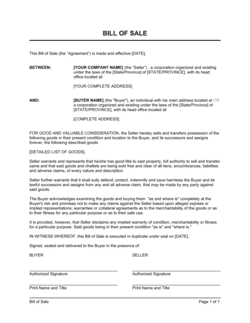
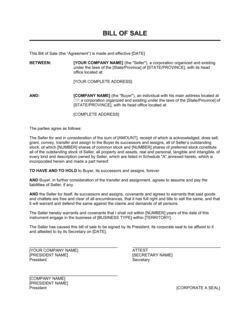
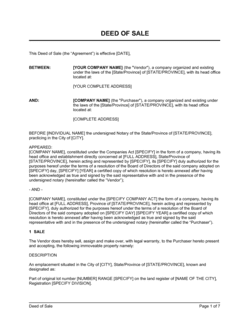
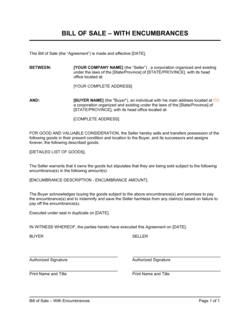
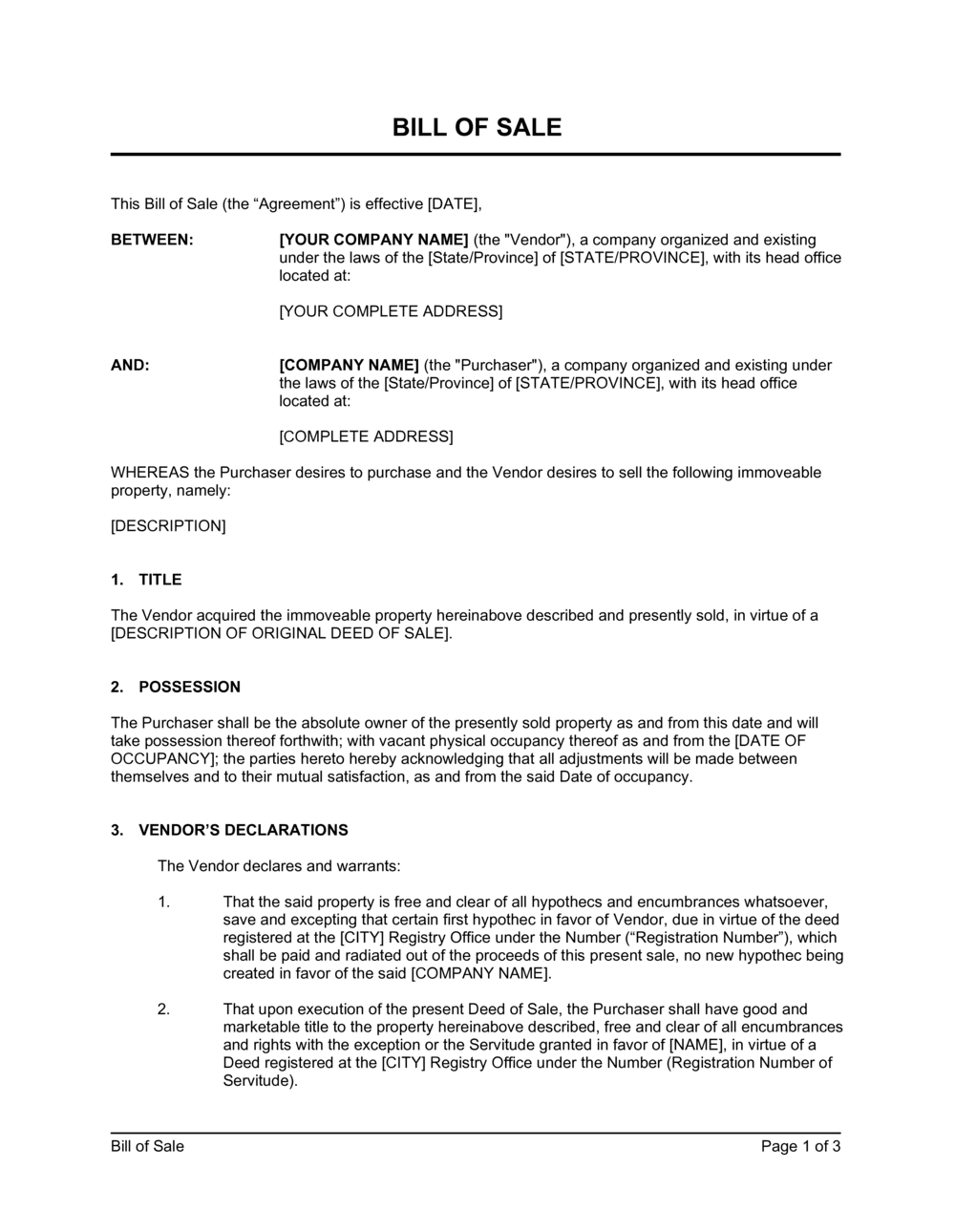
Bill of Sale Immovable Property Template

Free Word download • Edit online • Save & share with Drive • Export to PDF

3 pages20–30 min to fillDifficulty: StandardSignature requiredLegal review recommended
Learn more ↓
FreeBill of Sale Immovable Property Template

At a glance

What it is
A Bill of Sale for Immovable Property is a legally binding document that records the transfer of ownership of real property — land, buildings, or permanently attached structures — from a seller to a buyer for an agreed purchase price. This free Word download gives you a structured starting point covering all essential transfer terms, which you can edit online and export as PDF before execution and registration.
When you need it
Use it whenever a seller conveys title to real property outside of a full formal deed process, or as a supporting transaction record alongside a deed — including private land sales, commercial property transfers, and estate disposals. It is also used in jurisdictions where a bill of sale serves as the primary instrument of immovable property conveyance.
What's inside
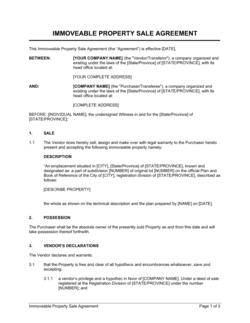
Party identification, full legal property description, purchase price and payment terms, representations and warranties on title and condition, transfer of possession clause, closing conditions, default and remedies, and governing law with signature blocks for both parties and a notary.

What is a Bill of Sale for Immovable Property?

A Bill of Sale for Immovable Property is a legally binding document that records the transfer of ownership of real property — land, buildings, and permanently attached structures — from a seller to a buyer for an agreed purchase price. Unlike a casual receipt or memorandum of agreement, a properly drafted bill of sale identifies both parties by their legal names, describes the property by its full cadastral or registry reference, states the consideration and payment mechanics, and includes the seller's warranties of title and disclosure of all known encumbrances. In civil-law jurisdictions such as Quebec and most of continental Europe, a notarized bill of sale is the primary instrument of conveyance registered in the public land registry; in common-law jurisdictions it frequently accompanies a deed as the governing commercial record of the transaction.

Why You Need This Document

Transferring real property without a comprehensive written instrument leaves both parties exposed in ways that are costly and slow to resolve. A seller without documented warranties can face post-closing claims for undisclosed liens or latent defects years after the transaction closes. A buyer without a financing condition forfeits their deposit — and potentially faces a damages lawsuit — if their mortgage falls through. Without explicit allocation of transfer taxes and registration fees, disputes over thousands of dollars in closing costs routinely delay or collapse transactions at the final stage. A buyer who skips registration after signing an unnotarized agreement may find that a subsequent creditor of the seller registers a competing claim first and takes priority. This template gives you the structured framework — parties, legal description, price, warranties, encumbrances, closing conditions, default remedies, and governing law — to protect both sides of the transaction from signing through registration.

Which variant fits your situation?

If your situation is…Use this template
Transferring residential land or a house in a private saleBill of Sale — Immovable Property (Residential)
Selling a commercial building or office premisesCommercial Property Sale Agreement
Transferring property as part of a full business acquisitionAsset Purchase Agreement
Documenting a vehicle or titled personal property transferBill of Sale — Motor Vehicle
Granting a long-term right to use property without transferring titleCommercial Lease Agreement
Transferring property between family members at a nominal considerationGift Deed
Documenting sale of land only, with no structuresLand Sale Agreement

Common mistakes to avoid

❌ Using only the civic address to describe the property

Why it matters: A street address is not a legally sufficient property identifier and can be ambiguous or subject to municipal renumbering. Land registry offices will reject an instrument without a proper legal description.

Fix: Pull the full legal description from the current deed or land registry record and include it verbatim in the property description clause.

❌ Failing to commission a title search before signing

Why it matters: An undisclosed mortgage, tax lien, or easement discovered after signing can make the property unsellable at the agreed price and expose the seller to damages for breach of warranty.

Fix: Require a clean title search as a closing condition and attach the search results as a schedule to the agreement before execution.

❌ Omitting a financing condition for the buyer

Why it matters: A buyer who cannot secure financing and has no contractual escape clause forfeits their deposit and may face a lawsuit for the seller's additional losses from a failed closing.

Fix: Include an explicit financing condition with a deadline — typically 15–21 days after signing — that allows the buyer to withdraw without penalty if financing is not confirmed.

❌ Not specifying who bears transfer taxes and registration fees

Why it matters: Transfer taxes on real property can reach 3–5% of the purchase price in many jurisdictions — an unallocated cost becomes a post-signing dispute that delays or derails closing.

Fix: State explicitly in the closing costs clause which party is responsible for land transfer tax, stamp duty, registration fees, and notarial fees.

❌ Signing after possession has already transferred

Why it matters: A buyer already in possession of the property has given up nothing new at the time of signing — restrictive covenants and condition clauses may be unenforceable, and the seller loses leverage to negotiate terms.

Fix: Execute the bill of sale before the buyer takes any possession of or control over the property, even informally.

❌ Not having the document notarized before filing

Why it matters: Most land registries reject instruments that are not authenticated by a notary. An unnotarized bill of sale provides no public notice of the transfer and leaves the buyer vulnerable to competing claims.

Fix: Schedule notarization as part of the closing process — never treat it as an afterthought. Both parties must be present or represented by a notarized power of attorney.

The 9 key clauses, explained

Parties and Recitals

In plain language: Identifies the seller and buyer as legal entities or individuals with full names and addresses, and states the basic intent of the transaction.

Sample language
This Bill of Sale is entered into as of [DATE] by and between [SELLER FULL LEGAL NAME], residing at [SELLER ADDRESS] ('Seller'), and [BUYER FULL LEGAL NAME], residing at [BUYER ADDRESS] ('Buyer').

Common mistake: Using informal or trade names instead of legal entity names. If the seller is a company, the registered corporate name must appear — not a trading name — or the transfer may be challenged as made by an entity without authority.

Property Description

In plain language: Provides the full legal description of the property being sold, including cadastral reference, lot-and-block number, civic address, and any appurtenant rights being conveyed.

Sample language
Seller hereby sells and transfers to Buyer the following described immovable property: [FULL LEGAL DESCRIPTION INCLUDING LOT, BLOCK, SUBDIVISION, MUNICIPALITY, AND CADASTRAL REFERENCE], together with all buildings, fixtures, and improvements thereon ('Property').

Common mistake: Using only the civic address instead of the full legal description. A street address can change or be ambiguous; the legal description is the definitive identifier in land registries and courts.

Purchase Price and Payment Terms

In plain language: States the total consideration, the amount paid at signing (deposit), the balance due at closing, and the accepted payment method.

Sample language
The total purchase price for the Property is [CURRENCY] [AMOUNT] ('Purchase Price'), payable as follows: (a) a deposit of [AMOUNT] upon execution of this Agreement; (b) the balance of [AMOUNT] by certified cheque or wire transfer at Closing on or before [CLOSING DATE].

Common mistake: Omitting the payment method and timeline. Courts have found that an unspecified payment deadline and method creates an implied 'reasonable time' obligation — which is litigated differently in every jurisdiction.

Representations and Warranties of Seller

In plain language: The seller's binding promises about the state of title, the absence of undisclosed encumbrances, and — where agreed — the physical condition of the property.

Sample language
Seller represents and warrants that: (a) Seller holds good and marketable title to the Property free of all encumbrances except as disclosed in Schedule A; (b) Seller has full legal authority to sell the Property; (c) there are no pending legal proceedings affecting the Property.

Common mistake: Drafting the warranties as representations only, without specifying they survive closing. Post-closing title defects or undisclosed encumbrances discovered after the transaction will be unactionable if the warranties expired at closing.

Disclosure of Encumbrances and Easements

In plain language: Lists all known mortgages, liens, easements, restrictions, and covenants that will survive the transfer, and confirms which will be discharged at or before closing.

Sample language
The Property is sold subject to the following encumbrances disclosed herein: [LIST ENCUMBRANCES, OR 'None']. Seller shall discharge the following at or before Closing: [LIST].

Common mistake: Leaving the encumbrance schedule blank or writing 'none' without conducting a title search first. An undisclosed lien discovered post-closing creates immediate liability for the seller and can cloud the buyer's title.

Transfer of Possession and Risk

In plain language: Specifies the date the buyer takes physical possession of the property and the point at which the risk of loss or damage shifts from seller to buyer.

Sample language
Possession of the Property shall be delivered to Buyer on [POSSESSION DATE]. Risk of loss or damage to the Property shall pass to Buyer upon delivery of possession.

Common mistake: Not distinguishing between the closing date and the possession date. In many transactions these differ — closing may occur remotely while physical possession transfers days later — and the party bearing risk during the gap is unspecified without this clause.

Closing Conditions

In plain language: Sets out the conditions each party must satisfy before the transaction closes — title clearance, discharge of liens, regulatory approvals, and financing confirmation.

Sample language
Closing is conditional upon: (a) Buyer receiving a title search confirming marketable title; (b) discharge of all encumbrances listed for discharge in Schedule A; (c) receipt of all required municipal or regulatory approvals; (d) Buyer's financing being confirmed in writing by [DATE].

Common mistake: Omitting a financing condition for buyers who have not yet secured final mortgage approval. If the buyer cannot fund and no condition protects them, they may forfeit the deposit and face a damages claim.

Default and Remedies

In plain language: Defines what constitutes a default by either party, the notice and cure period, and the remedies available — including deposit forfeiture, specific performance, and damages.

Sample language
If Buyer defaults, Seller may retain the deposit as liquidated damages and terminate this Agreement. If Seller defaults, Buyer may seek specific performance or recover all amounts paid plus documented costs. Either party must provide [X] days' written notice before exercising remedies.

Common mistake: Treating deposit forfeiture as the only remedy for buyer default. In high-value transactions, liquidated damages may be inadequate to cover the seller's actual loss from a failed closing — and courts in several jurisdictions will award additional damages if actual loss is proven.

Governing Law, Notarization, and Registration

In plain language: Specifies the jurisdiction whose law governs the agreement, confirms the notarization requirement, and assigns responsibility for filing the transfer in the public land registry.

Sample language
This Agreement shall be governed by the laws of [JURISDICTION]. The parties acknowledge that this instrument must be notarized and registered in the [LAND REGISTRY / CADASTRE] of [MUNICIPALITY / REGION]. Buyer shall bear all registration and transfer taxes unless otherwise agreed.

Common mistake: Omitting who bears transfer taxes and registration fees. These costs vary widely by jurisdiction and are a common source of post-signing disputes when not allocated explicitly.

How to fill it out

  1. 1

    Identify the parties with full legal names and addresses

    Enter the seller's and buyer's full legal names exactly as they appear on government-issued identification or corporate registration documents. Include complete mailing addresses for both parties.

    💡 For corporate sellers or buyers, confirm the registered entity name and jurisdiction of incorporation before signing — a mismatch with the title registry record can void the transfer.

  2. 2

    Insert the full legal description of the property

    Obtain the legal description from the current deed, title certificate, or land registry record and copy it verbatim. Include lot number, block, subdivision, cadastral reference, and municipality.

    💡 Never rely on Google Maps or a tax bill for the legal description — pull it directly from the land registry or a licensed surveyor's report.

  3. 3

    State the purchase price, deposit, and payment method

    Enter the total agreed price, the deposit amount due at signing, the balance payable at closing, and the accepted payment method (certified cheque, wire transfer). Include the closing date.

    💡 State the currency explicitly — especially in cross-border transactions — to avoid disputes if exchange rates shift between signing and closing.

  4. 4

    Complete the encumbrance schedule

    Commission a title search and list every mortgage, lien, easement, covenant, and restriction. For each encumbrance, state whether it survives the transfer or will be discharged at closing and by whom.

    💡 Order the title search before finalizing the sale price — an undisclosed lien or easement can materially affect property value and should be factored into negotiations.

  5. 5

    Draft the seller's representations and warranties

    Confirm that the seller represents good and marketable title, authority to sell, no pending litigation, and no undisclosed defects. Specify whether warranties survive closing and for how long.

    💡 A 12-month post-closing warranty survival period is a common negotiated standard — shorter favors the seller; longer favors the buyer.

  6. 6

    Set the closing conditions and possession date

    List every condition that must be satisfied before closing — title clearance, lien discharges, financing confirmation, and any regulatory approvals. State the possession date separately from the closing date if they differ.

    💡 Set a condition-satisfaction deadline at least 5 business days before the closing date to allow time to address any last-minute title or financing issues.

  7. 7

    Define default, remedies, and governing law

    State the notice period required before either party can exercise remedies, what happens to the deposit on buyer default, and whether specific performance is available to the buyer. Select the governing jurisdiction explicitly.

    💡 In Quebec and civil-law jurisdictions, specific performance is the default remedy for real property contracts — buyers may be compelled to complete. Confirm whether this aligns with your intent.

  8. 8

    Execute before a notary and register the transfer

    Both parties must sign in front of a licensed notary. After execution, file the instrument in the applicable land registry or cadastre within the required timeframe to protect the buyer's title against third-party claims.

    💡 Delays in registration can expose the buyer to competing claims — in most jurisdictions, priority among competing transferees goes to the first party to register, not the first to sign.

Frequently asked questions

What is a bill of sale for immovable property?

A bill of sale for immovable property is a legally binding document that records the transfer of ownership of real property — land, buildings, or permanently attached structures — from a seller to a buyer for an agreed purchase price. It identifies both parties, describes the property by legal description, states the consideration and payment terms, and includes the seller's warranties of title. In jurisdictions that use civil-law systems, a notarized bill of sale may serve as the primary instrument of conveyance registered in the public land registry.

What is the difference between a bill of sale and a deed for real property?

A deed is the instrument that formally transfers legal title to real property and is the standard instrument in common-law jurisdictions such as most US states and the UK. A bill of sale records the commercial transaction — purchase price, payment terms, warranties, and closing conditions — and may serve as the conveyance instrument in civil-law jurisdictions or as a supporting transaction record alongside a deed in common-law systems. In Quebec and many continental European countries, the notarized bill of sale is itself the title transfer instrument.

Does a bill of sale for immovable property need to be notarized?

In most jurisdictions, yes. Notarization is typically required for the instrument to be accepted by a land registry for registration, which is the step that gives the buyer's ownership public notice and priority against third-party claims. In Quebec, a notarized act is mandatory for all immovable property transfers. In the US, requirements vary by state — most require notarization for deed recording, and a bill of sale serving a similar function should meet the same standard. Always confirm the specific requirement in the applicable jurisdiction before execution.

What happens if I don't register the bill of sale after signing?

An unregistered transfer is generally valid between the parties but provides no public notice of the change in ownership. In most jurisdictions, priority among competing claims goes to the first party to register — meaning a subsequent buyer or creditor who registers before you can take priority over your unregistered transfer. Buyers should register the instrument in the applicable land registry as promptly as possible after execution.

Can a bill of sale be used to transfer property with an existing mortgage?

Yes, but the mortgage lender's consent is typically required if the mortgage contains a due-on-sale clause, which most residential mortgages do. Without lender consent, the sale may trigger immediate repayment of the outstanding mortgage balance. The bill of sale should include a closing condition requiring discharge or assumption of the mortgage, and the seller remains liable for the outstanding balance until it is fully discharged or the buyer assumes it with lender approval.

Who pays the land transfer tax on a property sale?

Transfer tax allocation is negotiable and should be stated explicitly in the bill of sale. By convention in most jurisdictions, the buyer pays land transfer tax, stamp duty, or registration fees — but the parties can agree to split costs or have the seller bear them. In Quebec, the welcome tax (taxe de bienvenue) is always the buyer's obligation regardless of contractual allocation. Confirm the applicable rate before negotiations, as transfer taxes on high-value properties can reach 3–5% of the purchase price.

Is a financing condition necessary in a bill of sale for immovable property?

A financing condition is strongly recommended for any buyer who has not received unconditional mortgage approval before signing. Without it, a buyer who cannot complete the purchase forfeits their deposit and may face a claim for the seller's additional losses. A standard financing condition allows the buyer 15–21 days to obtain written mortgage confirmation and to withdraw without penalty if financing is not secured.

What warranties should a seller give in a bill of sale for immovable property?

At minimum, a seller should warrant that they hold good and marketable title free of undisclosed encumbrances, that they have full legal authority to sell, that there are no pending legal proceedings affecting the property, and that the property complies with applicable zoning and building regulations. In residential transactions, sellers typically also warrant the absence of latent defects known to them. Buyers should confirm that warranties survive closing for at least 12 months to provide recourse for defects discovered post-transfer.

Do I need a lawyer to complete a bill of sale for immovable property?

Given the value and complexity of real property transactions, legal review is strongly recommended for all parties. In Quebec and most civil-law jurisdictions, a notary is legally required to authenticate the transfer. In common-law jurisdictions, while a lawyer is not always legally mandatory, the risks of an improperly drafted conveyance document — undisclosed encumbrances, unenforceable warranty clauses, or a defective legal description — typically far exceed the cost of a $500–$1,500 legal review.

How this compares to alternatives

vs Asset Purchase Agreement

An asset purchase agreement covers the sale of a bundle of business assets — equipment, inventory, IP, and goodwill — often including real property as one component. A bill of sale for immovable property focuses exclusively on the real property transfer and is the instrument filed with the land registry. Use an asset purchase agreement for full business acquisitions; use this bill of sale as the land-specific instrument within or alongside that broader transaction.

vs Commercial Lease Agreement

A commercial lease grants a tenant the right to occupy and use a property for a defined term without transferring ownership. A bill of sale transfers title outright in exchange for a purchase price. If the goal is to give a party long-term use of property without selling it, a lease is the correct instrument; if ownership is changing hands, a bill of sale is required.

vs Bill of Sale — Motor Vehicle

A motor vehicle bill of sale documents the transfer of a movable, titled personal property asset. An immovable property bill of sale covers real property — land and buildings — which is subject to land registry requirements, transfer taxes, and notarization obligations that do not apply to vehicle transfers. The legal formalities, costs, and registration steps are materially different between the two.

vs Deed of Sale

In common-law jurisdictions, a deed is the primary instrument transferring legal title to real property and is the document recorded in the land registry. A bill of sale documents the commercial terms of the transaction and may serve as the conveyance instrument in civil-law systems. In practice, many transactions use both: the deed passes title; the bill of sale records the agreed purchase price, warranties, and closing conditions that govern the parties' obligations.

Industry-specific considerations

Real Estate

Private sales between individuals or investors where a formal agent-brokered closing is bypassed, requiring the bill of sale to carry the full weight of the transaction record.

Construction and Development

Transfer of developed lots or completed units from a developer to a buyer, often with construction warranties and deficiency holdback amounts referenced in the closing conditions.

Manufacturing

Sale of industrial land and plant facilities as part of a business restructuring or plant closure, often bundled with equipment transfers under a separate asset purchase agreement.

Professional Services

Transfer of office or commercial premises between professional practice owners, including allocation of tenant improvements, fixtures, and lease obligations on attached structures.

Jurisdictional notes

United States

Real property transfer in the US is typically accomplished by deed — a warranty deed or quitclaim deed — rather than a bill of sale. A bill of sale may be used as a supplementary transaction record but is generally not the primary recorded instrument. Recording requirements, transfer taxes, and notarization rules vary by state: California imposes a documentary transfer tax; Florida requires a deed to be witnessed by two parties; Texas has no state transfer tax. Buyers should confirm the applicable state requirements before execution.

Canada

In Quebec, immovable property transfers must be executed by a notary as a notarized act and registered in the land register maintained by the Registre foncier — a bill of sale that is not notarized has no effect against third parties. In common-law provinces (Ontario, BC, Alberta), a transfer deed registered through the provincial land registry is the standard instrument; a bill of sale may serve as the underlying agreement. Provincial land transfer taxes apply in Ontario and BC; Quebec's welcome tax (taxe de bienvenue) is payable by the buyer based on the property value.

United Kingdom

In England and Wales, real property is transferred by a TR1 transfer form registered at HM Land Registry — not a bill of sale. A bill of sale for land has no legal effect as a conveyance instrument. The sale is typically documented through exchange of contracts followed by completion and registration. In Scotland, a disposition deed is used. Stamp Duty Land Tax (England), Land and Buildings Transaction Tax (Scotland), or Land Transaction Tax (Wales) applies based on purchase price thresholds updated annually.

European Union

Civil-law systems across the EU — France, Germany, Spain, Italy, the Netherlands — require immovable property transfers to be executed before a notary and registered in the national land or cadastral registry. The notarized instrument is the legally effective conveyance; an unnotarized bill of sale has no effect against third parties. Transfer taxes (droits de mutation in France, Grunderwerbsteuer in Germany) typically range from 3–10% of the purchase price and are generally borne by the buyer. GDPR compliance is relevant when processing personal data of the parties during the transaction.

Template vs lawyer — what fits your deal?

PathBest forCostTime
Use the templateLow-value land transfers between parties with a pre-existing agreement and access to a title searchFree1–2 hours to complete; 1–3 weeks to close including title search and registration
Template + legal reviewResidential or commercial property sales up to $1M where the parties want professional verification of title, encumbrances, and closing conditions$500–$1,500 for a real estate lawyer or notary review and closing2–4 weeks
Custom draftedHigh-value commercial or industrial property transfers, multi-parcel transactions, properties with complex encumbrances, or cross-border buyers and sellers$2,000–$10,000+ depending on transaction complexity and jurisdiction4–8 weeks

Glossary

Immovable Property
Land and anything permanently attached to it — buildings, fixtures, and infrastructure — as distinguished from movable personal property.
Conveyance
The legal act of transferring title or ownership of real property from one party to another, typically accomplished through a deed or bill of sale.
Legal Description
A formal, precise description of a parcel of land using metes and bounds, lot-and-block reference, or cadastral survey data — used to uniquely identify the property in public records.
Title
The legal right to own, use, and dispose of a piece of real property, evidenced by a deed or registration in a public land registry.
Encumbrance
Any claim, lien, mortgage, easement, or restriction on a property that may limit the owner's right to use or transfer it freely.
Warranty of Title
A seller's contractual promise that they hold clear title to the property and that no undisclosed encumbrances or third-party claims exist.
Closing
The final step of a property transaction at which the purchase price is paid, documents are executed, and ownership is formally transferred.
Notarization
The authentication of a document's signatures by a licensed notary public, required in most jurisdictions for real property transfer instruments to be recorded.
Consideration
The price or value exchanged for the property — typically the agreed purchase price in monetary terms, but can include other forms of value in non-arm's-length transactions.
Easement
A right granted to a third party to use a portion of the property for a specific purpose — such as a right-of-way or utility corridor — that survives ownership changes.
Lien
A legal claim against a property by a creditor — such as a mortgage lender or tax authority — that must typically be satisfied before clear title can pass to a buyer.

Part of your Business Operating System

This document is one of 3,000+ business & legal templates included in Business in a Box.

  • Fill-in-the-blanks — ready in minutes
  • 100% customizable Word document
  • Compatible with all office suites
  • Export to PDF and share electronically

Create your document in 3 simple steps.

From template to signed document — all inside one Business Operating System.
1
Download or open template

Access over 3,000+ business and legal templates for any business task, project or initiative.

2
Edit and fill in the blanks with AI

Customize your ready-made business document template and save it in the cloud.

3
Save, Share, Send, Sign

Share your files and folders with your team. Create a space of seamless collaboration.

Save time, save money, and create top-quality documents.

★★★★★

"Fantastic value! I'm not sure how I'd do without it. It's worth its weight in gold and paid back for itself many times."

Managing Director · Mall Farm
Robert Whalley
Managing Director, Mall Farm Proprietary Limited
★★★★★

"I have been using Business in a Box for years. It has been the most useful source of templates I have encountered. I recommend it to anyone."

Business Owner · 4+ years
Dr Michael John Freestone
Business Owner
★★★★★

"It has been a life saver so many times I have lost count. Business in a Box has saved me so much time and as you know, time is money."

Owner · Upstate Web
David G. Moore Jr.
Owner, Upstate Web

Run your business with a system — not scattered tools

Stop downloading documents. Start operating with clarity. Business in a Box gives you the Business Operating System used by over 250,000 companies worldwide to structure, run, and grow their business.

Start free · No credit card required