Bylaws Not for Profit Corporation Template

Free Word download • Edit online • Save & share with Drive • Export to PDF

4 pages25–35 min to fillDifficulty: ComplexSignature requiredLegal review recommended
Learn more ↓
FreeBylaws Not for Profit Corporation Template

At a glance

What it is
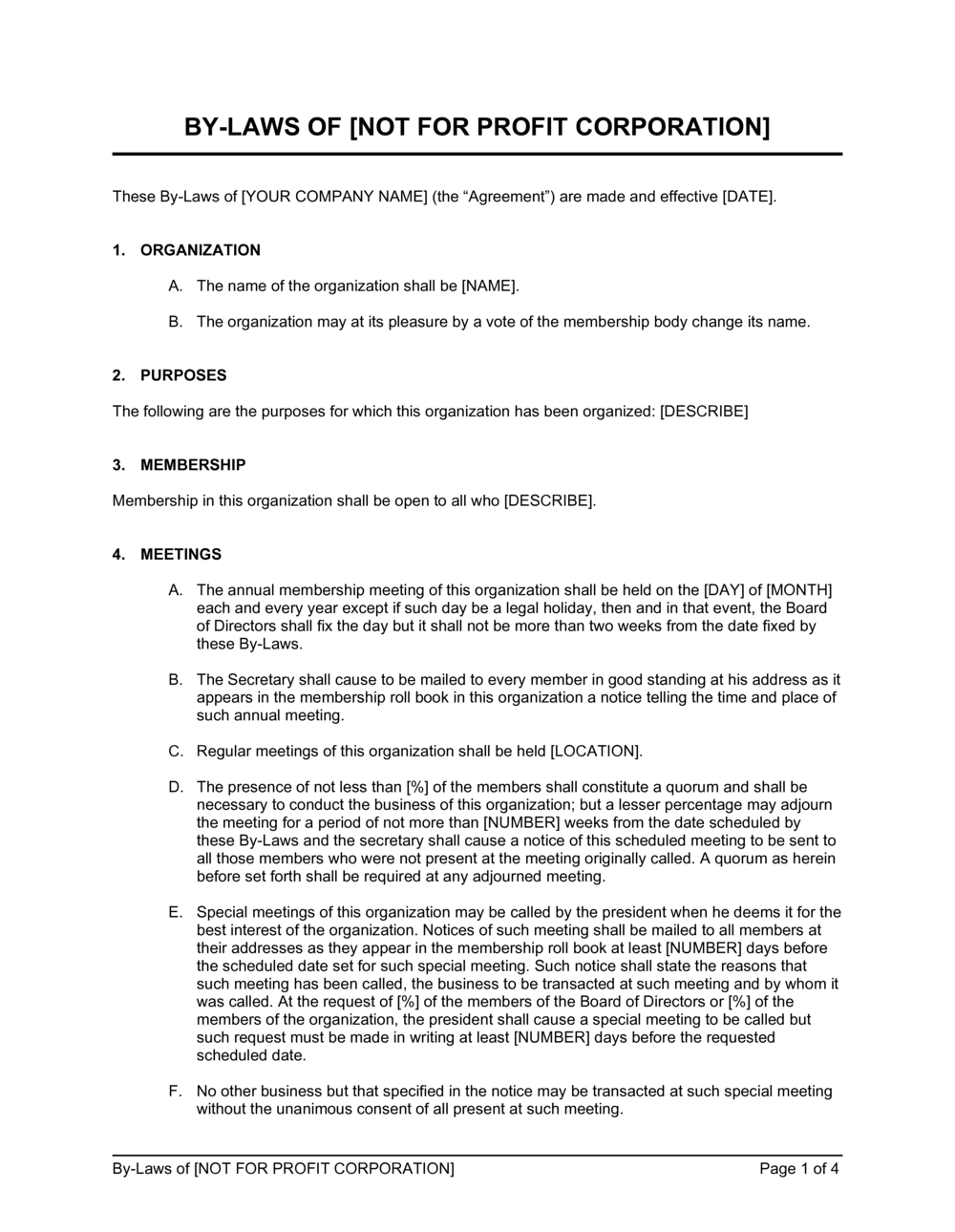
Nonprofit Corporation Bylaws are the foundational governing document that establishes how a not-for-profit corporation is structured, managed, and operated on a day-to-day basis. This free Word download covers board composition, officer roles, membership rules, meeting procedures, voting thresholds, conflict-of-interest policies, and dissolution — everything required to satisfy state law and IRS tax-exemption requirements in a single editable document.
When you need it
You need bylaws at the moment of incorporation — most states require them before the first board meeting — and again when applying for 501(c)(3) or equivalent tax-exempt status, which the IRS specifically requests as part of Form 1023. Any significant change to governance structure, board size, or membership categories also triggers a bylaws amendment.
What's inside
The template covers the organization's name, purpose, and registered office; board of directors composition, terms, and removal procedures; officer titles and responsibilities; membership classes and voting rights; annual and special meeting requirements; quorum and voting rules; conflict-of-interest and indemnification policies; amendment procedures; and dissolution and asset distribution clauses.

What is a Nonprofit Bylaws Document?

Nonprofit Corporation Bylaws are the foundational internal governing document of a not-for-profit corporation, setting out the rules by which the organization is structured, managed, and operated. They define the composition and powers of the board of directors, the roles and responsibilities of officers, the rights of any members, the procedures for calling and conducting meetings, quorum and voting requirements, conflict-of-interest and indemnification policies, and the procedures for amending the document itself. Unlike the Articles of Incorporation — which are filed publicly with the state — bylaws are an internal operational document, though they carry legal force as a binding governance contract among the board, officers, and members of the organization.

Nonprofit bylaws also serve a critical regulatory function: the IRS requires a copy of the organization's bylaws as part of the Form 1023 application for 501(c)(3) tax-exempt status and will scrutinize specific provisions — particularly the purpose clause, conflict-of-interest policy, and dissolution clause — before granting exemption. Bylaws that fail to include qualifying language in any of these sections are a leading cause of IRS application delays and denials.

Why You Need This Document

Operating a nonprofit corporation without properly adopted bylaws leaves the organization without a procedural basis for any board decision — officer elections, contract approvals, bank account authorizations, and grant acceptances are all potentially voidable if the underlying governance process cannot be validated against a written rule set. State nonprofit corporation acts in every US jurisdiction require bylaws to be adopted at or before the first board meeting, and many states make the requirement a condition of maintaining the corporation's legal status.

Beyond legal compliance, bylaws protect individual board members. A director who acts without a governing framework has no procedural shield against personal liability claims from co-directors, members, or regulators. The indemnification and conflict-of-interest provisions in a properly drafted set of bylaws are the primary governance tools that separate a board member acting in a protected fiduciary capacity from one acting without authority.

For organizations pursuing 501(c)(3) status, foundation grants, or government funding, compliant bylaws are not optional — they are a gatekeeping document. Grant applications from major foundations routinely require a current certified copy of bylaws as part of their due-diligence package, and an application submitted with outdated or non-compliant bylaws will stall in review. This template gives you a complete, IRS-aligned starting point you can adapt to your organization's structure in a matter of hours.

Which variant fits your situation?

If your situation is…Use this template
Forming a membership-based nonprofit where members elect the boardNonprofit Bylaws with Membership Structure
Forming a self-perpetuating board nonprofit with no public membershipNonprofit Bylaws (Board-Only / Non-Membership)
Incorporating a church or religious organizationChurch Bylaws
Establishing a homeowners association or community organizationHOA Bylaws
Setting up a Canadian not-for-profit corporation federallyCanada Not-for-Profit Corporation Bylaws
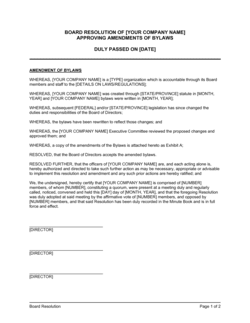
Amending existing bylaws after a board voteBylaws Amendment Resolution
Documenting board meeting decisions including bylaw adoptionNonprofit Board Meeting Minutes

Common mistakes to avoid

❌ Purpose clause that permits non-qualifying activities

Why it matters: The IRS will deny 501(c)(3) exemption if the purpose clause allows activities inconsistent with charitable, religious, educational, or scientific purposes — even if the organization never intends to conduct them.

Fix: Limit the purpose clause strictly to 501(c)(3) qualifying purposes and include the standard savings language: 'No part of the net earnings shall inure to the benefit of any private shareholder or individual.'

❌ No conflict-of-interest policy or undocumented recusals

Why it matters: Form 990 asks annually whether the organization has a written conflict-of-interest policy — answering 'no' flags the organization for IRS scrutiny and can jeopardize future grant funding from major foundations.

Fix: Include an explicit conflict-of-interest policy in the bylaws and require that all disclosures and recusals be recorded in meeting minutes every time the policy is triggered.

❌ Dissolution clause that allows distribution to individuals

Why it matters: The IRS requires that upon dissolution, assets be transferred only to other qualifying tax-exempt organizations. Any language permitting distribution to founders, board members, or the general public disqualifies the organization from 501(c)(3) status.

Fix: State explicitly that all remaining assets shall be distributed to one or more organizations described in Section 501(c)(3) and that no assets shall be distributed to directors, officers, or private individuals.

❌ Bylaws adopted after the first board meeting rather than at it

Why it matters: Actions taken at a board meeting held without adopted bylaws may be procedurally defective — state incorporation statutes typically require bylaws to be adopted at the organizational meeting, and later adoption creates a gap in governance.

Fix: Schedule bylaws adoption as the first substantive agenda item at the organizational meeting and record the adoption vote verbatim in the minutes.

❌ Amendment procedure with no advance notice requirement

Why it matters: Without mandatory advance notice of a proposed amendment, a quorate but incomplete board can change fundamental governance rules — reducing quorum thresholds, extending term limits, or eliminating the conflict-of-interest policy — before absent directors can respond.

Fix: Require written notice of any proposed amendment at least 10 to 14 days before the meeting and set the approval threshold at two-thirds of directors present and voting.

❌ Bylaws inconsistent with the Articles of Incorporation

Why it matters: If the bylaws state a different number of directors, purpose, or voting threshold than the Articles of Incorporation, the Articles govern — making the bylaws unenforceable on those points and creating confusion during audits, grant applications, or IRS review.

Fix: Compare the bylaws against the filed Articles of Incorporation clause by clause before adoption, and amend either document so they are fully consistent.

The 10 key clauses, explained

Name, purpose, and registered office

In plain language: States the corporation's full legal name, its charitable or nonprofit mission, and the address of its principal office and registered agent.

Sample language
The name of this corporation is [ORGANIZATION FULL LEGAL NAME] ('Corporation'). The Corporation is organized exclusively for [CHARITABLE / EDUCATIONAL / RELIGIOUS] purposes as described in Section 501(c)(3) of the Internal Revenue Code. The principal office is located at [ADDRESS], [CITY], [STATE] [ZIP].

Common mistake: Using a mission statement that is too broad or includes activities inconsistent with 501(c)(3) purposes — the IRS scrutinizes purpose language and may deny exemption if it allows non-qualifying activities.

Board of directors — composition and terms

In plain language: Defines the minimum and maximum number of directors, their term lengths, whether terms are staggered, and any eligibility requirements.

Sample language
The Board of Directors shall consist of not fewer than [MINIMUM NUMBER] and not more than [MAXIMUM NUMBER] directors. Each director shall serve a term of [X] years. Terms shall be [staggered / concurrent], with [X] directors elected each year at the annual meeting.

Common mistake: Setting a fixed board size instead of a range — a range (e.g., 5 to 15 directors) gives the board flexibility to grow without amending the bylaws every time a seat is added.

Election, vacancies, and removal of directors

In plain language: Describes how directors are elected or appointed, how vacancies mid-term are filled, and the process and threshold required to remove a director for cause or without cause.

Sample language
Directors shall be elected by a [majority / two-thirds] vote of the current Board at the annual meeting. Vacancies may be filled by a majority vote of the remaining directors. Any director may be removed with or without cause by a two-thirds vote of the entire Board, provided [X] days' written notice has been given.

Common mistake: Not specifying the vote threshold for removal separately from the general voting clause — many bylaws default to simple majority for everything, which can make removing a disruptive director practically impossible without a supermajority rule.

Officers — titles, duties, and succession

In plain language: Lists required officer positions (typically President/Chair, Vice President, Secretary, and Treasurer), their core responsibilities, and how vacancies in officer roles are filled.

Sample language
The officers of the Corporation shall be a President, a Vice President, a Secretary, and a Treasurer. Officers shall be elected by the Board at the annual meeting and shall serve terms of [X] year(s). One person may hold any two offices except the offices of President and Secretary.

Common mistake: Allowing one person to hold both President and Secretary simultaneously — this creates a governance conflict because the Secretary records and certifies board actions, including actions taken by the President.

Meetings of the board — notice and quorum

In plain language: Sets the frequency of regular board meetings, notice requirements for special meetings, quorum rules, and whether meetings may be held remotely.

Sample language
Regular meetings of the Board shall be held [quarterly / monthly] at a time and place determined by the President. Special meetings may be called by the President or any [X] directors upon [X] days' written notice. A quorum shall consist of a majority of the directors then in office.

Common mistake: Setting quorum too low (e.g., two directors on a fifteen-member board) — a low quorum allows a small faction to conduct binding organizational business that the broader board later disputes.

Membership classes and voting rights

In plain language: Defines whether the organization has members, the classes of membership, dues or eligibility requirements, and each class's voting rights in elections and major decisions.

Sample language
The Corporation shall have [one class of members / two classes: Voting Members and Associate Members]. Voting Members shall be entitled to [one vote per member / votes proportional to] at all meetings of the membership. Membership dues, if any, shall be set by the Board.

Common mistake: Omitting the membership section entirely when the organization does plan to have a public membership — leaving it out creates an irreconcilable conflict between the bylaws and the organization's actual operations.

Conflict of interest policy

In plain language: Requires directors and officers to disclose any personal financial interest in a transaction before the board votes, and to recuse themselves from the discussion and vote on that transaction.

Sample language
Any director, officer, or member of a committee who has a direct or indirect financial interest in any transaction to be considered by the Board shall disclose that interest and shall not vote on or participate in discussion of such transaction. The disclosure and recusal shall be recorded in the minutes.

Common mistake: Stating the policy in general terms without requiring that disclosures and recusals be recorded in the minutes — the IRS reviews Form 990 conflict-of-interest responses against actual minutes, and undocumented recusals create compliance exposure.

Indemnification and liability limitation

In plain language: Commits the organization to defend and indemnify directors and officers against claims arising from their good-faith service, to the extent permitted by state law.

Sample language
The Corporation shall indemnify any director or officer who is made a party to any civil or criminal proceeding by reason of their service to the Corporation, provided such person acted in good faith and in a manner reasonably believed to be in the best interests of the Corporation, to the fullest extent permitted by [STATE] law.

Common mistake: Failing to limit indemnification to good-faith conduct — an unconditional indemnification clause may be unenforceable and could expose the organization to covering costs for a director's intentional misconduct.

Amendment procedure

In plain language: Specifies the notice period and voting threshold required to change the bylaws, ensuring that amendments are deliberate rather than impulsive.

Sample language
These Bylaws may be amended at any regular or special meeting of the Board, provided that written notice of the proposed amendment has been given to all directors at least [X] days prior to the meeting and the amendment is approved by a [two-thirds] vote of the directors present and voting.

Common mistake: Setting the amendment threshold too low (simple majority with no advance notice) — this allows a quorate but incomplete board to change fundamental governance rules without input from absent directors.

Dissolution and distribution of assets

In plain language: Describes the process for winding down the corporation and requires that remaining assets be distributed to one or more qualifying tax-exempt organizations — a mandatory provision for 501(c)(3) status.

Sample language
Upon dissolution of the Corporation, the Board shall, after paying or making provision for all liabilities, distribute all remaining assets to one or more organizations that qualify as exempt under Section 501(c)(3) of the Internal Revenue Code, as the Board shall determine. No assets shall be distributed to any director, officer, or private individual.

Common mistake: Omitting the explicit prohibition on distributing assets to individuals — without this language, the IRS will reject a 501(c)(3) application or, worse, treat a distribution upon dissolution as taxable private benefit.

How to fill it out

  1. 1

    Enter the corporation's legal name and purpose

    Insert the exact legal name as it will appear in the Articles of Incorporation. Draft the purpose clause to match 501(c)(3) language precisely — include both the specific mission and the general charitable purpose savings clause.

    💡 Review IRS Publication 557 for purpose language that has been accepted for 501(c)(3) applications — slightly imprecise wording is the single most common cause of initial IRS rejections.

  2. 2

    Set board size as a range, not a fixed number

    Define the minimum and maximum number of directors (e.g., 5 to 15). Confirm the range aligns with your state's nonprofit corporation act minimum — most require at least three directors.

    💡 A range of 5 to 15 is the most common structure among community nonprofits and gives you room to add diverse expertise without amending the bylaws.

  3. 3

    Define term lengths and staggered election schedule

    Choose term lengths (typically 2 or 3 years) and decide whether to stagger terms so only one-third of the board turns over each year. Staggered terms preserve institutional knowledge.

    💡 For organizations applying for government grants, funders often look for staggered terms as a sign of governance maturity — note it explicitly.

  4. 4

    Complete the officer section with clear role definitions

    List the President, Vice President, Secretary, and Treasurer at minimum. Write two to three sentences of duties for each. Confirm no one person will hold both President and Secretary simultaneously.

    💡 If your organization uses 'Executive Director' instead of 'President,' decide whether the ED is an officer position elected by the board or a staff role — the bylaws must be consistent with your actual operating model.

  5. 5

    Set quorum at a meaningful threshold

    A quorum of a simple majority of the sitting board is standard. Confirm the threshold in your state's nonprofit corporation act and ensure the bylaws meet or exceed it.

    💡 Calculate your quorum against the maximum board size you set — if you cap at 15 directors, a majority quorum means 8 directors must be present for any binding vote.

  6. 6

    Tailor the conflict-of-interest policy to IRS requirements

    The IRS Form 1023 specifically asks whether the organization has a written conflict-of-interest policy and whether it requires annual disclosure statements. Confirm the policy in these bylaws answers both questions affirmatively.

    💡 Attach a separate annual disclosure form as an exhibit to the bylaws — it reinforces the policy's operational use and satisfies IRS best-practice expectations.

  7. 7

    Complete the dissolution clause with a named class of recipients

    Identify the category of recipient organizations (e.g., 'organizations described in Section 501(c)(3) of the Internal Revenue Code') rather than naming a specific organization — named recipients can wind down or change purpose.

    💡 Do not allow any flexibility for asset distribution to founders or board members upon dissolution — any such language will trigger IRS denial of 501(c)(3) status.

  8. 8

    Adopt the bylaws formally at the organizational meeting

    The initial board of directors must formally adopt the bylaws at the first organizational meeting and record the vote in the meeting minutes. The Secretary should certify the adopted bylaws with their signature and the date.

    💡 File a copy of the certified bylaws with the Form 1023 application — the IRS requires the document as part of the exemption determination package.

Frequently asked questions

What are nonprofit bylaws?

Nonprofit bylaws are the internal governing document of a not-for-profit corporation that defines how the organization is structured and operated. They cover the board of directors, officer roles, membership rules, meeting procedures, voting thresholds, conflict-of-interest policies, and dissolution procedures. Unlike the Articles of Incorporation — which are filed publicly with the state — bylaws are an internal document, though the IRS requests them as part of the 501(c)(3) application process.

Are bylaws required for a nonprofit corporation?

Yes, in virtually every US state and Canadian province, a not-for-profit corporation is legally required to adopt bylaws at or before its first board meeting. The IRS also requires a copy of the bylaws when processing Form 1023 or Form 1023-EZ applications for federal tax-exempt status. Operating without adopted bylaws exposes the organization to governance disputes and can invalidate board actions taken without a procedural basis.

What is the difference between bylaws and articles of incorporation?

The Articles of Incorporation are the public founding document filed with the state that legally creates the corporation. Bylaws are the internal rules that govern how the corporation operates after it is formed. The Articles take precedence over the bylaws in any conflict. Both documents must be consistent — different quorum thresholds or board-size limits in each document create governance conflicts that must be resolved by amending one of them.

Do nonprofit bylaws need to be filed with the state?

In most US states, bylaws do not need to be filed with the state — only the Articles of Incorporation are a public filing. However, some states require bylaws to be available for inspection by members or the public, and several states require them to be produced in response to a government inquiry. The IRS requires a copy with the Form 1023 application, and many grant funders require a current certified copy as part of their due-diligence process.

Can nonprofit bylaws be changed after adoption?

Yes, bylaws can be amended by the board — or by the membership if the organization has a membership structure — following the amendment procedure specified in the bylaws themselves. Most bylaws require advance written notice of the proposed change (typically 10 to 14 days) and approval by a two-thirds supermajority vote. Any amendment must be recorded in board minutes and the certified bylaws document should be updated and re-signed by the Secretary.

What is a conflict-of-interest policy in nonprofit bylaws, and why does the IRS care?

A conflict-of-interest policy requires directors and officers to disclose any personal financial interest in a transaction before the board votes on it and to recuse themselves from the discussion and vote. The IRS specifically asks on Form 990 whether the organization has a written conflict-of-interest policy and whether it requires annual disclosure statements from directors and officers. Organizations that cannot answer affirmatively face heightened IRS scrutiny and are less competitive for foundation grants that use Form 990 governance indicators in their due-diligence screening.

How many directors should a nonprofit board have?

Most states require at least three directors for a nonprofit corporation. As a practical matter, community nonprofits typically operate with 7 to 15 directors — large enough to distribute governance responsibilities and small enough to reach quorum reliably. The bylaws should define the range as a minimum and maximum (e.g., 5 to 15) rather than a fixed number so the board can adjust its size without a bylaw amendment.

What happens to a nonprofit's assets when it dissolves?

Federal tax law requires that upon dissolution, a 501(c)(3) organization distribute all remaining assets to one or more other organizations that qualify under Section 501(c)(3) of the Internal Revenue Code. Assets cannot be distributed to directors, officers, founders, or members. This requirement must be stated explicitly in the bylaws — it is a condition of obtaining and retaining tax-exempt status, and the IRS will deny a 501(c)(3) application that omits or contradicts it.

Do I need a lawyer to write nonprofit bylaws?

For most straightforward charitable, educational, or community nonprofits, a high-quality template is sufficient to produce compliant bylaws when completed carefully and reviewed against your state's nonprofit corporation act. Consider engaging a nonprofit attorney when the organization has a complex membership structure, operates in multiple states, involves a hospital or school subject to additional regulatory requirements, or when the IRS application involves unusual activities. A 1 to 2 hour attorney review typically costs $300 to $600 and is worthwhile before submitting Form 1023.

How this compares to alternatives

vs Articles of Incorporation

The Articles of Incorporation are filed publicly with the state and legally create the nonprofit corporation. Bylaws are the internal operational rules adopted after incorporation. The Articles are the higher-authority document — bylaws cannot contradict them. Both are required, but they serve different functions and audiences: state regulators see the Articles, while the board and IRS use the bylaws.

vs Corporate Bylaws (For-Profit)

For-profit corporate bylaws and nonprofit bylaws share similar governance structure — board composition, officer roles, meeting procedures — but nonprofit bylaws must include specific provisions required for tax-exempt status: a qualifying purpose clause, a conflict-of-interest policy, and an asset-distribution-upon-dissolution clause that prohibits private benefit. Using a for-profit template for a nonprofit omits these required provisions and will result in an IRS denial.

vs Operating Agreement (LLC)

An LLC operating agreement governs a for-profit limited liability company and addresses profit distribution, member buyout rights, and manager authority. Nonprofit corporations cannot be structured as LLCs for 501(c)(3) purposes — they must incorporate as nonprofit corporations and adopt bylaws. An operating agreement is the wrong document entirely for a charitable organization seeking tax-exempt status.

vs Board Meeting Minutes

Bylaws are the governing rules; board meeting minutes are the running record of decisions made under those rules. Minutes document that the board is following the bylaws — recording quorum, vote counts, officer elections, and conflict-of-interest disclosures. Both are required for IRS compliance and grant due diligence, but they serve distinct functions: bylaws set the rules, minutes prove the rules are being followed.

Industry-specific considerations

Education and schools

Accreditation bodies and state education departments often require certified bylaws on file; parent-teacher organizations need clear membership voting provisions distinct from the school's own governance.

Healthcare and social services

Hospital and clinic nonprofits face additional regulatory oversight and typically require enhanced conflict-of-interest policies covering physician and vendor relationships, along with credentialing committee provisions.

Arts and culture

Museums, theaters, and arts organizations commonly use tiered membership structures with voting and non-voting classes, requiring bylaws to define each class's rights and dues obligations clearly.

Religious organizations

Churches and religious nonprofits may qualify for automatic 501(c)(3) status without filing Form 1023, but still require bylaws to govern internal operations and satisfy state incorporation requirements.

Professional and trade associations

Member-driven associations require voting thresholds and election procedures tailored to large, geographically dispersed memberships, often including proxy voting and electronic ballot provisions.

Community and social advocacy

Grassroots organizations with volunteer boards need clear quorum rules and remote-meeting provisions to function reliably despite irregular member availability.

Jurisdictional notes

United States

Each state has its own Nonprofit Corporation Act setting minimum requirements for bylaws — including minimum director counts (typically three), required officer positions, and notice periods for meetings. The IRS requires bylaws as part of both Form 1023 and Form 1023-EZ applications for 501(c)(3) status. California, New York, and Texas impose additional requirements — California mandates specific audit committee provisions for nonprofits with gross revenues exceeding $2 million.

Canada

Federal nonprofits incorporated under the Canada Not-for-Profit Corporations Act (NFP Act) must adopt bylaws covering membership rights, board composition, and meeting procedures. Provincially incorporated nonprofits are governed by provincial legislation — Ontario's Not-for-Profit Corporations Act, 2010 (ONCA) came fully into force in 2022 and requires nonprofits to update legacy bylaws to comply. Quebec nonprofits incorporated under the Companies Act must ensure bylaws are available in French.

United Kingdom

UK charities typically operate under a constitution or articles of association rather than 'bylaws' as a named document — the function is equivalent. Charitable companies must file their articles with Companies House and register with the Charity Commission. The Charity Commission provides model governing documents that many small charities adopt directly. CIOs (Charitable Incorporated Organisations) use a constitution rather than articles and bylaws.

European Union

There is no unified EU nonprofit corporation law — each member state governs associations and nonprofit entities separately. France uses the 1901 Association law; Germany uses eingetragener Verein (e.V.) registration under the Civil Code. Most EU jurisdictions require governing statutes (equivalent to bylaws) to be filed with a court, notary, or public registry. Organizations seeking cross-border grant funding from EU institutions must typically demonstrate compliant governance documentation in their home jurisdiction.

Template vs lawyer — what fits your deal?

PathBest forCostTime
Use the templateStandard charitable, educational, or community nonprofits filing Form 1023-EZ or straightforward Form 1023 applicationsFree2–4 hours
Template + legal reviewNonprofits with complex membership structures, multi-state operations, or Form 1023 applications involving unusual activities$300–$6001–3 days
Custom draftedHospitals, schools, large foundations, or organizations subject to additional regulatory requirements beyond standard 501(c)(3) rules$1,500–$4,000+1–3 weeks

Glossary

Bylaws
The internal governing rules of a corporation that regulate how it is managed, including board structure, meeting procedures, and voting requirements.
Board of Directors
The governing body of a nonprofit corporation, legally responsible for its finances, strategy, and compliance with its stated mission.
Quorum
The minimum number of board members or voting members who must be present for a meeting to conduct official business.
501(c)(3)
The US IRS tax-exemption category for charitable organizations, which exempts qualifying nonprofits from federal income tax and enables donors to deduct contributions.
Conflict of Interest
A situation where a board member or officer has a personal or financial interest that could improperly influence a decision they make on behalf of the organization.
Indemnification
A bylaw provision that protects board members and officers from personal liability for actions taken in good faith on behalf of the organization.
Dissolution Clause
The bylaw provision specifying how the organization's assets are distributed if the nonprofit ceases operations — typically to another tax-exempt organization.
Amendment Procedure
The process, including required notice and voting threshold, by which the bylaws themselves may be changed.
Registered Agent
An individual or entity designated to receive official legal and government correspondence on behalf of the corporation in its state of incorporation.
Articles of Incorporation
The public founding document filed with the state that creates the legal entity; bylaws are the internal rules that govern it.
Fiduciary Duty
The legal obligation of board members to act in the best interests of the organization, including duties of care, loyalty, and obedience.

Part of your Business Operating System

This document is one of 3,000+ business & legal templates included in Business in a Box.

  • Fill-in-the-blanks — ready in minutes
  • 100% customizable Word document
  • Compatible with all office suites
  • Export to PDF and share electronically

Create your document in 3 simple steps.

From template to signed document — all inside one Business Operating System.
1
Download or open template

Access over 3,000+ business and legal templates for any business task, project or initiative.

2
Edit and fill in the blanks with AI

Customize your ready-made business document template and save it in the cloud.

3
Save, Share, Send, Sign

Share your files and folders with your team. Create a space of seamless collaboration.

Save time, save money, and create top-quality documents.

★★★★★

"Fantastic value! I'm not sure how I'd do without it. It's worth its weight in gold and paid back for itself many times."

Managing Director · Mall Farm
Robert Whalley
Managing Director, Mall Farm Proprietary Limited
★★★★★

"I have been using Business in a Box for years. It has been the most useful source of templates I have encountered. I recommend it to anyone."

Business Owner · 4+ years
Dr Michael John Freestone
Business Owner
★★★★★

"It has been a life saver so many times I have lost count. Business in a Box has saved me so much time and as you know, time is money."

Owner · Upstate Web
David G. Moore Jr.
Owner, Upstate Web

Run your business with a system — not scattered tools

Stop downloading documents. Start operating with clarity. Business in a Box gives you the Business Operating System used by over 250,000 companies worldwide to structure, run, and grow their business.

Start free · No credit card required