Interview Confidential Disclosure Agreement Template

Free Word download • Edit online • Save & share with Drive • Export to PDF

1 page20–30 min to fillDifficulty: StandardSignature requiredLegal review recommended
Learn more ↓
FreeInterview Confidential Disclosure Agreement Template

At a glance

What it is
An Interview Confidential Disclosure Agreement is a legally binding contract signed by a job candidate before or during the interview process, preventing them from disclosing sensitive business information they learn during hiring conversations. This free Word download lets you customize the confidentiality scope, permitted uses, and duration, then export as PDF for signature before any substantive interview begins.
When you need it
Use it whenever an interview requires sharing trade secrets, proprietary processes, unreleased product details, financial data, or strategic plans with candidates — before you can assess whether they are the right hire. It is especially critical when interviewing candidates who may simultaneously be considering roles with direct competitors.
What's inside
Party identification, definition of confidential information, permitted use restrictions, exclusions from confidentiality, non-solicitation of employees and customers, term and termination, remedies for breach, and governing law. The agreement covers both unilateral disclosure from employer to candidate and, where relevant, mutual obligations.

What is an Interview Confidential Disclosure Agreement?

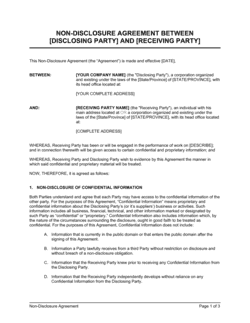
An Interview Confidential Disclosure Agreement is a legally binding contract signed by a job candidate before or during the hiring process, obligating them to keep any sensitive business information they encounter during interviews strictly confidential. Unlike a general NDA signed at the start of employment, this agreement takes effect before any employment relationship exists — the moment a company must begin sharing trade secrets, product roadmaps, financial data, client information, or proprietary processes simply to assess whether the candidate is the right hire. It establishes a defined permitted purpose (evaluating a potential employment opportunity), restricts any other use of the information, and gives the company enforceable legal remedies — including injunctive relief — if the candidate misuses what they learned.

Why You Need This Document

Without a signed interview confidentiality agreement in place, sharing anything beyond a job description with a candidate carries real legal and competitive risk. A technical candidate who learns your product architecture and then joins a competitor has cost you nothing you can recover in court if there was no signed agreement. A senior sales candidate who hears your pricing strategy, key account names, and growth targets — and then walks those details to a rival employer — may have committed no actionable wrong. The cost of that exposure is compounded by the fact that you cannot un-share what was already disclosed. Trade secret protection under the Defend Trade Secrets Act and its international equivalents requires that you take reasonable steps to maintain secrecy — and courts have found that briefing candidates without a confidentiality agreement is not a reasonable step. This template gives you a signed, timestamped agreement before any sensitive briefing takes place, covering permitted use, non-solicitation, return of materials, and remedies — closing the gap that exists between a candidate's first substantive interview and their first day on the job.

Which variant fits your situation?

If your situation is…Use this template
Interviewing for a senior executive or C-suite position involving strategic briefingsExecutive Interview NDA
Conducting a working interview or paid skills assessment using real company dataWorking Interview Confidentiality Agreement
Onboarding a hired employee with ongoing confidentiality obligationsEmployee Non-Disclosure Agreement
Engaging an independent contractor who will access sensitive systemsIndependent Contractor NDA
Sharing mutual confidential information in a partnership or vendor evaluationMutual Non-Disclosure Agreement
Protecting IP during a technical or product-design hiring assessmentTechnical Assessment Confidentiality Agreement
Covering a candidate interview involving proprietary financial data or M&A detailsNon-Disclosure Agreement (Business)

Common mistakes to avoid

❌ Sharing confidential information before the agreement is signed

Why it matters: An unsigned NDA creates no legal obligation. If you share trade secrets or strategic plans verbally before obtaining a signature, you may have lost trade secret protection for that information under the Defend Trade Secrets Act and most provincial equivalents.

Fix: Make signed receipt of the NDA a mandatory prerequisite before any substantive interview — block calendar invites until e-signature confirmation is received.

❌ Using an overly broad definition of confidential information

Why it matters: Definitions that purport to protect 'all information shared in any context' are routinely narrowed or voided by courts as unconscionable. This can nullify the clauses you actually needed enforced.

Fix: List specific, genuine categories of confidential information the role requires you to disclose — product roadmaps, pricing models, client databases — and rely on a catch-all as a supplement, not the primary definition.

❌ Omitting a non-use clause and only prohibiting disclosure

Why it matters: A candidate who does not share information externally but uses it to inform decisions at a competing employer has breached the spirit of the agreement without technically violating a disclosure-only clause. This leaves you with no enforceable claim.

Fix: Include an explicit non-use clause prohibiting the candidate from using confidential information for any purpose other than evaluating the specific employment opportunity.

❌ Setting an unreasonably long non-solicitation period for unaccepted candidates

Why it matters: Courts treat candidates who were never hired differently from departing employees. A 24-month non-solicitation on someone who attended one interview is frequently struck down as an unreasonable restraint of trade, voiding the clause entirely.

Fix: Limit non-solicitation for rejected or withdrawn candidates to 6–12 months and scope it narrowly to contacts they actually encountered during the interview process.

❌ Choosing a governing jurisdiction with no connection to the employer

Why it matters: Several jurisdictions — California, Germany, and Quebec notably — apply local employment law regardless of what the contract specifies. Choosing an unconnected favorable jurisdiction does not avoid mandatory local protections and signals to courts that you are trying to circumvent the law.

Fix: Select the governing law of the jurisdiction where the employer operates and where most interviews will be conducted. Consult local counsel for any cross-border hire.

❌ No return or destruction clause with a defined deadline

Why it matters: Without a specified deadline, candidates retain confidential materials indefinitely while technically 'intending' to return them — leaving you with no clear breach date and weakening any subsequent claim.

Fix: Specify that all materials must be returned or destroyed within 10 business days of a written request or the conclusion of the interview process, with a written certification of destruction.

The 10 key clauses, explained

Parties and recitals

In plain language: Identifies the employer entity and the candidate by full legal name, and explains the context — that confidential information will be shared in connection with evaluating a potential employment relationship.

Sample language
This Confidential Disclosure Agreement ('Agreement') is entered into as of [DATE] between [EMPLOYER LEGAL NAME], a [STATE/PROVINCE] [ENTITY TYPE] ('Company'), and [CANDIDATE FULL NAME] ('Candidate'), in connection with the Candidate's evaluation for the position of [JOB TITLE].

Common mistake: Using a trade name instead of the employer's registered legal entity name. If the agreement is ever enforced, a mismatch between the signing entity and the actual employer can void the contract or complicate injunctive proceedings.

Definition of confidential information

In plain language: Sets out precisely what counts as confidential — trade secrets, product roadmaps, financials, client lists, technology, and any information marked confidential — while being broad enough to cover oral disclosures.

Sample language
'Confidential Information' means any non-public information disclosed by the Company to Candidate, whether in writing, orally, or by inspection, relating to the Company's business, technology, customers, financial condition, or strategic plans, including but not limited to [SPECIFIC CATEGORIES].

Common mistake: Defining confidential information so broadly that courts find it unenforceable — for example, including information already widely known in the industry. Courts require the definition to be reasonable and tied to genuinely protectable interests.

Permitted use and non-use obligations

In plain language: Limits the candidate to using confidential information solely to evaluate whether to accept employment, and prohibits any other use including competing, building similar products, or sharing with third parties.

Sample language
Candidate shall use Confidential Information solely for the purpose of evaluating a potential employment relationship with the Company ('Permitted Purpose') and shall not use it for any other purpose, including personal benefit or advantage in dealings with third parties.

Common mistake: Omitting a non-use clause and only prohibiting disclosure. A candidate who does not share information externally but uses trade secrets to benefit a competing employer — or their own business — has technically complied with a disclosure-only clause.

Exclusions from confidentiality

In plain language: Carves out information the candidate does not need to protect: information already in the public domain, information the candidate knew before the interview, or information received from a third party without restriction.

Sample language
The obligations of this Agreement do not apply to information that: (a) is or becomes publicly available through no breach of this Agreement; (b) was known to Candidate before disclosure; (c) is independently developed by Candidate without use of Confidential Information; or (d) is disclosed by a third party lawfully entitled to do so.

Common mistake: Omitting the exclusions clause entirely. A court may interpret an unlimited confidentiality obligation as unconscionable and void the entire agreement, including the clauses you actually need enforced.

Non-solicitation of employees and customers

In plain language: Prevents the candidate from recruiting the company's employees or approaching its customers for a defined period after the interview process ends, whether or not the candidate is hired.

Sample language
For a period of [12] months following the conclusion of the interview process, Candidate shall not, directly or indirectly, solicit or induce any employee of the Company to leave their employment, or solicit any customer of the Company with whom Candidate came into contact during the interview process.

Common mistake: Setting an overly long non-solicitation period — 24 or 36 months — for a candidate who was never hired. Courts in several jurisdictions treat this as an unreasonable restraint of trade and void the clause.

Compelled disclosure

In plain language: Permits the candidate to disclose confidential information if required by law, court order, or regulatory authority, provided they give the company prompt written notice so it can seek a protective order.

Sample language
If Candidate is required by applicable law or court order to disclose Confidential Information, Candidate shall: (a) promptly notify the Company in writing before disclosure; (b) cooperate with the Company in seeking a protective order; and (c) disclose only the minimum information required.

Common mistake: Requiring the candidate to refuse to comply with a court order. This is unenforceable and can expose the candidate — and the employer — to contempt liability. The correct approach is prompt notice and cooperation in seeking a protective order.

Return or destruction of confidential materials

In plain language: Requires the candidate to return all physical and digital materials containing confidential information, or certifiably destroy them, within a set number of days after the interview process concludes or on demand.

Sample language
Upon written request by the Company, or upon conclusion of the interview process, Candidate shall promptly return or destroy all Confidential Information in any form, and certify in writing that all copies have been destroyed, within [10] business days.

Common mistake: Not specifying a return or destruction deadline. Without a deadline, candidates retain materials indefinitely while technically still 'intending' to return them, leaving the company with no clear breach trigger.

Term and survival

In plain language: States how long the confidentiality obligations last — typically 2–5 years from signing — and specifies which clauses survive termination of the agreement.

Sample language
The confidentiality obligations under this Agreement shall survive for [THREE (3)] years from the date of this Agreement. The provisions of Sections [X] (Permitted Use), [X] (Return of Materials), and [X] (Remedies) shall survive any expiration or termination.

Common mistake: Setting a perpetual term for all confidentiality obligations. Trade secrets can justifiably be protected indefinitely, but courts scrutinize perpetual obligations on general confidential information and sometimes void them as overbroad.

Remedies for breach

In plain language: States that a breach would cause irreparable harm not fully compensable by money damages, entitling the company to seek injunctive relief without posting bond, in addition to any other legal remedies.

Sample language
Candidate acknowledges that any breach of this Agreement would cause irreparable harm to the Company for which monetary damages would be an inadequate remedy, and the Company shall be entitled to seek injunctive or other equitable relief in any court of competent jurisdiction without the requirement to post bond.

Common mistake: Omitting the 'inadequate remedy at law' acknowledgment. Courts generally require this finding before granting a temporary restraining order. Without it, the company may need to separately prove irreparable harm in an emergency injunction hearing.

Governing law and dispute resolution

In plain language: Identifies which jurisdiction's laws govern the agreement and how disputes will be resolved — litigation, arbitration, or mediation — and where proceedings will be held.

Sample language
This Agreement shall be governed by and construed in accordance with the laws of [STATE/PROVINCE/COUNTRY], without regard to its conflict-of-laws provisions. Any dispute shall be resolved by [binding arbitration / litigation] in [CITY, JURISDICTION].

Common mistake: Choosing a governing law with no meaningful connection to the employer's location or the candidate's residence. Several jurisdictions — notably California — apply local law regardless of what the contract specifies, which can render the non-solicitation clauses unenforceable.

How to fill it out

  1. 1

    Insert the employer's legal entity name and details

    Use the full registered corporate name, not a brand name or DBA. Include the state or province of incorporation and the company's principal business address.

    💡 Cross-check the name against your corporate registry filing before printing — a mismatch between the signing entity and the actual employer is the most common reason interview NDAs fail in enforcement.

  2. 2

    Identify the candidate and the role

    Enter the candidate's full legal name as it appears on government-issued ID. Include the specific job title being considered so the agreement's purpose is clear and defensible.

    💡 If you are interviewing multiple candidates for the same role, prepare individual agreements with each candidate's name — never use a blank or generic 'candidate' reference on the signature page.

  3. 3

    Define the scope of confidential information

    Tailor the confidential information definition to the categories you will actually share — product roadmaps, financial data, customer lists, proprietary processes. List specific categories rather than relying solely on a catch-all clause.

    💡 Oral disclosures are easy to miss. Add language requiring the company to confirm oral disclosures in writing within 5 business days to preserve enforceability.

  4. 4

    Set the permitted purpose

    Confirm the permitted purpose clause is limited to evaluating a potential employment relationship. This prevents a candidate from arguing they were authorized to use the information for other purposes.

    💡 If you are also evaluating the candidate as a potential consultant or contractor, expand the permitted purpose clause to cover both relationships — two separate agreements are cleaner but a single clause covering both is valid.

  5. 5

    Calibrate non-solicitation scope and duration

    Set the non-solicitation period proportionate to the seniority of the role. For junior roles, 6–12 months is typical and defensible. For senior roles with access to key accounts or strategic hires, 12–18 months is more appropriate.

    💡 In California, non-solicitation of employees has been effectively banned for former employees since 2022 — apply the same caution to candidates and remove or significantly narrow this clause for California-based interviews.

  6. 6

    Choose the term of confidentiality obligations

    Set the confidentiality term to 2–5 years for general confidential information. If the agreement covers trade secrets, include language that trade secret protection extends for as long as the information qualifies as a trade secret under applicable law.

    💡 A two-tier term — 3 years for general confidential information and indefinite for trade secrets — is the most defensible structure and is accepted by courts in most US states, Canadian provinces, and EU member states.

  7. 7

    Select governing law tied to the employer's location

    Choose the state, province, or country where the employer operates as the governing jurisdiction. If the candidate is in a different jurisdiction, note any mandatory local law provisions that may override the agreement.

    💡 For candidates in California, Germany, or Quebec, have a local employment lawyer confirm whether any clauses — particularly non-solicitation — need to be modified or removed to be enforceable.

  8. 8

    Execute before the interview begins

    Send the agreement to the candidate at least 24–48 hours before the interview so they have time to review it. Obtain a countersigned copy before sharing any confidential information.

    💡 Use Business in a Box eSign to timestamp execution and store the fully-executed copy automatically. A timestamped record of when the agreement was signed is critical if a breach occurs within days of the interview.

Frequently asked questions

What is an interview confidential disclosure agreement?

An interview confidential disclosure agreement is a legally binding contract a candidate signs before or during the hiring process, obligating them to keep any sensitive business information learned during interviews strictly confidential. It typically covers trade secrets, unreleased product details, financial data, customer information, and strategic plans — information the employer must share to meaningfully assess the candidate's fit for the role. Unlike a post-employment NDA, it takes effect before any employment relationship exists.

When should a company require candidates to sign an interview NDA?

Require an interview NDA whenever the hiring process involves sharing genuinely sensitive information — product roadmaps, proprietary processes, financial projections, client databases, or competitive strategies. It is particularly critical for senior technical, executive, sales, and product roles where substantive briefings are necessary to evaluate fit. If the interview is purely competency-based with no proprietary disclosures, a formal NDA is typically unnecessary and may deter candidates unnecessarily.

Is an interview NDA enforceable against a candidate who was never hired?

Generally yes, provided the agreement was signed before any confidential information was shared and the restrictions are reasonable in scope and duration. Courts in most jurisdictions treat an interview NDA as a standalone contract supported by the consideration of the company sharing its confidential information. However, non-solicitation clauses applied to candidates who were never hired face stricter scrutiny — keep these narrow and time-limited to maximize enforceability.

What is the difference between an interview NDA and an employment NDA?

An interview NDA is signed before any employment relationship is formed and covers only information shared during the hiring process. An employment NDA is signed at or after hire and governs the entire employment relationship, including information the employee creates or accesses on the job. The two documents serve different moments in the relationship; many employers use both — the interview NDA first, then a broader employment NDA as part of the onboarding package.

Can a candidate refuse to sign an interview NDA?

A candidate may decline to sign, in which case the employer can — and typically should — decline to share confidential information or withdraw the candidate from consideration for roles requiring such access. There is no legal obligation on either party to proceed. In practice, candidates for senior or technical roles understand interview NDAs are standard; refusal without explanation can itself be a signal worth noting.

How long should the confidentiality obligation in an interview NDA last?

Two to five years is the most defensible range for general confidential information. Trade secrets can be protected indefinitely — as long as they qualify as trade secrets under applicable law. A two-tier structure (3 years for general confidential information, indefinite for trade secrets) is widely accepted by courts in the US, Canada, the UK, and most EU member states. Perpetual obligations on all information types face higher risk of being partially voided as overbroad.

Do interview NDAs need to be mutual?

Most interview NDAs are one-directional — the employer discloses, the candidate is bound. A mutual NDA makes sense only when the candidate is also sharing sensitive information, such as proprietary work samples, trade secrets from a prior employer (which raises separate legal issues), or confidential business plans they are bringing to the role. For standard hiring conversations, a unilateral agreement is appropriate and less administratively complex.

What happens if a candidate breaches an interview NDA?

The employer may seek injunctive relief to stop ongoing disclosure, claim monetary damages for proven losses, and in cases of trade secret misappropriation, pursue remedies under the Defend Trade Secrets Act (US), the Trade Secrets Act (Canada), or equivalent legislation. Courts can award actual damages, reasonable royalties, or — in willful misappropriation cases in the US — exemplary damages up to twice the actual damages. The practical first step is a cease-and-desist letter backed by the signed agreement.

Do I need a lawyer to prepare an interview NDA?

For standard domestic hires, a well-drafted template is typically sufficient. Engage a lawyer when the role involves highly sensitive IP in a competitive market, when the candidate is located in a jurisdiction with strict employment restrictions (California, Germany, Quebec), or when the interview process will involve disclosure of information that is the core commercial value of the business. A 1-hour legal review typically costs $200–$400 and is worthwhile for any C-suite or senior technical hire.

How this compares to alternatives

vs Employee Non-Disclosure Agreement

An employee NDA is signed at hire and governs confidentiality obligations throughout the employment relationship and after departure. An interview NDA is signed before any employment relationship exists and covers only information shared during the hiring process. The two documents are complementary — the interview NDA protects the pre-hire conversation; the employment NDA takes over from day one and covers everything the employee creates or accesses on the job.

vs Mutual Non-Disclosure Agreement

A mutual NDA binds both parties to confidentiality — used when both sides are sharing sensitive information, such as in a partnership or vendor evaluation. An interview NDA is typically unilateral — the employer discloses, the candidate is bound. Use a mutual NDA only if the candidate will also be sharing proprietary information of their own during the interview process.

vs Employment Contract

An employment contract governs the entire working relationship — compensation, duties, IP assignment, termination, and post-employment restrictions. An interview NDA has a narrower, earlier function: protecting information shared before employment begins. An employer needs both — the interview NDA for the hiring process, and the employment contract when the candidate accepts the offer.

vs Independent Contractor Agreement

An independent contractor agreement governs a project-based working relationship and typically includes a confidentiality clause within the contract itself. An interview NDA is a standalone pre-engagement document used before any formal relationship — employment or contractor — is established. If a candidate is being evaluated for either an employee or contractor role, the interview NDA should be signed first, regardless of which engagement type follows.

Industry-specific considerations

Technology / SaaS

Protects unreleased software features, algorithms, architecture decisions, and product roadmaps shared during technical interviews and system design assessments.

Financial Services

Covers proprietary trading strategies, client portfolios, risk models, and regulatory compliance frameworks that must be disclosed to assess senior candidates' expertise.

Healthcare / Life Sciences

Safeguards clinical trial data, drug development pipelines, proprietary formulations, and patient data governance frameworks shared during medical or scientific role interviews.

Manufacturing

Protects production processes, supplier relationships, cost structures, and proprietary equipment specifications disclosed during operations or engineering role evaluations.

Professional Services

Covers client identities, engagement methodologies, proprietary pricing models, and internal benchmarking data shared with senior consulting or advisory candidates.

Retail / E-commerce

Protects merchandising strategies, supplier terms, proprietary demand-forecasting models, and customer segmentation data discussed during buyer or operations leadership interviews.

Jurisdictional notes

United States

Trade secret protection at the federal level is governed by the Defend Trade Secrets Act (DTSA), which provides a federal cause of action and potential exemplary damages for willful misappropriation. State law varies significantly — California courts are hostile to non-solicitation clauses even in pre-employment contexts. The FTC's proposed non-compete rule (blocked in 2024–2025) does not affect standalone interview NDAs, but the trend toward restricting post-employment restraints warrants conservative scoping of any non-solicitation terms.

Canada

Trade secrets are protected under common law and, in some provinces, specific legislation such as Ontario's planned trade secrets act. Non-solicitation clauses for candidates who were never hired face meaningful scrutiny and should be limited to 6–12 months to be defensible. Quebec requires that any contract presented to a candidate be provided in French for provincially regulated employers. Federal employees fall under additional PIPEDA privacy obligations when personal information is collected during interviews.

United Kingdom

The UK does not have a standalone trade secrets statute equivalent to the US DTSA, but the Trade Secrets (Enforcement, etc.) Regulations 2018 implement the EU Trade Secrets Directive and provide a civil remedy for misappropriation. Restrictive covenants — including non-solicitation — are enforceable if reasonable and protecting a legitimate business interest. Courts apply a reasonableness test strictly; perpetual or overbroad clauses are blue-pencilled or voided. Post-Brexit, UK courts apply domestic law rather than EU directives directly.

European Union

The EU Trade Secrets Directive (2016/943), implemented across all member states, harmonizes trade secret protection and provides injunctive relief, damages, and publication of judicial decisions as remedies. GDPR applies to any personal data collected from candidates during the interview process — even the candidate's name and contact details — requiring a lawful basis for processing. Non-solicitation clauses must typically be supported by financial compensation to the candidate in several member states, including Germany and France, to be enforceable post-interview.

Template vs lawyer — what fits your deal?

PathBest forCostTime
Use the templateStandard domestic hires for roles below C-suite where the information shared is sensitive but not the core commercial value of the businessFree15–20 minutes
Template + legal reviewSenior technical, executive, or sales hires where trade secrets are central, or where the candidate is in a jurisdiction with complex employment restrictions$200–$5001–2 days
Custom draftedC-suite hires, cross-border candidates in heavily regulated jurisdictions, or interviews involving core IP with high misappropriation risk$800–$2,500+3–7 days

Glossary

Confidential Information
Any non-public business information disclosed to the candidate during the interview process, including trade secrets, financials, product details, and customer data.
Disclosing Party
The party — typically the employer — that shares confidential information with the other party during the interview.
Receiving Party
The party — typically the candidate — who receives confidential information and is bound by the non-disclosure obligations.
Trade Secret
Commercially valuable information that derives its value from being kept secret and is subject to reasonable efforts to maintain its secrecy.
Permitted Purpose
The specific, limited reason for which the receiving party may use confidential information — in this context, solely to evaluate a potential employment relationship.
Non-Solicitation
A restriction preventing the candidate from approaching or hiring the company's employees or customers for a defined period after the interview process ends.
Exclusions from Confidentiality
Categories of information the agreement does not protect — typically information already public, independently developed by the candidate, or disclosed by a third party without restriction.
Injunctive Relief
A court order requiring a party to stop a specific action immediately, used in NDA breaches where monetary damages alone are insufficient to remedy the harm.
Term
The defined duration of the confidentiality obligations — commonly 2–5 years from the date of signing or the last interview, whichever is later.
Return or Destruction of Materials
A clause requiring the candidate to return or certifiably destroy any documents, notes, or copies of confidential information if the employment offer is not extended or accepted.
Compelled Disclosure
A legal exception allowing the receiving party to disclose confidential information when required by a court order or government authority, provided they give prompt notice to the disclosing party.

Part of your Business Operating System

This document is one of 3,000+ business & legal templates included in Business in a Box.

  • Fill-in-the-blanks — ready in minutes
  • 100% customizable Word document
  • Compatible with all office suites
  • Export to PDF and share electronically

Create your document in 3 simple steps.

From template to signed document — all inside one Business Operating System.
1
Download or open template

Access over 3,000+ business and legal templates for any business task, project or initiative.

2
Edit and fill in the blanks with AI

Customize your ready-made business document template and save it in the cloud.

3
Save, Share, Send, Sign

Share your files and folders with your team. Create a space of seamless collaboration.

Save time, save money, and create top-quality documents.

★★★★★

"Fantastic value! I'm not sure how I'd do without it. It's worth its weight in gold and paid back for itself many times."

Managing Director · Mall Farm
Robert Whalley
Managing Director, Mall Farm Proprietary Limited
★★★★★

"I have been using Business in a Box for years. It has been the most useful source of templates I have encountered. I recommend it to anyone."

Business Owner · 4+ years
Dr Michael John Freestone
Business Owner
★★★★★

"It has been a life saver so many times I have lost count. Business in a Box has saved me so much time and as you know, time is money."

Owner · Upstate Web
David G. Moore Jr.
Owner, Upstate Web

Run your business with a system — not scattered tools

Stop downloading documents. Start operating with clarity. Business in a Box gives you the Business Operating System used by over 250,000 companies worldwide to structure, run, and grow their business.

Free Forever Plan · No credit card required