1
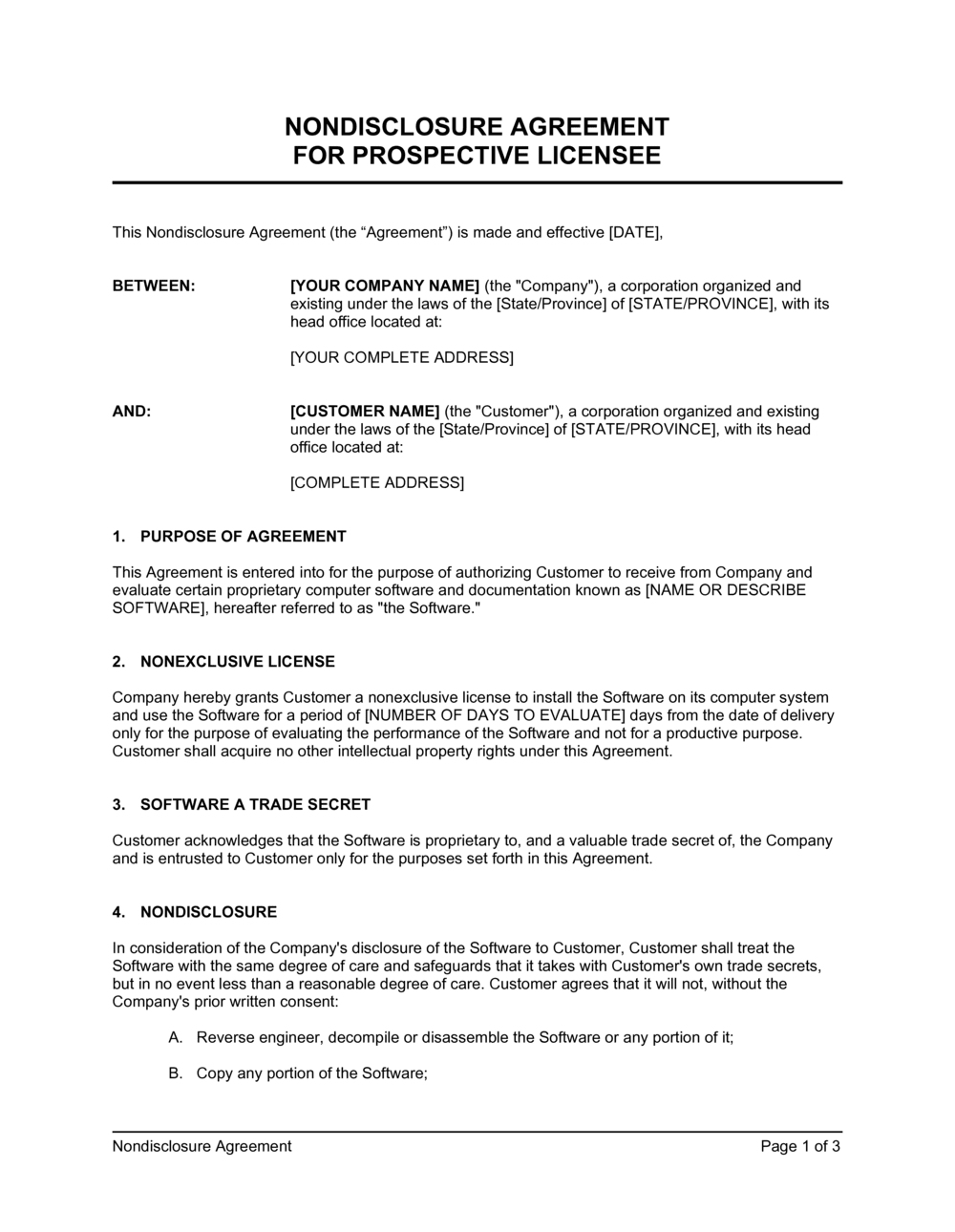
Identify both parties by full legal name
Enter the licensor's registered legal entity name and the prospective licensee's full legal name. Include entity type (LLC, Inc., Ltd.) and state or country of incorporation for both parties.
💡 Cross-check each party's name against its corporate registry filing — a single-word mismatch can complicate enforcement.
2
Define the confidential information precisely
Describe the IP or information being protected with enough specificity that a court could determine whether a given item falls within the definition. Include oral disclosures, demonstrations, and derivative works, not just marked written documents.
💡 If the IP includes both patented and unpatented elements, distinguish them — patent applications become public, but surrounding know-how may remain a trade secret.
3
State the permitted purpose narrowly
Limit the permitted purpose to evaluating a specific potential licensing arrangement. Name the IP or technology by type. Avoid generic language like 'business purposes' or 'exploring a relationship.'
💡 The narrower the permitted purpose, the easier it is to prove misuse if the prospective licensee uses your information to build a competing product.
4
Set the obligations and need-to-know access controls
Specify the standard of care (reasonable care or the same care as the receiving party uses for its own confidential information, whichever is higher), identify permitted recipients (employees, contractors, advisors), and require that those recipients be bound by written obligations.
💡 Add a clause requiring the receiving party to maintain a log of individuals given access — this is rarely resisted and is invaluable if a leak occurs.
5
Confirm the no-license grant and IP ownership
Ensure the agreement expressly states that no rights, title, or license in the confidential information or underlying IP are transferred to the prospective licensee by virtue of this NDA.
💡 If a subsequent license is executed, the NDA's no-license clause should be superseded by the license agreement — include a merger or supersession clause to clarify the relationship between the two documents.
6
Set the term and survival provisions
Enter the agreement duration (typically one to three years for a licensing evaluation) and ensure trade-secret obligations survive indefinitely while other obligations survive for at least two to five years post-expiration.
💡 For pharmaceutical, biotech, or semiconductor IP, consider extending general confidentiality survival to ten years — standard two-year survival is inadequate for long product cycles.
7
Include return/destruction and compelled-disclosure obligations
Specify that all materials — physical and digital, including derivative analyses — must be returned or destroyed on request, and require advance notice to the licensor before any compelled disclosure to regulators or courts.
💡 Request a written certification of destruction rather than relying on verbal confirmation — it creates an audit trail if a dispute arises later.
8
Choose governing law and sign before disclosure
Select the governing law of a jurisdiction with robust trade-secret protection relevant to where the disclosing party operates. Both authorized signatories must execute before any confidential information is shared.
💡 Never share a term sheet, technical data room link, or product demo before the signed NDA is in your files — the disclosure itself is the irreversible event.