Network Engineer Job Description Template

Free Word download • Edit online • Save & share with Drive • Export to PDF

2 pages20–30 min to fillDifficulty: StandardSignature requiredLegal review recommended
Learn more ↓
FreeNetwork Engineer Job Description Template

At a glance

What it is
A Network Engineer Job Description is a formal binding document that defines the scope of a network engineer role within an organization — covering duties, reporting structure, required qualifications, compensation range, and compliance obligations. This free Word download gives you a structured, legally grounded starting point you can edit online and export as PDF before attaching it to an offer letter or employment contract.
When you need it
Use it when opening a new network engineer position, replacing a departing employee, or formalizing an existing role that has grown beyond its original informal description. It is also required when posting to regulated job boards or initiating a sponsored visa application for a foreign national candidate.
What's inside
Job title and classification, reporting structure, core technical duties, required and preferred qualifications, certifications, compensation band and benefits, work location and travel requirements, and equal-opportunity and compliance language. Each clause is drafted to align with standard employment law requirements and reduce exposure to discrimination claims.

What is a Network Engineer Job Description?

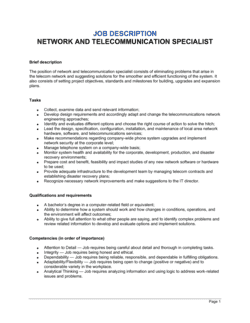
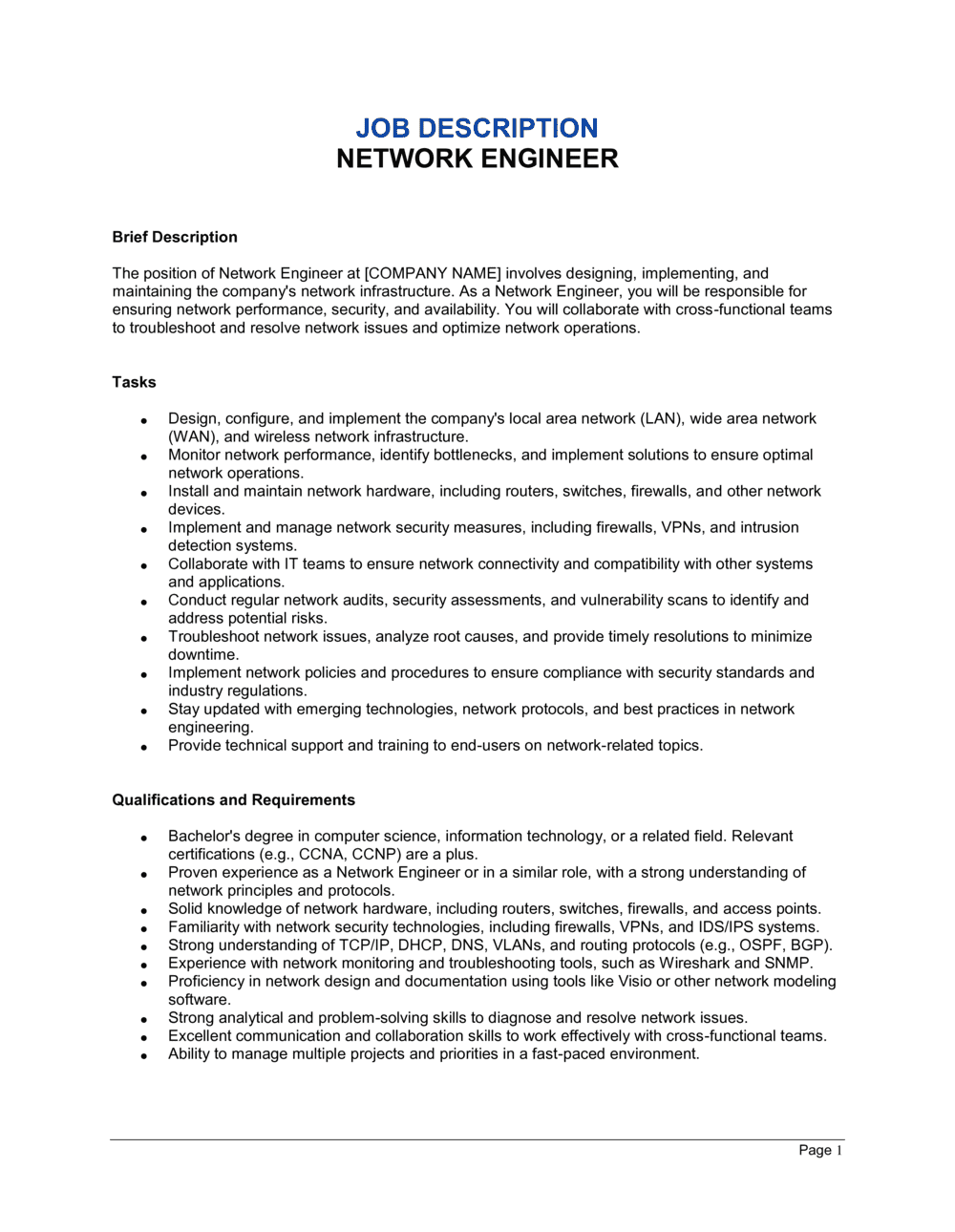
A Network Engineer Job Description is a formal document that defines the scope, duties, qualifications, compensation, and compliance requirements of a network engineering position within an organization. It identifies the role's essential functions — from LAN/WAN design and VPN deployment to firewall management and network monitoring — and establishes the minimum education, experience, and certifications a candidate must hold. When signed by both the hiring manager and the incoming employee, it becomes a binding record that governs performance management, ADA accommodation decisions, and FLSA exemption classification for the life of the employment relationship.

Why You Need This Document

An informal or incomplete job description exposes your organization on several fronts simultaneously. Without explicitly documented essential functions, you cannot enforce a performance improvement plan or deny an accommodation request on the grounds that a duty is fundamental to the role. Without a salary range in your posting, you may be in violation of pay transparency laws in Colorado, California, New York, or Washington — each carrying per-violation civil penalties. Without a defined list of authorized remote-work states, a single remote hire creates payroll tax nexus and workers' compensation obligations in a state where you are not registered. For network engineering roles supporting a visa petition, an imprecise duty statement is among the most common triggers for an H-1B Request for Evidence or a Tier 2 refusal. This template gives you a legally grounded, recruiter-ready starting point that addresses every one of these risks in under 30 minutes.

Which variant fits your situation?

If your situation is…Use this template
Hiring an entry-level network technician or associateJunior Network Engineer Job Description
Filling a senior-level individual contributor roleSenior Network Engineer Job Description
Hiring a team lead or people manager over a network teamNetwork Engineering Manager Job Description
Engaging a contractor for a defined infrastructure projectIndependent Contractor Agreement
Recruiting a specialist focused solely on cybersecurityNetwork Security Engineer Job Description
Defining a cloud-focused network or DevOps infrastructure roleCloud Network Engineer Job Description
Supporting a sponsored visa application with a formal duty statementEmployment Contract (At-Will)

Common mistakes to avoid

❌ Inflating education requirements beyond what the role genuinely needs

Why it matters: Requiring a four-year degree for a role performable with an associate degree and CCNA certification can constitute disparate impact discrimination and is increasingly challenged by the EEOC and state labor agencies.

Fix: Replace blanket degree requirements with 'bachelor's degree or equivalent combination of education, certifications, and experience' to widen the qualified pool without lowering standards.

❌ Omitting the salary range in pay-transparency jurisdictions

Why it matters: Colorado, California, New York, Washington, and several other states require salary range disclosure in job postings — violations carry civil penalties up to $10,000 per occurrence and can trigger agency investigations.

Fix: Identify every state where the role could be performed before posting and confirm current pay-transparency requirements; add the salary band to the posting in all covered jurisdictions.

❌ Listing remote work eligibility without specifying authorized states

Why it matters: A single remote employee in an unregistered state creates payroll tax nexus, unemployment insurance liability, and workers' compensation obligations that the company may be unprepared to fulfill.

Fix: Enumerate the specific states where remote work is authorized, and confirm with your legal or finance team that the company is registered to employ in each listed state before posting.

❌ Skipping the signature block because the description is treated as an HR form

Why it matters: An unsigned job description carries little evidentiary weight in an ADA accommodation dispute, FLSA exemption audit, or performance-management proceeding — the absence of a signed copy routinely disadvantages the employer.

Fix: Build a two-signature block — hiring manager and employee — into the template and collect both signatures before the role goes live and again at onboarding.

The 10 key clauses, explained

Job Title and Classification

In plain language: States the official job title, department, FLSA exemption status, and whether the role is full-time, part-time, or contract.

Sample language
Position: Network Engineer | Department: Information Technology | Classification: Full-Time, Exempt | Reports To: [MANAGER TITLE]

Common mistake: Using a generic title like 'IT Specialist' when the role is specifically network-focused — this creates FLSA misclassification risk and weakens visa petition filings that require an exact occupation title.

Position Summary

In plain language: A 3–5 sentence overview of the role's purpose, the team it sits within, and the business outcomes it is accountable for.

Sample language
[COMPANY NAME] is seeking a Network Engineer to design, implement, and maintain the network infrastructure supporting [X] employees across [Y] locations. Reporting to the [MANAGER TITLE], this role is responsible for [PRIMARY OUTCOME] and [SECONDARY OUTCOME].

Common mistake: Writing a position summary that doubles as a marketing pitch for the company rather than a clear statement of what the role does and why it exists — courts and regulators read job descriptions as evidence of a role's scope.

Core Duties and Essential Functions

In plain language: An itemized list of the fundamental responsibilities the employee must perform — marked as essential to satisfy ADA documentation requirements.

Sample language
Essential functions include: (a) designing and deploying LAN/WAN, SD-WAN, and VPN solutions; (b) monitoring network performance using [TOOLS] and resolving incidents within SLA targets; (c) managing [VENDOR] routers, switches, and firewalls; (d) documenting network topology and change procedures; (e) collaborating with [TEAM] on capacity planning.

Common mistake: Listing aspirational or occasional tasks alongside essential functions without distinguishing them — if every listed duty is treated as essential, the employer loses flexibility to reassign minor tasks and creates an unreasonable ADA accommodation standard.

Required Qualifications

In plain language: The minimum education, years of experience, and certifications a candidate must hold to be considered for the role.

Sample language
Required: Bachelor's degree in Computer Science, Information Technology, or a related field (or equivalent experience); [X]+ years of hands-on network engineering experience; CCNA or equivalent certification; proficiency in [PROTOCOL LIST — BGP, OSPF, MPLS].

Common mistake: Setting education requirements higher than the job genuinely requires — a blanket four-year degree requirement for a role performable with an associate degree and certifications can constitute disparate impact discrimination and is increasingly scrutinized by the EEOC.

Preferred Qualifications

In plain language: Additional skills or experience that are desirable but not eliminatory — used to differentiate candidates without excluding otherwise qualified applicants.

Sample language
Preferred: CCNP, CCIE, or equivalent; experience with cloud networking (AWS VPC, Azure Virtual Network); familiarity with network automation tools (Ansible, Python scripting); prior experience in [INDUSTRY — financial services / healthcare / government].

Common mistake: Treating preferred qualifications as a second required list during screening — this effectively makes them eliminatory and can expose the employer to claims that the posted requirements were pretextual.

Compensation and Benefits

In plain language: States the salary band, pay frequency, bonus eligibility, and a summary of benefits — required in full-disclosure jurisdictions and best practice everywhere.

Sample language
Base Salary: $[MIN] – $[MAX] per year, commensurate with experience. Pay cycle: bi-weekly. Eligible for annual discretionary performance bonus. Benefits include: medical, dental, and vision insurance; 401(k) with [X]% employer match; [X] days PTO; remote work flexibility.

Common mistake: Omitting the salary range in states with pay transparency laws (Colorado, California, New York, Washington) — non-compliant postings carry civil penalties of up to $10,000 per violation in some jurisdictions.

Work Location and Travel Requirements

In plain language: Specifies whether the role is on-site, hybrid, or fully remote, identifies the primary work location, and states any expected travel frequency.

Sample language
Primary location: [CITY, STATE]. Work arrangement: [On-site / Hybrid — X days on-site per week / Fully Remote]. Travel: up to [X]% travel to [COMPANY SITES / DATA CENTERS / CLIENT LOCATIONS] may be required.

Common mistake: Listing 'remote possible' without defining the authorized states or countries — this creates unintended tax nexus, benefits eligibility, and employment-law compliance obligations in jurisdictions where the employer is not registered.

Physical and Cognitive Requirements

In plain language: Documents the physical demands of the role — lifting, standing, screen time — to satisfy ADA interactive-process requirements and support accommodation decisions.

Sample language
This position requires the ability to: lift and move network equipment up to [X] lbs; work in data center environments with elevated noise levels; remain stationary at a workstation for extended periods; read technical documentation and monitor screens for sustained durations.

Common mistake: Omitting this section entirely for an IT role on the assumption it is purely desk-based — data center visits, rack-and-stack work, and cable management involve real physical demands that must be documented to evaluate accommodation requests fairly.

Equal Opportunity and Compliance Statement

In plain language: A legally required statement affirming the employer's commitment to non-discriminatory hiring and, where applicable, affirmative action obligations.

Sample language
[COMPANY NAME] is an equal opportunity employer. All qualified applicants will receive consideration for employment without regard to race, color, religion, sex, national origin, disability, veteran status, or any other characteristic protected by applicable law.

Common mistake: Using a boilerplate EEO statement that omits protected classes added by state or local law — many jurisdictions extend protection to categories not listed in federal law, including sexual orientation, gender identity, marital status, or source of income.

Acknowledgment and Signature Block

In plain language: A signature section where both the hiring manager and the employee confirm they have reviewed, understood, and agreed to the job description as a binding record of role scope.

Sample language
I acknowledge that I have read and understand the duties, qualifications, and requirements described above. Employee: [NAME] ________________________ Date: ________ | Manager: [NAME] ________________________ Date: ________

Common mistake: Skipping the signature block because the job description is 'just an HR form' — a signed copy is critical evidence in performance management, ADA accommodation disputes, and FLSA exemption audits.

How to fill it out

  1. 1

    Enter the role's official title and FLSA classification

    Use the exact job title the role will carry in payroll and HR systems. Confirm whether the role meets the FLSA computer employee or administrative exemption criteria — salary threshold as of 2024 is $684/week — before marking it exempt.

    💡 Cross-reference the Department of Labor's O*NET code for 'Network and Computer Systems Administrators' (15-1244.00) to anchor your classification in a recognized occupational category.

  2. 2

    Write the position summary from outcomes, not activities

    Draft 3–5 sentences that describe what the network engineer is accountable for delivering — network uptime target, infrastructure coverage, team size — rather than a list of things they will do.

    💡 If you can replace the company name in the summary with a competitor's and it still reads true, it is too generic. Add one specific detail about your environment.

  3. 3

    List essential functions separately from marginal tasks

    Identify 5–8 duties that are fundamental to the role and cannot be redistributed to another employee. List these as 'essential functions.' Any additional duties the employee may occasionally perform should appear in a separate 'other duties as assigned' line.

    💡 Ask yourself: if this employee could not perform this task at all, would we need to restructure the role? If yes, it is essential.

  4. 4

    Set qualifications at the genuine minimum required

    List only the education, experience, and certifications actually needed to perform the essential functions on day one. Distinguish required qualifications from preferred ones and keep them in separate labeled sections.

    💡 Replacing a degree requirement with 'bachelor's degree or equivalent combination of education and experience' significantly widens the qualified talent pool and reduces disparate impact risk.

  5. 5

    Enter the salary band and confirm pay transparency compliance

    Input the minimum and maximum of the approved salary band. Check whether the primary work location — or any remote-eligible state — has an active pay transparency law requiring public disclosure of the range.

    💡 Colorado, California, New York, and Washington all require salary range disclosure. Several more states passed laws effective 2024–2025 — verify current requirements before posting.

  6. 6

    Define the work location and remote-work parameters

    Choose one of three arrangements: fully on-site, hybrid (specify days), or fully remote. For remote roles, list the specific states or countries where the company is authorized to employ workers.

    💡 A single remote employee in a new state can create corporate tax nexus, unemployment insurance obligations, and workers' compensation requirements — confirm with your legal or finance team before listing any state as eligible.

  7. 7

    Add physical requirements and EEO statement

    Document all physical and environmental demands specific to the network engineer role, including data center work. Append your organization's standard equal-opportunity statement, updated for all applicable state and local protected classes.

    💡 Your EEO statement should be reviewed annually — protected class lists at state and local levels change more frequently than the federal standard.

  8. 8

    Obtain signatures before the role is posted or the hire is onboarded

    Have the hiring manager sign the finalized description to confirm role scope before the job goes live. Have the incoming employee sign a copy during onboarding as an acknowledgment of duties.

    💡 Store the signed copy in the employee's personnel file alongside the employment contract — you will need it if a performance dispute, accommodation request, or FLSA audit arises.

Frequently asked questions

What is a network engineer job description?

A network engineer job description is a formal document that defines the scope, duties, qualifications, compensation, and compliance requirements of a network engineering role within an organization. It serves as the authoritative record of what the position entails, supports legally defensible hiring decisions, and is referenced in performance management, accommodation requests, and FLSA exemption audits.

What should a network engineer job description include?

A complete network engineer job description covers job title and classification, a position summary, essential functions listed separately from marginal duties, required and preferred qualifications including certifications, compensation band, work location and remote-work parameters, physical requirements, an equal-opportunity statement, and a signature block. Missing any of these creates legal exposure or weakens the document's usefulness in HR and compliance proceedings.

What qualifications should be required for a network engineer?

Typical minimum requirements include a bachelor's degree in computer science or information technology (or equivalent experience), two or more years of hands-on network engineering experience, and a current CCNA or equivalent certification. Senior roles commonly require CCNP or CCIE credentials and experience with specific platforms such as Cisco, Juniper, Palo Alto, or cloud network services. Requiring more than the role genuinely needs increases disparate impact risk.

Is a job description a legally binding document?

A job description becomes binding when it is incorporated by reference into an employment contract or signed as a standalone acknowledgment. Even without a signature, courts and regulators treat job descriptions as evidence of the employer's stated role requirements in ADA accommodation disputes, FLSA exemption challenges, and discrimination claims. A signed copy provides the strongest evidentiary record.

Do I need to include a salary range in the job description?

In Colorado, California, New York, Washington, and several other US states, salary range disclosure is required in any public job posting — including remote roles that may be performed from those states. In Canada, British Columbia and Prince Edward Island have enacted pay transparency laws. Best practice is to include the band regardless of jurisdiction to attract qualified candidates and reduce negotiation friction.

How does a job description support an H-1B or Tier 2 visa petition?

Both the US H-1B and the UK Tier 2 skilled worker visa require a detailed job description that establishes the role as a specialty occupation, identifies the minimum educational requirements, and describes the specific duties the sponsored worker will perform. An imprecise or generic job description is one of the most common reasons petitions are denied or issued a Request for Evidence. The description used in the visa filing must match what the employee actually does.

What certifications are most relevant for a network engineer job description?

Cisco certifications (CCNA, CCNP, CCIE) remain the most widely recognized and referenced in job descriptions. CompTIA Network+ is commonly listed as an entry-level alternative. Juniper JNCIA/JNCIP, Palo Alto PCNSA/PCNSE, and AWS/Azure networking specializations are increasingly standard for roles with vendor-specific or cloud-networking scopes. List only the certifications genuinely required for the role's essential functions.

What is the difference between a job description and an employment contract?

A job description defines the role — its duties, qualifications, and expectations. An employment contract is the binding legal agreement governing the employment relationship — compensation, benefits, IP assignment, non-compete, termination, and severance. The job description is typically incorporated into or attached to the employment contract but does not by itself create the full set of contractual obligations.

How often should a network engineer job description be updated?

Review and update the job description whenever the role's scope changes materially — new technologies adopted, team structure reorganized, or remote-work policy revised. At minimum, conduct an annual review aligned to performance appraisal cycles. An outdated job description that no longer reflects actual duties creates risk in FLSA audits and undermines performance improvement plans based on duties not clearly documented.

How this compares to alternatives

vs Network Security Engineer Job Description

A network security engineer description focuses primarily on threat detection, firewall policy, intrusion prevention, and security compliance — duties that are a subset of the broader network engineering role. A network engineer description covers the full infrastructure lifecycle including design, deployment, and capacity planning. Use the security-focused template when the role reports into a CISO function and has no general infrastructure scope.

vs Systems Administrator Job Description

A systems administrator job description covers server, OS, and application infrastructure management — distinct from the network-layer focus of a network engineer role. The two roles overlap in areas like VPN configuration and firewall management but diverge on routing protocols, WAN design, and network hardware. Use separate descriptions for each role to avoid FLSA and compensation misclassification.

vs IT Manager Job Description

An IT manager description defines a people-management role responsible for team oversight, budget, and vendor relationships across all of IT — not hands-on technical execution. A network engineer description defines an individual contributor role with specific technical deliverables. Combining both into one description creates an unrealistic role scope and complicates FLSA exemption classification.

vs Independent Contractor Agreement

An independent contractor agreement engages a self-employed network professional for a defined project — no benefits, no tax withholding, no ongoing employment relationship. A job description is the foundational document for an employment relationship. Misclassifying an ongoing network engineering engagement as a contractor arrangement triggers IRS and state labor agency penalties; use the correct document for the correct relationship.

Industry-specific considerations

Financial Services

Network engineer descriptions in financial services must reference PCI DSS compliance duties, low-latency trading infrastructure requirements, and SOC 2 audit support responsibilities.

Healthcare

Healthcare network engineer roles require explicit reference to HIPAA network security obligations, medical device network segmentation duties, and uptime requirements tied to patient-care systems.

Technology / SaaS

SaaS and technology companies emphasize cloud networking (AWS, Azure, GCP), network automation via Python or Ansible, and site reliability engineering collaboration as core essential functions.

Government and Defense

Government roles typically require security clearance eligibility, NIST 800-53 compliance duties, and adherence to FedRAMP or CMMC framework requirements — all of which must appear explicitly in the job description.

Jurisdictional notes

United States

Most network engineer roles qualify as exempt under the FLSA computer employee exemption when the salary threshold ($684/week as of 2024) is met and the primary duty involves applying systems analysis techniques. Colorado, California, New York, and Washington require salary range disclosure in job postings; several more states enacted similar laws in 2024–2025. Remote work eligibility must specify authorized states to avoid unintended tax nexus. ADA compliance requires essential functions to be explicitly documented.

Canada

Canadian job descriptions must avoid language that could constitute discrimination under the Canadian Human Rights Act and provincial human rights codes, which extend protections to categories not covered federally. British Columbia and Prince Edward Island have enacted pay transparency legislation requiring salary range disclosure. Overtime exemptions for IT professionals vary by province — Ontario and Alberta have specific rules for managers and IT practitioners. Quebec postings must be in French for provincially regulated employers.

United Kingdom

UK employers must ensure job descriptions do not contain requirements that constitute indirect discrimination under the Equality Act 2010. For Tier 2 (Skilled Worker) visa sponsorship, the job description must align precisely with the Standard Occupational Classification (SOC) code for IT network professionals and meet the minimum salary threshold (£38,700 as of April 2024 for most skilled worker roles). The description must represent a genuine vacancy — the Home Office audits this on compliance visits.

European Union

The EU Pay Transparency Directive (effective 2026 transposition deadline) requires member states to mandate salary range disclosure in job advertisements. GDPR applies to any personal data collected during the recruitment process triggered by the job posting. Member states vary on overtime classifications for IT professionals — Germany, France, and the Netherlands each have distinct working-time rules that affect how duties and hours are described. Non-EU national hires require country-specific work authorization documentation aligned to the job description.

Template vs lawyer — what fits your deal?

PathBest forCostTime
Use the templateStandard domestic network engineer hires in states without complex pay transparency or remote-work nexus requirementsFree20–30 minutes
Template + legal reviewRoles in pay-transparency jurisdictions, remote positions spanning multiple states, or descriptions supporting a visa petition$150–$400 for an HR consultant or employment attorney review1–3 business days
Custom draftedGovernment-contractor roles requiring security clearance, highly regulated industries (healthcare, finance), or international hires requiring a bespoke duty statement$500–$2,000+1–2 weeks

Glossary

Job Classification
The formal category assigned to a role — exempt or non-exempt under the FLSA, or its equivalent — that determines overtime eligibility and minimum wage obligations.
FLSA Exemption
A US federal designation exempting certain employees from overtime pay requirements; most network engineer roles qualify under the computer employee or administrative exemption when salary thresholds are met.
Essential Functions
The fundamental duties of a position that an employee must be able to perform, with or without reasonable accommodation — a required element under the ADA for defensible job descriptions.
Bona Fide Occupational Qualification (BFOQ)
A requirement that would otherwise be discriminatory but is legally permissible because it is genuinely necessary to perform the core job duties.
Salary Band
A defined minimum and maximum pay range for a role, used to ensure internal pay equity and comply with salary transparency laws in jurisdictions that require disclosure.
At-Will Employment
Employment that either party may end at any time for any lawful reason without advance notice — applicable in most US states but not in Canada, the UK, or the EU.
Reasonable Accommodation
A modification to the work environment or job duties that enables a qualified person with a disability to perform essential functions without undue hardship to the employer.
H-1B Visa
A US nonimmigrant visa allowing employers to sponsor foreign nationals in specialty occupations requiring a bachelor's degree or equivalent — network engineering typically qualifies.
Prevailing Wage
The minimum wage an employer must pay a sponsored visa worker, set by the Department of Labor for the relevant occupation and geographic area, to prevent displacement of US workers.
Pay Transparency
A legal requirement in Colorado, California, New York, and other jurisdictions to disclose the salary range in any public job posting.
Tier 2 (General) Visa
The UK skilled-worker visa route allowing employers to sponsor overseas nationals; requires a detailed job description and a genuine vacancy that meets the minimum salary threshold.

Part of your Business Operating System

This document is one of 3,000+ business & legal templates included in Business in a Box.

  • Fill-in-the-blanks — ready in minutes
  • 100% customizable Word document
  • Compatible with all office suites
  • Export to PDF and share electronically

Create your document in 3 simple steps.

From template to signed document — all inside one Business Operating System.
1
Download or open template

Access over 3,000+ business and legal templates for any business task, project or initiative.

2
Edit and fill in the blanks with AI

Customize your ready-made business document template and save it in the cloud.

3
Save, Share, Send, Sign

Share your files and folders with your team. Create a space of seamless collaboration.

Save time, save money, and create top-quality documents.

★★★★★

"Fantastic value! I'm not sure how I'd do without it. It's worth its weight in gold and paid back for itself many times."

Managing Director · Mall Farm
Robert Whalley
Managing Director, Mall Farm Proprietary Limited
★★★★★

"I have been using Business in a Box for years. It has been the most useful source of templates I have encountered. I recommend it to anyone."

Business Owner · 4+ years
Dr Michael John Freestone
Business Owner
★★★★★

"It has been a life saver so many times I have lost count. Business in a Box has saved me so much time and as you know, time is money."

Owner · Upstate Web
David G. Moore Jr.
Owner, Upstate Web

Run your business with a system — not scattered tools

Stop downloading documents. Start operating with clarity. Business in a Box gives you the Business Operating System used by over 250,000 companies worldwide to structure, run, and grow their business.

Start free · No credit card required