A Mutual Friend Suggested I Contact you Template

Free Word download β€’ Edit online β€’ Save & share with Drive β€’ Export to PDF

1 pageβ€’20–25 min to fillβ€’Difficulty: Standardβ€’Signature requiredβ€’Legal review recommended
Learn more ↓
FreeA Mutual Friend Suggested I Contact you Template

At a glance

What it is
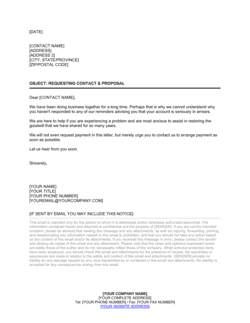
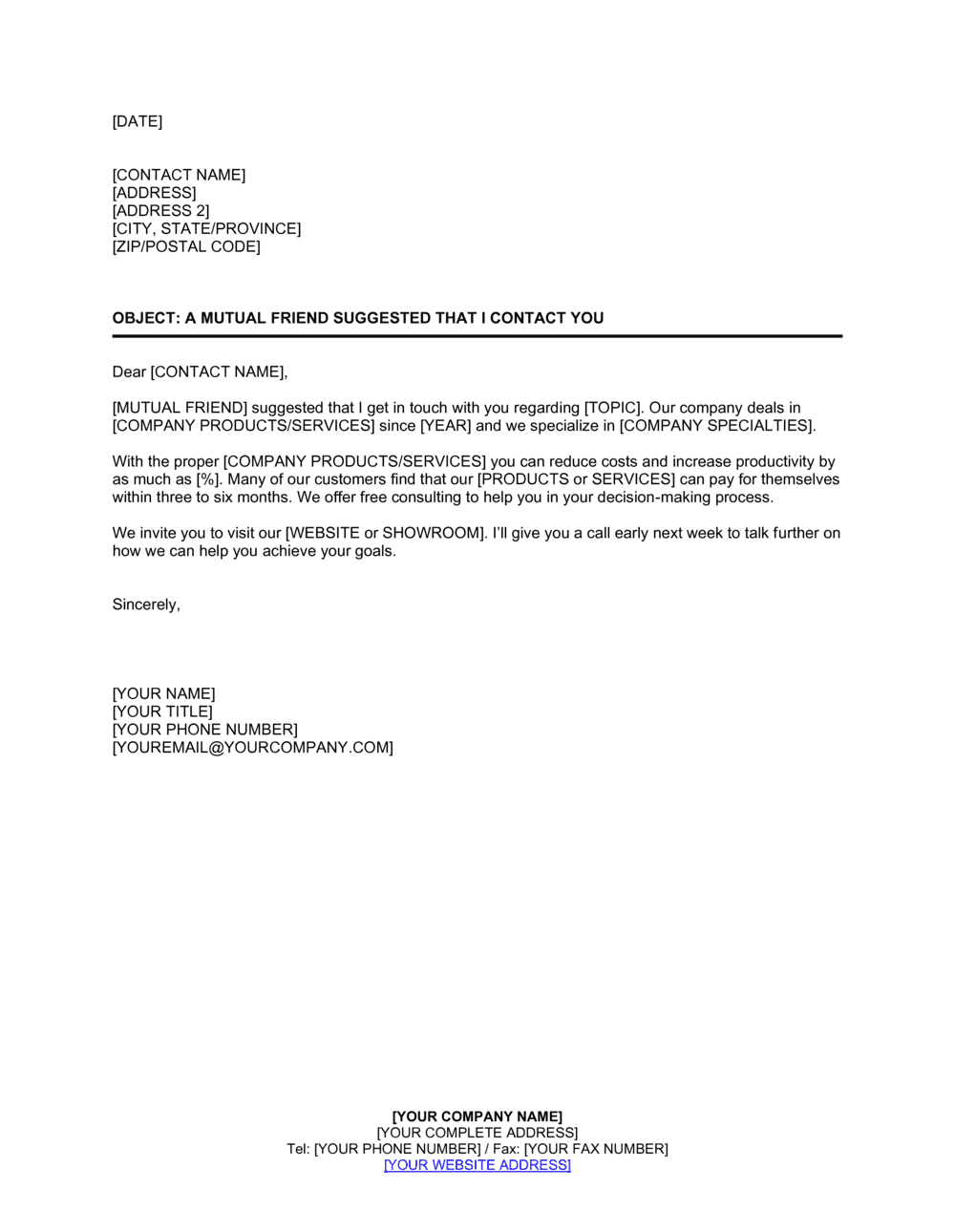
A Mutual Friend Suggested I Contact You letter is a formal written introduction that opens a professional relationship by citing a shared contact as the referral source. This free Word download gives you a structured, professionally worded template you can edit online and export as PDF β€” covering the mutual contact reference, the sender's purpose, credentials, proposed value, and a clear call to action.
When you need it
Use it when a colleague, client, or associate has suggested you reach out to a specific individual or organization and you need a formal written record of that introduction β€” particularly when the outreach precedes a business proposal, service engagement, or partnership discussion.
What's inside
Sender and recipient identification, the mutual contact reference and context, a concise statement of purpose, the sender's relevant credentials and value proposition, a proposed next step or meeting request, and a professional closing with signature block.

What is a Mutual Friend Introduction Letter?

A Mutual Friend Introduction Letter β€” often titled "A Mutual Friend Suggested I Contact You" β€” is a formal written communication in which the sender uses an endorsed referral from a shared contact to open a new professional relationship. Rather than approaching a stranger cold, the sender names the mutual party, explains the context of the referral, presents their credentials and purpose, and proposes a specific next step. The letter functions as the opening move in a professional relationship and creates a written record of the referral chain, the sender's representations, and the proposed basis for further discussion. When the outreach precedes sensitive business conversations, the letter may also introduce confidentiality expectations and reference the need for a formal NDA before deeper information sharing begins.

Why You Need This Document

Relying on an informal message or an unstructured email to follow up on a warm referral wastes one of the highest-value relationship assets available to any professional. A well-drafted introduction letter signals that you respect the recipient's time, have prepared specifically for them, and are operating at a level of professionalism consistent with the mutual contact's endorsement. Without it, the referral's credibility is not transferred β€” the recipient has no record of the introduction, no clear sense of your purpose, and no reason to respond. For professionals in regulated industries, the absence of a documented introduction can also create compliance exposure when solicitation rules govern how new business relationships are initiated. This template gives you a structured, professionally formatted starting point that covers every essential element of a credible warm introduction β€” from the mutual contact reference to the call to action β€” in a format you can customize and send in under 30 minutes.

Which variant fits your situation?

If your situation is…Use this template
Introducing yourself to a prospective client before a sales conversationBusiness Introduction Letter
Formally recommending a third party to a contact on their behalfLetter of Recommendation
Proposing a partnership after an initial warm introductionBusiness Proposal
Following up after an in-person referral introduction has already been madeFollow-Up Letter After Meeting
Introducing your company's services to a new market or geographic regionCompany Introduction Letter
Reaching out to a prospective employer with a referral from an industry contactCover Letter with Referral
Requesting an informational meeting or industry introduction via a shared contactMeeting Request Letter

Common mistakes to avoid

❌ Naming the mutual contact without their permission

Why it matters: If the mutual contact is surprised or unhappy to be named, they may tell the recipient β€” instantly undermining your credibility and damaging the referring relationship.

Fix: Always confirm verbally or in writing that the mutual contact approves being referenced before sending the letter.

❌ Leading with a lengthy company biography before stating the purpose

Why it matters: Recipients β€” especially senior executives β€” decide within the first few sentences whether to continue reading. An introduction buried in paragraph three is effectively an introduction never made.

Fix: State the mutual contact and your purpose in the first paragraph, then support with credentials and value proposition in subsequent paragraphs.

❌ Using a generic value proposition not tied to the recipient's specific situation

Why it matters: A value proposition that could apply to any recipient signals mass outreach, not a genuine warm introduction, and converts at a fraction of the rate of a tailored message.

Fix: Use at least one specific detail the mutual contact provided about the recipient's current priorities, challenges, or goals to anchor the value proposition.

❌ Omitting a specific call to action

Why it matters: An introduction letter with no clear next step places the entire burden of follow-through on the recipient, resulting in the letter going unanswered despite genuine interest.

Fix: Close with a specific, low-commitment request β€” a named date, a 20-minute call, or a choice of two time slots β€” and state that you will follow up by a specific date.

The 9 key clauses, explained

Sender and recipient identification

In plain language: Opens the letter by fully identifying the sender β€” name, title, organization, and contact details β€” and the specific individual and organization being addressed.

Sample language
[SENDER FULL NAME] | [TITLE] | [COMPANY NAME] | [ADDRESS] | [EMAIL] | [PHONE] β€” addressed to [RECIPIENT FULL NAME], [TITLE], [RECIPIENT ORGANIZATION].

Common mistake: Addressing the letter to a job title rather than a named individual. Letters not addressed to a specific person are frequently deprioritized or discarded by recipients' assistants.

Mutual contact reference and context

In plain language: Names the mutual contact explicitly, describes how the sender knows them, and explains in one to two sentences why that person suggested the outreach.

Sample language
Our mutual colleague, [MUTUAL CONTACT NAME] of [ORGANIZATION], suggested I reach out to you. [He/She/They] mentioned that you are currently [CONTEXT β€” e.g., 'exploring options for expanding your supply chain'] and believed our work in [AREA] might be directly relevant.

Common mistake: Referencing the mutual contact only by first name or without context. Recipients may know several people with the same first name β€” full name and affiliation eliminate ambiguity and confirm the referral is genuine.

Sender's purpose statement

In plain language: States clearly and briefly why the sender is writing β€” the specific outcome they are seeking from this introduction.

Sample language
I am writing to introduce myself and to explore whether there is an opportunity for [COMPANY NAME] to support [RECIPIENT ORGANIZATION] with [SPECIFIC SERVICE OR OBJECTIVE].

Common mistake: Opening with a lengthy background on the sender's company before stating the purpose. Burying the reason for the letter in paragraph three causes readers to disengage before reaching the point.

Sender's credentials and background

In plain language: Provides a brief, relevant summary of the sender's experience, qualifications, or achievements that are directly pertinent to the recipient's situation.

Sample language
[COMPANY NAME] has spent [X] years helping [INDUSTRY] organizations achieve [OUTCOME]. Most recently, we [SPECIFIC ACHIEVEMENT β€” e.g., 'reduced procurement costs by 22% for a regional manufacturer with similar challenges to yours'].

Common mistake: Listing generic credentials unrelated to the recipient's context. A credentials block that could apply to any recipient signals that the letter is a template blast, not a genuine warm outreach.

Value proposition specific to the recipient

In plain language: Explains the specific benefit or solution the sender can offer this particular recipient, tied to the context established in the mutual contact clause.

Sample language
Based on what [MUTUAL CONTACT NAME] shared about [RECIPIENT ORGANIZATION]'s current priorities around [TOPIC], I believe [COMPANY NAME] can help you [SPECIFIC OUTCOME] by [SPECIFIC METHOD OR TIMEFRAME].

Common mistake: Stating a general value proposition that is not tailored to the recipient's known situation. Generic value statements convert at a fraction of the rate of recipient-specific ones.

Confidentiality and information-handling note (optional but recommended)

In plain language: Where the letter introduces or anticipates sharing sensitive business, financial, or strategic information, includes a brief statement that such information will be treated with appropriate discretion.

Sample language
Any information exchanged as part of our initial discussions will be treated as strictly confidential. Should our conversation develop into a formal engagement, we would be pleased to execute a mutual non-disclosure agreement prior to sharing proprietary details.

Common mistake: Sharing commercially sensitive details in the body of the introduction letter itself without any confidentiality framing β€” creating a record of voluntary disclosure that can undermine later NDA protections.

Proposed next step and call to action

In plain language: Makes a specific, low-commitment request to advance the relationship β€” a 20-minute call, a coffee meeting, or a request to send additional materials.

Sample language
I would welcome the opportunity to speak with you briefly β€” a 20-minute call at a time convenient to you β€” to determine whether there is a basis for us to work together. I will follow up by [DATE] unless I hear from you sooner.

Common mistake: Ending the letter with a vague 'please feel free to reach out' close. Open-ended closings place the entire burden on the recipient and result in significantly lower response rates than a specific, time-bound request.

Acknowledgment of the referral and reciprocity

In plain language: Briefly acknowledges the value of the mutual contact's introduction and, where appropriate, signals a willingness to reciprocate introductions within the sender's own network.

Sample language
I am grateful to [MUTUAL CONTACT NAME] for the kind introduction and hope we can honor their confidence by finding a mutually beneficial way to work together. I am equally happy to make introductions on your behalf should the opportunity arise.

Common mistake: Ignoring the referral relationship in the body of the letter after the opening. Failing to acknowledge the mutual contact's role makes the letter read as cold outreach with a name drop rather than a genuine warm introduction.

Professional closing and signature block

In plain language: Closes the letter with an appropriate formal salutation, the sender's handwritten or digital signature, and full contact information for follow-up.

Sample language
Yours sincerely, [SENDER FULL NAME] | [TITLE] | [COMPANY NAME] | [DIRECT PHONE] | [EMAIL] | [LINKEDIN OR WEBSITE URL]

Common mistake: Using an overly casual closing (e.g., 'Cheers' or 'Thanks') in a formal business introduction letter. The closing tone should match the formality of the recipient's industry and seniority level.

How to fill it out

  1. 1

    Confirm the mutual contact's permission before naming them

    Contact the mutual party before drafting the letter and confirm they are comfortable being named as the referral source. Ask them for any context about the recipient's current priorities or challenges.

    πŸ’‘ A mutual contact who is surprised to be named can inadvertently undermine your credibility β€” a brief message or call takes two minutes and protects the relationship.

  2. 2

    Complete the sender and recipient identification blocks

    Enter your full legal name, title, company, and direct contact details in the sender block. Address the letter to the recipient's full name and correct title β€” verify both on LinkedIn or their organization's website before sending.

    πŸ’‘ Misspelling a recipient's name or using an outdated title is the single fastest way to signal that the introduction is not genuinely warm.

  3. 3

    Write the mutual contact reference clause

    Name the referring party with their full name and affiliation. In one to two sentences, explain specifically what they told you about the recipient that prompted the outreach.

    πŸ’‘ Include one specific detail the mutual contact shared β€” a current project, a challenge they mentioned, or a recent achievement β€” to demonstrate the introduction is genuine and not mass-produced.

  4. 4

    State your purpose in the first paragraph

    In no more than two sentences, tell the recipient exactly why you are writing and what you are hoping to explore. Clarity in the opening paragraph determines whether the rest of the letter is read.

    πŸ’‘ Read your purpose statement aloud. If it takes more than 15 seconds to say, condense it.

  5. 5

    Tailor the credentials and value proposition to the recipient's context

    Select the two or three credentials most relevant to the recipient's known situation. Link your value proposition directly to the context or challenge the mutual contact described.

    πŸ’‘ Replace any phrase that could apply to any recipient ('we serve clients across many industries') with something that applies only to this one ('we have helped three regional distributors in your sector reduce logistics costs by 15–20%').

  6. 6

    Add a confidentiality note if you anticipate sharing sensitive information

    If your next step involves sharing proprietary pricing, strategic plans, or client data, include the optional confidentiality clause and reference a willingness to execute an NDA before that exchange.

    πŸ’‘ Do not include sensitive information in the introduction letter itself β€” reserve it for a follow-up once a basic level of trust is established.

  7. 7

    Write a specific, time-bound call to action

    Name the exact next step you want (a 20-minute call, a lunch meeting, a document review), propose a specific timeframe, and state that you will follow up by a named date.

    πŸ’‘ Offering two specific time slots ('Tuesday at 10am or Thursday at 2pm') instead of an open-ended 'whenever suits you' increases response rates markedly in professional correspondence research.

  8. 8

    Sign and send on formal letterhead

    Print on company letterhead or format the digital version with your full signature block. For high-value introductions, a wet signature on printed letterhead conveys more formality than a digital-only version.

    πŸ’‘ Send a physical letter followed by an email PDF for senior executives β€” physical mail gets opened at a higher rate than email for this audience.

Frequently asked questions

What is a 'mutual friend suggested I contact you' letter?

It is a formal written introduction in which the sender explicitly references a shared contact who recommended the outreach. The letter uses that referral to establish immediate credibility, provides a brief statement of purpose and relevant credentials, and proposes a specific next step. It differs from cold outreach in that the recipient has some expectation of the contact through the mutual party's prior endorsement.

When should I use this letter instead of a cold outreach email?

Use this letter whenever a mutual contact has explicitly suggested you reach out, given you permission to use their name, and provided any context about the recipient's needs or situation. A warm introduction letter is appropriate when the relationship is professional and formal, when the outreach precedes a significant business discussion, or when a written record of the introduction is useful β€” for example, before a proposal, a funding conversation, or a partnership negotiation.

Do I need permission from the mutual contact before sending this letter?

Yes. Naming someone as a referral source without their knowledge creates a significant risk: if the mutual contact contradicts or disavows the introduction when the recipient follows up, your credibility is immediately damaged. Always confirm β€” by phone, email, or message β€” that the mutual party consents to being named and is comfortable with the context you plan to reference. This takes two minutes and protects three relationships simultaneously.

Is this type of letter legally binding?

An introduction letter is generally not a binding legal contract in most jurisdictions β€” it does not create an obligation on either party to enter into a business relationship. However, if the letter contains specific representations about the sender's qualifications, services, or pricing, those statements may be considered pre-contractual representations. If the letter anticipates sharing confidential information, include a confidentiality note and consider executing a separate NDA before sensitive discussions begin.

What should I avoid including in the letter itself?

Avoid including proprietary pricing, confidential client references, strategic plans, or financial information in the body of the letter. An introduction letter may be forwarded, printed, or shared beyond the intended recipient. Reserve sensitive details for a follow-up conversation protected by a signed NDA. Also avoid exaggerated claims about your credentials or results β€” pre-contractual misrepresentation can carry legal consequences if it induces the recipient to enter into an agreement.

How long should the letter be?

One page is the standard target for a professional introduction letter. Senior recipients in particular rarely read beyond a single page of unsolicited correspondence. Structure it as four to five concise paragraphs: mutual contact reference and purpose, credentials, value proposition, call to action, and closing. If you cannot make your case in one page, the purpose statement needs to be narrowed.

Can I send this by email instead of as a printed letter?

Yes. For most business contexts, an email with the letter attached as a formatted PDF β€” or written directly in the email body using the same structure β€” is entirely appropriate. For senior executives, C-suite introductions, or high-value partnership outreach, a printed letter on company letterhead followed by a PDF email copy carries more weight. The format should reflect the formality of the relationship you are seeking to establish.

What is the difference between this letter and a letter of recommendation?

A letter of recommendation is written by the mutual contact themselves, endorsing a third party to the recipient. A mutual introduction letter is written by the person seeking the introduction β€” it references the mutual contact but is the sender's own presentation of their credentials and purpose. Both rely on the mutual relationship for credibility, but they originate from different parties and serve different purposes.

Should I follow up after sending the letter?

Yes, always. State in the letter that you will follow up by a specific date β€” typically five to seven business days after sending β€” and do so. A single, brief follow-up (email or call) is professional and expected. Beyond one follow-up with no response, the recipient has declined the introduction. Continuing to contact them after that damages your professional reputation and the referring relationship.

How this compares to alternatives

vs Cold outreach email

A cold outreach email contacts someone with no prior connection or referral. A mutual introduction letter cites a shared contact who has endorsed the outreach, dramatically increasing open and response rates. Use cold outreach when no warm connection exists; use this letter whenever a genuine referral is available.

vs Letter of Recommendation

A letter of recommendation is authored by the mutual contact, endorsing someone else to the recipient. A mutual introduction letter is authored by the person seeking the introduction, using the mutual contact as a reference point. The two documents serve opposite roles in the same referral chain.

vs Business Proposal

A business proposal is a detailed, formal document outlining a specific scope of work, pricing, and deliverables. A mutual introduction letter precedes the proposal β€” it opens the relationship and secures the meeting or conversation at which a proposal becomes appropriate. Sending a proposal before an introduction letter reverses the natural progression of a business relationship.

vs Meeting Request Letter

A meeting request letter focuses solely on securing a scheduled interaction without necessarily referencing a referral source or making a credentials case. A mutual introduction letter accomplishes the meeting request as part of a broader introduction that establishes credibility and context. When a warm referral exists, the introduction letter is the stronger choice.

Industry-specific considerations

Financial Services

Warm introductions are a primary source of new client relationships in wealth management, private equity, and investment banking, where regulatory constraints limit cold solicitation.

Professional Services

Law firms, accounting practices, and consulting groups routinely exchange client referrals via formal introduction letters that precede engagement letters and NDA execution.

Technology / SaaS

Startup founders and enterprise sales teams use warm introduction letters to reach procurement decision-makers and investors in a market where inbox volume makes cold outreach largely ineffective.

Healthcare

Referral-based introductions between healthcare providers, medical device suppliers, and hospital procurement officers are common and often require formal written documentation before vendor onboarding begins.

Jurisdictional notes

United States

Introduction letters are not binding contracts under US law, but representations made in them can constitute pre-contractual statements. In regulated industries such as securities brokerage (FINRA) and insurance, solicitation via referral letter may trigger licensing and disclosure requirements. Several states have anti-spam and commercial solicitation regulations that apply to mass-distributed introduction letters.

Canada

Canada's Anti-Spam Legislation (CASL) applies to commercial electronic messages, including introduction emails β€” consent requirements differ from printed letters. Quebec's language laws may require French-language correspondence for businesses operating in the province. Financial services solicitation via referral is regulated by IIROC and provincial securities commissions.

United Kingdom

In the UK, financial promotions β€” including some forms of referral-based business introduction β€” may require FCA authorization or exemption. The UK GDPR imposes obligations on how the referral party may share the recipient's contact details with the sender. For most non-financial professional introductions, a well-drafted letter carries no specific regulatory burden.

European Union

EU GDPR is the primary compliance consideration: the mutual contact sharing a third party's name and contact details with the sender may constitute personal data processing, requiring a lawful basis. In financial services contexts, MiFID II and national solicitation rules may apply. Member state defamation laws vary β€” claims about competitors or third parties in the letter should be factual and verifiable.

Template vs lawyer β€” what fits your deal?

PathBest forCostTime
Use the templateStandard professional introductions for business development, sales, or career outreach where no sensitive information is exchangedFree15–30 minutes
Template + legal reviewIntroductions that precede high-value partnership negotiations, investor discussions, or engagements where pre-contractual representations could carry legal weight$150–$4001–2 days
Custom draftedRegulated industries (financial services, healthcare) where solicitation rules apply, or when the introduction is tied to a complex multi-party transaction requiring coordinated legal documentation$500–$1,500+3–7 days

Glossary

Warm Introduction
An introduction to a new contact facilitated by a mutual party who vouches for both sides, as opposed to unsolicited cold outreach.
Referral Source
The mutual contact who suggested the outreach β€” named explicitly in the letter to establish credibility and context.
Value Proposition
A concise statement explaining what specific benefit the sender offers the recipient and why it is relevant to them.
Call to Action
A specific, measurable request made at the close of the letter β€” such as a 30-minute call, a meeting date, or a request for further information.
Professional Credentials
Relevant qualifications, roles, or accomplishments the sender presents to establish credibility with the recipient.
Signature Block
The closing section of a formal letter containing the sender's name, title, organization, contact details, and wet or digital signature.
Consent of the Referring Party
Confirmation, obtained before sending the letter, that the mutual contact approves of being named as the referral source.
Confidentiality Caveat
Optional language noting that any proprietary information shared in connection with the introduction is to be treated as confidential.
Letterhead
The pre-printed or formatted header on formal business correspondence that includes the sender's company name, address, logo, and contact details.
NDA (Non-Disclosure Agreement)
A separate binding agreement that may be appropriate to execute before sharing sensitive information that arises from the introduction.

Part of your Business Operating System

This document is one of 3,000+ business & legal templates included in Business in a Box.

  • Fill-in-the-blanks β€” ready in minutes
  • 100% customizable Word document
  • Compatible with all office suites
  • Export to PDF and share electronically

Create your document in 3 simple steps.

From template to signed document β€” all inside one Business Operating System.
1
Download or open template

Access over 3,000+ business and legal templates for any business task, project or initiative.

2
Edit and fill in the blanks with AI

Customize your ready-made business document template and save it in the cloud.

3
Save, Share, Send, Sign

Share your files and folders with your team. Create a space of seamless collaboration.

Save time, save money, and create top-quality documents.

β˜…β˜…β˜…β˜…β˜…

"Fantastic value! I'm not sure how I'd do without it. It's worth its weight in gold and paid back for itself many times."

Managing Director Β· Mall Farm
Robert Whalley
Managing Director, Mall Farm Proprietary Limited
β˜…β˜…β˜…β˜…β˜…

"I have been using Business in a Box for years. It has been the most useful source of templates I have encountered. I recommend it to anyone."

Business Owner Β· 4+ years
Dr Michael John Freestone
Business Owner
β˜…β˜…β˜…β˜…β˜…

"It has been a life saver so many times I have lost count. Business in a Box has saved me so much time and as you know, time is money."

Owner Β· Upstate Web
David G. Moore Jr.
Owner, Upstate Web

Run your business with a system β€” not scattered tools

Stop downloading documents. Start operating with clarity. Business in a Box gives you the Business Operating System used by over 250,000 companies worldwide to structure, run, and grow their business.

Start freeΒ Β·Β No credit card required