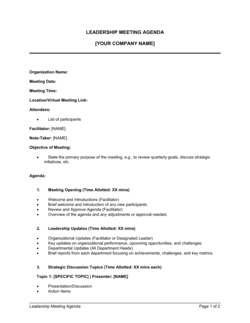
Agenda Meeting With Management Template

Free download • Use as a template • Print or share

2 pages20–30 min to useDifficulty: StandardSignature requiredLegal review recommended
Learn more ↓
FreeAgenda Meeting With Management Template

At a glance

What it is
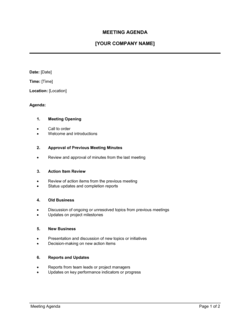
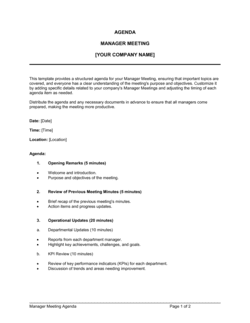
An Agenda Meeting With Management is a structured formal document that sets out the order of business, discussion topics, time allocations, and decision points for a scheduled meeting between employees, officers, or stakeholders and the company's management team. This free Word download gives you a ready-to-edit template you can customize for any management meeting and export as PDF to distribute to all participants in advance.
When you need it
Use it whenever a formal meeting with management is required — whether for performance reviews, disciplinary proceedings, strategic planning sessions, grievance hearings, or board-level operational reviews — and a documented record of the meeting's scope and outcomes is needed.
What's inside
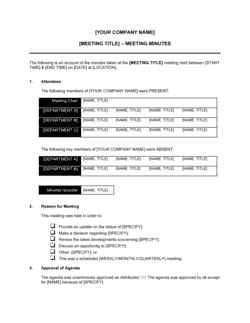
Meeting header and participant details, stated objectives, a numbered list of discussion items with time allocations, a section for decisions reached, assigned action items with owners and deadlines, and a signature block confirming attendance and agreement on the record.

What is an Agenda Meeting With Management?

An Agenda Meeting With Management is a formal document that establishes the structure, topics, participants, and expected outcomes of a scheduled meeting between employees, officers, or stakeholders and a company's management team. It provides advance written notice of the matters to be discussed, allocates time to each item, names the responsible leads, and — when signed — creates a contemporaneous record that the meeting was properly convened and conducted. Unlike an informal calendar invite or a bulleted email, a properly completed management meeting agenda carries evidentiary weight in employment disputes, grievance proceedings, regulatory inquiries, and governance reviews.

Why You Need This Document

Without a formal agenda, management meetings produce inconsistent outcomes, disputed records, and unenforceable action items. Employees who attend disciplinary or performance meetings without receiving proper written notice of the issues in advance have strong grounds to challenge any decision reached — in the UK, failure to follow the ACAS Code of Practice can increase employment tribunal awards by 25%. In Canada and the EU, procedural fairness obligations mean that an undocumented meeting is frequently treated as though it never formally occurred. Beyond legal exposure, unstructured meetings without a signed agenda routinely result in action items that are never completed because no one can agree on what was decided or who was responsible. This template closes all of those gaps: it structures the meeting before it happens, captures decisions and action items in a format that is unambiguous, and produces a signed record that protects both management and employees should any aspect of the meeting be questioned later.

Which variant fits your situation?

If your situation is…Use this template
Formal disciplinary or performance improvement meetingDisciplinary Meeting Agenda
Board of directors or executive committee meetingBoard Meeting Agenda
Weekly or monthly operational team meetingTeam Meeting Agenda
Employee grievance hearing with managementGrievance Meeting Agenda
Annual general meeting of shareholdersAnnual General Meeting Agenda
Project kick-off or status review meetingProject Meeting Agenda
Strategic planning or budget review sessionStrategic Planning Meeting Agenda

Common mistakes to avoid

❌ Distributing the agenda on the day of the meeting

Why it matters: Participants who receive an agenda minutes before the meeting start cannot review supporting documents or prepare positions, reducing the quality of decisions and making any resolution easier to challenge.

Fix: Establish a standing rule that agendas are distributed a minimum of 48 hours in advance — 72 hours for formal governance or disciplinary meetings. Document the distribution date on the agenda itself.
❌ Omitting the signature block or treating it as optional

Why it matters: An unsigned agenda or set of minutes has reduced evidentiary weight in grievance proceedings, regulatory inquiries, and legal disputes. The absence of signatures invites claims that the record does not accurately reflect what was discussed or decided.

Fix: Have the chairperson sign immediately after the meeting. For formal meetings — disciplinary hearings, grievance proceedings, or board sessions — circulate for participant countersignatures within 48 hours.

❌ Assigning action items to a team rather than a named individual

Why it matters: Collective responsibility diffuses accountability. Tasks assigned to 'the finance team' or 'HR' are completed at a significantly lower rate than those assigned to a named person with a specific deadline.

Fix: Every action item must have a single named owner and a specific calendar date as the deadline. At the start of the next meeting, review each open item by owner name.

❌ Skipping the meeting objectives section

Why it matters: Without stated objectives, there is no way to assess whether the meeting achieved its purpose, and the agenda cannot be used as evidence of notice in formal proceedings such as disciplinary hearings or arbitration.

Fix: Write at least one specific, measurable objective for every meeting before the agenda is distributed. If no objective can be articulated, reconsider whether the meeting is necessary.

The 10 key clauses, explained

Meeting header and identification

In plain language: Records the meeting's formal title, date, time, location (or virtual platform), and reference number for filing and future cross-referencing.

Sample language
Meeting: [MEETING TITLE] | Date: [DATE] | Time: [START TIME] – [END TIME] | Location / Platform: [VENUE / VIDEO LINK] | Reference: [MEETING REF NUMBER]

Common mistake: Omitting the meeting reference number. Without it, connecting this agenda to subsequent minutes, action-item logs, or follow-up correspondence becomes inconsistent and difficult to track.

Participants and roles

In plain language: Lists every expected attendee by name and title, identifies the chairperson, note-taker, and any observers or advisers, and records actual attendance at the close of the meeting.

Sample language
Chair: [NAME], [TITLE] | Note-taker: [NAME] | Attendees: [NAME, TITLE]; [NAME, TITLE] | Observers: [NAME, CAPACITY] | Apologies received from: [NAME]

Common mistake: Listing job titles without legal entity affiliation on multi-company or joint-venture meetings. When a dispute arises, it is unclear which organization each participant was representing.

Meeting objectives

In plain language: States in one to three sentences what the meeting is intended to achieve and what decisions or outputs are expected by the end.

Sample language
The purpose of this meeting is to [OBJECTIVE 1], to reach a decision on [DECISION POINT], and to assign ownership of [ACTION AREA] ahead of [DEADLINE].

Common mistake: Leaving the objectives blank or writing 'general discussion.' Undefined objectives make it impossible to measure whether the meeting achieved anything or to use the record in a subsequent dispute.

Agenda items with time allocations

In plain language: Enumerates each discussion topic in sequence, assigns a time slot, and names the person responsible for presenting or leading that item.

Sample language
1. [AGENDA ITEM TITLE] — Lead: [NAME] — [X] minutes | 2. [AGENDA ITEM TITLE] — Lead: [NAME] — [X] minutes | 3. Matters Arising from [PREVIOUS MEETING DATE] — Chair — [X] minutes

Common mistake: Allocating identical time to every agenda item regardless of complexity. A five-minute slot for a major budget decision and a five-minute slot for housekeeping items signal a poorly planned meeting and routinely lead to the most important items being cut for time.

Supporting documents and pre-reading

In plain language: Lists all documents circulated in advance — reports, proposals, financial summaries — so participants can confirm they have reviewed the required materials before attending.

Sample language
The following documents are circulated with this agenda and should be reviewed in advance: (a) [DOCUMENT TITLE], dated [DATE]; (b) [DOCUMENT TITLE], prepared by [NAME/DEPARTMENT].

Common mistake: Distributing supporting documents on the day of the meeting or not listing them on the agenda. Participants who have not had time to review materials make uninformed decisions, weakening the validity of any resolution reached.

Decisions and resolutions

In plain language: Provides a structured space to record each formal decision or resolution reached during the meeting, including the outcome of any vote and the names of those in favour, against, or abstaining.

Sample language
Decision [D-01]: [DESCRIPTION OF DECISION REACHED] | Proposed by: [NAME] | Seconded by: [NAME] | In favour: [NUMBER] | Against: [NUMBER] | Abstentions: [NUMBER] | Resolved: [YES / NO]

Common mistake: Recording decisions in narrative prose buried within meeting notes rather than in a dedicated numbered block. Decisions written this way are frequently missed when the record is reviewed and are harder to enforce or reference in follow-up correspondence.

Action items with owners and deadlines

In plain language: Captures every task arising from the meeting, names the responsible individual, sets a specific completion date, and references the agenda item that generated the task.

Sample language
Action [A-01]: [TASK DESCRIPTION] | Owner: [NAME] | Deadline: [DATE] | Arising from: Agenda Item [NUMBER]

Common mistake: Assigning action items to a department or team rather than a named individual. Shared ownership routinely means no ownership — tasks without a named accountable person are completed at a significantly lower rate.

Any other business (AOB)

In plain language: A standing end-of-agenda item allowing participants to raise any urgent matters not listed in the original agenda, with a note that substantive decisions on unscheduled items should be deferred to a properly noticed future meeting.

Sample language
Any other business raised by participants at the meeting. Note: material decisions on matters not included in the circulated agenda should be deferred to a subsequent meeting with proper notice, unless all participants consent to proceed.

Common mistake: Allowing AOB to expand into lengthy unplanned discussion that overruns the scheduled time and cannibalizes prior agenda items. Chairs should enforce a strict time limit of five to ten minutes on AOB in total.

Next meeting details

In plain language: Records the proposed date, time, and location of the next meeting and notes any standing items that will carry forward.

Sample language
Next meeting: [DATE], [TIME], [LOCATION / PLATFORM] | Items carrying forward: [ITEM DESCRIPTION]

Common mistake: Leaving the next meeting date blank and treating it as a follow-up task. Failing to confirm the next session before participants leave the current one typically results in scheduling delays of several weeks.

Signature block and acknowledgment

In plain language: Provides signature lines for the chairperson and, where required, each participant to confirm they have reviewed and agreed on the accuracy of the agenda and any decisions recorded.

Sample language
Confirmed accurate by: [CHAIR NAME] _______________ Date: [DATE] | Participant: [NAME] _______________ Date: [DATE]

Common mistake: Treating the signature block as optional. An unsigned agenda or set of minutes can be challenged as inaccurate or unrepresentative in grievance proceedings, arbitration, or court, materially weakening the document's evidentiary value.

How to fill it out

  1. 1

    Complete the meeting header

    Enter the full meeting title, date, start and end times, physical location or virtual platform link, and assign a unique reference number. Distribute this to all participants at least 48–72 hours before the meeting.

    💡 Use a consistent reference format — e.g., MGT-2026-0047 — so agendas, minutes, and action-item logs can be cross-referenced automatically in your document management system.

  2. 2

    List all participants and assign roles

    Name every expected attendee with their title and organizational affiliation, designate a chairperson and a note-taker, and include a line for recording apologies in advance.

    💡 Confirm attendance at least 24 hours before the meeting. If a key decision-maker cannot attend, assess whether quorum requirements are still met before proceeding.

  3. 3

    State clear meeting objectives

    Write one to three specific objectives that the meeting is designed to achieve. Each objective should map directly to at least one agenda item and produce a measurable output — a decision, an approved document, or an assigned action.

    💡 If you cannot articulate a clear objective for the meeting, consider whether the meeting is necessary or whether an email or memo would suffice.

  4. 4

    Build the agenda item list with time allocations

    List each discussion topic in logical sequence, assign a realistic time block proportionate to its complexity, and name the lead presenter or discussion owner for each item.

    💡 Put the most important and time-sensitive items second or third — never last. Items placed at the end of a long agenda are routinely cut when meetings run over time.

  5. 5

    Attach and list all supporting documents

    Identify every document participants should review before attending — reports, proposals, financial summaries, prior minutes — and list them in the agenda with their title and date. Distribute them with the agenda, not on the day.

    💡 Flag any document requiring a decision with a bold 'FOR DECISION' label next to its title so participants know in advance where they need to come prepared with a position.

  6. 6

    Prepare the decisions and action-item sections

    Leave the decisions and action-items sections blank before the meeting but make sure the structure is visible to the note-taker. During the meeting, capture each resolution and task in real time using the numbered format in the template.

    💡 Read back every action item aloud before moving to the next agenda topic. Real-time confirmation prevents disputes about what was agreed.

  7. 7

    Confirm the next meeting and obtain signatures

    Before closing, confirm the date, time, and location of the next meeting and have the chairperson sign the completed agenda immediately after the meeting. Where required by your internal policy or jurisdiction, circulate for participant signatures within 48 hours.

    💡 Send the signed agenda and any associated minutes within 24 hours of the meeting while recall is fresh. Delays beyond 48 hours increase the likelihood of factual disputes.

Frequently asked questions

What is an agenda meeting with management?

An agenda meeting with management is a formal, structured document that sets out the topics, time allocations, participants, and expected decisions for a scheduled meeting between employees or stakeholders and a company's management team. It serves as both advance notice to participants and a formal record of the meeting's scope. When signed, it also functions as evidence that proper process was followed — particularly important in disciplinary, grievance, or regulatory contexts.

Is a meeting agenda a legally binding document?

A meeting agenda itself is not typically a contract, but when signed by the chairperson and participants it becomes part of the formal record of proceedings. In employment disputes, grievance hearings, and regulatory inquiries, a signed agenda — along with accompanying minutes — is treated as evidence that proper notice was given and that specific matters were raised and addressed. In jurisdictions with formal procedural requirements for disciplinary or board meetings, a deficient or unsigned agenda can be grounds for challenging the validity of decisions reached.

How far in advance should a management meeting agenda be distributed?

For standard operational management meetings, 48 hours is the generally accepted minimum. For formal proceedings — disciplinary hearings, grievance meetings, board meetings, or AGMs — most jurisdictions and governance frameworks require 5–14 days' written notice, with the agenda included. Check your employment contracts, company bylaws, and any applicable statutory requirements for the specific notice period that applies to your meeting type.

What should a management meeting agenda include?

A complete management meeting agenda should include the meeting title, date, time, location or platform, a list of participants and their roles, clearly stated meeting objectives, numbered agenda items with time allocations and named leads, a list of supporting documents circulated in advance, a structured section for recording decisions and resolutions, an action-items section with named owners and deadlines, any other business, next meeting details, and a signature block for the chairperson and key participants.

Who should sign a management meeting agenda?

At minimum, the chairperson should sign the completed agenda after the meeting to confirm it accurately reflects what was discussed and decided. For formal proceedings — disciplinary hearings, grievance meetings, and board or executive committee meetings — all participants or their representatives should countersign within 48 hours. In some jurisdictions and for regulated entities, unsigned minutes or agendas are not considered valid records of board or management decisions.

What is the difference between a meeting agenda and meeting minutes?

A meeting agenda is issued before the meeting and sets out what will be discussed and who will attend. Meeting minutes are produced after the meeting and record what was actually discussed, what decisions were made, and what actions were assigned. Both documents should be retained together as a complete record of the meeting. The agenda provides notice and structure; the minutes provide the formal record of outcomes.

Can I use this agenda template for a disciplinary or grievance meeting?

Yes, with important caveats. Disciplinary and grievance meetings are subject to specific procedural requirements in most jurisdictions — in the UK under the ACAS Code of Practice, in Canada under provincial employment standards, and in the US under applicable labor law and any collective bargaining agreements. The agenda must give the employee adequate written notice of the specific allegations or issues to be discussed. Consider having your HR team or legal counsel review the agenda before distribution for any formal disciplinary or grievance proceeding.

How do I handle agenda items that are not resolved during the meeting?

Unresolved items should be recorded in the action-items section with a named owner, a specific follow-up deadline, and a note that the item will carry forward to the next meeting. Do not leave unresolved items in a narrative paragraph — capture them in the structured action-item format so ownership and accountability are clear. At the opening of the next meeting, review all carried-forward items before introducing new business.

Do virtual or hybrid management meetings require the same formal agenda?

Yes. Virtual and hybrid meetings carry the same governance and evidentiary obligations as in-person meetings. The agenda should additionally note the video platform being used, the dial-in or join link, and any technical participation requirements. For formal proceedings conducted virtually, consider whether your jurisdiction or internal policy requires the meeting to be recorded and whether participants must consent to recording in writing before the session begins.

How this compares to alternatives

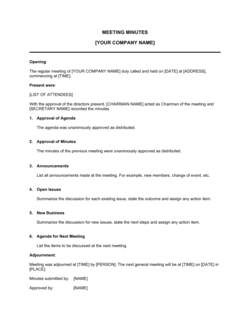
vs Meeting Minutes Template

A meeting agenda sets the structure and topics before the meeting takes place; meeting minutes record what was actually discussed and decided after it ends. Both documents are required for a complete and defensible meeting record. The agenda provides advance notice and sets expectations; the minutes provide the binding record of outcomes. Use both together — never one without the other.

vs Annual General Meeting Agenda

An AGM agenda is a specialized document designed for shareholder meetings with statutory notice requirements and fixed legal agenda items — financial statements, auditor appointment, director elections. A management meeting agenda is used for internal operational, disciplinary, or strategic sessions without those statutory requirements. Use the AGM template when shareholder or regulatory law governs the meeting; use this template for all other management meetings.

vs Board Meeting Agenda

A board meeting agenda is designed for formal director-level governance sessions with quorum requirements defined in company bylaws and, in regulated industries, by statute. A management meeting agenda is more flexible and used for a broader range of internal sessions below board level. If your meeting involves directors exercising formal governance authority, use the board meeting template.

vs Employee Performance Review Form

A performance review form captures an evaluation of an individual employee's performance against targets. A management meeting agenda structures the formal meeting at which that review is discussed and decisions are made. For disciplinary or formal performance improvement meetings, both documents are typically needed — the review form provides the substantive assessment; the agenda provides the procedural record of the meeting.

Industry-specific considerations

Financial Services

Regulated entities — banks, investment firms, and insurance companies — are often required by financial regulators to maintain formal signed meeting records, including board and risk committee agendas, as part of ongoing compliance obligations.

Healthcare

Clinical governance committees, credentialing panels, and disciplinary proceedings in healthcare organizations must follow strict procedural notice requirements, and signed agendas form part of the documentary evidence required in regulatory reviews.

Professional Services

Law firms, accounting firms, and consultancies use formal management meeting agendas to document partner-level decisions on client matters, staffing, and compliance — records that may be reviewed in professional regulatory inquiries.

Manufacturing

Safety committee meetings, union-management joint consultations, and quality review meetings in manufacturing require formally documented agendas to satisfy occupational health and safety regulations and collective bargaining obligations.

Technology / SaaS

Investor board meetings, audit committee sessions, and performance review meetings at technology companies require structured agendas to meet investor agreement obligations and maintain a defensible governance record ahead of due diligence.

Retail / Hospitality

High staff turnover and frequent disciplinary or performance management meetings make a consistent, documented agenda format essential for defending employment decisions and demonstrating fair process compliance.

Jurisdictional notes

United States

No federal law mandates a specific meeting agenda format for internal management meetings, but the NLRA requires good-faith consultation procedures for unionized workplaces. In employment disputes, signed agendas and minutes are treated as contemporaneous business records and carry significant evidentiary weight. State-specific requirements apply for board meetings of corporations chartered under state law — consult your state's Business Corporation Act for notice and quorum requirements.

Canada

Provincial employment standards acts — including Ontario's ESA and BC's Employment Standards Act — require that employees receive written notice of disciplinary or termination meetings in advance, and a documented agenda supports compliance with this obligation. Federal and provincial human rights codes require procedurally fair processes in workplace investigations and hearings. Quebec employers must ensure meeting documentation is available in French for francophone employees.

United Kingdom

The ACAS Code of Practice on Disciplinary and Grievance Procedures requires employers to give employees written notice of disciplinary or grievance meetings, including the specific issues to be discussed, with sufficient time to prepare. Failure to follow the ACAS Code can result in employment tribunal awards being increased by up to 25%. Employees have a statutory right to be accompanied by a trade union representative or colleague at formal disciplinary and grievance meetings.

European Union

EU member states vary significantly in their procedural requirements for management-employee meetings, particularly in works council consultation processes required under the European Works Council Directive and national co-determination laws in Germany, France, and the Netherlands. GDPR considerations apply where meeting agendas or minutes contain personal data about identifiable individuals — distribution should be limited to participants with a legitimate need to receive that information.

Template vs lawyer — what fits your deal?

PathBest forCostTime
Use the templateStandard operational management meetings, team reviews, and planning sessions where no employment, regulatory, or governance dispute is at stakeFree15–20 minutes per meeting
Template + legal reviewDisciplinary hearings, grievance meetings, or formal performance improvement meetings where there is a risk of employment dispute or legal challenge$150–$400 for an HR consultant or employment lawyer review1–2 days
Custom draftedBoard or executive committee meetings in regulated industries, union-management joint meetings subject to collective bargaining, or meetings with external governance obligations$500–$2,000+ for lawyer-drafted agenda and procedural guidance3–7 days

Glossary

Quorum
The minimum number of participants required to be present for a meeting to be valid and for decisions to be binding.
Action Item
A specific task assigned to a named individual during a meeting, with a defined deadline and expected deliverable.
Minutes
The official written record of what was discussed, decided, and assigned during a meeting, typically signed off by the chair.
Chairperson
The individual designated to run the meeting, manage the agenda, and ensure discussion stays within the allotted time.
Matters Arising
A standing agenda item that reviews outstanding action items and unresolved issues from the previous meeting.
Any Other Business (AOB)
An agenda item near the end of a meeting allowing participants to raise topics not listed in the original agenda.
Resolution
A formal decision reached during a meeting, recorded in writing and typically signed or confirmed by the chair.
Proxy
A person authorized in writing to attend and vote on behalf of a named participant who cannot be present.
Notice Period
The minimum advance time by which a meeting agenda must be distributed to all participants before the meeting takes place.
Standing Agenda
A fixed list of recurring items that appear on every meeting of a particular type, ensuring consistency and compliance.

Part of your Business Operating System

This document is one of 3,000+ business & legal templates included in Business in a Box.

  • Fill-in-the-blanks — ready in minutes
  • 100% customizable Word document
  • Compatible with all office suites
  • Export to PDF and share electronically

Create your document in 3 simple steps.

From template to signed document — all inside one Business Operating System.
1
Download or open template

Access over 3,000+ business and legal templates for any business task, project or initiative.

2
Edit and fill in the blanks with AI

Customize your ready-made business document template and save it in the cloud.

3
Save, Share, Send, Sign

Share your files and folders with your team. Create a space of seamless collaboration.

Save time, save money, and create top-quality documents.

★★★★★

"Fantastic value! I'm not sure how I'd do without it. It's worth its weight in gold and paid back for itself many times."

Managing Director · Mall Farm
Robert Whalley
Managing Director, Mall Farm Proprietary Limited
★★★★★

"I have been using Business in a Box for years. It has been the most useful source of templates I have encountered. I recommend it to anyone."

Business Owner · 4+ years
Dr Michael John Freestone
Business Owner
★★★★★

"It has been a life saver so many times I have lost count. Business in a Box has saved me so much time and as you know, time is money."

Owner · Upstate Web
David G. Moore Jr.
Owner, Upstate Web

Run your business with a system — not scattered tools

Stop downloading documents. Start operating with clarity. Business in a Box gives you the Business Operating System used by over 250,000 companies worldwide to structure, run, and grow their business.

Free Forever Plan · No credit card required