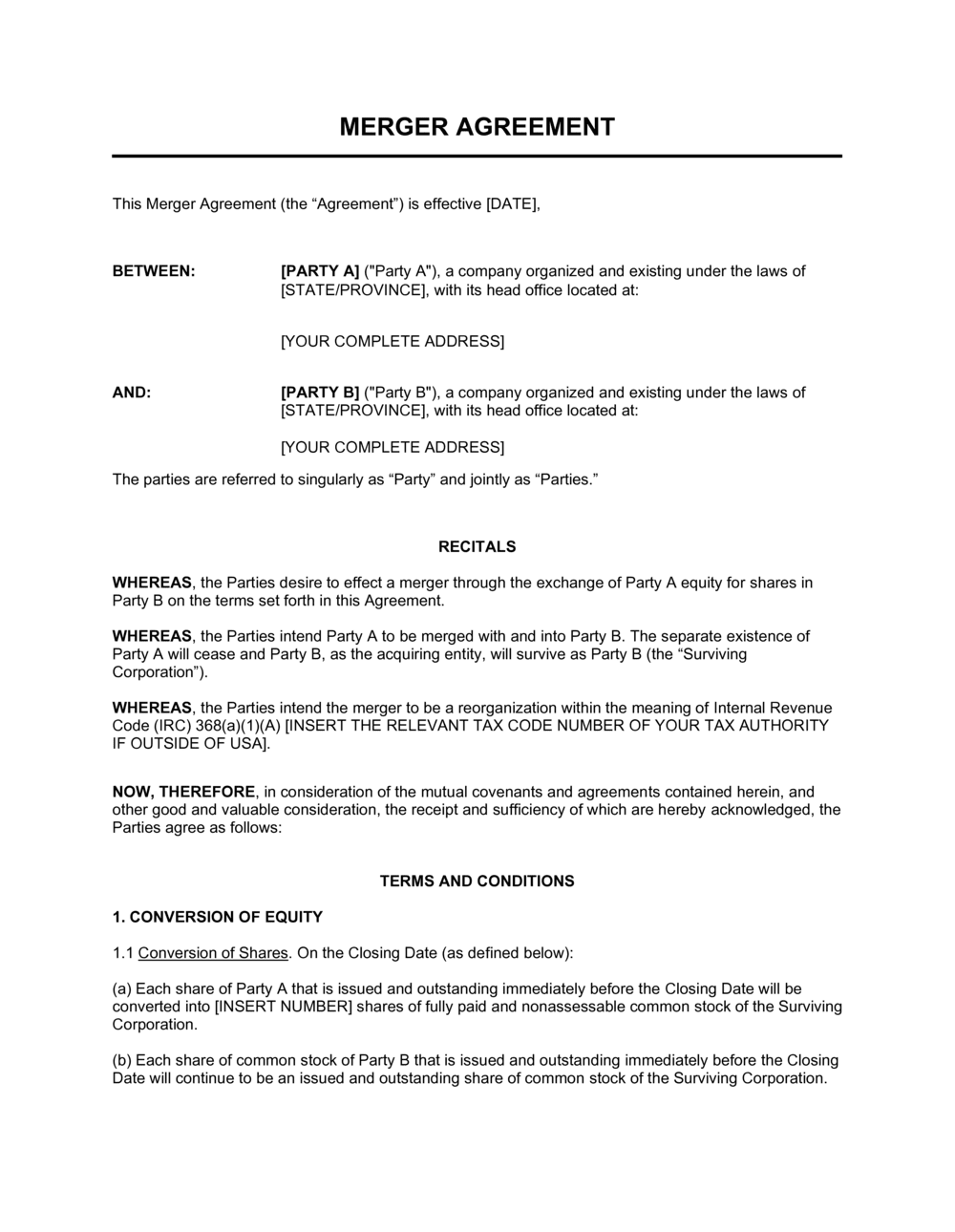
Merger Agreement Template

Free Word download • Edit online • Save & share with Drive • Export to PDF

6 pages30–40 min to fillDifficulty: ComplexSignature requiredLegal review recommended
Learn more ↓
FreeMerger Agreement Template

At a glance

What it is
A Merger Agreement is a binding legal contract between two or more companies that governs the terms under which one entity is absorbed into another or both combine to form a new entity. This free Word download gives you a professionally structured starting point covering deal consideration, representations and warranties, closing conditions, covenants, and termination rights — ready to edit online and export as PDF for legal review and execution.
When you need it
Use it when two businesses have agreed in principle to merge and need a definitive written agreement to document deal terms, protect both sides through closing, and satisfy regulatory, board, and shareholder approval requirements. It typically follows a letter of intent and precedes the closing date.
What's inside
Parties and recitals, merger structure and consideration, representations and warranties from each party, pre-closing covenants, closing conditions, indemnification and survival of representations, termination rights and break-up fees, and governing law and dispute resolution provisions.

What is a Merger Agreement?

A Merger Agreement — also called an Agreement and Plan of Merger — is a binding legal contract between two or more companies that governs the terms under which they combine into a single legal entity. It documents the agreed deal consideration (cash, stock, or a combination), the legal mechanics of the combination under the applicable corporate statute, each party's representations about the current state of their business, the conditions that must be satisfied before the transaction can close, and each party's rights if the deal cannot be completed. Unlike a letter of intent, which captures deal terms in a non-binding preliminary document, a merger agreement creates enforceable obligations on all parties and controls every aspect of the transaction from signing through the moment the merger becomes legally effective.

Why You Need This Document

Without a signed merger agreement, there is no binding deal — only a handshake that either party can walk away from without consequence. The agreement is the mechanism that locks in the agreed purchase price and prevents either side from renegotiating after due diligence is complete. It allocates post-closing risk through representations, warranties, and indemnification provisions, protecting the buyer from undisclosed liabilities and protecting the seller from unlimited post-closing exposure. Regulatory agencies, boards of directors, and shareholders all require a definitive executed agreement before granting their approvals. The indemnification, escrow, and break-up fee provisions embedded in this agreement are the only practical remedies available to either party if the other side fails to perform — making a carefully drafted merger agreement the foundation on which an entire transaction rests.

Which variant fits your situation?

If your situation is…Use this template
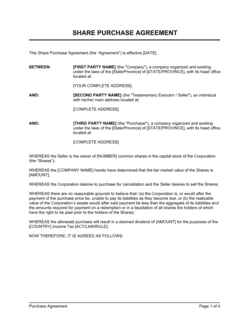
Acquiring a company's shares rather than merging entitiesShare Purchase Agreement
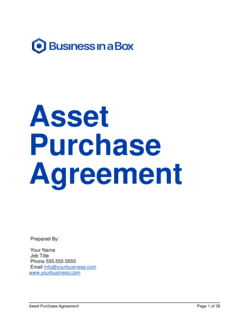
Buying selected business assets rather than the entire entityAsset Purchase Agreement
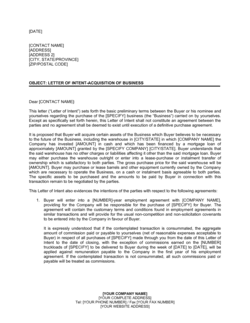
Documenting agreed deal terms before full diligence is completeLetter of Intent (M&A)
Two equal-sized companies combining into a new jointly-owned entityJoint Venture Agreement
Protecting confidential information exchanged during merger discussionsNon-Disclosure Agreement
Preventing sellers from competing post-mergerNon-Compete Agreement
Documenting the terms of a small business acquisition without full mergerBusiness Purchase Agreement

Common mistakes to avoid

❌ Omitting a working capital adjustment mechanism

Why it matters: Without a closing working capital peg and post-closing true-up, the seller can drain cash or let payables accumulate before closing, reducing the effective deal value for the buyer by hundreds of thousands of dollars.

Fix: Define a target working capital amount, the calculation methodology, and a 60–90 day post-closing adjustment period with a binding arbitration mechanism for disputes.

❌ Setting the outside date without accounting for regulatory review

Why it matters: HSR review, CFIUS clearance, or sector-specific approvals routinely take 3–9 months. An outside date set at 90 days post-signing will lapse before approvals are obtained, giving either party a free option to terminate.

Fix: Map every required regulatory approval to its realistic timeline before setting the outside date, and include an automatic extension right if regulatory review is still pending.

❌ Accepting unqualified seller representations without a disclosure schedule

Why it matters: Broad unqualified representations with no corresponding disclosure schedule expose sellers to indemnification claims for every known exception they failed to carve out, including routine litigation or contract deviations.

Fix: Complete disclosure schedules alongside the representations themselves, and ensure every known exception is documented before signing — not during closing.

❌ No reverse break-up fee for financing failure

Why it matters: If the acquirer's financing falls through and the agreement contains no reverse break-up fee, the seller's practical remedy is specific performance — a slow and expensive legal remedy that may not be available in all jurisdictions.

Fix: Negotiate a reverse break-up fee equal to 3–6% of deal value payable by the acquirer if financing fails, with specific performance as a concurrent remedy.

❌ Indemnification cap that equals 100% of deal value

Why it matters: A 100% cap effectively recreates the seller's full deal-value exposure post-closing and eliminates the economic benefit of completing the transaction for sellers who face significant litigation or tax contingencies.

Fix: Negotiate a general rep and warranty cap of 10–20% of deal value, with fundamental representations (title, authorization, capitalization) capped at 100% and fraud claims uncapped.

❌ Signing the merger agreement before board approval resolutions are in place

Why it matters: A merger agreement signed by an officer without prior board authorization is potentially voidable and exposes the officer to personal liability for unauthorized execution.

Fix: Obtain and execute board resolutions authorizing the merger and approving the agreement before any officer signs — attach the resolutions as a closing deliverable.

The 10 key clauses, explained

Parties, Recitals, and Definitions

In plain language: Identifies each party's full legal name and entity type, sets out the background and purpose of the transaction, and defines all capitalized terms used throughout the agreement.

Sample language
This Agreement and Plan of Merger ('Agreement') is entered into as of [DATE] by and among [ACQUIRER LEGAL NAME], a [STATE] [ENTITY TYPE] ('Parent'), [MERGER SUB LEGAL NAME], a [STATE] [ENTITY TYPE] and wholly owned subsidiary of Parent ('Merger Sub'), and [TARGET LEGAL NAME], a [STATE] [ENTITY TYPE] ('Company').

Common mistake: Using trade names or brand names instead of registered legal entity names. A mismatch between the agreement and corporate registry records can invalidate the merger filing.

Merger Structure and Effective Time

In plain language: Describes the legal mechanics of the merger — forward, reverse, or triangular — the surviving entity, and the exact moment the merger becomes legally effective upon filing with the relevant authority.

Sample language
At the Effective Time, Merger Sub shall be merged with and into the Company in accordance with [STATE STATUTE], whereupon the separate existence of Merger Sub shall cease and the Company shall continue as the surviving corporation ('Surviving Corporation') and a wholly owned subsidiary of Parent.

Common mistake: Failing to specify the governing state merger statute. Without a statutory reference, the filing process and entity treatment are ambiguous and may be rejected by the secretary of state.

Merger Consideration and Payment

In plain language: Specifies what each shareholder of the target company receives — cash per share, stock exchange ratio, or a combination — and the mechanics for delivering that consideration at closing.

Sample language
At the Effective Time, each share of Company Common Stock issued and outstanding immediately prior to the Effective Time shall be converted into the right to receive $[AMOUNT] in cash (the 'Merger Consideration'), without interest and subject to applicable withholding taxes.

Common mistake: Omitting closing price adjustments for cash, debt, and working capital at closing. Without a net working capital peg and adjustment mechanism, the final consideration can vary materially from the agreed price.

Representations and Warranties of the Company

In plain language: A comprehensive set of factual statements by the target company covering organization, capitalization, financial statements, absence of material changes, compliance with laws, litigation, taxes, intellectual property, and material contracts.

Sample language
The Company represents and warrants to Parent and Merger Sub that, except as set forth in the Company Disclosure Schedule: (a) the Company is duly organized, validly existing, and in good standing under the laws of [STATE]; (b) the Financial Statements fairly present in all material respects the financial condition of the Company as of [DATE]...

Common mistake: Agreeing to unqualified representations without materiality or knowledge qualifiers. Sellers should ensure most representations are qualified by 'material,' 'in all material respects,' or 'to the Company's knowledge' to limit indemnification exposure.

Representations and Warranties of the Acquirer

In plain language: Factual statements by the acquiring company confirming its authority to enter the agreement, financial capacity to fund the merger consideration, and absence of conditions that would prevent closing.

Sample language
Parent represents and warrants to the Company that: (a) Parent has all requisite corporate power and authority to execute, deliver, and perform this Agreement; (b) Parent has, or will have at the Effective Time, sufficient cash, available lines of credit, or other sources of immediately available funds to pay the aggregate Merger Consideration.

Common mistake: Skipping or minimizing acquirer representations. Sellers are entitled to confirm the buyer has financing committed and no hidden legal impediments — accepting thin acquirer reps leaves sellers unprotected if the buyer fails to close.

Pre-Closing Covenants

In plain language: Obligations binding on the target company between signing and closing — principally to operate in the ordinary course of business, obtain required third-party consents, and not take specified actions without the acquirer's consent.

Sample language
From the date of this Agreement until the earlier of the Effective Time and the termination of this Agreement, the Company shall, and shall cause each of its subsidiaries to, conduct its business in the ordinary course consistent with past practice and shall not, without the prior written consent of Parent: (a) declare or pay any dividend; (b) issue or sell any shares of capital stock...

Common mistake: Drafting an overly broad ordinary-course covenant that prevents the target from making routine business decisions. Sellers should negotiate carve-outs for specific pre-approved actions and set a consent-response deadline to avoid operational paralysis.

Conditions to Closing

In plain language: A list of prerequisites each party must satisfy — or waive — before they are obligated to complete the merger, covering regulatory clearances, shareholder approvals, bring-down of representations, and no material adverse change.

Sample language
The obligations of each party to consummate the Merger are subject to the satisfaction or waiver of the following conditions: (a) the Company Shareholder Approval shall have been obtained; (b) any waiting period applicable to the Merger under the HSR Act shall have expired or been terminated; (c) no Governmental Authority shall have enacted any Law restraining or prohibiting the consummation of the Merger.

Common mistake: Agreeing to a financing condition without a specific funding deadline and reverse break-up fee. If the acquirer cannot fund and there is no reverse break-up fee, the seller's only remedy is specific performance — which is expensive and uncertain.

Indemnification and Survival

In plain language: Defines each party's obligation to compensate the other for post-closing losses caused by breaches of representations, warranties, or covenants — including baskets, caps, and the time period during which claims can be made.

Sample language
The representations and warranties of the Company shall survive the Effective Time for a period of [18] months (the 'Survival Period'). Parent's sole recourse for any Losses arising from breaches of Company representations shall be limited to the Indemnification Escrow Fund of $[AMOUNT], which constitutes [X]% of the aggregate Merger Consideration.

Common mistake: Setting no indemnification cap or an excessively high cap without a corresponding basket. Without a deductible basket (typically 0.5–1% of deal value) and a cap (typically 10–20% of deal value), sellers face unlimited post-closing liability on relatively minor breaches.

Termination Rights and Break-Up Fees

In plain language: Specifies circumstances under which either party may walk away from the deal — including outside date, board withdrawal of recommendation, or material breach — and the financial consequences, including break-up and reverse break-up fees.

Sample language
This Agreement may be terminated at any time prior to the Effective Time: (a) by mutual written consent of Parent and the Company; (b) by either party if the Merger shall not have been consummated on or before [OUTSIDE DATE] (the 'End Date'); (c) by Parent, if the Company Board shall have effected a Company Adverse Recommendation Change. In the event of termination under Section [X], the Company shall pay Parent a termination fee of $[AMOUNT].

Common mistake: Setting the outside date too short. A merger involving regulatory review typically requires 6–9 months from signing — an outside date that lapses before HSR clearance forces costly extensions or terminates the deal at a bad moment.

Governing Law, Dispute Resolution, and Miscellaneous

In plain language: Specifies the jurisdiction whose law governs the agreement, the forum and mechanism for resolving disputes, and standard boilerplate provisions covering amendments, waivers, notices, assignment, and entire agreement.

Sample language
This Agreement shall be governed by and construed in accordance with the laws of the State of [DELAWARE / STATE], without giving effect to any choice-of-law rules. Any dispute arising out of or relating to this Agreement shall be submitted to the exclusive jurisdiction of the Court of Chancery of the State of [STATE], or, if jurisdiction is unavailable, to the federal courts located in [COUNTY], [STATE].

Common mistake: Choosing a governing law with no connection to either party's state of incorporation or the transaction. Courts in the chosen jurisdiction may decline to apply their law or apply unexpected local precedents that favor one side.

How to fill it out

  1. 1

    Identify all parties and confirm legal entity names

    Enter the full registered legal names of the acquirer, merger subsidiary (if using a triangular structure), and target company. Confirm each name against the relevant corporate registry filing.

    💡 For triangular mergers, the merger subsidiary must be formed and in good standing before the agreement is executed — confirm this with a certificate of good standing.

  2. 2

    Define the merger structure and surviving entity

    Choose the merger type — forward, reverse, or triangular — and confirm which entity survives. Reference the specific state statute governing the merger mechanics for each party's jurisdiction of incorporation.

    💡 Delaware short-form merger rules allow a 90%-or-more parent to merge out minority shareholders without a shareholder vote — confirm whether this applies before scheduling a shareholder meeting.

  3. 3

    Set the merger consideration and adjustment mechanics

    State the per-share cash amount, stock exchange ratio, or combination. Include a net working capital target and adjustment mechanism specifying how the final consideration is calculated and paid within a defined number of days after closing.

    💡 Define working capital using a sample calculation exhibit — ambiguity in the working capital definition is the most common source of post-closing disputes.

  4. 4

    Draft and negotiate representations and warranties

    Work through each representation category — organization, capitalization, financials, taxes, IP, contracts, employment, and compliance — and agree on appropriate knowledge and materiality qualifiers. Attach a disclosure schedule identifying known exceptions.

    💡 Sellers should complete disclosure schedules before signing, not during closing. Incomplete schedules at signing create indemnification exposure for items disclosed late.

  5. 5

    Specify pre-closing covenants and consent thresholds

    List the actions the target cannot take without acquirer consent and set a response deadline (typically 5–10 business days) for consent requests. Include a specific carve-out list of pre-approved actions to keep the business running normally.

    💡 Deadlock on consent requests is a common deal disruption — include a deemed-consent provision if the acquirer fails to respond within the deadline.

  6. 6

    Set closing conditions and regulatory filing timeline

    List all required regulatory approvals (HSR Act, CFIUS, sector-specific), shareholder vote mechanics, and bring-down certification requirements. Set an outside date at least 60 days beyond the longest expected regulatory review.

    💡 For deals requiring HSR filing, the standard waiting period is 30 days — but second requests can add 6–12 months. Build this into the outside date from day one.

  7. 7

    Negotiate indemnification baskets, caps, and escrow

    Agree on the survival period for representations (typically 12–24 months), the deductible basket amount, the indemnification cap, and the escrow amount and release schedule. Specify which representations survive indefinitely (fraud, tax, fundamental reps).

    💡 Representations and warranties insurance (RWI) can replace or reduce escrow requirements and shift indemnification risk to an insurer — consider it for deals above $10M in value.

  8. 8

    Execute before all parties sign ancillary documents

    Coordinate signing of the merger agreement with all required ancillary documents — employment agreements, non-competes, escrow agreements, and officer certificates — on the same date to prevent any party from being bound without the full package.

    💡 Use a closing checklist circulated to all counsel at least two weeks before signing to prevent last-minute gaps that delay execution.

Frequently asked questions

What is a merger agreement?

A merger agreement is a binding legal contract between two or more companies that governs the terms under which they combine into a single entity. It sets out the deal consideration, the legal mechanics of the combination, each party's representations about their business, the conditions that must be met before closing can occur, and each party's rights if the deal falls apart. It is the definitive document that replaces any prior letter of intent and controls the transaction through to closing.

What is the difference between a merger agreement and an acquisition agreement?

The terms are often used interchangeably, but they describe slightly different structures. A merger agreement governs a statutory merger in which one entity is absorbed into another by operation of law, with the surviving entity assuming all assets and liabilities. An acquisition agreement — often a share purchase or asset purchase agreement — governs a transaction where the buyer purchases equity or specific assets rather than combining entities through a statutory filing. The choice of structure affects tax treatment, liability assumption, and required approvals.

What is a triangular merger?

A triangular merger is a structure in which the acquirer creates a wholly owned subsidiary (Merger Sub) that merges with the target company. In a forward triangular merger, Merger Sub merges into the target and the target survives as a subsidiary of the acquirer. In a reverse triangular merger, the target merges into Merger Sub and the target survives. The reverse triangular structure is more common because it preserves the target's contracts and licenses that might otherwise require third-party consent on assignment.

Does a merger require shareholder approval?

In most jurisdictions, yes — a merger requires approval from the target company's shareholders and, in some structures, the acquirer's shareholders. The vote threshold is typically a majority or two-thirds of outstanding shares, depending on the jurisdiction and entity type. Exceptions exist for short-form mergers, where a parent company owning 90% or more of the target can complete the merger without a target shareholder vote under Delaware law and similar statutes in other states.

What is a break-up fee in a merger agreement?

A break-up fee — also called a termination fee — is a predetermined cash payment owed by one party if the merger fails to close due to that party's actions, such as a board reversing its merger recommendation or accepting a competing offer. Target break-up fees typically range from 2–4% of deal value. Acquirer reverse break-up fees — payable if the buyer fails to close, often due to financing failure — typically range from 3–6% of deal value. The fee is designed to compensate the non-breaching party for deal costs without requiring protracted litigation.

What is a material adverse change clause and why does it matter?

A material adverse change (MAC) clause — sometimes called a material adverse effect (MAE) clause — gives the acquirer the right to walk away from the deal if a significant negative event affects the target's business, finances, or prospects between signing and closing. Courts interpret MAC clauses narrowly; most buyers rarely succeed in invoking them. The definition of what qualifies as a MAC is one of the most heavily negotiated provisions in any merger agreement, with sellers seeking to exclude industry-wide downturns, regulatory changes, and general economic conditions from the definition.

How long does it typically take to close a merger after signing?

For small and mid-market transactions not requiring regulatory review, closing typically occurs 30–60 days after signing. Transactions subject to HSR Act notification require a minimum 30-day waiting period, which can extend to 6–12 months if the DOJ or FTC issues a second request. Mergers involving regulated industries — banking, insurance, defense, or telecommunications — face additional sector-specific review timelines that can push the closing window to 12–18 months from signing.

What is an earn-out and when is it used in a merger agreement?

An earn-out is a post-closing payment mechanism under which the seller receives additional consideration if the acquired business meets defined revenue, EBITDA, or other performance targets within a specified period — typically 1–3 years after closing. Earn-outs are used to bridge valuation gaps when the buyer and seller disagree on future performance prospects. They introduce significant post-closing complexity, including disputes over how the business is managed and how metrics are calculated, so earn-out definitions and governance rights should be drafted with precise metrics and dispute resolution procedures.

Do I need a lawyer to complete a merger agreement?

Yes — a merger agreement is one of the most complex legal documents in commercial practice and should be reviewed and finalized by qualified M&A legal counsel before execution. This template provides a structured drafting baseline and helps founders and executives understand deal terms before engaging counsel, but it is not a substitute for legal advice on a transaction of this significance. Merger agreements involve statutory requirements, regulatory filings, tax structuring, and post-closing liability that require jurisdiction-specific legal expertise.

How this compares to alternatives

vs Share Purchase Agreement

A share purchase agreement transfers equity ownership from sellers to the buyer without combining the legal entities through a statutory filing. The target company survives as a separate subsidiary with all its existing contracts, licenses, and liabilities intact. A merger agreement combines entities by operation of law, with the surviving entity assuming all assets and liabilities automatically. Share purchases are simpler for small transactions; mergers are preferred when minority shareholders must be cashed out or when a statutory squeeze-out is needed.

vs Asset Purchase Agreement

An asset purchase agreement allows the buyer to select specific assets and liabilities to acquire while leaving unwanted obligations behind. It avoids successor liability in most jurisdictions but requires individual asset transfers and third-party consents for assigned contracts. A merger agreement transfers all assets and liabilities by operation of law — faster and simpler for complex businesses, but the buyer assumes the full liability profile of the target.

vs Letter of Intent (M&A)

A letter of intent (LOI) is a non-binding document that outlines the key deal terms — price, structure, exclusivity, and timeline — before full legal documentation and due diligence. A merger agreement is the definitive binding contract that follows the LOI and governs the transaction through closing. The LOI creates moral commitment; the merger agreement creates legal obligation.

vs Joint Venture Agreement

A joint venture agreement creates a new jointly-owned entity or contractual arrangement for a specific project or market, with both parties retaining their independent existence. A merger agreement permanently combines entities — one or both cease to exist as independent legal entities. Joint ventures are appropriate when both parties want to preserve independence; mergers are appropriate when full combination is the strategic goal.

Industry-specific considerations

Technology / SaaS

IP representations covering software ownership and open-source compliance are heavily negotiated; acquirer covenants preserving key employee retention through closing are standard; earn-outs tied to ARR milestones are common in SaaS deals.

Healthcare and Life Sciences

Regulatory approval conditions include FDA clearances, CMS enrollment, and state health department permits; representations cover HIPAA compliance and government contract exclusions; milestone-based earn-outs tied to clinical trial outcomes or drug approvals are frequently used.

Financial Services

Regulatory closing conditions include OCC, FDIC, SEC, or FINRA approvals depending on the entity type; change-of-control provisions in banking licenses require advance notice filings; customer data transfer provisions must comply with applicable privacy regulations.

Manufacturing and Industrial

Environmental representations and indemnification for pre-closing site contamination are critical; union contract change-of-control provisions must be addressed in pre-closing covenants; real property title representations and surveys are typically required closing deliverables.

Professional Services

Client consent requirements for assignment of material contracts are a key pre-closing covenant; non-solicitation of key clients and employees for 2–3 years post-closing is standard; professional licensing representations cover each jurisdiction where services are delivered.

Retail and Consumer

Lease assignment and landlord consent requirements are key closing conditions for location-based businesses; inventory representations and physical count procedures at closing are standard; franchise agreement change-of-control provisions require franchisor consent.

Jurisdictional notes

United States

Most US mergers are governed by the Delaware General Corporation Law or the Model Business Corporation Act of the relevant state. Transactions with a deal value above the HSR Act threshold (approximately $119M in 2026) require pre-merger notification to the DOJ and FTC with a 30-day waiting period. CFIUS review applies to mergers involving foreign acquirers and US businesses with national security implications. Delaware's Court of Chancery is the preferred dispute resolution forum for corporate merger disputes.

Canada

Canadian mergers are governed by the Canada Business Corporations Act or provincial equivalents, with shareholder approval typically required by two-thirds of votes cast. Mergers exceeding the Competition Act threshold (net Canadian assets or annual Canadian revenues above approximately CAD $93M) require pre-merger notification to the Competition Bureau with a 30-day waiting period. The Investment Canada Act applies to mergers involving non-Canadian acquirers above defined thresholds and in sensitive sectors including culture, telecommunications, and national security. Quebec law requires French-language versions of material contracts.

United Kingdom

UK mergers are governed by the Companies Act 2006 and the Court of Session for Scottish entities. The Competition and Markets Authority (CMA) reviews mergers where the target's UK turnover exceeds £70M or the combined entity has a 25% or greater share of supply. Public company takeovers are regulated by the Takeover Panel under the UK Takeover Code, which imposes mandatory offer rules and strict timetables. Post-Brexit, mergers with EU operations require separate UK and EU regulatory review rather than a single combined filing.

European Union

Mergers with EU-wide significance — where combined worldwide turnover exceeds €5B and EU-wide turnover of each of at least two parties exceeds €250M — fall under the EU Merger Regulation and require notification to the European Commission before closing. Below those thresholds, member state competition authorities apply national merger control rules, which vary significantly across France, Germany, Spain, and other jurisdictions. GDPR governs the transfer of personal data in connection with due diligence and closing, requiring data processing agreements for any target customer or employee data shared with the acquirer.

Template vs lawyer — what fits your deal?

PathBest forCostTime
Use the templateBusiness owners and executives familiarizing themselves with merger deal terms and structure before engaging legal counselFree1–2 hours to review and annotate
Template + legal reviewSmall to mid-market mergers under $5M in value with straightforward structures and limited regulatory exposure$5,000–$25,000 for M&A legal counsel review and negotiation4–8 weeks
Custom draftedTransactions above $5M, cross-border mergers, regulated industries, or deals requiring HSR filing, CFIUS review, or complex earn-out structures$25,000–$200,000+ depending on deal size and complexity2–6 months from engagement to closing

Glossary

Merger
A transaction in which two or more legal entities combine so that one or both cease to exist as separate entities, with assets and liabilities transferred to the surviving entity.
Surviving Entity
The legal entity that remains in existence after the merger is completed, absorbing the assets, liabilities, and obligations of the merged company.
Consideration
The payment or exchange — cash, stock, a combination of both, or other assets — that the acquiring company provides to the target company's shareholders in exchange for their interests.
Representations and Warranties
Factual statements made by each party about the state of their business, financials, legal compliance, and ownership as of the signing date, which survive closing for a defined period.
Closing Conditions
Specified requirements — such as regulatory approvals, shareholder votes, or the absence of material adverse changes — that must be satisfied before the merger can legally close.
Material Adverse Change (MAC)
A significant negative event or development affecting a party's business, finances, or prospects that gives the other party the right to terminate the agreement without penalty.
Indemnification
A contractual obligation by one party to compensate the other for losses arising from breaches of representations, warranties, or covenants discovered after closing.
Break-Up Fee
A predetermined cash payment owed by one party if the merger fails to close due to that party's breach, board reversal, or acceptance of a competing offer.
Earn-Out
A post-closing payment mechanism under which the seller receives additional consideration if the acquired business meets defined performance targets within a specified period.
Pre-Closing Covenant
An obligation binding on one or both parties between signing and closing — typically requiring the target to operate in the ordinary course of business and obtain necessary consents.
Definitive Agreement
The final, fully negotiated binding contract governing a merger or acquisition, as distinct from a non-binding letter of intent or term sheet.
Fiduciary Out
A clause permitting the target company's board to withdraw its merger recommendation and accept a superior competing offer without breaching the agreement, subject to notice and payment of a break-up fee.

Part of your Business Operating System

This document is one of 3,000+ business & legal templates included in Business in a Box.

  • Fill-in-the-blanks — ready in minutes
  • 100% customizable Word document
  • Compatible with all office suites
  • Export to PDF and share electronically

Create your document in 3 simple steps.

From template to signed document — all inside one Business Operating System.
1
Download or open template

Access over 3,000+ business and legal templates for any business task, project or initiative.

2
Edit and fill in the blanks with AI

Customize your ready-made business document template and save it in the cloud.

3
Save, Share, Send, Sign

Share your files and folders with your team. Create a space of seamless collaboration.

Save time, save money, and create top-quality documents.

★★★★★

"Fantastic value! I'm not sure how I'd do without it. It's worth its weight in gold and paid back for itself many times."

Managing Director · Mall Farm
Robert Whalley
Managing Director, Mall Farm Proprietary Limited
★★★★★

"I have been using Business in a Box for years. It has been the most useful source of templates I have encountered. I recommend it to anyone."

Business Owner · 4+ years
Dr Michael John Freestone
Business Owner
★★★★★

"It has been a life saver so many times I have lost count. Business in a Box has saved me so much time and as you know, time is money."

Owner · Upstate Web
David G. Moore Jr.
Owner, Upstate Web

Run your business with a system — not scattered tools

Stop downloading documents. Start operating with clarity. Business in a Box gives you the Business Operating System used by over 250,000 companies worldwide to structure, run, and grow their business.

Start free · No credit card required