Mastering Quick and Effective Decision Making Template

Free to read β€’ Save or share with one click

FreeMastering Quick and Effective Decision Making Template

At a glance

What it is
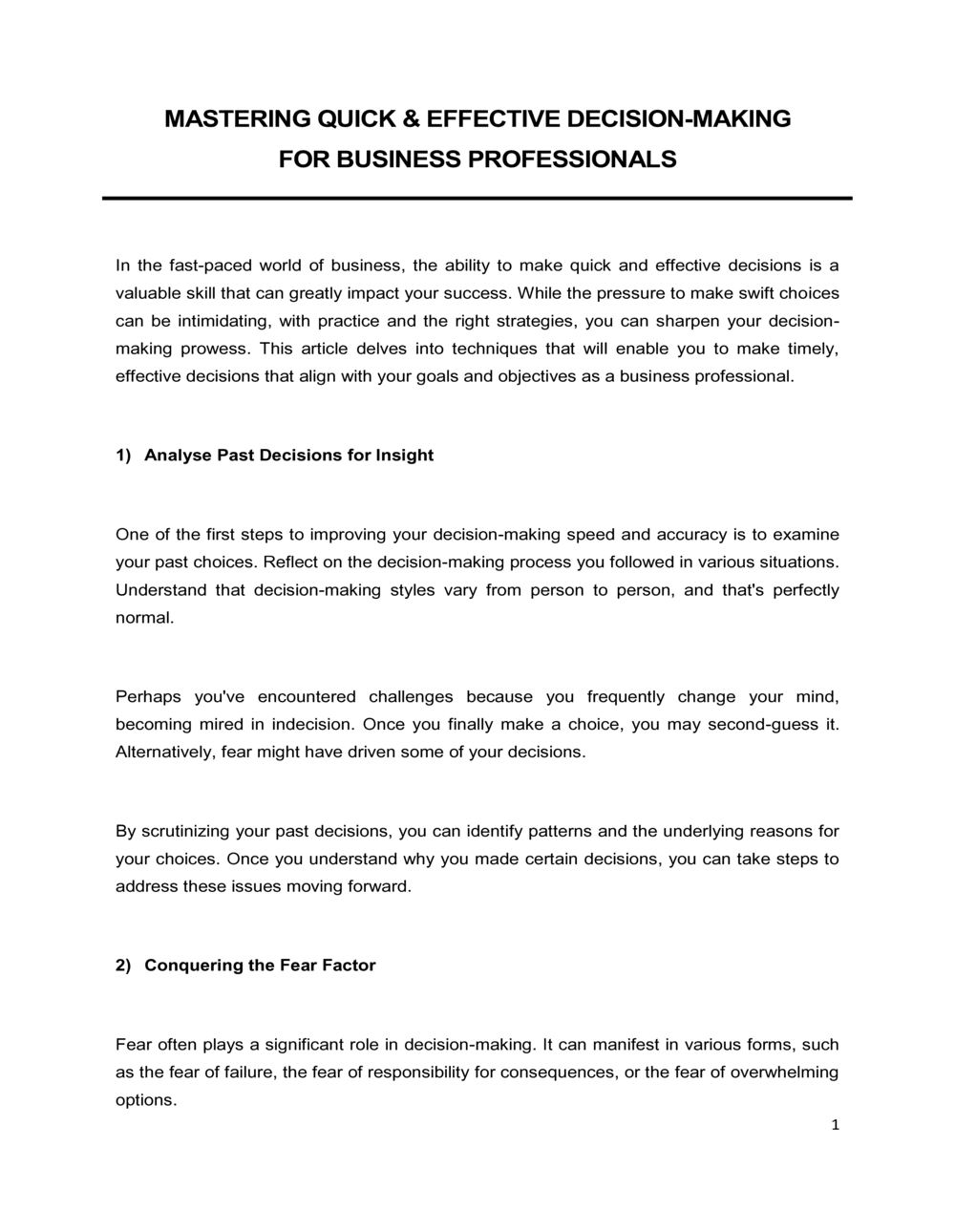
Mastering Quick and Effective Decision Making is a structured operational guide that walks managers and teams through a repeatable process for identifying the real problem, generating options, evaluating risk, and committing to a course of action under time pressure. This free Word download gives you a ready-to-edit framework you can adapt to your organization's context and export as PDF for training, onboarding, or team alignment.
When you need it
Use it when your team consistently delays decisions, revisits settled choices, or escalates routine judgment calls to senior leadership. It is also the right starting point when building a management training program or standardizing how decisions are documented across departments.
What's inside
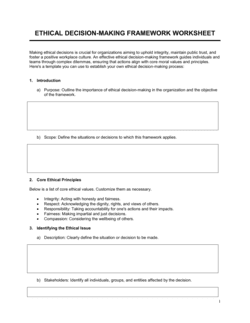
The guide covers the full decision cycle: problem definition, stakeholder mapping, option generation, risk and trade-off analysis, decision criteria weighting, selection and commitment, communication of the decision, and post-decision review. Each section includes practical instructions, worked examples, and fill-in prompts your team can use immediately.

What is a Decision Making Framework?

A Decision Making Framework is a structured operational guide that walks managers, team leads, and individual contributors through a repeatable process for defining a problem, generating options, evaluating trade-offs, selecting a course of action, and reviewing the outcome. Rather than relying on intuition alone or convening an open-ended group discussion, it provides a consistent sequence of steps that produces faster, more defensible decisions β€” and leaves a documented record of the rationale behind each one. This template is a free Word download you can adapt to your team's context and use immediately for any decision where accountability and speed both matter.

Why You Need This Document

Organizations that lack a structured decision process pay for it in three ways: decisions get delayed while teams seek more information that never materially changes the outcome; settled choices get relitigated by stakeholders who were not aligned during the process; and the same mistakes recur because no one documented what went wrong the first time. The cost of slow, inconsistent decision making is measured in missed market windows, frustrated employees, and projects that stall waiting for approvals that should have been routine. This template gives your team a common language and process for every significant choice β€” so the energy that currently goes into debating how to decide gets redirected into deciding well and executing fast.

Which variant fits your situation?

If your situation is…Use this template
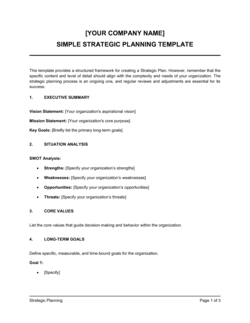
Making strategic decisions with a leadership teamStrategic Planning Template
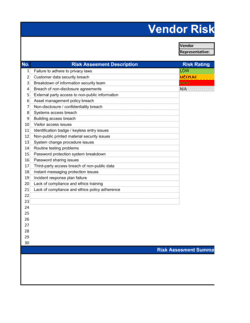
Assessing risks before a major business decisionRisk Assessment Template
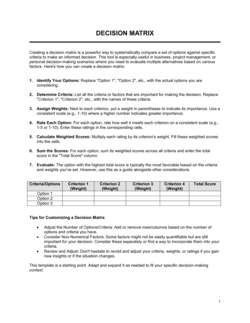
Comparing two or more options with weighted criteriaDecision Matrix Template
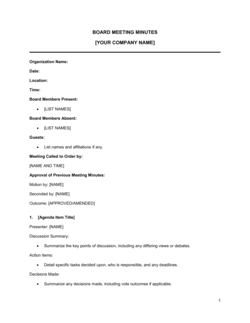
Documenting a decision after the fact for accountabilityMeeting Minutes Template
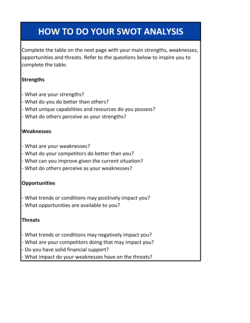
Aligning a team on priorities before deciding on directionSWOT Analysis Template
Building a full operational policy for how decisions are governedPolicies and Procedures Manual
Training new managers on leadership decision skillsManagement Training Plan

Common mistakes to avoid

❌ Framing the decision as a binary yes/no

Why it matters: Binary framing eliminates the middle-ground options that often carry the best risk-reward profile and are the easiest to implement.

Fix: Always generate at least three options β€” including the status quo β€” before evaluating any of them. If only two options seem to exist, probe harder.

❌ Waiting for complete information before deciding

Why it matters: In most business contexts, complete information never arrives. Waiting past the point of diminishing returns costs more in delayed action than the marginal data is worth.

Fix: Time-box the information-gathering phase. Set a decision deadline at the start of the process and stick to it, making the best call possible with available data.

❌ Assigning no single decision owner

Why it matters: When a group owns a decision collectively, each individual assumes someone else will act β€” producing either no decision or a decision that gets relitigated by whoever disagrees.

Fix: Name one person as the decision-maker before the process begins. Consultees advise; the named owner decides and is accountable for the outcome.

❌ Skipping the post-decision review

Why it matters: Without a structured review, teams repeat the same decision-process errors because no one has documented what worked and what did not.

Fix: Schedule the review at the same time the decision is made, not afterward. Treat the review as mandatory, not optional, even when early results look positive.

❌ Communicating the decision without the rationale

Why it matters: Teams that know what was decided but not why are more likely to resist implementation, surface objections late, or quietly work around the decision.

Fix: Include a two-to-three sentence rationale in every decision communication β€” what options were considered, why this one was chosen, and what problem it solves.

❌ Treating all decisions with the same level of rigor

Why it matters: Applying a full eight-step framework to a low-stakes reversible call wastes time and trains teams to skip the framework for everything.

Fix: Classify decisions by reversibility and impact before starting. Reserve the full framework for high-stakes or irreversible decisions; use a simplified three-step version for routine calls.

The 9 key sections, explained

Problem Definition

Stakeholder and Decision Rights Map

Option Generation

Decision Criteria and Weighting

Risk and Trade-off Analysis

Decision Selection and Rationale

Implementation Assignments

Communication Plan

Post-Decision Review

How to fill it out

  1. 1

    Define the problem in one sentence

    Write the decision to be made as a clear, specific question β€” not a symptom or a pre-selected solution. Confirm the deadline and who holds final authority before proceeding.

    πŸ’‘ If you cannot write the decision in one sentence, you have not yet identified the real choice. Spend five minutes here to save hours later.

  2. 2

    Map decision rights with a RACI

    List the decision-maker, all required consultees, and the inform-only audience. Assign an escalation owner in case the deadline arrives without consensus.

    πŸ’‘ Limit the 'consulted' list to people whose input materially changes the option set. More than five consultees on a routine decision is a warning sign.

  3. 3

    Generate at least three options

    Identify all realistic courses of action, including the status quo. Write a one-line description, estimated cost, and timeline for each option before evaluating any of them.

    πŸ’‘ Generate options before scoring them. Mixing generation and evaluation causes the group to anchor on the first plausible option and stop looking.

  4. 4

    Define and weight decision criteria

    List the factors that matter for this specific decision and assign a percentage weight to each. Ensure weights sum to 100% and reflect actual organizational priorities, not assumed equal importance.

    πŸ’‘ Ask the decision-maker to set weights before the options are scored β€” post-hoc weighting to justify a preferred option undermines credibility.

  5. 5

    Score options and assess risks

    Rate each option 1–5 on every criterion, calculate the weighted total, then run a pre-mortem on the top-scoring option to surface overlooked risks.

    πŸ’‘ If the pre-mortem uncovers a risk that reverses the ranking, adjust the criteria weights rather than ignoring the finding.

  6. 6

    Record the decision and rationale

    Document the chosen option, the decision-maker's name and date, and a two-to-three sentence rationale linking the criteria scores and risk findings to the final call.

    πŸ’‘ Write the rationale for the option you rejected, too. It prevents the same alternative from being relitigated at the next team meeting.

  7. 7

    Assign actions and communicate the decision

    Convert the decision into tasks with single named owners and firm deadlines. Send the communication plan outputs within 24 hours of the decision to prevent rumor from filling the vacuum.

    πŸ’‘ State the decision, the reason, and the next step in that order when communicating. Skip any of the three and expect follow-up questions that slow execution.

  8. 8

    Schedule and run the post-decision review

    Set the review date at the time of the decision β€” 30, 60, or 90 days depending on the implementation timeline. Compare actual outcomes to the assumptions in your option analysis.

    πŸ’‘ Add the outcome summary to the organization's decision log before the review meeting ends. Undocumented reviews produce no institutional memory.

Frequently asked questions

What is a decision making framework?

A decision making framework is a structured process that guides individuals or teams from problem definition through option evaluation to a documented final choice. It reduces the cognitive load of deciding under pressure, ensures relevant factors are consistently considered, and produces a record of why the decision was made β€” which matters when outcomes are later questioned or reviewed.

How do I make faster decisions without sacrificing quality?

Speed and quality improve together when you separate the steps of a decision process and time-box each one. Define the problem and the deadline first, then generate options without evaluating them, then score and select. Most decision delays happen because problem definition and option generation happen simultaneously β€” separating them alone cuts decision time significantly. Limiting the consulted list to five or fewer people also removes a major source of delay.

What is the difference between a decision log and meeting minutes?

Meeting minutes record what was discussed and what actions were assigned. A decision log focuses specifically on what was decided, which options were considered, why the chosen option won, and what the actual outcome was after implementation. A decision log is a learning and accountability tool; meeting minutes are a communication record. High-performing teams maintain both.

When should I use a decision matrix?

Use a decision matrix when you have three or more options to compare across multiple criteria that carry different weights. It is most valuable for medium-to-high-stakes decisions where a defensible, documented rationale matters β€” hiring, vendor selection, product prioritization, or capital allocation. For simple or highly time-pressured decisions, a two-minute pre-mortem on the leading option is faster and sufficient.

How do I handle disagreement within a team before a decision?

Surface disagreement at the criteria-weighting stage, not the option-scoring stage. Most team disagreements about decisions are actually disagreements about what matters most β€” cost vs. speed, short-term vs. long-term. Agreeing on weights before scoring forces the underlying value conflict into the open where it can be resolved explicitly. If consensus on weights is impossible, the decision-maker sets them and the team executes.

What is a pre-mortem and how does it improve decisions?

A pre-mortem is a five-to-ten minute exercise in which the team imagines that the selected option has already failed six months from now and works backward to identify what went wrong. It surfaces risks that optimism bias suppresses during forward-looking analysis. Run it on the top-scoring option before committing β€” if the pre-mortem reveals a deal-breaking risk, revise the option set or the risk mitigations rather than proceeding blind.

Should every business decision be documented?

No β€” documenting every decision creates bureaucracy that slows teams down. Reserve formal documentation for decisions that are high-stakes, affect multiple teams, involve significant resource commitment, or are likely to be questioned later. A practical threshold: if the decision would be hard to explain six months from now without notes, document it. Routine, reversible, low-cost decisions do not need a formal record.

How often should a decision making framework be updated?

Review the framework annually or after any major process failure where the decision process contributed to a poor outcome. The criteria categories and weighting guidance should be updated whenever organizational priorities shift significantly β€” for example, after a funding round that changes the growth vs. profitability balance, or after a restructuring that changes decision authority.

Can this framework be used for personal decisions as well as business ones?

Yes β€” the core steps of problem definition, option generation, criteria weighting, and post-decision review apply to any significant choice under uncertainty. The main adaptation for personal use is simplifying the stakeholder map to just the people whose input genuinely matters and shortening the documentation to a one-page summary rather than a full organizational record.

How this compares to alternatives

vs Strategic Planning Template

A strategic plan sets the organizational direction and multi-year goals over a defined planning cycle. A decision making framework is used in real time to resolve specific choices that arise during execution. The two complement each other β€” strategy defines the criteria by which tactical decisions should be judged.

vs Risk Assessment Template

A risk assessment systematically identifies, scores, and mitigates threats across a project or function. A decision making framework incorporates risk analysis as one step in a broader choice process. Use the risk assessment template when you need a comprehensive threat register; use the decision framework when you need to move from analysis to a committed course of action.

vs SWOT Analysis Template

A SWOT analysis maps strengths, weaknesses, opportunities, and threats to inform strategic positioning. A decision framework is action-oriented β€” it takes inputs like a SWOT and converts them into a documented, time-bound choice with assigned owners. Run a SWOT before a major decision to populate the option-generation and risk sections.

vs Policies and Procedures Manual

A policies and procedures manual codifies how recurring operational activities are carried out across the organization. A decision making framework governs novel or judgment-heavy choices that fall outside standard procedure. Organizations typically need both β€” procedures for routine work, a decision framework for situations that require weighing trade-offs.

Industry-specific considerations

Technology / SaaS

Product prioritization, build-vs-buy calls, and incident response decisions where speed and reversibility are critical differentiators.

Financial Services

Credit and investment decisions requiring auditable rationale, formal risk scoring, and documented approval chains for regulatory compliance.

Healthcare

Clinical and operational decisions where evidence-based criteria, escalation protocols, and post-decision outcome tracking are mandatory.

Professional Services

Client engagement decisions, staffing allocation, and scope-change approvals where speed matters but a documented rationale protects against dispute.

Manufacturing

Supply chain and production decisions with high cost-of-reversal, where structured trade-off analysis and single-owner accountability reduce costly restarts.

Retail / E-commerce

Pricing, promotion, and inventory decisions that must be made quickly against real-time data, with clear owner accountability and rapid post-decision review cycles.

Template vs pro β€” what fits your needs?

PathBest forCostTime
Use the templateManagers and team leads building a decision process for their own team or departmentFree1–2 hours to customize and 30–60 minutes per significant decision
Template + professional reviewOrganizations embedding this framework into a formal management training or leadership development program$500–$2,000 for a facilitator or L&D consultant review1–2 weeks
Custom draftedEnterprises redesigning governance structures, decision rights, or building an organization-wide decision intelligence capability$5,000–$25,000+ for an organizational design or management consulting engagement4–12 weeks

Glossary

Decision Criteria
The specific factors β€” cost, speed, risk, alignment with strategy β€” used to evaluate and compare options before selecting a course of action.
Decision Rights
A clear assignment of who has the authority to make a given type of decision, distinguishing between the decision-maker, advisors, and those who must be informed.
RACI Matrix
A responsibility chart identifying who is Responsible, Accountable, Consulted, and Informed for each decision or task.
Time-Boxing
Setting a fixed deadline for reaching a decision so that the search for more information does not delay action indefinitely.
Reversible vs. Irreversible Decision
A reversible decision can be undone at low cost if it proves wrong; an irreversible one cannot β€” the distinction determines how much analysis is warranted before committing.
Analysis Paralysis
A state in which the pursuit of additional information or options prevents any decision from being made, often at greater cost than making an imperfect choice quickly.
Pre-mortem
A structured exercise in which the team imagines a decision has already failed and works backward to identify the most likely causes β€” used to surface hidden risks before committing.
Second-Order Consequences
The downstream effects of a decision that only become visible after the immediate outcome β€” e.g., a cost cut that saves money this quarter but triggers key-employee attrition next quarter.
Decision Log
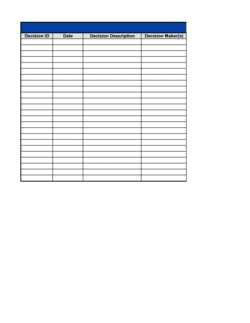
A running record of significant decisions made, the options considered, the rationale, and the outcome β€” used for accountability and organizational learning.
Satisficing
Choosing the first option that meets a minimum acceptable threshold rather than searching exhaustively for the optimal one β€” a practical strategy under time and information constraints.

Part of your Business Operating System

This document is one of 3,000+ business & legal templates included in Business in a Box.

  • Fill-in-the-blanks β€” ready in minutes
  • Compatible with all office suites
  • Export to PDF and share electronically

Create your document in 3 simple steps.

From template to signed document β€” all inside one Business Operating System.
1
Download or open template

Access over 3,000+ business and legal templates for any business task, project or initiative.

2
Edit and fill in the blanks with AI

Customize your ready-made business document template and save it in the cloud.

3
Save, Share, Send, Sign

Share your files and folders with your team. Create a space of seamless collaboration.

Save time, save money, and create top-quality documents.

β˜…β˜…β˜…β˜…β˜…

"Fantastic value! I'm not sure how I'd do without it. It's worth its weight in gold and paid back for itself many times."

Managing Director Β· Mall Farm
Robert Whalley
Managing Director, Mall Farm Proprietary Limited
β˜…β˜…β˜…β˜…β˜…

"I have been using Business in a Box for years. It has been the most useful source of templates I have encountered. I recommend it to anyone."

Business Owner Β· 4+ years
Dr Michael John Freestone
Business Owner
β˜…β˜…β˜…β˜…β˜…

"It has been a life saver so many times I have lost count. Business in a Box has saved me so much time and as you know, time is money."

Owner Β· Upstate Web
David G. Moore Jr.
Owner, Upstate Web

Run your business with a system β€” not scattered tools

Stop downloading documents. Start operating with clarity. Business in a Box gives you the Business Operating System used by over 250,000 companies worldwide to structure, run, and grow their business.

Free Forever PlanΒ Β·Β No credit card required