1
Write the decision statement before anything else
Articulate the specific choice to be made, why it matters now, and the deadline. One or two sentences. If you cannot write it in two sentences, the scope is too broad.
💡 A well-written decision statement eliminates at least a third of the options you would otherwise evaluate — precision up front saves hours of analysis.
2
Map stakeholders and assign decision authority
List every person who must be consulted, who has approval authority, and who will be informed of the outcome. Confirm the decision authority with that individual before the analysis begins.
💡 Use a RACI (Responsible, Accountable, Consulted, Informed) shorthand to prevent the common failure of decisions that get made and then reversed by an unconsulted senior leader.
3
Define and weight your evaluation criteria
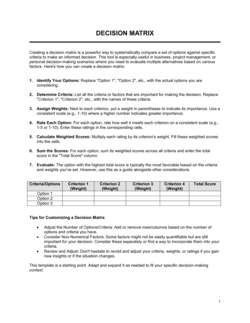
List four to six factors that matter most — financial return, strategic alignment, risk, time to value, feasibility. Assign weights that sum to 100%, reflecting actual organizational priorities.
💡 Get the decision authority to approve the criteria and weights before scoring options. This prevents accusations of result-rigging after the model favors an unpopular choice.
4
Document all options including the status quo
Write a two-to-three sentence description of each realistic option, including doing nothing. Incomplete options lists are the single most common cause of post-decision regret.
💡 Aim for three to five options. Fewer than three feels like a false choice; more than five creates analysis paralysis without meaningfully improving the outcome.
5
Score risks and upside for each option independently
Complete the risk assessment and reward quantification sections for each option before building the comparison matrix. Scoring risks after you know the comparison outcome introduces bias.
💡 Use a simple 1–3 scale for probability and impact, then multiply to get a risk score of 1–9. This is fast, defensible, and sufficient for most business decisions.
6
Run the weighted scoring model
Apply each option's scores against the criteria weights to produce a total weighted score per option. The highest-scoring option is your model's recommended choice — not necessarily the final one, but the starting point for discussion.
💡 If the model output surprises decision makers, revisit the criteria weights rather than the scores. Surprise usually signals a weight that doesn't reflect real priorities.
7
Document the decision rationale with conditions and triggers
Record the selected option, the primary reasons it was chosen, any significant dissenting views, and the conditions under which the decision should be revisited.
💡 Include at least one explicit trigger condition — a revenue threshold, a competitive event, a regulatory change — that would prompt a review. This makes the decision adaptive rather than static.
8
Attach the implementation plan and schedule the post-decision review
Convert the selected option into a task list with named owners, deadlines, and resource requirements. Set a calendar date for the first post-decision review — 60 to 90 days after implementation start is standard.
💡 The post-decision review is not a blame exercise; it is the mechanism by which the organization improves its decision-making calibration over time. Make attendance mandatory for the same stakeholders who participated in the original process.