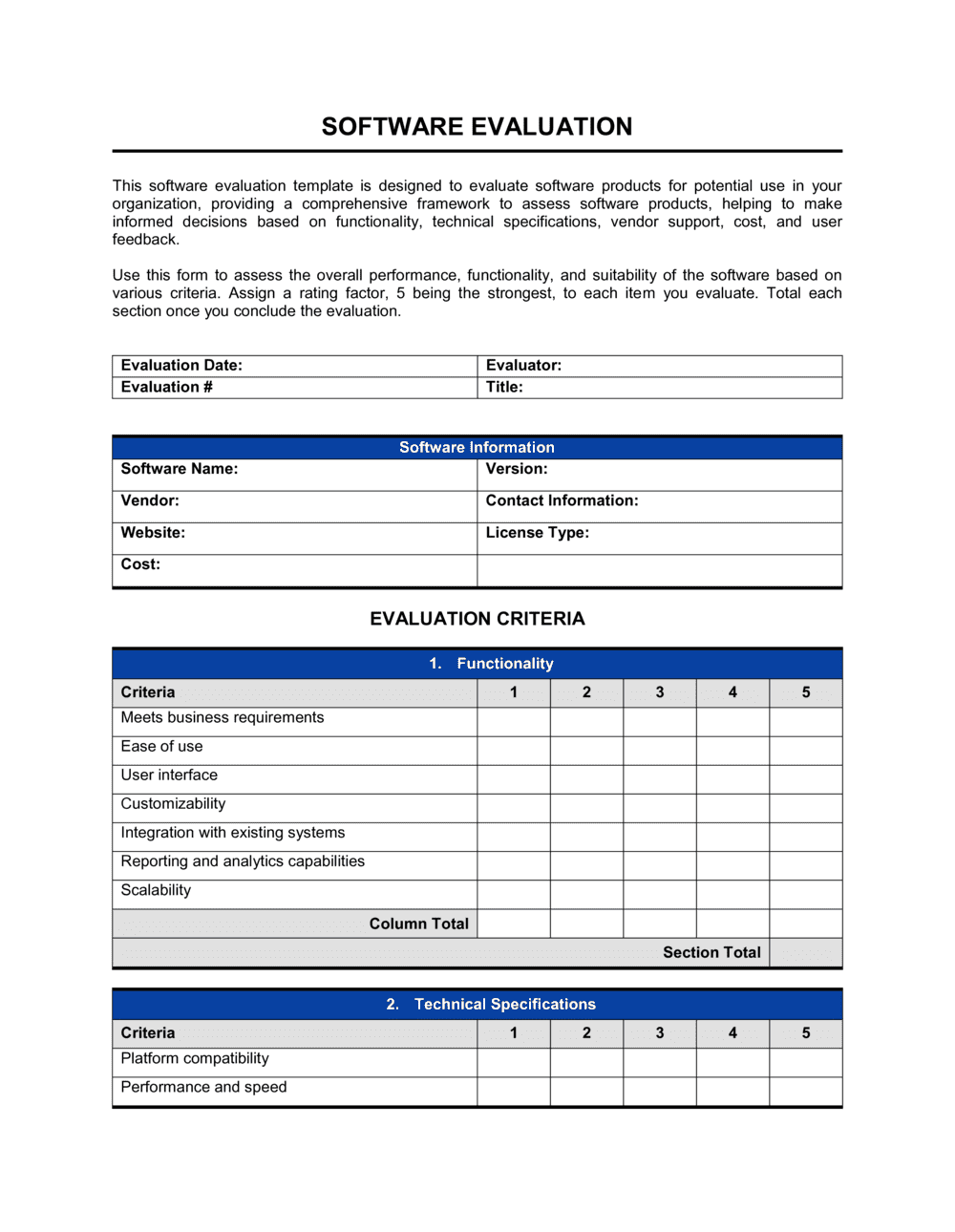
Software Evaluation Template

Free Word download β€’ Edit online β€’ Save & share with Drive β€’ Export to PDF

3 pagesβ€’25–30 min to fillβ€’Difficulty: Standardβ€’Signature requiredβ€’Legal review recommended
Learn more ↓
FreeSoftware Evaluation Template

At a glance

What it is
A Software Evaluation Agreement is a legally binding contract between a software vendor and a prospective customer that governs a time-limited trial or pilot of a software product. This free Word download gives you a structured, editable starting point covering access rights, confidentiality, IP ownership, liability limitations, and acceptance criteria β€” ready to export as PDF and execute before any evaluation begins.
When you need it
Use it whenever a vendor grants a prospect access to proprietary software for testing purposes before a purchase decision. It applies equally to enterprise SaaS pilots, on-premise evaluations, and proof-of-concept deployments where the software is not yet commercially released.
What's inside
Defined evaluation scope and permitted uses, confidentiality and data protection obligations, intellectual property ownership, warranty disclaimers and liability caps, evaluation period and termination rights, acceptance criteria and feedback obligations, and governing law.

What is a Software Evaluation Agreement?

A Software Evaluation Agreement is a legally binding contract between a software vendor and a prospective customer that governs time-limited, restricted access to a software product for testing purposes before any commercial commitment is made. It defines the permitted scope of the evaluation, sets a hard expiration date, establishes confidentiality obligations for both parties, confirms the vendor's ownership of all intellectual property β€” including any feedback provided during the trial β€” and caps the vendor's liability for defects or data loss during the evaluation period. Unlike a standard software license, a software evaluation agreement explicitly prohibits production use, disclaims all warranties, and creates a structured framework for transitioning to a commercial relationship if the evaluation succeeds.

Why You Need This Document

Without a signed software evaluation agreement in place before access is provisioned, a vendor's proprietary source code, architecture, and pricing are exposed with no contractual protection against disclosure. Evaluators who load real customer or employee data into a trial environment create GDPR, CCPA, or HIPAA exposure for both parties with no documented framework to address it. Vendors who allow evaluations to proceed on a handshake have found prospects running live workloads on trial licenses for months β€” or retaining copies of proprietary software long after an evaluation ended β€” with no enforceable basis to demand cessation. A properly drafted evaluation agreement closes all of these gaps: it protects the vendor's IP, limits liability for evaluation-period defects, governs data handling, and creates a clear conversion path to a paid license when the trial succeeds. This template gives you a court-ready starting point you can execute in under 30 minutes.

Which variant fits your situation?

If your situation is…Use this template
Full enterprise software trial with data integration and custom setupSoftware Evaluation Agreement (Enterprise)
Early-stage beta access for a pre-release productBeta Software Agreement
Proof-of-concept deployment with defined success criteriaProof of Concept Agreement
Ongoing commercial use after a successful evaluationSoftware License Agreement
Access to sensitive technical data or trade secrets during evaluationMutual Non-Disclosure Agreement
Third-party development work performed during the evaluation periodSoftware Development Agreement
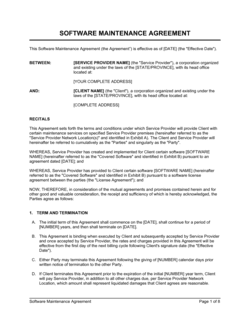
Vendor providing ongoing support and maintenance after trial acceptanceSoftware Maintenance Agreement

Common mistakes to avoid

❌ Granting access before the agreement is signed

Why it matters: Any IP, data handling, or confidentiality protection in the agreement is unenforceable for the period between access provisioning and signature β€” which can span days or weeks in enterprise sales cycles.

Fix: Gate all access provisioning on receipt of a countersigned agreement. Use eSign tools that allow same-day execution and confirm the timestamp precedes any login credentials being issued.

❌ No hard expiration date on the evaluation period

Why it matters: Without a fixed end date, evaluators have run on trial licenses for months or years without converting to paid contracts, and vendors have had limited contractual recourse to demand access termination.

Fix: Always use specific calendar dates for the evaluation period start and end. Require written mutual consent for any extension, executed before the original end date lapses.

❌ Omitting a data handling clause

Why it matters: Evaluators routinely load real customer records, employee data, or financial information into trial environments. Without a data handling clause, neither party has a documented framework for GDPR, CCPA, or HIPAA compliance during the evaluation.

Fix: Add an explicit data handling clause prohibiting regulated data in the evaluation environment, or require execution of a DPA addendum before any personal or regulated data is processed.

❌ No return-or-destroy obligation on termination

Why it matters: Without a documented obligation, evaluators may retain software installers, configuration files, API keys, or copies of the vendor's confidential documentation indefinitely after the evaluation ends.

Fix: Include a clause requiring the evaluator to certify in writing β€” within 10 business days of termination β€” that all software copies and confidential materials have been destroyed or returned.

❌ Using a warranty disclaimer in lowercase text

Why it matters: In the US, Canada, and the UK, warranty exclusions must be conspicuous to be enforceable against a commercial counterparty. Lowercase disclaimers buried in dense boilerplate have been struck down by courts even when both parties signed.

Fix: Present warranty disclaimers and liability caps in all-capitals or bold font, in a type size no smaller than the surrounding body text.

❌ No feedback license grant from evaluator to vendor

Why it matters: When a vendor incorporates an evaluator's bug report, feature suggestion, or integration idea into the product without an explicit license, the evaluator can later claim an implied co-authorship interest or demand compensation.

Fix: Include a perpetual, irrevocable, royalty-free feedback license in the IP section, making clear the evaluator assigns any rights in feedback to the vendor at the moment of submission.

The 10 key clauses, explained

Parties, recitals, and evaluation scope

In plain language: Identifies the vendor and evaluator as legal entities, describes the software being evaluated, and defines the permitted scope of the trial β€” internal testing only, named users, and specific systems.

Sample language
This Software Evaluation Agreement is entered into as of [DATE] between [VENDOR LEGAL NAME], a [STATE/JURISDICTION] [ENTITY TYPE] ('Vendor'), and [EVALUATOR LEGAL NAME] ('Evaluator'). Vendor grants Evaluator a non-exclusive, non-transferable right to access [SOFTWARE NAME] ('Software') solely for internal evaluation purposes during the Evaluation Period.

Common mistake: Using a trade name instead of the registered legal entity name for either party β€” causing enforcement ambiguity if a dispute arises over IP or confidentiality obligations after the evaluation ends.

Evaluation period and extension

In plain language: States the start date, the fixed end date, and the conditions under which the evaluation may be extended β€” typically by mutual written consent only.

Sample language
The Evaluation Period shall commence on [START DATE] and expire on [END DATE] ('Evaluation Period'), unless earlier terminated in accordance with this Agreement. Any extension must be agreed in writing by both parties prior to expiration.

Common mistake: Omitting an end date and using language like 'until the parties agree otherwise.' Without a hard expiration, evaluators have operated software for years without a license, creating infringement exposure for the vendor.

Permitted use and restrictions

In plain language: Lists what the evaluator may and may not do with the software β€” typically permitting internal testing by named users and prohibiting sublicensing, reverse engineering, production deployment, and benchmarking publication.

Sample language
Evaluator shall use the Software solely for internal evaluation by up to [NUMBER] named users. Evaluator shall not: (a) sublicense, sell, or transfer the Software; (b) reverse engineer or decompile the Software; (c) deploy the Software in a production environment; or (d) publish benchmarking results without Vendor's prior written consent.

Common mistake: No restriction on production use β€” evaluators who begin running live workflows on evaluation software are effectively using a commercial license without paying for one, and the vendor has no contractual basis to stop them.

Confidentiality obligations

In plain language: Requires each party to protect the other's confidential information disclosed during the evaluation β€” including source code, pricing, technical architecture, and business data β€” using at least the same care they apply to their own confidential information.

Sample language
Each party agrees to hold the other's Confidential Information in strict confidence using no less than reasonable care, and not to disclose it to any third party without prior written consent. Confidential Information excludes information that: (a) is or becomes publicly known through no breach of this Agreement; (b) was already known to the receiving party; or (c) is independently developed without reference to the disclosing party's information.

Common mistake: Omitting a mutual confidentiality obligation β€” the vendor focuses on protecting its software but forgets that the evaluator's test data, business processes, and integration specifications are equally sensitive.

Intellectual property ownership and feedback license

In plain language: Confirms the vendor retains all IP in the software and grants the vendor a royalty-free license to use any feedback, suggestions, or bug reports the evaluator provides during the trial.

Sample language
Vendor retains all right, title, and interest in and to the Software, including all derivative works. Evaluator hereby grants Vendor a perpetual, irrevocable, royalty-free license to use any Feedback provided by Evaluator during the Evaluation Period to develop, improve, or commercialize the Software.

Common mistake: No feedback license at all β€” leaving the vendor legally exposed when it incorporates evaluator suggestions into the product, since the evaluator could later claim co-authorship or an implied license fee.

Warranty disclaimer

In plain language: States that the software is provided 'as is' during the evaluation, with no warranties regarding fitness, merchantability, accuracy, or uptime β€” protecting the vendor from warranty claims arising from evaluation-period defects.

Sample language
THE SOFTWARE IS PROVIDED 'AS IS' FOR EVALUATION PURPOSES ONLY. VENDOR DISCLAIMS ALL WARRANTIES, EXPRESS OR IMPLIED, INCLUDING WARRANTIES OF MERCHANTABILITY, FITNESS FOR A PARTICULAR PURPOSE, AND NON-INFRINGEMENT. VENDOR DOES NOT WARRANT THAT THE SOFTWARE WILL BE ERROR-FREE OR UNINTERRUPTED DURING THE EVALUATION PERIOD.

Common mistake: Using lowercase warranty disclaimer text β€” in many jurisdictions, warranty exclusions must be conspicuous (capitalized or bold) to be enforceable against a commercial counterparty.

Limitation of liability

In plain language: Caps the total damages either party may recover from the other in connection with the evaluation, typically limiting recovery to direct damages only and excluding consequential, incidental, or punitive losses.

Sample language
IN NO EVENT SHALL EITHER PARTY BE LIABLE FOR ANY CONSEQUENTIAL, INCIDENTAL, INDIRECT, SPECIAL, OR PUNITIVE DAMAGES ARISING OUT OF OR RELATED TO THIS AGREEMENT. VENDOR'S TOTAL LIABILITY SHALL NOT EXCEED [USD $X / THE GREATER OF $500 OR THE FEES PAID, IF ANY, FOR THE EVALUATION].

Common mistake: Setting the liability cap at zero or omitting it entirely on the assumption that no fees are exchanged. Courts have awarded substantial damages for data loss and business disruption during unpaid evaluations when no cap was in place.

Data handling and security

In plain language: Addresses how any data the evaluator loads into the software during the trial is handled, protected, and deleted β€” particularly critical when the evaluation involves personally identifiable information or regulated data.

Sample language
Evaluator shall not input any personal data, protected health information, or regulated financial data into the Software without Vendor's prior written consent and execution of a separate Data Processing Agreement. Vendor shall delete all Evaluator data within [30] days of the end of the Evaluation Period upon written request.

Common mistake: No data handling clause at all β€” evaluators routinely load real customer or employee records into trial environments, creating GDPR, HIPAA, or CCPA exposure for both parties with no contractual framework in place.

Termination and effect of termination

In plain language: States when and how either party may end the evaluation early, what obligations survive termination, and what the evaluator must do with the software and confidential information upon expiration or termination.

Sample language
Either party may terminate this Agreement upon [5] business days' written notice. Upon expiration or termination: (a) all access rights cease immediately; (b) Evaluator shall destroy or return all copies of the Software and Confidential Information within [10] business days; and (c) the confidentiality and IP provisions of this Agreement shall survive for [3] years.

Common mistake: No return-or-destroy obligation β€” vendors have discovered evaluators retaining copies of proprietary software or configuration files years after an evaluation ended, with no contractual basis to demand deletion.

Governing law, dispute resolution, and entire agreement

In plain language: Specifies which jurisdiction's law governs the agreement, how disputes are resolved, and confirms the written contract supersedes all prior discussions, emails, or term sheets about the evaluation.

Sample language
This Agreement is governed by the laws of [STATE/JURISDICTION], without regard to conflict-of-law principles. Any dispute shall be resolved by binding arbitration under [AAA/JAMS] rules in [CITY], except that either party may seek injunctive relief in any court of competent jurisdiction. This Agreement constitutes the entire agreement between the parties regarding the subject matter hereof.

Common mistake: Choosing a governing jurisdiction with no connection to where either party operates β€” causing enforceability challenges and practical inconvenience if a dispute over IP or data deletion ever needs to be litigated.

How to fill it out

  1. 1

    Enter both parties' legal entity names and addresses

    Use each party's full registered corporate name β€” not a trade name or product brand β€” and include the state or country of incorporation. Confirm the names against corporate registry filings before signing.

    πŸ’‘ If the vendor is a subsidiary, confirm whether the parent or the subsidiary is the correct contracting entity β€” signing with the wrong entity can make IP ownership provisions unenforceable.

  2. 2

    Define the software and the evaluation scope precisely

    Identify the specific software product, version or build, and any modules or APIs included in the evaluation. State whether the evaluation covers cloud-hosted, on-premise, or hybrid deployment.

    πŸ’‘ Attach a one-page Schedule A describing the software and its components in technical terms β€” this prevents scope-creep disputes about which features the evaluator was permitted to test.

  3. 3

    Set a hard evaluation period start date and end date

    Enter specific calendar dates β€” not relative periods like '30 days from access.' If access is provisioned in stages, note the provisioning date separately and tie the evaluation period to the first access date.

    πŸ’‘ Build in a 5-business-day buffer before the end date to allow time for written extension requests without the agreement lapsing mid-evaluation.

  4. 4

    List permitted uses and prohibited activities explicitly

    State the number of named users, the permitted systems or environments, and a clear list of prohibited activities β€” production deployment, sublicensing, benchmarking publication, and reverse engineering at minimum.

    πŸ’‘ For SaaS evaluations, specify whether the evaluator may integrate the software with third-party tools via API during the trial β€” unauthorized integrations can expose vendor data to external systems.

  5. 5

    Complete the confidentiality and data handling provisions

    Define what counts as Confidential Information for each party, set the standard of care, and address data types the evaluator is and is not permitted to load into the software.

    πŸ’‘ If the evaluation might involve any personal data β€” even in anonymized test datasets β€” execute a separate Data Processing Agreement or DPA addendum before provisioning access.

  6. 6

    Set acceptance criteria and feedback obligations

    List the specific functional, performance, or integration benchmarks the software must meet for the evaluation to be considered successful. Include a feedback delivery obligation β€” e.g., a written summary within 10 days of evaluation end.

    πŸ’‘ Quantified acceptance criteria (e.g., 'API response time under 500ms for 95% of requests') protect both parties β€” the evaluator has a clear pass/fail standard, and the vendor has a defined scope of liability.

  7. 7

    Confirm the liability cap and warranty disclaimer are capitalized

    Both the warranty disclaimer and the limitation of liability block must appear in all-caps or bold type to be conspicuous β€” a legal requirement for enforceability in the US, UK, and most common-law jurisdictions.

    πŸ’‘ Do not reduce the font size of the disclaimer to save space β€” courts have rejected inconspicuous disclaimers even when they were technically included in the signed document.

  8. 8

    Sign before access is provisioned

    Both parties must execute the agreement before the evaluator receives any access credentials, login tokens, or downloadable installer files. Post-access signatures leave the vendor unprotected for the period between provisioning and signing.

    πŸ’‘ Use a timestamped eSign platform so the executed agreement record includes the exact signing time, confirming it preceded system access.

Frequently asked questions

What is a software evaluation agreement?

A software evaluation agreement is a legally binding contract between a software vendor and a prospective customer that governs a time-limited trial of the vendor's software. It establishes permitted uses, confidentiality obligations, IP ownership, warranty disclaimers, liability caps, and data handling rules for the evaluation period. Without one, a vendor's proprietary code and a prospect's sensitive data are both unprotected during the trial.

Is a software evaluation agreement legally required?

No law mandates a written software evaluation agreement, but operating without one creates substantial legal exposure. A vendor who provisions access without a signed agreement has no contractual basis to enforce confidentiality, demand return of the software, or limit liability for defects discovered during the trial. Most enterprise procurement teams require a signed evaluation agreement before an IT environment will permit access to a trial system.

What is the difference between a software evaluation agreement and a software license agreement?

A software evaluation agreement grants temporary, restricted access for testing purposes only β€” typically with no fees, no production use, and strong warranty disclaimers. A software license agreement is the commercial contract that governs ongoing, production use after a purchase decision. A well-drafted evaluation agreement should include a conversion clause that describes how the relationship transitions to a full license if the evaluation is successful.

How long should a software evaluation period be?

Evaluation periods typically run 30 to 90 days for enterprise software trials, with 30 days common for SaaS products and 60 to 90 days for complex on-premise or deeply integrated platforms. The period should be long enough to test the specific acceptance criteria agreed in the contract, but short enough that the vendor can enforce conversion or termination without a protracted negotiation. Always use specific calendar dates rather than rolling day counts.

Can a vendor charge a fee for a software evaluation?

Yes. While many vendors offer free evaluations to reduce friction in the sales process, a nominal fee β€” even $1 β€” can provide additional consideration that strengthens the enforceability of restrictive covenants in some jurisdictions. Paid evaluations are more common for enterprise deployments requiring vendor resources for setup, integration support, or customization during the trial period.

What data should an evaluator be permitted to use during a software evaluation?

Best practice is to restrict evaluations to anonymized or synthetic test data that does not include personally identifiable information, protected health information, or regulated financial records. If real data is operationally necessary, the agreement should require execution of a separate Data Processing Agreement and specify the data categories permitted, the security controls the vendor must maintain, and the deletion timeline after the evaluation ends.

Who owns improvements or customizations made during a software evaluation?

Under a well-drafted evaluation agreement, the vendor retains ownership of all derivative works, modifications, and improvements β€” including those developed in response to evaluator feedback or test results. The evaluator grants the vendor a feedback license covering any suggestions, bug reports, or integration ideas contributed during the trial. Without this clause, evaluators have successfully argued co-authorship interests in features they helped design during a pilot.

What happens to the software and data when a software evaluation ends?

Upon expiration or termination, the evaluator's access rights should cease immediately. The evaluator is typically required to destroy or return all copies of the software, documentation, and confidential materials within 10 business days and certify compliance in writing. The vendor should delete all evaluator data loaded during the trial within a defined window β€” commonly 30 days β€” unless the parties transition to a commercial license.

Do I need a lawyer to prepare a software evaluation agreement?

For straightforward SaaS trials with standard scope, a high-quality template is usually sufficient. Engage a lawyer when the evaluation involves regulated data such as PHI or financial records, when the software contains export-controlled technology, when the evaluator operates in a jurisdiction with strict data protection laws such as the EU or California, or when the commercial opportunity is significant enough to warrant a fully negotiated agreement. A 1–2 hour review typically costs $300–$600 and is worthwhile for enterprise pilots.

How this compares to alternatives

vs Software License Agreement

A software license agreement is the commercial contract governing ongoing production use of software after a purchase decision. A software evaluation agreement is a temporary, restricted-access arrangement for testing only β€” with no production use permitted and stronger warranty disclaimers. The two documents address different stages of the vendor-customer relationship and should not be substituted for each other.

vs Non-Disclosure Agreement

An NDA covers confidentiality obligations for information exchanged during discussions or demonstrations β€” typically before any software access is granted. A software evaluation agreement includes confidentiality provisions but also adds IP ownership, permitted use restrictions, liability limits, and data handling obligations specific to hands-on software access. Signing an NDA alone is not sufficient protection once a prospect begins testing proprietary code.

vs Software Development Agreement

A software development agreement governs the creation of new software by one party for another β€” covering deliverables, milestones, IP assignment, and payment. A software evaluation agreement governs access to existing software for testing purposes, with no development obligations on either side. The two documents are not interchangeable and address entirely different commercial relationships.

vs Software Maintenance Agreement

A software maintenance agreement governs ongoing support, updates, and bug-fix obligations after a commercial license is in place. A software evaluation agreement explicitly disclaims support and uptime warranties during the trial period. The maintenance agreement becomes relevant only after a successful evaluation results in a commercial license being executed.

Industry-specific considerations

Technology / SaaS

API rate limits, uptime expectations, and multi-tenant data isolation requirements during the evaluation must be documented to avoid production-creep and unauthorized data commingling.

Healthcare / MedTech

HIPAA requires a Business Associate Agreement alongside any evaluation agreement that may involve PHI β€” the evaluation template should explicitly prohibit real patient data without a BAA in place.

Financial Services

Regulatory obligations under SOC 2, PCI-DSS, or GLBA mean financial institutions require vendor security certifications and audit rights as a condition of any software evaluation, regardless of trial duration.

Manufacturing and Industrial

OT/ICS software evaluations introduce operational risk if trial deployments interact with live production systems β€” the permitted use clause must explicitly restrict evaluation to isolated or sandboxed environments.

Professional Services

Law firms, accounting firms, and consultancies evaluating practice management software must ensure the agreement covers client confidentiality obligations that extend to any data inadvertently exposed during the trial.

Retail / E-commerce

Evaluations of commerce platforms may involve customer PII, payment flow testing, or inventory data β€” the data handling clause must address CCPA compliance and PCI-DSS scope for any payment-adjacent testing.

Jurisdictional notes

United States

Warranty disclaimers and liability caps must be conspicuous under the UCC to be enforceable β€” all-caps formatting is standard practice. California's CCPA imposes data handling obligations that apply even to trial environments processing California residents' personal data. Export Administration Regulations (EAR) may restrict providing access to foreign nationals for certain categories of software, including encryption and cybersecurity tools.

Canada

PIPEDA and provincial privacy laws such as Quebec's Law 25 apply to personal data processed during software evaluations, regardless of the trial's temporary nature. Quebec's Law 25 requires a privacy impact assessment for new technologies handling personal information. French-language contract requirements apply to Quebec-based evaluators in provincially regulated industries.

United Kingdom

Post-Brexit UK GDPR applies independently of EU GDPR and requires documented lawful bases for any personal data processed during evaluations. The UK's Computer Misuse Act creates criminal liability for unauthorized access to computer systems β€” the permitted use clause must be precise about authorized access scope. Standard warranty disclaimer capitalization conventions apply under the Unfair Contract Terms Act 1977 for business-to-business agreements.

European Union

GDPR Article 28 requires a Data Processing Agreement whenever a vendor processes personal data on behalf of an evaluator β€” this applies even to short-term trials. Standard Contractual Clauses (SCCs) are required for transferring evaluation data outside the EEA. The EU Cybersecurity Act and forthcoming Cyber Resilience Act impose security requirements on software vendors that may affect evaluation terms for products targeted at the EU market.

Template vs lawyer β€” what fits your deal?

PathBest forCostTime
Use the templateStandard SaaS trials with no regulated data, domestic counterparties, and evaluation periods of 30–90 daysFree20–30 minutes
Template + legal reviewEnterprise pilots involving API integrations, sensitive business data, or evaluators in GDPR or CCPA-regulated jurisdictions$300–$6001–3 days
Custom draftedEvaluations involving regulated data (PHI, PCI), export-controlled software, cross-border deployments, or commercially significant pilots exceeding $500K in potential contract value$1,500–$4,000+1–2 weeks

Glossary

Evaluation Period
The contractually defined time window β€” typically 30 to 90 days β€” during which the prospective customer is permitted to access and test the software.
Permitted Use
The specific activities the evaluator is authorized to perform with the software, such as internal testing, benchmarking, or integration testing β€” excluding production deployment or resale.
Acceptance Criteria
Measurable technical or functional benchmarks the software must meet for the evaluation to be deemed successful and trigger a purchase decision.
Proof of Concept (PoC)
A structured evaluation exercise designed to confirm that a software product can perform a specific function or integrate with the evaluator's existing systems before a commercial commitment.
Confidential Information
Non-public information disclosed by either party during the evaluation β€” including source code, product roadmaps, pricing, and technical specifications β€” that the receiving party must protect from disclosure.
Intellectual Property (IP) Ownership
The clause confirming that the vendor retains all ownership of the software, including any modifications or improvements suggested or tested during the evaluation.
Warranty Disclaimer
A provision stating that the software is provided 'as is' during the evaluation period, with no warranty of fitness, merchantability, or error-free operation.
Limitation of Liability
A cap on the damages either party may claim arising from the evaluation β€” typically limiting liability to direct damages and excluding consequential or incidental losses.
Feedback License
A grant from the evaluator to the vendor authorizing the vendor to use any bug reports, feature suggestions, or test results provided during the evaluation to improve the product β€” without compensation.
Derivative Work
Any modification, adaptation, or extension of the software created during the evaluation period; the agreement typically assigns ownership of derivative works to the vendor.
Termination for Convenience
A right allowing either party to end the evaluation agreement at any time before the evaluation period expires, without cause, typically with 5–10 business days' written notice.

Part of your Business Operating System

This document is one of 3,000+ business & legal templates included in Business in a Box.

  • Fill-in-the-blanks β€” ready in minutes
  • 100% customizable Word document
  • Compatible with all office suites
  • Export to PDF and share electronically

Create your document in 3 simple steps.

From template to signed document β€” all inside one Business Operating System.
1
Download or open template

Access over 3,000+ business and legal templates for any business task, project or initiative.

2
Edit and fill in the blanks with AI

Customize your ready-made business document template and save it in the cloud.

3
Save, Share, Send, Sign

Share your files and folders with your team. Create a space of seamless collaboration.

Save time, save money, and create top-quality documents.

β˜…β˜…β˜…β˜…β˜…

"Fantastic value! I'm not sure how I'd do without it. It's worth its weight in gold and paid back for itself many times."

Managing Director Β· Mall Farm
Robert Whalley
Managing Director, Mall Farm Proprietary Limited
β˜…β˜…β˜…β˜…β˜…

"I have been using Business in a Box for years. It has been the most useful source of templates I have encountered. I recommend it to anyone."

Business Owner Β· 4+ years
Dr Michael John Freestone
Business Owner
β˜…β˜…β˜…β˜…β˜…

"It has been a life saver so many times I have lost count. Business in a Box has saved me so much time and as you know, time is money."

Owner Β· Upstate Web
David G. Moore Jr.
Owner, Upstate Web

Run your business with a system β€” not scattered tools

Stop downloading documents. Start operating with clarity. Business in a Box gives you the Business Operating System used by over 250,000 companies worldwide to structure, run, and grow their business.

Start freeΒ Β·Β No credit card required