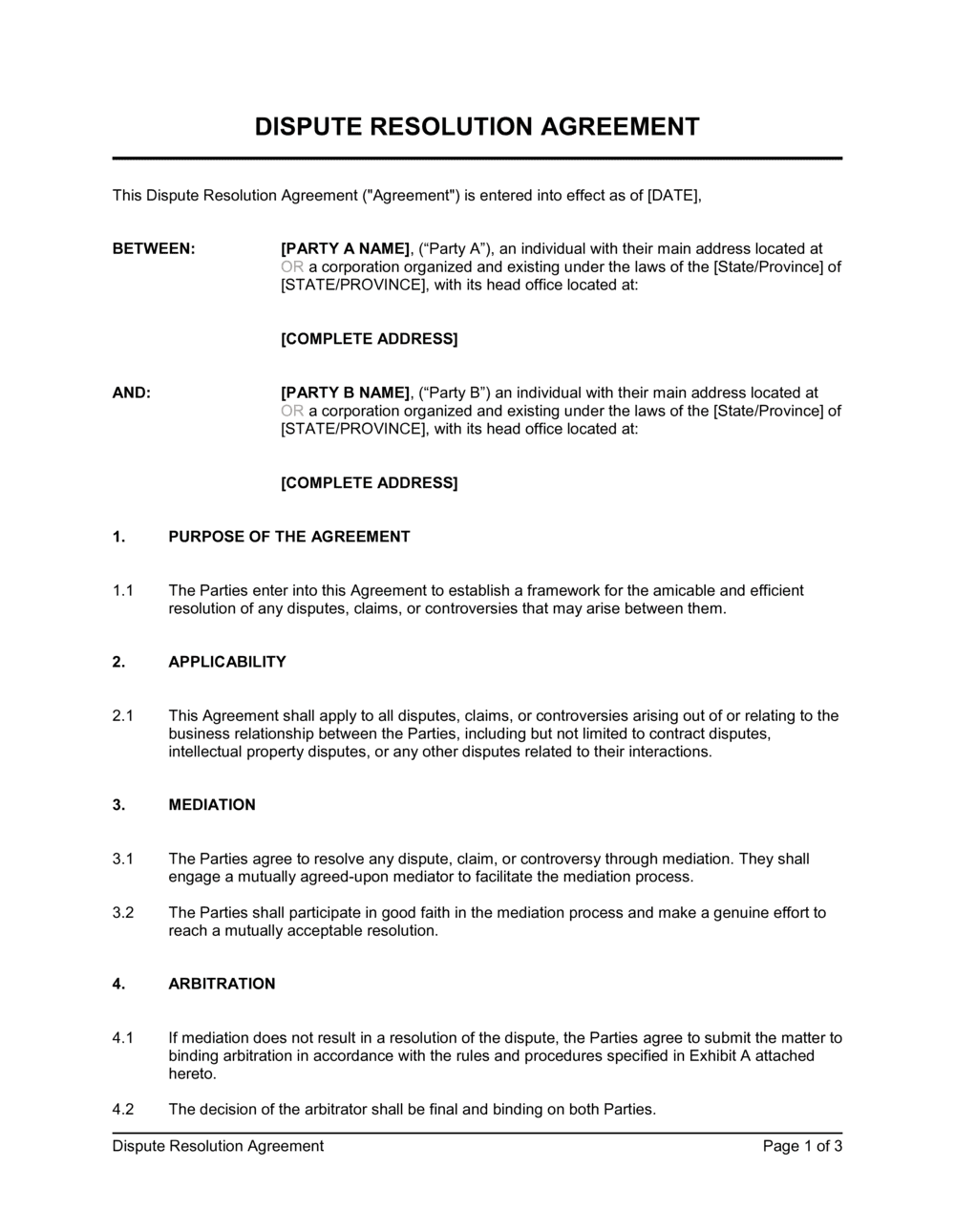
Dispute Resolution Agreement Template

Free Word download • Edit online • Save & share with Drive • Export to PDF

3 pages25–30 min to fillDifficulty: StandardSignature requiredLegal review recommended
Learn more ↓
FreeDispute Resolution Agreement Template

At a glance

What it is
A Dispute Resolution Agreement is a legally binding contract that establishes the process both parties must follow to resolve disagreements — before, and instead of, filing a lawsuit. This free Word download covers negotiation, mediation, and binding arbitration in a structured sequence, and can be used as a standalone agreement or incorporated into any master commercial contract.
When you need it
Use it when entering any commercial relationship where disputes are foreseeable — vendor contracts, partnership agreements, service arrangements, or joint ventures. It is also used to resolve an existing dispute by agreement once the parties decide to avoid litigation.
What's inside
Defined dispute scope, mandatory negotiation and cooling-off period, mediation procedures and mediator selection, binding arbitration rules and seat, confidentiality obligations, cost allocation, governing law, and enforcement provisions.

What is a Dispute Resolution Agreement?

A Dispute Resolution Agreement is a legally binding contract that specifies the process two or more parties must follow to resolve disagreements — typically requiring negotiation, then mediation, then binding arbitration — before either party may file a lawsuit. Rather than leaving dispute resolution to default court procedures, this agreement gives both parties a defined, private, and cost-controlled path from the moment a disagreement arises to a final enforceable outcome. It can operate as a standalone document governing the entire commercial relationship, or as an embedded clause within a master service agreement, partnership contract, or employment agreement. This free Word download covers all three escalation stages in a single document and can be adapted for domestic or cross-border commercial use.

Why You Need This Document

Without a dispute resolution agreement, either party can file suit immediately in any court with jurisdiction — triggering a process that averages two to four years to resolution, exposes both parties' confidential business information in public filings, and costs $100,000 to $500,000 or more per side in legal fees for typical commercial disputes. A signed dispute resolution agreement changes that calculus entirely: most commercial disputes are resolved in the mandatory negotiation or mediation stage at a fraction of arbitration cost, and those that reach arbitration are resolved in 6 to 18 months in a private, confidential proceeding. The agreement also eliminates strategic litigation leverage — a party cannot threaten a prolonged public lawsuit to extract a nuisance settlement when a fast, private, and binding process is already contractually locked in. This template gives any business the structural protection of an institutional-quality ADR framework without the cost of a custom-drafted clause.

Which variant fits your situation?

If your situation is…Use this template
Standalone agreement between two commercial parties before a contract disputeDispute Resolution Agreement
Clause to embed inside a master service agreement or vendor contractArbitration Clause (standalone clause addendum)
Resolving an employment or workplace claim outside of courtEmployment Arbitration Agreement
Settling an active dispute with a negotiated financial resolutionSettlement Agreement
Multi-party joint venture with complex governance and deadlock provisionsJoint Venture Agreement
International commercial dispute requiring ICC or UNCITRAL arbitration rulesInternational Arbitration Agreement
Consumer-facing dispute resolution policy for an e-commerce or SaaS businessTerms and Conditions (with dispute resolution clause)

Common mistakes to avoid

❌ Skipping the negotiation and mediation steps

Why it matters: Jumping straight to arbitration forfeits the cheapest resolution options. Mediation resolves roughly 70–80% of commercial disputes at a fraction of arbitration cost, which typically runs $15,000–$100,000+ in fees alone.

Fix: Build a mandatory escalation ladder — negotiation, then mediation, then arbitration — and require written notice to trigger each step before the next one is available.

❌ Failing to specify the arbitration seat

Why it matters: Without a designated seat, the parties and any arbitral institution must litigate where the arbitration is legally grounded, adding months of procedural delay before the merits are even addressed.

Fix: Name a specific city and country as the legal seat. For US domestic disputes, a major commercial hub (New York, Chicago, or Los Angeles) is standard. For international disputes, choose a New York Convention signatory with established arbitration infrastructure.

❌ Using a class-action waiver without conspicuous formatting

Why it matters: Courts regularly void class-action and jury-trial waivers buried in standard-form text, finding the waiver was not knowing and voluntary — invalidating the entire arbitration clause in some jurisdictions.

Fix: Present waivers in bold, all-caps, or a separately initialed box. For employment or consumer agreements, get jurisdiction-specific legal review before including any waiver.

❌ Omitting the emergency relief carve-out

Why it matters: Without a judicial emergency-relief exception, a party cannot immediately seek a temporary restraining order or injunction — leaving trade secrets, proprietary code, or customer data exposed while arbitration is organized over weeks or months.

Fix: Include a standard carve-out allowing either party to seek injunctive or equitable relief from a competent court without waiving the obligation to arbitrate the underlying claim.

❌ Selecting arbitration rules that are mismatched to the dispute value

Why it matters: Using full AAA Commercial Rules for a $20,000 dispute costs more in arbitrator fees and case management than the dispute is worth, incentivizing the other party to simply ignore the claim.

Fix: Match the rule set to the likely dispute value — AAA's Expedited Procedures apply automatically to claims under $100,000 and cost far less. JAMS Streamlined Rules serve a similar function.

❌ Signing the agreement after the dispute has already started

Why it matters: In common-law jurisdictions, an agreement signed after a dispute is underway may be challenged for lack of fresh consideration or entered under commercial duress, potentially voiding the ADR obligation entirely.

Fix: Execute the dispute resolution agreement before any disagreement arises — either as a standalone document at the start of the relationship or as a clause embedded in the underlying contract.

The 10 key clauses, explained

Scope of Disputes Covered

In plain language: Defines which types of disputes are subject to this agreement — claims arising from the underlying contract, tort claims, statutory violations, or all claims between the parties.

Sample language
This Agreement applies to any dispute, claim, or controversy arising out of or relating to the [CONTRACT NAME] dated [DATE], including any breach, termination, enforcement, interpretation, or validity thereof, whether based in contract, tort, statute, or otherwise.

Common mistake: Using scope language that is too narrow — for example, covering only 'contract disputes' — leaving tort or statutory claims to be litigated in court, which undermines the cost-saving purpose of the entire agreement.

Mandatory Negotiation and Cooling-Off Period

In plain language: Requires both parties to attempt direct good-faith negotiation for a defined period before invoking mediation or arbitration.

Sample language
Before initiating any formal ADR process, the disputing party shall deliver written notice to the other party. The parties shall negotiate in good faith for a period of [30] calendar days following such notice ('Negotiation Period') before proceeding to mediation.

Common mistake: Setting a negotiation period but not requiring written notice to start it — without a clear trigger date, either party can claim the clock never started and delay the process indefinitely.

Mediation Procedure

In plain language: Establishes mediation as the second step if negotiation fails, specifying who selects the mediator, which institution's rules apply, where mediation takes place, and who pays.

Sample language
If the dispute is not resolved within the Negotiation Period, either party may submit it to mediation administered by [AAA / JAMS / OTHER] under their then-current Commercial Mediation Procedures. The mediator shall be jointly selected within [15] days. Mediation costs shall be shared equally.

Common mistake: Omitting a mediator-selection fallback. If parties cannot agree on a mediator, the clause needs a default — typically appointment by the named institution — or mediation never begins.

Binding Arbitration Clause

In plain language: If mediation fails, submits the dispute to final and binding arbitration, specifying the rules, number of arbitrators, seat, language, and enforceability of the award.

Sample language
If mediation does not resolve the dispute within [60] days of commencement, either party may submit the dispute to binding arbitration administered by [AAA] under its Commercial Arbitration Rules. The arbitration shall be conducted by [one / three] arbitrator(s), seated in [CITY, STATE], in the English language.

Common mistake: Not specifying the number of arbitrators for high-value disputes. A single arbitrator is faster and cheaper; a three-person panel provides more protection in claims over $1M — defaulting to one arbitrator for material disputes is a common, costly error.

Governing Law

In plain language: Identifies the substantive law that governs the underlying dispute and the procedural law governing the arbitration itself.

Sample language
This Agreement and any arbitration conducted hereunder shall be governed by the laws of the State of [STATE], without regard to its conflict-of-laws principles. The [FEDERAL ARBITRATION ACT / APPLICABLE ARBITRATION ACT] shall govern the arbitration procedure.

Common mistake: Choosing a governing law with no connection to either party's operations. Courts in several jurisdictions — and some arbitral institutions — scrutinize choice-of-law provisions that appear designed to deprive a party of mandatory statutory protections.

Confidentiality of Proceedings

In plain language: Obligates both parties and the arbitrator to keep the existence, content, and outcome of proceedings confidential, subject to limited disclosure exceptions.

Sample language
All negotiations, mediation sessions, arbitration proceedings, and any award or settlement shall be kept strictly confidential. Neither party shall disclose any information about the proceedings to any third party without the prior written consent of the other party, except as required by law or court order.

Common mistake: Drafting confidentiality with no carve-out for enforcement proceedings. If you need to take an arbitral award to court for enforcement, you may need to disclose the award — an absolute confidentiality clause can block you from enforcing your own win.

Cost and Fee Allocation

In plain language: States who pays arbitration filing fees, arbitrator fees, and legal costs — either each party bears its own, or the losing party pays all costs.

Sample language
Each party shall bear its own attorneys' fees and costs. Filing fees and arbitrator compensation shall be shared equally, except that the arbitrator may reallocate costs against a party who filed a frivolous claim or engaged in dilatory conduct, as determined by the arbitrator in the award.

Common mistake: A blanket 'loser pays all fees' provision without a frivolous-claim qualifier. This can deter a party with a valid but uncertain claim from pursuing it at all, which undermines the fairness and utility of the entire ADR process.

Waiver of Class Action and Jury Trial

In plain language: Each party waives the right to participate in a class action and to a jury trial, agreeing that all claims will be resolved individually through arbitration.

Sample language
EACH PARTY IRREVOCABLY WAIVES ANY RIGHT TO A TRIAL BY JURY. ALL CLAIMS SHALL BE BROUGHT SOLELY IN AN INDIVIDUAL CAPACITY AND NOT AS A PLAINTIFF OR CLASS MEMBER IN ANY PURPORTED CLASS, COLLECTIVE, OR REPRESENTATIVE PROCEEDING.

Common mistake: Failing to present this waiver conspicuously. Courts in many jurisdictions will not enforce a jury-trial or class-action waiver buried in fine print — it must be set off in bold, caps, or a separate acknowledgment to be upheld.

Emergency Relief and Injunctions

In plain language: Preserves each party's right to seek interim injunctive relief from a court to prevent irreparable harm while arbitration is pending, without waiving the arbitration obligation.

Sample language
Notwithstanding the foregoing, either party may seek emergency injunctive or other equitable relief from a court of competent jurisdiction to prevent irreparable harm pending the resolution of the dispute through arbitration. Such application shall not be deemed a waiver of this Agreement.

Common mistake: Omitting this carve-out entirely. Without it, a party whose trade secrets or IP are being actively misused may be stuck waiting months for an arbitration hearing while the harm continues.

Enforcement and Award Finality

In plain language: Confirms that the arbitral award is final, binding, and may be entered as a judgment in any court of competent jurisdiction, with very limited grounds for appeal.

Sample language
The arbitral award shall be final and binding on both parties. Judgment upon the award may be entered in any court having jurisdiction. The parties waive any right to appeal the award except on the grounds set forth in the [Federal Arbitration Act / applicable statute], including manifest disregard of law and fraud.

Common mistake: Including broad appeal rights that mirror court appellate review. This negates the speed and finality that make arbitration valuable — parties end up in court arguing about the award anyway, doubling the cost and time.

How to fill it out

  1. 1

    Identify the parties and the underlying relationship

    Enter the full legal names of both parties, their entity types, and a reference to the contract or business relationship this agreement covers. For standalone agreements, state the date and subject matter of the relationship.

    💡 Use the same entity names that appear on the underlying contract — mismatches between the dispute resolution agreement and the main contract create enforcement problems.

  2. 2

    Define the scope of covered disputes

    Choose whether the agreement covers only contract claims, or all claims between the parties including tort, statutory, and equitable claims. Broader scope reduces the risk of parallel litigation on claims excluded from the clause.

    💡 If you intend to exclude securities or intellectual property claims from arbitration — common in venture-backed companies — state those exclusions explicitly rather than leaving scope ambiguous.

  3. 3

    Set the negotiation period and notice requirements

    Enter the cooling-off period in calendar days (typically 15–30). Specify that the period is triggered by written notice delivered to a named address or email, and require the notice to describe the dispute in reasonable detail.

    💡 A 30-day negotiation period resolves roughly 40–60% of commercial disputes before any third party is involved — do not skip this step in the interest of moving directly to arbitration.

  4. 4

    Select mediation rules and a mediator-selection process

    Name the administering institution (AAA, JAMS, or a regional equivalent), specify the rules by name and version if possible, and include a fallback appointment process if the parties cannot agree on a mediator within the stated time.

    💡 JAMS rules tend to be better suited for disputes between sophisticated commercial parties; AAA Commercial rules work well for a broader range of transaction sizes.

  5. 5

    Complete the arbitration clause with seat, rules, and arbitrator count

    Specify the arbitral institution and rule set, the seat of arbitration (legal jurisdiction), the number of arbitrators (one for claims under $500K; three for claims above $1M), and the hearing language.

    💡 The seat determines which national court has supervisory jurisdiction over the arbitration — choose a seat in a country that is a signatory to the New York Convention if international enforcement of the award is important.

  6. 6

    Address cost allocation and fee responsibility

    State whether administrative fees are split equally or allocated to the claimant, and whether attorneys' fees follow the American Rule (each party pays its own) or the English Rule (loser pays). Include a frivolous-claim exception.

    💡 For consumer-facing agreements in the US, the AAA Consumer Rules require the business to pay most arbitration fees — confirm which rule set applies to avoid an unenforceable fee provision.

  7. 7

    Add the class action waiver and jury trial waiver in conspicuous text

    Present both waivers in bold or all-caps, separately from surrounding clauses. Both parties should initial this section in addition to signing the full agreement.

    💡 Several US states and the EU restrict or prohibit class-action waivers in consumer contracts — if your counterparty is a consumer rather than a business, get legal advice before including this clause.

  8. 8

    Execute before any dispute arises

    Both authorized signatories must sign before a dispute occurs. A dispute resolution agreement signed after a disagreement has started may be challenged as lacking consideration or entered under duress.

    💡 For multi-party agreements, stagger signature blocks so each party's signatory can confirm authority independently — an unauthorized signature on a dispute resolution clause can render the entire ADR process challengeable.

Frequently asked questions

What is a dispute resolution agreement?

A dispute resolution agreement is a binding contract that specifies the process two or more parties must follow to resolve disagreements — typically requiring negotiation, then mediation, then binding arbitration — before either party can file a lawsuit. It replaces or supplements litigation with faster, private, and usually less expensive alternatives. It can be a standalone document or a clause embedded in a broader commercial contract.

What is the difference between mediation and arbitration?

Mediation is a facilitated negotiation where a neutral third party helps the disputing parties reach a voluntary settlement — the mediator cannot impose a decision. Arbitration is a private adjudication where an arbitrator hears evidence and issues a binding award that courts will enforce. Most dispute resolution agreements require mediation first; arbitration is the final binding step if mediation fails. Mediation typically costs $2,000–$10,000 per party; arbitration typically costs $15,000–$100,000+ per party for commercial disputes.

Is a dispute resolution agreement legally binding?

Yes, a properly executed dispute resolution agreement is generally enforceable in most jurisdictions, provided it meets standard contract requirements — offer, acceptance, and consideration. In the US, the Federal Arbitration Act creates a strong policy in favor of enforcing arbitration agreements. Certain clauses — particularly class-action waivers and jury-trial waivers — face additional scrutiny in consumer and employment contexts and should be reviewed by a lawyer before use.

Can I include a dispute resolution clause in another contract instead of a standalone agreement?

Yes, and this is the most common approach. Dispute resolution clauses appear as a standard section of master service agreements, vendor contracts, employment contracts, shareholder agreements, and terms of service. A standalone dispute resolution agreement is used when parties want to govern an existing relationship that lacks one, or when they wish to resolve an active dispute by agreeing on the process before engaging a mediator or arbitrator.

Do I need a lawyer to draft or review a dispute resolution agreement?

For straightforward commercial disputes between two businesses of similar bargaining power, a high-quality template is a reasonable starting point. Legal review is strongly recommended when the agreement covers employment or consumer claims (where statutory restrictions vary significantly by jurisdiction), when the dispute value is likely to exceed $500,000, when the agreement involves international parties, or when class-action or jury-trial waivers are included.

What makes an arbitration clause unenforceable?

Courts have voided arbitration clauses that are procedurally unconscionable (buried in fine print, presented on a take-it-or-leave-it basis with no opportunity to negotiate), substantively unconscionable (one-sided cost allocation, unreasonably short filing deadlines), or that violate statutory rights that cannot be waived by contract. California, New Jersey, and several EU member states apply particularly strict standards to consumer and employment arbitration clauses.

What is the New York Convention and why does it matter?

The New York Convention on the Recognition and Enforcement of Foreign Arbitral Awards (1958) is a treaty signed by over 170 countries that requires signatory states to recognize and enforce arbitral awards made in other signatory countries. It is the foundation of international commercial arbitration — if you choose an arbitration seat in a New York Convention country, your award can be enforced in courts across the world with minimal procedural barriers.

Can a dispute resolution agreement prevent a party from going to court entirely?

Generally yes for the merits of the dispute, but not for emergency relief. Courts will enforce a valid arbitration clause by staying or dismissing any lawsuit filed in breach of it. However, most dispute resolution agreements — and most arbitral institutions' rules — preserve each party's right to seek immediate injunctive relief from a court to prevent irreparable harm while arbitration is organized. Without this carve-out, a party cannot stop ongoing harm quickly enough for the remedy to matter.

How long does arbitration typically take compared to litigation?

Commercial arbitration under AAA or JAMS rules typically resolves in 6–18 months from filing to award for straightforward disputes. Complex multi-party arbitrations can run 2–3 years. Court litigation in busy US federal or state jurisdictions averages 2–4 years to trial. Arbitration's speed advantage is most pronounced in simple commercial disputes — for highly complex matters, the time savings narrow considerably. Mandatory mediation typically adds 1–3 months but resolves the majority of disputes before arbitration is needed.

What happens if one party refuses to participate in arbitration?

A party who refuses to arbitrate in breach of a valid agreement can be compelled to do so by court order — most courts will issue a stay of any parallel litigation and order the parties to arbitrate. If the refusing party simply fails to appear, most arbitral institutions permit the arbitration to proceed and the arbitrator to issue a default award against the non-participating party. That award is then enforceable in court in the same manner as a contested award.

How this compares to alternatives

vs Settlement Agreement

A settlement agreement resolves a specific existing dispute with a negotiated outcome — typically including a financial payment and mutual release of claims. A dispute resolution agreement establishes the process for resolving future or ongoing disputes before any outcome is known. You use a dispute resolution agreement at the start of a relationship; you use a settlement agreement at the end of a specific dispute.

vs Arbitration Agreement (standalone)

A standalone arbitration agreement covers only the final binding adjudication step — it skips the mandatory negotiation and mediation stages. A full dispute resolution agreement includes all three escalation steps, which statistically resolves most disputes before reaching arbitration and reduces total resolution costs significantly. Use a standalone arbitration agreement only when both parties are sophisticated and have independently agreed to skip lower-cost steps.

vs Litigation (no ADR clause)

Without a dispute resolution agreement, either party can file a lawsuit immediately in any court with jurisdiction, which typically means 2–4 years to resolution, public court records, and legal fees of $100,000–$500,000+ per side for commercial disputes. A dispute resolution agreement routes claims through private, faster, and substantially cheaper processes. The only scenario where litigation is preferable is when a party needs emergency injunctive relief — which is why ADR agreements always preserve that option.

vs Dispute Resolution Clause (embedded in contract)

An embedded dispute resolution clause is a section within a master contract — service agreement, partnership agreement, or employment contract — that serves the same purpose as a standalone agreement but applies only to disputes arising from that specific contract. A standalone dispute resolution agreement is used when the parties want to govern all disputes between them regardless of which underlying agreement they arise from, or when the main contract lacks a clause and needs to be supplemented.

Industry-specific considerations

Technology / SaaS

IP ownership disputes, SLA breach claims, and data breach liability are standard ADR subjects; arbitration confidentiality protects proprietary technology details from public court records.

Construction and Real Estate

Subcontractor payment disputes, defect claims, and project delay liability are high-frequency and high-value; AAA Construction Rules are specifically tailored to this sector.

Financial Services

FINRA arbitration is mandatory for broker-dealer disputes; commercial lending and investment management agreements commonly include bespoke ADR clauses with confidentiality protections.

Professional Services

Fee disputes, scope-of-work disagreements, and professional liability claims between law firms, consultants, and accounting firms are commonly resolved through ADR to avoid public reputational damage.

Manufacturing and Supply Chain

Cross-border supplier disputes benefit from ICC or UNCITRAL arbitration rules with a neutral seat, avoiding the need to litigate in a supplier's home country court system.

Healthcare

Provider–payor disputes, medical device licensing disagreements, and HIPAA-sensitive litigation are well-suited to confidential arbitration, which keeps protected health information out of public filings.

Jurisdictional notes

United States

The Federal Arbitration Act (FAA) governs most commercial arbitration agreements and creates a strong presumption of enforceability. State-level restrictions apply in consumer and employment contexts — California, New Jersey, and Washington impose significant limits on mandatory arbitration and class-action waivers. The Supreme Court has upheld most commercial arbitration clauses, but courts scrutinize unconscionability defenses on a case-by-case basis.

Canada

Arbitration in Canada is governed provincially — Ontario's Arbitration Act 1991, British Columbia's Arbitration Act 2020, and Quebec's Code of Civil Procedure each have distinct rules. Class-action waivers in consumer contracts may be unenforceable in Ontario and Quebec. The International Commercial Arbitration Act (based on the UNCITRAL Model Law) applies to international commercial disputes in most provinces. French-language requirements apply to Quebec contracts.

United Kingdom

The Arbitration Act 1996 governs English-seated arbitration and is widely regarded as one of the most arbitration-friendly frameworks globally. The UK is a New York Convention signatory. Post-Brexit, UK awards are no longer automatically enforceable in EU courts under EU mechanisms, though the New York Convention route remains available. Scotland has separate arbitration legislation under the Arbitration (Scotland) Act 2010.

European Union

EU member states are New York Convention signatories, but B2C arbitration clauses that deprive consumers of EU statutory rights are generally unenforceable under the Unfair Contract Terms Directive. The EU Online Dispute Resolution platform provides a mandatory first-step mechanism for e-commerce consumer disputes. GDPR compliance must be considered when arbitration proceedings involve personal data, particularly for cross-border disputes involving EU data subjects.

Template vs lawyer — what fits your deal?

PathBest forCostTime
Use the templateCommercial agreements between two businesses of similar bargaining power, with disputes unlikely to exceed $250,000Free30–60 minutes
Template + legal reviewEmployment or consumer-facing agreements, cross-border commercial relationships, or disputes likely to exceed $500,000$400–$900 for a 1–2 hour attorney review2–5 business days
Custom draftedComplex multi-party joint ventures, international contracts requiring institutional rule customization, or regulated-industry disputes (financial services, healthcare)$1,500–$5,000+1–3 weeks

Glossary

Alternative Dispute Resolution (ADR)
Any process for resolving a dispute outside of traditional court litigation, including negotiation, mediation, and arbitration.
Arbitration
A private adjudication process in which one or more arbitrators hear evidence and issue a binding decision, replacing a court judgment.
Mediation
A voluntary, confidential process in which a neutral third party facilitates negotiation between disputing parties — the mediator has no power to impose a decision.
Binding Arbitration
Arbitration whose award is final and enforceable by courts, with very limited grounds for appeal, as opposed to non-binding arbitration which functions more like a recommendation.
Seat of Arbitration
The legal jurisdiction governing the arbitration proceeding — distinct from the physical hearing location — which determines which national arbitration law applies.
Escalation Clause
A contractual requirement that parties attempt each lower-cost step (negotiation, then mediation) before proceeding to the more expensive step (arbitration or litigation).
Cooling-Off Period
A defined number of days — typically 15 to 30 — during which parties must attempt good-faith negotiation before invoking formal dispute resolution.
Arbitral Award
The final decision issued by an arbitrator or arbitral tribunal, which courts in most jurisdictions will enforce as if it were a court judgment.
AAA / JAMS / ICC
Major arbitration institutions — American Arbitration Association, JAMS, and the International Chamber of Commerce — whose procedural rules parties can adopt by reference.
Waiver of Jury Trial
A clause in which both parties give up their right to have a jury decide their dispute, directing it instead to arbitration or a bench trial.
Confidentiality in ADR
An obligation preventing either party from disclosing the existence, content, or outcome of mediation or arbitration proceedings to third parties.
Class Action Waiver
A provision requiring each party to bring claims individually rather than as part of a class or collective action — commonly paired with arbitration clauses.

Part of your Business Operating System

This document is one of 3,000+ business & legal templates included in Business in a Box.

  • Fill-in-the-blanks — ready in minutes
  • 100% customizable Word document
  • Compatible with all office suites
  • Export to PDF and share electronically

Create your document in 3 simple steps.

From template to signed document — all inside one Business Operating System.
1
Download or open template

Access over 3,000+ business and legal templates for any business task, project or initiative.

2
Edit and fill in the blanks with AI

Customize your ready-made business document template and save it in the cloud.

3
Save, Share, Send, Sign

Share your files and folders with your team. Create a space of seamless collaboration.

Save time, save money, and create top-quality documents.

★★★★★

"Fantastic value! I'm not sure how I'd do without it. It's worth its weight in gold and paid back for itself many times."

Managing Director · Mall Farm
Robert Whalley
Managing Director, Mall Farm Proprietary Limited
★★★★★

"I have been using Business in a Box for years. It has been the most useful source of templates I have encountered. I recommend it to anyone."

Business Owner · 4+ years
Dr Michael John Freestone
Business Owner
★★★★★

"It has been a life saver so many times I have lost count. Business in a Box has saved me so much time and as you know, time is money."

Owner · Upstate Web
David G. Moore Jr.
Owner, Upstate Web

Run your business with a system — not scattered tools

Stop downloading documents. Start operating with clarity. Business in a Box gives you the Business Operating System used by over 250,000 companies worldwide to structure, run, and grow their business.

Free Forever Plan · No credit card required