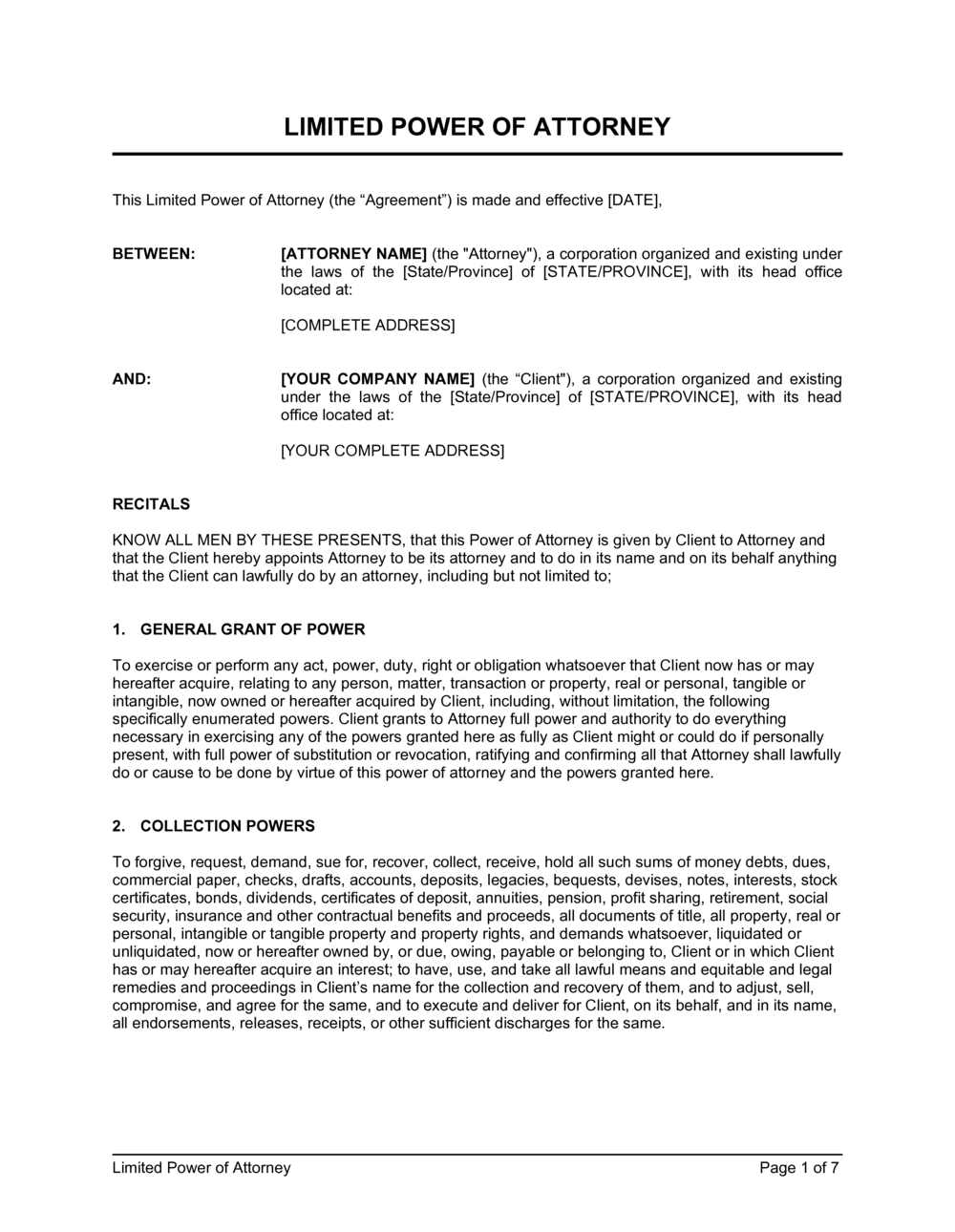
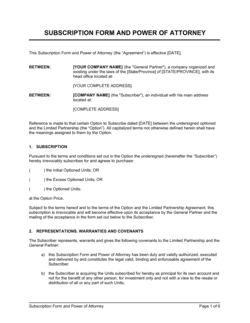
Limited Power of Attorney Template

Free Word download β€’ Edit online β€’ Save & share with Drive β€’ Export to PDF

7 pagesβ€’30–40 min to fillβ€’Difficulty: Complexβ€’Signature requiredβ€’Legal review recommended
Learn more ↓
FreeLimited Power of Attorney Template

At a glance

What it is
A Limited Power of Attorney is a legally binding document in which one party (the Principal) grants another party (the Agent or Attorney-in-Fact) narrowly defined authority to act on the Principal's behalf for a specific purpose or transaction. This free Word download gives you a structured, attorney-reviewed starting point you can edit online and export as PDF β€” covering scope of authority, duration, revocation, and governing law in a single document.
When you need it
Use it when you need someone to act on your behalf for a defined task β€” such as closing a real estate transaction, managing a vehicle sale, signing contracts while you travel, or handling a specific bank transaction β€” but you do not want to grant broad or ongoing authority.
What's inside
Identification of the Principal and Agent, a precisely defined scope of authorized acts, effective date and expiration, revocation rights, notarization block, governing law clause, and signature and witness lines required for legal validity in most jurisdictions.

What is a Limited Power of Attorney?

A Limited Power of Attorney is a legally binding document in which a Principal grants an Agent β€” also called an Attorney-in-Fact β€” specific, narrowly defined authority to act on the Principal's behalf for a single transaction, purpose, or time period. Unlike a general power of attorney, which confers broad and ongoing authority over financial and legal matters, a limited POA restricts the Agent to exactly the acts listed in the document. Once the specified task is complete or the expiration date is reached, the authority terminates automatically. The document is generally non-durable, meaning it also ends if the Principal becomes legally incapacitated. To be effective with third parties such as banks, title companies, and government registries, a limited POA typically must be signed before a notary public and, in many jurisdictions, in the presence of one or two witnesses.

Why You Need This Document

Without a properly drafted limited power of attorney, a time-sensitive transaction can collapse the moment you are unavailable to sign in person β€” a real estate closing proceeds without you, a contract deadline passes, or a customs clearance stalls. Using an overly broad or informal authorization creates the opposite problem: an Agent with poorly defined authority can act beyond what you intended, exposing you to contracts you did not approve, withdrawals you did not authorize, or liability you did not anticipate. A precisely scoped limited POA solves both problems β€” it gives the Agent exactly the authority needed for the named task and nothing more, terminates automatically when that task is done, and gives banks, title companies, and government agencies the notarized documentation they require to act without hesitation. This template provides the structure to define scope correctly, set a firm expiration, and execute with the formalities required to make the document legally effective wherever the Agent will be acting.

Which variant fits your situation?

If your situation is…Use this template
Granting authority for a single real estate closingLimited Power of Attorney for Real Estate
Delegating authority to manage all financial and legal affairs long-termGeneral Power of Attorney
Granting authority that remains in effect if the Principal becomes incapacitatedDurable Power of Attorney
Authorizing a parent or guardian to make medical decisions for a minorMedical Power of Attorney
Delegating authority specifically for a vehicle sale or transferLimited Power of Attorney for Vehicle
Revoking a previously granted power of attorneyRevocation of Power of Attorney
Granting authority to an agent for tax filing and IRS matters onlyIRS Form 2848 (Power of Attorney and Declaration of Representative)

Common mistakes to avoid

❌ Overly broad scope language

Why it matters: Phrases like 'and all related matters' convert a limited POA into a general one, giving the Agent far more authority than intended and exposing the Principal to unexpected liability or fraud.

Fix: List each authorized act explicitly and add a sentence stating that the Agent has no authority beyond those listed acts. If new acts are needed, issue a revised document.

❌ No expiration date

Why it matters: A limited POA without an expiration date can technically remain valid for years after the intended transaction, allowing an Agent to invoke it for entirely different purposes.

Fix: Always include a specific calendar expiration date or a self-executing trigger tied to the completion of the named transaction, whichever comes first.

❌ Using an incorrect or outdated notarization certificate

Why it matters: Many jurisdictions prescribe the exact wording of the notarial acknowledgment for POA documents. A certificate that does not match the statutory form can make the document unrecordable and unacceptable to banks and title companies.

Fix: Check the current statutory form required in the governing jurisdiction before the signing appointment and use it verbatim, including any required state-specific language.

❌ Failing to deliver revocation notice to third parties

Why it matters: Even after notifying the Agent that their authority has been revoked, banks and other institutions that received the original POA may continue to honor it until they receive their own written revocation notice.

Fix: Send written revocation notice simultaneously to the Agent and to every third party that received or relied on the original document. Keep proof of delivery for each.

❌ Using a residential template for a corporate or commercial transaction

Why it matters: Individual POA forms typically require only the Principal's signature. Corporate POAs must reflect the entity's signing authority β€” a sole signatory on a corporate document when two officers are required under the bylaws creates an invalid execution.

Fix: For corporate Principals, confirm the entity's signing authority requirements in its articles, bylaws, or board resolutions before drafting and have the document executed by an authorized officer or officers.

❌ No copy delivered to the Agent before the transaction date

Why it matters: An Agent who does not have the original or a certified copy in hand cannot exercise authority β€” a title company or bank will refuse to act on a verbal representation that a POA exists.

Fix: Deliver the executed original or a certified copy to the Agent well before the scheduled transaction date, and confirm the Agent has presented it to any relying institution for pre-approval.

The 9 key clauses, explained

Identification of the Principal and Agent

In plain language: Establishes the full legal names, addresses, and (where applicable) entity details of both the person granting authority and the person receiving it.

Sample language
I, [PRINCIPAL FULL LEGAL NAME], of [PRINCIPAL ADDRESS], hereby appoint [AGENT FULL LEGAL NAME], of [AGENT ADDRESS], as my Agent (Attorney-in-Fact) for the limited purpose described herein.

Common mistake: Using a nickname or trade name instead of the Principal's or Agent's full legal name β€” third parties such as banks and title companies will reject a POA that does not match government-issued identification.

Scope of Authorized Acts

In plain language: The single most important clause β€” it lists precisely what the Agent may and may not do. Any act not explicitly listed is outside the Agent's authority.

Sample language
My Agent is authorized solely to: (a) execute and deliver the purchase and sale agreement for the property located at [PROPERTY ADDRESS]; (b) sign all closing documents related to that transaction; and (c) receive and disburse proceeds as directed in the closing statement. My Agent has no authority beyond these specific acts.

Common mistake: Using broad catch-all language such as 'and any other related acts' β€” this effectively converts a limited POA into a general one, exposing the Principal to unintended liability.

Effective Date and Expiration

In plain language: States when the Agent's authority begins and when it automatically ends, either by a fixed date or upon completion of the specified transaction.

Sample language
This Limited Power of Attorney is effective on [START DATE] and shall automatically expire on [EXPIRATION DATE], or upon completion of the transaction described above, whichever occurs first.

Common mistake: Omitting an expiration date entirely β€” a limited POA with no end date can remain technically effective for years, creating risk if the Agent acts outside the intended scope long after the original purpose was fulfilled.

Revocation Rights

In plain language: Confirms the Principal's right to revoke the authority at any time by written notice, and specifies how revocation must be delivered to be effective against third parties.

Sample language
The Principal may revoke this Limited Power of Attorney at any time by delivering written notice of revocation to the Agent and to any third party relying on this document. Revocation is effective upon receipt by the Agent.

Common mistake: Failing to deliver revocation notice to third parties such as banks or title companies β€” even after notifying the Agent, those institutions may continue to honor the original document until they receive their own notice.

Agent's Fiduciary Obligations

In plain language: Sets out the Agent's duty to act solely in the Principal's interest, avoid conflicts, keep accurate records, and not delegate authority without express permission.

Sample language
Agent shall act in good faith and in the best interests of the Principal, shall not commingle Principal's assets with Agent's own, shall maintain records of all transactions, and shall not sub-delegate authority without the Principal's prior written consent.

Common mistake: Skipping fiduciary language entirely on the assumption it is implied by law β€” while fiduciary duties do apply by default in most jurisdictions, stating them explicitly makes enforcement and any breach claim significantly cleaner.

Compensation and Expense Reimbursement

In plain language: States whether the Agent is acting without compensation or entitled to a fee, and how documented expenses incurred on the Principal's behalf will be reimbursed.

Sample language
Agent shall serve [without compensation / for a fee of $[AMOUNT] per [PERIOD]], and shall be reimbursed for reasonable and documented out-of-pocket expenses incurred in the performance of authorized acts upon submission of receipts.

Common mistake: Leaving compensation undefined in a business context β€” when the Agent is an employee or third-party professional, silence on fees creates a dispute risk, particularly if the transaction is delayed or contested.

Non-Durable Provision

In plain language: Explicitly states that this power of attorney is non-durable and will terminate automatically if the Principal becomes incapacitated, ensuring it cannot be used for healthcare or long-term financial decisions.

Sample language
This Limited Power of Attorney is non-durable. It shall automatically terminate upon the legal incapacity or disability of the Principal and shall not survive such incapacity.

Common mistake: Omitting this clause and inadvertently creating a document that could be interpreted as durable β€” in some jurisdictions, silence on durability is interpreted as non-durable, but explicit language eliminates ambiguity and protects the Principal.

Governing Law and Venue

In plain language: Specifies which jurisdiction's laws govern the document and where disputes will be resolved.

Sample language
This Limited Power of Attorney is governed by the laws of the State of [STATE / PROVINCE / COUNTRY]. Any dispute arising from or relating to this document shall be resolved in the courts of [COUNTY / JURISDICTION].

Common mistake: Selecting a governing law that has no connection to where the Agent will be acting β€” if the Agent is executing a real estate closing in Florida, a New York governing-law clause creates confusion for title companies and may not be recognized.

Notarization and Witness Attestation

In plain language: The execution block where the Principal signs in front of a notary and any required witnesses, providing the authentication that makes the document legally effective for use with third parties.

Sample language
Signed by the Principal on [DATE], in the presence of the undersigned Notary Public and two witnesses. STATE OF [STATE], COUNTY OF [COUNTY]: Before me personally appeared [PRINCIPAL NAME], known to me or proved by satisfactory evidence, who executed the foregoing instrument for the purposes therein expressed. [NOTARY SIGNATURE AND SEAL].

Common mistake: Using a general acknowledgment form that does not match the jurisdiction's statutory notarization requirements β€” several states and provinces prescribe the exact language of the notarial certificate, and deviating from it can render the document unrecordable or unacceptable to financial institutions.

How to fill it out

  1. 1

    Enter the Principal's and Agent's full legal details

    Use the exact legal name and current address for both parties as they appear on government-issued identification. For corporate Principals, use the registered entity name and jurisdiction of incorporation.

    πŸ’‘ Request a copy of the Agent's government-issued ID before completing the document β€” mismatches between the POA and the Agent's ID are the most common reason third parties reject the document.

  2. 2

    Define the scope of authority with precise, transaction-specific language

    List every act the Agent is authorized to perform and name the specific property, account, or transaction involved. Then add an explicit exclusion: 'Agent has no authority beyond the acts listed above.'

    πŸ’‘ If you are unsure whether an act needs to be listed, list it β€” omitting an act that turns out to be necessary requires a new document, which can derail a time-sensitive transaction.

  3. 3

    Set the effective date and a fixed expiration date

    Enter the date the authority begins and either a specific calendar expiration date or a self-executing trigger such as 'upon completion of the transaction described herein, whichever occurs first.'

    πŸ’‘ For real estate closings, set the expiration 30–60 days beyond the expected closing date to account for delays β€” a POA that expires on the day of closing creates last-minute problems.

  4. 4

    Include the non-durable and revocation provisions

    Confirm the document is non-durable by including explicit language that terminates authority upon the Principal's incapacity. State how revocation must be delivered to be effective.

    πŸ’‘ Keep a signed revocation letter on file, dated but not delivered, so you can terminate the Agent's authority immediately if circumstances change.

  5. 5

    State compensation terms clearly

    If the Agent is a professional or employee, specify their fee or confirm they are acting without compensation. Reference how expense receipts should be submitted and within what timeframe reimbursement will occur.

    πŸ’‘ For business POAs involving employees, cross-reference the compensation clause with the employee's existing contract to avoid creating an unintended entitlement.

  6. 6

    Select the correct governing law

    Choose the jurisdiction where the Agent will be performing the authorized acts β€” not where the Principal is located or where the company is incorporated. For real estate, the governing law should match the property's state or province.

    πŸ’‘ Check the jurisdiction's specific POA statute to confirm whether additional language, a statutory form, or a specific notarial certificate is required for the document to be legally effective.

  7. 7

    Execute with notarization and witnesses before the effective date

    Sign before a licensed notary public and, if the jurisdiction requires it, two disinterested adult witnesses. Do not pre-sign the document before appearing before the notary β€” many notaries will refuse to acknowledge a pre-signed document.

    πŸ’‘ For real estate transactions, confirm with the title company whether they require the POA to be recorded in the public land records before closing β€” if so, factor in recording lead time.

  8. 8

    Deliver certified copies to all relying third parties

    Provide the original or a certified copy to the Agent and a copy to each third party β€” bank, title company, government registry β€” that will rely on the document. Retain the original in your records.

    πŸ’‘ Request an 'apostille' if the POA will be used in a foreign country that is a party to the Hague Convention β€” standard US or Canadian notarization alone is not sufficient for international use.

Frequently asked questions

What is a limited power of attorney?

A limited power of attorney is a legal document in which a Principal grants an Agent narrowly defined authority to act on their behalf for a specific transaction, purpose, or time period. Unlike a general power of attorney, which covers broad financial and legal matters, a limited POA restricts the Agent to exactly the acts listed in the document β€” nothing more. It terminates automatically when the task is complete or the expiration date is reached.

What is the difference between a limited and a general power of attorney?

A general power of attorney grants the Agent broad authority to handle most legal and financial matters on the Principal's behalf β€” signing contracts, managing accounts, and buying or selling property. A limited power of attorney restricts authority to one specific act or transaction, such as closing a real estate deal or signing a single contract. When the specified task is done or the expiration date passes, a limited POA terminates automatically; a general POA continues until revoked or the Principal becomes incapacitated.

Does a limited power of attorney need to be notarized?

In most jurisdictions, yes β€” notarization is required for a limited power of attorney to be legally effective, particularly when it will be used for real estate transactions, financial account access, or any matter requiring a recorded document. Some jurisdictions also require two disinterested witnesses in addition to notarization. Check the specific requirements of the state, province, or country where the Agent will be acting, as the required notarial certificate language varies and non-compliance can render the document unacceptable to third parties.

Can a business use a limited power of attorney?

Yes β€” businesses frequently use limited powers of attorney to authorize specific officers, employees, or agents to execute contracts, manage accounts, or handle transactions on the entity's behalf. For corporate Principals, the document must be executed by an officer or authorized signatory consistent with the company's bylaws or articles of incorporation, and may require a supporting board resolution confirming the signatory's authority to grant the POA.

How long is a limited power of attorney valid?

A limited power of attorney is valid for the period stated in the document. It typically terminates on a specified calendar date, upon completion of the named transaction, or upon revocation by the Principal β€” whichever comes first. A limited POA is generally non-durable, meaning it also terminates automatically if the Principal becomes legally incapacitated. A document with no expiration date remains technically valid until revoked, which is why including a fixed end date is strongly recommended.

Can I revoke a limited power of attorney?

Yes β€” the Principal can revoke a limited power of attorney at any time by delivering written notice of revocation to the Agent. To be effective against third parties such as banks or title companies that have received the original document, revocation notice must also be delivered to those institutions directly. Simply notifying the Agent is not sufficient to stop a third party that has not received its own notice from continuing to act on the Agent's instructions.

What acts can an Agent perform under a limited power of attorney?

The Agent may perform only the specific acts listed in the scope-of-authority clause β€” nothing else. Typical limited POA authorizations include signing a real estate purchase and sale agreement, executing a vehicle title transfer, managing a specific bank account for a defined period, or signing a single contract on the Principal's behalf. Any act not explicitly listed is outside the Agent's authority, and third parties who rely on the Agent performing unlisted acts do so at their own risk.

Does a limited power of attorney need to be registered or recorded?

Registration or recording requirements depend on the jurisdiction and the nature of the transaction. For real estate transactions, many US states and Canadian provinces require the POA to be recorded in the county or land registry where the property is located before or at closing. For financial or corporate transactions, recording is generally not required but the original or certified copy must be presented to the relying institution. If the POA will be used internationally, an apostille may be required for it to be recognized in a foreign jurisdiction.

Do I need a lawyer to create a limited power of attorney?

For straightforward, single-transaction domestic POAs, a high-quality template is typically sufficient, provided you tailor the scope-of-authority language precisely and confirm the jurisdiction's notarization requirements. Consider engaging a lawyer when the transaction is high-value or complex, when the Agent will be acting in a regulated industry, when the document will be used internationally, or when there is any risk of the Agent's authority being disputed. A one-hour legal review for a business POA typically costs $150–$400 and eliminates execution risk on material transactions.

How this compares to alternatives

vs General Power of Attorney

A general power of attorney grants broad authority over most legal and financial matters and continues until revoked or the Principal is incapacitated. A limited POA restricts authority to a single named transaction or purpose and terminates automatically when that purpose is fulfilled or the expiration date arrives. Use a general POA only when you need ongoing, wide-ranging delegated authority; use a limited POA for any defined, time-bound task.

vs Durable Power of Attorney

A durable power of attorney survives the Principal's mental incapacity and is used for long-term financial or healthcare planning. A limited power of attorney is non-durable β€” it terminates automatically if the Principal becomes incapacitated. For a business transaction or short-term delegation where the Principal is fully capable, a limited POA is the appropriate and safer choice.

vs Corporate Authorization Resolution

A corporate authorization resolution is a board-level document authorizing an officer to take a specific corporate action, such as entering a contract or opening a bank account. A limited POA is a document the individual or entity Principal executes to grant authority to an Agent who may be outside the corporate structure entirely. For transactions requiring a third party to act on behalf of the company, a limited POA β€” supported by a board resolution β€” provides the clearest chain of authority.

vs Revocation of Power of Attorney

A revocation of power of attorney formally terminates a previously granted POA before its expiration date. It must be delivered in writing to the Agent and to every third party relying on the original document. If a limited POA has an expiration date that already covers the intended transaction window, a separate revocation document may not be needed β€” but it is the correct instrument when you need to terminate authority early.

Industry-specific considerations

Real estate

Used to authorize a closing attorney, title agent, or trusted party to execute purchase agreements and closing documents when the buyer or seller cannot attend in person.

Financial services

Allows a designated representative to access specific accounts, execute wire transfers up to a stated limit, or file documents with a regulatory authority for a defined period.

Manufacturing and supply chain

Authorizes a freight broker, customs agent, or logistics partner to clear goods through customs, execute carrier contracts, or sign delivery documentation on the company's behalf.

Professional services

Grants accountants or tax advisors authority to sign and file specific returns, correspond with tax authorities, or access payroll accounts during an audit or compliance review.

Jurisdictional notes

United States

POA laws vary significantly by state. Many states β€” including California, New York, Florida, and Texas β€” have statutory short-form POA acts that prescribe required language and notarial certificate wording. Deviating from the statutory form can make a document unrecordable or unacceptable to financial institutions. Some states require two witnesses in addition to notarization. For real estate, the POA typically must be recorded in the county where the property is located.

Canada

Each province regulates powers of attorney separately. Ontario's Substitute Decisions Act and British Columbia's Power of Attorney Act set specific requirements for execution, including witnessing rules that exclude the Agent and relatives of the Principal. Quebec uses the civil law concept of a 'mandate' rather than a POA and requires notarization before a Quebec notary for property transactions. Limited (non-continuing) POAs in all provinces automatically terminate on the Principal's incapacity.

United Kingdom

In England and Wales, a limited (ordinary) power of attorney is governed by the Powers of Attorney Act 1971 and must be signed as a deed β€” executed in the presence of a witness who is not the Agent. It automatically terminates if the donor loses mental capacity. Scotland and Northern Ireland have separate statutory frameworks with equivalent requirements. For property transactions, the POA must be in deed form and typically lodged with HM Land Registry.

European Union

POA requirements vary by member state, but most EU jurisdictions require notarization β€” and in many civil-law countries such as Germany, France, Spain, and Italy, notarization by a civil-law notary (not a common-law notary public) is mandatory for real estate and commercial transactions. Cross-border use within the EU is facilitated by the eIDAS Regulation for electronic signatures on certain documents, but real estate transactions generally still require in-person notarization. An apostille under the Hague Convention is required for documents originating outside the EU to be recognized in member states.

Template vs lawyer β€” what fits your deal?

PathBest forCostTime
Use the templateStraightforward domestic transactions β€” vehicle transfers, single contract signings, or short-term account management with a trusted agentFree20–30 minutes
Template + legal reviewReal estate closings, business transactions above $50K, or any POA where the Agent is a third-party professional or vendor$150–$400 for a one-hour attorney review1–3 days
Custom draftedCross-border transactions, corporate POAs requiring board resolutions, regulated-industry delegations, or high-value commercial deals$500–$2,000+3–7 days

Glossary

Principal
The person or entity granting authority to another to act on their behalf under the power of attorney.
Agent (Attorney-in-Fact)
The person authorized by the Principal to perform specific acts as defined in the power of attorney document.
Scope of Authority
The precise list of acts the Agent is permitted to perform β€” any action not listed is outside the Agent's authority.
Notarization
Authentication by a commissioned notary public confirming the identity of the signatories and the voluntariness of their signatures.
Revocation
A formal act by the Principal terminating the Agent's authority, typically done in writing and delivered to the Agent and any third parties relying on the document.
Fiduciary Duty
The Agent's legal obligation to act in the Principal's best interest and avoid self-dealing or conflicts of interest.
Expiration Date
The specific calendar date or triggering event on which the Agent's authority automatically terminates without requiring a formal revocation.
Durable Power of Attorney
A power of attorney that remains valid if the Principal later becomes mentally incapacitated β€” a limited POA is typically non-durable.
General Power of Attorney
A broad grant of authority covering most legal, financial, and property matters, as opposed to the narrow, transaction-specific grant in a limited POA.
Witness
A disinterested adult who observes the Principal's signature and signs the document to confirm its authenticity β€” required in addition to notarization in many jurisdictions.
Third-Party Reliance
The right of banks, government agencies, and other parties to act on instructions from the Agent without liability, provided the POA appears valid on its face.

Part of your Business Operating System

This document is one of 3,000+ business & legal templates included in Business in a Box.

  • Fill-in-the-blanks β€” ready in minutes
  • 100% customizable Word document
  • Compatible with all office suites
  • Export to PDF and share electronically

Create your document in 3 simple steps.

From template to signed document β€” all inside one Business Operating System.
1
Download or open template

Access over 3,000+ business and legal templates for any business task, project or initiative.

2
Edit and fill in the blanks with AI

Customize your ready-made business document template and save it in the cloud.

3
Save, Share, Send, Sign

Share your files and folders with your team. Create a space of seamless collaboration.

Save time, save money, and create top-quality documents.

β˜…β˜…β˜…β˜…β˜…

"Fantastic value! I'm not sure how I'd do without it. It's worth its weight in gold and paid back for itself many times."

Managing Director Β· Mall Farm
Robert Whalley
Managing Director, Mall Farm Proprietary Limited
β˜…β˜…β˜…β˜…β˜…

"I have been using Business in a Box for years. It has been the most useful source of templates I have encountered. I recommend it to anyone."

Business Owner Β· 4+ years
Dr Michael John Freestone
Business Owner
β˜…β˜…β˜…β˜…β˜…

"It has been a life saver so many times I have lost count. Business in a Box has saved me so much time and as you know, time is money."

Owner Β· Upstate Web
David G. Moore Jr.
Owner, Upstate Web

Run your business with a system β€” not scattered tools

Stop downloading documents. Start operating with clarity. Business in a Box gives you the Business Operating System used by over 250,000 companies worldwide to structure, run, and grow their business.

Free Forever PlanΒ Β·Β No credit card required