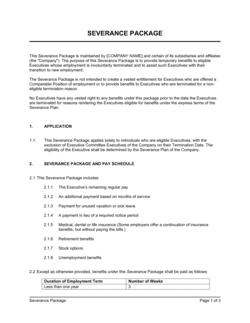
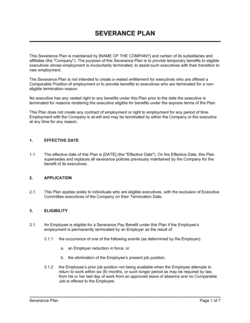
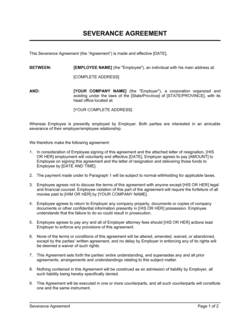
- Severance Pay
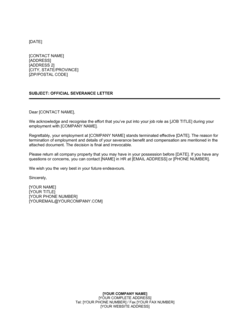
- A lump sum or series of payments made by an employer to a departing employee, typically calculated as a number of weeks of base salary per year of service.
- WARN Act
- The US Worker Adjustment and Retraining Notification Act, which requires employers with 100 or more employees to give 60 days' advance notice before mass layoffs or plant closings.
- COBRA Continuation Coverage
- A US federal program that allows departing employees to continue employer-sponsored health insurance for up to 18 months by paying the full premium themselves.
- Non-Disparagement Clause
- A provision in a severance agreement prohibiting either party from making negative public statements about the other after separation.
- General Release of Claims
- A legal waiver in which the employee gives up the right to sue the employer for claims arising from the employment relationship, in exchange for severance consideration.
- Outplacement Services
- Career transition support — resume coaching, interview prep, job search assistance — provided or funded by the employer as part of a severance package.
- Equity Acceleration
- A contractual provision that vests unvested stock options or restricted stock units immediately upon a qualifying termination event, rather than on the original vesting schedule.
- Notice Period
- The defined period between written notice of termination and the employee's last day, during which the employee may continue working or be placed on garden leave.
- Garden Leave
- A notice period during which the employee is paid their full salary but is not required — or permitted — to report to work, preventing access to clients or confidential information.
- Mutual Separation
- An arrangement in which both employer and employee agree to end the employment relationship, often negotiated to avoid a formal termination record and preserve the employee's eligibility for certain benefits.
- Clawback Provision
- A clause requiring the employee to repay severance or bonus amounts if specific post-separation conditions are violated, such as breaching the non-compete or non-disparagement obligations.