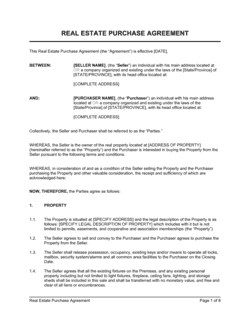
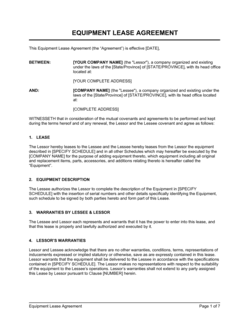
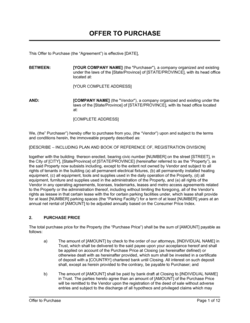
Lease To Own Agreement Template

Free Word download • Edit online • Save & share with Drive • Export to PDF

6 pages25–35 min to fillDifficulty: ComplexSignature requiredLegal review recommended
Learn more ↓
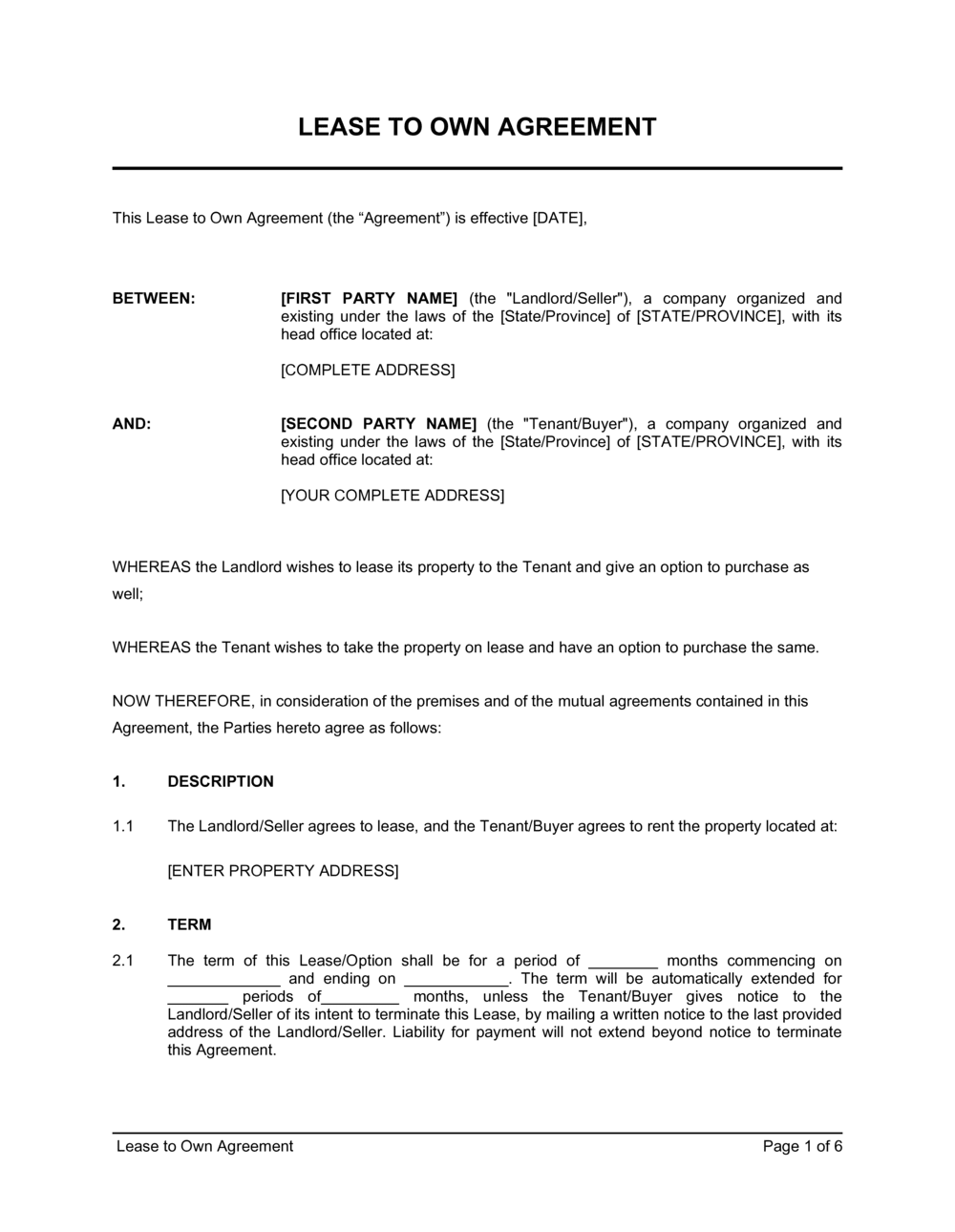
FreeLease To Own Agreement Template

At a glance

What it is
A Lease To Own Agreement is a legally binding contract that combines a standard lease with an option — or obligation — for the tenant to purchase the property at a predetermined price before or at the end of the lease term. This free Word download covers rent credits, the option fee, purchase price, maintenance responsibilities, and default remedies in a single document you can edit online and export as PDF.
When you need it
Use it when a buyer cannot yet qualify for a mortgage but wants to lock in a purchase price today, or when a seller wants rental income while securing a committed future buyer. It is also used for equipment and vehicle financing where immediate purchase is not practical.
What's inside
Property or asset description, lease term and monthly rent, option fee and rent credit provisions, agreed purchase price and exercise deadline, maintenance and insurance allocation, default and forfeiture clauses, and the conditions under which the purchase option converts to an obligation.

What is a Lease To Own Agreement?

A Lease To Own Agreement is a legally binding contract that combines a property or asset lease with a structured pathway to ownership — giving the tenant the right, or in some versions the obligation, to purchase the property at a price agreed upon at signing. The agreement runs for a defined option period, typically one to three years, during which the tenant pays monthly rent, a portion of which accumulates as a rent credit toward the eventual purchase price. Two principal structures exist: a lease option, where the tenant holds the right but not the obligation to buy, and a lease purchase, where both parties are contractually committed to completing the sale at term end. The distinction matters significantly — one creates a forfeiture risk on the tenant's side; the other creates a breach of contract exposure if either party walks away.

Why You Need This Document

Without a written lease to own agreement, the tenant's option to purchase is legally unenforceable in virtually every jurisdiction — any verbal understanding can be denied, reinterpreted, or overridden by a subsequent buyer or lender. An owner who takes on a new mortgage after an unrecorded option is signed can unknowingly subordinate the tenant's purchase right to the lender's priority claim. Equally, a tenant who accumulates rent credits without a written forfeiture clause may argue entitlement to those funds even after choosing not to buy — exposing the owner to a costly dispute. Beyond protecting both parties from each other, a properly drafted and recorded agreement prevents title defects that can derail closing years after the lease begins. This template gives both parties a clear, enforceable record of the purchase price, exercise deadline, rent credit mechanics, maintenance allocation, and default consequences — the six provisions most commonly missing from informal arrangements and most frequently litigated when deals fall apart.

Which variant fits your situation?

If your situation is…Use this template
Tenant has the right but not the obligation to buy at term endLease Option Agreement
Both parties are contractually committed to the eventual saleLease Purchase Agreement
Standard residential rental with no purchase componentResidential Lease Agreement
Commercial property with negotiated purchase optionCommercial Lease Agreement
Equipment or machinery with end-of-term buyoutEquipment Lease Agreement
Vehicle lease with purchase option at residual valueVehicle Lease Agreement
Land only, with buyer constructing improvements during leaseLand Lease Agreement

Common mistakes to avoid

❌ Using only a street address to identify the property

Why it matters: A street address is not a legally unique property identifier. If the deed's legal description differs even slightly, the option may not attach to the correct parcel and can be challenged at closing.

Fix: Copy the full legal description from the current deed or land registry record and paste it verbatim into the agreement's property description field.

❌ Skipping the memorandum of option recording

Why it matters: An unrecorded option is invisible to third parties. If the owner takes out a new mortgage or sells to another buyer who has no notice of the option, the tenant's purchase right can be extinguished.

Fix: File a memorandum of option with the county recorder or land registry within the timeframe specified in the agreement — typically within 10 to 30 days of execution.

❌ No written notice requirement for exercising the option

Why it matters: Without a formal written exercise mechanism, the parties may dispute whether a conversation or email constituted valid exercise, potentially voiding the tenant's right to purchase after years of rent credit accumulation.

Fix: Require the tenant to deliver signed written notice of intent to exercise by certified mail or documented email to a named address, with a specific deadline at least 45 days before option expiry.

❌ Setting the cure period shorter than the statutory eviction notice minimum

Why it matters: A contractual 3-day cure period is unenforceable in jurisdictions that require 14 or 30 days' notice for residential lease defaults. Attempting to enforce it can expose the owner to wrongful eviction liability.

Fix: Check the landlord-tenant statute in the governing jurisdiction before drafting the default clause and set the cure period at or above the statutory minimum.

❌ No lien prohibition on the owner during the option period

Why it matters: An owner under financial pressure can encumber the property with new mortgages after the agreement is signed. A lender who takes a first mortgage without notice of the option has priority over the tenant at foreclosure.

Fix: Include an explicit clause prohibiting the owner from placing additional liens or mortgages on the property without the tenant's written consent, and record the memorandum of option to put lenders on constructive notice.

❌ Leaving maintenance responsibility undefined above a threshold

Why it matters: Without a clear dollar threshold or itemized list distinguishing routine maintenance from structural repairs, disputes over major expenses — roof, HVAC, foundation — routinely end in litigation or agreement termination.

Fix: Set a specific dollar threshold (e.g., repairs costing less than $500 are the tenant's responsibility; repairs exceeding $500 are the owner's) and list any categorical exceptions such as appliances or HVAC systems.

The 9 key clauses, explained

Parties, property description, and recitals

In plain language: Identifies the seller-landlord and buyer-tenant as legal entities or individuals, provides a complete legal description of the property or asset, and states the purpose of the agreement.

Sample language
This Lease To Own Agreement ('Agreement') is entered into on [DATE] between [SELLER/LANDLORD FULL NAME OR ENTITY] ('Owner') and [BUYER/TENANT FULL NAME OR ENTITY] ('Tenant'). The subject property is located at [FULL LEGAL ADDRESS], legally described as [LEGAL DESCRIPTION] ('Property').

Common mistake: Using only a street address instead of the full legal property description. An address is not a unique legal identifier — if the deed description differs, the option may be unenforceable against third parties.

Lease term, rent amount, and payment schedule

In plain language: Sets the start and end date of the lease, the monthly rent, the due date, the grace period, and the late fee — identical in function to a standard lease but forming part of the purchase pathway.

Sample language
The lease term commences on [START DATE] and expires on [END DATE]. Tenant shall pay monthly rent of $[AMOUNT] on the [DAY] of each month. A grace period of [X] days applies; payments received after the grace period are subject to a late fee of $[AMOUNT] per day.

Common mistake: Setting the option expiry date on the same day as the lease end date without a grace period for closing. Mortgage approvals and title work routinely take 30–45 days longer than anticipated, leaving the tenant unable to close in time.

Option fee and consideration

In plain language: States the non-refundable option fee paid at signing, confirms it represents valid consideration for the purchase option, and specifies whether any portion applies to the purchase price.

Sample language
Tenant shall pay a non-refundable option fee of $[AMOUNT] upon execution of this Agreement ('Option Fee'). The Option Fee constitutes consideration for the purchase option and shall [be credited in full / not be credited] toward the purchase price at closing.

Common mistake: Failing to label the option fee as non-refundable in the agreement body. Courts in several jurisdictions have awarded option fee refunds when forfeiture language was absent or ambiguous.

Agreed purchase price and exercise mechanism

In plain language: States the fixed purchase price for the property, the deadline by which the tenant must deliver written notice of intent to exercise, and the process for converting the option into a binding purchase and sale.

Sample language
Owner agrees to sell the Property to Tenant for $[PURCHASE PRICE] ('Purchase Price'). To exercise the option, Tenant must deliver written notice to Owner no later than [NOTICE DEADLINE] before the option expiry date of [EXPIRY DATE]. Closing shall occur within [X] days of notice.

Common mistake: No written notice requirement for exercising the option. Without it, the parties may dispute whether a verbal conversation constituted valid exercise, voiding the tenant's right to purchase.

Rent credit provisions

In plain language: Defines the dollar amount or percentage of each monthly payment that accumulates as a credit toward the purchase price or down payment, and the conditions under which credits are forfeited.

Sample language
Of each monthly rent payment, $[AMOUNT] ('Rent Credit') shall accumulate toward the purchase price, provided all payments are made on time. Rent Credits are forfeited in full upon default or failure to exercise the purchase option by [EXPIRY DATE].

Common mistake: Allowing rent credits to accumulate even when payments are late. This creates disputes about whether a partially credited payment triggers forfeiture of prior credits, and incentivizes late payment.

Maintenance, repairs, and insurance

In plain language: Allocates responsibility for routine maintenance, major structural repairs, and insurance between the parties — typically placing more of this burden on the tenant than in a standard lease, reflecting their beneficial ownership interest.

Sample language
Tenant shall maintain the Property in good repair and be responsible for all routine maintenance and repairs costing less than $[THRESHOLD]. Owner shall be responsible for structural repairs exceeding $[THRESHOLD]. Each party shall maintain [specified insurance types and minimum coverage amounts].

Common mistake: Leaving the maintenance threshold undefined. Without a dollar amount, disputes arise over whether a roof repair is 'routine' or 'structural,' and the courts will determine which party bears the cost.

Default, cure period, and forfeiture

In plain language: Defines what constitutes default by either party, the number of days to cure a default before remedies are triggered, and the consequences — including forfeiture of the option fee and rent credits by the tenant.

Sample language
Tenant shall be in default upon: (a) failure to pay rent within [X] days of the due date; (b) breach of any material term of this Agreement; or (c) failure to maintain required insurance. Owner shall provide [X] days' written notice to cure. Upon uncured default, this Agreement terminates and all Option Fees and Rent Credits are forfeited.

Common mistake: Setting a cure period shorter than the jurisdiction's statutory minimum for residential eviction notices. A contractual 3-day cure period may be unenforceable if the applicable landlord-tenant law requires 14 or 30 days.

Title, liens, and encumbrances

In plain language: Requires the owner to maintain clear title throughout the option period, prohibits the owner from encumbering the property with new mortgages or liens without consent, and commits to delivering marketable title at closing.

Sample language
Owner represents that title to the Property is free of material encumbrances as of [DATE] and shall not voluntarily place additional liens or mortgages on the Property without Tenant's prior written consent. Owner shall deliver marketable title at closing, evidenced by a title insurance commitment from [TITLE COMPANY].

Common mistake: No lien prohibition clause. An owner in financial distress can mortgage the property to a lender who takes priority over the tenant's unrecorded option, effectively wiping out the tenant's interest at foreclosure.

Governing law, recording, and entire agreement

In plain language: Specifies which jurisdiction's law governs the agreement, whether a memorandum of option will be recorded with the land registry, and that the written contract supersedes all prior oral agreements.

Sample language
This Agreement is governed by the laws of [STATE / PROVINCE / COUNTRY]. The parties [shall / shall not] record a Memorandum of Option with the [COUNTY RECORDER / LAND REGISTRY] within [X] days of execution. This Agreement constitutes the entire agreement of the parties and supersedes all prior representations and negotiations.

Common mistake: Skipping recordation of a memorandum of option to 'keep the deal private.' Without recordation, a subsequent bona fide purchaser or mortgage lender who has no notice of the option can take the property free of it.

How to fill it out

  1. 1

    Identify the parties and describe the property precisely

    Enter the full legal names of both the owner and tenant, including entity type for businesses. Use the complete legal property description from the current deed — not just the street address.

    💡 Pull the legal description directly from the most recent title deed or land registry record to eliminate any discrepancy between the contract and public records.

  2. 2

    Set the lease term and monthly rent

    Choose a lease term that gives the tenant enough time to arrange financing — typically 1 to 3 years. Set monthly rent at or slightly above market rate to account for the rent credit component.

    💡 Build in an option expiry date that is at least 45 days before the lease end date to allow time for mortgage processing and closing without triggering a deadline crisis.

  3. 3

    Define the option fee and confirm it is non-refundable

    Negotiate an option fee proportionate to the property's value — typically 1% to 5% of the purchase price. State clearly in the agreement that it is non-refundable and specify whether it applies to the purchase price.

    💡 A higher option fee signals stronger tenant commitment and compensates the owner for taking the property off the open market during the option period.

  4. 4

    Fix the purchase price and exercise deadline

    Agree on a fixed purchase price today — or a formula tied to an independent appraisal — and write the exact exercise deadline and closing window into the agreement. Require written notice of intent to exercise.

    💡 Fixing the price today benefits the tenant in appreciating markets and the owner in declining ones. An appraisal formula suits both parties in uncertain markets but adds complexity at closing.

  5. 5

    Calculate and document rent credits

    Decide the dollar amount of each monthly payment that accumulates as a rent credit. State the conditions for forfeiture and confirm that credits require on-time payment to vest.

    💡 Keep rent credits at 10–25% of monthly rent to keep the total meaningful without creating a tax or accounting complication for either party.

  6. 6

    Allocate maintenance and insurance obligations

    Set a dollar threshold distinguishing routine maintenance (tenant's responsibility) from structural repairs (owner's responsibility). Specify minimum insurance types and coverage amounts for each party.

    💡 Require the tenant to name the owner as an additional insured on their property insurance — this protects the owner's interest in the asset during the lease period.

  7. 7

    Draft default, cure, and forfeiture terms

    List each event of default, the cure period, and the forfeiture consequences. Confirm that the cure period meets or exceeds the statutory minimum notice requirements in the governing jurisdiction.

    💡 Include a separate default provision for the owner — failure to maintain clear title or to deliver possession at closing — so the tenant has a defined remedy if the owner breaches.

  8. 8

    Execute, notarize if required, and record a memorandum of option

    Both parties must sign before the lease and option period begin. Check whether the jurisdiction requires notarization for real property agreements. File a memorandum of option with the county recorder or land registry to protect the tenant's interest against third-party claims.

    💡 Use Business in a Box eSign to create a timestamped execution record and store the fully executed agreement securely before any rent or option fee payments are exchanged.

Frequently asked questions

What is a lease to own agreement?

A lease to own agreement is a contract that combines a residential or commercial lease with an option — or in some versions, an obligation — for the tenant to purchase the property at a predetermined price before or at the end of the lease term. It allows a tenant to occupy and use the property immediately while working toward ownership, with a portion of monthly rent typically credited toward the future purchase price. The agreement is binding on both parties from the date of execution.

What is the difference between a lease option and a lease purchase?

A lease option gives the tenant the right but not the obligation to buy the property. If the tenant declines to exercise the option, they forfeit the option fee and any accumulated rent credits, but owe nothing further. A lease purchase creates a binding obligation — both parties are committed to completing the sale at the end of the term. Defaulting on a lease purchase can expose the tenant to a breach of contract claim, not just forfeiture of deposits. Choose the structure based on the tenant's certainty of intent and the owner's need for a committed buyer.

Is a lease to own agreement legally binding?

Yes. A properly executed lease to own agreement is generally enforceable as a binding contract when it contains the essential elements: offer and acceptance, consideration (the option fee), definite terms, and signatures of both parties. In most jurisdictions, real property agreements must be in writing to be enforceable under the Statute of Frauds. Consider having the agreement reviewed by a licensed attorney in the governing jurisdiction before signing to confirm it meets all local requirements.

What happens to the option fee if the tenant does not buy?

The option fee is non-refundable in virtually all lease to own agreements. If the tenant does not exercise the purchase option before the expiry deadline — whether by choice, inability to obtain financing, or default — the option fee is forfeited to the owner. The same typically applies to accumulated rent credits. This forfeiture is the owner's compensation for taking the property off the open market during the option period.

Should a lease to own agreement be recorded with the county?

Recording a memorandum of option with the county recorder or land registry is strongly advisable. Recording puts subsequent buyers, lenders, and lienholders on constructive notice that a purchase option exists on the property. Without recording, a tenant's option can be extinguished by a bona fide purchaser or mortgage lender who had no actual notice of the agreement. The memorandum is a short summary document — not the full agreement — and keeps the financial terms private while protecting the tenant's interest.

Who is responsible for repairs in a lease to own agreement?

Lease to own agreements typically place more repair and maintenance responsibility on the tenant than a standard lease, reflecting the tenant's beneficial ownership interest. Routine maintenance and minor repairs below a defined dollar threshold are generally the tenant's responsibility; major structural repairs above that threshold are the owner's. The specific allocation should be negotiated and written into the agreement — leaving it undefined almost always leads to disputes.

Can a lease to own agreement be used for equipment or vehicles?

Yes. Lease to own structures are widely used for commercial equipment, manufacturing machinery, and vehicles. In these arrangements, the buyout price at term end is called the residual value and is often set at $1 or a small fixed amount to reflect the amortized cost over the lease period. Equipment lease to own agreements typically do not require recording but should clearly specify the asset's serial number, condition at commencement, maintenance obligations, and the buyout mechanism.

What are the tax implications of a lease to own agreement?

Tax treatment varies by jurisdiction, structure, and whether the arrangement is classified as a lease or a conditional sale. In the US, the IRS may recharacterize a lease purchase as an installment sale if the tenant has a compelling economic reason to exercise the option, which affects depreciation deductions and interest treatment for both parties. In Canada and the UK, similar reclassification rules apply for accounting and tax purposes. Consult a tax advisor before finalizing the structure, particularly for commercial or equipment transactions.

Do I need a lawyer to draft a lease to own agreement?

For straightforward residential arrangements in a single jurisdiction, a high-quality template reviewed by a local real estate attorney is typically sufficient. Engage a lawyer when the property value is significant, when the owner carries an existing mortgage (which may contain a due-on-sale clause triggered by a lease purchase), when the transaction is commercial or involves multiple parcels, or when the governing jurisdiction has complex landlord-tenant or conveyancing rules. A 1–2 hour attorney review typically costs $300–$600 and can prevent costly disputes at closing.

How this compares to alternatives

vs Standard lease agreement

A standard lease gives the tenant the right to occupy and use a property for a fixed term with no pathway to ownership. A lease to own agreement layers a purchase option or obligation on top of the lease, fixing a purchase price and accumulating rent credits toward it. Use a standard lease when ownership transfer is not part of the arrangement; use a lease to own when both parties want a defined purchase pathway.

vs Purchase and sale agreement

A purchase and sale agreement commits both parties to an immediate or near-term sale on agreed terms, typically closing within 30 to 90 days. A lease to own agreement defers the purchase to a future date — often 1 to 3 years away — while the tenant occupies the property in the interim. Use a purchase and sale agreement when financing is in place; use a lease to own when the buyer needs time to qualify.

vs Commercial lease agreement

A commercial lease governs the use of business premises without any purchase component or rent credit mechanism. A commercial lease to own adds a purchase option, fixes a price, and typically shifts maintenance obligations to the tenant. Use a commercial lease for pure tenancy arrangements; use a commercial lease to own when the business intends to acquire the premises over time.

vs Equipment lease agreement

An equipment lease provides the right to use machinery or assets for a term with payments but no ownership transfer at the end. An equipment lease to own agreement includes a defined residual buyout price and the mechanism to transfer title at term end. Use an equipment lease when flexibility to return or upgrade the asset is valued; use an equipment lease to own when ownership at the end of the term is the goal.

Industry-specific considerations

Residential real estate

Fixed purchase price protects buyers in appreciating markets; rent credits bridge the gap between current rent payments and future down payment requirements.

Commercial real estate

Businesses secure long-term premises stability while preserving capital, with option fees negotiated as a percentage of commercial property value and maintenance obligations shifted substantially to the tenant.

Equipment and machinery

Residual value buyouts at end of term allow manufacturers and logistics operators to acquire capital equipment without large upfront expenditure while treating payments as operating expenses.

Automotive and fleet

Fleet operators use lease to own structures to acquire vehicles at a predetermined residual price, with maintenance schedules and permitted mileage defined in the agreement to protect asset value.

Jurisdictional notes

United States

Lease to own agreements must satisfy the Statute of Frauds, requiring a signed writing for any real property contract. Due-on-sale clauses in the owner's existing mortgage may be triggered by a lease purchase — verify with the lender before signing. Non-compete enforceability of forfeiture clauses varies by state; some states require a cure period of 30 days or more for residential tenants. Recording a memorandum of option at the county recorder's office is advisable in all states.

Canada

Residential lease to own agreements are subject to provincial landlord-tenant legislation, which may override contractual terms — particularly cure periods and eviction procedures. Ontario's Residential Tenancies Act provides significant tenant protections that cannot be waived by contract. Quebec requires all real property agreements affecting title to be notarized and registered at the land registry to be opposable to third parties. Option fees and rent credits have specific GST/HST treatment that should be confirmed with a tax advisor.

United Kingdom

Lease option agreements in England and Wales must comply with the Law of Property (Miscellaneous Provisions) Act 1989, requiring a signed written contract to create a binding option over land. Options lasting more than three years must be registered at HM Land Registry to bind third parties. Stamp Duty Land Tax may be payable on the option fee and potentially on rent credits depending on how the transaction is structured. Scotland has a separate land registration system under the Land Registration (Scotland) Act 2012.

European Union

Real property law is not harmonized across EU member states, so requirements vary significantly. In Germany, a notarized deed is required for any agreement creating an obligation to transfer real property — an unnotarized lease purchase is void. In France, a promesse de vente or compromis de vente is the standard pre-sale instrument, and lease option structures must be carefully drafted to avoid reclassification. GDPR considerations apply where the agreement involves processing personal data of residential tenants. Always engage a local notary or property lawyer in the relevant member state.

Template vs lawyer — what fits your deal?

PathBest forCostTime
Use the templateStraightforward residential or small equipment lease to own arrangements in a single jurisdiction where both parties understand the termsFree30–60 minutes
Template + legal reviewResidential transactions above $200K, any property with an existing mortgage, or jurisdictions with complex landlord-tenant or conveyancing rules$300–$6001–3 days
Custom draftedHigh-value commercial property, multi-parcel transactions, cross-border arrangements, or lease purchases where the existing mortgage contains a due-on-sale clause$1,500–$5,000+1–3 weeks

Glossary

Option Fee
A non-refundable upfront payment made by the tenant to secure the right to purchase the property at the agreed price during the option period.
Rent Credit
A portion of each monthly rent payment that accumulates as a credit toward the purchase price or down payment if the tenant exercises the purchase option.
Option Period
The defined window of time — typically 1 to 3 years — during which the tenant may exercise the right to purchase the property.
Purchase Price
The agreed sale price of the property or asset, fixed at the time the lease to own agreement is signed, regardless of market fluctuations during the option period.
Lease Option vs. Lease Purchase
A lease option gives the tenant the right but not the obligation to buy; a lease purchase creates a binding obligation on both parties to complete the sale at term end.
Forfeiture
The loss of the option fee and accumulated rent credits by the tenant upon default or failure to exercise the purchase option before the deadline.
Equitable Interest
A beneficial ownership stake a tenant may acquire in a property under a lease purchase agreement, which can affect the seller's ability to sell or encumber the property to third parties.
Memorandum of Option
A short recordable document filed with the land registry or county recorder to put third parties on notice that a purchase option exists on the property.
Residual Value
In equipment lease to own arrangements, the predetermined buyout price at the end of the lease term, often set at $1 or a fixed percentage of original value.
Repair and Maintenance Allocation
The contractual division of responsibility for upkeep costs between tenant and owner, which in lease to own agreements typically places more obligations on the tenant than in a standard lease.
Closing Conditions
The specific requirements — financing approval, title clearance, inspection — that must be satisfied before the purchase option can convert to a completed sale.
Lis Pendens
A legal notice recorded against a property indicating that litigation is pending that may affect title — a risk that can arise if a lease to own dispute goes to court before the option is exercised.

Part of your Business Operating System

This document is one of 3,000+ business & legal templates included in Business in a Box.

  • Fill-in-the-blanks — ready in minutes
  • 100% customizable Word document
  • Compatible with all office suites
  • Export to PDF and share electronically

Create your document in 3 simple steps.

From template to signed document — all inside one Business Operating System.
1
Download or open template

Access over 3,000+ business and legal templates for any business task, project or initiative.

2
Edit and fill in the blanks with AI

Customize your ready-made business document template and save it in the cloud.

3
Save, Share, Send, Sign

Share your files and folders with your team. Create a space of seamless collaboration.

Save time, save money, and create top-quality documents.

★★★★★

"Fantastic value! I'm not sure how I'd do without it. It's worth its weight in gold and paid back for itself many times."

Managing Director · Mall Farm
Robert Whalley
Managing Director, Mall Farm Proprietary Limited
★★★★★

"I have been using Business in a Box for years. It has been the most useful source of templates I have encountered. I recommend it to anyone."

Business Owner · 4+ years
Dr Michael John Freestone
Business Owner
★★★★★

"It has been a life saver so many times I have lost count. Business in a Box has saved me so much time and as you know, time is money."

Owner · Upstate Web
David G. Moore Jr.
Owner, Upstate Web

Run your business with a system — not scattered tools

Stop downloading documents. Start operating with clarity. Business in a Box gives you the Business Operating System used by over 250,000 companies worldwide to structure, run, and grow their business.

Free Forever Plan · No credit card required