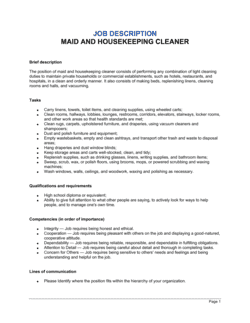
Janitor and Building Cleaner Job Description Template

Free Word download β€’ Edit online β€’ Save & share with Drive β€’ Export to PDF

2 pagesβ€’20–30 min to fillβ€’Difficulty: Standardβ€’Signature requiredβ€’Legal review recommended
Learn more ↓
FreeJanitor and Building Cleaner Job Description Template

At a glance

What it is
A Janitor and Building Cleaner Job Description is a formal document that defines the role title, duties, reporting structure, physical requirements, qualifications, and employment terms for a cleaning or custodial position. This free Word download gives employers a legally defensible, editable starting point they can tailor to their facility and export as PDF for posting, onboarding, or HR records.
When you need it
Use it when posting an open janitorial or custodial vacancy, onboarding a new cleaner, updating an existing role after responsibilities change, or defending a termination or accommodation decision that references the employee's documented duties.
What's inside
Role title and department, summary of purpose, detailed list of daily and periodic cleaning duties, physical and environmental requirements, required and preferred qualifications, reporting structure, schedule and shift terms, equipment and chemical handling expectations, and compliance and acknowledgment language.

What is a Janitor and Building Cleaner Job Description?

A Janitor and Building Cleaner Job Description is a formal HR and legal document that defines the role title, essential duties, physical requirements, equipment and chemical handling expectations, work schedule, required qualifications, and acknowledgment terms for a custodial or cleaning position. It functions as the authoritative record of what the employer and employee agree the role entails β€” underpinning performance evaluations, accommodation analyses, disciplinary proceedings, and workers' compensation claims. This free Word download gives employers an editable, legally structured starting point they can tailor to their specific facility and workforce.

Why You Need This Document

Operating without a documented, signed job description for cleaning staff is a risk that compounds over time. When a physical injury prompts an accommodation request, HR needs a written record of the role's essential functions to determine what adjustments are feasible β€” without one, the employer is making that determination in the dark and under legal scrutiny. When an employee refuses to perform a duty that was never written down, progressive discipline becomes nearly indefensible. When a termination is challenged, courts and tribunals look for documented performance standards against which the employee was evaluated. A signed janitor job description closes all of those gaps before they become disputes, gives supervisors a clear framework for managing cleaning staff consistently, and demonstrates to regulators β€” OSHA, provincial OHS authorities, or the HSE β€” that chemical handling and safety expectations were communicated in writing before the employee's first shift.

Which variant fits your situation?

If your situation is…Use this template
Hiring a general office or retail cleanerJanitor and Building Cleaner Job Description
Hiring a dedicated floor care or industrial cleaning specialistMaintenance Technician Job Description
Posting a combined cleaning and general maintenance roleBuilding Maintenance Worker Job Description
Engaging a cleaning company rather than an individual employeeCleaning Services Agreement
Onboarding a cleaner under a fixed-term or seasonal contractFixed-Term Employment Contract
Hiring a supervisor or lead custodian overseeing a teamCustodial Supervisor Job Description
Documenting a school or university custodian roleSchool Custodian Job Description

Common mistakes to avoid

❌ Setting an unjustified education requirement

Why it matters: Requiring a high school diploma for a purely physical cleaning role with no reading-intensive tasks can constitute disparate impact discrimination under Title VII, the Canadian Human Rights Act, or the UK Equality Act.

Fix: Include only qualifications that are demonstrably necessary to perform the essential functions. If literacy is needed to read SDS labels, state that β€” don't proxy it with a diploma requirement.

❌ Omitting periodic or seasonal duties

Why it matters: A job description that lists only daily tasks leaves supervisors without documentation to assign floor stripping, deep cleaning, or exterior work β€” making it nearly impossible to discipline an employee who refuses those tasks.

Fix: Add a 'periodic duties' section covering weekly, monthly, and seasonal tasks, and use language like 'other duties as assigned' to cover unanticipated requirements.

❌ No acknowledgment or signature block

Why it matters: Without a signed acknowledgment, an employee can credibly claim they were never informed of the physical demands, chemical exposure, or schedule requirements β€” complicating accommodation disputes, terminations, and workers' compensation claims.

Fix: Include a signature block on the final page and obtain a signed copy before or on the first day of work. Store the original in the personnel file.

❌ Listing the supervisor's name instead of their title

Why it matters: When the supervisor changes β€” through promotion, resignation, or restructuring β€” the job description becomes instantly inaccurate and requires an amendment, creating unnecessary administrative overhead.

Fix: Use the supervisor's title only (e.g., 'Facilities Manager') in the reporting line. Update the name separately in the HRIS system.

❌ No non-discrimination or accommodation statement

Why it matters: A document that details heavy physical requirements without an accommodation statement is facially incomplete under the ADA, AODA, or Equality Act, and can be used as evidence of discriminatory intent in a human rights complaint.

Fix: Add a standard equal opportunity and accommodation statement to every job description, regardless of how physical the role is.

❌ Using the job description as a substitute for an employment contract

Why it matters: A job description that includes compensation, termination language, or benefit promises can be interpreted as a contractual commitment in common-law jurisdictions β€” creating obligations the employer did not intend.

Fix: Include an explicit disclaimer that the job description does not constitute an employment contract, and handle compensation and termination terms in a separate signed employment agreement.

The 9 key clauses, explained

Role Title, Department, and Reporting Line

In plain language: States the official job title, the department or facility the role sits in, and the direct supervisor or manager the employee reports to.

Sample language
Job Title: Janitor / Building Cleaner | Department: Facilities | Reports To: [FACILITIES MANAGER / SUPERVISOR NAME] | Location: [FACILITY ADDRESS OR NAME]

Common mistake: Using an informal title like 'Cleaner' that doesn't match the payroll system or org chart β€” creating discrepancies that complicate termination paperwork and unemployment claims.

Position Summary

In plain language: A 2–4 sentence overview of the role's purpose and its contribution to the organization β€” used in job postings and as the opening orientation for new hires.

Sample language
The Janitor / Building Cleaner is responsible for maintaining the cleanliness, order, and safety of [FACILITY NAME]'s interior and, as applicable, exterior spaces. The role supports a healthy and productive environment for [EMPLOYEES / TENANTS / STUDENTS / CUSTOMERS].

Common mistake: Writing a summary so generic it could apply to any position β€” 'responsible for keeping the building clean' β€” which fails to capture scope and makes the description useless for performance management.

Essential Duties and Responsibilities

In plain language: A detailed, bulleted list of the core tasks the employee performs daily, weekly, and periodically β€” the legal foundation for performance evaluation and accommodation decisions.

Sample language
Essential duties include: sweeping, mopping, and vacuuming floors in all common areas; emptying and sanitizing waste receptacles; cleaning and disinfecting restrooms, including toilets, sinks, mirrors, and floors; replenishing soap, paper towels, and toilet tissue; [ADD FACILITY-SPECIFIC DUTIES].

Common mistake: Listing only daily tasks and omitting periodic duties (monthly floor stripping, annual carpet shampooing) β€” leaving supervisors without documentation to assign or enforce those tasks.

Physical Requirements

In plain language: Documents the physical demands of the role β€” lifting capacity, standing duration, bending, pushing, and environmental exposures β€” to support ADA accommodation reviews and workers' compensation.

Sample language
The position requires the ability to: lift and carry up to [50] lbs unassisted; stand and walk for extended periods up to [8] hours per shift; bend, stoop, and kneel frequently; push or pull cleaning carts weighing up to [100] lbs; and work in environments with exposure to cleaning chemicals and moderate noise.

Common mistake: Omitting a specific lift weight, which forces HR to guess during an accommodation review β€” potentially exposing the employer to ADA liability or inconsistent treatment across employees.

Equipment and Chemical Handling

In plain language: Identifies the cleaning equipment and chemical products the employee is expected to operate or handle, and references applicable safety training requirements.

Sample language
Employee is required to operate and maintain: floor buffers, vacuum cleaners, mops, pressure washers, and [SPECIFIC EQUIPMENT]. Employee must handle cleaning chemicals in compliance with OSHA HAZCOM standards and the employer's SDS program. PPE β€” including [GLOVES / GOGGLES / MASK] β€” is required when [SPECIFY TASKS].

Common mistake: Referencing HAZCOM or SDS training requirements without linking them to the employer's specific training program β€” making it impossible to prove the employee was actually trained if a chemical incident occurs.

Work Schedule, Shift, and Location

In plain language: States the shift hours, days of the week, work location, and any on-call or weekend requirements β€” preventing disputes over schedule expectations.

Sample language
Standard schedule: [DAYS] from [START TIME] to [END TIME]. Location: [FACILITY NAME / ADDRESS]. Shift: [Day / Evening / Night]. Weekend and holiday coverage may be required with [X] days' advance notice. Schedule changes are subject to [POLICY REFERENCE].

Common mistake: Omitting weekend or holiday coverage expectations β€” leading to scheduling disputes and potential constructive-dismissal claims when the employer later adds those requirements unilaterally.

Qualifications and Certifications

In plain language: Lists the minimum required and preferred qualifications β€” education, experience, language requirements, certifications, and background check conditions.

Sample language
Required: [High school diploma or equivalent / No minimum education required]; [X months / years] of experience in commercial cleaning or janitorial work. Preferred: ISSA CIMS certification or equivalent; experience with [SPECIFIC EQUIPMENT OR PRODUCT]. Other: valid [state/provincial] driver's license if operating a facility vehicle; satisfactory background check.

Common mistake: Setting a minimum education requirement that has no demonstrable relationship to the job's functions β€” creating disparate-impact exposure under Title VII or equivalent human rights laws.

Non-Discrimination and Accommodation Statement

In plain language: Confirms that the employer is an equal opportunity employer and that reasonable accommodations will be provided for qualified individuals with disabilities who can perform the essential functions.

Sample language
[EMPLOYER NAME] is an equal opportunity employer. All qualified applicants will receive consideration for employment without regard to race, color, religion, sex, national origin, disability, or any other protected characteristic. Reasonable accommodations will be provided upon request for individuals with disabilities who can perform the essential functions of the role.

Common mistake: Omitting the accommodation statement entirely β€” which, in combination with a strict physical requirements clause, creates a facially discriminatory document under the ADA, AODA, or Equality Act.

Acknowledgment and Signature Block

In plain language: A signed confirmation by the employee that they have received, read, and understood the job description β€” and that it does not constitute an employment contract unless stated otherwise.

Sample language
I acknowledge that I have received and reviewed this job description. I understand the essential functions and physical requirements of this position. This document does not constitute a contract of employment. Employee Signature: ________ | Date: ________ | Supervisor Signature: ________ | Date: ________

Common mistake: Omitting the disclaimer that the job description is not an employment contract β€” leaving the employer exposed to claims that the document creates contractual entitlements to specific duties, hours, or work location.

How to fill it out

  1. 1

    Enter the role title and reporting structure

    Use the exact job title that appears in your payroll system or HR platform. Identify the direct supervisor by title (not name where turnover is likely) and the facility or department the role belongs to.

    πŸ’‘ Match the title to any applicable collective agreement, civil-service classification, or union schedule β€” a title mismatch can trigger a grievance.

  2. 2

    Write the position summary

    Draft 2–4 sentences describing what the role exists to accomplish and who benefits from it. Mention the type of facility (office, school, healthcare, retail) and the scope of the cleaning area.

    πŸ’‘ Tailor the summary to the facility type β€” 'maintaining clinical hygiene standards in a medical office' is far more useful than 'keeps the building clean.'

  3. 3

    List all essential duties by frequency

    Separate duties into daily, weekly, monthly, and as-needed categories. Include both routine tasks (mopping, vacuuming, restocking) and periodic tasks (floor stripping, exterior pressure washing, HVAC filter checks).

    πŸ’‘ Use action verbs: 'sweep,' 'disinfect,' 'replenish,' 'report.' Noun-phrase lists ('floor care,' 'restroom maintenance') are harder to use in performance evaluations.

  4. 4

    Document physical demands with specific metrics

    State the maximum lift weight, continuous standing duration, and specific movements (bending, kneeling, climbing ladders). Note any environmental exposures β€” chemicals, noise, outdoor weather β€” that are material to the role.

    πŸ’‘ Consult your workers' compensation carrier or HR advisor if you are unsure of the appropriate lift weight for the role β€” they often have industry benchmarks.

  5. 5

    Identify required equipment and chemical training

    List every piece of powered equipment the employee will operate and every chemical product they will handle. Cross-reference your HAZCOM training program and note which PPE applies to which tasks.

    πŸ’‘ Attach or link the current SDS index for the chemicals in use β€” this turns the job description into a defensible safety-training record.

  6. 6

    Specify schedule, shift, and location details

    Enter the exact shift hours, days, and location. If evening, night, or weekend shifts are in rotation, say so explicitly. Note any on-call or short-notice coverage obligations.

    πŸ’‘ If the schedule is variable by season or building occupancy, include a range ('shifts between 6:00 AM and 11:00 PM') rather than a fixed time, to preserve scheduling flexibility.

  7. 7

    Set qualifications β€” required versus preferred

    List the minimum qualifications the role genuinely requires to perform essential functions, and separate them from preferred credentials. Avoid education requirements that have no operational justification.

    πŸ’‘ If the role requires operating a company vehicle, confirm that a valid driver's license is listed as a required qualification and reflected in your background-check authorization form.

  8. 8

    Obtain signed acknowledgment before the first shift

    Have the employee and their supervisor sign the acknowledgment block before or on the first day of work. File the signed copy in the employee's personnel record.

    πŸ’‘ If the employee cannot sign due to a language barrier, arrange for the description to be explained in their primary language and document that explanation in writing.

Frequently asked questions

What is a janitor and building cleaner job description?

A janitor and building cleaner job description is a formal HR and legal document that defines the duties, physical requirements, qualifications, schedule, and employment conditions for a custodial or cleaning role. It is used in hiring, onboarding, performance management, and legal compliance β€” providing documented evidence of what the employer and employee agreed the role entails.

Why does a janitorial job description need to be legally specific?

Cleaning roles involve physical demands, chemical exposures, and schedule requirements that carry legal implications under occupational health and safety law, disability accommodation statutes, and employment standards legislation. A vague description leaves the employer without documentation to support accommodation decisions, disciplinary actions, or workers' compensation claims. Specific, signed job descriptions significantly reduce that exposure.

What physical requirements should be included in a cleaner's job description?

Include a maximum lift weight (typically 30–50 lbs for most janitorial roles), the expected duration of standing or walking per shift, specific movements such as bending, kneeling, or climbing, and any environmental exposures including cleaning chemicals, noise, or outdoor weather conditions. These details are required to conduct a proper ADA or equivalent accommodation analysis if an employee develops a physical limitation.

Does a janitor job description constitute an employment contract?

No β€” a job description is not an employment contract unless it is drafted and signed as one. To avoid creating unintended contractual obligations, include an explicit disclaimer in the acknowledgment section stating that the document does not constitute a contract of employment. All compensation, termination, and benefit terms should be addressed in a separate employment agreement.

Is a signed job description legally required?

No jurisdiction generally mandates a signed job description as a standalone legal requirement, but having a signed acknowledgment is considered best practice and is often critical evidence in accommodation disputes, disciplinary hearings, and wrongful dismissal claims. In unionized workplaces, the collective agreement may specify how job descriptions are issued and acknowledged.

What OSHA or safety requirements apply to cleaning staff job descriptions?

In the US, OSHA's Hazard Communication Standard (HAZCOM / 29 CFR 1910.1200) requires employers to ensure cleaning workers are trained on the chemicals they handle, have access to Safety Data Sheets, and use appropriate PPE. The job description should reference these obligations and the employer's HAZCOM training program. Similar requirements exist under provincial occupational health and safety regulations in Canada and the Control of Substances Hazardous to Health (COSHH) regulations in the UK.

How often should a janitorial job description be updated?

Review it whenever the role's duties change materially β€” new equipment, expanded cleaning areas, added shift requirements, or changes in the chemicals used. At a minimum, review it annually alongside performance appraisals and each time the position is re-posted. Employees should sign an updated acknowledgment whenever the description changes in a way that materially affects their duties or working conditions.

Can I use the same job description for unionized and non-unionized cleaners?

Not without review. Unionized custodial roles are typically governed by a collective agreement that specifies how duties, schedules, and qualifications are defined, modified, and communicated. The job description must be consistent with β€” and in some cases approved under β€” the applicable collective agreement. Using a standard template without that reconciliation can create grievance exposure.

What qualifications should a building cleaner job description require?

At minimum, most roles require no formal education but do require the physical ability to perform essential functions and, in many cases, a satisfactory background check. Preferred qualifications may include prior commercial cleaning experience, familiarity with specific equipment, ISSA CIMS certification, or a valid driver's license for roles involving vehicle operation. Avoid imposing education requirements that have no demonstrable relationship to the role's actual functions.

How this compares to alternatives

vs Employment Contract

An employment contract governs the legal terms of the working relationship β€” compensation, termination, IP, and benefits. A job description defines what the employee does within that relationship. Both documents should be executed together, but they serve distinct legal functions and should not be combined into one document.

vs Cleaning Services Agreement

A cleaning services agreement is a commercial contract between a business and an external cleaning company. A janitor job description is an internal HR document for an employee of the business. Using a cleaning services agreement when you have direct control over how the work is done risks misclassification of the worker as an independent contractor.

vs Job Offer Letter

A job offer letter confirms the role, compensation, and start date to secure the candidate's acceptance. A job description provides the operational and legal detail behind the role. The offer letter gets the candidate to say yes; the job description governs the day-to-day employment relationship and supports performance management.

vs Performance Review Template

A performance review evaluates how well the employee has fulfilled their role. The job description is the benchmark against which that evaluation is made. Without a signed job description, a performance review lacks a documented standard and becomes difficult to defend in a dismissal or discipline proceeding.

Industry-specific considerations

Healthcare and Medical Facilities

Infection control protocols, regulated disinfectant use, biohazard waste handling, and compliance with Joint Commission or equivalent accreditation standards add significant specificity to cleaning duties and training requirements.

Education and Institutional

Civil-service classification systems, union collective agreements, and background-check requirements for working with minors typically govern how custodial job descriptions are structured and approved.

Commercial Real Estate and Property Management

Multi-tenant buildings require duty schedules that distinguish common-area cleaning from tenant-specific obligations, with service-level standards often tied to lease agreements.

Retail and Hospitality

High foot-traffic environments with variable hours, seasonal intensity, and customer-facing cleanliness standards require shift flexibility language and appearance or uniform requirements in the job description.

Jurisdictional notes

United States

The ADA requires that physical demands be documented as 'essential functions' to support accommodation analyses β€” vague descriptions expose employers to failure-to-accommodate claims. OSHA HAZCOM (29 CFR 1910.1200) mandates chemical training and SDS access for all cleaning staff. Some states, including California and New York, impose additional paid sick leave, break, and scheduling notice requirements that should be reflected in the job description's schedule section.

Canada

Provincial human rights codes (e.g., Ontario Human Rights Code, BC Human Rights Code) require employers to accommodate physical disabilities to the point of undue hardship β€” making a documented physical demands section essential. Occupational health and safety regulations in each province parallel OSHA's chemical handling requirements. Quebec employers must ensure the document is provided in French for Quebec-based employees.

United Kingdom

The Equality Act 2010 requires reasonable adjustments for disabled workers, and a documented physical requirements section supports the employer's analysis of what adjustments are possible. The Control of Substances Hazardous to Health (COSHH) Regulations require documented risk assessments and training for workers handling cleaning chemicals. Employers must also provide a written statement of employment particulars on or before day one, which should reference the job description.

European Union

The EU Framework Directive on Safety and Health (89/391/EEC) and the Chemical Agents Directive (98/24/EC) require documented risk assessments and training for workers exposed to hazardous cleaning substances. Member states have varying obligations around written employment terms, but the EU Transparent and Predictable Working Conditions Directive requires written task and schedule details within seven days of hire. The job description should be consistent with those written particulars.

Template vs lawyer β€” what fits your deal?

PathBest forCostTime
Use the templateSmall businesses and facilities managers hiring one or a few non-unionized cleaners in a single jurisdictionFree15–30 minutes
Template + legal reviewEmployers in regulated industries (healthcare, education), those hiring in multiple jurisdictions, or workplaces with existing union agreements$150–$400 for an HR advisor or employment lawyer review1–3 days
Custom draftedLarge facilities operations, government or institutional employers with civil-service classification requirements, or organizations under EEOC or human rights tribunal scrutiny$500–$2,000+1–2 weeks

Glossary

Job Description
A formal document that records the title, duties, qualifications, and employment conditions for a specific position β€” used in hiring, performance management, and legal compliance.
Essential Functions
The core duties a position exists to perform, as distinguished from marginal tasks β€” relevant to ADA and similar accommodation obligations.
Physical Demands Section
A clause documenting the lifting, standing, bending, and exposure requirements of the role β€” used to support accommodation determinations and workers' compensation claims.
HAZCOM / GHS
Hazard Communication Standard and Globally Harmonized System β€” OSHA frameworks requiring employers to train workers on the chemicals they handle and maintain Safety Data Sheets.
SDS (Safety Data Sheet)
A standardized document for each chemical or cleaning agent that details hazards, safe handling procedures, and first-aid measures β€” required to be accessible to workers under OSHA HAZCOM.
PPE (Personal Protective Equipment)
Gloves, goggles, masks, or other protective gear required when handling cleaning chemicals or working in hazardous environments.
At-Will Employment
Employment that either party may end at any time for any lawful reason β€” common in most US states and referenced in the acknowledgment section of a job description.
ADA (Americans with Disabilities Act)
US federal law requiring employers to provide reasonable accommodations for qualified employees with disabilities, including those in physically demanding roles.
Acknowledgment Clause
A signed statement from the employee confirming they have received, read, and understood the job description β€” used as evidence in disciplinary or termination proceedings.
Reporting Structure
The clause identifying who the employee reports to directly and, where applicable, who reports to them β€” relevant to performance oversight and chain-of-command accountability.

Part of your Business Operating System

This document is one of 3,000+ business & legal templates included in Business in a Box.

  • Fill-in-the-blanks β€” ready in minutes
  • 100% customizable Word document
  • Compatible with all office suites
  • Export to PDF and share electronically

Create your document in 3 simple steps.

From template to signed document β€” all inside one Business Operating System.
1
Download or open template

Access over 3,000+ business and legal templates for any business task, project or initiative.

2
Edit and fill in the blanks with AI

Customize your ready-made business document template and save it in the cloud.

3
Save, Share, Send, Sign

Share your files and folders with your team. Create a space of seamless collaboration.

Save time, save money, and create top-quality documents.

β˜…β˜…β˜…β˜…β˜…

"Fantastic value! I'm not sure how I'd do without it. It's worth its weight in gold and paid back for itself many times."

Managing Director Β· Mall Farm
Robert Whalley
Managing Director, Mall Farm Proprietary Limited
β˜…β˜…β˜…β˜…β˜…

"I have been using Business in a Box for years. It has been the most useful source of templates I have encountered. I recommend it to anyone."

Business Owner Β· 4+ years
Dr Michael John Freestone
Business Owner
β˜…β˜…β˜…β˜…β˜…

"It has been a life saver so many times I have lost count. Business in a Box has saved me so much time and as you know, time is money."

Owner Β· Upstate Web
David G. Moore Jr.
Owner, Upstate Web

Run your business with a system β€” not scattered tools

Stop downloading documents. Start operating with clarity. Business in a Box gives you the Business Operating System used by over 250,000 companies worldwide to structure, run, and grow their business.

Start freeΒ Β·Β No credit card required