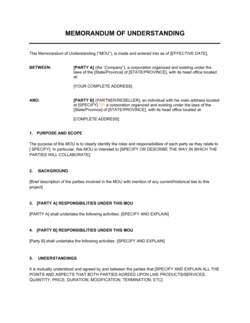
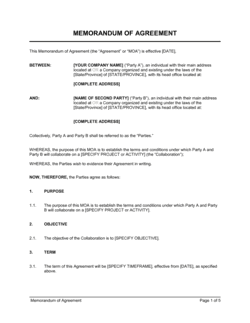
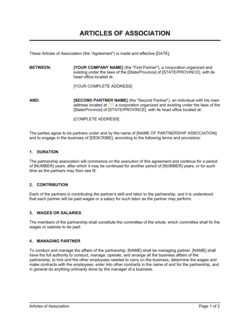
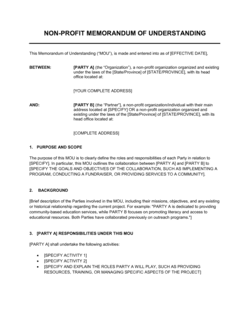
Memorandum Of Association Template

Free Word download • Edit online • Save & share with Drive • Export to PDF

2 pages20–30 min to fillDifficulty: StandardSignature requiredLegal review recommended
Learn more ↓
FreeMemorandum Of Association Template

At a glance

What it is
A Memorandum of Association (MoA) is a foundational constitutional document filed at the time of company incorporation that establishes the company's legal existence and defines the outer limits of its authorised activities. This free Word download gives you a structured, jurisdiction-ready starting point you can edit online and export as PDF for submission to a Companies Registry or Registrar of Companies.
When you need it
You need it when incorporating a new private limited company, public company, or guarantee company in the UK, India, or any Commonwealth jurisdiction that requires statutory formation documents. It must be signed by all initial subscribers before registration is submitted.
What's inside
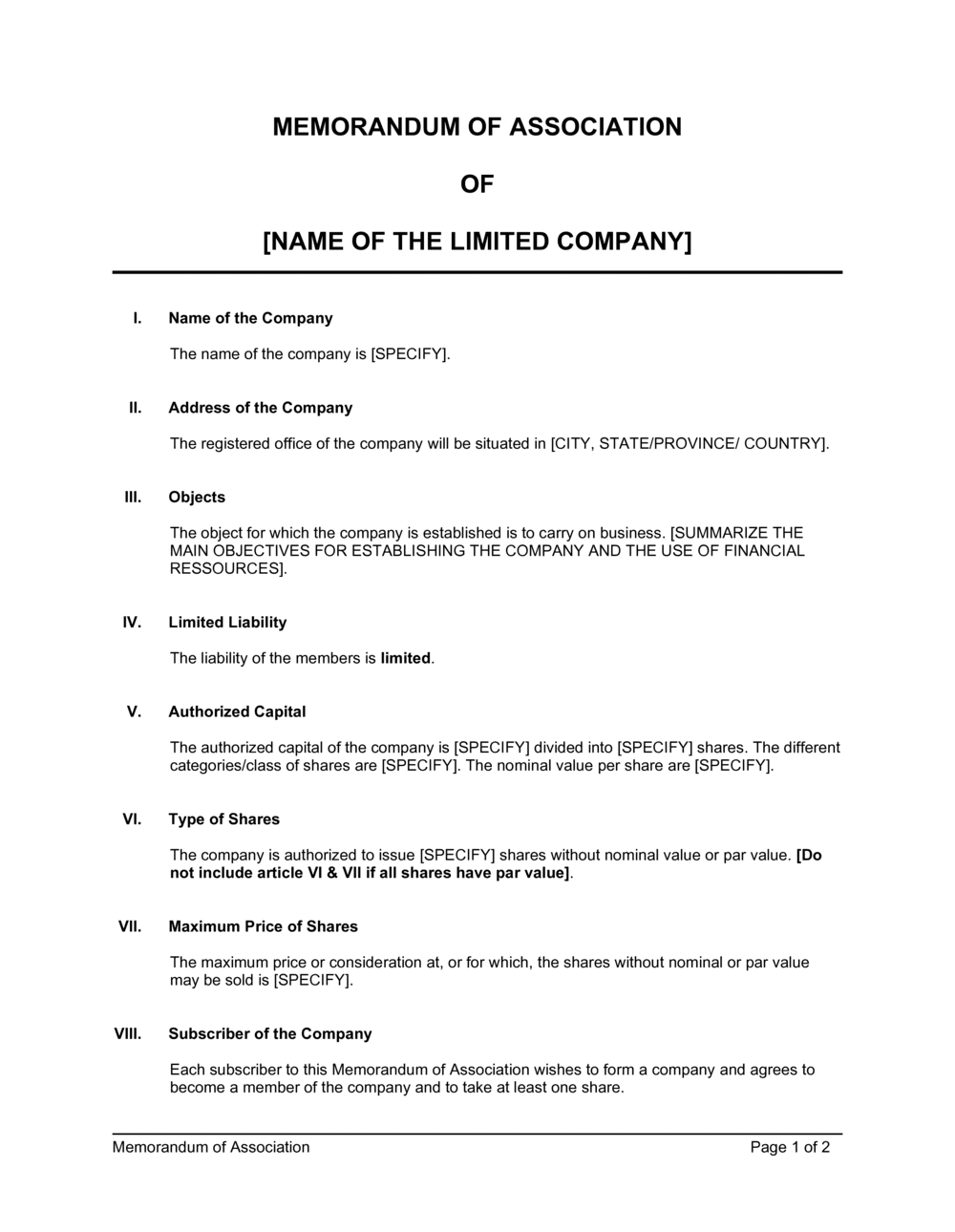
Company name clause, registered office clause, objects clause defining authorised business activities, liability clause, share capital and authorised capital clause, and a subscriber page listing each founding member with their signature and shareholding details.

What is a Memorandum of Association?

A Memorandum of Association (MoA) is a foundational statutory document submitted to a Companies Registry or Registrar of Companies at the time of incorporation to establish a company's legal existence. It records the company's name, the jurisdiction of its registered office, the scope of its authorised activities through an objects clause, the nature of its members' liability, and its authorised share capital — along with the names and signatures of the founding subscribers who agree to take shares and form the company. In the UK, India, and most Commonwealth jurisdictions, a valid MoA is a mandatory prerequisite for receiving a certificate of incorporation; no company can legally exist without one on file.

The MoA functions as the company's external constitutional document — it tells the world what the company is and what it is authorised to do. This distinguishes it from the Articles of Association, which govern how the company is internally managed. Together, the two documents form the complete constitutional foundation of any Commonwealth company.

Why You Need This Document

Without a properly drafted and filed Memorandum of Association, a company simply cannot be incorporated in the UK, India, or any other Commonwealth jurisdiction that requires it — there is no workaround and no grace period. An incomplete or incorrectly structured MoA will be rejected by the Companies Registry, delaying incorporation and potentially breaching contractual deadlines for business partners, landlords, or investors who are waiting on a registered entity before proceeding. Beyond the filing requirement, a poorly drafted objects clause can render contracts entered into outside those objects unenforceable in India and other jurisdictions where the ultra vires doctrine still applies with full force — exposing the company to voided agreements and directors to personal liability. Setting authorised share capital too low at inception creates an avoidable amendment process at precisely the moment a funding round demands speed. This template gives you the complete structure to get incorporation right the first time, with sample language and guidance on the most common Registrar rejection points built in at every clause.

Which variant fits your situation?

If your situation is…Use this template
Incorporating a private company limited by shares in the UKMemorandum of Association (UK Private Limited)
Incorporating a private limited company in India under the Companies Act 2013Memorandum of Association (India)
Incorporating a company limited by guarantee (nonprofit or professional association)Memorandum of Association (Company Limited by Guarantee)
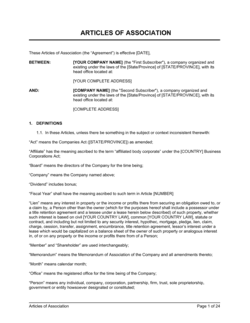
Setting out full internal governance rules in addition to the MoAArticles of Association
Forming a partnership rather than a registered companyPartnership Agreement
Establishing a joint venture company between two existing entitiesJoint Venture Agreement
Updating the objects clause after incorporationSpecial Resolution (Amendment of MoA)

Common mistakes to avoid

❌ Using the wrong MoA form for the company type

Why it matters: A private company's MoA differs structurally from a public company's, and a guarantee company's differs from both. Filing the wrong form causes the Registrar to reject the application, delaying incorporation and potentially triggering late-filing penalties if tied to a contractual deadline.

Fix: Identify the company type (private limited by shares, public limited, limited by guarantee, unlimited) before selecting the template, and match it to the prescribed statutory form for your jurisdiction.

❌ Drafting an overly narrow objects clause

Why it matters: A clause that lists only one specific trade or product can render contracts for ancillary services — leasing office space, opening a bank account, or hiring staff — technically ultra vires in jurisdictions that still apply the doctrine strictly, such as India.

Fix: Include a general commercial objects clause as the primary object, followed by specific activities, and conclude with a catch-all authorising anything incidental or conducive to the main objects.

❌ Setting authorised share capital too low at incorporation

Why it matters: Increasing authorised capital after incorporation requires a special resolution, a board meeting, a Registrar filing, and in some jurisdictions a stamp duty payment — adding cost and delay at precisely the moment when speed matters most, such as during a funding round.

Fix: At incorporation, set authorised capital at a level that accommodates at least two rounds of equity issuance and an employee option pool — 10,000 shares is a common minimum for companies anticipating investment.

❌ Subscriber signatures not properly witnessed

Why it matters: An unwitnessed or incorrectly witnessed subscriber signature is grounds for outright rejection by the Companies Registry in most Commonwealth jurisdictions. There is no cure other than re-execution — which may not be possible if a subscriber is abroad or has since withdrawn.

Fix: Arrange for each subscriber to sign in the physical presence of a witness who is not also a subscriber, and have the witness enter their full name and address on the document at the time of signing.

❌ Filing the MoA without the accompanying Articles of Association

Why it matters: The MoA and Articles of Association are co-dependent constitutional documents — registries require both to be filed simultaneously. A standalone MoA filing will be rejected, and resubmission resets the incorporation timeline.

Fix: Prepare both documents in parallel and submit them together with the incorporation application form and the applicable registration fee.

❌ Copying a MoA clause from a different jurisdiction

Why it matters: A UK Companies Act 2006 MoA references different statutory provisions, uses different prescribed language, and follows a different structure than an Indian Companies Act 2013 MoA. Filing a document with the wrong statutory references will be flagged immediately by the Registrar.

Fix: Always start from the prescribed form published by the relevant Companies Registry for your specific jurisdiction and company type, and use this template as a structural guide rather than a verbatim filing document.

The 9 key clauses, explained

Company Name Clause

In plain language: States the full registered legal name of the company exactly as it will appear on the certificate of incorporation and all official documents.

Sample language
The name of the Company is [COMPANY FULL LEGAL NAME] Limited.

Common mistake: Using a trading name or abbreviated name instead of the full registered name. Any discrepancy between the MoA and the incorporation application causes the Registrar to reject the filing.

Registered Office Clause

In plain language: Identifies the country and, where required, the jurisdiction within the country where the registered office is situated, establishing where service of legal process is valid.

Sample language
The registered office of the Company is to be situated in [ENGLAND AND WALES / SCOTLAND / WALES / INDIA — STATE NAME].

Common mistake: Stating a full street address in this clause rather than simply the jurisdiction. The full address is filed separately with the Registrar; including it here creates an amendment obligation every time the address changes.

Objects Clause

In plain language: Defines the purposes and activities the company is authorised to carry out — the legal boundary of the company's capacity to enter contracts and conduct business.

Sample language
The objects of the Company are to carry on business as a general commercial company and to do all such other things as are incidental or conducive to the attainment of the foregoing object, including [SPECIFIC BUSINESS ACTIVITIES].

Common mistake: Drafting a narrow objects clause that omits ancillary activities. If the company later enters a contract outside the stated objects, that contract may be ultra vires and unenforceable in certain jurisdictions.

Liability Clause

In plain language: Declares the nature and limit of each member's liability — either limited to unpaid share capital, limited by guarantee to a fixed amount, or unlimited.

Sample language
The liability of the members of the Company is limited to the amount, if any, unpaid on the shares respectively held by them. [OR] Each member of the Company undertakes to contribute to the assets of the Company in the event of it being wound up, not exceeding [AMOUNT].

Common mistake: Omitting this clause or using the wrong liability type for the chosen company structure — a guarantee company using share-liability language will be rejected by the Registrar.

Share Capital Clause

In plain language: States the total authorised share capital of the company, the number of shares it is divided into, and the nominal (par) value of each share.

Sample language
The share capital of the Company is [CURRENCY][AMOUNT], divided into [NUMBER] shares of [CURRENCY][NOMINAL VALUE] each.

Common mistake: Setting authorised capital too low at incorporation. Increasing authorised capital later requires a special resolution and a fee — founders who anticipate raising investment or issuing options should set a sufficiently high ceiling from the start.

Subscriber Details and Undertaking

In plain language: Lists each founding subscriber with their full name and address, the number of shares each agrees to take, and provides a space for each to sign and date the document in the presence of a witness.

Sample language
We, the subscribers to this Memorandum of Association, wish to form a company pursuant to this Memorandum, and we agree to take the number of shares shown opposite our respective names. [SUBSCRIBER FULL NAME], [ADDRESS] — [NUMBER] share(s). Signed: ________ Date: [DATE] Witnessed by: [WITNESS NAME], [WITNESS ADDRESS].

Common mistake: Having fewer than two subscribers sign the MoA when the statute requires a minimum — or having the subscriber sign without a witness. An unwitnessed signature is grounds for rejection in most Commonwealth Registries.

Association Clause

In plain language: A declaration by each subscriber that they desire to be formed into a company and agree to be bound by the MoA and Articles of Association.

Sample language
We, the several persons whose names and addresses are subscribed, are desirous of being formed into a company in pursuance of this Memorandum of Association, and we respectively agree to take the number of shares in the capital of the Company set out opposite our respective names.

Common mistake: Omitting the association clause under the assumption it is covered by the subscriber signatures. In India (Companies Act 2013) and several other jurisdictions, this is a mandatory standalone declaration.

Alteration and Amendment Clause

In plain language: States the conditions under which the MoA may be altered — typically requiring a special resolution of shareholders and, for certain amendments, approval of the relevant court or Registrar.

Sample language
This Memorandum may be altered in the manner and to the extent permitted by the applicable companies legislation from time to time in force, including by special resolution passed by not less than [75]% of votes cast.

Common mistake: Specifying a higher threshold for amendment than the statutory minimum without realising it — a self-imposed 90% requirement can make it practically impossible to amend the objects clause if shareholders later disagree.

Governing Law and Jurisdiction Clause

In plain language: Confirms the legal system and Companies Act under which the company is incorporated and to which it remains subject.

Sample language
This Memorandum of Association is drawn up in accordance with the [Companies Act 2006 / Companies Act 2013 / applicable legislation] of [JURISDICTION] and all provisions thereof shall be interpreted in accordance with the laws of [JURISDICTION].

Common mistake: Using a generic governing-law clause copied from a commercial contract rather than citing the specific Companies Act applicable to the jurisdiction of incorporation — the Registrar may reject a document that references the wrong statute.

How to fill it out

  1. 1

    Confirm the jurisdiction of incorporation

    Before filling in any clause, confirm which country and sub-jurisdiction the company will be registered in — England and Wales, Scotland, Wales, an Indian state, or another Commonwealth jurisdiction. The required clauses, their mandatory content, and the applicable Companies Act differ materially between jurisdictions.

    💡 The UK's Companies House and India's Ministry of Corporate Affairs both publish the prescribed MoA format for each company type — match the template to the official form for your jurisdiction.

  2. 2

    Choose and confirm the registered company name

    Search the Companies Registry to confirm the proposed name is available and does not conflict with an existing company, trademark, or restricted word. Enter the full legal name — including 'Limited', 'Ltd', 'Private Limited', or 'Pvt Ltd' as required — exactly as it will appear on the incorporation certificate.

    💡 Run the name check on the official registry portal the same day you file — availability can change within hours in active filing periods.

  3. 3

    State the registered office jurisdiction

    Enter the country or sub-jurisdiction only — not a street address. In the UK, specify England and Wales, Scotland, or Wales. In India, specify the state of incorporation. The full registered office address is filed separately with the Registrar.

    💡 The jurisdiction stated here determines which court has supervisory jurisdiction over the company for its entire existence — it cannot be changed without a court order in many systems.

  4. 4

    Draft the objects clause

    Write a clear statement of the company's principal business activities. For most trading companies, include a general commercial objects clause as the primary object, followed by specific ancillary activities. For nonprofit or guarantee companies, state the charitable or membership objects precisely.

    💡 For UK companies incorporated after 1 October 2009, the Companies Act 2006 implies unrestricted objects unless the MoA expressly restricts them — a general commercial clause is still best practice to avoid any ambiguity.

  5. 5

    Select the liability type and complete the liability clause

    Choose 'limited by shares' for standard trading companies, 'limited by guarantee' for nonprofits and associations, or 'unlimited' for certain professional structures. Enter the exact guarantee amount if limited by guarantee.

    💡 Mismatching the liability type with the company type selected in the incorporation application is the most common cause of Registrar rejection — double-check both documents before filing.

  6. 6

    Set the authorised share capital and nominal value

    Enter the total authorised capital amount, the number of shares, and the nominal value per share. A common starting structure is 100 shares at £1.00 or INR 10 each. For companies anticipating investment, consider setting authorised capital at 10,000 or more shares to allow future issuances without amendment.

    💡 The nominal value of shares is not the same as their market value — £1 nominal shares can be issued at any price above £1; the premium over nominal value goes into a share premium account.

  7. 7

    Complete the subscriber table and obtain witnessed signatures

    List each founding subscriber's full legal name, residential or registered address, and the number of shares they are taking. Each subscriber must sign in the presence of a witness, who must also sign and provide their name and address.

    💡 Each subscriber must take at least one share. If any subscriber is a corporate entity rather than an individual, an authorised signatory must sign on the entity's behalf and state their capacity.

  8. 8

    Date the document and attach it to the Articles of Association

    Enter the execution date after all signatures are in place. File the MoA together with the Articles of Association, the incorporation form (IN01 in the UK, SPICe+ in India), and any required registration fee.

    💡 In the UK, Companies House accepts electronic incorporation through their online portal — the MoA and Articles are generated automatically when you file online; this template is most useful for reviewing, customising, or filing offline.

Frequently asked questions

What is a Memorandum of Association?

A Memorandum of Association is a foundational statutory document filed at the time of company incorporation that establishes the company's legal existence and defines the outer limits of its authorised activities. It typically states the company's name, registered office jurisdiction, objects (authorised business purposes), liability type, share capital, and the details of each founding subscriber. In Commonwealth jurisdictions such as the UK, India, Australia, and Canada, it is a mandatory filing document required before a certificate of incorporation can be issued.

Is a Memorandum of Association required in the United States?

No. The US does not use a Memorandum of Association. US corporations file Articles of Incorporation (or a Certificate of Incorporation) with the relevant state's Secretary of State, and LLCs file Articles of Organisation. The MoA is a Commonwealth concept — it is primarily relevant for incorporations in the UK, India, Canada, Australia, Singapore, Hong Kong, Nigeria, Kenya, and other jurisdictions that follow English company law traditions.

What is the difference between a Memorandum of Association and Articles of Association?

The Memorandum of Association defines what the company is and what it is authorised to do — its name, objects, liability structure, and share capital. The Articles of Association govern how the company is internally managed — board composition, shareholder meetings, voting rights, dividend policy, and transfer of shares. Both are constitutional documents filed at incorporation; the MoA establishes the company's external legal capacity, while the Articles govern its internal operations.

Can a Memorandum of Association be amended after incorporation?

Yes, but the process is strictly regulated. In most jurisdictions, amending the MoA requires a special resolution passed by at least 75% of voting shareholders, followed by a filing with the Companies Registry. Certain amendments — particularly changes to the objects clause or liability type — may also require court approval or Registrar consent. In the UK, the Companies Act 2006 significantly simplified the process; in India, the Companies Act 2013 requires National Company Law Tribunal approval for changes to the registered office across states.

How many subscribers does a Memorandum of Association require?

In the UK, a minimum of one subscriber is sufficient for a private company under the Companies Act 2006. In India, a private limited company requires at least two subscribers, and a public limited company requires at least seven. Other Commonwealth jurisdictions vary — check the minimum subscriber requirement for your specific jurisdiction and company type before preparing the subscriber page.

What is the objects clause and how broad should it be?

The objects clause defines the scope of activities the company is authorised to carry out. In the UK, Companies Act 2006 implies unrestricted objects for companies incorporated after 1 October 2009 unless the MoA expressly restricts them. In India and many other Commonwealth jurisdictions, the objects clause is still a substantive limitation on the company's capacity. A general commercial objects clause — 'to carry on business as a general commercial company' — supplemented by specific activities and a catch-all for incidental purposes is the recommended approach for most trading companies.

What happens if a company acts outside its objects clause?

Any act outside the objects clause is said to be ultra vires — 'beyond the powers' of the company. In jurisdictions that still apply the ultra vires doctrine strictly (notably India), an ultra vires contract may be void and unenforceable against the company. In the UK, the Companies Act 2006 protects third parties dealing with the company in good faith, so most contracts remain enforceable — but directors may face personal liability for authorising ultra vires acts. A broadly drafted objects clause eliminates this risk.

Does the Memorandum of Association need to be notarised?

Notarisation is not generally required for domestic incorporations in the UK or India — witnessed signatures by the subscribers are sufficient. However, if a subscriber is signing outside the jurisdiction of incorporation, or if a copy of the MoA is being used for a foreign registration or apostille process, notarisation or apostille certification may be required. Always check the specific requirements of the relevant Companies Registry and, if applicable, the foreign jurisdiction's requirements for recognising the document.

Do I need a lawyer to prepare a Memorandum of Association?

For a straightforward private limited company incorporation with a general commercial objects clause, a high-quality template is often sufficient when reviewed carefully against the jurisdiction's prescribed form. Engaging a company secretary or solicitor is advisable when the objects clause needs precise drafting for a regulated industry, when a guarantee company or public company structure is used, when multiple jurisdictions are involved, or when the subscriber arrangements are complex. A professional review of the draft typically costs £200–£800 in the UK or INR 5,000–25,000 in India and is worthwhile for any company expected to raise investment or operate in a regulated sector.

How this compares to alternatives

vs Articles of Association

The Memorandum of Association defines the company's external legal identity — its name, objects, and authorised capital — while the Articles of Association govern its internal management: board structure, voting rights, and dividend procedures. Both are constitutional documents filed at the same time, but they serve distinct functions. You need both to incorporate; neither alone is sufficient.

vs Partnership Agreement

A Memorandum of Association is filed with a government Registrar to create a company with separate legal personality and limited liability. A Partnership Agreement is a private contract between individuals who carry on business together without creating a separate legal entity. Partners remain personally liable for partnership debts; shareholders in a limited company do not.

vs Shareholder Agreement

The MoA is a public constitutional document filed at the Companies Registry that establishes the company's existence and authorised scope. A Shareholder Agreement is a private contract between shareholders governing their rights, obligations, and relationships — drag-along rights, pre-emption, and dispute resolution. The MoA is compulsory and public; the Shareholder Agreement is optional and confidential.

vs Certificate of Incorporation

The Memorandum of Association is the document you prepare and submit to the Registrar. The Certificate of Incorporation is the official document the Registrar issues to confirm that the company has been successfully registered and now exists as a legal entity. You draft and sign the MoA; the Registrar issues the Certificate as a consequence of accepting it.

Industry-specific considerations

Technology / SaaS

Objects clause must cover software development, data processing, and licensing activities to avoid ultra vires arguments when entering SaaS subscription or IP licensing contracts.

Financial Services

Regulated financial activities — lending, payment processing, investment management — must be explicitly stated in the objects clause to satisfy both the Companies Registry and the financial regulator at licensing stage.

Healthcare / MedTech

Objects clause should cover manufacture, distribution, and provision of medical devices or healthcare services; subscriber details scrutinised by healthcare regulators during operator registration.

Nonprofit / Social Enterprise

A company limited by guarantee uses the MoA to state charitable or community objects that must align precisely with the objects required by the Charity Commission or equivalent regulator for charitable status.

Manufacturing

Authorised capital and share capital structure in the MoA determines stamp duty on incorporation in India — higher capital attracts higher registration fees, so founders balance future flexibility against upfront cost.

Professional Services

For professional firms (law, accountancy, architecture), objects clause must align with the permitted scope of activities under the relevant professional licensing body to avoid regulatory challenge.

Jurisdictional notes

United States

The Memorandum of Association has no direct US equivalent. US corporations file Articles of Incorporation (or a Certificate of Incorporation) with the relevant state's Secretary of State; LLCs file Articles of Organisation. If you are incorporating a US entity, use the applicable state's Articles template rather than this document. This MoA template is relevant for US-based founders incorporating a subsidiary in the UK, India, or another Commonwealth jurisdiction.

Canada

Canada replaced the traditional MoA structure with Articles of Incorporation under the Canada Business Corporations Act (CBCA) for federal corporations and under provincial statutes for provincial companies. However, companies incorporated in Canada's older Letters Patent provinces — notably Nova Scotia and British Columbia under earlier acts — may still have MoA-style documents on file. For current Canadian incorporations, use Articles of Incorporation rather than this template.

United Kingdom

The UK's Companies Act 2006 significantly simplified the MoA — post-2009 UK MoAs are short, prescribed-form documents stating only the subscribers' intention to form a company and take shares. The detailed objects and capital provisions moved to the Articles of Association. Companies House provides a standard MoA form (available in the IN01 filing package); this template covers the full traditional structure useful for review, jurisdictions that still require it in full, or pre-2006 company amendments.

European Union

EU member states do not use the Commonwealth MoA concept. Equivalent constitutional documents vary by country: France uses Statuts, Germany uses a Gesellschaftsvertrag, and the Netherlands uses an Akte van Oprichting. The EU Directive on company law harmonises certain disclosure requirements, but the form and content of constitutional documents remain national law matters. Use jurisdiction-specific local counsel for incorporations within EU member states.

Template vs lawyer — what fits your deal?

PathBest forCostTime
Use the templateFounders incorporating a standard private limited company in the UK or India with a general commercial objects clauseFree1–2 hours to complete, same-day filing possible online
Template + legal reviewCompanies in regulated industries, guarantee companies, or incorporations with complex subscriber arrangements or multiple share classes£200–£800 (UK solicitor or company secretary); INR 5,000–25,000 (Indian company secretary)2–5 business days
Custom draftedPublic companies, cross-border holding structures, joint ventures with institutional partners, or incorporations in multiple Commonwealth jurisdictions simultaneously£1,500–£5,000+ (UK corporate solicitor); INR 25,000–100,000+ (Indian corporate law firm)1–3 weeks

Glossary

Memorandum of Association
A statutory constitutional document filed at incorporation that defines the company's name, registered office, authorised objects, liability structure, and share capital.
Objects Clause
The section of the MoA that defines the scope of activities the company is legally authorised to carry out — activities outside this scope are said to be ultra vires.
Ultra Vires
Latin for 'beyond the powers' — describes any act or contract entered into by a company that falls outside the scope permitted by its objects clause.
Subscriber
A founding member who signs the MoA and agrees to take at least one share in the company at the time of incorporation.
Authorised Share Capital
The maximum value of shares a company is permitted to issue, as stated in the MoA — individual shares may not be issued beyond this ceiling without amending the document.
Company Limited by Shares
A company structure in which each member's liability is capped at the unpaid amount on their shares — the most common form for trading companies.
Company Limited by Guarantee
A company structure in which members guarantee to contribute a fixed amount on winding up, typically used for nonprofits, charities, and professional associations.
Registered Office
The official legal address of the company, registered with the Companies Registry, where statutory notices and legal correspondence are validly served.
Articles of Association
A separate constitutional document that governs the internal management and governance of the company — the MoA defines what the company can do; the Articles govern how it is run.
Special Resolution
A formal vote by at least 75% of shareholders (or the proportion set by statute) required to amend the MoA or Articles of Association.
Paid-Up Capital
The portion of authorised share capital that has actually been issued to shareholders and paid for, as opposed to capital that remains unissued.

Part of your Business Operating System

This document is one of 3,000+ business & legal templates included in Business in a Box.

  • Fill-in-the-blanks — ready in minutes
  • 100% customizable Word document
  • Compatible with all office suites
  • Export to PDF and share electronically

Create your document in 3 simple steps.

From template to signed document — all inside one Business Operating System.
1
Download or open template

Access over 3,000+ business and legal templates for any business task, project or initiative.

2
Edit and fill in the blanks with AI

Customize your ready-made business document template and save it in the cloud.

3
Save, Share, Send, Sign

Share your files and folders with your team. Create a space of seamless collaboration.

Save time, save money, and create top-quality documents.

★★★★★

"Fantastic value! I'm not sure how I'd do without it. It's worth its weight in gold and paid back for itself many times."

Managing Director · Mall Farm
Robert Whalley
Managing Director, Mall Farm Proprietary Limited
★★★★★

"I have been using Business in a Box for years. It has been the most useful source of templates I have encountered. I recommend it to anyone."

Business Owner · 4+ years
Dr Michael John Freestone
Business Owner
★★★★★

"It has been a life saver so many times I have lost count. Business in a Box has saved me so much time and as you know, time is money."

Owner · Upstate Web
David G. Moore Jr.
Owner, Upstate Web

Run your business with a system — not scattered tools

Stop downloading documents. Start operating with clarity. Business in a Box gives you the Business Operating System used by over 250,000 companies worldwide to structure, run, and grow their business.

Start free · No credit card required