Indemnity for Directors Short Form Template

Free Word download β€’ Edit online β€’ Save & share with Drive β€’ Export to PDF

2 pagesβ€’20–25 min to fillβ€’Difficulty: Standard
Learn more ↓
FreeIndemnity for Directors Short Form Template

At a glance

What it is
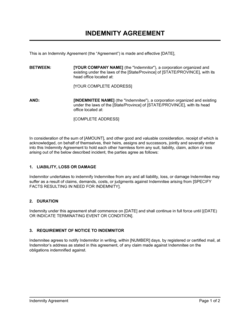
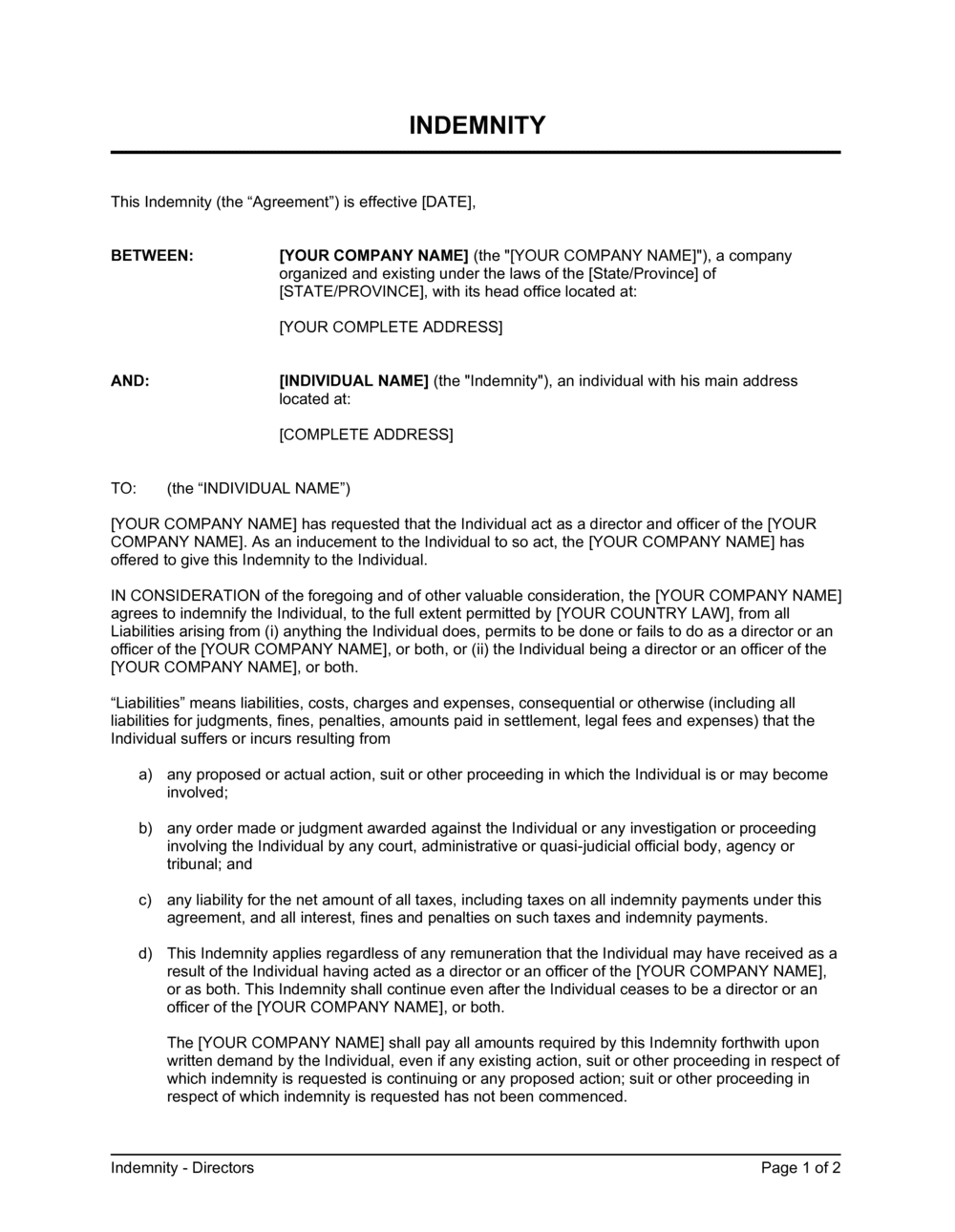
An Indemnity for Directors Short Form is a concise corporate document in which a company formally commits to indemnify and hold harmless its directors against personal liability, costs, and expenses arising from decisions made in their official capacity. This free Word download gives you a ready-to-edit template you can tailor to your company, export as PDF, and file with board records in minutes.
When you need it
Use it when onboarding a new board member, renewing director terms, or formalizing existing indemnity commitments that were made verbally or through bylaws alone. It is especially important when recruiting independent directors who require written assurances before accepting a seat.
What's inside
Company and director identification fields, the scope of indemnified acts, exclusions for bad faith or willful misconduct, an advancement-of-expenses provision, an undertaking-to-repay clause, and the effective date of coverage.

What is an Indemnity for Directors Short Form?

An Indemnity for Directors Short Form is a concise corporate document in which a company formally commits to protect its directors from personal financial liability for decisions made in good faith during their board service. It covers legal costs, settlements, and judgments arising from any proceeding brought against a director because of an act or omission in their official capacity β€” while carving out fraud, willful misconduct, and knowing violations of law. The short form version distills this commitment into a standardized, easy-to-execute record without the negotiated complexity of a full indemnification agreement.

Why You Need This Document

Without a written indemnity form, a director facing a legal proceeding must personally fund their defense while waiting to see whether the company will reimburse them β€” and whether the company will still exist or be solvent when the proceeding concludes. Qualified independent directors, investor nominees, and experienced advisors routinely decline board appointments where no written indemnity exists, because a bylaw provision alone offers no direct contractual claim against the company. Issuing a signed form at onboarding eliminates this barrier, aligns your governance records with best practice, and gives each director a clear, enforceable document they can rely on if a claim arises. This template lets you produce that record in minutes rather than drafting from scratch.

Which variant fits your situation?

If your situation is…Use this template
Providing indemnity to a director with a negotiated, detailed scopeIndemnity Agreement for Directors (Long Form)
Indemnifying an officer as well as a directorDirector and Officer Indemnification Agreement
Recording board approval of indemnity in minutesBoard Meeting Minutes
Covering directors under a D&O insurance policyD&O Insurance Questionnaire
Indemnifying a contractor or third party, not a directorIndemnity Agreement (General)
Appointing the director for the first time with full termsDirector Appointment Letter

Common mistakes to avoid

❌ Using the signing date as the effective date

Why it matters: Directors make consequential decisions from their first day on the board. An effective date set to the signing date leaves all prior acts unprotected.

Fix: Always set the effective date to the director's original appointment date and confirm this matches the corporate register.
❌ Omitting the advancement-of-expenses clause

Why it matters: Without advancement, a director facing a multi-year legal proceeding must personally fund their defense β€” which often deters qualified candidates from joining boards.

Fix: Include a clear advancement commitment tied to a written request process and an undertaking-to-repay obligation.

❌ No exclusion clause for fraud and willful misconduct

Why it matters: An indemnity with no carve-outs is frequently challenged by courts and shareholders as an improper grant of unlimited company funds.

Fix: Include standard exclusions for fraud, willful misconduct, and knowing violations of applicable law, aligned to your jurisdiction's corporate statute.

❌ Mismatching governing law and incorporation jurisdiction

Why it matters: Director indemnity rights are defined by corporate statute β€” applying the wrong jurisdiction's law can void rights the statute grants or expand liability beyond what the statute allows.

Fix: Set governing law to the jurisdiction where the company is incorporated, not where it operates or where the director resides.

The 9 key fields, explained

Company details

Director identification

Effective date of coverage

Scope of indemnified acts

Exclusions (bad faith and misconduct)

Advancement of expenses

Undertaking to repay

D&O insurance coordination

Governing law

How to fill it out

  1. 1

    Enter the company's registered legal name and address

    Use the full legal name exactly as it appears on your certificate of incorporation or articles of organization. Include the registered address and jurisdiction.

    πŸ’‘ Pull the exact name from your corporate registry filing β€” even a minor spelling variation can complicate enforcement.

  2. 2

    Identify the director by full legal name and address

    Enter the director's name as it appears on their government ID and any corporate registry appointment filings. Include their residential or registered address.

    πŸ’‘ Cross-check the name against your company's register of directors to ensure consistency across all corporate records.

  3. 3

    Set the effective date to the original appointment date

    Enter the date the director was first appointed to the board β€” not today's date β€” so that coverage applies retroactively to all prior board decisions.

    πŸ’‘ If the director has served multiple terms, use the date of their first appointment to maximize coverage continuity.

  4. 4

    Define the scope of indemnified acts

    Confirm the scope language covers all acts and omissions in the director's official capacity, including written resolutions, committee decisions, and informal consultations β€” not only formal board meetings.

    πŸ’‘ Avoid adding bespoke restrictions here unless specifically advised by counsel β€” narrowing scope creates coverage gaps the director may not anticipate.

  5. 5

    Confirm the exclusions are appropriate

    Review the bad-faith, willful-misconduct, and knowing-violation exclusions to ensure they match the carve-outs in your company's bylaws and any D&O insurance policy.

    πŸ’‘ If your bylaws provide broader indemnity than the form's exclusions, update the form to match β€” inconsistency between documents creates uncertainty for both parties.

  6. 6

    Include the undertaking-to-repay clause with the advancement provision

    Ensure both the advancement-of-expenses commitment and the director's undertaking to repay appear together. One without the other creates either a funding gap or an unconditional grant.

    πŸ’‘ The undertaking can be a standalone letter signed by the director at the time expenses are first advanced, referenced here by inclusion.

  7. 7

    State the governing law matching the incorporation jurisdiction

    Enter the state, province, or country whose corporate law governs β€” this should match the jurisdiction in your certificate of incorporation, not the director's residence.

    πŸ’‘ Delaware corporations should specify Delaware law even if operations or the director are based elsewhere.

Frequently asked questions

What is a director indemnity form?

A director indemnity form is a written commitment from a company to protect its directors from personal financial liability for decisions made in good faith in their board capacity. It covers legal costs, settlements, and judgments arising from covered proceedings, giving directors the confidence to make decisions without fear of personal ruin. The short form version documents the core commitment concisely, without the extensive negotiated provisions found in a long-form agreement.

Is a director indemnity form legally required?

No jurisdiction universally mandates a separate written indemnity form β€” many corporate statutes permit indemnity through bylaw provisions alone. However, a signed standalone form provides clearer, more direct evidence of the company's commitment and is typically required by independent directors and investors as a condition of board service.

What is the difference between a short form and a long form director indemnity?

A short form covers the essential indemnity commitment β€” scope, exclusions, advancement, and governing law β€” in a concise, standardized format. A long form adds negotiated provisions such as specific litigation management rights, detailed insurance-coordination mechanics, dispute resolution procedures, and survival clauses. Short forms are appropriate for most board appointments; long forms are used for senior executives, high-liability industries, or directors with significant negotiating leverage.

Does a director indemnity form replace D&O insurance?

No. A contractual indemnity is only as strong as the company's financial ability to pay β€” if the company is insolvent, the indemnity is worthless. D&O insurance pays claims regardless of the company's financial condition, up to policy limits. Best practice is to maintain both: the indemnity form as the primary commitment and D&O insurance as the backstop.

What acts are typically excluded from director indemnity?

Standard exclusions include fraud, willful misconduct, dishonest acts, and knowing violations of applicable law. Some forms also exclude claims brought by the company itself against the director. Negligence β€” even gross negligence β€” is typically covered, because the exclusions are limited to intentional wrongdoing rather than errors in judgment.

Can a director indemnity form be backdated?

The effective date should be set to the director's original appointment date to ensure all prior acts in their board capacity are covered. This is not backdating in a fraudulent sense β€” it is simply aligning the coverage period to the actual service period. The form is signed on the current date; the effective date reflects when the relationship and associated liability began.

Who signs a director indemnity short form?

Typically, an authorized officer of the company β€” the CEO, president, or company secretary β€” signs on behalf of the company. The director being indemnified acknowledges and accepts the form. Some companies also require board approval by resolution before issuing the form, which is recorded in board minutes separately.

Does the form need to be notarized?

Notarization is not required for a director indemnity form in most jurisdictions. The document derives its authority from the company's corporate capacity to grant indemnity and from the authorized signature of a company officer, not from notarial certification.

How this compares to alternatives

vs Indemnity Agreement (General)

A general indemnity agreement can apply to any party β€” contractors, suppliers, or third parties. A director-specific form is tailored to corporate governance obligations, advancement of expenses, and the statutory indemnity framework that applies to board members. Use the general form for commercial relationships and this form for board appointments.

vs Director Appointment Letter

A director appointment letter confirms the role, responsibilities, and compensation of a new board member. It does not, on its own, constitute a binding indemnity commitment. The indemnity form is a separate document that should accompany the appointment letter to provide full legal protection from day one.

vs Board Meeting Minutes

Board minutes can record a resolution to indemnify directors, but a resolution alone lacks the direct contractual relationship between company and individual director that a signed indemnity form creates. A signed form is harder to challenge than a minutes entry and is the document directors typically rely on in proceedings.

vs Non-Disclosure Agreement

An NDA governs the confidentiality obligations of a director regarding company information. An indemnity form governs the company's financial obligations to the director regarding liability. Both are standard board-onboarding documents but serve entirely different purposes β€” one protects the company, the other protects the individual.

Industry-specific considerations

Technology / SaaS

Startup boards frequently include investor nominees and independent advisors who require written indemnity before accepting seats on early-stage company boards.

Financial Services

Regulatory proceedings and enforcement actions make director indemnity essential; the form is issued alongside D&O coverage as standard practice for licensed entities.

Nonprofit

Volunteer board members of nonprofits routinely require a written indemnity form before accepting appointments, given the absence of equity compensation for their service.

Professional Services

Law firms, accounting firms, and consulting partnerships use director indemnity forms when appointing non-equity partners or external advisors to governance boards.

Template vs pro β€” what fits your needs?

PathBest forCostTime
Use the templateStandard board appointments at SMEs, startups, and nonprofits with straightforward governance structuresFree10 minutes per director
Template + professional reviewCompanies in regulated industries, multi-jurisdiction boards, or where independent directors negotiate their own terms$200–$500 for a brief legal review1–2 days
Custom draftedPublic companies, PE-backed boards with multiple nominee directors, or senior executives requiring negotiated indemnity terms$1,000–$3,000+1–2 weeks

Glossary

Indemnity
A commitment by one party (the company) to compensate another (the director) for losses, costs, or liabilities they incur in a defined role.
Indemnitee
The person receiving protection under an indemnity agreement β€” in this context, the director being indemnified.
Indemnitor
The party providing the indemnity commitment β€” here, the company whose board the director serves on.
Advancement of Expenses
A provision requiring the company to pay a director's legal costs upfront during a proceeding, before the final outcome is determined.
Undertaking to Repay
A director's promise to return advanced expenses if it is ultimately determined they are not entitled to indemnification.
Good Faith
Acting honestly and in the company's best interest β€” the standard a director must meet to qualify for indemnity coverage.
Willful Misconduct
Deliberate wrongdoing or reckless disregard for legal obligations β€” typically excluded from indemnity coverage.
D&O Insurance
Directors and Officers liability insurance, which sits alongside (but does not replace) a contractual indemnity and covers claims up to policy limits.
Covered Proceeding
Any legal action, investigation, or administrative proceeding in which the director is named because of acts taken in their board capacity.
Effective Date
The date from which the indemnity commitment applies β€” typically the date the director was first appointed, not the date the form is signed.

Part of your Business Operating System

This document is one of 3,000+ business & legal templates included in Business in a Box.

  • Fill-in-the-blanks β€” ready in minutes
  • 100% customizable Word document
  • Compatible with all office suites
  • Export to PDF and share electronically

Create your document in 3 simple steps.

From template to signed document β€” all inside one Business Operating System.
1
Download or open template

Access over 3,000+ business and legal templates for any business task, project or initiative.

2
Edit and fill in the blanks with AI

Customize your ready-made business document template and save it in the cloud.

3
Save, Share, Send, Sign

Share your files and folders with your team. Create a space of seamless collaboration.

Save time, save money, and create top-quality documents.

β˜…β˜…β˜…β˜…β˜…

"Fantastic value! I'm not sure how I'd do without it. It's worth its weight in gold and paid back for itself many times."

Managing Director Β· Mall Farm
Robert Whalley
Managing Director, Mall Farm Proprietary Limited
β˜…β˜…β˜…β˜…β˜…

"I have been using Business in a Box for years. It has been the most useful source of templates I have encountered. I recommend it to anyone."

Business Owner Β· 4+ years
Dr Michael John Freestone
Business Owner
β˜…β˜…β˜…β˜…β˜…

"It has been a life saver so many times I have lost count. Business in a Box has saved me so much time and as you know, time is money."

Owner Β· Upstate Web
David G. Moore Jr.
Owner, Upstate Web

Run your business with a system β€” not scattered tools

Stop downloading documents. Start operating with clarity. Business in a Box gives you the Business Operating System used by over 250,000 companies worldwide to structure, run, and grow their business.

Start freeΒ Β·Β No credit card required