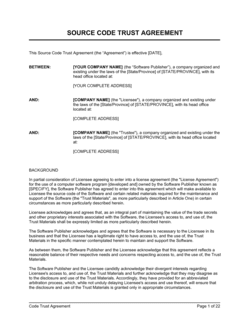
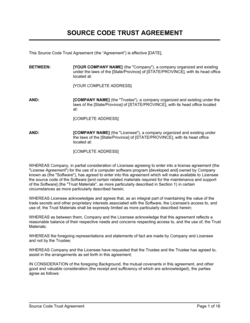
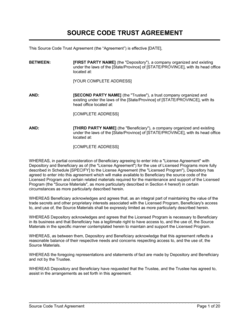
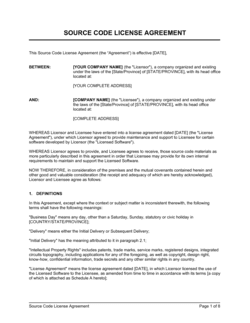
Source Code License Agreement Short Form Template

Free Word download β€’ Edit online β€’ Save & share with Drive β€’ Export to PDF

4 pagesβ€’20–30 min to fillβ€’Difficulty: Standard
Learn more ↓
FreeSource Code License Agreement Short Form Template

At a glance

What it is
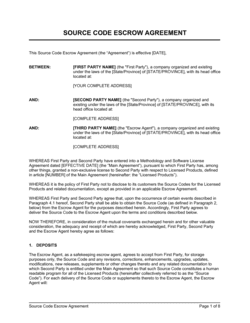
A Source Code License Agreement Short Form is a concise document that grants a licensee the right to access, use, and modify a licensor's software source code under defined conditions. This free Word download covers the essential fields β€” parties, licensed code, permitted uses, restrictions, fees, and termination β€” in a single page you can fill out online and export as PDF in minutes.
When you need it
Use it when sharing proprietary source code with a partner, client, or contractor who needs access to build, integrate, or modify software, but where a full multi-page software license agreement is more than the situation requires.
What's inside
Licensor and licensee identification, a description of the licensed code, grant of rights with explicit permitted and prohibited uses, fee and royalty terms, confidentiality obligations, and termination conditions.

What is a Source Code License Agreement Short Form?

A Source Code License Agreement Short Form is a concise contract that grants a licensee defined rights to access, use, and sometimes modify a licensor's proprietary software source code. Unlike a full software license agreement, the short form strips away extended warranty, indemnification, and multi-tier support clauses to deliver the essential terms β€” permitted use, restrictions, fees, confidentiality, and termination β€” on a single page. It is designed for business-to-business code sharing where both parties are technically sophisticated and the arrangement is straightforward enough that a lengthy agreement creates more friction than protection.

Why You Need This Document

Sharing source code without a written agreement leaves three critical questions unanswered: who owns the code, what the recipient is allowed to do with it, and what happens when the relationship ends. Without clear permitted-use and restriction language, a licensee may redistribute, resell, or build competing products on your codebase β€” and you will have no contractual basis to stop them. Missing confidentiality terms means copyright law alone must protect the code, which does not prevent disclosure to third parties. A properly completed short-form license agreement closes all three gaps in under 15 minutes, giving both parties a clear, enforceable record of exactly what was agreed before a single line of code changes hands.

Which variant fits your situation?

If your situation is…Use this template
Simple one-off code sharing with a contractor or clientSource Code License Agreement Short Form
Ongoing commercial software licensing with royaltiesSoftware License Agreement
Distributing open-source code with contribution termsOpen Source Software License
Granting a reseller the right to sublicense your softwareSoftware Reseller Agreement
Hiring a developer to build software owned by your companySoftware Development Agreement
Protecting source code shared under an NDA before licensingNon-Disclosure Agreement (NDA)
Transferring full ownership of source code to a buyerIntellectual Property Assignment Agreement

Common mistakes to avoid

❌ Omitting exclusivity language

Why it matters: Without stating whether the license is exclusive or non-exclusive, the licensor may inadvertently be contractually blocked from licensing the same code to other customers.

Fix: Explicitly label the grant as exclusive or non-exclusive in the Grant of Rights field and confirm the choice reflects your commercial intent.
❌ Leaving the licensed code description vague

Why it matters: A description like 'all software owned by licensor' can inadvertently cover unrelated codebases, creating liability the licensor never intended.

Fix: Name the specific software, version, and repository reference. Attach a file manifest as Exhibit A if the codebase spans multiple components.

❌ No confidentiality clause for the source code

Why it matters: Copyright alone does not prevent a licensee from sharing the code with third parties. Without a confidentiality clause, there is no contractual remedy for disclosure.

Fix: Add a confidentiality obligation that requires the licensee to restrict access to named personnel and prohibit any disclosure without written consent.

❌ No effect-of-termination clause

Why it matters: When the license ends, the licensee may retain and continue using copies of the code without a clause requiring deletion and written certification.

Fix: Require the licensee to delete all copies and provide written certification of destruction within a defined number of business days after termination.

The 9 key fields, explained

Licensor and Licensee Identification

Description of Licensed Code

Grant of Rights

Permitted Use and Restrictions

License Fee and Royalties

Confidentiality Obligation

Term and Termination

Effect of Termination

Governing Law

How to fill it out

  1. 1

    Identify both parties with full legal names

    Enter the registered legal name, address, and contact email for both the licensor and the licensee. Confirm the licensor is the actual legal owner of the source code.

    πŸ’‘ If a freelancer wrote the code, confirm IP ownership has already been assigned to the licensor's entity before executing this agreement.

  2. 2

    Describe the licensed code precisely

    Name the software, include the version number, and reference a repository URL or attach a file manifest as Exhibit A. Specificity prevents scope disputes later.

    πŸ’‘ A GitHub commit hash or release tag is the most precise identifier for a versioned codebase.

  3. 3

    Define the grant of rights and restrictions

    State clearly whether the license is exclusive or non-exclusive, what the licensee may do (use, modify, integrate), and what is prohibited (redistribute, sublicense, sell).

    πŸ’‘ If the licensee only needs to run the software β€” not modify it β€” limit the grant to 'use' only. A modify right is much broader.

  4. 4

    Set the fee and royalty terms

    Enter the one-time license fee, recurring royalty percentage (if any), payment schedule, and currency. If the license is free, write '$0' explicitly rather than leaving the field blank.

    πŸ’‘ Tie royalty payments to net revenue rather than gross to account for returns, taxes, and payment processor fees.

  5. 5

    Add the confidentiality obligation

    Specify that the licensee must treat the source code as confidential, limit access to authorized personnel, and bind those personnel to equivalent obligations.

    πŸ’‘ Reference any existing NDA between the parties so confidentiality obligations stack rather than conflict.

  6. 6

    State the term and termination conditions

    Set the start date, license duration, notice period for voluntary termination, and the specific breaches that trigger immediate termination without notice.

    πŸ’‘ For short-term project licenses, a fixed end date is cleaner than an open-ended term with a notice period.

  7. 7

    Specify the effect of termination and governing law

    Require deletion and written certification of all code copies upon termination, then select the governing jurisdiction closest to the licensor's place of business.

    πŸ’‘ Include a survival clause listing which obligations β€” confidentiality, IP ownership β€” continue after the agreement ends.

Frequently asked questions

What is a source code license agreement?

A source code license agreement is a contract that grants a licensee the right to access, use, and in some cases modify a licensor's software source code under defined conditions. It specifies what the licensee may and may not do with the code, how much they pay, how long the license lasts, and what happens when it ends. Without one, sharing source code creates ambiguity about ownership, permitted use, and confidentiality.

When should I use the short form instead of a full software license agreement?

Use the short form for straightforward, single-purpose arrangements β€” a contractor integrating one module, a client receiving a finished codebase, or a partner accessing a utility library. The full software license agreement is better suited to commercial SaaS licensing, multi-product arrangements, or deals involving sublicensing, warranty terms, and indemnification. When the deal is simple and both parties are sophisticated, the short form covers the essential bases in a fraction of the time.

Does a source code license agreement need to be signed to be valid?

In most jurisdictions, a written agreement becomes binding when both parties indicate their acceptance β€” typically through signature, but also through conduct or electronic acknowledgment. A signature block is recommended because it creates a clear, timestamped record of agreement that is easy to enforce. Without it, establishing exactly when and on what terms each party agreed becomes a factual dispute.

What is the difference between an exclusive and non-exclusive license?

An exclusive license means only the named licensee can exercise the granted rights β€” the licensor cannot grant the same rights to any other party during the term. A non-exclusive license allows the licensor to license the same code to multiple parties simultaneously. Most commercial arrangements use non-exclusive licenses unless the licensee is paying a premium specifically for exclusivity.

Can the licensee sublicense the source code to a third party?

Only if the agreement explicitly permits it. The default position in most jurisdictions is that sublicensing is prohibited without the licensor's written consent. If you intend to allow sublicensing β€” for example, to let a client embed the code in a product they sell β€” add a specific sublicensing clause with any conditions, such as written notice and revenue-sharing requirements.

What happens to the source code when the agreement is terminated?

The licensee should be required to immediately cease using the code, delete all copies from its systems, and provide the licensor with written certification of deletion within a defined window β€” typically 10 business days. Without this clause, the licensee may retain and continue using the code after the license has ended, which is effectively unauthorized use.

Does this agreement protect the source code's confidentiality?

Yes, if a confidentiality clause is included. Copyright law protects against unauthorized reproduction and distribution but does not prevent a licensee from disclosing the code to third parties. A confidentiality clause creates a separate contractual obligation β€” with its own remedies β€” to keep the source code private and restrict access to authorized personnel.

Do I need a lawyer to use this template?

For a straightforward code-sharing arrangement between two sophisticated parties, this template is typically sufficient without legal review. Consider engaging a lawyer if the license involves significant royalties, if the code is a core competitive asset, if sublicensing is contemplated, or if the parties are in different countries with conflicting IP laws. A one-hour legal review generally costs $200–$400 and is worthwhile for high-value codebases.

How this compares to alternatives

vs Software License Agreement

A full software license agreement covers compiled software delivered to end users and typically includes warranty disclaimers, limitation of liability, indemnification, and multi-tier support terms. The short form is designed for source code shared between two parties in a business-to-business context. When the deal involves a consumer-facing product or significant commercial liability exposure, use the full agreement.

vs Non-Disclosure Agreement (NDA)

An NDA protects confidential information before or during negotiations but does not grant any usage rights. A source code license agreement grants defined usage rights and includes confidentiality as one of several terms. Use an NDA when you need to share the code for evaluation only; use the license agreement once you are ready to grant actual usage rights.

vs Software Development Agreement

A software development agreement governs the creation of new software by a developer for a client, including IP ownership of the output. A source code license agreement governs usage rights to code that already exists. If you are commissioning new code, use a development agreement; if you are sharing existing code, use the license agreement.

vs Intellectual Property Assignment Agreement

An IP assignment transfers full ownership of the source code from one party to another permanently. A license agreement retains ownership with the licensor and grants only defined usage rights. Use an assignment when the buyer needs to own the code outright; use a license when the licensor wants to retain ownership and control reuse.

Industry-specific considerations

Software and SaaS

Used to grant integration partners or white-label clients access to a specific module or API implementation while retaining full IP ownership.

Professional Services

Agencies and consultancies use it to deliver client projects with defined post-delivery code usage rights, preventing unauthorized resale or redistribution.

Manufacturing and Industrial Technology

Embedded software licensed to equipment manufacturers under a short-form agreement tied to unit volume and deployment restrictions.

Financial Services

Fintech providers license proprietary calculation engines or data-processing code to banks and brokers with strict confidentiality and audit-trail requirements.

Template vs pro β€” what fits your needs?

PathBest forCostTime
Use the templateDevelopers, agencies, and small businesses sharing source code in a straightforward single-purpose arrangementFree10–15 minutes
Template + professional reviewArrangements involving royalties, exclusivity, or code that is a primary business asset$200–$400 (one-hour attorney review)1–2 days
Custom draftedMulti-party licensing, sublicensing structures, cross-border IP, or high-value commercial code deals$800–$2,500+1–2 weeks

Glossary

Licensor
The party that owns the source code and grants the right to use it under defined terms.
Licensee
The party receiving the right to access, use, or modify the source code under the agreement.
Source Code
Human-readable programming instructions written in a programming language, before compilation into machine-executable code.
Grant of Rights
The specific permissions given to the licensee β€” such as the right to use, copy, modify, or distribute the source code within stated limits.
Exclusive License
A grant where only the named licensee may exercise the stated rights; the licensor cannot grant the same rights to anyone else during the term.
Non-Exclusive License
A grant that allows the licensor to simultaneously license the same code to multiple parties.
Derivative Work
A new work based on the licensed source code β€” such as a modified version or a product that incorporates the code.
Sublicense
Permission for the licensee to grant usage rights in the source code to a third party, only if explicitly authorized by the licensor.
Royalty
A recurring fee paid to the licensor, typically calculated as a percentage of revenue or a fixed amount per unit sold or deployed.
Termination for Cause
Cancellation of the license due to a specific breach β€” such as exceeding permitted use or sharing the code without authorization.

Part of your Business Operating System

This document is one of 3,000+ business & legal templates included in Business in a Box.

  • Fill-in-the-blanks β€” ready in minutes
  • 100% customizable Word document
  • Compatible with all office suites
  • Export to PDF and share electronically

Create your document in 3 simple steps.

From template to signed document β€” all inside one Business Operating System.
1
Download or open template

Access over 3,000+ business and legal templates for any business task, project or initiative.

2
Edit and fill in the blanks with AI

Customize your ready-made business document template and save it in the cloud.

3
Save, Share, Send, Sign

Share your files and folders with your team. Create a space of seamless collaboration.

Save time, save money, and create top-quality documents.

β˜…β˜…β˜…β˜…β˜…

"Fantastic value! I'm not sure how I'd do without it. It's worth its weight in gold and paid back for itself many times."

Managing Director Β· Mall Farm
Robert Whalley
Managing Director, Mall Farm Proprietary Limited
β˜…β˜…β˜…β˜…β˜…

"I have been using Business in a Box for years. It has been the most useful source of templates I have encountered. I recommend it to anyone."

Business Owner Β· 4+ years
Dr Michael John Freestone
Business Owner
β˜…β˜…β˜…β˜…β˜…

"It has been a life saver so many times I have lost count. Business in a Box has saved me so much time and as you know, time is money."

Owner Β· Upstate Web
David G. Moore Jr.
Owner, Upstate Web

Run your business with a system β€” not scattered tools

Stop downloading documents. Start operating with clarity. Business in a Box gives you the Business Operating System used by over 250,000 companies worldwide to structure, run, and grow their business.

Free Forever PlanΒ Β·Β No credit card required