Deed of Hypothec on Movables Template

Free Word download • Edit online • Save & share with Drive • Export to PDF

8 pages25–35 min to fillDifficulty: ComplexSignature requiredLegal review recommended
Learn more ↓
FreeDeed of Hypothec on Movables Template

At a glance

What it is
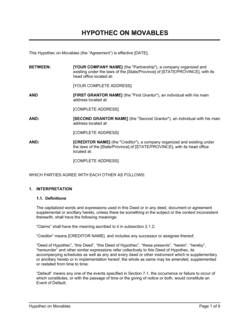
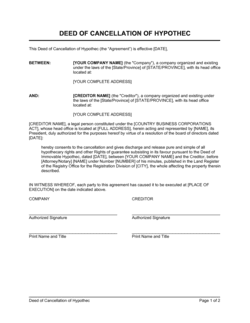
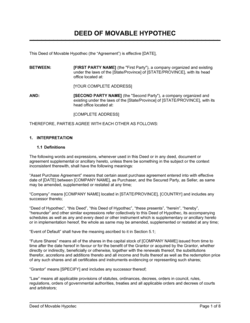
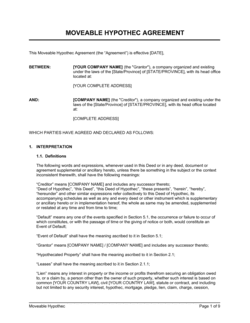
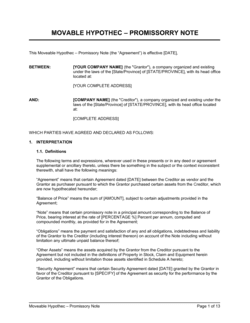
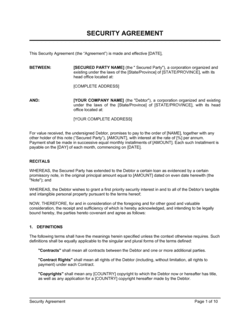
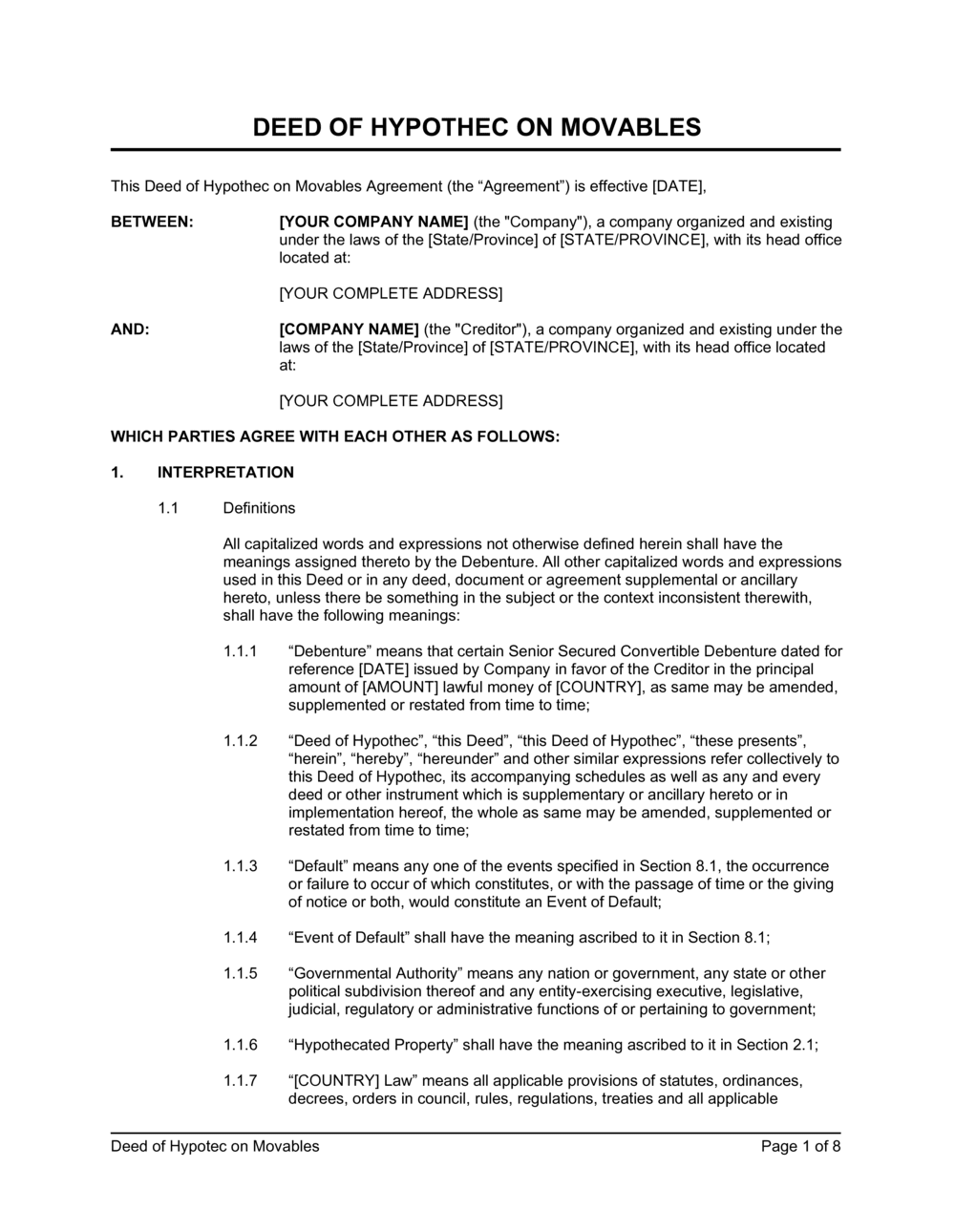
A Deed of Hypothec on Movables is a legally binding security agreement that grants a creditor a real right over a debtor's movable property — such as equipment, inventory, receivables, or intellectual property — as collateral for a loan or other financial obligation. Rooted in Quebec's civil law system and the Civil Code of Quebec, it functions similarly to a security agreement under common-law jurisdictions but follows distinct formal requirements. This free Word download gives you a structured, notary-ready starting point you can edit online and export as PDF.
When you need it
Use it when a lender requires security over a borrower's movable assets before advancing funds, when a business is pledging equipment or receivables as collateral for a line of credit, or when any transaction under Quebec civil law calls for a registered security interest in personal property.
What's inside
Identification of the parties and the secured obligation, a precise description of the hypothecated movables, the hypothec amount and interest rate, publication and registration requirements, debtor obligations to maintain the charged assets, creditor remedies upon default, and governing law provisions.

What is a Deed of Hypothec on Movables?

A Deed of Hypothec on Movables is a formal security agreement under Quebec civil law that grants a lender or creditor a real right — a hypothec — over a borrower's movable property as collateral for a loan or other financial obligation. Movable property in this context includes tangible assets such as equipment, vehicles, and inventory, as well as intangible assets such as receivables, intellectual property, and software licences. Unlike a pledge, which requires the creditor to take physical possession of the pledged asset, a movable hypothec allows the debtor to retain and use the charged property while the creditor holds a registered security interest enforceable upon default. The deed is governed by the Civil Code of Quebec (CCQ) and must be published in the Register of Personal and Movable Real Rights (RPMRR) to be effective against third parties and competing creditors.

Why You Need This Document

Without a properly drafted and registered deed of hypothec on movables, a lender advancing funds against a borrower's assets has no enforceable priority claim over those assets in insolvency, competing creditor proceedings, or a sale of the business. An unpublished hypothec — or one published late — can rank behind creditors who registered the same day, leaving the original lender partially or entirely unsecured. A poorly described asset schedule can fail to attach to key collateral, and remedies clauses that omit the statutory notice requirements under Articles 2757–2758 CCQ can be voided by a Quebec court, forcing the creditor to restart enforcement from the beginning. This template provides the structural framework to avoid all four failure points, giving lenders a defensible, publication-ready deed while giving borrowers clear visibility into their obligations — from asset maintenance covenants through to the exact sequence of events that triggers hypothecary enforcement.

Which variant fits your situation?

If your situation is…Use this template
Securing a loan against immovable property such as land or buildingsDeed of Hypothec on Immovables
Pledging receivables only, with daily fluctuating balancesFloating Charge / Hypothec on Universality of Receivables
Securing obligations under common-law personal property rules outside QuebecGeneral Security Agreement
Lender requires a pledge of shares or investment securitiesShare Pledge Agreement
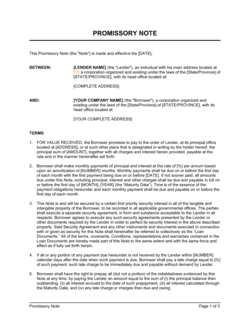
Short-term asset-backed financing with a fixed repayment scheduleSecured Promissory Note
Multiple creditors sharing a security interest in the same movable assetsInter-Creditor Agreement
Borrower is an individual consumer rather than a business entityConsumer Hypothec Agreement

Common mistakes to avoid

❌ Setting the hypothec amount equal to the loan principal only

Why it matters: The hypothec amount is the ceiling of the creditor's secured claim. If interest, fees, and enforcement costs exceed that amount, the excess is unsecured and ranks behind other creditors in distribution.

Fix: Set the hypothec amount at 125–150% of the loan principal and expressly include interest, costs of enforcement, and any future advances up to the stated maximum.

❌ Delaying registration in the RPMRR after execution

Why it matters: Priority among competing hypothecary creditors is determined by registration date and time, not the date of the deed. A creditor who registers one day later ranks behind an earlier registrant, even if their deed was signed first.

Fix: File the RPMRR registration within one business day of execution as standard practice, and confirm the registration timestamp immediately after filing.

❌ Using a generic asset description without a detailed schedule

Why it matters: A description that reads 'all business assets' or 'equipment' without further identification can fail to attach to specific assets, be challenged as insufficiently certain, and leave key collateral outside the hypothec.

Fix: Attach a Schedule A listing each asset by type, model, and serial number for specific items, or define the universality category precisely (e.g., 'all accounts receivable arising from the sale of goods in the Grantor's ordinary course of business').

❌ Omitting the prior-notice requirement for hypothecary remedies

Why it matters: The Civil Code of Quebec requires a creditor to send a prior notice — typically 20 days for taking in payment — before exercising hypothecary remedies. Skipping or shortening this notice period voids the remedy entirely.

Fix: Include the statutory notice periods verbatim in the remedies clause and build a compliance checklist so that creditor counsel follows the prescribed steps in sequence before exercising any remedy.

❌ Failing to run an RPMRR search before execution

Why it matters: If undisclosed prior hypothecs exist on the charged assets, the new creditor may rank behind them in a default scenario, receiving little or no recovery despite holding a registered security interest.

Fix: Conduct an RPMRR search against the grantor's name and against each specific asset no more than 48 hours before execution, and require the grantor to represent and warrant that the search results are complete.

❌ Choosing a non-Quebec governing law for assets located in Quebec

Why it matters: Quebec courts apply the Civil Code of Quebec to movable hypothecs over Quebec-situated assets regardless of any choice-of-law clause. Remedy provisions drafted under common-law concepts (e.g., PPSA enforcement) will be unenforceable in Quebec.

Fix: Always specify Quebec law and the Civil Code of Quebec as governing law in the deed, and ensure the remedies clause mirrors CCQ Articles 2748–2762 precisely.

The 10 key clauses, explained

Identification of parties and recitals

In plain language: Names the grantor (debtor) and the hypothecary creditor as legal entities, states their addresses, and briefly describes the underlying obligation being secured.

Sample language
This Deed of Hypothec on Movables is granted on [DATE] by [GRANTOR FULL LEGAL NAME], a [ENTITY TYPE] incorporated under the laws of [JURISDICTION], with its registered office at [ADDRESS] (the 'Grantor'), in favour of [CREDITOR FULL LEGAL NAME] (the 'Creditor'), as security for the Secured Obligations described herein.

Common mistake: Using a trade name instead of the full registered legal name. A mismatch between the deed and the RPMRR registration invalidates publication and can void the hypothec's priority against third parties.

Description of the secured obligation

In plain language: Sets out the principal amount of the loan or obligation, the interest rate, repayment schedule, and a reference to the underlying loan agreement or promissory note.

Sample language
The Grantor hypothecates the Charged Property as security for the payment and performance of all amounts owing under the Loan Agreement dated [DATE] between the Grantor and the Creditor, including principal of $[AMOUNT], interest at [RATE]% per annum, and all fees, costs, and ancillary charges.

Common mistake: Describing the secured obligation too narrowly — limiting it to a fixed principal only. If the loan is later increased or restructured, the hypothec may not cover the additional amounts without a new deed.

Hypothec amount and interest

In plain language: States the maximum amount for which the hypothec is granted — which must be a fixed sum under Quebec law — and the rate of interest secured.

Sample language
The Grantor hereby grants a hypothec in the amount of $[HYPOTHEC AMOUNT] together with interest at the rate of [RATE]% per annum in favour of the Creditor on the Charged Property described in Schedule A.

Common mistake: Setting the hypothec amount equal to the loan principal without adding a buffer for interest, fees, and enforcement costs. Best practice is to set the hypothec amount at 125–150% of the principal to cover all ancillary amounts.

Description of the charged movable property

In plain language: Identifies with precision the movable assets subject to the hypothec — either by specific item or as a universality of assets of a defined category.

Sample language
The hypothec is granted over all of the Grantor's present and after-acquired [EQUIPMENT / INVENTORY / RECEIVABLES / OTHER MOVABLES] more particularly described in Schedule A attached hereto, together with all proceeds, accessions, and replacements thereof (the 'Charged Property').

Common mistake: Using generic descriptions like 'all business assets' without specifying the category of movable. An insufficiently defined description can be challenged at registration and may fail to attach to specific assets.

Grantor's representations and warranties

In plain language: The debtor confirms ownership of the charged assets, the absence of prior encumbrances other than those disclosed, and the authority to grant the hypothec.

Sample language
The Grantor represents and warrants that: (a) it is the owner of the Charged Property free and clear of all encumbrances except as disclosed in Schedule B; (b) it has full authority to grant this hypothec; and (c) the Charged Property is not subject to any prior ranking security interest except as disclosed.

Common mistake: Omitting a schedule of prior encumbrances. Undisclosed prior hypothecs discovered after execution can trigger an event of default and expose the grantor to a fraud claim.

Grantor's covenants and maintenance obligations

In plain language: Requires the debtor to maintain, insure, and preserve the charged assets, and restricts the debtor from disposing of or further encumbering them without creditor consent.

Sample language
The Grantor shall: (a) maintain the Charged Property in good repair and working condition; (b) keep it insured against loss or damage for no less than its full replacement value naming the Creditor as loss payee; and (c) not sell, lease, or otherwise dispose of the Charged Property outside the ordinary course of business without the prior written consent of the Creditor.

Common mistake: Allowing ordinary-course-of-business exceptions for inventory without defining what constitutes ordinary course. A debtor can sell substantially all inventory and claim ordinary course if the boundary is left undefined.

Events of default

In plain language: Lists the specific events that trigger the creditor's right to exercise hypothecary remedies — typically payment failure, insolvency, breach of covenants, or material adverse change.

Sample language
Each of the following constitutes an Event of Default: (a) failure to pay any amount when due under the Loan Agreement; (b) any proceeding in bankruptcy, insolvency, or receivership commenced by or against the Grantor; (c) any material breach of this Deed not remedied within [X] days of written notice; or (d) any other event of default as defined in the Loan Agreement.

Common mistake: Cross-referencing events of default in the loan agreement without reproducing them or attaching the loan agreement as a schedule. If the loan agreement is amended, the default provisions in the deed can become inconsistent.

Hypothecary remedies

In plain language: Sets out the four remedies available to the creditor under the Civil Code of Quebec upon an event of default and confirms that written notice requirements will be followed.

Sample language
Upon the occurrence and continuance of an Event of Default, the Creditor may, at its option and subject to the prior notice requirements of the Civil Code of Quebec: (a) take the Charged Property in payment of the Secured Obligations; (b) sell the Charged Property by private or judicial sale; (c) take possession and administer the Charged Property; or (d) cause the Charged Property to be sold under judicial authority.

Common mistake: Omitting the 20-day prior notice requirement for taking in payment (Article 2758 CCQ). Failure to comply with statutory notice periods voids the remedy and exposes the creditor to a claim for damages.

Publication and registration

In plain language: Requires the creditor to register the hypothec in the RPMRR and confirms the Grantor's cooperation with registration formalities.

Sample language
The Creditor is hereby authorized to publish this hypothec in the Register of Personal and Movable Real Rights (RPMRR) at the Grantor's expense. The Grantor shall execute all documents and provide all information necessary to effect and maintain such publication.

Common mistake: Failing to specify who bears the registration cost. If left silent, disputes arise — and if the creditor bears the cost but fails to register, the hypothec is enforceable only between the parties and not against third-party creditors or a trustee in bankruptcy.

Governing law and general provisions

In plain language: Confirms that Quebec law governs the deed, includes the entire-agreement clause, severability, and waiver provisions.

Sample language
This Deed is governed by and construed in accordance with the laws of the Province of Quebec and the Civil Code of Quebec. This Deed constitutes the entire agreement of the parties with respect to the hypothec on the Charged Property and supersedes all prior agreements, representations, and understandings relating thereto.

Common mistake: Choosing a common-law governing jurisdiction for a movable hypothec over Quebec assets. Quebec courts apply CCQ rules regardless of a foreign choice-of-law clause, and a mismatched governing law creates unenforceable remedy provisions.

How to fill it out

  1. 1

    Identify the parties with full legal names

    Enter the grantor's and creditor's exact registered legal names, entity types, and addresses as they appear in corporate registry filings. These must match the names used in the RPMRR registration exactly.

    💡 Pull the grantor's name directly from their Quebec enterprise registrar (REQ) entry — even a minor spelling difference can invalidate the registration.

  2. 2

    Describe the underlying secured obligation precisely

    Reference the loan agreement or promissory note by date and parties, state the principal amount, interest rate, and repayment schedule. Attach the loan agreement as Schedule B if it is not otherwise filed.

    💡 Include an 'and all amounts that may be owing from time to time' catch-all to cover future advances, fees, and interest without requiring a new deed.

  3. 3

    Set the hypothec amount at a buffer above the principal

    State the hypothec amount as a fixed sum — typically 125–150% of the loan principal — to cover accrued interest, enforcement costs, and any future advances up to the stated ceiling.

    💡 The hypothec amount is the maximum sum the charged property secures, not the loan balance. Setting it too low leaves part of the debt unsecured.

  4. 4

    Draft a precise description of the charged movables

    List the specific assets by type, serial number, or category, or define a universality of assets (e.g., 'all present and after-acquired inventory'). Attach a detailed schedule for itemized assets.

    💡 For equipment, include manufacturer, model, and serial number in Schedule A. For a universality, define the category narrowly enough to be identifiable but broadly enough to capture future replacements.

  5. 5

    Complete the grantor's representations and disclose prior encumbrances

    Have the grantor confirm ownership and authority, and list any existing hypothecs, liens, or security interests on the charged assets in a Schedule B disclosure.

    💡 Run an RPMRR search against the grantor's name before execution to verify all disclosed encumbrances and confirm there are no undisclosed registrations.

  6. 6

    Define events of default with cure periods

    List each triggering event specifically and include a cure period (typically 10–30 days) for remediable breaches. Cross-reference any additional defaults in the loan agreement.

    💡 Negotiate cure periods that match the grantor's operational reality — a 10-day cure period for a seasonal inventory business can trigger technical defaults that the parties never intended.

  7. 7

    Execute the deed with proper formalities

    Both parties must sign the deed before a witness or, where required, before a Quebec notary. Confirm whether the transaction requires a notarial deed in authentic form or a deed under private writing.

    💡 A deed in authentic form (before a notary) is required for certain hypothecs — including those given by a natural person — and carries evidentiary weight that a private deed does not.

  8. 8

    Publish the hypothec in the RPMRR promptly after execution

    File a registration application in the RPMRR within the agreed timeframe — typically within 5 business days of execution. Confirm the registration number and attach it to the loan file.

    💡 Priority among creditors is determined by the date and time of registration, not the date of the deed. A one-day delay in registration can cost you priority over a competing creditor.

Frequently asked questions

What is a deed of hypothec on movables?

A deed of hypothec on movables is a formal security agreement under Quebec civil law that grants a creditor a real right — a hypothec — over a debtor's movable property, such as equipment, inventory, receivables, or intellectual property, as collateral for a loan or other financial obligation. Unlike a mortgage, which covers immovable property such as land, a movable hypothec attaches to personal property and must be published in Quebec's Register of Personal and Movable Real Rights (RPMRR) to be effective against third parties. It is the Quebec civil law equivalent of a security agreement or general security agreement used in common-law provinces.

What types of assets can be subject to a movable hypothec?

Under the Civil Code of Quebec, almost any movable property can be hypothecated — including physical assets such as machinery, vehicles, and inventory; financial assets such as receivables and bank accounts; and intangible assets such as intellectual property, software licences, and goodwill. A hypothec can be granted over specific identified assets or over a universality of assets of a defined category — for example, all present and after-acquired inventory — which allows the debtor to continue using and replacing assets in the ordinary course of business.

How is a deed of hypothec on movables different from a general security agreement?

A general security agreement (GSA) is a common-law instrument used in Canadian provinces governed by Personal Property Security Acts (PPSA) — Ontario, British Columbia, Alberta, and others. A deed of hypothec on movables serves the same economic function but is governed exclusively by the Civil Code of Quebec and must follow distinct formal requirements, including publication in the RPMRR rather than a PPSA registry. The enforcement remedies are also different: Quebec law provides four specific hypothecary remedies, while PPSA regimes use a different set of secured-party enforcement rights. For assets located in Quebec, only the movable hypothec provides an enforceable Quebec-law security interest.

Does a deed of hypothec on movables need to be notarized?

It depends on the nature of the transaction and the grantor. A movable hypothec granted by a legal person (corporation) can be created by a deed under private writing — signed by both parties without a notary. However, a hypothec granted by a natural person (individual) in certain contexts may require a notarial deed in authentic form. Even where not strictly required, executing the deed before a Quebec notary provides greater evidentiary weight and simplifies enforcement in court. Always confirm the formal requirements with a Quebec notary or lawyer before execution.

What is the RPMRR and why is registration essential?

The RPMRR — Registre des droits personnels et réels mobiliers — is Quebec's public registry for personal and movable real rights, including movable hypothecs. Registration (called publication in civil law) makes the hypothec opposable to third parties — meaning it ranks against other creditors, buyers, and a trustee in bankruptcy. An unregistered hypothec is valid between the parties but has no priority over third-party creditors. Priority among competing hypothecs is determined by the date and time of registration, making prompt filing after execution critical.

What remedies does a hypothecary creditor have on default?

The Civil Code of Quebec provides four hypothecary remedies: (1) taking in payment — the creditor takes ownership of the charged property in full satisfaction of the debt; (2) sale by the creditor — the creditor sells the property privately or by judicial sale and applies proceeds to the debt; (3) taking possession for administration — the creditor takes over and operates the charged assets to generate income; and (4) sale under judicial authority — a court-supervised sale. All remedies require a prior notice to the debtor (typically 20 days) under Articles 2757–2758 CCQ, and the taking in payment remedy requires the debtor to have no equity in the property or to waive their equity.

Can a movable hypothec cover future assets not yet owned by the debtor?

Yes. Under Article 2666 of the Civil Code of Quebec, a hypothec can be granted over a universality of present and future movable assets of the same nature, such as all present and after-acquired inventory or all receivables. The hypothec attaches to future assets automatically as the debtor acquires them, without the need for a new deed. However, the universality must be defined precisely — a vague catch-all description may not attach to assets that fall outside the defined category.

How does a movable hypothec rank against other creditors?

Ranking among hypothecs is generally determined by publication date in the RPMRR — earlier registration takes priority. However, certain prior claims under Quebec law — such as employee wage claims, municipal taxes, and certain government debts — rank ahead of all hypothecs regardless of registration date. In insolvency proceedings, federal law (Bankruptcy and Insolvency Act) also affects ranking, particularly for Crown claims and employee super-priority for pension contributions. A creditor should conduct thorough due diligence on existing encumbrances and prior claims before advancing funds.

Is a deed of hypothec on movables enforceable outside Quebec?

The movable hypothec is a Quebec civil law instrument and its enforceability in other jurisdictions depends on conflict-of-laws rules applied by foreign courts. Common-law provinces recognize Quebec hypothecs over assets physically located in Quebec but may require re-registration under provincial PPSA rules if the debtor or assets move to another province. For cross-border secured lending involving assets in multiple provinces, lenders typically take both a movable hypothec (for Quebec assets) and a PPSA general security agreement (for assets in other provinces) to ensure full coverage.

Do I need a lawyer to prepare a deed of hypothec on movables?

For straightforward commercial transactions with a clear asset description and an existing loan agreement, a high-quality template provides a solid structural starting point. However, given the specific formal requirements of the Civil Code of Quebec, the registration process in the RPMRR, and the complex ranking rules among creditors, engaging a Quebec notary or civil law lawyer for at least a review — and execution before a notary where required — is strongly recommended. The cost of legal review ($500–$1,500) is modest relative to the amount typically secured and the consequences of an unenforceable hypothec in default.

How this compares to alternatives

vs General Security Agreement

A general security agreement (GSA) is a common-law security instrument registered under provincial PPSA legislation outside Quebec. A deed of hypothec on movables is its Quebec civil law equivalent, governed by the Civil Code of Quebec and published in the RPMRR. For assets located in Quebec, only the movable hypothec provides an enforceable Quebec-law security interest; a GSA registered in a PPSA registry does not perfect a security interest over Quebec-situated assets.

vs Deed of Hypothec on Immovables

A deed of hypothec on immovables (mortgage) secures a creditor's interest in real property — land and buildings — under Quebec civil law and is published in the Land Register. A movable hypothec covers personal property such as equipment, inventory, and receivables and is published in the RPMRR. The two instruments complement each other in transactions where both real and personal property are pledged as collateral.

vs Promissory Note

A promissory note is the borrower's written promise to repay a sum — it evidences the debt but does not create a security interest in any property. A deed of hypothec on movables is a security document that charges specific assets as collateral for the repayment obligation evidenced by the note. In most secured lending transactions, both documents are executed together: the note establishes the debt; the hypothec secures it.

vs Pledge Agreement

A pledge (nantissement) under Quebec civil law requires the creditor to take physical possession of the pledged asset — a diamond, a promissory note, or certificated shares. A movable hypothec, by contrast, allows the debtor to retain possession and continue using the charged assets. For assets the debtor needs to operate its business — equipment, inventory, vehicles — a movable hypothec is the appropriate instrument rather than a pledge.

Industry-specific considerations

Manufacturing

Equipment financing secured by specific machinery and production assets registered by serial number in the RPMRR to protect priority against competing creditors.

Retail and Wholesale

Floating hypothec over a universality of inventory, allowing the debtor to buy and sell stock in the ordinary course while the creditor maintains a continuing security interest in aggregate inventory.

Financial Services

Hypothec over a portfolio of receivables or loans as collateral for warehouse lending or securitization facilities, with subrogation rights over insurance and collection proceeds.

Technology / SaaS

Hypothec over intellectual property, software licences, and receivables from subscription contracts, with careful definition of intangible asset categories to ensure attachment and registration.

Construction

Hypothec over heavy equipment, vehicles, and construction materials, often combined with a legal hypothec of construction in favour of contractors and subcontractors.

Healthcare

Hypothec over medical equipment and diagnostic devices, with compliance considerations for assets subject to Health Canada regulations and restrictions on disposal or transfer.

Jurisdictional notes

United States

The US equivalent of a movable hypothec is a security interest under Article 9 of the Uniform Commercial Code (UCC), perfected by filing a UCC-1 financing statement in the debtor's state of organization. The hypothec concept does not exist in US law. For cross-border transactions involving US-based debtors with Quebec assets, lenders typically take a Quebec movable hypothec over Quebec-situated collateral in addition to any UCC filing.

Canada

Outside Quebec, Canadian provinces are governed by Personal Property Security Acts (PPSA), and security interests in personal property are perfected by registering a financing statement in the applicable provincial PPSA registry. Quebec is the only province where the Civil Code hypothec regime applies. For assets straddling Quebec and other provinces, lenders must register in both the RPMRR and the relevant PPSA registry. Federal insolvency law (BIA, CCAA) affects enforcement priorities nationally regardless of the security instrument used.

United Kingdom

The UK equivalent for security over personal property is a fixed or floating charge, created by a debenture and registered at Companies House under the Companies Act 2006. The hypothec is a civil law concept with no direct UK counterpart. For Quebec assets owned by a UK-incorporated debtor, a Quebec movable hypothec is required in addition to any English-law security package. Cross-border enforcement of Quebec hypothecary remedies in the UK requires recognition proceedings.

European Union

Several EU member states — France, Belgium, and Luxembourg in particular — have civil law security instruments analogous to the Quebec movable hypothec, including the nantissement and the gage commercial. However, the specific rules, registration requirements, and remedies differ materially by member state, and Quebec hypothec documentation is not directly portable into EU jurisdictions. GDPR considerations arise when the charged assets include databases containing personal data, as the creditor's access to those assets on enforcement must be structured to comply with applicable data protection law.

Template vs lawyer — what fits your deal?

PathBest forCostTime
Use the templateStraightforward commercial hypothecs between businesses with a clear asset description and an existing loan agreementFree1–2 hours
Template + legal reviewAny transaction where asset categories are complex, prior encumbrances exist, or the hypothec amount exceeds $100,000$500–$1,500 for a Quebec notary or civil law lawyer review2–5 business days
Custom draftedLarge-scale secured financings, syndicated lending, cross-border transactions, or hypothecs over complex intangible or IP assets$2,500–$10,000+1–3 weeks

Glossary

Hypothec
A real right granted by a debtor to a creditor over specific property as security for an obligation, without transferring possession of the property to the creditor.
Movable Property
Under Quebec civil law, any property that is not immovable — including equipment, vehicles, inventory, receivables, intellectual property, and securities.
Grantor / Debtor
The party who owns the charged movable assets and grants the hypothec to the creditor as security for a debt or obligation.
Hypothecary Creditor
The lender or secured party who holds the hypothec and has the right to exercise hypothecary remedies upon the debtor's default.
RPMRR
The Register of Personal and Movable Real Rights — Quebec's public registry where movable hypothecs must be published to be enforceable against third parties.
Publication
The act of registering a security right in a public registry (such as the RPMRR) to make it opposable to third parties including other creditors and trustees in bankruptcy.
Hypothecary Remedies
The four enforcement rights available to a hypothecary creditor upon default: taking in payment, sale by creditor, sale under judicial authority, and taking possession for administration.
Prior Claim
A statutory preferential right that ranks ahead of hypothecs in the distribution of proceeds — examples include claims of employees for wages and tax authorities.
Universality
A grouping of present and future assets of the same nature — such as all inventory or all receivables — that can be hypothecated as a single body of property under Article 2666 CCQ.
Floating Hypothec
A hypothec over a universality of assets that allows the debtor to freely use and dispose of the charged assets in the ordinary course of business until crystallization on default.
Subrogation
The creditor's right to step into the debtor's position and claim proceeds, insurance payments, or damages that arise from or replace the hypothecated movable property.
Civil Code of Quebec (CCQ)
The statute governing private law in Quebec, including all rules for the creation, publication, ranking, and enforcement of hypothecs on movable and immovable property.

Part of your Business Operating System

This document is one of 3,000+ business & legal templates included in Business in a Box.

  • Fill-in-the-blanks — ready in minutes
  • 100% customizable Word document
  • Compatible with all office suites
  • Export to PDF and share electronically

Create your document in 3 simple steps.

From template to signed document — all inside one Business Operating System.
1
Download or open template

Access over 3,000+ business and legal templates for any business task, project or initiative.

2
Edit and fill in the blanks with AI

Customize your ready-made business document template and save it in the cloud.

3
Save, Share, Send, Sign

Share your files and folders with your team. Create a space of seamless collaboration.

Save time, save money, and create top-quality documents.

★★★★★

"Fantastic value! I'm not sure how I'd do without it. It's worth its weight in gold and paid back for itself many times."

Managing Director · Mall Farm
Robert Whalley
Managing Director, Mall Farm Proprietary Limited
★★★★★

"I have been using Business in a Box for years. It has been the most useful source of templates I have encountered. I recommend it to anyone."

Business Owner · 4+ years
Dr Michael John Freestone
Business Owner
★★★★★

"It has been a life saver so many times I have lost count. Business in a Box has saved me so much time and as you know, time is money."

Owner · Upstate Web
David G. Moore Jr.
Owner, Upstate Web

Run your business with a system — not scattered tools

Stop downloading documents. Start operating with clarity. Business in a Box gives you the Business Operating System used by over 250,000 companies worldwide to structure, run, and grow their business.

Start free · No credit card required