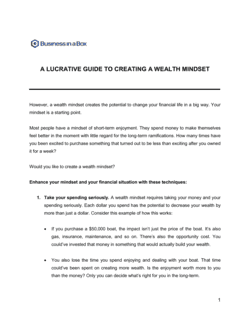
How To Create A Wealth Mindset

Free to read β€’ Save or share with one click

FreeHow To Create A Wealth Mindset Template

At a glance

What it is
How To Create A Wealth Mindset is a structured personal development and financial planning document that guides you through identifying limiting money beliefs, setting wealth goals, and building daily habits aligned with long-term financial growth. This free Word download gives you a step-by-step framework you can edit online and export as PDF to use as a personal roadmap or share with a coach or mentor.
When you need it
Use it when you are launching a business, reassessing your financial trajectory, or working through a coaching or personal development program that requires a documented plan of action around money and wealth creation.
What's inside
Core sections covering a financial beliefs audit, wealth vision statement, measurable financial goals, income diversification strategy, daily wealth habits, accountability structure, and progress review checkpoints β€” all organized into a single actionable document.

What is a How To Create A Wealth Mindset document?

A How To Create A Wealth Mindset document is a structured personal development and financial planning guide that walks you through the full process of identifying the beliefs, habits, and strategies that determine your financial outcomes. It begins with a diagnostic audit of your current money beliefs, establishes a specific wealth vision with measurable goals, maps an income diversification strategy, and builds a daily habit and accountability framework β€” all in a single editable Word file. Unlike a generic motivational resource, this template produces a concrete written plan you can review against actual financial data on a quarterly basis and adjust as your circumstances evolve.

Why You Need This Document

Most people who struggle to build wealth are not lacking financial knowledge β€” they are operating from beliefs formed in childhood or early career that actively work against the actions a financial plan requires. Without a documented wealth mindset framework, those beliefs remain invisible, silently driving avoidance of investment decisions, underpricing of services, and inconsistent savings behavior. The cost is measurable: a person who delays serious wealth-building by five years loses not just five years of contributions but the compounding growth on every dollar not invested during that window. This template surfaces those beliefs, replaces them with a specific vision and daily habits, and connects everything to an accountability structure that keeps the plan active between reviews rather than archived after the first week of enthusiasm.

Which variant fits your situation?

If your situation is…Use this template
Working through a personal wealth mindset shift independentlyHow To Create A Wealth Mindset
Setting structured short- and long-term financial goalsPersonal Financial Plan
Coaching clients through a money mindset programCoaching Action Plan
Building a full business strategy alongside personal wealth goalsBusiness Plan
Tracking monthly personal income, expenses, and savings targetsPersonal Budget Template
Developing a professional development roadmap for career growthIndividual Development Plan
Documenting a 90-day action plan to implement new financial habits90-Day Action Plan

Common mistakes to avoid

❌ Setting vague financial goals with no numbers or dates

Why it matters: A goal like 'build wealth' gives you nothing to measure, no deadline to create urgency, and no milestone to celebrate. The plan becomes motivational decoration rather than an operational guide.

Fix: Every goal in the document must have a specific dollar figure and a calendar date. Replace 'build an emergency fund' with 'save $15,000 in a high-yield savings account by December 31.'

❌ Skipping the financial beliefs audit

Why it matters: Without surfacing limiting beliefs, every goal-setting and habit-building section sits on an unstable foundation. The beliefs you hold unconsciously will undermine actions that contradict them.

Fix: Complete the audit first and use the results to inform which reframing exercises you prioritize. Do not move to goal-setting until you have identified at least three beliefs that directly conflict with your wealth vision.

❌ Listing income streams without startup costs or timelines

Why it matters: An income diversification plan without resource requirements and launch dates is an aspiration list. It creates false confidence without producing any new income.

Fix: For every income stream listed, document the startup cost in dollars, the hours per week required, and a specific launch date. Remove any stream you are not prepared to resource within 90 days.

❌ Naming an accountability partner but never scheduling a review

Why it matters: A named but unscheduled accountability partner provides no accountability. The absence of a standing meeting means the plan is reviewed only when motivation is high β€” which is rarely when it is most needed.

Fix: Before finalizing the document, send a calendar invitation for the first three monthly reviews. Treat these meetings as non-negotiable commitments with the same weight as a client meeting.

❌ Treating daily habits as optional once the initial motivation fades

Why it matters: Wealth-building habits compound in value over months and years. Dropping them at the first sign of inconvenience prevents the behavioral change that the plan is designed to create.

Fix: Build a minimum viable version of each habit β€” a 5-minute fallback β€” so the streak continues even on low-energy days. A consistent 5-minute habit is more valuable than an occasional 60-minute session.

❌ Completing the plan once and never reviewing it

Why it matters: A wealth mindset plan that is not reviewed against actual financial data becomes outdated within 90 days. Goals that made sense in January may be irrelevant or insufficiently ambitious by April.

Fix: Schedule a 90-day review as a recurring calendar event at the time you complete the plan. At each review, update the financial baseline, assess milestone completion, and adjust goals as circumstances change.

The 9 key sections, explained

Financial beliefs audit

Wealth vision statement

Current financial baseline

Wealth goals with milestones

Income diversification strategy

Daily wealth habits

Mindset reframing exercises

Accountability and review structure

Learning and resource plan

How to fill it out

  1. 1

    Complete the financial beliefs audit before anything else

    Set aside 30 uninterrupted minutes to list every belief you hold about money β€” positive and negative. For each, trace where it came from and rate how much it currently limits your decisions.

    πŸ’‘ Write down the first five to eight beliefs that come to mind without filtering. Censoring the audit defeats its purpose.

  2. 2

    Write a specific, dated wealth vision statement

    Define your target net worth, passive income figure, and one or two lifestyle outcomes with a specific target date. Write it in the present tense as if it has already been achieved.

    πŸ’‘ A target date 3–5 years out is specific enough to feel urgent and far enough to be achievable through compound growth.

  3. 3

    Calculate your current financial baseline

    Pull actual numbers from your bank statements, investment accounts, and liabilities. Calculate net worth as assets minus liabilities and record your current monthly savings rate.

    πŸ’‘ Use a net worth tracking app or spreadsheet to make this repeatable β€” you will update these numbers at every review.

  4. 4

    Set three to five goals with 90-day milestones

    Choose goals that directly close the gap between your baseline and your vision. Break each into 90-day milestones and assign a specific dollar figure or percentage target to each.

    πŸ’‘ Prioritize one primary goal per quarter so focus is not diluted across too many targets simultaneously.

  5. 5

    Map your income diversification plan

    Identify two additional income streams that are realistic given your current skills and capital. For each, document the startup cost, time commitment, and monthly revenue target with a launch date.

    πŸ’‘ Start with a stream that leverages a skill you already have β€” the time to revenue is faster and the startup cost is lower.

  6. 6

    Define and schedule your daily wealth habits

    Choose three to five daily or weekly habits, assign a specific time slot in your calendar, and set a minimum duration for each. Link habits to existing routines where possible to increase consistency.

    πŸ’‘ Habit stacking β€” attaching a new habit to an existing one like your morning coffee routine β€” increases 90-day completion rates.

  7. 7

    Complete the mindset reframing exercises for your top three limiting beliefs

    Take the three highest-rated limiting beliefs from the audit and write out the replacement belief, supporting evidence, and a daily affirmation for each. Review them each morning for 30 days.

    πŸ’‘ Speak affirmations aloud rather than reading them silently β€” the physical act of speaking increases retention and emotional impact.

  8. 8

    Book your first accountability review before closing the document

    Name your accountability partner, schedule the first monthly review meeting before you finalize the plan, and agree on which three metrics you will report at each session.

    πŸ’‘ A 30-minute monthly check-in with a specific agenda is more effective than an open-ended conversation β€” use the metrics from the plan as the standing agenda.

Frequently asked questions

What is a wealth mindset?

A wealth mindset is a set of beliefs, habits, and decision-making patterns that orient a person toward building and preserving financial assets over time. It contrasts with a scarcity mindset, which focuses on lack and fear of loss. People with a wealth mindset tend to see opportunities where others see risk, invest rather than consume, and make financial decisions based on long-term compounding rather than short-term gratification.

What is the purpose of a wealth mindset template?

A wealth mindset template gives structure to what is often an informal and inconsistent personal development process. It guides you through a financial beliefs audit, goal-setting, income diversification planning, and daily habit design in a single document. The result is a written plan you can review, update, and hold yourself accountable to β€” rather than a collection of intentions that never become actions.

Who should use a wealth mindset document?

Entrepreneurs, small business owners, sales professionals, financial coaches, and anyone at a financial inflection point β€” launching a business, recovering from debt, or beginning a serious savings and investment program β€” will find the document useful. Financial coaches also use it as a client worksheet to anchor coaching conversations in concrete, measurable commitments.

How is a wealth mindset plan different from a financial plan?

A financial plan focuses primarily on numbers β€” budgets, projections, investment allocations, and tax strategy. A wealth mindset plan focuses on the beliefs and behaviors that determine whether a person follows through on a financial plan in the first place. The two are complementary: a financial plan tells you what to do; a wealth mindset plan addresses why you may be avoiding it and how to build the habits that make execution consistent.

How long does it take to complete a wealth mindset template?

The initial completion takes approximately 2–4 hours spread across two or three sessions. The financial beliefs audit and reframing exercises require focused reflection and should not be rushed. The financial baseline section requires pulling actual account data. Subsequent quarterly reviews take 30–60 minutes to update numbers and assess milestone progress.

Can a business use this template for employee financial wellness programs?

Yes. HR and learning and development teams can adapt the template as part of employee financial wellness initiatives, pairing it with access to a financial advisor or coach. The document works particularly well for commission-based teams in sales, where individual money beliefs directly affect performance, and for management development programs that include personal finance as a leadership competency.

What is the difference between a wealth mindset and positive thinking?

Positive thinking is a general attitude; a wealth mindset is a specific operational framework. Positive thinking alone does not produce financial results β€” a wealth mindset combines a clear financial vision with a baseline assessment, specific goals, income strategies, daily habits, and an accountability structure. The template is designed to translate mindset into measurable behavior, not to substitute motivation for planning.

How often should I review and update the wealth mindset plan?

A 90-day review cadence is the recommended minimum. At each review, update your financial baseline with current net worth and savings rate, assess which milestones were hit or missed, adjust income stream timelines if circumstances changed, and revise habit targets based on what is and is not working. An annual full rewrite of the vision statement and goals is appropriate as your financial position evolves significantly.

Do I need a coach to use this template effectively?

The template is designed for self-directed use and does not require a coach. However, pairing it with a financial coach or accountability partner significantly increases follow-through rates. Research on behavior change consistently shows that people who report progress to another person are more likely to complete planned actions. The accountability section of the template is included specifically to capture the benefits of coaching even when working independently.

How this compares to alternatives

vs Personal Financial Plan

A personal financial plan is a numbers-first document covering budgets, investment allocations, debt repayment schedules, and retirement projections. A wealth mindset plan addresses the beliefs and behaviors that determine whether someone follows a financial plan consistently. Use the mindset plan to identify and remove psychological barriers, then a financial plan to structure the mechanics.

vs Business Plan

A business plan structures an external-facing commercial strategy with market analysis, competitive positioning, and financial projections. A wealth mindset plan is personal and behavioral β€” it addresses the individual's relationship with money and wealth creation. Founders benefit from both: the business plan defines the vehicle; the mindset plan ensures the driver is equipped to operate it.

vs Individual Development Plan

An individual development plan focuses on professional skills, career goals, and competency gaps. A wealth mindset plan focuses specifically on financial beliefs, income strategy, and wealth-building habits. The two are complementary for professionals who want both career and financial growth, but they address fundamentally different development domains.

vs 90-Day Action Plan

A 90-day action plan is a short-term operational document for executing specific tasks within a quarter. A wealth mindset plan is a longer-horizon framework that covers beliefs, vision, multi-year goals, and habits. The 90-day plan is an ideal companion tool for implementing the first milestone set within the wealth mindset plan.

Industry-specific considerations

Financial Services

Advisors use the template to help clients surface money beliefs that are driving suboptimal investment or savings decisions before presenting a formal financial plan.

Professional Services

Consultants and coaches build the template into onboarding packages, giving clients a structured foundation before beginning strategy or performance work.

Technology / SaaS

Startup founders use the plan to separate personal financial anxiety from business financial decisions, enabling clearer capital allocation and risk-taking.

Retail / E-commerce

Owner-operators in retail use the plan to transition from reinvesting everything back into inventory to deliberately building personal net worth alongside the business.

Template vs pro β€” what fits your needs?

PathBest forCostTime
Use the templateIndividuals working through financial mindset shifts independently or as part of self-directed learningFree2–4 hours initial completion; 30–60 minutes per quarterly review
Template + professional reviewAnyone working with a financial coach, life coach, or therapist who specializes in money psychology$150–$500 per coaching session2–4 weeks with guided sessions
Custom draftedOrganizations building a structured employee financial wellness program with facilitated group workshops$1,000–$5,000 for program design and facilitation4–8 weeks

Glossary

Wealth Mindset
A set of beliefs and mental frameworks that orient a person toward identifying opportunity, building assets, and making decisions that compound financial well-being over time.
Limiting Belief
An internalized assumption β€” often formed in childhood or early career β€” that constrains a person's financial choices and expectations, such as 'money is the root of all evil' or 'I'm not good with money.'
Abundance Mindset
The perspective that financial resources, opportunities, and success are not finite β€” and that another person's gain does not reduce your own potential.
Income Diversification
The practice of generating revenue from multiple sources β€” salary, investments, side businesses, royalties β€” to reduce dependence on a single income stream.
Net Worth
Total assets minus total liabilities β€” the single most important measure of accumulated financial position at any point in time.
Financial Affirmation
A deliberately chosen, present-tense statement that reinforces a positive belief about money and wealth, used to replace negative self-talk patterns.
Compounding
The process by which returns on an asset generate their own returns over time β€” the mathematical engine behind long-term wealth accumulation.
Scarcity Mindset
A belief system focused on lack, competition for limited resources, and fear of loss β€” the cognitive opposite of an abundance mindset and a common barrier to wealth-building behavior.
Wealth Vision Statement
A written description of the specific financial life a person intends to create, including net worth targets, lifestyle markers, and the timeline to achieve them.
Accountability Partner
A coach, mentor, or peer who regularly reviews a person's progress against their stated financial goals and holds them to their commitments.

Part of your Business Operating System

This document is one of 3,000+ business & legal templates included in Business in a Box.

  • Fill-in-the-blanks β€” ready in minutes
  • Compatible with all office suites
  • Export to PDF and share electronically

Create your document in 3 simple steps.

From template to signed document β€” all inside one Business Operating System.
1
Download or open template

Access over 3,000+ business and legal templates for any business task, project or initiative.

2
Edit and fill in the blanks with AI

Customize your ready-made business document template and save it in the cloud.

3
Save, Share, Send, Sign

Share your files and folders with your team. Create a space of seamless collaboration.

Save time, save money, and create top-quality documents.

β˜…β˜…β˜…β˜…β˜…

"Fantastic value! I'm not sure how I'd do without it. It's worth its weight in gold and paid back for itself many times."

Managing Director Β· Mall Farm
Robert Whalley
Managing Director, Mall Farm Proprietary Limited
β˜…β˜…β˜…β˜…β˜…

"I have been using Business in a Box for years. It has been the most useful source of templates I have encountered. I recommend it to anyone."

Business Owner Β· 4+ years
Dr Michael John Freestone
Business Owner
β˜…β˜…β˜…β˜…β˜…

"It has been a life saver so many times I have lost count. Business in a Box has saved me so much time and as you know, time is money."

Owner Β· Upstate Web
David G. Moore Jr.
Owner, Upstate Web

Run your business with a system β€” not scattered tools

Stop downloading documents. Start operating with clarity. Business in a Box gives you the Business Operating System used by over 250,000 companies worldwide to structure, run, and grow their business.

Free Forever PlanΒ Β·Β No credit card required