How to Create a Contract

Free to read β€’ Save or share with one click

FreeHow to Create a Contract Template

At a glance

What it is
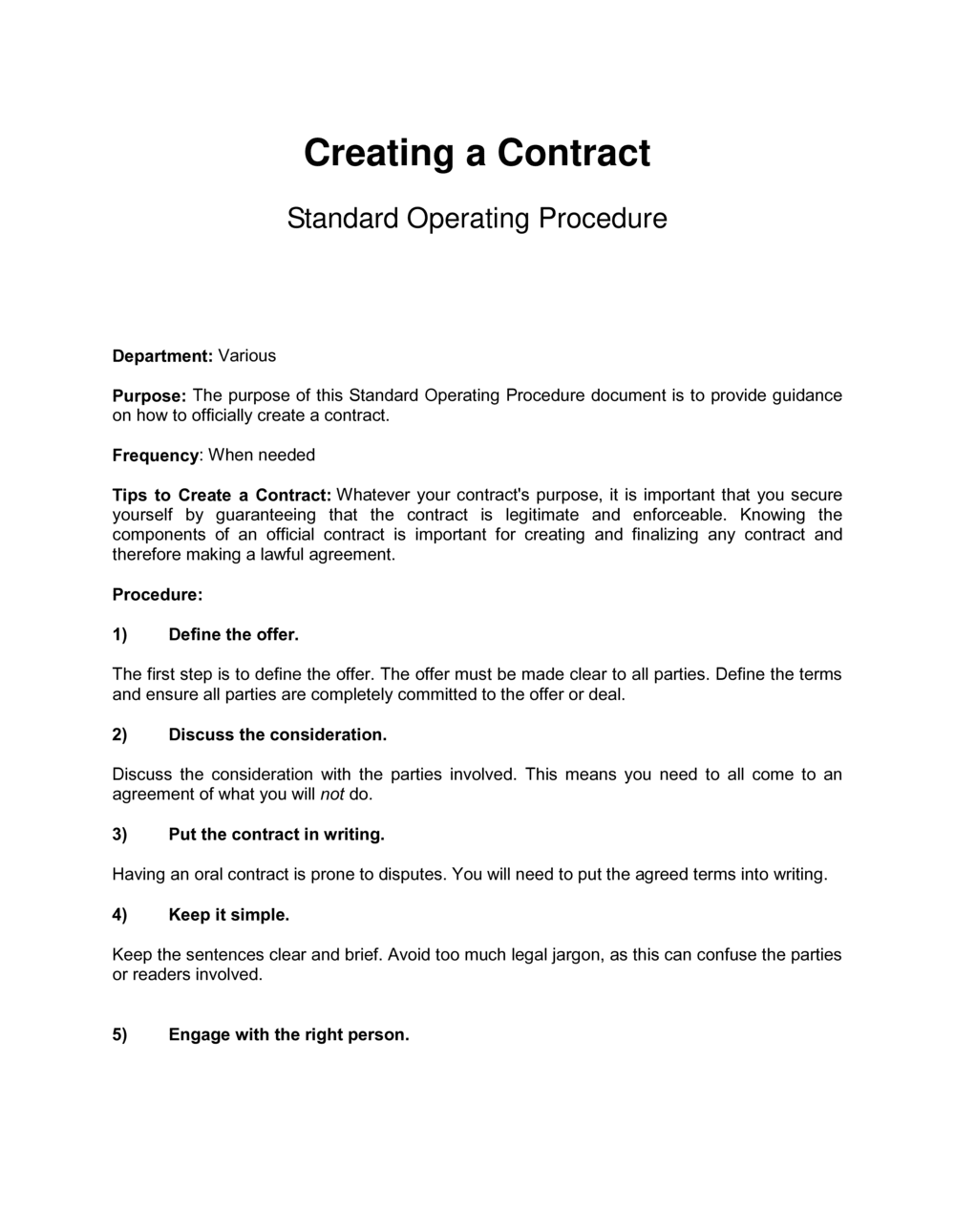
How To Create A Contract is a practical step-by-step guide and Word template that walks you through drafting a legally sound, professionally structured contract from scratch. It covers every core component β€” from identifying the parties and defining obligations to setting payment terms, dispute resolution, and termination β€” so you can produce a usable contract without starting from a blank page.
When you need it
Use it whenever you need to formalize a business relationship in writing for the first time, adapt an existing template to a new situation, or train a team member on the fundamentals of contract structure. It is also useful as a checklist before signing any agreement you did not draft yourself.
What's inside
A structured drafting guide covering parties and recitals, scope of work, payment terms, representations and warranties, confidentiality, IP ownership, termination, dispute resolution, and governing law β€” with plain-English explanations and sample language for each section.

What is a How To Create A Contract guide?

A How To Create A Contract guide is a structured operational reference that walks you through every component of a business contract β€” from identifying the parties and defining obligations to setting payment terms, assigning intellectual property, and specifying what happens when things go wrong. Rather than presenting a single pre-written agreement, it explains the purpose and logic behind each clause so you can draft, adapt, or evaluate any contract with confidence. The guide covers ten core sections found in virtually every enforceable business contract, with plain-English explanations and sample language for each.

Why You Need This Document

Without a clear understanding of contract structure, businesses routinely sign agreements with dangerous gaps: no IP ownership clause, no limitation of liability, no defined termination process, and scope language vague enough to support two contradictory interpretations simultaneously. Each of these gaps is a potential dispute waiting to happen β€” and disputes are expensive even when you win. Freelancers who start work before a contract is signed have no enforceable basis for their fee. Business owners who accept the other party's template without reviewing the governing law clause may find themselves subject to a jurisdiction they've never operated in. This guide gives you the vocabulary and structure to produce contracts that protect your interests, clearly define mutual obligations, and hold up if a disagreement reaches arbitration or court. The Business in a Box template puts the full drafting framework in your hands in under an hour.

Which variant fits your situation?

If your situation is…Use this template
Engaging an independent contractor for a defined projectIndependent Contractor Agreement
Selling goods or services to a business clientService Agreement
Protecting confidential information before negotiations beginNon-Disclosure Agreement
Formalizing a partnership between two business ownersPartnership Agreement
Hiring a full-time employee with enforceable IP and non-compete termsEmployment Contract
Licensing software or intellectual property to another partySoftware License Agreement
Renting commercial space or equipment to a businessCommercial Lease Agreement

Common mistakes to avoid

❌ Starting work before the contract is signed

Why it matters: Beginning performance before execution gives courts reason to imply terms from conduct rather than the written document β€” typically resulting in terms less favorable than what you negotiated.

Fix: Make execution a precondition to any kickoff call, deposit request, or first deliverable. Treat an unsigned contract as no contract at all.

❌ Copying a contract from the internet without adapting it

Why it matters: Generic online contracts are often drafted for a different jurisdiction, entity type, or transaction structure. Key clauses β€” IP ownership, limitation of liability, governing law β€” may contradict your actual situation or be unenforceable where you operate.

Fix: Start from a jurisdiction-appropriate template and read every clause, confirming each applies to your specific deal before finalizing.

❌ Leaving scope language vague to 'maintain flexibility'

Why it matters: Vague scope creates scope creep, unpaid additional work, and disputes about what was agreed β€” the single most common source of contract litigation between freelancers and clients.

Fix: Define deliverables with quantity, format, and deadline. Use a written change-order process for any out-of-scope requests.

❌ Omitting a limitation of liability clause

Why it matters: Without a cap on damages, a service provider can be held liable for consequential losses β€” lost profits, downstream customer claims β€” far exceeding the contract value.

Fix: Include a mutual limitation of liability capping each party's exposure at the fees paid in the prior 12 months, or the total contract value, whichever is greater.

The 10 key sections, explained

Parties and recitals

Definitions

Scope of work and deliverables

Payment terms and invoicing

Representations and warranties

Intellectual property ownership

Confidentiality

Term and termination

Dispute resolution and governing law

General provisions (boilerplate)

How to fill it out

  1. 1

    Identify the parties using their full legal names

    Look up the registered legal entity name for every party on the state or provincial corporate registry. Enter the entity type (LLC, Inc., sole proprietor) and state of organization.

    πŸ’‘ Ask the other party to confirm their legal name in writing before you draft β€” a name mismatch discovered after signing creates an amendment before you've even started.

  2. 2

    Define the scope in measurable, specific terms

    List every deliverable, service, or obligation with a quantity, format, and deadline. Move detailed specifications to a Schedule A so the main body stays readable.

    πŸ’‘ Read the scope aloud to someone unfamiliar with the project. If they can't tell you exactly what will be delivered by when, rewrite it until they can.

  3. 3

    Set payment terms with specific dates and amounts

    Enter the total fee, the payment schedule (milestone-based, monthly, or on delivery), the invoice due date (e.g., Net 30), and the late-payment interest rate.

    πŸ’‘ Always include a late-payment interest clause β€” even if you never invoke it, its presence accelerates payment behavior.

  4. 4

    Clarify intellectual property ownership explicitly

    Decide whether the client owns the deliverables outright (full assignment), the provider retains them and grants a license, or ownership is split. Write the outcome into the IP clause directly β€” do not leave it implied.

    πŸ’‘ For any contract involving code, design, or written content, an IP clause is non-negotiable. Default copyright law in most jurisdictions favors the creator, not the buyer.

  5. 5

    Write the termination clause with a cure period

    Set a notice period for convenience termination (typically 14–30 days) and a cure period for breach termination (typically 10–15 days). Specify what happens to work in progress and deposits if terminated early.

    πŸ’‘ Define what constitutes 'material breach' with at least two concrete examples. Vague breach definitions are the most litigated contract provision.

  6. 6

    Select governing law and dispute resolution method

    Choose the jurisdiction where at least one party is located or where performance primarily occurs. Decide between arbitration (faster, private, binding) and litigation (public court record, right to appeal).

    πŸ’‘ Arbitration clauses should name a specific arbitration body (AAA or JAMS in the US) and a seat city β€” omitting either creates a procedural dispute before the substantive one is even heard.

  7. 7

    Add the boilerplate provisions and review for consistency

    Include entire-agreement, severability, amendment, waiver, and notice clauses. Then read the entire contract checking that every defined term is used consistently and every cross-reference is accurate.

    πŸ’‘ Search the document for every capitalized term and confirm it appears in the definitions section. Undefined capitalized terms are a common drafting error that creates interpretive ambiguity.

  8. 8

    Execute before any work or payment begins

    Both parties must sign before any work starts or money changes hands. Use a dated signature block with printed name, title, and date for each signatory.

    πŸ’‘ For contracts over $5,000 or any engagement with meaningful IP or confidentiality exposure, use a timestamped e-signature platform to create an audit trail of when and by whom the document was signed.

Frequently asked questions

What makes a contract legally binding?

A contract is generally legally binding when it contains three elements: offer (a clear proposal on specific terms), acceptance (unambiguous agreement to those exact terms), and consideration (something of value exchanged by both sides). The parties must also have legal capacity to contract β€” they must be adults of sound mind acting voluntarily. Some contract types, such as those involving real estate or agreements lasting more than one year, typically must be in writing to be enforceable.

Do contracts need to be notarized to be enforceable?

Most business contracts do not require notarization to be enforceable. Notarization is generally required only for specific document types such as real estate deeds, powers of attorney, and certain affidavits. For standard service agreements, vendor contracts, and NDAs, a signed and dated document β€” including an e-signature β€” is typically sufficient. If you are unsure, check the requirements for your specific contract type in your jurisdiction.

Can I write my own contract without a lawyer?

Yes β€” for standard, lower-stakes engagements, a well-structured template is typically sufficient. Most freelance agreements, vendor contracts, and simple service agreements can be created and used without legal assistance. Consider engaging a lawyer when the contract value is high, the IP or liability exposure is significant, the other party is represented by counsel, or the engagement spans multiple jurisdictions.

What is the difference between a contract and an agreement?

In everyday usage the terms are interchangeable, but technically an agreement is any mutual understanding between parties, while a contract is an agreement that is legally enforceable because it includes offer, acceptance, and consideration. Every contract is an agreement, but not every agreement rises to the level of an enforceable contract.

Does a contract have to be signed to be enforceable?

A signature is strong evidence of acceptance but is not always legally required. Courts have enforced contracts based on conduct, email exchanges, or payment alone. That said, a signed written contract is far easier to enforce and interpret than an implied one. For any business relationship involving money, IP, or confidentiality, always get it in writing and signed before work begins.

What should I do if the other party wants to change the contract after signing?

Changes to a signed contract must be made through a written amendment or addendum signed by both parties. Verbal agreements to change contract terms are difficult to prove and may be unenforceable, especially if your contract includes an entire-agreement or written-amendment-only clause. Never agree to a material change by email alone without a formal amendment referencing the original contract.

How specific does the scope of work need to be?

Specific enough that a neutral third party β€” such as a judge or arbitrator who has no context β€” can read it and determine whether the work was completed. Describe deliverables with quantity, format, and deadline. If the scope is complex, attach a detailed Schedule A rather than embedding every specification in the body. Scope disputes are the most common cause of contract litigation between service providers and clients, so precision here is never wasted effort.

What happens if a clause in my contract is unenforceable?

If your contract includes a severability clause β€” which most well-drafted contracts do β€” the remainder of the agreement stays in force even if one provision is struck down by a court. Without a severability clause, an unenforceable provision could potentially void the entire contract, depending on how central it is to the agreement. This is why boilerplate clauses, including severability, should never be omitted.

When should I use arbitration instead of a court clause?

Arbitration is generally faster, less expensive, and private compared to court litigation β€” making it preferable for most business contracts. Choose litigation instead when the dispute is likely to involve a significant public record (e.g., injunctive relief), when one party is a consumer with statutory rights that arbitration clauses cannot waive, or when you anticipate needing discovery tools only available in court proceedings.

How this compares to alternatives

vs Service Agreement

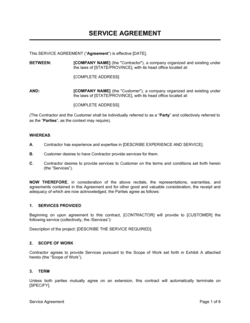
A service agreement is a ready-to-use contract for a specific service engagement β€” it is the finished document. How To Create A Contract is the drafting guide that teaches you the structure and logic behind any contract, including service agreements. Use the guide to understand what you are signing or to adapt a template; use the service agreement to formalize a client engagement directly.

vs Non-Disclosure Agreement

An NDA is a single-purpose contract protecting confidential information β€” it typically covers just one clause type. How To Create A Contract covers the full structure of a multi-clause business agreement, including confidentiality as one of many components. Use an NDA when confidentiality alone is the issue; use this guide when you need to draft a complete, multi-obligation contract.

vs Independent Contractor Agreement

An independent contractor agreement is a pre-built contract for engaging freelancers or contractors. This guide explains the building blocks that make that agreement work β€” scope, IP, payment, termination β€” so you can use, modify, or evaluate any contractor agreement with confidence rather than accepting the other party's template at face value.

vs Letter of Intent

A letter of intent outlines agreed terms in a non-binding preliminary document before a formal contract is drafted. How To Create A Contract picks up where the LOI leaves off β€” converting agreed points into enforceable obligations with the structural clauses (warranties, IP, termination, governing law) that a letter of intent deliberately omits.

Industry-specific considerations

Professional services

Scope-of-work precision is critical β€” consulting, legal, and accounting engagements routinely result in scope disputes when deliverables are described in hours rather than outputs.

Technology / SaaS

IP ownership and software license grants require careful drafting; default copyright law assigns ownership to the creator, not the client, absent an explicit assignment clause.

Creative and marketing agencies

Usage rights for creative assets β€” whether the client can resell, sublicense, or modify deliverables β€” must be defined explicitly to avoid post-project disputes.

Construction and trades

Payment milestone structures tied to project phases, change-order procedures, and lien-waiver references are standard requirements that generic contract templates often omit.

Template vs pro β€” what fits your needs?

PathBest forCostTime
Use the templateSmall business owners, freelancers, and first-time contractors drafting standard service or vendor agreementsFree30–60 minutes per contract
Template + professional reviewContracts over $10,000, agreements involving IP assignment, or engagements with a foreign counterparty$200–$600 for a 1-hour lawyer review1–3 days
Custom draftedComplex multi-party arrangements, regulated industries, or contracts with material liability exposure above $100,000$1,000–$5,000+1–3 weeks

Glossary

Offer
A clear proposal by one party to enter into an agreement on specific terms β€” one of the three elements required for a binding contract.
Acceptance
Unambiguous agreement to the exact terms of an offer, completing the mutual assent required to form a contract.
Consideration
Something of value exchanged between the parties β€” money, services, or a promise to act or refrain from acting β€” that makes the contract enforceable.
Recitals
Background statements at the start of a contract that describe the context and purpose of the agreement without creating binding obligations.
Representations and Warranties
Statements of fact (representations) and promises that those facts will remain true (warranties) that a party makes to induce the other to enter the contract.
Indemnification
A clause requiring one party to compensate the other for specified losses, damages, or legal costs arising from defined events or breaches.
Force Majeure
A clause excusing a party from performance when extraordinary events outside their control β€” natural disasters, government actions, pandemics β€” make performance impossible.
Severability
A clause stating that if one provision of the contract is found unenforceable, the rest of the agreement remains in effect.
Entire Agreement Clause
A clause confirming that the written contract is the complete and final agreement, superseding all prior emails, letters, and verbal promises.
Governing Law
The jurisdiction whose laws will be used to interpret and enforce the contract in the event of a dispute.
Liquidated Damages
A pre-agreed sum specified in the contract that one party pays the other if a particular breach occurs, avoiding the need to prove actual loss.

Part of your Business Operating System

This document is one of 3,000+ business & legal templates included in Business in a Box.

  • Fill-in-the-blanks β€” ready in minutes
  • Compatible with all office suites
  • Export to PDF and share electronically

Create your document in 3 simple steps.

From template to signed document β€” all inside one Business Operating System.
1
Download or open template

Access over 3,000+ business and legal templates for any business task, project or initiative.

2
Edit and fill in the blanks with AI

Customize your ready-made business document template and save it in the cloud.

3
Save, Share, Send, Sign

Share your files and folders with your team. Create a space of seamless collaboration.

Save time, save money, and create top-quality documents.

β˜…β˜…β˜…β˜…β˜…

"Fantastic value! I'm not sure how I'd do without it. It's worth its weight in gold and paid back for itself many times."

Managing Director Β· Mall Farm
Robert Whalley
Managing Director, Mall Farm Proprietary Limited
β˜…β˜…β˜…β˜…β˜…

"I have been using Business in a Box for years. It has been the most useful source of templates I have encountered. I recommend it to anyone."

Business Owner Β· 4+ years
Dr Michael John Freestone
Business Owner
β˜…β˜…β˜…β˜…β˜…

"It has been a life saver so many times I have lost count. Business in a Box has saved me so much time and as you know, time is money."

Owner Β· Upstate Web
David G. Moore Jr.
Owner, Upstate Web

Run your business with a system β€” not scattered tools

Stop downloading documents. Start operating with clarity. Business in a Box gives you the Business Operating System used by over 250,000 companies worldwide to structure, run, and grow their business.

Free Forever PlanΒ Β·Β No credit card required