1
Define the advisory board's purpose and limits
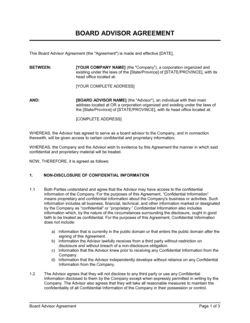
Write a one-paragraph purpose statement naming the two or three strategic challenges the board will address. Explicitly state that advisors have no voting rights or fiduciary duties.
💡 Share the draft purpose statement with your existing investors or board of directors before recruiting — misaligned expectations between governance layers cause friction later.
2
Conduct a skill gap analysis
List every functional domain critical to your next 24 months of growth. Mark each one as 'strong,' 'adequate,' or 'gap' based on the current leadership team. Advisor seats should map directly to the gaps.
💡 Limit the initial advisory board to three to five seats — too many advisors creates coordination overhead and dilutes each advisor's sense of accountability.
3
Write a role profile for each seat
For each gap identified, write a one-paragraph role profile: ideal background, specific experience required, and what a successful contribution looks like in Year 1.
💡 Include one or two 'anti-criteria' — backgrounds or affiliations that disqualify a candidate regardless of seniority — to make evaluation faster and more consistent.
4
Source and screen candidates
Identify five to ten candidates per seat through founder networks, investor referrals, and targeted LinkedIn outreach. Screen for domain expertise, availability, and absence of competitive conflicts before the first conversation.
💡 Ask each candidate a single specific question relevant to your company's challenge before making an offer — their answer reveals both expertise and how they communicate under limited context.
5
Set compensation terms and prepare the engagement letter
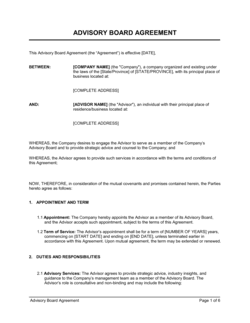
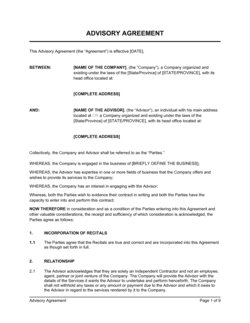
Decide on equity percentage and vesting schedule for each seat. Draft the engagement letter covering role, compensation, confidentiality, term, and conflict-of-interest disclosure before any offer conversation.
💡 Use the FAST Framework benchmarks (Founder, Alliance, Strategic, Technical) as a reference point for equity ranges — 0.1% to 0.5% covers most early-stage advisor situations.
6
Document meeting cadence and engagement expectations in writing
Set the quarterly meeting schedule, pre-read delivery timeline, and ad-hoc response expectations. Include these in the engagement letter so they are binding, not aspirational.
💡 Schedule the first four quarterly meetings at the time of onboarding — advisors who join without dates on the calendar rarely prioritize your meetings when conflicts arise.
7
Execute onboarding and the first meeting
Send the onboarding package within five business days of the signed engagement letter. Run the first advisory meeting as a structured orientation — cover company status, strategic priorities, and how each advisor's expertise maps to the agenda.
💡 Record a short video overview of the product and company that advisors can reference asynchronously — it reduces onboarding call time and gets advisors contributing faster.
8
Schedule the annual review cadence
Set a recurring annual review for each advisor at the time of onboarding. Define the four evaluation criteria in the review section and confirm the renewal or off-boarding process in writing.
💡 A brief annual survey sent to each advisor before their review — asking what they found most and least useful — surfaces engagement issues before they become quiet attrition.