Forbearance Agreement Template

Free Word download • Edit online • Save & share with Drive • Export to PDF

7 pages30–40 min to fillDifficulty: ComplexSignature requiredLegal review recommended
Learn more ↓
FreeForbearance Agreement Template

At a glance

What it is
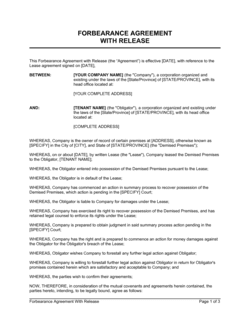
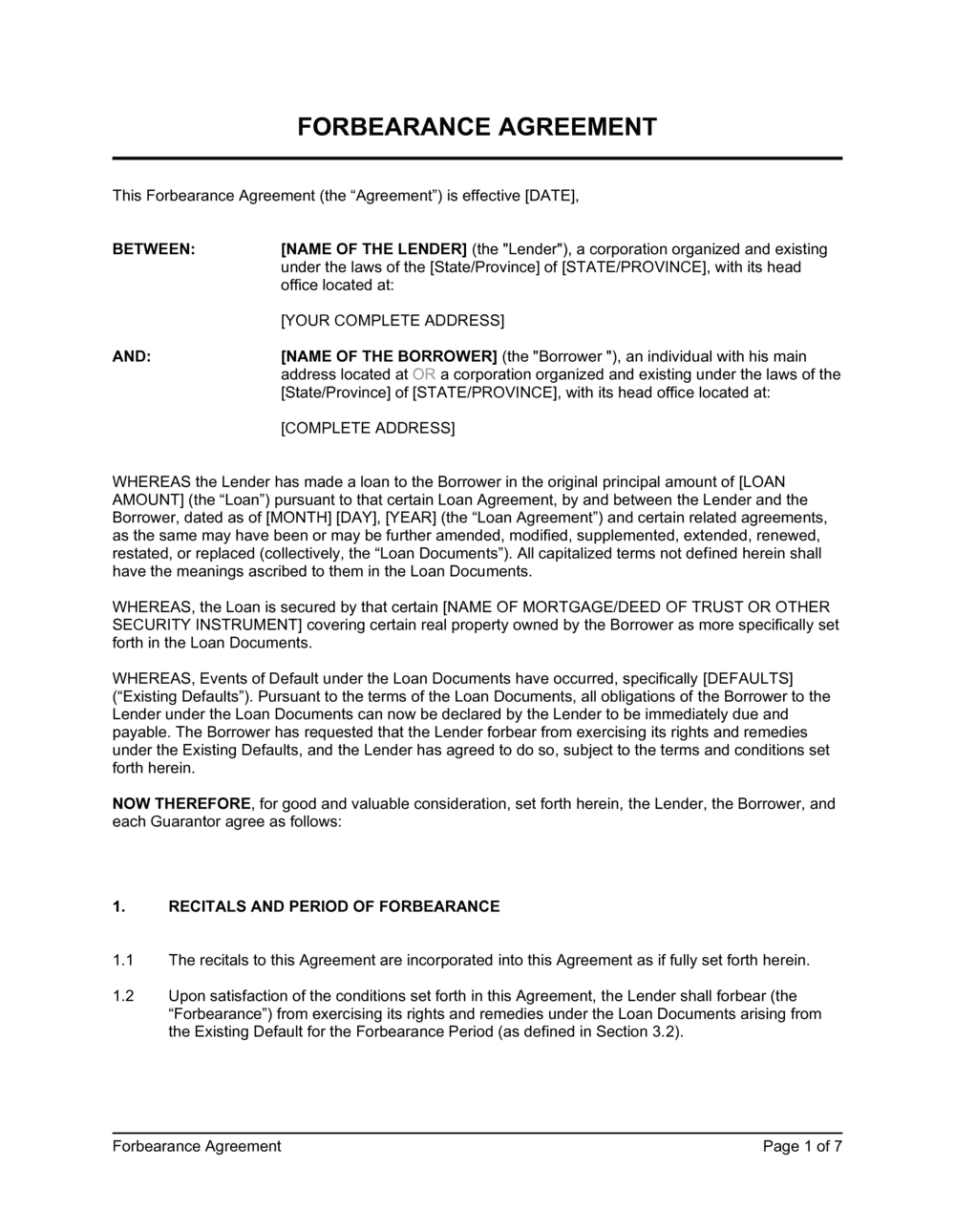
A Forbearance Agreement is a binding legal contract between a lender and a borrower in which the lender agrees to temporarily refrain from enforcing its remedies — such as calling the loan, initiating foreclosure, or filing suit — while the borrower works to cure a default or restructure repayment. This free Word download gives you a professionally structured starting point you can edit online and export as PDF for execution by both parties.
When you need it
Use it when a borrower has missed payments or breached a loan covenant and both parties prefer a structured workout over immediate enforcement. It is also used proactively when a known cash-flow shortfall is approaching and the lender is willing to grant temporary relief in exchange for documented commitments from the borrower.
What's inside
Identification of parties and the underlying loan, acknowledgment of existing defaults, the lender's forbearance commitment and duration, borrower's cure obligations and milestones, representations and conditions, waiver limitations, and governing law with default-reinstatement triggers.

What is a Forbearance Agreement?

A Forbearance Agreement is a binding legal contract between a lender and a borrower in which the lender voluntarily agrees to refrain from exercising its enforcement remedies — including loan acceleration, foreclosure, or litigation — for a defined period while the borrower works to cure an existing default or negotiate a longer-term restructuring. The agreement does not forgive the debt or eliminate the default; it creates a structured standstill with specific conditions the borrower must meet to keep the lender's enforcement rights suspended. Both parties receive something of value: the borrower gains time and protection from immediate legal action, while the lender secures a formal acknowledgment of the debt, documented milestones, and a contractual basis to reinstate full remedies if the borrower fails to perform.

Why You Need This Document

Operating on an informal understanding with a lender during a default is one of the most common and costly mistakes a distressed borrower can make. Without a signed forbearance agreement, the lender retains the unrestricted right to accelerate the loan, file for foreclosure, or obtain a judgment at any time — regardless of any verbal assurances. For lenders, proceeding without a written standstill risks waiver arguments: a court may find that continued inaction on a known default constituted an implied waiver of enforcement rights, particularly if the borrower can show a course of dealing suggesting the lender accepted non-payment. A properly drafted forbearance agreement eliminates these ambiguities on both sides, creates enforceable milestones, binds guarantors, and preserves every legal right the lender needs if the workout fails — all while giving a genuinely distressed borrower the runway to execute a cure. This template gives you the structural framework to document that arrangement correctly from the first conversation.

Which variant fits your situation?

If your situation is…Use this template
Lender deferring enforcement on a commercial real estate mortgageReal Estate Forbearance Agreement
Bank granting payment relief on a business term loanCommercial Loan Forbearance Agreement
Modifying ongoing loan terms permanently rather than temporarily deferringLoan Modification Agreement
Settling an existing debt for less than the full amount owedDebt Settlement Agreement
Creditor agreeing to accept partial or delayed payments on a trade debtPayment Plan Agreement
Restructuring multiple debts with several creditors simultaneouslyDebt Restructuring Agreement
Pausing enforcement of a judgment while the debtor pays in installmentsStipulation for Settlement and Payment Plan

Common mistakes to avoid

❌ Using vague default descriptions

Why it matters: A forbearance that references 'existing defaults' without listing them specifically leaves open whether the agreement covers every breach the lender knows about — any unlisted default can be used to terminate forbearance immediately.

Fix: List each default by the contract section it triggers, the date it occurred, and the specific obligation breached. Attach a default notice or balance statement as an exhibit for reference.

❌ Omitting borrower acknowledgment of indebtedness

Why it matters: Without an explicit acknowledgment, a borrower may later challenge the amount owed or the existence of the default, forcing the lender to litigate facts that should have been admitted in the forbearance itself.

Fix: Include a stand-alone acknowledgment clause requiring the borrower to confirm the outstanding balance, accrued interest, and default status as of a specific date — and have the borrower's counsel sign off on the figures.

❌ No reinstatement trigger for new defaults

Why it matters: A forbearance agreement that does not automatically terminate upon a new default effectively grants the borrower a waiver for future breaches, stripping the lender of its leverage to keep the borrower on track.

Fix: Draft the termination section to include any new Event of Default under the original loan documents as an immediate, automatic termination event — not one subject to cure.

❌ Failing to bind guarantors separately

Why it matters: If guarantors are not parties to the forbearance agreement, they may argue the lender's agreement to forbear materially altered the underlying obligation and discharged their guarantee.

Fix: Have all guarantors execute the forbearance agreement as parties, with an explicit clause confirming their guarantees remain in full force and are not affected by the forbearance.

❌ Setting milestones without any cure window

Why it matters: A missed milestone by even one day triggers reinstatement of all remedies, which can force a borrower into bankruptcy over a trivial delay and expose the lender to preference or bad-faith claims in the resulting proceeding.

Fix: Include a 5-business-day written-notice cure period for milestone payment failures only — not for new defaults or misrepresentations, which should remain immediate termination events.

❌ Choosing a governing law inconsistent with the original loan

Why it matters: Conflicting governing-law provisions between the loan agreement and the forbearance create ambiguity courts must resolve, adding litigation cost and unpredictability to an already distressed situation.

Fix: Use the same governing law as the original loan agreement, or include an explicit clause noting the intentional change and confirming which document's choice-of-law controls in the event of conflict.

The 10 key clauses, explained

Recitals and Background

In plain language: Sets out the factual context — the original loan, existing default, and why both parties are entering into the forbearance arrangement.

Sample language
WHEREAS, on [DATE], Lender made a loan to Borrower in the principal amount of $[AMOUNT] pursuant to that certain Loan Agreement dated [DATE] (the 'Loan Agreement'); WHEREAS, Borrower has failed to make the payment due on [DATE], constituting an Event of Default under Section [X] of the Loan Agreement; WHEREAS, Borrower has requested that Lender forbear from exercising its remedies, and Lender is willing to do so on the terms set forth herein.

Common mistake: Omitting the specific default being addressed. A vague recital that references 'various defaults' can cause disputes later about whether the agreement covered a particular breach.

Acknowledgment of Default and Indebtedness

In plain language: The borrower formally admits that the default occurred and confirms the outstanding balance, accrued interest, and fees — waiving any defense to the existence of the debt.

Sample language
Borrower hereby acknowledges and agrees that: (a) an Event of Default has occurred and is continuing under the Loan Agreement as a result of [SPECIFIC DEFAULT]; (b) the outstanding principal balance as of [DATE] is $[AMOUNT]; (c) accrued and unpaid interest as of [DATE] is $[AMOUNT]; and (d) Borrower has no defenses, offsets, or counterclaims against Lender with respect to the Loan.

Common mistake: Including a broad waiver of all defenses without legal review. A borrower should confirm the accuracy of the debt figures before acknowledging them in a binding document, as errors in the balance are difficult to unwind afterward.

Lender's Forbearance Commitment

In plain language: The operative clause where the lender agrees to refrain from specific enforcement actions — foreclosure, acceleration, litigation, or exercising rights against collateral — for the duration of the forbearance period.

Sample language
Subject to the terms and conditions of this Agreement, Lender agrees to forbear from exercising any of its rights and remedies under the Loan Documents with respect to the Existing Default during the period commencing on [START DATE] and ending on [END DATE] (the 'Forbearance Period'), unless earlier terminated pursuant to Section [X].

Common mistake: Failing to enumerate exactly which remedies are being suspended. A generic 'Lender will forbear' clause invites disputes about whether a specific action — such as sending a demand letter or refusing to advance further funds — was prohibited.

Forbearance Period and Milestones

In plain language: Defines the start and end date of the standstill and sets any interim milestone payments or actions the borrower must complete to keep the agreement in effect.

Sample language
The Forbearance Period shall commence on [DATE] and expire on [DATE] unless earlier terminated. During the Forbearance Period, Borrower shall: (a) make a good-faith payment of $[AMOUNT] on or before [DATE]; (b) deliver monthly financial statements within [15] days of each month end; and (c) not incur any additional indebtedness without Lender's prior written consent.

Common mistake: Setting milestone dates without any grace period. A borrower who misses a milestone by one day will trigger reinstatement of all lender remedies — often a disproportionate outcome that could have been avoided with a 5-business-day cure window.

Conditions to Forbearance

In plain language: Lists what the borrower must deliver or represent to activate and maintain the lender's forbearance — such as execution of the agreement, payment of fees, or delivery of additional collateral.

Sample language
Lender's obligation to forbear is conditioned upon: (a) Borrower's execution and delivery of this Agreement; (b) payment of a forbearance fee of $[AMOUNT] on or before [DATE]; (c) delivery of updated personal financial statements from each guarantor; and (d) no additional Event of Default occurring after the date hereof.

Common mistake: Omitting the forbearance fee or structuring it as waivable at the lender's discretion without documenting the agreement. Lenders frequently include a fee to compensate for the risk of delay; leaving it out weakens the lender's position.

Representations and Warranties of Borrower

In plain language: The borrower confirms key facts as of the signing date — that it has the authority to enter the agreement, that no additional undisclosed defaults exist, and that information provided to the lender is accurate.

Sample language
Borrower represents and warrants that: (a) it has full legal authority to execute and perform this Agreement; (b) except for the Existing Default, no other Event of Default has occurred or is continuing; (c) all financial information provided to Lender is true, complete, and not misleading; and (d) no bankruptcy or insolvency proceeding is pending or contemplated by Borrower.

Common mistake: Borrowers agreeing to represent 'no other defaults exist' without first conducting an internal audit. If an undisclosed default later surfaces, the misrepresentation voids the forbearance and may constitute fraud.

No Waiver of Other Rights

In plain language: Clarifies that the lender's decision to forbear on the specific identified default does not waive any other rights, including the right to enforce defaults not listed, or to enforce the same default once the forbearance period expires.

Sample language
Nothing in this Agreement shall constitute a waiver of any Event of Default other than the Existing Default, nor shall it constitute a waiver of any right or remedy of Lender that is not expressly stated herein. Lender expressly reserves all rights and remedies under the Loan Documents and applicable law.

Common mistake: Drafting the no-waiver clause so broadly that it contradicts the forbearance commitment itself. Courts have struck down forbearance provisions where the no-waiver language rendered the lender's promise illusory.

Termination and Reinstatement of Remedies

In plain language: Specifies the events that immediately end the forbearance and restore the lender's full rights — including failure to meet a milestone, a new default, or the borrower filing for bankruptcy.

Sample language
The Forbearance Period shall terminate immediately and all Lender remedies shall be reinstated, without notice or cure period, upon the occurrence of any of the following: (a) Borrower fails to make any payment required hereunder when due; (b) any additional Event of Default occurs under the Loan Documents; (c) any representation made herein proves to have been false or misleading; or (d) Borrower commences or is subject to any bankruptcy, insolvency, or receivership proceeding.

Common mistake: Not including an automatic termination on bankruptcy filing. An automatic-stay in bankruptcy halts most lender actions, but a well-drafted termination clause preserves the lender's position as of the filing date and avoids ambiguity about pre-petition remedies.

Fees, Costs, and Expenses

In plain language: Allocates responsibility for legal fees, forbearance fees, and out-of-pocket expenses incurred by the lender in connection with negotiating and documenting the agreement.

Sample language
Borrower agrees to reimburse Lender for all reasonable attorneys' fees, costs, and expenses incurred in connection with the preparation, negotiation, and execution of this Agreement, not to exceed $[AMOUNT], payable on or before [DATE].

Common mistake: Capping fees without including a carve-out for enforcement costs if the borrower defaults under the forbearance itself. A borrower who triggers reinstatement should bear full enforcement costs, not just the capped negotiation fees.

Governing Law and Entire Agreement

In plain language: Designates which jurisdiction's law governs the agreement, confirms this document supersedes any prior oral or written understandings about the forbearance, and includes standard boilerplate integration language.

Sample language
This Agreement shall be governed by and construed in accordance with the laws of [STATE/JURISDICTION], without regard to its conflicts-of-law principles. This Agreement constitutes the entire agreement of the parties with respect to the subject matter hereof and supersedes all prior negotiations, representations, and understandings relating thereto.

Common mistake: Choosing a governing law that differs from the original loan agreement without explicitly noting the change. Conflicting governing-law provisions between the loan agreement and the forbearance create unnecessary litigation risk.

How to fill it out

  1. 1

    Identify both parties and the underlying loan

    Enter the lender's and borrower's full legal entity names, states of formation, and the exact title and date of the original loan agreement being addressed. Include any guarantors who will be bound.

    💡 Cross-check the entity names against the original loan documents — a mismatch between the forbearance and the loan agreement can create an enforceability gap.

  2. 2

    Document the specific default being addressed

    Identify each Event of Default by the exact contract section it triggers, the date it occurred, and the amount or obligation involved. Do not use catch-all language like 'all existing defaults.'

    💡 Listing defaults specifically protects both parties: the lender retains rights against any unlisted default; the borrower knows exactly what relief covers.

  3. 3

    Confirm the outstanding balance figures

    State the principal balance, accrued interest, and any fees or charges as of a specific date. Have the lender prepare a payoff or balance statement and attach it as an exhibit.

    💡 Both parties should reconcile their internal records before signing — an acknowledged balance that later proves incorrect is costly to correct and may void the acknowledgment.

  4. 4

    Set the forbearance period with a firm end date

    Enter specific calendar start and end dates rather than relative references like '90 days from execution.' Confirm the duration is realistic for the borrower's cure timeline while limiting lender exposure.

    💡 A 60–90 day initial forbearance period is typical for commercial loans. Build in a written-extension option rather than an automatic rollover.

  5. 5

    Define borrower milestones and interim obligations

    List every payment, report, or action the borrower must complete during the forbearance period, with specific dates and dollar amounts for each.

    💡 Attach milestones as a schedule rather than embedding them in the body — this makes amendments cleaner if the timeline needs to be adjusted.

  6. 6

    Draft the termination triggers carefully

    List every event that immediately ends the forbearance and restores lender remedies, including new defaults, misrepresentation, and any bankruptcy filing.

    💡 Include a 'material adverse change' trigger for commercial loans — a sudden deterioration in the borrower's financial condition should end forbearance even if scheduled milestones have been met.

  7. 7

    Address fees and cost reimbursement

    State the forbearance fee amount and due date, and include a provision requiring the borrower to reimburse the lender's legal fees up to a specified cap for the negotiation and drafting.

    💡 A forbearance fee of 0.5–1.0% of the outstanding principal is a common market range for commercial real estate and business loans.

  8. 8

    Execute before the lender takes any enforcement action

    Both parties — and any guarantors — must sign the agreement before the lender issues a formal notice of acceleration, files a foreclosure, or commences litigation. Post-action forbearance agreements face higher litigation scrutiny.

    💡 Use a contemporaneous resolutions or authorizations from each entity confirming the signatories are authorized — this is particularly important for LLC and corporate borrowers.

Frequently asked questions

What is a forbearance agreement?

A forbearance agreement is a binding contract between a lender and a borrower in which the lender agrees to temporarily refrain from enforcing its legal remedies — such as accelerating the loan, initiating foreclosure, or filing suit — while the borrower works to cure a default or restructure the debt. It does not eliminate the debt or the default; it suspends enforcement for a defined period in exchange for specific borrower commitments. Both commercial and residential lenders use forbearance agreements to avoid costly litigation when a borrower has a credible path to cure.

What is the difference between a forbearance agreement and a loan modification?

A forbearance agreement is temporary — it suspends enforcement for a defined period without permanently changing the loan terms. A loan modification permanently alters one or more terms of the original loan, such as reducing the interest rate, extending the maturity date, or capitalizing missed payments into the principal balance. Forbearance is typically used as a bridge while the parties negotiate a longer-term solution, which may ultimately be a formal modification.

Does a forbearance agreement affect the borrower's credit?

It can, depending on how the lender reports the arrangement to credit bureaus. In many cases, the underlying missed payments have already been reported as delinquent before the forbearance is executed. The forbearance itself may be reported as a special accommodation or deferred-payment arrangement. Borrowers should request in writing that the lender not report additional derogatory information during the forbearance period and confirm whether existing delinquencies will be updated.

Can a lender still sue during a forbearance period?

Generally no — if the forbearance agreement is properly drafted, the lender's commitment to refrain from enforcement actions includes refraining from filing suit. However, the specific remedies suspended depend entirely on the contract language. A lender may reserve the right to take certain protective actions — such as filing a lis pendens to preserve priority — while suspending foreclosure proceedings. Review the forbearance commitment clause carefully to confirm exactly which actions are restricted.

What happens when the forbearance period ends?

If the borrower has cured the default and met all milestones during the forbearance period, the loan typically returns to its original terms and the lender's right to enforce the cured default is extinguished. If the borrower has not cured the default, all lender remedies are reinstated immediately — the lender can accelerate the loan, foreclose, or sue without providing any additional notice beyond what the original loan documents require. Some agreements include a pre-negotiated workout path if the cure is not completed.

Is a forbearance agreement the same as a standstill agreement?

The terms are often used interchangeably in commercial lending, but there is a technical distinction in some contexts. A standstill agreement is broader — it can refer to any agreement by a creditor to take no action for a period, including in acquisition finance and competitive bid situations. A forbearance agreement is more specifically used when a default has already occurred. In practice, both documents serve the same function and contain substantially similar provisions.

Do guarantors need to sign a forbearance agreement?

Yes — guarantors should always be parties to the forbearance agreement. Under the common-law principle of suretyship, a material change to the underlying obligation without the guarantor's consent can discharge the guarantee entirely. Since a forbearance alters the enforcement timeline of the loan, it constitutes a material change. Having guarantors co-execute the agreement and confirm their guarantees remain in full force eliminates this risk.

How long does a forbearance period typically last?

Commercial forbearance periods most commonly run 60 to 180 days, with 60 to 90 days being the typical initial term for business loans and real estate mortgages. The period reflects the time realistically needed to cure the default, close a refinancing, or negotiate a permanent modification. Residential mortgage forbearance periods under government programs (such as CARES Act arrangements) ran up to 18 months, but private commercial forbearance is typically much shorter.

Can a forbearance agreement be extended?

Yes, most commercial forbearance agreements include an extension provision allowing the parties to extend the forbearance period by written amendment, subject to continued compliance with milestones and payment of an additional fee. Extensions require fresh consideration and should be documented in a signed amendment rather than an email exchange. Automatic rollovers without a formal amendment create ambiguity about the new termination date and the conditions applicable to the extended period.

How this compares to alternatives

vs Loan Modification Agreement

A loan modification permanently changes one or more terms of the original loan — interest rate, maturity, or principal balance — and the modified terms survive indefinitely. A forbearance agreement is temporary, suspending enforcement for a defined period without altering the underlying loan terms. Use forbearance when the borrower needs short-term relief while pursuing a longer-term solution; use a modification when the parties have agreed to permanent structural changes.

vs Debt Settlement Agreement

A debt settlement agreement resolves a debt by having the lender accept less than the full amount owed in exchange for a lump-sum payment. A forbearance agreement does not reduce the debt — it preserves the full obligation while suspending enforcement temporarily. Settlement is used when the borrower cannot repay in full and the lender prefers a discounted recovery over litigation; forbearance is used when the borrower has a credible path to full repayment.

vs Payment Plan Agreement

A payment plan agreement restructures how a debt is repaid — typically through installments over time — without addressing an existing default or suspending enforcement. A forbearance agreement specifically responds to an existing default by halting enforcement while the borrower attempts to cure. For consumer or trade debts with no formal default, a payment plan is sufficient; for loan defaults with enforcement risk, a forbearance agreement is required.

vs Default Notice

A default notice is a unilateral document sent by the lender notifying the borrower that a default has occurred and demanding cure or payment by a deadline. It is not bilateral and creates no obligation on the lender. A forbearance agreement is a negotiated bilateral contract that supersedes or supplements a default notice by establishing the parties' mutual commitments during the cure period. A default notice often precedes and triggers the forbearance negotiation.

Industry-specific considerations

Commercial Real Estate

Used when a property owner misses mortgage payments due to vacancy or rent shortfalls, with milestones tied to leasing activity, refinancing timelines, or asset sale proceeds.

Banking and Financial Services

Banks use standardized forbearance agreements to manage classified loan portfolios, with specific covenant-relief provisions and reporting requirements that align with bank regulatory guidance.

Private Equity and Credit

Private credit funds grant forbearance to portfolio companies experiencing EBITDA covenant breaches, typically conditioning relief on management reporting, advisor engagement, and no-dividend restrictions.

Healthcare

Healthcare providers facing reimbursement delays use forbearance agreements with equipment lenders and real estate creditors, with milestones tied to Medicare/Medicaid payment cycles.

Retail and Hospitality

Operators with seasonal cash flows use forbearance to defer obligations during low-revenue periods, with cure milestones tied to peak-season revenue targets or lease renegotiation outcomes.

Manufacturing

Manufacturers with supply-chain disruptions or inventory financing defaults use forbearance while restructuring working capital facilities, with lender oversight of receivables and inventory reporting.

Jurisdictional notes

United States

Forbearance agreements are governed by state contract and UCC law, with no single federal standard for commercial loans. Real property forbearances must comply with state foreclosure timelines — non-judicial foreclosure states (e.g., California, Texas) allow faster enforcement reinstatement than judicial states (e.g., New York, Florida). The CARES Act created specific residential mortgage forbearance frameworks during COVID-19; commercial forbearance remains entirely contract-based. Borrowers should confirm whether state lender-liability statutes impose good-faith obligations on lenders entering forbearance negotiations.

Canada

Commercial forbearance in Canada is governed by the common law of contract in all provinces except Quebec, where the Civil Code applies. Ontario and British Columbia lenders must comply with provincial Mortgages Acts and Real Property Acts for real estate-secured loans, which impose cure-period notice requirements before power-of-sale proceedings. The Bankruptcy and Insolvency Act and Companies' Creditors Arrangement Act provide borrower-protection frameworks that interact with forbearance terms if insolvency proceedings commence during the standstill period.

United Kingdom

Forbearance agreements in the UK are enforceable as binding contracts provided consideration is present — typically the lender's agreement to delay enforcement in exchange for the borrower's acknowledgment of debt and payment commitment. FCA-regulated lenders must comply with treating-customers-fairly obligations, and forbearance of consumer mortgages is subject to FCA mortgage conduct rules. The Law of Property Act 1925 governs mortgage enforcement timelines for real property. Insolvency Act 1986 provisions on wrongful trading and preferences must be considered when granting forbearance to companies approaching insolvency.

European Union

The EU Banking Recovery and Resolution Directive (BRRD) and EBA Guidelines on forbearance and non-performing exposures require regulated banks to classify and report forbearance exposures under standardized criteria — this creates documentation and reporting obligations that go beyond the bilateral contract. Member states have varying contractual law frameworks: French law requires cause and good faith in creditor conduct; German law imposes extensive pre-enforcement notification requirements. GDPR applies to any personal data processed in connection with the borrower's financial situation during the forbearance period.

Template vs lawyer — what fits your deal?

PathBest forCostTime
Use the templateSimple commercial loan forbearances between two sophisticated parties with a single identified default and no guarantorsFree1–2 hours
Template + legal reviewReal estate mortgage forbearances, loans with multiple defaults, or any arrangement involving guarantors or cross-collateralized obligations$500–$1,5002–5 days
Custom draftedLarge commercial credit facilities, multi-lender syndicated loans, distressed company workouts, or any forbearance preceding a restructuring or bankruptcy$3,000–$15,000+1–4 weeks

Glossary

Forbearance
A lender's voluntary decision to refrain from exercising legal remedies it is otherwise entitled to pursue when a borrower is in default.
Default
A borrower's failure to meet a contractual obligation under a loan agreement — including missing a payment, breaching a covenant, or failing to maintain required insurance.
Forbearance Period
The defined window of time during which the lender agrees to hold off on enforcement actions, typically expressed as a specific number of days or a calendar date range.
Cure Period
The time granted to a borrower to remedy a specific default before the lender can exercise remedies — distinct from the forbearance period, which covers the broader standstill.
Acknowledgment of Default
A provision in which the borrower confirms that a default has occurred, preventing later disputes about whether the default existed at all.
Waiver
A lender's relinquishment of a specific right — such as the right to charge a late fee for a missed payment — which the forbearance agreement may grant or explicitly disclaim.
Reinstatement Trigger
A defined event — such as missing a milestone payment or breaching a forbearance condition — that immediately terminates the standstill and restores all lender remedies.
Workout
An informal out-of-court process in which a lender and borrower negotiate revised terms to resolve a distressed debt situation without litigation or bankruptcy.
Covenant
A contractual obligation in a loan agreement — financial covenants require the borrower to maintain certain ratios; affirmative covenants require specific actions; negative covenants prohibit certain actions.
Acceleration
A lender's right to demand the full outstanding loan balance become immediately due and payable upon a borrower's default, rather than on the original repayment schedule.
Standstill
An agreement by a creditor to take no enforcement action for a defined period, used interchangeably with forbearance in some jurisdictions.
Deficiency
The remaining amount owed by a borrower after collateral is liquidated, if the collateral's value does not cover the full outstanding debt.

Part of your Business Operating System

This document is one of 3,000+ business & legal templates included in Business in a Box.

  • Fill-in-the-blanks — ready in minutes
  • 100% customizable Word document
  • Compatible with all office suites
  • Export to PDF and share electronically

Create your document in 3 simple steps.

From template to signed document — all inside one Business Operating System.
1
Download or open template

Access over 3,000+ business and legal templates for any business task, project or initiative.

2
Edit and fill in the blanks with AI

Customize your ready-made business document template and save it in the cloud.

3
Save, Share, Send, Sign

Share your files and folders with your team. Create a space of seamless collaboration.

Save time, save money, and create top-quality documents.

★★★★★

"Fantastic value! I'm not sure how I'd do without it. It's worth its weight in gold and paid back for itself many times."

Managing Director · Mall Farm
Robert Whalley
Managing Director, Mall Farm Proprietary Limited
★★★★★

"I have been using Business in a Box for years. It has been the most useful source of templates I have encountered. I recommend it to anyone."

Business Owner · 4+ years
Dr Michael John Freestone
Business Owner
★★★★★

"It has been a life saver so many times I have lost count. Business in a Box has saved me so much time and as you know, time is money."

Owner · Upstate Web
David G. Moore Jr.
Owner, Upstate Web

Run your business with a system — not scattered tools

Stop downloading documents. Start operating with clarity. Business in a Box gives you the Business Operating System used by over 250,000 companies worldwide to structure, run, and grow their business.

Free Forever Plan · No credit card required