Banquet Chef Job Description Template

Free Word download • Edit online • Save & share with Drive • Export to PDF

2 pages20–30 min to fillDifficulty: StandardSignature requiredLegal review recommended
Learn more ↓
FreeBanquet Chef Job Description Template

At a glance

What it is
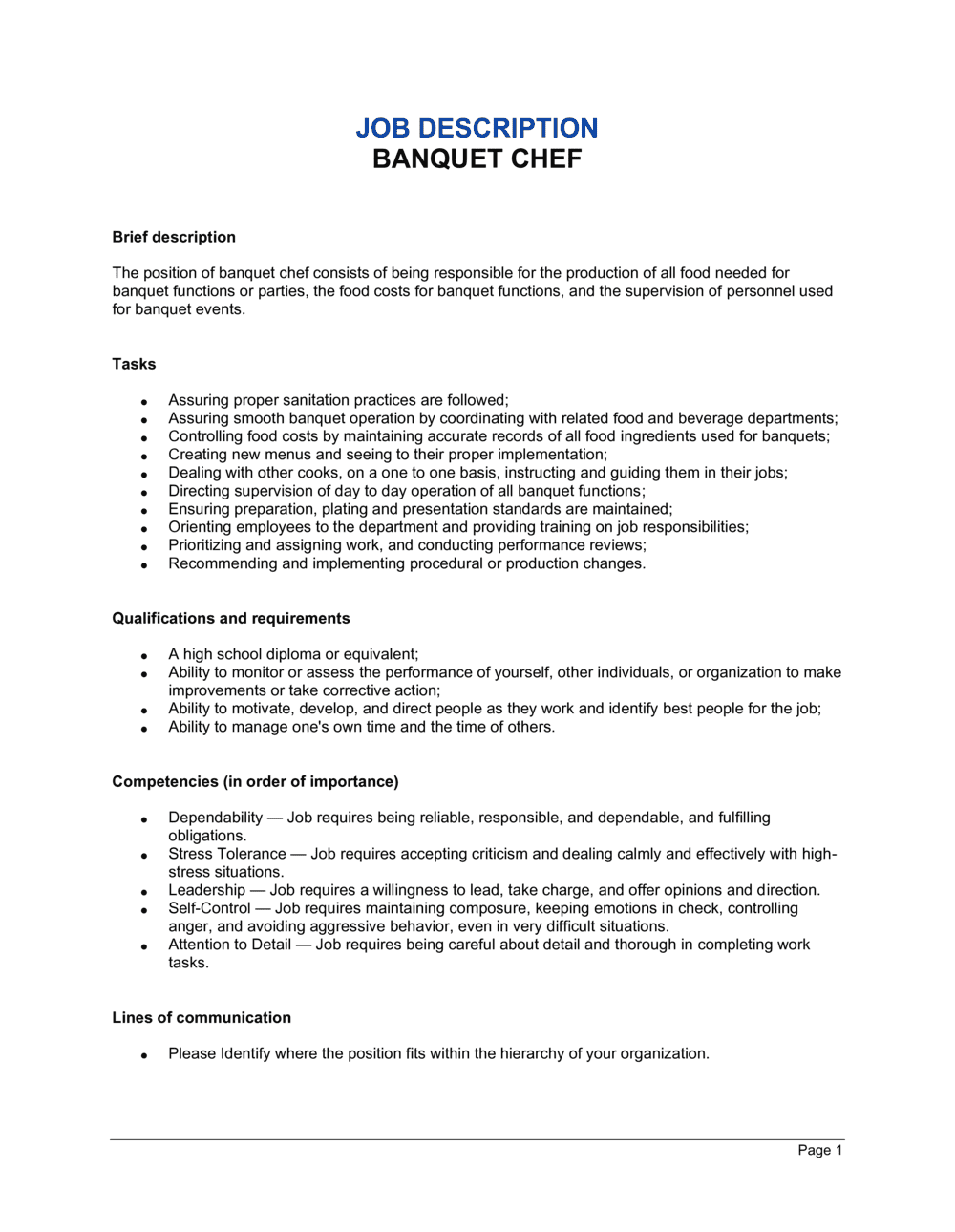
A Banquet Chef Job Description is a formal employment document that defines the role, responsibilities, reporting structure, qualifications, and performance expectations for a banquet chef position. This free Word download gives you a legally grounded, editable template you can tailor to your property or catering operation and export as PDF for onboarding or recruitment.
When you need it
Use it when hiring or onboarding a banquet chef at a hotel, convention center, catering company, or event venue — or when formalizing an existing role to support performance management, termination proceedings, or HR compliance audits.
What's inside
Position title and department, reporting line, core duties and event responsibilities, staffing and supervision obligations, required qualifications and certifications, physical and scheduling requirements, compensation reference, and signature acknowledgment block.

What is a Banquet Chef Job Description?

A Banquet Chef Job Description is a formal employment document that defines the scope of work, reporting structure, required qualifications, performance expectations, and physical demands for a banquet chef position at a hotel, convention center, catering company, or private event venue. Unlike a casual role summary posted on a job board, a properly drafted job description functions as a legally grounded HR record — one that establishes objective performance standards, supports FLSA wage-and-hour compliance, and provides the documentary foundation for performance management, disciplinary action, and, if necessary, termination proceedings. This free Word download gives you an editable, attorney-informed starting point you can tailor to your property's event volume, kitchen structure, and compensation grade before exporting as PDF.

Why You Need This Document

Operating without a signed, detailed banquet chef job description creates compounding risk across three areas: wage compliance, performance management, and employment disputes. Without a documented FLSA exemption classification, overtime liability accrues silently — and Department of Labor audits in the hospitality sector routinely result in back-pay awards covering two to three years. Without a measurable food cost benchmark in writing, managing a banquet chef's cost performance becomes subjective, making disciplinary action legally vulnerable. And without a signed acknowledgment block that includes an at-will or non-contract disclaimer, a signed job description in some states can be treated as an implied employment contract — eliminating your ability to terminate without severance. This template closes all three gaps in under 30 minutes, giving your HR team a defensible, property-specific document that holds up in an audit and protects your operation when employment relationships become complicated.

Which variant fits your situation?

If your situation is…Use this template
Hiring a senior banquet chef who also manages the entire catering kitchenExecutive Chef Job Description
Filling an entry-level line cook position for banquet serviceLine Cook Job Description
Engaging a banquet chef as a freelance contractor for event seasonIndependent Contractor Agreement
Creating a full employment agreement alongside the job descriptionEmployment Agreement (At-Will Employee)
Hiring a sous chef to support banquet operationsSous Chef Job Description
Documenting a banquet manager role separate from the kitchen leadBanquet Manager Job Description
Staffing a temporary chef for a single large catering eventTemporary Employment Contract

Common mistakes to avoid

❌ Omitting FLSA exemption classification

Why it matters: Failing to classify the banquet chef as non-exempt when they regularly perform hands-on kitchen labor exposes the employer to back overtime pay, liquidated damages, and Department of Labor penalties.

Fix: Review the duties against the FLSA duties test before issuing the job description. Most banquet chefs qualify as non-exempt; mark the status explicitly on the face of the document.

❌ Listing duties without 'not limited to' language

Why it matters: An enumerated duties list without a scope-preserving qualifier can be read as exhaustive — meaning any task not listed could be challenged as outside the employee's agreed role.

Fix: Use the phrase 'duties include but are not limited to' before any list of responsibilities, and confirm your employment counsel reviews the final document.

❌ No food cost performance benchmark

Why it matters: Without a defined food cost target in the job description, managing the banquet chef against cost variances becomes subjective — making it harder to support performance-based discipline or termination.

Fix: Insert a specific food cost percentage target agreed upon with your finance team, and reference it in subsequent performance review documentation.

❌ Signing the job description after the employee's start date

Why it matters: A signed acknowledgment obtained after work begins may lack consideration in common-law jurisdictions, reducing its enforceability as a record of agreed duties and expectations.

Fix: Present the job description for signature before or on day one. If the document is updated after hire, pair the new signature with a documented benefit — a pay adjustment or title change — as fresh consideration.

❌ Stating a specific salary in the job description

Why it matters: In states that recognize signed job descriptions as implied employment contracts, a salary figure that differs from the actual offer creates a breach-of-contract exposure.

Fix: Reference a compensation grade or band ('within the Grade 4 compensation range') and let the offer letter or employment agreement carry the specific dollar figure.

❌ Missing the at-will or non-contract disclaimer in the signature block

Why it matters: Several US states have found that signed job descriptions create implied employment contracts when they lack a clear disclaimer — potentially eliminating at-will status and obligating severance.

Fix: Add a bold disclaimer above the signature line confirming the document does not constitute a contract of employment and that employment remains at-will or subject to the notice terms in the governing employment agreement.

The 10 key clauses, explained

Position Title, Department, and Employment Status

In plain language: Identifies the exact job title, the department the role sits within (typically Food and Beverage or Culinary), and whether the position is full-time, part-time, or seasonal.

Sample language
Position: Banquet Chef | Department: Food and Beverage | Reports to: Executive Chef / Director of Food and Beverage | Employment Status: Full-Time, Non-Exempt | Location: [PROPERTY NAME], [CITY, STATE]

Common mistake: Omitting the FLSA exemption status (exempt vs. non-exempt) — misclassifying a banquet chef as exempt when overtime is regularly worked triggers back-pay liability and Department of Labor complaints.

Position Summary

In plain language: A 3–5 sentence overview of the role's primary purpose, the scope of events managed, and the kitchen leadership expectations.

Sample language
The Banquet Chef is responsible for planning, preparing, and executing all food production for banquet and catering events at [PROPERTY NAME], including events up to [MAX COVERS] covers. The Banquet Chef leads a kitchen team of [X] staff, ensures all production meets quality and food safety standards, and partners with the Events team to deliver on each Banquet Event Order.

Common mistake: Writing a position summary so generic it could apply to any chef role — specificity about covers, event volume, and team size is what makes the job description defensible in a wrongful-termination claim.

Core Duties and Responsibilities

In plain language: Lists the day-to-day and event-based tasks the banquet chef is expected to perform — from menu planning and prep oversight to food costing and post-event cleanup.

Sample language
Duties include but are not limited to: (a) reviewing BEOs and confirming menu details with the Events team no later than [X] business days before each event; (b) directing all mise en place and production timelines; (c) maintaining food cost percentage at or below [X]%; (d) conducting pre-service line checks; (e) ensuring compliance with all HACCP protocols and local health regulations.

Common mistake: Using 'duties include' without the qualifier 'but are not limited to' — courts have found that an enumerated list without this phrase restricts the employer to only those tasks, making reasonable additional assignments a breach claim.

Staffing and Supervision Responsibilities

In plain language: Defines who the banquet chef supervises, the extent of their hiring or disciplinary authority, and their accountability for staff performance and scheduling.

Sample language
The Banquet Chef directly supervises [X] kitchen staff including [TITLES]. Responsibilities include scheduling, on-the-job training, performance coaching, and initiating progressive discipline in accordance with [PROPERTY NAME] HR policies. Hiring and termination decisions require approval from the Executive Chef and Human Resources.

Common mistake: Granting full hire-and-fire authority in the job description without HR co-approval language — this creates liability when a chef terminates a subordinate without following the property's formal process.

Menu Planning and Food Cost Management

In plain language: Sets expectations for the banquet chef's role in developing banquet menus, coordinating tastings, managing purchasing, and controlling food costs against budget targets.

Sample language
The Banquet Chef shall develop and present banquet menus for client approval in coordination with the Director of Food and Beverage. The Banquet Chef is responsible for maintaining a food cost percentage not to exceed [X]% and shall review variance reports with the Executive Chef [weekly / monthly].

Common mistake: Omitting a food cost target from the job description — without a stated benchmark, performance management around cost control becomes subjective and difficult to enforce or document.

Food Safety, Sanitation, and Compliance

In plain language: Establishes the banquet chef's personal accountability for maintaining food safety standards, holding required certifications, and ensuring the kitchen passes health inspections.

Sample language
The Banquet Chef must hold a current [ServSafe / equivalent] Food Handler Manager Certification and ensure all kitchen staff hold valid food handler permits. The Banquet Chef is personally accountable for the kitchen's compliance with local health department regulations and the property's HACCP plan at all times.

Common mistake: Failing to name the specific certification required — listing 'appropriate certifications' instead of 'ServSafe Manager Certification or state-equivalent' creates ambiguity and allows non-compliant hires.

Physical Requirements and Scheduling

In plain language: Discloses the physical demands of the role and the scheduling expectations — including evenings, weekends, and holidays — which are essential for ADA compliance and setting clear expectations at hire.

Sample language
The Banquet Chef must be able to: stand and walk for up to [X] hours per shift; lift and carry up to [X] lbs; work in hot kitchen environments. This role regularly requires evening, weekend, and holiday availability consistent with the property's event schedule.

Common mistake: Omitting physical requirements entirely — this creates ADA accommodation disputes when a chef claims a physical limitation was not disclosed as a job requirement at hire.

Required Qualifications and Preferred Credentials

In plain language: States the minimum education, culinary training, years of experience, and any preferred credentials that differentiate strong candidates from minimally qualified ones.

Sample language
Required: Culinary degree or equivalent [X] years of progressive banquet/catering kitchen experience; minimum [X] years in a supervisory kitchen role. Preferred: CIA or equivalent culinary school graduate; prior experience managing events of [X]+ covers; working knowledge of [RELEVANT POS / KITCHEN MANAGEMENT SOFTWARE].

Common mistake: Setting experience requirements that screen out protected classes without documented business necessity — overly restrictive credential requirements have been challenged under disparate-impact discrimination theory.

Compensation Reference and Benefits

In plain language: References the compensation band and benefits eligibility for the role without locking specific dollar amounts into the job description itself.

Sample language
Compensation for this position is within the range established for Grade [X] in the [PROPERTY NAME] compensation structure, commensurate with experience. The Banquet Chef is eligible to participate in the Company's standard benefits program as in effect from time to time.

Common mistake: Stating a specific salary figure in the job description — if the offer differs from what the description states, the discrepancy creates an implied-contract argument in states that recognize job descriptions as contractual documents.

Acknowledgment and Signature Block

In plain language: Confirms that the employee has read, understood, and agrees to perform the duties as described, and that the job description does not constitute a contract of employment.

Sample language
I acknowledge that I have read and understand this job description and that it accurately reflects the general nature and level of work assigned to this position. I understand that this document does not constitute a contract of employment and that either party may end the employment relationship at any time in accordance with applicable law. Employee Signature: ___________ Date: ___________ | Manager Signature: ___________ Date: ___________

Common mistake: Omitting the disclaimer that the job description is not a contract of employment — several US states treat signed job descriptions as implied employment contracts if this language is absent.

How to fill it out

  1. 1

    Enter the property name, location, and department details

    Fill in the legal name of the employing entity, the physical location of the role, and the department. Use the registered legal entity name — not a brand or trade name — to ensure consistency with payroll records.

    💡 If the property is owned by a management company separate from the brand, use the management company's legal name as the employer of record.

  2. 2

    Confirm the FLSA exemption status

    Determine whether the role is exempt or non-exempt under the Fair Labor Standards Act. Most banquet chef roles are non-exempt because they involve manual kitchen labor, making them overtime-eligible.

    💡 When in doubt, classify as non-exempt. Misclassifying a non-exempt employee as exempt to avoid overtime costs is the most common FLSA violation in food service.

  3. 3

    Define the event scope and plate count range

    Insert the typical event volume — minimum and maximum covers per event and the number of events per week or month. These numbers anchor the core duties section and justify staffing levels.

    💡 Pull the last 12 months of BEO data to establish realistic cover ranges rather than using aspirational targets.

  4. 4

    List core duties with the 'not limited to' qualifier

    Enumerate the banquet chef's primary responsibilities clearly and in order of frequency. Always include the phrase 'including but not limited to' before the list to preserve flexibility for reasonable additional assignments.

    💡 Aim for 8–12 specific duties. Too few leaves gaps that create disputes; too many suggests the role is unmanageable and may deter qualified candidates.

  5. 5

    Set a specific food cost target

    Insert the property's target food cost percentage for banquet operations in the menu planning clause. This creates an objective performance metric that can be used in performance reviews and, if needed, disciplinary proceedings.

    💡 A typical banquet food cost target runs 28–35% depending on the property tier — confirm the target with your finance team before finalizing the document.

  6. 6

    Name the required certifications explicitly

    State the exact certification required — for example, 'ServSafe Food Protection Manager Certification or state-equivalent' — rather than a generic reference to 'appropriate food safety credentials.'

    💡 Verify your jurisdiction's specific food handler manager certification requirements before finalizing, as state and provincial requirements vary.

  7. 7

    Add the physical requirements and scheduling disclosure

    Fill in the specific weight-lifting threshold, standing duration, and temperature conditions applicable to your kitchen. State the scheduling expectations — evenings, weekends, holidays — explicitly.

    💡 Mirror the physical requirements language used in your other culinary job descriptions to maintain consistency across your HR documentation.

  8. 8

    Obtain signatures before the first day of work

    Both the hiring manager and the employee should sign and date the acknowledgment block before or on the employee's first day. File the executed copy in the employee's personnel file.

    💡 Include the at-will disclaimer and the 'not a contract' statement in bold above the signature line to ensure the employee cannot claim they missed it.

Frequently asked questions

What is a banquet chef job description?

A banquet chef job description is a formal HR and employment document that defines the duties, qualifications, reporting structure, physical requirements, and performance expectations for a banquet chef role. It serves both as a recruitment tool — setting candidate expectations — and as a legal record of agreed job scope used in performance management, disciplinary proceedings, and termination documentation.

Does a banquet chef job description need to be signed?

Yes, in most cases. A signed acknowledgment confirms the employee received, read, and understood the job description before beginning work. This signature is especially important in the hospitality industry, where performance disputes and overtime classification challenges are common. The signature block should include a disclaimer that the document does not constitute a contract of employment.

Is a banquet chef typically exempt or non-exempt under the FLSA?

Most banquet chefs qualify as non-exempt under the FLSA because their primary duties involve hands-on food production rather than management or professional discretion. Non-exempt status means they are entitled to overtime pay at 1.5 times their regular rate for hours worked beyond 40 per week. Misclassifying a non-exempt banquet chef as exempt is one of the most common and costly wage-and-hour violations in food service.

What qualifications should a banquet chef job description require?

At minimum, a banquet chef job description should require a culinary degree or equivalent progressive experience (typically 3–5 years in banquet or catering kitchen roles), a supervisory track record, and a current food handler manager certification such as ServSafe. Preferred qualifications often include formal culinary school training, experience with large-volume events (500+ covers), and familiarity with property management or kitchen-management software.

What is the difference between a banquet chef job description and an employment contract?

A job description defines the scope of work — duties, qualifications, reporting structure, and physical requirements. An employment contract creates enforceable legal obligations around compensation, IP, confidentiality, non-compete restrictions, and termination terms. The job description is typically incorporated by reference into the employment contract or attached as Schedule A. Using a job description alone, without an employment agreement, leaves the employer without enforceable restrictive covenants.

Can a job description be used as evidence in a wrongful termination claim?

Yes. Courts regularly admit job descriptions as evidence of agreed job scope and performance standards. A well-drafted job description that documents specific duties, measurable performance benchmarks (such as food cost targets), and physical requirements strengthens the employer's defense in wrongful termination or discrimination claims. A vague or unsigned job description provides little protection and may even undermine the employer's position.

Should the banquet chef job description include a food cost target?

Yes, whenever possible. Including a specific food cost percentage target — for example, 'maintain food cost at or below 32%' — creates an objective, documented performance standard. This makes performance reviews clearer, corrective action easier to support, and termination for cost overruns less susceptible to a discrimination or pretext challenge.

Do I need to update the banquet chef job description when duties change?

Yes. Any material change to duties, reporting structure, or performance expectations should be reflected in an updated job description, signed and dated by the employee. Unchanged job descriptions for roles that have evolved significantly create gaps between documented expectations and actual practice — gaps that surface during performance disputes or audits.

What physical requirements should be disclosed in a banquet chef job description?

The job description should state the maximum weight the position requires lifting (typically 30–50 lbs in a banquet kitchen), the duration of sustained standing or walking per shift, exposure to heat and kitchen equipment, and any repetitive motion requirements. These disclosures are required for ADA compliance and allow the employer to evaluate accommodation requests objectively if an employee later reports a physical limitation.

How this compares to alternatives

vs Executive Chef Job Description

An executive chef job description covers the leadership of the entire culinary operation — all outlets, menus, and kitchen staff across the property. A banquet chef job description is scoped specifically to event and catering production. Use the executive chef template when the hire will oversee all culinary functions; use this template when the role is dedicated to banquet and event execution.

vs Employment Agreement (At-Will Employee)

A job description defines what the employee will do; an employment agreement creates binding legal obligations around compensation, IP, confidentiality, non-compete, and termination. Both documents are needed for a complete hire — the job description is typically attached as a schedule to the employment agreement. Using only a job description leaves the employer without enforceable restrictive covenants.

vs Independent Contractor Agreement

An independent contractor agreement is used when the banquet chef is engaged as a self-employed vendor for specific events, with no employment benefits, tax withholding, or overtime entitlement. A job description paired with an employment agreement is for an employee relationship. Misclassifying an employee as a contractor triggers back taxes, benefits liability, and regulatory penalties.

vs Sous Chef Job Description

A sous chef job description covers a second-in-command kitchen role that supports the lead chef across all culinary operations. A banquet chef job description is specific to event and catering production with dedicated supervisory and cost-management responsibilities. Where banquet volume justifies a standalone leader, use this template; where the role is subordinate to a banquet chef, use the sous chef template.

Industry-specific considerations

Hotels and Resorts

Banquet chef roles in full-service hotels cover multi-room concurrent events and require coordination with the catering sales team on BEOs, often managing 500–2,000 covers per event.

Convention Centers and Event Venues

High-volume, back-to-back events with tight turnovers mean the job description must address cross-shift handoff protocols and capacity planning alongside standard culinary duties.

Catering and Food Service Companies

Off-premise catering operations require the job description to address transportation of prepared food, remote kitchen setup, and on-site food safety compliance at client locations.

Private Clubs and Country Clubs

Member-facing banquet service demands menu personalization and repeat-client relationship management as documented job responsibilities, in addition to standard production duties.

Jurisdictional notes

United States

The FLSA governs overtime eligibility for banquet chefs, who typically qualify as non-exempt and must receive 1.5× their regular rate for hours over 40 per week. Several states — including California, New York, and Washington — impose stricter wage-and-hour rules, daily overtime triggers, and mandatory rest-break requirements beyond federal minimums. California also requires meal period documentation and penalizes missed breaks at one hour of pay per violation.

Canada

Provincial employment standards acts set minimum requirements for hours of work, overtime thresholds, and vacation pay that must be reflected in the job description and accompanying employment agreement. In Ontario, most kitchen workers qualify for overtime after 44 hours per week rather than the US standard of 40. Quebec employers must provide job descriptions in French for provincially regulated workplaces. Unionized properties in BC and Alberta must ensure job descriptions align with collective agreement classifications.

United Kingdom

The Working Time Regulations 1998 limit banquet kitchen staff to an average of 48 working hours per week unless the employee opts out in writing; this should be addressed in the accompanying employment contract, not the job description alone. The Equality Act 2010 requires that physical requirements stated in the job description be genuinely necessary and proportionate to avoid indirect discrimination claims. Food safety obligations are governed by the Food Safety Act 1990 and associated regulations, which should be referenced in the compliance clause.

European Union

The EU Working Time Directive caps working hours at 48 per week on average, with mandatory rest periods that apply to kitchen staff across member states. The EU Transparent and Predictable Working Conditions Directive requires employers to provide written particulars of employment — including a clear job description — within 7 days of the start date. In France and Germany, collective bargaining agreements (CCN Hôtels-Cafés-Restaurants in France; DEHOGA tariff agreements in Germany) may dictate job classification, pay grades, and working conditions that override or supplement the job description.

Template vs lawyer — what fits your deal?

PathBest forCostTime
Use the templateIndependent hotels, catering companies, and hospitality groups hiring banquet chefs for standard full-time domestic rolesFree20–30 minutes
Template + legal reviewMulti-property groups, unionized kitchens, or roles involving significant IP (proprietary recipes) or non-compete expectations$200–$500 for an employment lawyer review1–3 days
Custom draftedExecutive-level banquet chef hires with equity, complex severance, or cross-border assignments in regulated jurisdictions$800–$2,500+1–2 weeks

Glossary

Banquet Chef
A culinary professional responsible for planning, preparing, and executing food service for large-scale catered events such as weddings, corporate dinners, and galas.
BEO (Banquet Event Order)
A written document issued by a venue or catering company that details all logistical and menu requirements for a specific event, serving as the kitchen's primary execution guide.
Mise en Place
A French culinary term meaning 'everything in its place' — the practice of preparing and organizing all ingredients, equipment, and stations before service begins.
Food Cost Percentage
The ratio of food ingredient costs to the revenue generated from selling those dishes, expressed as a percentage; typically managed at 28–38% in banquet operations.
HACCP
Hazard Analysis and Critical Control Points — a systematic food safety management protocol that identifies and controls biological, chemical, and physical hazards in food production.
Plate Count
The confirmed number of meal covers required for a banquet event, used to plan purchasing, prep quantities, and staffing levels.
Tasting Menu
A pre-event tasting session where the banquet chef presents proposed dishes to the client or event planner for approval prior to the event date.
Station Chef (Chef de Partie)
A line cook responsible for a specific preparation station — such as hot appetizers, carving, or desserts — during banquet service.
At-Will Employment
Employment that either party may terminate at any time for any lawful reason without advance notice or cause, common as the default in most US states.
Progressive Discipline
A structured HR process — verbal warning, written warning, suspension, termination — used to address performance or conduct issues before separation.

Part of your Business Operating System

This document is one of 3,000+ business & legal templates included in Business in a Box.

  • Fill-in-the-blanks — ready in minutes
  • 100% customizable Word document
  • Compatible with all office suites
  • Export to PDF and share electronically

Create your document in 3 simple steps.

From template to signed document — all inside one Business Operating System.
1
Download or open template

Access over 3,000+ business and legal templates for any business task, project or initiative.

2
Edit and fill in the blanks with AI

Customize your ready-made business document template and save it in the cloud.

3
Save, Share, Send, Sign

Share your files and folders with your team. Create a space of seamless collaboration.

Save time, save money, and create top-quality documents.

★★★★★

"Fantastic value! I'm not sure how I'd do without it. It's worth its weight in gold and paid back for itself many times."

Managing Director · Mall Farm
Robert Whalley
Managing Director, Mall Farm Proprietary Limited
★★★★★

"I have been using Business in a Box for years. It has been the most useful source of templates I have encountered. I recommend it to anyone."

Business Owner · 4+ years
Dr Michael John Freestone
Business Owner
★★★★★

"It has been a life saver so many times I have lost count. Business in a Box has saved me so much time and as you know, time is money."

Owner · Upstate Web
David G. Moore Jr.
Owner, Upstate Web

Run your business with a system — not scattered tools

Stop downloading documents. Start operating with clarity. Business in a Box gives you the Business Operating System used by over 250,000 companies worldwide to structure, run, and grow their business.

Free Forever Plan · No credit card required