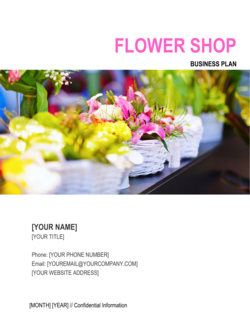
Flower Shop Business Plan Template

Free Word download β€’ Edit online β€’ Save & share with Drive β€’ Export to PDF

39 pagesβ€’3h 5m – 4h 15m to fillβ€’Difficulty: Expert
Learn more ↓
FreeFlower Shop Business Plan Template

At a glance

What it is
A Flower Shop Business Plan is a structured document that maps out every key dimension of starting or growing a floral retail business β€” from market positioning and supplier sourcing to staffing, pricing, and 3-year financial projections. This free Word download gives you a professionally organized starting point you can edit online and export as PDF to share with lenders, investors, or partners.
When you need it
Use it when opening a new flower shop, applying for a small business loan or SBA financing, seeking an investor for a floral studio expansion, or formalizing a strategy for an existing shop entering new revenue streams such as event floristry or subscription delivery.
What's inside
Executive summary, company overview, market and competitive analysis, products and services with pricing, marketing and sales strategy, operations plan covering suppliers and staffing, management team, and three-year financial projections including P&L and cash flow.

What is a Flower Shop Business Plan?

A Flower Shop Business Plan is a structured planning document that maps every operational and financial dimension of starting or scaling a floral retail business β€” from competitive positioning and supplier relationships to staffing, spoilage management, and three-year financial projections. It covers the unique economics of perishable inventory retail, seasonal demand peaks, and diversified revenue streams including walk-in retail, wedding packages, corporate accounts, and subscriptions. This free Word download gives you a purpose-built, lender-ready starting point you can edit online and export as PDF in hours rather than days.

Why You Need This Document

Opening a flower shop without a written plan means making your most expensive decisions β€” refrigeration capacity, supplier terms, staffing levels, and opening inventory volume β€” on intuition rather than evidence. The consequences are concrete: spoilage rates of 15% or more in the first year, cash flow shortfalls during the January and summer troughs, and loan applications declined for missing financial detail. Banks and SBA lenders require a formal business plan for any financing above $50,000, and lenders familiar with floral retail will immediately test your spoilage assumptions, seasonal revenue indexing, and working capital runway. A well-completed flower shop business plan does not just satisfy lenders β€” it forces you to model the break-even revenue figure, identify your two or three highest-margin revenue streams, and build the supplier relationships before you sign a lease.

Which variant fits your situation?

If your situation is…Use this template
Opening a new standalone retail flower shopFlower Shop Business Plan
Adding an online delivery or subscription service to an existing shopE-commerce Business Plan
Launching a wedding and event floristry studioEvent Planning Business Plan
Applying for a bank loan or SBA 7(a) financingBank Loan Business Plan
Early ideation or quick internal alignmentOne-Page Business Plan
Planning a new floral product line or seasonal collectionNew Product Launch Plan
Expanding a flower shop into a second locationBusiness Expansion Plan

Common mistakes to avoid

❌ Projecting flat monthly revenue

Why it matters: Valentine's Day and Mother's Day alone account for 30–40% of a typical flower shop's annual revenue. A flat model produces a misleading break-even calculation and understates working capital needs in January, February off-peak, and summer.

Fix: Index monthly revenue projections to historical floral industry seasonal indices from SAF data, then adjust for your specific market and service mix.

❌ Ignoring spoilage in COGS

Why it matters: A new florist with no demand history can easily hit 15% spoilage β€” projecting 3% inflates gross margin by 8–12 percentage points and makes the financial model unachievable.

Fix: Model spoilage at 10–12% for Year 1, dropping to 6–8% by Year 2 as you calibrate ordering to actual demand. Show the improvement assumption explicitly.

❌ Listing only walk-in retail as a revenue source

Why it matters: A single-channel retail model is highly exposed to foot traffic variability, online aggregator competition, and seasonal troughs. Lenders view diversified revenue as a materially lower risk.

Fix: Add at least two secondary revenue streams β€” corporate accounts and a weekly subscription tier are the fastest to build β€” and project their combined contribution at 20–30% of Year 2 revenue.

❌ Requesting only 2–3 months of working capital

Why it matters: Most flower shops do not reach break-even until Month 6–9. Running out of working capital in Month 4 forces emergency borrowing at higher rates or a premature closure.

Fix: Request a minimum of 6 months of working capital in the initial funding ask, and model the cash flow statement monthly to show the exact month you cross break-even.

❌ Omitting competitor analysis of online floral aggregators

Why it matters: 1-800-Flowers, Teleflora, and FTD capture significant order volume in every US metro by dominating Google search results. Ignoring them signals incomplete competitive research to any experienced lender.

Fix: Include a one-paragraph analysis of how your shop competes with or differentiates from online-first floral services, including your local SEO and Google Business Profile strategy.

❌ Using national floral market statistics without local validation

Why it matters: A $6B national market figure is irrelevant to a lender approving a $150K loan for a shop in a specific zip code. Unlocalized data reads as copy-paste research, not genuine analysis.

Fix: Supplement national figures with local census data, a count of area competitors, and an estimate of the trade-area household count and average floral spend per household.

The 10 key sections, explained

Executive Summary

Company Overview

Market Analysis

Competitive Analysis

Products and Services

Marketing and Sales Strategy

Operations Plan

Management Team

Financial Projections

Funding Requirements and Use of Funds

How to fill it out

  1. 1

    Complete the company overview and mission

    Enter your legal business name, entity type, founding date, location, and a one-sentence mission. Clarify your primary model β€” retail storefront, studio, delivery-only, or hybrid.

    πŸ’‘ Decide upfront whether your primary revenue engine is walk-in retail or event/wedding floristry β€” this choice shapes every section that follows.

  2. 2

    Research and localize your market analysis

    Gather data on the local floral market using SAF (Society of American Florists) reports, local census household income data, and a count of competing florists within your trade area. Calculate a realistic serviceable market.

    πŸ’‘ Drive or walk your proposed trade area and count every competitor β€” including grocery store floral counters β€” within a 2-mile radius. Lenders will ask.

  3. 3

    Map competitors and define your differentiation

    List at least four competitors including online aggregators and grocery floral. For each, note price points, specialty, hours, and weaknesses. Then write one specific paragraph on why your shop wins.

    πŸ’‘ Avoid claiming superiority on 'customer service' β€” it is uncheckable. Differentiate on a verifiable attribute: locally sourced stems, same-day delivery by 2 PM, or AIFD-certified designers.

  4. 4

    Define every revenue stream with prices

    List all products and services with price ranges. Include walk-in retail, custom orders, wedding packages, corporate accounts, subscriptions, and add-on gifts. Estimate the percentage of annual revenue each stream represents.

    πŸ’‘ If you plan to pursue wedding floristry, price out a minimum of three package tiers ($X, $X, $X) before opening β€” brides ask on day one.

  5. 5

    Build the operations plan around your supplier relationships

    Name your primary and backup wholesale suppliers, state order frequency and payment terms, and set a spoilage rate target. Document cold storage capacity and reorder triggers.

    πŸ’‘ Negotiate net-15 or net-30 terms with your wholesaler before writing the financial model β€” cash flow timing changes significantly between cash-on-delivery and net-30.

  6. 6

    Build financial projections with seasonal peaks

    Model monthly P&L for Year 1, indexing revenue to seasonal demand β€” Valentine's Day, Mother's Day, prom, and Christmas. Build your cash flow statement from the monthly P&L and calculate a break-even revenue figure.

    πŸ’‘ If Year 1 gross margin is below 50%, revisit your COGS assumptions β€” spoilage rate and supplier pricing are the two most commonly underestimated line items.

  7. 7

    State the funding ask with specific allocation

    Enter the total capital needed and break it into at least five buckets: build-out, equipment, opening inventory, working capital, and marketing. State whether the capital is a loan, equity investment, or personal contribution.

    πŸ’‘ Include 6 months of working capital in your ask β€” not 2 or 3. Lenders who see insufficient working capital routinely reduce loan approval amounts.

  8. 8

    Write the executive summary last

    Pull the one most compelling data point from each section and compress them into one to two pages. The summary should answer: what is the shop, why will it win, how much is needed, and what will it achieve.

    πŸ’‘ Have someone unfamiliar with your concept read only the executive summary and tell you what business you are opening. If they cannot answer accurately, rewrite it.

Frequently asked questions

What is a flower shop business plan?

A flower shop business plan is a structured document that defines the concept, target market, competitive positioning, products and services, operations model, and financial projections for a floral retail business. It functions as both an internal roadmap for the owner and an external document for banks, SBA lenders, and investors evaluating the business's viability. A complete plan typically runs 15–25 pages plus a financial model appendix.

Do I need a business plan to open a flower shop?

You do not legally need one, but you practically do if you are seeking any external financing. Banks and SBA lenders require a formal business plan for loan applications above $50K. Even without outside financing, writing the plan forces you to work through spoilage rates, seasonal cash flow, supplier terms, and break-even revenue β€” decisions that directly determine whether the shop survives its first year.

How much does it cost to open a flower shop?

Startup costs for a small retail flower shop typically range from $25,000 to $75,000, covering build-out and fixtures, walk-in refrigeration ($8,000–$20,000), opening floral inventory, display equipment, POS system, and 3–6 months of working capital. Larger studios with a design workshop and event floristry capacity can run $100,000–$200,000. Your business plan's funding requirements section should itemize every cost category before you approach a lender.

What is the average profit margin for a flower shop?

Retail flower shops typically operate at gross margins of 50–65% before accounting for spoilage. After spoilage (6–15% of COGS depending on inventory management maturity), net gross margins land at 40–55%. Net operating margins after rent, labor, and overhead are typically 5–15% for profitable shops. Event and wedding floristry can carry margins of 60–70% on materials, which is why diversifying beyond walk-in retail improves overall profitability significantly.

What financial projections should a flower shop business plan include?

A complete financial section should include a monthly P&L for Year 1 indexed to seasonal demand peaks, annual P&L for Years 2–3, a monthly cash flow statement for Year 1, a break-even analysis showing the revenue needed to cover fixed costs, and a start-up cost schedule with funding requirements. Lenders also want to see your spoilage assumption, COGS breakdown, and working capital runway explicitly modeled.

How do I handle seasonality in a flower shop business plan?

Index your monthly revenue projections to known floral industry demand peaks β€” Valentine's Day (February), Mother's Day (May), prom and graduation season (April–June), and Christmas and Poinsettia season (November–December). These four windows represent approximately 40–50% of annual floral retail revenue for most shops. Your cash flow model should show the working capital buffer needed to survive January and the post-Mother's Day trough in June and July.

What makes a flower shop business plan credible to a bank?

Lenders look for four things: localized market data (not just national statistics), a realistic spoilage assumption in COGS, at least 6 months of working capital in the funding ask, and a break-even revenue figure that is achievable given your trade area size and competitor count. Missing any of these signals insufficient preparation and will typically result in a reduced approval amount or a decline.

Should a flower shop business plan include event and wedding floristry?

Yes, if you intend to pursue that revenue β€” and most lenders view it favorably. Event floristry and wedding packages typically carry higher margins than walk-in retail (60–70% vs. 50%) and generate larger average transactions. Including them in the plan demonstrates a diversified revenue strategy, which reduces the perceived risk of seasonal retail variability. If you plan to add event work in Year 2, model it as a separate revenue line with a conservative ramp-up schedule.

How long does it take to write a flower shop business plan?

First-time shop owners typically spend 15–30 hours over 1–3 weeks using a structured template. The financial model β€” particularly building monthly projections with seasonal indexing and a cash flow statement β€” accounts for roughly half that time. Using a purpose-built template reduces the structural and formatting work significantly, letting you focus on the local market research and financial assumptions that require original analysis.

How this compares to alternatives

vs General Business Plan

A general business plan covers the same core sections but uses generic placeholders suitable for any industry. A flower shop business plan is pre-structured for floral retail specifics β€” spoilage rate modeling, seasonal demand indexing, supplier sourcing, and cold storage requirements. Use the industry-specific version when your audience is a lender or investor who will evaluate floral industry benchmarks.

vs One-Page Business Plan

A one-page plan is a rapid-alignment tool for early ideation and internal clarity. It lacks the financial depth, competitive analysis, and operational detail that banks and SBA lenders require for loan applications. Use the one-page version to validate your concept, then build the full flower shop plan before approaching any external capital source.

vs Restaurant Business Plan

A restaurant business plan and a flower shop business plan both address perishable inventory management and high-seasonality retail, but they diverge significantly on revenue model, supplier structure, staffing ratios, and health and safety requirements. Use a purpose-built flower shop template rather than adapting a restaurant plan β€” the financial benchmarks and operational assumptions are materially different.

vs Event Planning Business Plan

An event planning business plan is designed for service-based coordination businesses with no physical retail or perishable inventory. If your primary model is a storefront with walk-in retail, a flower shop plan is the right starting point. If you are launching a floristry studio focused exclusively on weddings and events with no retail component, the event planning template is a closer fit.

Industry-specific considerations

Retail floristry

Walk-in sales, daily arrangement refresh cycles, spoilage management, POS integration, and holiday staffing plans for Valentine's Day and Mother's Day peaks.

Wedding and event services

Contract-based revenue booked 3–12 months in advance, tiered wedding package pricing, venue partnership referral programs, and higher-margin event installations.

Food and beverage / hospitality

Corporate floral installation contracts with hotels, restaurants, and spas β€” recurring weekly revenue at wholesale rates with predictable demand volumes.

E-commerce and delivery

Same-day local delivery operations, subscription box fulfillment, online ordering system integration, and competing with national aggregators on local SEO and Google Business Profile.

Template vs pro β€” what fits your needs?

PathBest forCostTime
Use the templateFirst-time flower shop owners, SBA loans under $250K, and internal planning with no outside investorsFree15–30 hours over 1–3 weeks
Template + professional reviewSBA 7(a) loans above $250K, first-time borrowers who want a financial model reviewed for accuracy$300–$1,500 for a SCORE mentor session or small business advisor review2–4 weeks
Custom draftedMulti-location floral retail groups, franchise applications, or equity raises above $200K$2,000–$6,000 for a professional business plan writer with retail industry experience3–6 weeks

Glossary

Cost of Goods Sold (COGS)
The direct cost of the flowers, foliage, supplies, and packaging used to produce the arrangements sold in a given period.
Gross Margin
Revenue minus COGS, expressed as a percentage β€” a healthy retail flower shop typically targets 50–65% gross margin.
Floral Design Services
Revenue-generating work beyond walk-in retail, including event floristry, wedding packages, corporate accounts, and subscription arrangements.
Spoilage Rate
The percentage of perishable inventory β€” stems, bouquets, and potted plants β€” that goes unsold and must be discarded, directly reducing gross margin.
Average Transaction Value (ATV)
Total revenue divided by the number of customer transactions in a period, used to track upsell effectiveness and product mix shifts.
Event Floristry
Large-scale floral design work for weddings, corporate events, and galas, typically contracted months in advance at higher margins than walk-in retail.
Supplier Lead Time
The number of days between placing a flower order with a wholesaler or farm and receiving the shipment, which determines minimum inventory planning windows.
Consignment Arrangement
A supplier agreement where unsold inventory is returned at no charge, shifting spoilage risk back to the wholesaler β€” uncommon but available from select local growers.
Seasonal Demand Peaks
High-revenue periods driven by holidays β€” Valentine's Day, Mother's Day, and Christmas account for approximately 40% of annual US floral retail sales.
Corporate Account
A recurring wholesale-rate contract with a business customer β€” hotel lobby, restaurant, or office β€” for weekly or bi-weekly floral installations.

Part of your Business Operating System

This document is one of 3,000+ business & legal templates included in Business in a Box.

  • Fill-in-the-blanks β€” ready in minutes
  • 100% customizable Word document
  • Compatible with all office suites
  • Export to PDF and share electronically

Create your document in 3 simple steps.

From template to signed document β€” all inside one Business Operating System.
1
Download or open template

Access over 3,000+ business and legal templates for any business task, project or initiative.

2
Edit and fill in the blanks with AI

Customize your ready-made business document template and save it in the cloud.

3
Save, Share, Send, Sign

Share your files and folders with your team. Create a space of seamless collaboration.

Save time, save money, and create top-quality documents.

β˜…β˜…β˜…β˜…β˜…

"Fantastic value! I'm not sure how I'd do without it. It's worth its weight in gold and paid back for itself many times."

Managing Director Β· Mall Farm
Robert Whalley
Managing Director, Mall Farm Proprietary Limited
β˜…β˜…β˜…β˜…β˜…

"I have been using Business in a Box for years. It has been the most useful source of templates I have encountered. I recommend it to anyone."

Business Owner Β· 4+ years
Dr Michael John Freestone
Business Owner
β˜…β˜…β˜…β˜…β˜…

"It has been a life saver so many times I have lost count. Business in a Box has saved me so much time and as you know, time is money."

Owner Β· Upstate Web
David G. Moore Jr.
Owner, Upstate Web

Run your business with a system β€” not scattered tools

Stop downloading documents. Start operating with clarity. Business in a Box gives you the Business Operating System used by over 250,000 companies worldwide to structure, run, and grow their business.

Start freeΒ Β·Β No credit card required