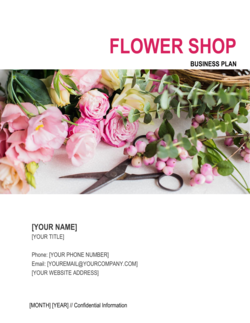
Flower Shop Business Plan 3 Template

Free Word download β€’ Edit online β€’ Save & share with Drive β€’ Export to PDF

38 pagesβ€’3h 5m – 4h 10m to fillβ€’Difficulty: Expert
Learn more ↓
FreeFlower Shop Business Plan 3 Template

At a glance

What it is
A Flower Shop Business Plan is a structured document that outlines every material dimension of launching or growing a retail floral business β€” from target market and supplier relationships to pricing strategy, seasonal demand management, and 3-year financial projections. This free Word download gives you an industry-specific starting point you can edit online and export as PDF to share with lenders, investors, or partners.
When you need it
Use it when opening a new flower shop, applying for a small-business loan or SBA financing, seeking a retail lease from a commercial landlord, or restructuring an existing florist operation around a defined growth strategy.
What's inside
Executive summary, company overview, market and competitive analysis, products and services with pricing, marketing and seasonal sales strategy, supplier and inventory management plan, operations and staffing, and 3-year financial projections including revenue, cost of goods, and cash flow.

What is a Flower Shop Business Plan?

A Flower Shop Business Plan is a structured planning document that defines every material dimension of a retail floral business β€” from trade-area market analysis and competitive positioning to product mix, perishable inventory management, seasonal sales strategy, and three-year financial projections. Unlike a generic retail plan, a flower shop plan addresses the specific operational realities of the floral industry: perishable inventory with shrinkage rates of 15–20%, revenue concentrated in five to six holiday peaks, cold-chain supplier relationships, and the dual revenue model of walk-in retail and contract event floristry. This free Word download gives florists and aspiring shop owners an industry-specific, lender-ready starting point they can edit online and export as PDF in hours rather than weeks.

Why You Need This Document

Without a written business plan, a flower shop loan application stalls at the first meeting with a bank officer, commercial landlords decline lease applications with no financial backing, and seasonal cash flow crises arrive as surprises rather than planned events. SBA lenders require a formal plan for virtually every loan program, and the plan's use-of-funds schedule is the document that determines how much capital you actually need β€” not a rough guess. Beyond financing, a complete flower shop business plan forces you to confront the numbers that determine whether the concept is viable: the shrinkage rate that erodes margin, the wire service fees that reduce net revenue, and the holiday staffing costs that appear once or twice a year but represent a third of annual labor spend. This template gives you the structure to answer every one of those questions before you sign a lease, place an opening inventory order, or commit a dollar of startup capital.

Which variant fits your situation?

If your situation is…Use this template
Opening a standalone brick-and-mortar flower shopFlower Shop Business Plan 3
Launching an online-only or delivery-first floral serviceE-commerce Business Plan
Adding a wedding and event floristry arm to an existing shopEvent Planning Business Plan
Applying for a bank loan with a single-page executive summaryOne-Page Business Plan
Expanding a flower shop into a second retail locationBusiness Expansion Plan
Pitching a floral concept to an angel investor or incubatorInvestor Pitch Deck
Planning a flower shop's marketing and seasonal promotionsMarketing Plan

Common mistakes to avoid

❌ Ignoring seasonal cash flow timing

Why it matters: A flower shop can show strong annual revenue while repeatedly running out of cash in February, April, and December β€” the weeks of heaviest inventory investment before peak-period receipts arrive.

Fix: Model cash flow weekly for peak periods and monthly for the rest of the year. Identify the weeks where outflows exceed inflows and size your working capital line accordingly.

❌ Understating perishable shrinkage in COGS

Why it matters: A shrinkage rate of 15–20% is common in floral retail. Projecting 5% makes gross margin look 8–10 percentage points higher than it actually will be, producing a plan that fails in its first quarter.

Fix: Research industry-average shrinkage rates (15–20% for fresh-cut, lower for plants), apply them explicitly in the COGS build, and describe the inventory management practices you will use to reduce them.

❌ Omitting wire service fees from operating expenses

Why it matters: Wire service memberships and order commissions can reduce net revenue by 20–27% on inbound orders. Not accounting for these fees inflates projected revenue and distorts the profitability model.

Fix: Decide upfront whether to join a wire service, model the membership fee and per-order commission explicitly, and include only the net revenue your shop retains in the financial projections.

❌ No staffing plan for peak periods

Why it matters: Valentine's Day and Mother's Day together can represent 25–35% of annual revenue and require 2–3 times normal labor β€” an owner who plans for flat staffing will either miss orders or burn out the team.

Fix: Create a separate staffing schedule for each peak holiday showing hours, roles, and labor cost. Include temporary and part-time hiring lead times in the operations section.

❌ Using national industry data without a local market estimate

Why it matters: A national $[X]B market size means nothing to a bank loan officer evaluating a single-location shop β€” they want evidence of demand in your specific trade area.

Fix: Localize your market sizing using census data, local business license counts, and a trade-area radius analysis. A bottom-up estimate (households Γ— estimated annual floral spend) is more credible than a top-down national share claim.

❌ Underpricing event and wedding floristry

Why it matters: Event work is labor-intensive and requires advance inventory commitment. Shops that price it at retail arrangement margins routinely find event floristry reduces overall profitability rather than increasing it.

Fix: Price event and wedding work at a minimum 65–70% gross margin on materials and include a separate line item for design labor at your hourly cost. Require a 50% deposit at booking to cover advance inventory orders.

The 10 key sections, explained

Executive Summary

Company Overview

Market Analysis

Competitive Analysis

Products and Services

Marketing and Sales Strategy

Supplier and Inventory Management

Operations and Staffing Plan

Financial Projections

Funding Requirements and Use of Funds

How to fill it out

  1. 1

    Complete the company overview and mission

    Enter your shop's legal name, entity type, founding date, and physical address. Write a one-sentence mission that explains what kind of shop you are, who you serve, and what makes you different.

    πŸ’‘ Lock the mission statement before writing any other section β€” it provides the strategic filter that keeps every subsequent section consistent.

  2. 2

    Research and document your local market

    Pull US Census trade-area data and local chamber of commerce reports to size the addressable market. Identify the three to five customer segments most relevant to your location β€” residential retail, weddings, corporate, sympathy, and subscription.

    πŸ’‘ Drive or walk your trade area and count competing floral points of sale β€” grocery departments, independent florists, and garden centers all compete for the same wallet.

  3. 3

    Map the competitive landscape

    List every direct and indirect competitor within your primary trade area with their price range, strengths, and weaknesses. Write one paragraph explaining specifically why your shop wins against each.

    πŸ’‘ Check Google Maps reviews for each competitor β€” customer complaints reveal the service or quality gap your shop should fill.

  4. 4

    Define your product mix and pricing

    List each product category with a price range and the estimated contribution to total revenue. Identify the two or three lines with the highest gross margin and ensure your marketing strategy prioritizes them.

    πŸ’‘ Target a blended gross margin of 55–65% across your product mix. If a category consistently falls below 45%, evaluate whether it belongs in the plan at all.

  5. 5

    Build the seasonal marketing calendar

    Map Valentine's Day, Mother's Day, Easter, Thanksgiving, and December holidays on a calendar and assign a promotion, budget, and staffing plan to each. Include at least two off-peak promotional periods to smooth revenue.

    πŸ’‘ Start marketing for Valentine's Day no later than January 20 β€” orders from corporate accounts and wedding clients come in weeks before the holiday.

  6. 6

    Document your supplier relationships and inventory approach

    Name your primary wholesaler, order cadence, payment terms, and target shrinkage rate. Include a contingency supplier for peak holiday periods when primary wholesalers face shortages.

    πŸ’‘ Negotiate Net 30 terms with your wholesaler from day one β€” paying COD on perishable inventory destroys cash flow during the slow months between peak periods.

  7. 7

    Build the three-year financial model

    Model monthly revenue using weekly order counts and average transaction value by segment. Apply your target COGS percentage to project gross profit. Layer in fixed costs (rent, utilities, insurance) and variable costs (labor, delivery) to reach net income.

    πŸ’‘ Model Year 1 cash flow weekly for the first three months β€” the gap between opening inventory spend and first customer receipts is where new flower shops most often run out of cash.

  8. 8

    Write the executive summary last

    Pull the single strongest data point from each section β€” market size, competitive advantage, break-even date, and funding ask β€” and compress them into one to two pages.

    πŸ’‘ A lender or investor should be able to read your executive summary in under five minutes and understand exactly what the business is, why it will work, and what you are asking for.

Frequently asked questions

What is a flower shop business plan?

A flower shop business plan is a structured document that defines the concept, target market, product mix, pricing, supplier relationships, staffing, seasonal strategy, and financial projections for a retail floral business. It functions as both an internal operational roadmap and an external document for securing financing, a retail lease, or investor capital. A complete plan typically runs 15–25 pages plus a financial model appendix.

What sections should a flower shop business plan include?

A complete flower shop business plan covers ten core areas: executive summary, company overview, market analysis, competitive analysis, products and services with pricing, marketing and seasonal strategy, supplier and inventory management, operations and staffing, financial projections (P&L, cash flow, balance sheet), and funding requirements with use of funds. Industry-specific sections on perishable inventory management and seasonal demand distinguish a floral plan from a generic retail plan.

How much does it cost to open a flower shop?

Startup costs for a small retail flower shop typically range from $30,000 to $100,000, depending on location, lease terms, and equipment. Major line items include leasehold improvements ($5,000–$30,000), a walk-in cooler ($3,000–$15,000), opening inventory ($5,000–$15,000), signage, point-of-sale system, and 3–6 months of working capital reserve. Your business plan's use-of-funds section should itemize every cost category before you approach a lender.

What gross margin should a flower shop target?

Industry benchmarks for healthy retail flower shops target a blended gross margin of 55–65% on fresh product and arrangements, and 50–60% on plants. Hardgoods and gift items can carry margins of 60–70%. Event and wedding floristry should be priced to a minimum 65–70% gross margin on materials plus a separate design labor fee. Shops that fall below 50% blended gross margin typically struggle to cover fixed costs.

Do I need a business plan to get an SBA loan for a flower shop?

Yes. SBA lenders require a written business plan as part of the loan application package for most programs, including the SBA 7(a) and SBA Microloan. The plan must include financial projections, a use-of-funds schedule, a market analysis, and an operations overview. A well-completed template is generally sufficient for loans under $350,000; larger or more complex requests may benefit from a professional review.

How do I handle seasonal cash flow in a flower shop business plan?

Model cash flow monthly for the full year and weekly for the six weeks surrounding Valentine's Day, Mother's Day, and the December holiday period. Identify the weeks when inventory purchases peak ahead of holiday receipts and quantify the working capital gap. Structure your line-of-credit request around that gap. Projecting flat monthly cash flow in a floral business signals to lenders that the owner has not thought through the perishable inventory cycle.

Should my flower shop join a wire service like FTD or Teleflora?

Wire services provide order volume and brand visibility but charge a monthly membership fee plus a 20–27% commission on inbound orders. For a new shop dependent on walk-in and local traffic, that commission can significantly erode margins. Evaluate whether the incremental order volume justifies the cost structure before committing. If you join, model the fees explicitly in your financial projections and track net revenue per wire order versus direct orders to make an informed annual renewal decision.

What is a realistic timeline to profitability for a flower shop?

Most well-planned independent flower shops reach monthly operating profitability within 12–24 months, depending on location, lease terms, and how quickly they capture wedding and corporate account revenue. Shops that open shortly before a major holiday (Valentine's Day or Mother's Day) and execute their marketing effectively can compress the timeline. Your financial plan should model break-even explicitly and ensure working capital reserves cover at least the first 6 months of operations.

How do I differentiate my flower shop in a competitive market?

Sustainable and locally sourced flowers, same-day hyperlocal delivery, a subscription model for home and corporate accounts, and a niche in high-end wedding or event floristry are the most defensible differentiation strategies for independent florists competing against grocery departments and online delivery platforms. Your business plan's competitive analysis section should articulate one or two specific advantages that are hard for a grocery floral department or wire-service fulfillment shop to replicate.

How this compares to alternatives

vs Generic Retail Business Plan

A generic retail business plan covers product sourcing, store layout, pricing, and financials applicable to any shop. A flower shop plan adds perishable inventory management, seasonal demand modeling, wire service analysis, cold-chain logistics, and event floristry pricing β€” all of which are material to profitability and not addressed in a generic retail template.

vs One-Page Business Plan

A one-page plan is a rapid-alignment tool for internal use or early-stage ideation. It lacks the financial depth, market evidence, and competitive analysis that bank lenders and SBA programs require. Use a one-page plan to test the concept quickly, then build the full flower shop plan before any loan application or lease negotiation.

vs Marketing Plan

A marketing plan focuses exclusively on customer acquisition channels, promotional calendar, and campaign budgets. A flower shop business plan contextualizes marketing within the full operational and financial picture β€” supplier relationships, staffing, cash flow, and capital requirements β€” that a lender or investor needs to evaluate the business.

vs Event Planning Business Plan

An event planning business plan is designed for full-service event coordinators who manage venues, catering, and logistics alongside florals. A flower shop business plan is anchored in retail floral operations, perishable inventory, and walk-in customer revenue β€” with event floristry as one revenue stream rather than the entire business model.

Industry-specific considerations

Retail Floristry

Walk-in and e-commerce sales of fresh arrangements, plants, and hardgoods with seasonal revenue concentration around five to six major holidays per year.

Wedding and Event Services

Contract-based event floristry requiring advance inventory commitment, deposit collection, and labor pricing separate from the retail margin structure.

Food and Beverage / Hospitality

Corporate and hotel account subscriptions for weekly lobby and table arrangements β€” recurring revenue that smooths the cash flow gaps between retail peak periods.

E-commerce and Delivery

Online ordering with same-day local delivery requires a distinct marketing spend model and delivery logistics plan separate from brick-and-mortar walk-in operations.

Template vs pro β€” what fits your needs?

PathBest forCostTime
Use the templateIndependent florists, aspiring shop owners, and existing shops applying for SBA loans under $350,000Free2–3 weeks (30–50 hours)
Template + professional reviewShops seeking bank loans above $350,000, multi-location expansions, or franchise applications requiring lender-grade financial models$500–$2,000 for a SCORE mentor, business advisor, or accountant review3–4 weeks
Custom draftedInstitutional lenders, equity investors, or complex multi-location floral operations with event and wholesale revenue streams$3,000–$8,000 for a professional business plan writer4–6 weeks

Glossary

Cost of Goods Sold (COGS)
The direct cost of the flowers, foliage, containers, and supplies used to produce the arrangements sold in a given period.
Perishable Inventory
Stock β€” fresh-cut flowers, potted plants, greenery β€” that has a limited shelf life and must be sold or disposed of within days to weeks.
Hardgoods
Non-perishable retail items in a flower shop such as vases, ribbons, greeting cards, and candles that carry longer shelf life and higher margin.
Shrinkage Rate
The percentage of floral inventory lost to spoilage, damage, or unsold perishables β€” a key driver of profitability in floral retail.
Seasonal Demand Spike
Predictable high-volume periods β€” Valentine's Day, Mother's Day, and the December holiday season β€” during which sales can represent 30–50% of annual revenue.
Wire Service
A floral network such as FTD, Teleflora, or 1-800-Flowers through which shops send and receive orders from distant customers, typically in exchange for a membership fee and order commission.
Average Transaction Value (ATV)
Total revenue divided by the number of transactions in a period β€” a key metric for measuring upsell effectiveness in a retail flower shop.
Gross Margin
Revenue minus cost of goods sold, expressed as a percentage of revenue. Healthy floral retail gross margins typically fall between 50% and 70%.
Event Floristry
Design and installation of floral arrangements for weddings, corporate events, and celebrations β€” typically higher-value, contract-based work separate from walk-in retail.
Cold Chain
The temperature-controlled logistics process β€” from grower to wholesaler to shop cooler β€” that preserves cut flower freshness and extends sellable life.

Part of your Business Operating System

This document is one of 3,000+ business & legal templates included in Business in a Box.

  • Fill-in-the-blanks β€” ready in minutes
  • 100% customizable Word document
  • Compatible with all office suites
  • Export to PDF and share electronically

Create your document in 3 simple steps.

From template to signed document β€” all inside one Business Operating System.
1
Download or open template

Access over 3,000+ business and legal templates for any business task, project or initiative.

2
Edit and fill in the blanks with AI

Customize your ready-made business document template and save it in the cloud.

3
Save, Share, Send, Sign

Share your files and folders with your team. Create a space of seamless collaboration.

Save time, save money, and create top-quality documents.

β˜…β˜…β˜…β˜…β˜…

"Fantastic value! I'm not sure how I'd do without it. It's worth its weight in gold and paid back for itself many times."

Managing Director Β· Mall Farm
Robert Whalley
Managing Director, Mall Farm Proprietary Limited
β˜…β˜…β˜…β˜…β˜…

"I have been using Business in a Box for years. It has been the most useful source of templates I have encountered. I recommend it to anyone."

Business Owner Β· 4+ years
Dr Michael John Freestone
Business Owner
β˜…β˜…β˜…β˜…β˜…

"It has been a life saver so many times I have lost count. Business in a Box has saved me so much time and as you know, time is money."

Owner Β· Upstate Web
David G. Moore Jr.
Owner, Upstate Web

Run your business with a system β€” not scattered tools

Stop downloading documents. Start operating with clarity. Business in a Box gives you the Business Operating System used by over 250,000 companies worldwide to structure, run, and grow their business.

Start freeΒ Β·Β No credit card required