Environmental Policy Analyst Job Description Template

Free Word download • Edit online • Save & share with Drive • Export to PDF

2 pages20–25 min to fillDifficulty: Standard
Learn more ↓
FreeEnvironmental Policy Analyst Job Description Template

At a glance

What it is
An Environmental Policy Analyst Job Description is a structured hiring document that defines the responsibilities, qualifications, reporting structure, and performance expectations for a professional who researches, evaluates, and advocates for environmental regulations and sustainability policies. This free Word download gives you a ready-to-edit template you can tailor to your organization's sector, regulatory context, and team structure, then post to job boards or share with candidates in minutes.
When you need it
Use it when hiring a new environmental policy analyst, backfilling a vacant role, or formalizing an existing position that has grown beyond its original informal scope. It is also useful when creating a job family framework or aligning role expectations ahead of a performance review cycle.
What's inside
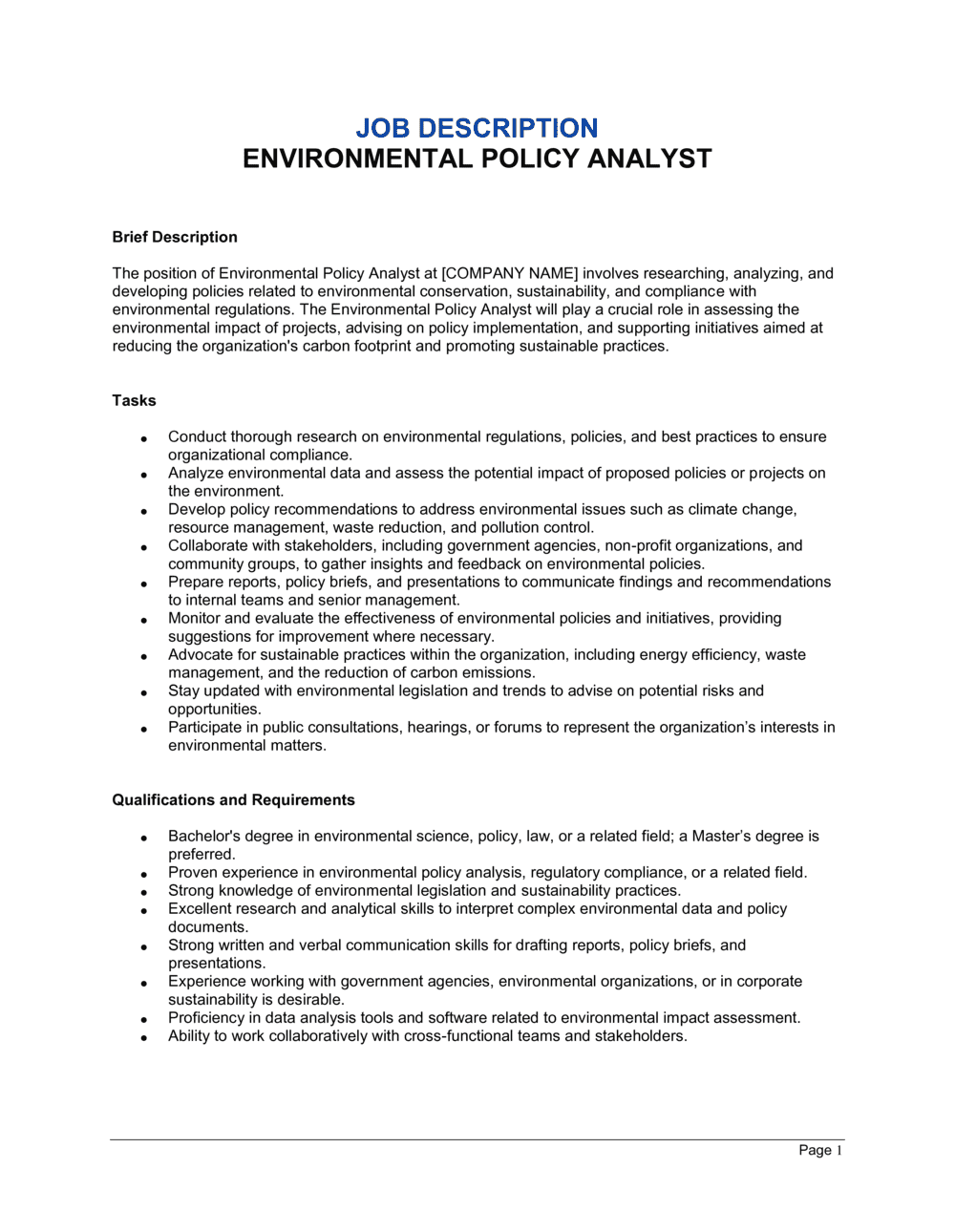
The template covers role summary, core duties and responsibilities, required and preferred qualifications, key competencies, reporting relationships, working conditions, and compensation band guidance. Together these sections give candidates a clear picture of the role and give hiring managers a consistent standard against which to screen applicants.

What is an Environmental Policy Analyst Job Description?

An Environmental Policy Analyst Job Description is a structured hiring document that defines the responsibilities, qualifications, reporting relationships, and performance expectations for a professional who researches and interprets environmental regulations, evaluates proposed policies, and advises organizations on regulatory risk and compliance strategy. It serves as both a recruitment tool — attracting candidates with the specific domain expertise the role requires — and an internal governance document that establishes clear scope and accountability for the position. Unlike a generic analyst job description, an effective environmental policy version names the specific regulatory frameworks, agencies, and deliverables the analyst will own, from Clean Air Act permitting to NEPA review coordination to public comment drafting.

Why You Need This Document

A vague or generic job description for an environmental policy analyst role produces two predictable outcomes: an applicant pool flooded with unqualified candidates and a hiring process that stalls because no one can agree on what the role actually requires. The cost is concrete — environmental policy positions that go unfilled for 60 or more days expose organizations to regulatory monitoring gaps, missed comment deadlines, and compliance blind spots that can result in permit violations or enforcement actions. A well-crafted job description solves the problem before it starts: it gives candidates the regulatory context they need to self-screen accurately, gives hiring managers a consistent standard for evaluation, and gives the new hire a clear performance contract from day one. This template eliminates the hours of formatting and structural work, letting you focus on the sector-specific content that actually differentiates a strong posting from a forgettable one.

Which variant fits your situation?

If your situation is…Use this template
Hiring for a role focused primarily on regulatory compliance monitoringEnvironmental Compliance Officer Job Description
Recruiting a senior analyst who will manage junior staff and lead projectsSenior Environmental Policy Analyst Job Description
Defining a role focused on corporate sustainability strategy and ESG reportingSustainability Manager Job Description
Posting a research-heavy academic or think-tank positionEnvironmental Research Analyst Job Description
Hiring for a broad environmental health and safety functionEHS Manager Job Description
Defining an entry-level analyst role for a recent graduate hireEnvironmental Policy Associate Job Description
Recruiting a consultant for a fixed-term policy projectIndependent Contractor Agreement

Common mistakes to avoid

❌ Copying a generic analyst job description and adding 'environmental' to the title

Why it matters: Candidates with genuine environmental policy expertise immediately recognize an undifferentiated posting and assume the organization does not understand the role — leading top candidates to self-select out.

Fix: Name specific regulations, agencies, and deliverables relevant to your sector in every section of the description, starting with the role summary.

❌ Requiring a specific degree field instead of equivalency language

Why it matters: Restricting to 'environmental science degree only' excludes strong policy analysts with degrees in public policy, geography, law, or economics — fields that often produce better regulatory analysts than environmental science programs.

Fix: Use inclusive language: 'Bachelor's degree in environmental science, public policy, political science, law, or a related field, or equivalent professional experience.'

❌ Omitting the salary range

Why it matters: Missing compensation data extends time-to-fill, increases candidate drop-off after offers, and violates pay transparency laws in a growing number of jurisdictions.

Fix: Include the approved salary band in the compensation section. If the range is wide, note that placement depends on experience and qualifications.

❌ Listing 20 or more responsibilities without prioritization

Why it matters: An exhaustive task list signals a poorly defined role and makes candidates feel the position is unmanageable — reducing application rates among the most qualified, experienced candidates who have options.

Fix: Limit the responsibilities list to 10–12 items, grouped by theme. Move secondary duties to a 'may also include' subsection so the primary scope remains clear.

The 9 key sections, explained

Job title and department

Role summary

Core responsibilities

Required qualifications

Preferred qualifications and certifications

Key competencies and skills

Reporting structure and working relationships

Working conditions and travel requirements

Compensation and benefits summary

How to fill it out

  1. 1

    Define the role's organizational context

    Before editing the template, confirm the department, reporting line, and team structure. Clarify whether this is a new role or a backfill, and identify the two or three most critical outcomes the hire is accountable for in their first 12 months.

    💡 Interview the hiring manager and one current team member before drafting — their language about what success looks like will make your role summary far more specific and compelling.

  2. 2

    Tailor the job title to your sector

    Adjust the job title to reflect your industry context — 'Environmental Policy Analyst, Energy Sector' or 'Regulatory Policy Analyst, Municipal Government' helps the posting surface in targeted job board searches and sets expectations immediately.

    💡 Check LinkedIn and Indeed for the title conventions used by your direct competitors — matching industry norms improves organic search visibility for the posting.

  3. 3

    Write the role summary from the organization's perspective

    In 3–5 sentences, explain why this role exists, what problem it solves, and what a successful analyst will contribute to the organization's mission or bottom line. Avoid task-listing — focus on purpose and impact.

    💡 Lead with the most motivating aspect of the role for target candidates — regulatory influence, conservation outcomes, or policy innovation — not administrative or compliance functions.

  4. 4

    Build the responsibilities list from actual work outputs

    List 8–12 responsibilities as action-verb sentences (monitor, analyze, draft, coordinate, present). Each item should describe a real deliverable or activity, not a vague domain. Review recent performance objectives for the role if they exist.

    💡 Group responsibilities by theme — research, stakeholder engagement, reporting, compliance — to make the list scannable and to signal what proportion of the analyst's time each area represents.

  5. 5

    Separate required from preferred qualifications

    List only the genuinely non-negotiable criteria under 'Required.' Move anything you would waive for an exceptional candidate to 'Preferred.' This distinction directly controls the quality and quantity of your applicant pool.

    💡 Research shows that women and underrepresented candidates are less likely to apply when they do not meet every listed requirement — keep the required list to true minimums.

  6. 6

    Add sector-specific regulatory context

    Name the specific regulations, agencies, or frameworks the analyst will work with — Clean Air Act, CERCLA, state-level permitting, EU taxonomy, or TCFD reporting. Generic descriptions attract generic applicants.

    💡 Use the same regulatory acronyms and terminology that appear in the résumés of strong candidates — ATS systems and experienced candidates both scan for keyword matches.

  7. 7

    State the compensation range and benefits

    Enter the approved salary band and summarize the key benefits. If your jurisdiction has pay transparency requirements (CA, NY, CO, WA, and others), including the range is legally required — and it improves candidate quality regardless of location.

    💡 Cross-reference the range against the Bureau of Labor Statistics Occupational Employment Statistics for environmental scientists and specialists to confirm market alignment before posting.

  8. 8

    Review for compliance with employment law

    Ensure the job description does not include language that could be interpreted as discriminatory — avoid age-coded language ('recent graduate'), physical requirements not tied to genuine job functions, or national origin references. Have HR or legal review before posting.

    💡 Run a brief bias audit using a free tool like Textio or Gender Decoder before the final post — both flag language patterns that systematically deter qualified applicants from underrepresented groups.

Frequently asked questions

What does an environmental policy analyst do?

An environmental policy analyst researches, interprets, and communicates environmental laws, regulations, and policy proposals that affect an organization or community. Day-to-day work typically includes monitoring regulatory developments from agencies like the EPA or state environmental departments, drafting policy briefs and public comments, advising leadership on compliance strategy, and coordinating with legal and operations teams on implementation. The role sits at the intersection of science, law, and public affairs.

What qualifications does an environmental policy analyst need?

Most positions require a bachelor's degree in environmental science, public policy, political science, law, or a related field — with a master's degree preferred for mid-level and senior roles. Employers typically look for demonstrated experience interpreting federal or state environmental regulations, strong research and writing skills, and familiarity with stakeholder engagement processes. GIS proficiency, NEPA certification, and experience with specific regulatory frameworks like the Clean Air Act or CERCLA are common differentiators.

How is an environmental policy analyst different from an environmental scientist?

An environmental scientist primarily collects and analyzes physical data about ecosystems, pollution, and natural systems. An environmental policy analyst focuses on the regulatory and policy implications of that data — interpreting laws, evaluating policy proposals, and advising decision-makers. In practice, many organizations employ both, with the scientist supplying technical findings and the policy analyst translating them into regulatory strategy and stakeholder communication.

What industries hire environmental policy analysts?

Government agencies at the federal, state, and municipal level are the largest employers. Utilities, energy companies, and extractive industries hire analysts to manage regulatory compliance. Environmental nonprofits and advocacy organizations hire them for policy research and comment drafting. Consulting firms serve all of these sectors on a project basis. Corporate ESG teams at publicly traded companies increasingly hire analysts to manage disclosure obligations and regulatory risk.

What should a job description for this role include?

A complete job description covers the role summary, core responsibilities (with specific regulatory and deliverable context), required and preferred qualifications, key competencies, reporting relationships, working conditions, and a compensation range. The most common weakness in environmental policy analyst postings is generic language — strong descriptions name the specific regulations, agencies, and deliverables the analyst will work with from day one.

Should I require a master's degree for this role?

For entry-level positions, a bachelor's degree with relevant internship or research experience is typically sufficient. For roles involving independent regulatory interpretation, stakeholder management, or policy advocacy at a senior level, a master's degree in public policy, environmental law, or environmental management is a meaningful differentiator. Requiring a master's for junior roles will unnecessarily restrict your applicant pool and price your compensation band above entry-level market rates.

How specific should the responsibilities section be?

Specific enough that a strong candidate can picture their first 90 days on the job. Name the regulatory bodies, reporting cycles, and deliverables the analyst will own — not just broad categories like 'supports compliance efforts.' The more specific the posting, the more precisely it will attract candidates with directly relevant experience and the fewer unqualified applications you will receive to screen.

Do I need a lawyer to review a job description?

A formal legal review is not required for most standard job descriptions, but HR or employment counsel should review postings before publication to ensure language does not inadvertently violate anti-discrimination laws, pay equity requirements, or pay transparency statutes in your jurisdiction. This is especially important for roles in California, New York, Colorado, and Washington, which have specific salary disclosure requirements.

How often should a job description be updated?

Review and update job descriptions whenever the role's core responsibilities change materially, before any new hire cycle begins, and at minimum annually as part of a compensation benchmarking exercise. Environmental regulation evolves quickly — a job description that references outdated frameworks like the Obama-era Clean Power Plan without current context signals that the organization is not actively managing its regulatory environment.

How this compares to alternatives

vs Environmental Compliance Officer Job Description

A compliance officer job description focuses on ensuring that an organization meets existing regulatory requirements — permits, reporting, inspections, and audits. An environmental policy analyst job description emphasizes research, analysis, and advocacy around regulations that are proposed, emerging, or evolving. Organizations in regulated industries often need both roles: the analyst monitors what is coming, and the compliance officer manages what is already required.

vs Sustainability Manager Job Description

A sustainability manager job description covers ESG strategy, corporate sustainability reporting, and stakeholder communication around environmental performance — often with a business value and brand lens. An environmental policy analyst description focuses on regulatory and legislative analysis rather than strategic sustainability positioning. Larger organizations staff both roles; smaller ones often ask one person to cover the overlap.

vs EHS Manager Job Description

An EHS (Environmental, Health, and Safety) manager description covers occupational safety, environmental compliance, and site-level risk management — a broader operational scope than the policy analyst role. The policy analyst is externally focused on regulatory and legislative developments; the EHS manager is internally focused on operational compliance and worker safety. The two roles collaborate closely but require different core competencies.

vs Research Analyst Job Description

A general research analyst description covers data gathering and synthesis without a sector-specific focus. An environmental policy analyst description requires deep knowledge of environmental law, agency processes, and regulatory frameworks that a generic research role does not. Using a generic research analyst template for an environmental policy hire will attract candidates without the domain expertise the role demands.

Industry-specific considerations

Government and public sector

Federal and state agencies use this role to interpret statutory mandates, draft regulatory guidance, and coordinate rulemaking comment processes across departments.

Energy and utilities

Power generators and grid operators hire environmental policy analysts to track Clean Air Act permitting, greenhouse gas reporting rules, and state-level renewable portfolio standards.

Consulting and professional services

Environmental consulting firms use this role to serve multiple clients simultaneously, requiring analysts who can shift between regulatory frameworks, sectors, and jurisdictional contexts quickly.

Nonprofit and advocacy organizations

Environmental NGOs rely on policy analysts to draft public comments, produce policy briefs for legislators, and monitor regulatory dockets for opportunities to advance conservation or climate priorities.

Template vs pro — what fits your needs?

PathBest forCostTime
Use the templateHR managers and hiring managers recruiting for standard environmental policy analyst roles in any sectorFree30–60 minutes to customize
Template + professional reviewOrganizations in heavily regulated industries, jurisdictions with pay transparency laws, or roles with unusual scope or seniority$150–$400 for an HR consultant or employment counsel review1–3 business days
Custom draftedExecutive-level roles, multi-jurisdictional organizations, or positions requiring specialized legal or scientific credentials$500–$1,500 for a specialized HR consultant or employment attorney3–7 business days

Glossary

Policy Analysis
The systematic evaluation of potential or existing policies against evidence, stakeholder interests, and projected outcomes to recommend action.
Regulatory Compliance
The process of adhering to laws, rules, and regulations issued by government agencies — such as the EPA in the US or Environment Agency in the UK.
Environmental Impact Assessment (EIA)
A structured process for evaluating the environmental consequences of a proposed project or policy before a decision is made.
ESG (Environmental, Social, and Governance)
A framework organizations use to measure and report non-financial performance across environmental stewardship, social responsibility, and governance practices.
Stakeholder Engagement
The structured process of identifying, communicating with, and incorporating input from parties who have an interest in a policy decision or project outcome.
GIS (Geographic Information System)
Software that captures, stores, and analyzes spatial data — used in environmental analysis to map pollution, land use, and ecological zones.
NEPA (National Environmental Policy Act)
A US federal law requiring government agencies to assess the environmental effects of major federal actions before proceeding.
Carbon Footprint Analysis
Quantification of the total greenhouse gas emissions caused directly and indirectly by an organization, activity, or product, expressed in CO2 equivalent units.
Comment Period
A defined window during which the public and stakeholders may submit written responses to a proposed government regulation or environmental review.
Policy Brief
A concise document summarizing a policy issue, the options for addressing it, and a recommended course of action for a specific decision-making audience.

Part of your Business Operating System

This document is one of 3,000+ business & legal templates included in Business in a Box.

  • Fill-in-the-blanks — ready in minutes
  • 100% customizable Word document
  • Compatible with all office suites
  • Export to PDF and share electronically

Create your document in 3 simple steps.

From template to signed document — all inside one Business Operating System.
1
Download or open template

Access over 3,000+ business and legal templates for any business task, project or initiative.

2
Edit and fill in the blanks with AI

Customize your ready-made business document template and save it in the cloud.

3
Save, Share, Send, Sign

Share your files and folders with your team. Create a space of seamless collaboration.

Save time, save money, and create top-quality documents.

★★★★★

"Fantastic value! I'm not sure how I'd do without it. It's worth its weight in gold and paid back for itself many times."

Managing Director · Mall Farm
Robert Whalley
Managing Director, Mall Farm Proprietary Limited
★★★★★

"I have been using Business in a Box for years. It has been the most useful source of templates I have encountered. I recommend it to anyone."

Business Owner · 4+ years
Dr Michael John Freestone
Business Owner
★★★★★

"It has been a life saver so many times I have lost count. Business in a Box has saved me so much time and as you know, time is money."

Owner · Upstate Web
David G. Moore Jr.
Owner, Upstate Web

Run your business with a system — not scattered tools

Stop downloading documents. Start operating with clarity. Business in a Box gives you the Business Operating System used by over 250,000 companies worldwide to structure, run, and grow their business.

Start free · No credit card required