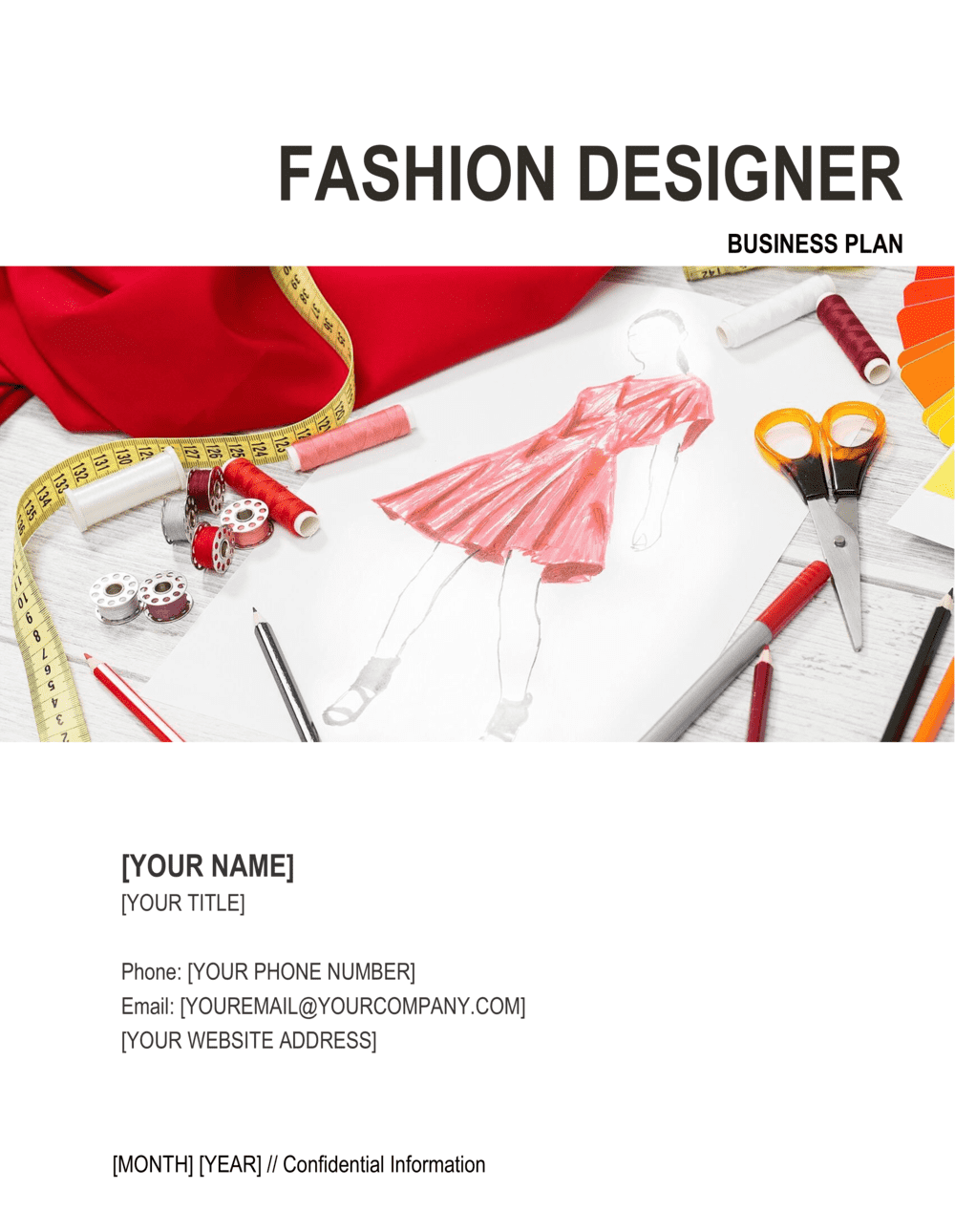
Fashion Designer Business Plan Template

Free Word download β€’ Edit online β€’ Save & share with Drive β€’ Export to PDF

37 pagesβ€’3h – 4h 5m to fillβ€’Difficulty: Expert
Learn more ↓
FreeFashion Designer Business Plan Template

At a glance

What it is
A Fashion Designer Business Plan is a structured document that maps your brand vision, target customer, collection strategy, production model, distribution channels, and 3-year financial projections into a single investor- and lender-ready file. This free Word download gives you a professionally formatted starting point you can edit online and export as PDF to share with buyers, backers, or accelerator programs.
When you need it
Use it when launching a new label, applying for a fashion incubator or grant, seeking wholesale buyer relationships, or raising capital from angel investors or boutique lenders who require a formal plan.
What's inside
Brand overview and mission, target market and customer profile, competitive positioning, collection and product strategy, marketing and sales channels, production and supply chain plan, management team, and financial projections including revenue model, cost of goods, and a 3-year P&L.

What is a Fashion Designer Business Plan?

A Fashion Designer Business Plan is a structured planning document that translates a clothing label's creative vision into a commercially viable strategy β€” covering brand identity, target customer, collection architecture, production sourcing, sales channels, and 3-year financial projections in a single file. Unlike a generic business plan, it accounts for the specific dynamics of the fashion industry: seasonal collection cadence, production deposit timing, wholesale buyer relationships, and the margin compression that comes from duties, freight, and chargebacks. This free Word download gives designers and founders a professionally formatted, investor-ready starting point they can edit online and export as PDF.

Why You Need This Document

Without a written fashion business plan, wholesale buyers decline to carry your line, incubator programs reject your application before reviewing the portfolio, and investors ask for financials you have not built. The consequences are concrete: trade show buyers expect a line sheet backed by a credible production and delivery schedule; SBA lenders require formal financial projections before approving a microloan; fashion accelerators evaluate commercial viability, not just aesthetic. Beyond external audiences, the plan forces you to validate your unit economics before committing production capital β€” catching margin errors, lead-time miscalculations, and channel conflicts before they become expensive mistakes in your first season. This template gives you the structure to build that foundation in weeks, not months.

Which variant fits your situation?

If your situation is…Use this template
Launching a luxury or couture label targeting high-net-worth customersLuxury Fashion Business Plan
Starting a sustainable or ethical clothing brandSustainable Fashion Business Plan
Opening a physical boutique or retail storeBoutique Business Plan
Quick internal planning or early concept validationOne-Page Business Plan
Launching a clothing e-commerce brand with no physical retailE-commerce Business Plan
Applying for a fashion grant or incubator programFashion Business Grant Proposal
Expanding an existing label into international wholesale marketsBusiness Expansion Plan

Common mistakes to avoid

❌ Overcrowding the first collection

Why it matters: Launching with 25+ SKUs requires more production capital than most early-stage brands have, fragments the brand story, and makes sell-through tracking complex. A weak sell-through on a large collection signals poor editing to future buyers.

Fix: Cap the debut collection at 10–14 styles. A tightly edited capsule that sells through at 80%+ is far more compelling to buyers and investors than a sprawling line with 50% sell-through.

❌ Ignoring production lead times in the financial model

Why it matters: A plan that models delivery in Month 3 but requires a 16-week production cycle will run out of cash before the first invoice is paid. This is the most common cause of first-year fashion startup failures.

Fix: Map every lead time β€” sampling, bulk production, freight, customs β€” to calendar dates and build those dates into the cash flow statement before projecting any revenue.

❌ Using aspirational competitors instead of actual ones

Why it matters: Comparing your brand to ChloΓ© when your customer buys Madewell tells investors and buyers you do not understand your real competitive set or your customer's actual spending behavior.

Fix: Identify the four brands your target customer currently buys in your price range and category. These are your real competitors β€” benchmark against their prices, channels, and margins.

❌ Projecting unrealistic gross margins in Year 1

Why it matters: First-year fashion brands routinely underestimate sampling costs, freight, duties, chargeback deductions, and production minimums that compress gross margins well below plan β€” sometimes turning projected profits into losses.

Fix: Model COGS to include fabric, CMT, trim, packaging, freight, duties, and a 5% contingency. Validate your wholesale price against at least three comparable brands before finalizing the model.

❌ Omitting a use-of-funds breakdown

Why it matters: A capital ask without a specific allocation β€” 'to launch the brand' β€” tells investors the founder has not stress-tested the execution plan. It signals financial inexperience and reduces funding credibility.

Fix: Break the funding request into at least four specific buckets: production deposit, marketing and trade show, e-commerce and photography, and working capital β€” with a dollar amount and timeline for each.

❌ Writing the target customer as a demographic range instead of a profile

Why it matters: Broad demographics like 'women 25–45' provide no strategic guidance for design decisions, pricing, channel selection, or content strategy β€” and signal a lack of customer research to experienced buyers.

Fix: Write a single-customer narrative: name, occupation, income, where she lives, what she values, which brands she already buys, and the specific gap your label fills for her.

The 10 key sections, explained

Executive Summary

Brand Overview and Mission

Target Market and Customer Profile

Competitive Analysis

Collection and Product Strategy

Marketing and Sales Strategy

Production and Supply Chain Plan

Management Team

Financial Projections

Funding Requirements and Use of Funds

How to fill it out

  1. 1

    Define your brand identity and mission

    Write a one-sentence mission that captures what the brand makes, who it is for, and the value it delivers. Establish the aesthetic direction, price point tier (mass, contemporary, designer, luxury), and the core values that will inform every business decision.

    πŸ’‘ A precise price-point declaration β€” e.g., 'contemporary womenswear at $150–$350 retail' β€” anchors your cost structure, channel choices, and competitor set from the start.

  2. 2

    Build a specific target customer profile

    Go beyond age and gender. Define income, geography, lifestyle, the brands she currently buys, and the gap in her wardrobe your label fills. Quantify the addressable market using at least two sources.

    πŸ’‘ Interview 10 real potential customers before writing this section. Specific quotes and behavioral data are far more persuasive to buyers and investors than demographic estimates alone.

  3. 3

    Map the competitive landscape honestly

    Identify four or more direct competitors at your price point and in your category. Document their retail prices, key stockists, and one specific weakness your brand addresses.

    πŸ’‘ Shop your competitors in person or online and document real price points and stocking levels β€” assumptions made from Instagram alone are usually wrong.

  4. 4

    Define your collection and SKU plan

    Decide on collection cadence (two seasons, four drops, or evergreen), the number of styles per release, your size run, and the price architecture from opening price to top-of-line. Keep the first collection to 10–14 SKUs.

    πŸ’‘ Calculate the production capital required for each style at your factory's MOQ before finalizing the SKU count β€” the collection plan must fit the funding available.

  5. 5

    Choose and prioritize your sales channels

    Select two primary channels for Year 1 β€” typically wholesale boutiques plus DTC e-commerce β€” and define a revenue target for each. Resist adding more channels until the first two are generating consistent sell-through.

    πŸ’‘ Research which trade shows your target buyers attend and build show dates into the production and cash flow timeline at the start β€” show fees, travel, and sample costs are frequently overlooked.

  6. 6

    Document your production and sourcing model

    Name your production partner, state the MOQ and lead time per style, identify your key fabric suppliers, and outline your quality-control process. Include a backup supplier if one is identified.

    πŸ’‘ Convert every lead time into calendar dates and map them against your collection delivery windows before writing the financial projections β€” production delays are the single most common cause of first-year cash flow crises.

  7. 7

    Build the financial model from unit economics

    Start with cost per garment (fabric, CMT, trim, freight, duties), set wholesale and retail prices, calculate gross margin per style, then multiply by projected units to build revenue. Model cash flow monthly for Year 1 to identify the production deposit timing.

    πŸ’‘ Include a column for chargebacks, freight allowances, and markdown support β€” wholesale accounts routinely deduct 3–8% from invoices for these items and the model must reflect this.

  8. 8

    Write the executive summary last

    Pull the single strongest data point from each section β€” market size, traction, gross margin, team credential, and funding ask β€” and compress them into one to two pages. The summary is a trailer for the full document.

    πŸ’‘ If a buyer or investor has 90 seconds, the executive summary must give them enough to request the full plan. Test it by reading it aloud β€” if it takes longer than two minutes, cut it.

Frequently asked questions

What is a fashion designer business plan?

A fashion designer business plan is a structured document that defines a clothing label's brand identity, target customer, collection strategy, production model, sales channels, and financial projections β€” typically covering three years. It serves as both an internal operating roadmap and an external document for raising capital from investors, securing wholesale accounts, or applying to fashion incubator programs.

What sections should a fashion business plan include?

A complete fashion designer business plan covers ten core sections: executive summary, brand overview and mission, target market and customer profile, competitive analysis, collection and product strategy, marketing and sales strategy, production and supply chain plan, management team, financial projections, and funding requirements with use of funds. The financial section should include a P&L, cash flow statement, and revenue model built from unit economics.

How long should a fashion business plan be?

For investor or wholesale buyer audiences, 20–30 pages is the accepted range. A plan submitted to a fashion incubator or grant program may have a page limit specified in the application β€” follow it exactly. A financial model and lookbook are typically attached as appendices and do not count toward the main page target.

How do I calculate gross margin for a fashion brand?

Gross margin equals revenue minus cost of goods sold, divided by revenue. For wholesale, calculate COGS as fabric plus CMT (cut, make, trim) plus freight, duties, and packaging β€” then divide your wholesale price minus COGS by your wholesale price. A healthy first-year wholesale gross margin is 45–55% after accounting for sampling costs and freight. DTC margins run higher (60–70%) but come with additional fulfillment and returns costs.

Do I need a business plan to apply to a fashion incubator?

Yes β€” virtually all fashion incubators and accelerators, including CFDA/Vogue Fashion Fund, LVMH Prize, and university-affiliated programs, require a formal business plan as part of the application. Requirements vary, but most ask for a brand overview, target market analysis, financial projections, and a funding or investment ask. Review each program's specific application criteria before adapting this template.

What financial projections should I include?

Include a monthly P&L for Year 1 and annual statements for Years 2–3, a cash flow statement showing production deposit timing and receivables lag, and a revenue model built from unit economics β€” styles Γ— units Γ— average selling price by channel. Also include a gross margin summary by channel (wholesale vs. DTC) and a funding requirements schedule showing the capital needed and when it will be deployed.

Can I use this template for both wholesale and DTC brands?

Yes β€” the template accommodates both distribution models. In the marketing and sales strategy section, allocate revenue targets by channel and describe the acquisition tactics specific to each. Wholesale and DTC carry different margin structures, cash flow timing, and inventory management requirements, so model them separately in the financial projections rather than blending them into a single revenue line.

How is a fashion business plan different from a standard business plan?

A fashion business plan adds collection and product strategy, production and supply chain planning, and a seasonal sales calendar that do not appear in a generic business plan. The financial model must account for the unique cash flow dynamics of fashion β€” production deposits paid months before delivery, wholesale invoices with Net 30–60 terms, and inventory risk from unsold seasonal stock. A standard business plan template does not capture these dynamics adequately.

How often should I update my fashion business plan?

Update the plan before any investor conversation, wholesale trade show, or grant application. Operationally, review the financial model against actuals after each season β€” sell-through rates, COGS variances, and channel performance should be reconciled and the forward projections adjusted. A plan that is more than one season out of date does not reflect the business you are actually running.

How this compares to alternatives

vs Boutique Business Plan

A boutique business plan is written for a retail store owner who curates and sells other designers' merchandise. A fashion designer business plan is written by the creator of an original label β€” it includes collection strategy, production sourcing, and wholesale channel development that a boutique plan does not address. Use the boutique plan if you are opening a store; use this plan if you are building a brand.

vs E-commerce Business Plan

An e-commerce business plan focuses on online store operations, digital acquisition, and platform logistics without addressing design, collection strategy, or wholesale. A fashion designer business plan covers all of these plus production sourcing and buyer relationships. Use the e-commerce plan if you are building a channel; use this plan if you are building a brand that sells through multiple channels including online.

vs One-Page Business Plan

A one-page plan is a rapid-alignment tool for early ideation and internal team discussions. It lacks the financial depth, competitive analysis, and production detail that trade show buyers, incubators, and investors require. Use the one-page plan to pressure-test an idea quickly, then build this full plan before any external presentation or capital raise.

vs Marketing Plan

A marketing plan covers brand positioning, campaign tactics, content strategy, and acquisition channels in detail β€” but contains no financial projections, production model, or funding requirements. A fashion business plan incorporates a marketing strategy section and connects it to revenue targets and budget allocations. Use a standalone marketing plan after the business plan is complete to build out campaign-level detail.

Industry-specific considerations

Womenswear and Ready-to-Wear

Two-season wholesale cadence, boutique and department store buyer relationships, trunk show strategy, and DTC e-commerce layered on top of wholesale.

Sustainable and Ethical Fashion

Certification costs (GOTS, Fair Trade), premium pricing rationale, ESG investor reporting metrics, and supply chain transparency documentation.

Streetwear and Lifestyle Brands

Drop model with limited SKUs and tight release windows, community-led DTC growth, influencer and collaboration strategy, and resale market dynamics.

Luxury and Couture

Made-to-order and bespoke production models, clienteling strategy, controlled distribution to avoid brand dilution, and high AUV with very low volume projections.

Template vs pro β€” what fits your needs?

PathBest forCostTime
Use the templateIndependent designers, early-stage labels, incubator applications, and SBA microloans under $150KFree3–5 weeks (50–80 hours)
Template + professional reviewSeed raises up to $500K, first wholesale trade show submissions, or fashion grant applications$500–$2,500 for a financial model review or fashion business advisor session4–6 weeks
Custom draftedInstitutional investors, LVMH Prize or CFDA Fund applications, or complex multi-category brand launches$3,000–$10,000 for a fashion-specialized business plan writer6–10 weeks

Glossary

Cost of Goods Sold (COGS)
The direct costs of producing a garment β€” fabric, trims, labor, and packaging β€” before any retail markup is applied.
Wholesale Price
The price at which a designer sells to a retailer, typically 2–2.5Γ— the cost of goods, which the retailer then marks up to the consumer price.
Keystone Markup
A standard retail pricing method that doubles the wholesale price to set the consumer retail price.
Direct-to-Consumer (DTC)
Selling finished goods directly to the end customer through an owned channel β€” e-commerce site, pop-up, or flagship store β€” bypassing wholesale intermediaries.
Collection
A cohesive group of garments and accessories designed around a unified theme, season, or aesthetic and presented together to buyers or consumers.
Lead Time
The total elapsed time from placing a production order to receiving finished goods β€” typically 90–120 days for overseas manufacturing.
Minimum Order Quantity (MOQ)
The smallest quantity a manufacturer will produce in a single run, which determines the minimum capital required per style.
Lookbook
A visual catalog β€” photography and styling β€” that presents a collection to buyers, press, and consumers and supports the marketing strategy.
Sell-Through Rate
The percentage of inventory sold at full price within a given season, a key metric for collection performance and markdown risk.
Capsule Collection
A small, tightly edited collection of 8–15 pieces designed to be versatile, seasonless, and commercially accessible β€” often used for a brand's first market entry.
Factoring
A financing arrangement where a fashion business sells its outstanding wholesale invoices to a third party at a discount in exchange for immediate cash.
SKU (Stock Keeping Unit)
A unique identifier for each distinct product variation β€” style, color, and size combination β€” used to track inventory and sales.

Part of your Business Operating System

This document is one of 3,000+ business & legal templates included in Business in a Box.

  • Fill-in-the-blanks β€” ready in minutes
  • 100% customizable Word document
  • Compatible with all office suites
  • Export to PDF and share electronically

Create your document in 3 simple steps.

From template to signed document β€” all inside one Business Operating System.
1
Download or open template

Access over 3,000+ business and legal templates for any business task, project or initiative.

2
Edit and fill in the blanks with AI

Customize your ready-made business document template and save it in the cloud.

3
Save, Share, Send, Sign

Share your files and folders with your team. Create a space of seamless collaboration.

Save time, save money, and create top-quality documents.

β˜…β˜…β˜…β˜…β˜…

"Fantastic value! I'm not sure how I'd do without it. It's worth its weight in gold and paid back for itself many times."

Managing Director Β· Mall Farm
Robert Whalley
Managing Director, Mall Farm Proprietary Limited
β˜…β˜…β˜…β˜…β˜…

"I have been using Business in a Box for years. It has been the most useful source of templates I have encountered. I recommend it to anyone."

Business Owner Β· 4+ years
Dr Michael John Freestone
Business Owner
β˜…β˜…β˜…β˜…β˜…

"It has been a life saver so many times I have lost count. Business in a Box has saved me so much time and as you know, time is money."

Owner Β· Upstate Web
David G. Moore Jr.
Owner, Upstate Web

Run your business with a system β€” not scattered tools

Stop downloading documents. Start operating with clarity. Business in a Box gives you the Business Operating System used by over 250,000 companies worldwide to structure, run, and grow their business.

Start freeΒ Β·Β No credit card required