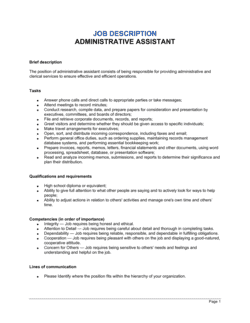
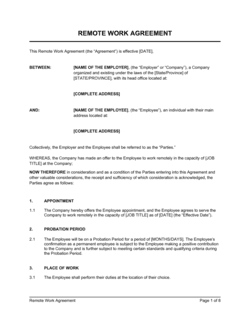
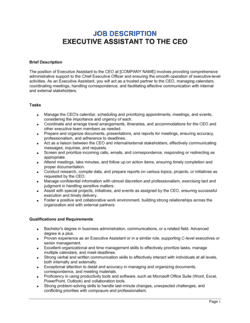
Executive Assistant 101 Template

Free Word download • Edit online • Save & share with Drive • Export to PDF

10 pages25–35 min to fillDifficulty: ComplexSignature requiredLegal review recommended
Learn more ↓
FreeExecutive Assistant 101 Template

At a glance

What it is
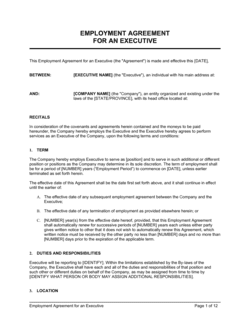
An Executive Assistant Agreement is a legally binding employment contract between an employer and a hired executive assistant that defines the full scope of the working relationship — duties, compensation, confidentiality obligations, and termination terms. This template is a free Word download you can edit online and export as PDF, covering the key provisions needed to onboard an EA with clear, enforceable terms in a single document.
When you need it
Use it before an executive assistant's first day whenever you are hiring someone who will have regular access to sensitive executive communications, calendars, financial data, strategic plans, or personal information. It is equally relevant for full-time, part-time, and contract-based EA roles.
What's inside
Parties and job title, duties and reporting structure, compensation and benefits, confidentiality and non-disclosure obligations, IP assignment, conflict of interest, termination and notice periods, and governing law.

What is an Executive Assistant Agreement?

An Executive Assistant Agreement is a legally binding employment contract between an employer and a hired executive assistant that governs every material dimension of the working relationship — job title and duties, compensation, confidentiality obligations, IP assignment, conflict-of-interest requirements, and termination terms. Unlike a generic offer letter or a standard employment contract, it is specifically calibrated to the elevated access an executive assistant has to sensitive information: executive communications, personal schedules, financial accounts, strategic plans, and often the private affairs of the executive and their family. A properly drafted agreement creates enforceable protections on both sides and eliminates the ambiguity that courts otherwise resolve using jurisdiction-specific defaults.

Why You Need This Document

Without a written executive assistant agreement, you are exposed in ways that a standard employment contract does not address. An EA who departs with no binding confidentiality obligations can freely share the executive's calendar, correspondence, client relationships, and household details. Without an IP assignment clause, custom workflow systems, contact databases, and communication templates the assistant built may not legally belong to the employer. And without clear termination terms, severance disputes are resolved by courts applying statutory defaults — often significantly more than the employer expected to pay. A signed agreement, executed before the assistant's first day, closes all of these gaps for the cost of a single document review, and gives both the executive and the assistant a clear, unambiguous record of what was agreed.

Which variant fits your situation?

If your situation is…Use this template
Hiring a full-time permanent executive assistant with benefitsExecutive Assistant Agreement (Full-Time)
Engaging a part-time or shared executive assistantPart-Time Employment Contract
Bringing on a freelance or contract executive assistantIndependent Contractor Agreement
Hiring an executive assistant for a defined project or interim periodFixed-Term Employment Contract
Onboarding a remote executive assistant in another state or countryRemote Work Employment Agreement
Hiring an executive-level personal assistant with household dutiesPersonal Services Agreement
Formalizing an EA role that transitions from contractor to employeeEmployment Contract (At-Will)

Common mistakes to avoid

❌ Signing the agreement after the first day of work

Why it matters: In common-law jurisdictions, a contract signed after employment has already begun lacks fresh consideration — IP assignment and confidentiality obligations may be unenforceable against the assistant.

Fix: Execute the agreement before or on the first day of work. If circumstances require a later signature, provide documented additional consideration — a bonus, raise, or extra PTO — at the time of signing.

❌ Using a generic employment contract instead of an EA-specific agreement

Why it matters: Standard employment contracts omit key EA provisions: personal-information confidentiality, financial account access controls, conflict-of-interest disclosures, and household or personal-schedule protections.

Fix: Use an agreement that explicitly addresses the categories of sensitive information an executive assistant handles, including personal and family matters the executive would not want disclosed.

❌ No conflict-of-interest clause for an assistant with financial authority

Why it matters: Executive assistants who manage vendor payments, expense accounts, or purchasing decisions have meaningful opportunity to act in ways that benefit personal interests — without a conflict-of-interest clause, the employer has no contractual basis to challenge or terminate that conduct.

Fix: Include a conflict-of-interest disclosure and prohibition clause, and separately document the scope and limits of any financial authority the assistant is granted.

❌ Vague or missing confidentiality definitions

Why it matters: A clause that says 'all company information is confidential' without specifics is routinely challenged in court — an overbroad definition can render the entire confidentiality obligation unenforceable.

Fix: Define Confidential Information with specific categories relevant to the role: executive communications, financial records, client and vendor contracts, personal schedule, household information, and strategic plans.

The 10 key clauses, explained

Parties, position, and start date

In plain language: Identifies the employer and the executive assistant as legal parties, states the job title, and records the official first day of employment.

Sample language
This Executive Assistant Agreement is entered into on [DATE] between [EMPLOYER LEGAL NAME], a [STATE/PROVINCE] [ENTITY TYPE] ('Employer'), and [EMPLOYEE FULL NAME] ('Executive Assistant'), commencing [START DATE] in the role of Executive Assistant to [EXECUTIVE TITLE].

Common mistake: Using a trade name rather than the employer's registered legal entity name — making it difficult to enforce IP assignment or confidentiality obligations against the correct legal entity.

Duties and reporting structure

In plain language: Describes the core responsibilities of the role — calendar management, travel coordination, correspondence, and special projects — and identifies who the assistant reports to.

Sample language
The Executive Assistant shall perform the duties set out in Schedule A, including but not limited to managing [EXECUTIVE NAME]'s calendar, coordinating travel, handling confidential correspondence, and such other duties as reasonably assigned by Employer.

Common mistake: Defining duties so narrowly that routine task expansion requires a contract amendment — or so broadly that performance management becomes impossible when specific deliverables are disputed.

Compensation, benefits, and expenses

In plain language: States the base salary or hourly rate, payment frequency, bonus eligibility, benefits entitlements, and the policy for reimbursing work-related expenses.

Sample language
Employer shall pay Executive Assistant a base salary of $[AMOUNT] per year, payable [bi-weekly / semi-monthly]. Executive Assistant is eligible to participate in Employer's standard benefits program. Reasonable business expenses shall be reimbursed within [30] days of submission with supporting receipts.

Common mistake: Detailing specific benefit plan coverage inside the contract body — when plans change annually, locked-in specifics create amendment obligations or unmet expectations.

Confidentiality and non-disclosure

In plain language: Prohibits the assistant from disclosing or misusing the employer's confidential information — including executive communications, financial data, personnel matters, and strategic plans — during and after employment.

Sample language
Executive Assistant shall not, during or after employment, disclose or use any Confidential Information of Employer without prior written consent. 'Confidential Information' means any non-public information relating to Employer's business, finances, personnel, clients, or the personal affairs of [EXECUTIVE NAME].

Common mistake: Failing to include personal or household information in the definition of 'Confidential Information' for EAs supporting senior executives — leaving private calendar details, travel itineraries, and family matters unprotected.

Intellectual property assignment

In plain language: Assigns to the employer all documents, templates, systems, or processes the executive assistant creates in connection with their role.

Sample language
All work product, documents, templates, scheduling systems, and other materials created by Executive Assistant in the course of employment are the sole property of Employer and are hereby irrevocably assigned to Employer.

Common mistake: Omitting an IP assignment clause entirely on the assumption that an administrative role produces no valuable IP — ignoring that custom workflow systems, communication templates, and contact databases have real business value.

Conflict of interest

In plain language: Requires the assistant to disclose any outside employment, business interests, or personal relationships that could create a conflict with their duties.

Sample language
Executive Assistant shall promptly disclose to Employer any outside employment, consulting arrangement, financial interest, or personal relationship that could reasonably create a conflict of interest with the performance of duties under this Agreement.

Common mistake: No conflict-of-interest clause at all — particularly risky for EAs who manage vendor relationships, authorize purchases, or control access to the executive's financial accounts.

Confidentiality of personal and household matters

In plain language: Extends non-disclosure obligations specifically to personal information about the executive and their family — travel schedules, medical appointments, household staff, and financial accounts.

Sample language
Executive Assistant acknowledges that duties may include access to personal information concerning [EXECUTIVE NAME] and their family members. Such information is Confidential Information and must not be disclosed to any third party without prior written consent.

Common mistake: Treating personal executive information identically to standard business confidentiality — EAs often need an explicit clause covering household, medical, and personal-finance data because courts apply different standards to personal versus corporate information.

Termination, notice, and severance

In plain language: Sets the notice period required for voluntary resignation or employer-initiated termination, conditions that allow immediate termination for cause, and the severance formula.

Sample language
Either party may terminate this Agreement with [X weeks'] written notice. Employer may terminate for Cause immediately without notice or severance. In the event of termination without Cause, Executive Assistant shall receive [Y weeks per year of service] severance, subject to execution of a release.

Common mistake: A severance formula that falls below statutory minimums in the applicable jurisdiction — the statutory floor applies regardless of what the contract says, and a lower number can void the release the employer sought in exchange.

Governing law and dispute resolution

In plain language: Specifies which jurisdiction's employment law governs the agreement and how disputes are handled — mediation, arbitration, or litigation.

Sample language
This Agreement is governed by the laws of [STATE / PROVINCE / COUNTRY]. Any dispute arising under this Agreement shall first be submitted to mediation, and if unresolved, to binding arbitration administered by [AAA / JAMS] in [CITY], except claims for injunctive relief.

Common mistake: Choosing a governing law with no meaningful connection to where the assistant actually performs work — several jurisdictions apply local employment law regardless of the chosen governing law clause.

Entire agreement and amendments

In plain language: Confirms the written contract is the complete and exclusive record of agreed terms, superseding all prior discussions, offer letters, and verbal promises.

Sample language
This Agreement constitutes the entire agreement between the parties concerning the subject matter hereof and supersedes all prior representations, negotiations, and agreements, whether written or oral. Any amendment must be in writing and signed by both parties.

Common mistake: No entire-agreement clause, allowing the assistant to introduce prior email exchanges or verbal promises as contractual terms that override the written document.

How to fill it out

  1. 1

    Enter the parties' legal names and the effective date

    Use the employer's full registered entity name — not a brand name — and the assistant's legal name as it appears on government-issued identification. Record the date the agreement is signed, not the start date.

    💡 Cross-reference your corporate registry filing to confirm the exact legal entity name before the agreement is executed.

  2. 2

    Define the role, duties, and reporting line

    State the job title, the name or title of the executive the assistant supports, and reference a Schedule A for the detailed duty list. This keeps the main agreement clean while allowing duty updates without a full contract amendment.

    💡 Have the assistant initial Schedule A separately at signing to confirm they reviewed and accepted the full scope of duties.

  3. 3

    Set the compensation structure and expense policy

    Enter the base salary or hourly rate, pay frequency, any bonus eligibility, and reference the company's benefits plan by category only. Specify the expense reimbursement window — 30 days is standard — and any per-item approval threshold.

    💡 State the currency explicitly for any assistant working in a country different from the employer's home jurisdiction.

  4. 4

    Tailor the confidentiality clause to the role's actual access

    List the categories of information the assistant will specifically encounter — executive communications, financial accounts, personal schedule, household staff, client details — and include these explicitly in the definition of Confidential Information.

    💡 For EAs supporting high-profile executives, add a separate personal-information clause covering family members, medical appointments, and personal financial accounts, which courts may treat differently from business data.

  5. 5

    Include an IP assignment and conflict-of-interest declaration

    Assign all work product — documents, templates, contact databases, workflow systems — to the employer. Add a conflict-of-interest disclosure requirement and, if the role involves financial authority, a prohibition on unauthorized transactions.

    💡 If the assistant will have signing authority or access to financial accounts, consider a separate authorization schedule rather than embedding limits in the main agreement body.

  6. 6

    Set termination notice periods and the severance formula

    Specify the notice period for both voluntary and employer-initiated termination, define what constitutes termination for cause, and set a severance formula expressed as weeks of base pay per year of service.

    💡 Check the statutory minimum in the employee's work location before finalizing the notice period and severance formula — contractual terms below the statutory floor are automatically replaced by the legal minimum.

  7. 7

    Choose the governing law and dispute resolution method

    Select the jurisdiction whose employment law will govern the agreement — ideally the state or province where the assistant primarily performs work. Choose between mediation-first, binding arbitration, or court proceedings for dispute resolution.

    💡 Arbitration clauses are generally enforceable for employment agreements in the US, but California imposes specific procedural requirements — confirm local rules if the assistant works in California.

  8. 8

    Sign before the start date and retain executed copies

    Both parties must sign before or on the first day of work. Post-start-date signatures raise a fresh-consideration problem in common-law jurisdictions that can void restrictive covenants. Store a signed PDF copy in a secure HR file and provide the assistant with their own executed copy.

    💡 Use an e-signature platform to timestamp execution — this eliminates disputes about when the agreement was signed relative to the start date.

Frequently asked questions

What is an executive assistant agreement?

An executive assistant agreement is a legally binding employment contract between an employer and an executive assistant that defines the terms of their working relationship — duties, compensation, confidentiality obligations, IP assignment, and termination conditions. Unlike a general offer letter, it creates enforceable protections around the sensitive information an EA routinely handles and eliminates ambiguity about what the assistant can and cannot do with that information after leaving.

Do I need a written agreement for an executive assistant?

A written agreement is not always legally required, but it is strongly recommended for any EA role. Executive assistants typically access sensitive executive communications, financial records, personal schedules, and strategic plans. Without a written agreement, the employer has no enforceable confidentiality or IP assignment obligations, and termination disputes are resolved by jurisdiction-specific defaults — usually more favorable to the employee.

What should an executive assistant agreement include?

At minimum: parties and job title, start date, duties and reporting structure, compensation and benefits, confidentiality and non-disclosure, IP assignment, conflict-of-interest obligations, personal-information protections, termination notice periods, severance formula, and governing law. EA-specific agreements should go further than standard employment contracts by explicitly covering personal and household information, financial account access controls, and the executive's private schedule.

Can an executive assistant be classified as an independent contractor?

In some cases, yes — but misclassification risk is high for EA roles. Tax authorities in the US, Canada, and the UK apply multi-factor tests that look at behavioral control, financial control, and the type of relationship. An EA who works exclusively for one employer, follows a set schedule, and uses employer-provided equipment is almost always an employee. Misclassifying an EA as a contractor triggers back taxes, penalties, and benefit liability. Use an independent contractor agreement only when the role genuinely meets the contractor criteria in your jurisdiction.

What confidentiality obligations should an executive assistant have?

An executive assistant should be contractually bound to protect business confidential information — executive communications, financial data, client and vendor relationships, and strategic plans — as well as personal information about the executive and their family, including travel itineraries, medical appointments, household staff details, and personal financial accounts. Confidentiality obligations typically survive termination and should be written to extend for the lifetime of the information or a defined number of years.

How much notice should an executive assistant give or receive?

Two to four weeks is the standard notice period for EA roles in the US. In Canada, provincial Employment Standards Acts set statutory minimums of one week per year of service (typically capped at eight weeks), and common-law notice for long-tenured employees can run significantly higher. In the UK, the statutory minimum is one week per year of service after two years, capped at 12 weeks. The written agreement should match or exceed the applicable statutory minimum.

Is a non-compete clause appropriate for an executive assistant?

Post-employment non-competes for EAs are generally harder to enforce than for senior executives because the assistant typically does not hold proprietary competitive knowledge of the kind courts consider necessary to justify restricting future employment. A well-drafted confidentiality and non-disclosure clause with a clear definition of protected information provides more reliable and enforceable protection in most jurisdictions than a broad non-compete.

What happens if the executive assistant agreement is signed after the start date?

In common-law jurisdictions — including the US, Canada, the UK, and Australia — a contract requires fresh consideration to be enforceable. An employee who has already started work has given nothing new in exchange for post-start restrictions, meaning confidentiality obligations and IP assignment clauses signed after day one may be voided by a court. The fix is to execute before or on the first day of work, or to provide documented additional compensation — a bonus, salary increase, or extra leave — as fresh consideration at the time of signing.

What law governs an executive assistant agreement?

The governing law should be the jurisdiction where the assistant primarily performs work — typically the state or province of the employer's principal office or the assistant's home location for remote roles. Several jurisdictions apply their local employment law regardless of what the contract specifies — California, for example, applies its own labor code to any work performed in the state. In cross-border arrangements, legal review is recommended to confirm which jurisdiction's mandatory employment standards apply.

How this compares to alternatives

vs Employment Contract (General)

A general employment contract covers the universal elements of an employment relationship but omits EA-specific provisions such as personal-information confidentiality, financial account access controls, and executive schedule protections. An executive assistant agreement is calibrated to the specific sensitivity and scope of an EA role and provides more targeted protections for both parties.

vs Independent Contractor Agreement

An independent contractor agreement engages a self-employed individual for project-based work without employment entitlements — no benefits, no tax withholding, no overtime. EA roles that involve exclusive, ongoing work for a single employer almost always meet the employee definition under IRS and CRA tests. Misclassifying an EA as a contractor can trigger significant tax and benefit liability.

vs Non-Disclosure Agreement (NDA)

A standalone NDA covers confidentiality obligations only. An executive assistant agreement includes confidentiality as one of several integrated provisions alongside compensation, duties, IP assignment, and termination — creating a single enforceable document that governs the entire relationship. Using only an NDA leaves the employer without enforceable employment terms and creates ambiguity about the nature of the engagement.

vs Executive Employment Agreement

An executive employment agreement is designed for C-suite and VP-level hires — it adds equity vesting, change-of-control provisions, D&O indemnification, and enhanced severance that are inappropriate for an EA role. An executive assistant agreement is calibrated to the support function: it emphasizes confidentiality of the executive's information, personal-information protections, and administrative scope rather than governance or equity terms.

Industry-specific considerations

Financial services

EAs in financial services handle account statements, trading instructions, and client financial data — enhanced confidentiality provisions and explicit financial account access controls are standard.

Technology / SaaS

EAs supporting tech executives often manage product roadmap documents, board meeting materials, and investor communications, making IP assignment and confidentiality scope particularly critical.

Legal and professional services

Attorneys and professional services executives require EA agreements that acknowledge privilege considerations and expressly extend confidentiality to client matter information.

Healthcare

EAs working for healthcare executives may access patient information indirectly — the agreement should reference HIPAA compliance obligations and prohibit any unauthorized disclosure of protected health information.

Entertainment and media

High-profile executives in entertainment require robust personal-information clauses covering talent schedules, deal negotiations, public appearance logistics, and family privacy protections.

Retail and e-commerce

EAs supporting retail CEOs often handle vendor pricing, supply chain negotiations, and promotional strategy data — confidentiality provisions should explicitly cover commercial and pricing information.

Jurisdictional notes

United States

At-will employment is the default in 49 states, allowing termination at any time for any lawful reason. Federal FLSA rules govern overtime and minimum wage; EAs classified as exempt must meet the salary and duties tests. California imposes strict limitations on confidentiality clauses that restrict an employee's right to report illegal conduct, and its labor code restricts IP assignment for off-duty inventions. Non-compete clauses for EAs are difficult to enforce in California, Minnesota, and several other states.

Canada

At-will employment does not exist in Canada. Provincial Employment Standards Acts set mandatory minimums for notice and termination pay — agreements that provide less are void to that extent. Common-law notice for long-tenured EAs can exceed statutory minimums substantially. Quebec employers in provincially regulated industries must provide contracts in French. Confidentiality obligations are generally enforceable if reasonably scoped.

United Kingdom

Employers must provide a written statement of employment particulars on or before the first day. Statutory minimum notice is one week per year of service after two years, capped at 12 weeks. Post-employment confidentiality obligations are enforceable if reasonable in scope and duration. Data protection obligations under the UK GDPR apply to any personal information the EA processes on behalf of the employer.

European Union

The EU Transparent and Predictable Working Conditions Directive requires written employment terms within seven days of the start date. GDPR applies to any personal data the EA processes in the course of their duties — the agreement should reference the employer's data processing policy and the assistant's obligations as an authorized processor. Minimum notice and severance vary significantly by member state; France, Germany, and Spain impose some of the strongest employee protections.

Template vs lawyer — what fits your deal?

PathBest forCostTime
Use the templateStandard domestic EA hires below senior management in a single US state or Canadian provinceFree20–30 minutes
Template + legal reviewEAs with financial account access, cross-border arrangements, or executives in regulated industries$300–$6001–3 days
Custom draftedHigh-profile executives, household-level EA roles with significant personal-information exposure, or multi-jurisdiction engagements$1,000–$3,500+1–2 weeks

Glossary

Executive Assistant
A professional employed to manage an executive's schedule, communications, travel, and administrative tasks, often with access to sensitive business information.
Confidential Information
Any non-public data the assistant encounters in the role — including executive communications, financial records, client details, and strategic plans — that the employer designates as protected.
Non-Disclosure Obligation
A contractual duty prohibiting the assistant from sharing, using, or reproducing the employer's confidential information during or after employment.
At-Will Employment
An employment arrangement in most US states where either party may end the relationship at any time for any lawful reason, without cause or advance notice beyond what the contract specifies.
IP Assignment
A clause that transfers ownership of any work product, documents, schedules, or systems the assistant creates in the course of employment to the employer.
Conflict of Interest
A situation in which the assistant's personal interests or outside activities could compromise their duties or loyalty to the employer.
Probationary Period
An initial evaluation window — typically 30 to 90 days — during which performance is assessed and termination formalities are reduced.
Garden Leave
A notice period during which the departing employee is paid but required to stay away from the workplace and refrain from taking on new employment.
Severance
Compensation paid to the employee upon termination without cause, typically expressed as a number of weeks' pay per year of service.
Entire Agreement Clause
A provision stating that the written contract supersedes all prior verbal or written representations and is the sole binding record of the agreed terms.
Fiduciary Duty
An obligation of trust and loyalty — relevant for EAs who manage financial accounts, execute payments, or act on behalf of the executive — requiring them to act in the employer's best interest.

Part of your Business Operating System

This document is one of 3,000+ business & legal templates included in Business in a Box.

  • Fill-in-the-blanks — ready in minutes
  • 100% customizable Word document
  • Compatible with all office suites
  • Export to PDF and share electronically

Create your document in 3 simple steps.

From template to signed document — all inside one Business Operating System.
1
Download or open template

Access over 3,000+ business and legal templates for any business task, project or initiative.

2
Edit and fill in the blanks with AI

Customize your ready-made business document template and save it in the cloud.

3
Save, Share, Send, Sign

Share your files and folders with your team. Create a space of seamless collaboration.

Save time, save money, and create top-quality documents.

★★★★★

"Fantastic value! I'm not sure how I'd do without it. It's worth its weight in gold and paid back for itself many times."

Managing Director · Mall Farm
Robert Whalley
Managing Director, Mall Farm Proprietary Limited
★★★★★

"I have been using Business in a Box for years. It has been the most useful source of templates I have encountered. I recommend it to anyone."

Business Owner · 4+ years
Dr Michael John Freestone
Business Owner
★★★★★

"It has been a life saver so many times I have lost count. Business in a Box has saved me so much time and as you know, time is money."

Owner · Upstate Web
David G. Moore Jr.
Owner, Upstate Web

Run your business with a system — not scattered tools

Stop downloading documents. Start operating with clarity. Business in a Box gives you the Business Operating System used by over 250,000 companies worldwide to structure, run, and grow their business.

Free Forever Plan · No credit card required