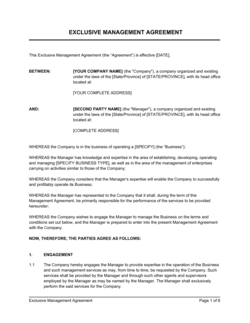
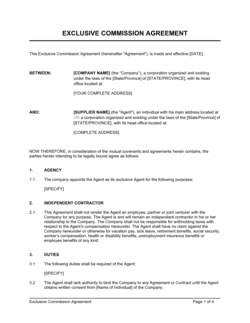
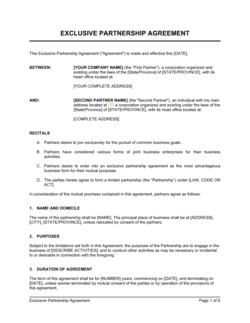
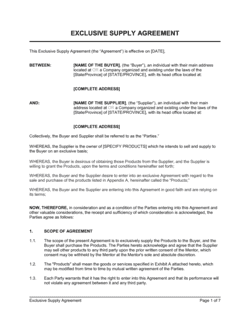
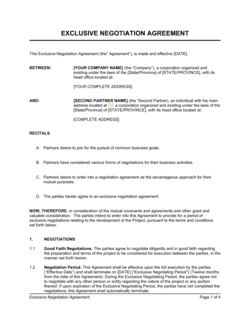
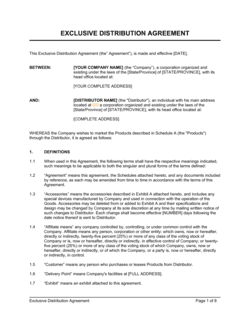
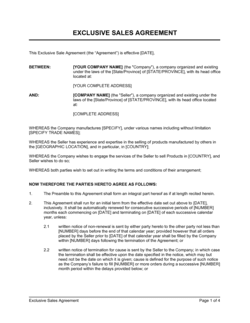
Exclusivity Agreement Template

Free Word download • Edit online • Save & share with Drive • Export to PDF

8 pages30–40 min to fillDifficulty: ComplexSignature requiredLegal review recommended
Learn more ↓
FreeExclusivity Agreement Template

At a glance

What it is
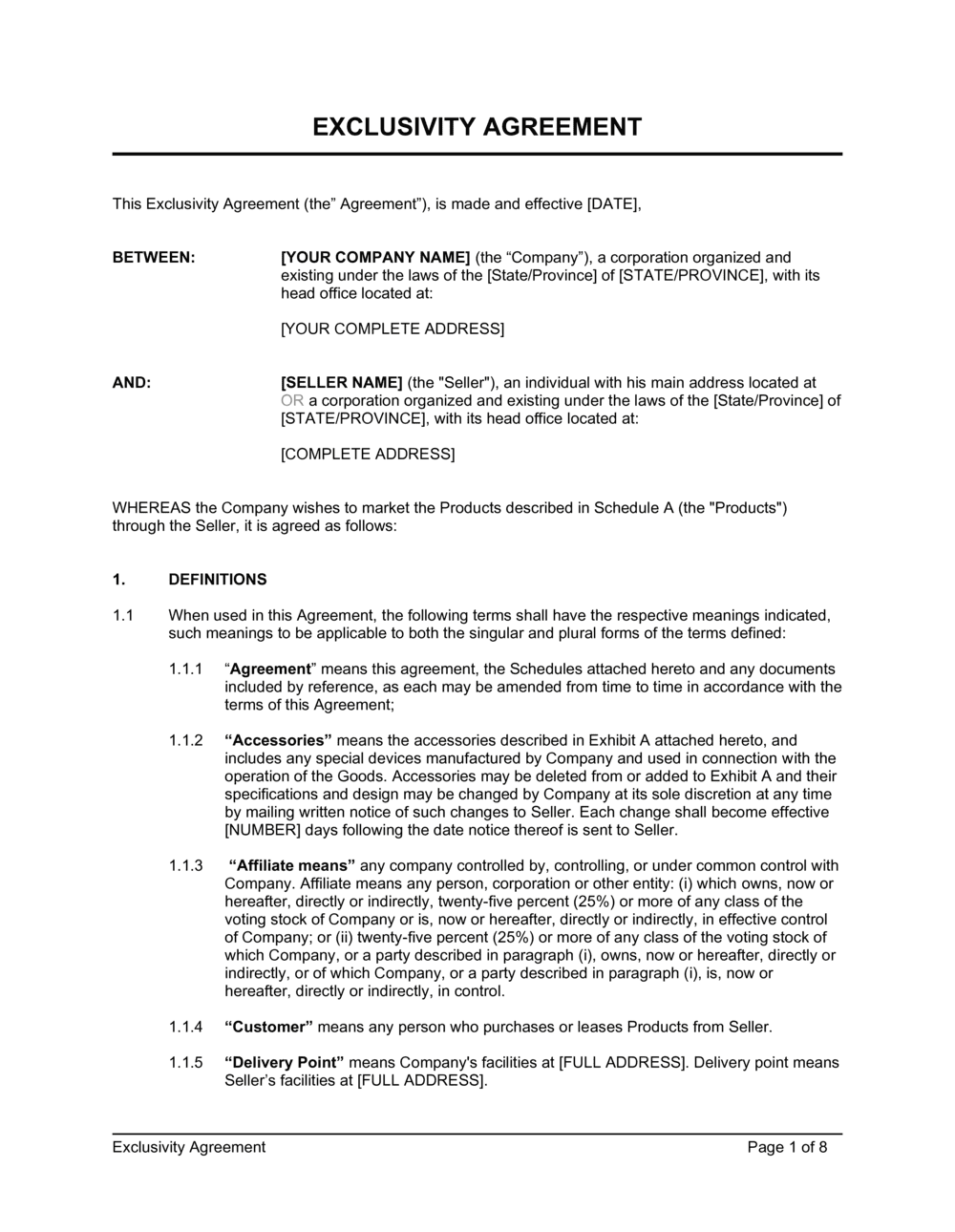
An Exclusivity Agreement is a legally binding contract in which one party commits, for a defined period, to deal exclusively with the other in a specified market, channel, or transaction — and to refrain from negotiating or contracting with third-party competitors or alternative buyers. This free Word download covers the exclusivity period, geographic and product scope, permitted exceptions, breach consequences, and termination, and can be exported as PDF and signed in minutes.
When you need it
Use it when entering M&A due diligence, locking in a distribution or supply partner, or protecting a negotiation from being shopped to competitors while a deal is being structured. It is triggered any time one party needs assurance that the other will not simultaneously pursue competing arrangements.
What's inside
Defined exclusivity period with start and end dates, precise scope of the exclusive relationship by geography, product, and channel, carve-outs and permitted exceptions, exclusivity fee or consideration provisions, breach remedies and break-up fee mechanics, confidentiality obligations during the exclusive period, and governing law and dispute resolution.

What is an Exclusivity Agreement?

An Exclusivity Agreement is a legally binding contract under which one party — the restricted party — commits, for a defined period, to deal exclusively with the other party in a specified market, channel, or transaction, and to refrain from soliciting, negotiating with, or entering arrangements with third-party competitors or alternative counterparties during that window. The agreement defines the scope of the restriction by geography, product category, and transaction type; sets the duration of the exclusive period with a hard end date; establishes the consideration or fee paid in exchange for the commitment; and specifies the break-up fee and remedies that apply if the restriction is breached. It functions as a temporary but enforceable lock-in mechanism that protects the beneficiary's investment of time, diligence costs, and negotiating effort from being undermined by a competing deal.

Why You Need This Document

Without a signed exclusivity agreement, the party on the other side of a negotiation or partnership discussion is free to simultaneously pursue competing buyers, distributors, or suppliers — and to use the information and terms you have shared to drive a better offer elsewhere. In M&A, an unprotected due diligence period routinely results in competing bids that inflate price or collapse the deal entirely. In distribution and supply, a supplier who has not committed to exclusivity can grant the same territory to a competitor the following week. A properly drafted exclusivity agreement closes that window: it creates an enforceable obligation backed by a meaningful break-up fee, preserves your right to seek injunctive relief if the restriction is violated, and signals to the other party that you are a serious counterparty investing real resources in the relationship. This template gives you a complete, attorney-reviewed starting point in Word format — ready to execute in under an hour for straightforward arrangements, and structured to support legal review for higher-stakes transactions.

Which variant fits your situation?

If your situation is…Use this template
Protecting M&A negotiations from competing bids during due diligenceExclusivity Agreement (M&A / No-Shop)
Granting a distributor sole rights in a defined territoryExclusive Distribution Agreement
Locking in an exclusive supplier for a product or componentExclusive Supply Agreement
Licensing IP or a brand to a single licensee in a marketExclusive License Agreement
Protecting confidential information shared during the exclusivity periodNon-Disclosure Agreement
Formalizing the full transaction after the exclusivity period endsLetter of Intent
Preventing a former partner from dealing with competitors post-agreementNon-Compete Agreement

Common mistakes to avoid

❌ Duration without a hard end date

Why it matters: When the exact signing date is later disputed, a duration-only clause leaves the expiry date uncertain — potentially extending or shortening the period unintentionally.

Fix: Always state both the duration and the calculated calendar end date in the same clause so there is no ambiguity regardless of when the signature date is contested.

❌ No consideration for the exclusivity commitment

Why it matters: A standalone exclusivity agreement with only 'mutual promises' as consideration may be unenforceable in jurisdictions that require independent consideration for a restriction of this type.

Fix: Include a specific exclusivity fee, a documented concession, or a binding reciprocal obligation that constitutes real consideration beyond the agreement itself.

❌ Scope so broad it covers existing operations

Why it matters: If the restricted party already has third-party contracts that fall within the exclusivity scope, the agreement creates an immediate breach on day one and gives the counterparty leverage to claim damages.

Fix: Attach a Schedule A carving out all pre-existing arrangements and tailor the scope to the specific transaction or product category under negotiation.

❌ No-talk clause without a fiduciary-out for corporate sellers

Why it matters: Boards of public or investor-backed companies have fiduciary duties to consider superior offers — a blanket no-talk clause can expose directors to liability and may be voided by a court.

Fix: Add a fiduciary-out carve-out allowing the board to engage with and accept a superior unsolicited offer, subject to notice to the other party and payment of the break-up fee.

❌ Break-up fee set too low to deter breach

Why it matters: A nominal break-up fee is cheaper to pay than to honor the exclusivity — it functions as an option to exit rather than a genuine deterrent, undermining the entire purpose of the agreement.

Fix: Set the fee at 1–3% of deal value for M&A transactions or at a level that genuinely compensates for diligence costs and opportunity cost, and document the rationale in the recitals.

❌ No survival clause for confidentiality and accrued obligations

Why it matters: Without explicit survival language, termination of the exclusivity agreement can be read to extinguish confidentiality obligations and break-up fee liability at the same moment.

Fix: List each obligation that survives termination by section number and state the survival period — 'Section [X] shall survive for two years following the date of termination' eliminates the ambiguity.

The 10 key clauses, explained

Parties and Recitals

In plain language: Identifies the contracting parties by full legal name and entity type, and describes the context and purpose of the exclusivity arrangement.

Sample language
This Exclusivity Agreement is entered into as of [DATE] between [PARTY A LEGAL NAME], a [STATE/COUNTRY] [ENTITY TYPE] ('Buyer'), and [PARTY B LEGAL NAME], a [STATE/COUNTRY] [ENTITY TYPE] ('Seller'). The parties are engaged in preliminary discussions regarding [TRANSACTION DESCRIPTION] and wish to establish an exclusive negotiating period on the terms set out herein.

Common mistake: Using trade names instead of registered legal entity names. If the party name on the agreement doesn't match the party name on the subsequent definitive agreement, enforcing breach remedies or break-up fees becomes procedurally complicated.

Exclusivity Period

In plain language: Sets the precise start and end dates of the exclusive window and the conditions under which it may be extended or will automatically lapse.

Sample language
The Exclusivity Period shall commence on [START DATE] and expire at 11:59 p.m. [TIME ZONE] on [END DATE], unless earlier terminated pursuant to Section [X] or extended by written agreement of both parties. Time is of the essence with respect to this Section.

Common mistake: Stating a duration without a hard end date. 'Sixty days from signing' creates ambiguity when the signing date is disputed — always include both the duration and the calculated calendar date.

Scope of Exclusivity

In plain language: Defines exactly what the restricted party cannot do — and with whom — by specifying the geography, product or service category, and transaction type covered.

Sample language
During the Exclusivity Period, [RESTRICTED PARTY] shall not, directly or indirectly, solicit, initiate, encourage, or participate in discussions or negotiations with any third party regarding [DESCRIPTION OF RESTRICTED ACTIVITY] in [GEOGRAPHIC TERRITORY] with respect to [PRODUCT/SERVICE/TRANSACTION TYPE].

Common mistake: Drafting scope so broadly that it inadvertently covers the restricted party's existing business operations. Overly wide scope clauses are challenged in court and may void the entire restriction.

No-Shop and No-Talk Obligations

In plain language: Specifies whether the restriction covers only active solicitation (no-shop) or also passive receipt of unsolicited approaches (no-talk), and any permitted exceptions.

Sample language
During the Exclusivity Period, [RESTRICTED PARTY] shall not (a) solicit, initiate, or encourage any Acquisition Proposal from any third party, or (b) [if no-talk applies:] participate in any discussion or negotiation regarding any Acquisition Proposal, whether or not solicited. 'Acquisition Proposal' means any offer or proposal relating to [TRANSACTION DESCRIPTION].

Common mistake: Including a no-talk clause without a fiduciary-out carve-out for corporate sellers with public shareholders. Courts have found that boards cannot contractually bind themselves to ignore superior offers when they have a fiduciary duty to maximize shareholder value.

Permitted Exceptions and Carve-Outs

In plain language: Lists specific activities or pre-existing arrangements that are explicitly excluded from the exclusivity restriction so the restricted party retains freedom to operate its normal business.

Sample language
Notwithstanding the foregoing, the exclusivity obligations of Section [X] shall not apply to: (a) any transaction or arrangement entered into prior to [EFFECTIVE DATE] as listed in Schedule A; (b) ordinary-course sales transactions individually below $[THRESHOLD]; and (c) any activity required by applicable law or regulatory authority.

Common mistake: Omitting a carve-out for pre-existing contracts. If the restricted party has an existing distribution arrangement with a third party that technically falls within the exclusivity scope, the omission creates an immediate breach on day one.

Consideration and Exclusivity Fee

In plain language: States what the beneficiary of exclusivity pays or provides as consideration for the other party's commitment to forgo competing opportunities.

Sample language
In consideration of the exclusivity obligations set forth herein, [BENEFICIARY PARTY] shall pay [RESTRICTED PARTY] a non-refundable exclusivity fee of $[AMOUNT] within [X] business days of the Effective Date. This fee [shall / shall not] be credited against the purchase price or other consideration payable under any definitive agreement.

Common mistake: Providing no consideration for the exclusivity commitment beyond 'mutual promises.' In several jurisdictions, an exclusivity obligation unsupported by independent consideration — particularly a fee or a meaningful concession — may be unenforceable as a standalone agreement.

Breach Remedies and Break-Up Fee

In plain language: Sets out the consequences of a breach — typically a liquidated damages or break-up fee — and preserves the non-breaching party's right to seek injunctive relief.

Sample language
In the event [RESTRICTED PARTY] breaches any obligation under this Agreement, [BENEFICIARY PARTY] shall be entitled to: (a) a break-up fee of $[AMOUNT] as liquidated damages; and (b) seek injunctive or other equitable relief without the requirement to post bond. The break-up fee represents the parties' reasonable estimate of damages and is not a penalty.

Common mistake: Setting a break-up fee so low that it is cheaper to breach than to honor the exclusivity. A nominal fee provides no real deterrent and signals to counterparties that the restriction is not seriously intended.

Confidentiality During the Exclusivity Period

In plain language: Requires both parties to keep confidential all information exchanged during due diligence or negotiations within the exclusive window.

Sample language
Each party agrees to keep confidential all non-public information received from the other party during the Exclusivity Period and to use such information solely for the purpose of evaluating [TRANSACTION DESCRIPTION]. This obligation shall survive termination of this Agreement for a period of [X] years.

Common mistake: Relying solely on a separate NDA and omitting confidentiality from the exclusivity agreement itself. If the NDA is challenged or narrower in scope than the exclusivity arrangement, information exchanged during the exclusive period may not be protected.

Termination

In plain language: Defines the events that end the exclusivity early — expiry of the period, execution of a definitive agreement, mutual written consent, or material breach.

Sample language
This Agreement shall terminate upon the earliest of: (a) the expiry of the Exclusivity Period; (b) execution of a definitive agreement between the parties with respect to [TRANSACTION]; (c) written agreement of both parties to terminate; or (d) [X] business days following written notice of a material breach if such breach remains uncured.

Common mistake: Not specifying what happens to accrued obligations — confidentiality, break-up fee liability — upon termination. 'This Agreement terminates' without survival language can extinguish obligations the parties intended to survive.

Governing Law and Dispute Resolution

In plain language: Specifies the jurisdiction whose laws govern the agreement and the mechanism for resolving disputes — arbitration, mediation, or litigation.

Sample language
This Agreement is governed by the laws of [STATE/PROVINCE/COUNTRY], without regard to conflict-of-law principles. Any dispute arising under or in connection with this Agreement shall be resolved by [binding arbitration before [AAA/JAMS] in [CITY] / litigation in the courts of [JURISDICTION]], and the parties consent to exclusive jurisdiction therein.

Common mistake: Choosing a governing law with no connection to where either party operates. Some jurisdictions — particularly Delaware for US M&A and England for international deals — are chosen precisely for their developed case law on exclusivity and M&A agreements, but only if both parties operate under or consent to those courts.

How to fill it out

  1. 1

    Identify the parties with full legal entity names

    Enter the registered legal name, entity type (corporation, LLC, partnership), and state or country of incorporation for both parties. Assign clear defined terms — 'Buyer' and 'Seller', or 'Company' and 'Distributor' — that you will use consistently throughout.

    💡 Check the exact registered name against a corporate registry filing — discrepancies between the agreement name and the registry name complicate enforcement.

  2. 2

    Set precise exclusivity period dates

    Enter both the start date and the hard calendar end date. If the period is defined by a duration, calculate and write out the exact end date rather than leaving it as '60 days from signing.'

    💡 Add 'time is of the essence' language in the exclusivity period clause — this strengthens the argument that a one-day overrun constitutes a breach.

  3. 3

    Define the scope with geographic, product, and channel specifics

    List exactly which territories, product lines, and transaction types are covered by the exclusivity obligation. Anything not listed remains outside the restriction and the restricted party is free to pursue it.

    💡 Attach a Schedule A listing existing third-party arrangements that predate the agreement — this prevents an inadvertent day-one breach.

  4. 4

    Choose no-shop only or add a no-talk obligation

    Decide whether the restriction covers active solicitation only (no-shop) or also passive receipt of unsolicited third-party approaches (no-talk). For corporate sellers with public shareholders, include a fiduciary-out carve-out alongside any no-talk obligation.

    💡 No-talk clauses are significantly harder to enforce and more likely to be challenged as unreasonable restraints — reserve them for high-stakes M&A where the beneficiary is investing material diligence costs.

  5. 5

    Enter the consideration or exclusivity fee

    Specify the dollar amount of any exclusivity fee, the payment deadline, and whether it credits against the final deal price. If no cash fee is exchanged, document the specific non-monetary consideration — access to diligence materials, a concession on price, or a binding exclusivity obligation from the other side.

    💡 A nominal $1 consideration clause is legally insufficient in many jurisdictions for a standalone exclusivity agreement — use a real fee or a specific documented concession.

  6. 6

    Set the break-up fee at a meaningful level

    Calculate the break-up fee as a percentage of the transaction value or the estimated cost of diligence — typically 1–3% of deal value for M&A, or 3–6 months of projected exclusive-period revenue for distribution deals. Enter the amount and confirm it is labeled as liquidated damages, not a penalty.

    💡 Courts are more likely to enforce a break-up fee labeled as a reasonable pre-estimate of damages than one described as a penalty for breach.

  7. 7

    Specify termination triggers and survival provisions

    List every event that terminates the agreement — expiry, execution of definitive agreement, mutual consent, uncured breach. Then identify which obligations survive termination: at minimum, confidentiality and accrued break-up fee liability.

    💡 A survival clause reading 'Sections [X], [Y], and [Z] shall survive termination of this Agreement for [X] years' is cleaner than a general 'accrued rights survive' statement.

  8. 8

    Select governing law and dispute resolution mechanism

    Choose the jurisdiction whose courts and case law you want to govern interpretation. For US deals, Delaware is preferred for its developed M&A jurisprudence. For international deals, English law or New York law are common. Specify whether disputes go to arbitration or litigation and name the forum.

    💡 If one party is in a jurisdiction with a weak commercial court system, arbitration with a neutral seat (e.g., ICC in Paris or AAA in New York) provides more predictable enforcement.

Frequently asked questions

What is an exclusivity agreement?

An exclusivity agreement is a contract in which one party — the restricted party — agrees, for a defined period, not to negotiate, contract, or deal with third parties regarding a specific transaction, product, or market while the other party — the beneficiary — has the exclusive right to proceed. It is used in M&A due diligence, distribution arrangements, and supply negotiations to protect the time and cost invested by the beneficiary from being undermined by a competing deal.

What is the difference between a no-shop clause and a no-talk clause?

A no-shop clause prohibits the restricted party from actively soliciting or initiating discussions with competing third parties. A no-talk clause goes further and also bars the restricted party from responding to unsolicited approaches — even when a third party initiates contact without any encouragement. No-talk clauses are harder to enforce and, for corporate sellers with shareholders, typically require a fiduciary-out carve-out to be legally defensible.

How long should an exclusivity period last?

The appropriate duration depends on the transaction type. M&A due diligence typically runs 30 to 90 days, with one extension option of 15 to 30 days if both parties agree in writing. Distribution exclusivity can run 12 to 36 months, often tied to performance milestones. The period should be long enough for the beneficiary to complete their diligence or establish the relationship, but no longer — courts and counterparties scrutinize unusually long exclusive periods as unreasonable restraints of trade.

Does an exclusivity agreement need to be supported by consideration?

Yes, in most jurisdictions a standalone exclusivity agreement requires independent consideration to be enforceable — the restriction must be exchanged for something of real value. A dedicated exclusivity fee is the cleanest solution. Alternatively, access to proprietary diligence materials, a price concession, or a binding reciprocal obligation from the beneficiary can constitute sufficient consideration. A nominal $1 recital is generally insufficient for a material commercial restriction.

What happens if the restricted party breaches an exclusivity agreement?

The non-breaching party is typically entitled to the contractually agreed break-up fee as liquidated damages, plus the right to seek injunctive relief to stop the breach if damages would be inadequate. Courts in the US, UK, and Canada have granted specific performance and injunctions to enforce exclusivity obligations in M&A and distribution contexts. The practical remedy depends on how quickly the breach is discovered — once a competing deal closes, monetary damages are often the only available remedy.

Is an exclusivity agreement the same as a letter of intent?

No. A letter of intent (LOI) is a broader preliminary document that outlines the proposed terms of a transaction — price, structure, and conditions — and typically includes an exclusivity clause as one provision. A standalone exclusivity agreement covers only the exclusive dealing obligation, without committing either party to the substantive terms of any transaction. Many M&A deals use an LOI that incorporates exclusivity rather than a separate exclusivity agreement.

Can an exclusivity agreement be challenged as an unreasonable restraint of trade?

Yes, particularly in distribution and supply contexts. Courts evaluate whether the scope, duration, and geographic reach of the exclusivity obligation are proportionate to the legitimate business interest being protected. An exclusivity arrangement that covers an unreasonably broad market, lasts for an unusually long period, or locks out competitors in a way that harms consumers can be challenged under competition law in the EU, the UK, and US antitrust frameworks. Limiting scope to specific products, channels, and territories reduces this risk.

What is a break-up fee and how is it calculated?

A break-up fee is a pre-agreed liquidated damages sum payable when the restricted party terminates early or enters a competing deal in breach of the exclusivity obligation. For M&A transactions, break-up fees are commonly set at 1–3% of the deal value, calibrated to cover the beneficiary's diligence costs and opportunity cost. For distribution or supply exclusivity, the fee is often expressed as a multiple of anticipated monthly revenue. Courts are more likely to enforce fees labeled as a reasonable pre-estimate of damages than those described as penalties.

Do I need a lawyer to draft an exclusivity agreement?

For straightforward distribution or supply exclusivity with a defined scope and a modest fee, a high-quality template is generally sufficient. Legal review is strongly recommended for M&A exclusivity where the deal value exceeds $500K, where no-talk clauses are included, where the restricted party has public shareholders, or where the governing jurisdiction has complex competition-law implications. A 1–2 hour review by an M&A or commercial lawyer typically costs $400–$800 and is proportionate to the stakes in most situations.

How does an exclusivity agreement interact with antitrust or competition law?

Exclusive dealing arrangements — particularly in distribution and supply — can raise concerns under US antitrust law (Sherman Act Section 1), EU competition law (Article 101 TFEU), and UK competition law if they foreclose a significant portion of a market or harm consumer welfare. Agreements covering a minor share of a defined market and limited in duration are generally permissible. Exclusive arrangements involving dominant market players, or those with very long durations and broad scope, should be reviewed for competition-law compliance before execution.

How this compares to alternatives

vs Letter of Intent

A letter of intent covers the full proposed terms of a transaction — price, structure, and conditions — and typically includes an exclusivity clause as one of several provisions, most of which are non-binding. A standalone exclusivity agreement addresses only the exclusive dealing obligation and is fully binding as to that restriction. For simple exclusivity needs, the standalone agreement is cleaner; for M&A transactions, the LOI incorporating exclusivity is the industry standard.

vs Non-Disclosure Agreement

An NDA restricts disclosure and use of confidential information shared between parties; it says nothing about who else either party can deal with. An exclusivity agreement restricts competitive dealing during a defined period but may not fully cover confidentiality unless a separate clause or agreement is included. The two documents serve complementary but distinct purposes and are frequently executed together.

vs Exclusive Distribution Agreement

An exclusive distribution agreement is a long-term operational contract governing the full distributor relationship — pricing, territories, minimum purchase obligations, termination, and product liability. An exclusivity agreement is a shorter, narrower instrument designed to protect a negotiating period or a pre-contract window. Once the distribution relationship is finalized, the standalone exclusivity agreement is superseded by the full distribution contract.

vs Non-Compete Agreement

A non-compete agreement restricts a party — typically a former employee or business seller — from competing in a defined market after a relationship ends. An exclusivity agreement restricts competing dealings during an active relationship or negotiation period. Non-competes are post-relationship instruments; exclusivity agreements are in-relationship instruments with a defined expiry.

Industry-specific considerations

Mergers and Acquisitions

M&A exclusivity agreements protect the buyer's diligence investment with a no-shop period of 30–90 days, typically including a break-up fee of 1–3% of transaction value and a fiduciary-out for corporate sellers.

Distribution and Wholesale

Distributors obtain exclusive territory rights in exchange for minimum purchase commitments, with the exclusivity period tied to performance milestones and renewable annually.

Technology and SaaS

Exclusivity agreements protect strategic partnerships and reseller arrangements, with scope limited to specific verticals or geographies to avoid antitrust exposure in broad software markets.

Retail and Consumer Goods

Retailers negotiate exclusive product rights from suppliers for defined sales channels — e.g., exclusive online or exclusive in a specific country — often tied to minimum order volumes and marketing commitments.

Jurisdictional notes

United States

Exclusivity agreements in M&A are generally enforceable under state contract law, with Delaware courts providing the most developed jurisprudence on no-shop and no-talk clauses. California courts apply stricter scrutiny to restraints of trade under Business and Professions Code §16600, which can affect distribution exclusivity arrangements. Federal antitrust law (Sherman Act Section 1) governs exclusive dealing in supply and distribution contexts — arrangements that foreclose a substantial share of a relevant market may be challenged by the DOJ or FTC.

Canada

Exclusivity agreements are enforceable under provincial contract law across Canada, with Ontario and British Columbia providing robust commercial court frameworks. The Competition Act prohibits exclusive dealing arrangements that substantially lessen competition in a market — agreements with dominant suppliers or covering significant market share should be reviewed for compliance. Quebec civil law applies to agreements with Quebec counterparties and may interpret exclusivity obligations differently from common-law provinces.

United Kingdom

Exclusivity agreements are enforceable under English contract law, which provides well-developed case law on break-up fees and no-shop obligations in M&A. Post-Brexit, UK competition law (Chapter I of the Competition Act 1998) independently governs exclusive dealing arrangements, mirroring EU Article 101 TFEU analysis but now administered by the Competition and Markets Authority. Exclusive distribution agreements benefiting from the Vertical Agreements Block Exemption Regulation (as retained in UK law) are generally permissible where the supplier's market share does not exceed 30%.

European Union

Exclusive dealing arrangements in distribution and supply are assessed under Article 101 TFEU and the EU Vertical Block Exemption Regulation (VBER, revised 2022), which provides a safe harbor when neither party's market share exceeds 30%. Exclusive agreements falling outside the safe harbor require individual assessment and may require notification to national competition authorities. For M&A, EU merger control notification thresholds may trigger review obligations separately from the exclusivity agreement itself. Member state courts — particularly in Germany, France, and the Netherlands — enforce exclusivity and break-up fee provisions under domestic contract law.

Template vs lawyer — what fits your deal?

PathBest forCostTime
Use the templateDistribution or supply exclusivity with a defined scope, modest deal value, and a straightforward break-up feeFree30–45 minutes
Template + legal reviewM&A exclusivity on deals up to $5M, cross-border distribution exclusivity, or arrangements involving competition-law considerations$400–$8001–3 days
Custom draftedM&A transactions above $5M, public-company sellers with fiduciary considerations, or multi-jurisdiction exclusive dealing with antitrust exposure$2,000–$8,000+1–2 weeks

Glossary

Exclusivity Period
The defined window of time — typically 30 to 120 days — during which the restricted party may not solicit or negotiate with third-party alternatives.
No-Shop Clause
A provision prohibiting a party from actively soliciting competing offers or alternative buyers during the exclusivity period.
No-Talk Clause
A stricter variant of the no-shop clause that also bars a party from responding to unsolicited third-party approaches, not just initiating them.
Break-Up Fee
A contractually agreed sum paid by the party that terminates the exclusive arrangement early or enters a competing deal in breach of the agreement.
Exclusivity Fee
Consideration — typically a flat fee or deposit — paid by the beneficiary of exclusivity in exchange for the other party forgoing competing opportunities.
Carve-Out
A defined exception to the exclusivity obligation, such as existing contracts signed before the agreement's effective date or transactions below a minimum threshold.
Standstill Obligation
A requirement that a party freeze certain actions — such as acquiring shares or soliciting customers — during the exclusivity period.
Fiduciary Out
A carve-out allowing a board of directors to consider and accept a superior unsolicited offer when their fiduciary duty to shareholders requires it, notwithstanding the no-shop clause.
Specific Performance
A court remedy ordering a party to fulfill its contractual obligations rather than simply paying damages — particularly relevant when monetary compensation is inadequate for an exclusivity breach.
Exclusivity Scope
The defined combination of geography, product category, and channel to which the exclusivity obligation applies — anything outside this scope remains unrestricted.

Part of your Business Operating System

This document is one of 3,000+ business & legal templates included in Business in a Box.

  • Fill-in-the-blanks — ready in minutes
  • 100% customizable Word document
  • Compatible with all office suites
  • Export to PDF and share electronically

Create your document in 3 simple steps.

From template to signed document — all inside one Business Operating System.
1
Download or open template

Access over 3,000+ business and legal templates for any business task, project or initiative.

2
Edit and fill in the blanks with AI

Customize your ready-made business document template and save it in the cloud.

3
Save, Share, Send, Sign

Share your files and folders with your team. Create a space of seamless collaboration.

Save time, save money, and create top-quality documents.

★★★★★

"Fantastic value! I'm not sure how I'd do without it. It's worth its weight in gold and paid back for itself many times."

Managing Director · Mall Farm
Robert Whalley
Managing Director, Mall Farm Proprietary Limited
★★★★★

"I have been using Business in a Box for years. It has been the most useful source of templates I have encountered. I recommend it to anyone."

Business Owner · 4+ years
Dr Michael John Freestone
Business Owner
★★★★★

"It has been a life saver so many times I have lost count. Business in a Box has saved me so much time and as you know, time is money."

Owner · Upstate Web
David G. Moore Jr.
Owner, Upstate Web

Run your business with a system — not scattered tools

Stop downloading documents. Start operating with clarity. Business in a Box gives you the Business Operating System used by over 250,000 companies worldwide to structure, run, and grow their business.

Free Forever Plan · No credit card required