1
Identify the parties with their legal names
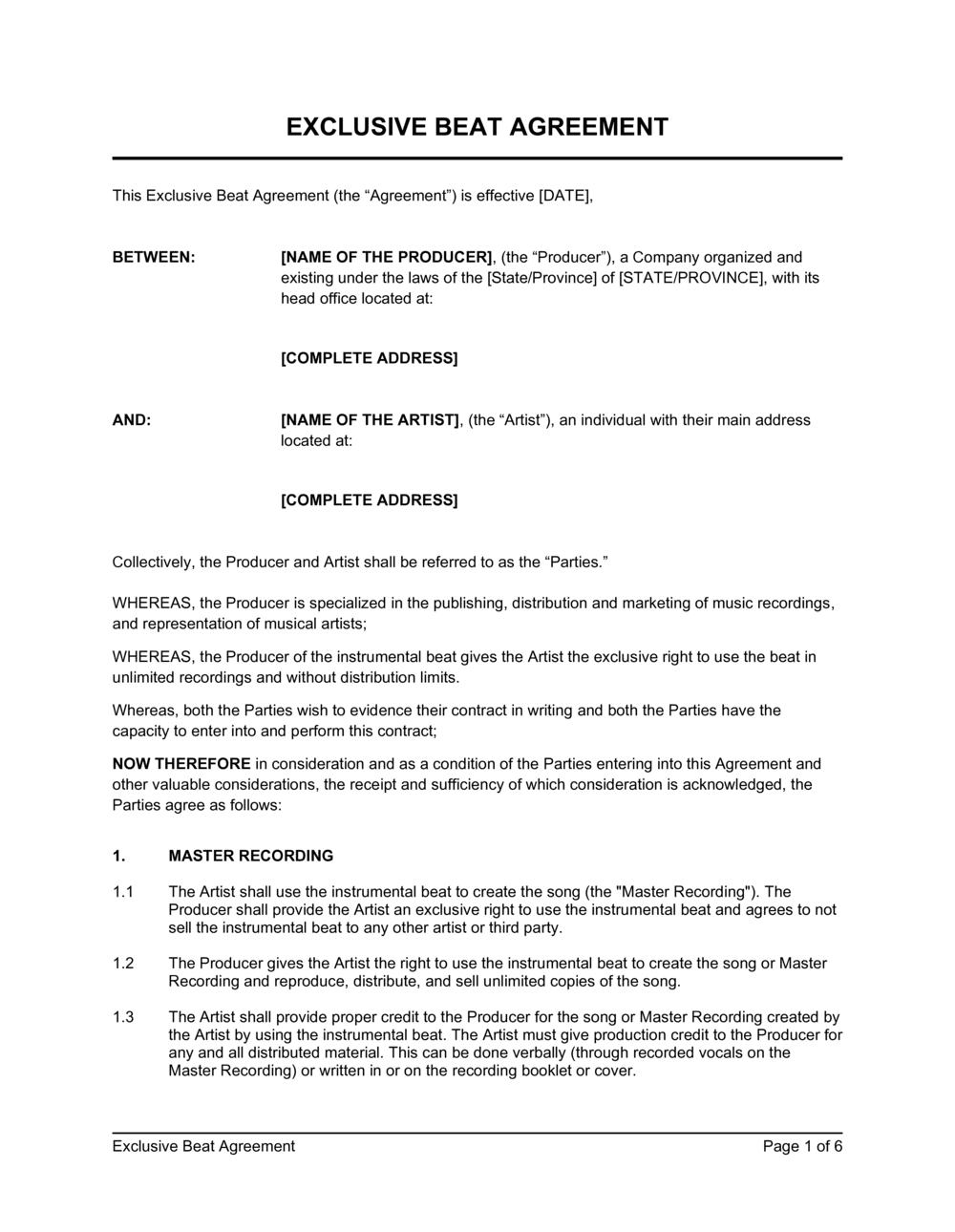
Enter the producer's full legal name or registered business name and the artist's or label's full legal entity name. If either party operates through a company, use that company's name and add a signature block for the authorized representative.
💡 Confirm that the producer signing is the actual copyright owner of the beat — if it was co-produced, all co-producers must either sign or assign their interest to the lead producer before execution.
2
Describe and reference the beat precisely
Include the beat's working title, the date it was created, and a reference to the specific audio file being transferred — ideally a file name with an MD5 hash or a timestamp from your beat-store platform.
💡 Attach the final WAV or stem files as a named exhibit to the agreement. This eliminates any dispute about which version was sold.
3
Set the buy-out fee and payment schedule
Enter the total fee, deposit amount, balance due date, and the payment method. Add explicit language that rights do not transfer until the balance is received in cleared funds.
💡 Avoid accepting personal checks for beat sales — use a payment platform that confirms cleared funds before you deliver stems or remove the beat from your catalog.
4
Decide whether to retain a back-end royalty
If you want ongoing participation in streams and sales, complete the royalty clause with a specific percentage (typically 2–5 points) and accounting frequency. If the deal is a true flat-fee buyout with no royalties, state that explicitly so there is no ambiguity.
💡 A producer royalty requires the artist to report sales, which adds accounting obligations. For lower-priced beats, a clean flat-fee buyout is often simpler for both parties.
5
Specify the publishing split and PRO registration obligation
Agree on the publishing percentage split — common arrangements are 50/50, 70/30 in favor of the artist, or 100% to the artist with the producer retaining only performance royalties through their PRO registration.
💡 Both parties should register their shares with their respective PROs — ASCAP, BMI, SESAC, or SOCAN — within 30 days of signing, not at release. Delayed registration causes royalty collection gaps that are difficult to recover.
6
State the producer credit line verbatim
Write out the exact credit string the artist must embed in streaming metadata and print on physical releases. Include both the display name and any producer tag the producer uses.
💡 Ask the artist's distributor what metadata field receives the producer credit — typically the 'composer' or 'producer' field in the DDEX delivery spec — and reference it explicitly in the agreement.
7
Review warranties and confirm sample clearance
Before signing, the producer should verify that every element of the beat is original or cleared. If the beat contains a sample, attach written clearance documentation as an exhibit.
💡 An uncleared sample in a commercially released beat can generate a statutory damages claim of up to $150,000 per infringement in the US — clearance documentation is non-negotiable for any major-label or sync-targeted release.
8
Execute before the beat is used in any recording
Both parties must sign before the artist begins recording vocals or distributing the beat commercially. Post-use signatures create consideration problems and may leave the agreement unenforceable.
💡 Use a timestamped e-signature platform so both execution date and parties' identities are recorded and tamper-evident.