Escrow Holdback Agreement Template

Free Word download β€’ Edit online β€’ Save & share with Drive β€’ Export to PDF

4 pagesβ€’25–35 min to fillβ€’Difficulty: Complexβ€’Signature requiredβ€’Legal review recommended
Learn more ↓
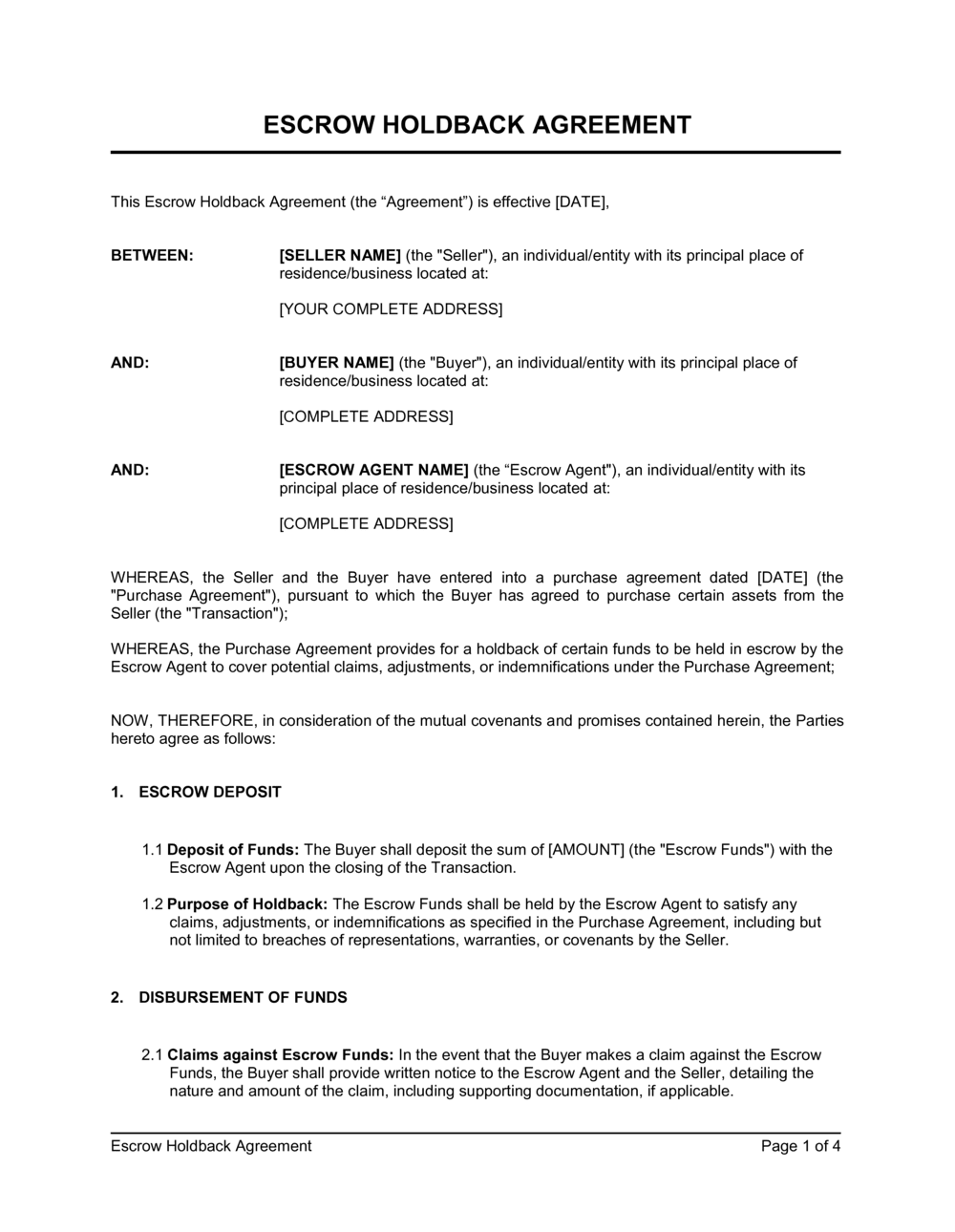
FreeEscrow Holdback Agreement Template

At a glance

What it is
An Escrow Holdback Agreement is a legally binding contract in which a portion of a transaction's purchase price or payment is withheld and held by a neutral third-party escrow agent until specific conditions are met. This free Word download gives you a structured, attorney-approved starting point you can edit online and export as PDF for real estate closings, M&A transactions, and construction projects.
When you need it
Use it whenever a buyer or payer needs financial assurance that outstanding obligations β€” repairs, indemnification claims, regulatory approvals, or milestone completions β€” will be fulfilled after a transaction closes. It is most commonly executed at or immediately before closing.
What's inside
Identification of the parties and escrow agent, holdback amount and funding mechanics, release conditions and trigger events, claim and dispute procedures, escrow agent fees and liability limits, termination provisions, and governing law and dispute resolution clauses.

What is an Escrow Holdback Agreement?

An Escrow Holdback Agreement is a legally binding contract in which a defined portion of a transaction's purchase price or payment is withheld from the seller or payee and deposited with a neutral third-party escrow agent, to be released only when specific, pre-agreed conditions are satisfied. Rather than requiring the buyer to pursue post-closing claims against a seller who has already received full payment, the holdback structure pre-funds the obligation β€” placing real dollars with a neutral party before any dispute arises. The agreement governs every aspect of that arrangement: who holds the funds, how much is withheld, what events trigger release, how claims are submitted, and what happens when the parties disagree.

Escrow holdback agreements are used across three primary contexts in commercial practice. In real estate, buyers withhold a portion of the purchase price to cover post-closing repairs identified in a home inspection. In mergers and acquisitions, acquirers retain 5–15% of the purchase price for 12–24 months to secure the seller's indemnification obligations against breaches of representations and warranties. In construction, project owners hold back the final 5–10% of a contract until the contractor completes all punch-list items to the owner's satisfaction.

Why You Need This Document

Without a written escrow holdback agreement, the financial protection a holdback is intended to provide exists only in theory. A purchase agreement that references a holdback but omits the operational mechanics β€” disbursement instructions, claim notice deadlines, dispute resolution procedures, and escrow agent authority β€” gives the escrow agent no clear basis to act when parties disagree, and gives neither party an enforceable framework for release. Funds can sit frozen for months while both sides litigate over terms that were never written down.

The consequences are concrete: a buyer who relies on a verbal understanding about post-closing repair holdbacks may find the escrow agent unwilling to disburse without joint written instructions β€” instructions the seller has no incentive to sign. An M&A acquirer without a properly drafted claim notice procedure may lose the right to recover against an indemnification escrow simply by missing an undocumented deadline. A contractor withheld final payment on a construction project may have no mechanism to compel release when the owner refuses to issue a completion certificate.

This template provides the full operational structure that purchase agreements and verbal understandings leave out β€” objective release conditions, hard claim notice deadlines, interpleader protection for the escrow agent, and a governing law provision that gives courts a clear framework for resolving disputes. For high-stakes transactions, that structure is the difference between a holdback that works and a holdback that triggers the exact litigation it was meant to prevent.

Which variant fits your situation?

If your situation is…Use this template
Post-closing repair holdback in a residential real estate saleEscrow Holdback Agreement (Real Estate)
Indemnification escrow in an M&A stock or asset purchaseM&A Indemnification Escrow Agreement
Construction project final-payment holdback tied to punch listConstruction Escrow Holdback Agreement
Software development milestone payment held pending deliveryMilestone Payment Escrow Agreement
Earnest money held pending completion of due diligenceEarnest Money Escrow Agreement
Revenue adjustment holdback in a business acquisitionPurchase Price Adjustment Escrow Agreement
Tenant security deposit held in escrow by a neutral agentSecurity Deposit Escrow Agreement

Common mistakes to avoid

❌ Subjective release conditions

Why it matters: Conditions like 'to the buyer's reasonable satisfaction' give the depositor unlimited discretion to block release, effectively converting the holdback into leverage rather than protection.

Fix: Replace subjective language with objective, third-party-verified triggers β€” a licensed inspector's written certification, a contractor's completion statement, or a specific calendar date.

❌ No claim notice deadline

Why it matters: Without a cutoff date, a depositor can submit claims after the escrow period nominally expires, leaving the beneficiary unable to receive final payment for months or years.

Fix: Set a hard claim notice deadline β€” typically 15–30 business days before the escrow period ends β€” and state that claims submitted after that date are barred.

❌ Naming an individual rather than an institution as escrow agent

Why it matters: If the individual named changes roles, leaves the firm, or becomes unavailable, the agreement creates an enforcement gap β€” disputed funds can be frozen with no authorized agent to act.

Fix: Name the institutional escrow agent (the bank, title company, or escrow firm) and reference the specific department or account number, not an individual employee.

❌ Omitting the interpleader provision

Why it matters: Without interpleader language, an escrow agent facing a dispute between parties has no clear legal pathway to protect itself β€” many agents will simply refuse to disburse, leaving funds frozen indefinitely.

Fix: Include an explicit interpleader clause granting the escrow agent the right to deposit disputed funds with a court and seek reimbursement of its legal costs from the disputing parties.

❌ Escrow period too short for the underlying conditions

Why it matters: A 30-day repair holdback sounds reasonable until a contractor quotes a 6-week lead time β€” the escrow expires before the condition can be satisfied, triggering a dispute over automatic release.

Fix: Set the escrow period to at least twice the realistic time needed to satisfy all conditions, and include a mechanism for mutual written extension if conditions are not yet resolved.

❌ Failing to address interest accrual ownership

Why it matters: In a 12-month M&A indemnification escrow on a $1M holdback, accrued interest at current rates can exceed $40,000 β€” leaving this unaddressed creates a material dispute at release.

Fix: Specify explicitly in the escrow account terms which party owns accrued interest and whether it is disbursed proportionally with each release or only at final distribution.

The 10 key clauses, explained

Parties and escrow agent identification

In plain language: Names and identifies the depositor (typically the buyer or payer), the beneficiary (typically the seller or payee), and the neutral escrow agent responsible for holding and disbursing funds.

Sample language
This Escrow Holdback Agreement ('Agreement') is entered into as of [DATE] among [DEPOSITOR NAME] ('Depositor'), [BENEFICIARY NAME] ('Beneficiary'), and [ESCROW AGENT NAME] ('Escrow Agent'), collectively the 'Parties.'

Common mistake: Naming the escrow agent by individual employee name rather than the institution β€” if that person leaves, the agreement creates an enforcement gap.

Holdback amount and deposit mechanics

In plain language: States the exact dollar amount to be withheld, the deadline for funding the escrow account, and the form of deposit β€” wire transfer, certified check, or direct deduction from closing proceeds.

Sample language
Depositor shall deposit the Holdback Amount of $[AMOUNT] USD into the Escrow Account by wire transfer no later than [DATE], deducted from the Purchase Price at closing pursuant to the [PURCHASE AGREEMENT NAME] dated [DATE].

Common mistake: Failing to specify the exact funding deadline and method β€” ambiguity here allows a party to delay funding the escrow without technically breaching the agreement.

Escrow account terms

In plain language: Describes where funds will be held, the type of account (interest-bearing or not), how interest accrues and to whom it belongs, and any investment restrictions on the escrow agent.

Sample language
The Escrow Agent shall hold the Holdback Amount in a segregated, interest-bearing account at [BANK NAME]. All interest accrued shall be credited to [DEPOSITOR / BENEFICIARY] and disbursed with the principal at final release.

Common mistake: Not specifying which party owns accrued interest β€” in a 12-month escrow on a $500,000 holdback, this can be a material amount that becomes disputed at release.

Release conditions and trigger events

In plain language: Sets out the specific, objectively verifiable events or certifications that authorize the escrow agent to release all or part of the holdback funds to the beneficiary.

Sample language
Escrow Agent shall release the Holdback Amount to Beneficiary upon: (a) receipt of a joint written release instruction signed by both Depositor and Beneficiary; or (b) expiration of the Escrow Period without a pending Claim Notice, provided no dispute is outstanding.

Common mistake: Drafting release conditions that require subjective satisfaction β€” for example, 'when the Depositor is satisfied with the repairs' β€” rather than objective standards, inviting bad-faith delay.

Claim procedure and notice requirements

In plain language: Defines how the depositor submits a claim against the holdback, what documentation is required, how much notice must be given, and how the escrow agent handles a valid claim.

Sample language
Depositor may submit a Claim Notice to Escrow Agent and Beneficiary no later than [X] days before expiration of the Escrow Period. Each Claim Notice must specify the claimed amount, the basis for the claim, and include supporting documentation reasonably sufficient to substantiate the claim.

Common mistake: Omitting a deadline by which claims must be submitted β€” without one, the depositor can assert claims indefinitely after the escrow period nominally ends, preventing final release.

Dispute resolution

In plain language: Establishes the process for resolving disagreements between the depositor and beneficiary over the release or amount of holdback funds, including the escrow agent's right to interplead.

Sample language
In the event of a dispute, Escrow Agent shall hold the disputed portion pending: (a) a written joint instruction from Depositor and Beneficiary; (b) a final, non-appealable court order; or (c) a binding arbitration award. Escrow Agent may file an interpleader action and deposit the disputed funds with a court of competent jurisdiction.

Common mistake: Failing to include an interpleader provision β€” without it, the escrow agent may refuse to act at all when parties disagree, leaving funds frozen with no resolution mechanism.

Escrow agent fees, indemnification, and liability

In plain language: Specifies the escrow agent's fee schedule, which party bears the fees, and the scope of the escrow agent's liability β€” typically limited to gross negligence or willful misconduct.

Sample language
Escrow Agent shall be entitled to a fee of $[AMOUNT] per [month / year / transaction], payable by [DEPOSITOR / BENEFICIARY / equally]. Escrow Agent's liability is limited to direct damages caused by its gross negligence or willful misconduct and shall not exceed the Holdback Amount.

Common mistake: Using an institutional escrow agent without negotiating the fee schedule in advance β€” institutional agents often charge additional fees for disbursements, account maintenance, and dispute handling that can total 1–2% of the holdback.

Escrow period and termination

In plain language: Defines the duration of the escrow arrangement, when it terminates, and what happens to undisputed funds upon expiration of the escrow period.

Sample language
The Escrow Period shall commence on the Closing Date and expire on [DATE] or [X] months after the Closing Date, whichever is earlier. Upon expiration, any Holdback Amount not subject to a pending Claim Notice shall be released to Beneficiary within [X] business days.

Common mistake: Setting an escrow period that is shorter than the period in which conditions can realistically be assessed β€” for example, a 30-day escrow on a repair holdback where contractor scheduling delays are common.

Representations and warranties of the parties

In plain language: Each party confirms it has authority to enter the agreement, the agreement does not conflict with other obligations, and the information provided is accurate.

Sample language
Each Party represents and warrants that: (a) it has full legal authority to execute and perform this Agreement; (b) execution does not violate any agreement to which it is a party; and (c) all information provided to Escrow Agent is accurate and complete as of the date hereof.

Common mistake: Omitting entity-level authority confirmations β€” if a signatory lacks authority and the holdback is disputed, the entire agreement may be voidable.

Governing law and dispute resolution forum

In plain language: Specifies which jurisdiction's law governs the agreement, where disputes must be litigated or arbitrated, and whether attorney fees shift to the losing party.

Sample language
This Agreement is governed by the laws of [STATE / PROVINCE / COUNTRY], without regard to conflict-of-laws principles. Any dispute not resolved by negotiation shall be submitted to binding arbitration in [CITY] under [AAA / JAMS] rules. The prevailing party shall be entitled to recover reasonable attorney fees.

Common mistake: Choosing a governing law that has no connection to where the escrow agent operates or the underlying transaction occurred β€” courts in several jurisdictions will disregard a governing law clause that has no reasonable nexus to the parties or the transaction.

How to fill it out

  1. 1

    Identify and name all parties with precision

    Enter the full legal names of the depositor, beneficiary, and escrow agent β€” including entity type and state or province of incorporation. Confirm the escrow agent's institutional name, not an individual employee.

    πŸ’‘ Request a copy of the escrow agent's current fee schedule and licensing information before filling in the agent's details β€” institutional agents must be licensed in most US states and Canadian provinces.

  2. 2

    Specify the holdback amount and funding deadline

    Enter the exact dollar amount to be withheld, the currency, and the precise deadline and method for depositing funds β€” wire transfer details, routing numbers, or reference to closing proceeds.

    πŸ’‘ State the holdback as both a dollar figure and, if applicable, a percentage of the purchase price β€” this prevents rounding disputes at closing.

  3. 3

    Define the escrow period precisely

    Set a specific end date or a defined period after the closing date. Make sure the escrow period is long enough to allow conditions to be assessed and claims to be evaluated β€” a minimum of 60 days for repair holdbacks and 12–18 months for M&A indemnification escrows.

    πŸ’‘ Build in a 10-business-day release buffer at the end of the escrow period so both parties have time to confirm no claims are pending before funds are disbursed.

  4. 4

    Draft objective, verifiable release conditions

    List each release trigger with enough specificity that the escrow agent can verify satisfaction without exercising judgment β€” for example, 'receipt of a licensed contractor's completion certificate' rather than 'completion of repairs to Depositor's satisfaction.'

    πŸ’‘ If multiple conditions must all be met for release, use an enumerated list with 'and' between each β€” avoid ambiguity about whether conditions are conjunctive or disjunctive.

  5. 5

    Set the claim notice deadline and documentation requirements

    Specify the latest date by which a claim notice must be submitted, the required form, and the supporting documentation the escrow agent needs to hold funds β€” invoices, inspection reports, or legal notices.

    πŸ’‘ Set the claim notice deadline at least 15 business days before the escrow period expires, giving the escrow agent time to process and the beneficiary time to respond before automatic release.

  6. 6

    Agree on escrow agent fees and liability limits

    Complete the fee schedule, confirm which party bears the cost, and review the liability limitation clause to ensure the escrow agent's standard form language does not conflict with your negotiated terms.

    πŸ’‘ Ask the escrow agent for its standard form addendum β€” many institutions use pre-printed terms that override conflicting language in the main agreement unless explicitly superseded.

  7. 7

    Complete governing law and dispute resolution provisions

    Select a governing jurisdiction connected to the transaction or the escrow agent's location, choose between arbitration and litigation, and decide whether to include an attorney-fee-shifting clause.

    πŸ’‘ For real estate transactions, use the state where the property is located as the governing law β€” courts in that state are most familiar with applicable escrow regulations.

  8. 8

    Execute before or at closing with all parties signing

    All three parties β€” depositor, beneficiary, and escrow agent β€” must sign before or simultaneously with the funding of the escrow account. Collect signatures from authorized signatories and confirm entity authority documentation.

    πŸ’‘ Attach and initial all exhibits β€” disbursement instructions, fee schedules, and condition checklists β€” at signing so there is no dispute later about which version governs.

Frequently asked questions

What is an escrow holdback agreement?

An escrow holdback agreement is a legally binding contract in which a portion of a transaction's payment is withheld from the seller or payee and held by a neutral third-party escrow agent until specific conditions are met. It is used in real estate, M&A, and construction transactions to give the buyer or payer financial assurance that outstanding obligations β€” repairs, indemnification claims, or project completions β€” will be fulfilled after the transaction closes. Once the release conditions are satisfied, the escrow agent disburses the holdback funds to the beneficiary according to the agreement's terms.

When is an escrow holdback agreement typically used?

The most common contexts are residential and commercial real estate closings where inspection issues require post-closing repairs, M&A transactions where the buyer wants to secure the seller's indemnification obligations, and construction projects where the owner withholds final payment until punch-list items are completed. It is also used in software development, franchise sales, and any transaction where payment and delivery are separated by time or contingent on performance.

Who acts as the escrow agent in a holdback agreement?

The escrow agent is typically a licensed, neutral third party β€” most commonly a title company, bank trust department, licensed escrow company, or law firm trust account. In real estate transactions, the title company handling the closing usually serves as escrow agent. In M&A transactions, a commercial bank or specialized escrow services firm is standard. The agent must be acceptable to both parties and, in most US states and Canadian provinces, must hold a valid escrow or trust license.

How is the holdback amount determined?

The holdback amount is negotiated between the parties and typically reflects the estimated cost of the outstanding obligation plus a buffer. For post-closing repair holdbacks, a common benchmark is 1.5–2Γ— the contractor's repair estimate. For M&A indemnification escrows, holdbacks typically range from 5–15% of the purchase price, held for 12–24 months. For construction punch-list holdbacks, 5–10% of the final contract value is standard. The amount should be large enough to cover the risk but not so large that it creates undue hardship for the beneficiary.

What happens if the release conditions are never met?

If the release conditions are not satisfied within the escrow period and no claim notice has been submitted, most agreements provide for automatic release of the holdback to the beneficiary upon expiration. If a claim notice has been filed, the disputed portion remains in escrow while the parties resolve the dispute through negotiation, arbitration, or litigation. The escrow agent may file an interpleader action to deposit funds with a court if the parties cannot agree and the dispute is prolonged. The specific outcome depends entirely on the agreement's dispute resolution and termination provisions.

Is a separate escrow holdback agreement needed if the purchase agreement already addresses the holdback?

Yes, in most cases. A purchase agreement may reference or authorize a holdback but rarely contains the operational mechanics the escrow agent needs to act β€” specific disbursement instructions, claim notice procedures, agent fee terms, and dispute resolution triggers. The escrow holdback agreement is the governing document for the escrow agent's conduct; the purchase agreement establishes the commercial obligation. Both are typically executed at or before closing.

Can an escrow holdback agreement be used in an M&A transaction?

Yes β€” indemnification escrows are a standard feature of M&A deals, particularly in transactions under $50M where the seller's balance sheet may not support a direct indemnification obligation after closing. A portion of the purchase price β€” typically 5–15% β€” is held in escrow for 12–24 months to cover claims arising from breaches of the seller's representations and warranties, undisclosed liabilities, or post-closing purchase price adjustments. Larger transactions increasingly use representations and warranties insurance in place of or alongside an indemnification escrow.

Do both parties need a lawyer to sign an escrow holdback agreement?

Legal review is strongly recommended for both parties, particularly in M&A and commercial real estate transactions where the holdback amount is material. The escrow agent typically presents its own standard-form agreement, which is drafted primarily to protect the agent β€” not the depositor or beneficiary. Having independent counsel review and negotiate release conditions, claim procedures, and dispute mechanics costs $500–$2,000 and can prevent months of litigation. For small residential holdbacks under $25,000, a well-drafted template with title company review is often sufficient.

How long does an escrow holdback agreement typically last?

Duration varies significantly by transaction type. Residential real estate repair holdbacks typically run 30–90 days. Construction punch-list holdbacks generally last 60–180 days after substantial completion. M&A indemnification escrows most commonly run 12–18 months, with a portion sometimes held for the full statute of limitations period on representations and warranties β€” up to 36 months for fundamental representations such as title, capitalization, and tax matters.

How this compares to alternatives

vs Purchase Agreement

A purchase agreement establishes the commercial terms of a transaction β€” price, representations, and closing conditions. An escrow holdback agreement governs the operational mechanics of withholding and disbursing a portion of that price post-closing. The purchase agreement creates the obligation; the escrow holdback agreement provides the enforcement mechanism. Both are typically required and executed simultaneously at closing.

vs Escrow Agreement

A general escrow agreement can cover any type of asset or obligation held by a third party β€” including documents, intellectual property, or source code. An escrow holdback agreement is specifically structured around withholding a portion of a payment pending satisfaction of post-closing conditions. The holdback agreement includes claim notice procedures and automatic release mechanics that a general escrow agreement may not address.

vs Indemnification Agreement

An indemnification agreement creates a contractual obligation for one party to compensate the other for specified losses or liabilities, but relies on the indemnifying party's ability and willingness to pay. An escrow holdback agreement pre-funds that obligation by setting aside specific dollars with a neutral third party at closing, making the indemnification mechanically enforceable without litigation over collectability.

vs Letter of Credit

A letter of credit is a bank's irrevocable commitment to pay a beneficiary upon presentation of specified documents β€” it is an off-balance-sheet credit instrument, not a cash deposit. An escrow holdback agreement involves actual cash deposited with a neutral agent. Escrow holdbacks are simpler to administer and less expensive for smaller transactions; letters of credit are preferred when the depositor cannot or will not fund cash into escrow at closing.

Industry-specific considerations

Real estate

Post-closing repair holdbacks tied to inspection findings are the most common use, with the title company serving as escrow agent and release triggered by a licensed contractor's completion certificate.

Mergers and acquisitions

Indemnification escrows of 5–15% of purchase price are standard in deals under $50M, with 12–24 month escrow periods covering breaches of representations and warranties and post-closing purchase price adjustments.

Construction

Final-payment holdbacks of 5–10% of contract value are retained until punch-list completion is certified, with the escrow agent releasing funds upon receipt of a licensed architect's or engineer's written sign-off.

Technology and SaaS

Software development milestone escrows hold payment tranches pending delivery and acceptance testing of defined functional specifications, with release tied to written client acceptance certificates.

Jurisdictional notes

United States

Escrow agents must be licensed in most states β€” requirements vary significantly, with California, Texas, and Washington imposing the strictest licensing obligations. Real estate escrow holdbacks are commonly governed by state-specific escrow statutes and title insurance regulations. Non-compete and IP holdback provisions in M&A transactions may be subject to state-specific enforceability rules. California's Escrow Law (Financial Code Β§17000 et seq.) imposes specific fiduciary duties and account segregation requirements.

Canada

Escrow arrangements in Canada are typically administered through law firm trust accounts or institutional trust companies, as standalone escrow companies are uncommon in most provinces. Real estate holdbacks in Ontario are governed by the Real Estate and Business Brokers Act and Law Society trust account rules. In Quebec, escrow arrangements must comply with civil law principles rather than common law, and notarized deposits are standard. Provincial real estate council regulations govern the handling of holdback funds in residential transactions.

United Kingdom

Escrow holdbacks in UK M&A transactions are commonly held in solicitor client accounts governed by the Solicitors Regulation Authority's Accounts Rules. Completion accounts and locked-box mechanisms are more common than escrow holdbacks in UK private M&A deals, but holdbacks are used for specific indemnity claims. The Financial Services and Markets Act 2000 may impose authorization requirements on entities providing escrow services commercially. Stamp Duty Land Tax and VAT implications should be considered when structuring property-related holdbacks.

European Union

EU escrow arrangements vary significantly by member state β€” Germany commonly uses notary-held escrow accounts (Notaranderkonto), while France uses sequestre arrangements administered through notaires. GDPR compliance is required when escrow documentation contains personal data, particularly in employment-related holdbacks. Cross-border EU transactions must consider whether the escrow agent's home jurisdiction imposes currency controls or capital movement restrictions. Payment Services Directive (PSD2) regulations affect which entities can lawfully hold and transfer escrow funds commercially.

Template vs lawyer β€” what fits your deal?

PathBest forCostTime
Use the templateResidential real estate repair holdbacks under $50,000 where a title company serves as escrow agentFree30–60 minutes
Template + legal reviewCommercial real estate holdbacks, construction projects over $100,000, or any M&A holdback regardless of size$500–$2,0002–5 business days
Custom draftedM&A indemnification escrows over $500,000, multi-tranche holdbacks, cross-border transactions, or heavily negotiated release conditions$3,000–$10,000+1–3 weeks

Glossary

Holdback Amount
The specific dollar sum withheld from the total transaction price and deposited into escrow pending satisfaction of defined conditions.
Escrow Agent
A neutral third party β€” typically a bank, title company, or licensed escrow company β€” that holds and disburses the holdback funds according to the agreement's terms.
Release Conditions
The specific events, certifications, or deadlines that must occur before the escrow agent is authorized to disburse funds to the seller or payee.
Claim Notice
A formal written notice submitted by the buyer or depositor to the escrow agent asserting a right to some or all of the holdback funds based on an identified condition or breach.
Indemnification Escrow
A holdback structure used in M&A transactions to secure the seller's obligation to indemnify the buyer for pre-closing liabilities, misrepresentations, or warranty breaches.
Escrow Period
The defined duration during which the holdback funds remain in escrow β€” typically ranging from 30 days for repair holdbacks to 18–24 months for M&A indemnification arrangements.
Disbursement Instructions
Written directions, signed by authorized parties, that instruct the escrow agent to release funds to a specified recipient on a specified date or upon a triggering event.
Punch List
In construction contexts, a documented list of incomplete or deficient work items that must be finished before the final payment holdback is released.
Earnest Money
A good-faith deposit made by a buyer at contract signing, held in escrow and applied to the purchase price at closing or forfeited if the buyer defaults.
Interpleader
A legal proceeding in which an escrow agent deposits disputed funds with a court and asks the court to determine the rightful recipient, shielding the agent from double liability.
Purchase Price Adjustment
A post-closing recalculation of the transaction price based on actual financial metrics β€” such as working capital or net debt β€” compared to estimates used at closing.

Part of your Business Operating System

This document is one of 3,000+ business & legal templates included in Business in a Box.

  • Fill-in-the-blanks β€” ready in minutes
  • 100% customizable Word document
  • Compatible with all office suites
  • Export to PDF and share electronically

Create your document in 3 simple steps.

From template to signed document β€” all inside one Business Operating System.
1
Download or open template

Access over 3,000+ business and legal templates for any business task, project or initiative.

2
Edit and fill in the blanks with AI

Customize your ready-made business document template and save it in the cloud.

3
Save, Share, Send, Sign

Share your files and folders with your team. Create a space of seamless collaboration.

Save time, save money, and create top-quality documents.

β˜…β˜…β˜…β˜…β˜…

"Fantastic value! I'm not sure how I'd do without it. It's worth its weight in gold and paid back for itself many times."

Managing Director Β· Mall Farm
Robert Whalley
Managing Director, Mall Farm Proprietary Limited
β˜…β˜…β˜…β˜…β˜…

"I have been using Business in a Box for years. It has been the most useful source of templates I have encountered. I recommend it to anyone."

Business Owner Β· 4+ years
Dr Michael John Freestone
Business Owner
β˜…β˜…β˜…β˜…β˜…

"It has been a life saver so many times I have lost count. Business in a Box has saved me so much time and as you know, time is money."

Owner Β· Upstate Web
David G. Moore Jr.
Owner, Upstate Web

Run your business with a system β€” not scattered tools

Stop downloading documents. Start operating with clarity. Business in a Box gives you the Business Operating System used by over 250,000 companies worldwide to structure, run, and grow their business.

Start freeΒ Β·Β No credit card required