Escrow Agreement Template

Free Word download • Edit online • Save & share with Drive • Export to PDF

2 pages25–30 min to fillDifficulty: StandardSignature requiredLegal review recommended
Learn more ↓
FreeEscrow Agreement Template

At a glance

What it is
An Escrow Agreement is a legally binding three-party contract among a depositor, a beneficiary, and a neutral escrow agent that governs the holding and conditional release of funds, documents, or assets. This free Word download gives you a structured starting point you can edit online and export as PDF — covering release conditions, agent duties and fees, default procedures, and dispute resolution in a single document.
When you need it
Use it whenever the transfer of money, property, or documents between two parties depends on a condition being satisfied — such as the close of a real estate transaction, the completion of a business acquisition, or the delivery of software source code. It protects both sides by keeping assets in neutral hands until agreed milestones are met.
What's inside
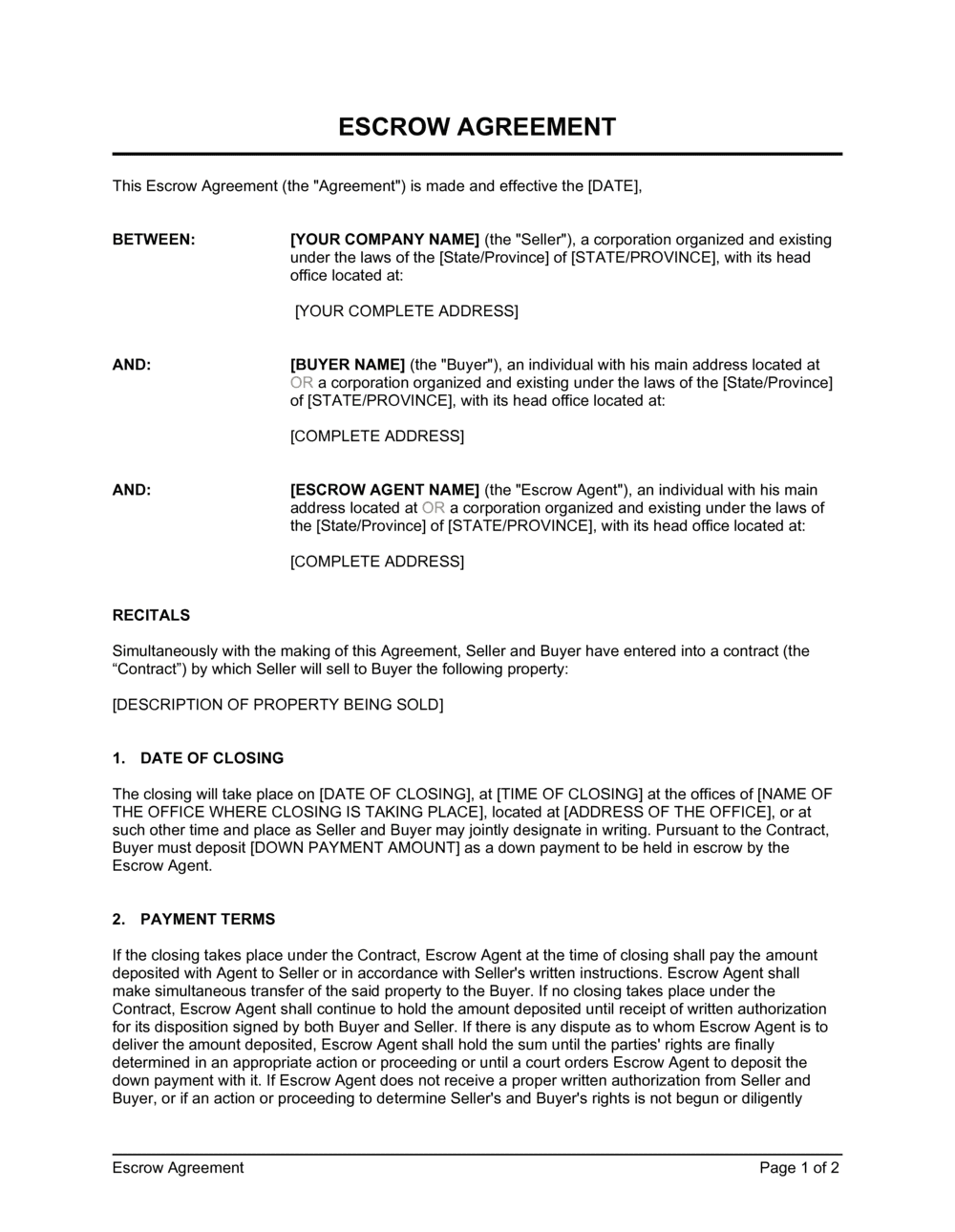
Identification of all three parties, a description of the escrowed assets, precise release conditions and triggers, the escrow agent's duties and liability limits, fee structure, default and breach procedures, and governing law with dispute resolution mechanics.

What is an Escrow Agreement?

An Escrow Agreement is a legally binding three-party contract among a depositor, a beneficiary, and a neutral escrow agent that governs the holding and conditional release of funds, documents, or other assets until specific, objectively verifiable conditions are met. Unlike a simple payment arrangement between two parties, an escrow agreement inserts a trusted intermediary — a title company, bank, attorney, or specialized escrow firm — who holds the assets in a defined account and disburses them only when the parties' agreed milestones are satisfied. The document sets out exactly what is being held, the precise events that trigger release, the agent's limited duties and liability, the fee structure, and the procedures for resolving competing claims or agent resignation.

Why You Need This Document

Without a written escrow agreement, both sides of a conditional transaction are exposed in different ways simultaneously. The depositor has no contractual assurance that funds or assets are being held in a segregated account rather than commingled with the agent's own funds. The beneficiary has no enforceable release trigger and no recourse if the depositor directs the agent to return the assets before conditions are met. And the escrow agent has no liability shield, no fee entitlement, and no defined procedure if the parties dispute whether conditions have been satisfied. In real estate, M&A, and software licensing transactions, the absence of a formal escrow agreement has resulted in frozen closings, interpleader litigation, and lost earnest money deposits. A properly drafted escrow agreement — executed by all three parties before the first asset is transferred — eliminates each of these gaps and gives every party a clear, enforceable set of rights from the moment the deposit is made.

Which variant fits your situation?

If your situation is…Use this template
Residential real estate purchase with earnest money depositReal Estate Escrow Agreement
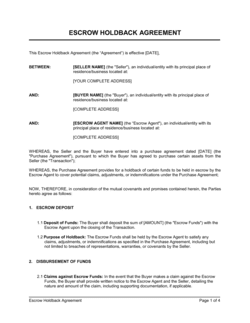
Business acquisition with post-close indemnification holdbackM&A Escrow Agreement
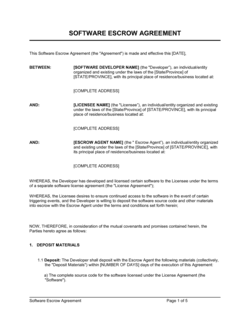
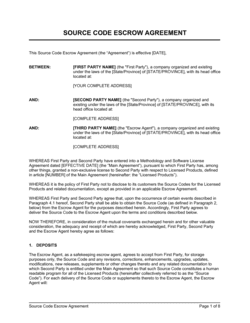
Software source code held for release on vendor insolvencySoftware Escrow Agreement
Construction project with milestone-based payment releaseConstruction Escrow Agreement
Online marketplace transaction requiring buyer protectionOnline Transaction Escrow Agreement
Intellectual property licensing with conditional royalty holdbackIP Licensing Escrow Agreement
General escrow for any two-party conditional asset transferEscrow Agreement (General)

Common mistakes to avoid

❌ Subjective or unilateral release conditions

Why it matters: A release condition that says 'Depositor is satisfied with the deliverable' gives one party veto power over disbursement indefinitely, making the escrow unenforceable as written.

Fix: Replace subjective triggers with objectively verifiable events — written acceptance, a third-party inspection report, or receipt of a regulatory approval letter.

❌ No interpleader provision

Why it matters: When parties dispute whether conditions have been met, the escrow agent is caught between two competing demands with no contractual path to resolve the conflict without personal liability.

Fix: Add an explicit clause granting the agent the right to file an interpleader action, with costs funded from the escrowed assets, discharging the agent upon deposit with the court.

❌ Omitting the tax reporting allocation

Why it matters: Interest accrued on escrow funds is taxable income, and the IRS requires a Form 1099 to be issued — if the agreement does not specify who receives it, both parties may receive one and dispute the liability.

Fix: State explicitly which party's taxpayer identification number governs IRS reporting for the escrow account, and attach a completed IRS Form W-9 from that party at signing.

❌ Choosing a governing law inconsistent with the asset's location

Why it matters: Property law — including the rules governing transfer and lien priority — is territorial. A contract governed by New York law cannot override California's rules for releasing a California real estate deed.

Fix: Align governing law with the jurisdiction where the underlying asset is located or the transaction closes, and confirm the escrow agent is licensed or authorized in that jurisdiction.

❌ No resignation or successor-agent clause

Why it matters: If the escrow agent resigns, becomes insolvent, or is otherwise unavailable, the agreement provides no mechanism to transfer the assets — leaving them effectively frozen.

Fix: Include a resignation notice period (typically 30 days), a deadline for the parties to name a successor, and a fallback allowing the agent to deposit assets with a court if no successor is appointed.

❌ Failing to execute before the deposit is made

Why it matters: Funds transferred before a signed agreement exists are not technically held in escrow — they are an unstructured deposit with no defined release conditions or agent obligations.

Fix: Circulate the agreement for execution by all three parties before any transfer is initiated, and confirm the agent's acceptance in writing before wiring funds.

The 10 key clauses, explained

Parties and recitals

In plain language: Identifies all three parties by full legal name and role — depositor, beneficiary, and escrow agent — and states the purpose of the escrow arrangement.

Sample language
This Escrow Agreement is entered into as of [DATE] among [DEPOSITOR LEGAL NAME] ('Depositor'), [BENEFICIARY LEGAL NAME] ('Beneficiary'), and [ESCROW AGENT LEGAL NAME] ('Escrow Agent'). The parties enter this Agreement in connection with [UNDERLYING TRANSACTION DESCRIPTION].

Common mistake: Naming the escrow agent as an individual rather than their employer entity — if the individual leaves their firm, the agreement may have no valid counterparty.

Description of escrowed assets

In plain language: Describes exactly what is being placed in escrow — dollar amount, specific documents, software materials, or other assets — and the account or location where they will be held.

Sample language
Depositor shall deposit the sum of $[AMOUNT] USD ('Escrow Funds') into the escrow account maintained by Escrow Agent at [BANK NAME], Account No. [ACCOUNT NUMBER], ABA Routing No. [ROUTING NUMBER], within [X] business days of the Effective Date.

Common mistake: Describing assets vaguely, such as 'certain funds related to the transaction.' Without a specific dollar amount, account, or asset list, the agent has no clear custody obligation.

Release conditions

In plain language: Defines the precise, objectively verifiable events that require the escrow agent to disburse the assets — and to whom they are disbursed in each scenario.

Sample language
Escrow Agent shall release the Escrow Funds to Beneficiary upon receipt of: (a) a joint written instruction signed by both Depositor and Beneficiary; or (b) a final, non-appealable court order directing disbursement. In the absence of either, Escrow Agent shall retain the Escrow Funds pending resolution.

Common mistake: Making release conditions dependent on one party's sole satisfaction or subjective judgment — courts may void such conditions as illusory, leaving the escrow with no enforceable release trigger.

Escrow agent's duties and standard of care

In plain language: States that the agent's obligations are limited to following written instructions, and that the agent has no duty to verify the underlying transaction, investigate disputes, or take discretionary action.

Sample language
Escrow Agent shall act as a stakeholder only and shall have no duties or obligations except those expressly set forth herein. Escrow Agent shall not be responsible for the validity or sufficiency of this Agreement or any underlying transaction, and shall act in good faith based solely on the written instructions received.

Common mistake: Drafting the agent's duties in broad, open-ended language — which can expose a corporate escrow agent to fiduciary liability well beyond what it agreed to assume.

Investment and interest on escrow funds

In plain language: Specifies whether the escrow agent may invest the funds, permissible investment vehicles, how interest is allocated between the parties, and tax reporting obligations.

Sample language
Escrow Agent shall hold the Escrow Funds in a non-interest-bearing account unless otherwise directed in writing by both Depositor and Beneficiary. Any interest earned shall accrue to [DEPOSITOR / BENEFICIARY / PRO-RATA] and shall be reported to the IRS under the taxpayer identification number of [PARTY].

Common mistake: Omitting the tax-reporting provision entirely — leaving both parties uncertain which of them will receive a Form 1099 for interest earned during the escrow period.

Escrow agent fees and expenses

In plain language: Sets out the agent's compensation — setup fee, annual or monthly holding fee, and disbursement fee — and specifies which party bears the cost.

Sample language
Depositor and Beneficiary shall each pay [50% / as agreed] of Escrow Agent's fee of $[SETUP FEE] at execution and $[ANNUAL FEE] per year thereafter. Escrow Agent is entitled to reimbursement for reasonable out-of-pocket expenses, including counsel fees incurred in connection with any dispute.

Common mistake: Leaving agent fees to be 'as agreed later' — without a defined fee structure, the agent may resign before the transaction closes, citing an inability to agree on compensation.

Default, breach, and competing claims

In plain language: Addresses what the escrow agent does when it receives conflicting instructions from the parties, or when one party alleges the other is in default of the underlying transaction.

Sample language
In the event Escrow Agent receives conflicting written instructions from Depositor and Beneficiary, Escrow Agent shall (a) continue to hold the Escrow Funds pending resolution, (b) give written notice of the conflict to both parties, and (c) at its option, commence an interpleader action in a court of competent jurisdiction and be reimbursed its costs from the Escrow Funds.

Common mistake: Failing to include an interpleader right — without it, the agent is legally exposed between two parties making competing claims and has no clear path to protect itself.

Indemnification of the escrow agent

In plain language: Requires the depositor and beneficiary to hold the escrow agent harmless from losses, claims, and legal costs arising from its good-faith performance, except in cases of gross negligence or willful misconduct.

Sample language
Depositor and Beneficiary, jointly and severally, shall indemnify, defend, and hold harmless Escrow Agent from any claim, loss, liability, or expense — including reasonable attorneys' fees — arising from Escrow Agent's performance of its duties hereunder, except to the extent caused by Escrow Agent's gross negligence or willful misconduct.

Common mistake: Omitting the gross negligence and willful misconduct carve-out — professional escrow agents will refuse to execute an agreement that indemnifies them against their own intentional wrongdoing.

Resignation and replacement of the escrow agent

In plain language: Gives the escrow agent the right to resign on written notice, requires the parties to appoint a successor within a set number of days, and addresses what happens to the assets if no successor is named.

Sample language
Escrow Agent may resign at any time by giving [30] days' written notice to Depositor and Beneficiary. Within [15] days of such notice, Depositor and Beneficiary shall jointly appoint a successor escrow agent. If no successor is appointed within that period, Escrow Agent may deposit the Escrow Funds with a court of competent jurisdiction and be discharged of all obligations.

Common mistake: No resignation clause at all — without it, an escrow agent that wants to exit has no clean off-ramp, and may simply go dark, leaving the assets in limbo.

Governing law and dispute resolution

In plain language: Specifies the jurisdiction whose law governs the agreement and how disputes between any two of the three parties are resolved — typically arbitration or litigation in a named forum.

Sample language
This Agreement shall be governed by the laws of [STATE / PROVINCE / COUNTRY], without regard to its conflict-of-laws principles. Any dispute shall be resolved by binding arbitration administered by [AAA / JAMS] in [CITY], except that any party may seek injunctive or other equitable relief in any court of competent jurisdiction.

Common mistake: Choosing a governing law that differs from where the escrowed asset is physically located or where the underlying transaction closes — creating a conflict between property law and the contract's procedural rules.

How to fill it out

  1. 1

    Identify all three parties by full legal name

    Enter the depositor's and beneficiary's registered legal entity names — not trade names — and the escrow agent's full institutional name. Confirm each party's signing authority before execution.

    💡 Ask the escrow agent to confirm the exact entity name and jurisdiction of formation; title companies and law firms sometimes operate escrow services through a separate subsidiary.

  2. 2

    Describe the escrowed assets with specificity

    For funds, state the exact dollar amount, currency, and the bank account details where the deposit will be held. For documents or other assets, attach a schedule listing each item by name, date, and unique identifier.

    💡 A vague asset description is the single most common reason escrow agents refuse to accept a deposit — be specific enough that a stranger could identify the asset without context.

  3. 3

    Draft objective, verifiable release conditions

    Write each release trigger as an observable event or the receipt of a specific document — not as a party's satisfaction or opinion. Include the timeline within which the agent must act after the condition is met.

    💡 Test each condition by asking: 'Could a court objectively verify that this event occurred?' If not, rewrite it until the answer is yes.

  4. 4

    Define the agent's duties and liability limits

    Limit the agent's obligations to following written instructions and expressly exclude any implied fiduciary duties, duty to investigate, or duty to give legal advice. Add the gross negligence carve-out to the indemnification block.

    💡 Corporate escrow agents often have their own standard duty-limitation language — request it in advance and incorporate it to reduce negotiation friction.

  5. 5

    Set the fee structure and payment responsibility

    State the setup fee, ongoing holding fee, and disbursement fee in dollar terms. Specify which party pays each component and the due date for each payment.

    💡 Negotiate the fee schedule before signing — escrow agents rarely reduce fees after execution, and an unresolved fee dispute can delay closings by days.

  6. 6

    Include competing-claims and interpleader language

    Add a clause granting the escrow agent the right to file an interpleader action if it receives conflicting instructions. Specify that legal costs of interpleader are paid from the escrowed funds, not by the agent.

    💡 Without interpleader language, a professional escrow agent may decline to accept the engagement for high-value or contested transactions.

  7. 7

    Specify governing law tied to the transaction's location

    Choose the law of the jurisdiction where the underlying transaction closes or where the escrowed asset is located. Confirm the chosen forum aligns with the agent's licensing jurisdiction.

    💡 If the parties are in different states or countries, consider choosing the escrow agent's home jurisdiction as the governing law — it simplifies enforcement if the agent needs to file an interpleader.

  8. 8

    Execute before the deposit is transferred

    All three parties must sign the agreement before the depositor transfers any funds or assets to the escrow account. An unsigned or partially signed agreement gives the escrow agent no authority to hold the assets on defined terms.

    💡 Use dated, countersigned copies and distribute an executed PDF to all three parties the same day as signing — gaps in the paper trail create disputes about when the escrow relationship began.

Frequently asked questions

What is an escrow agreement?

An escrow agreement is a three-party contract among a depositor, a beneficiary, and a neutral escrow agent that governs the holding and conditional release of funds, documents, or other assets. The escrow agent holds the assets until specific, objectively verifiable conditions are met, at which point it disburses them according to the agreement's instructions. It is used in real estate closings, M&A transactions, software licensing arrangements, and any deal where one party needs assurance that assets are secured before performing their own obligations.

Who are the three parties to an escrow agreement?

The three parties are the depositor (the party placing assets into escrow), the beneficiary (the party entitled to receive the assets when conditions are met), and the escrow agent (the neutral third party that holds and administers the assets). In a real estate transaction, the buyer is typically the depositor, the seller is the beneficiary, and a title company or attorney serves as the escrow agent. In an M&A deal, roles may be more complex — a portion of the purchase price may be held for the seller's benefit pending indemnification claims by the buyer.

What are typical release conditions in an escrow agreement?

Release conditions are the specific, verifiable events that trigger disbursement of the escrowed assets. Common examples include receipt of joint written instructions from both principal parties, completion of a title search or property inspection, delivery of a regulatory approval, or a final court order. The conditions should be drafted as observable external events rather than one party's subjective satisfaction — courts have voided release conditions that give a single party unlimited discretion to block disbursement.

What does an escrow agent do?

An escrow agent holds the deposited assets, follows written instructions from the principal parties, and releases assets only when the stated release conditions are met. The agent does not investigate the merits of the underlying transaction, give legal advice, or take discretionary action. Its liability is typically limited to gross negligence and willful misconduct. Qualified escrow agents include licensed title companies, banks, attorneys, and specialized escrow service firms.

Is an escrow agreement legally required for real estate transactions?

In the United States, most residential real estate transactions in states with an escrow-based closing culture — particularly California, Washington, and Oregon — rely on a formal escrow arrangement, though a written escrow agreement may be supplemented by title company instructions. In attorney- closing states such as New York and Massachusetts, an attorney typically holds escrow funds under their professional rules rather than a separate written agreement. In Canada and the UK, solicitor undertakings or trust account rules govern the equivalent function.

How is an escrow agent paid?

Escrow agents typically charge a combination of a setup or opening fee, an annual or transaction-period holding fee, and a disbursement fee. For real estate transactions, fees run roughly $300–$900 for residential closings and $1,000–$5,000 for commercial deals. M&A holdback escrows at major banks often charge 0.10–0.25% of the escrowed amount annually plus a flat setup fee. The agreement should specify who pays each component — typically split equally between depositor and beneficiary, or allocated as part of transaction negotiations.

What happens if the parties cannot agree on whether release conditions have been met?

When the depositor and beneficiary dispute whether conditions have been satisfied, the escrow agent should follow the agreement's competing-claims procedure — typically holding the assets, notifying both parties in writing, and filing an interpleader action with a court. Interpleader allows the agent to deposit the assets with the court and be discharged of further liability while the parties litigate the dispute. Without an interpleader clause, the agent faces personal exposure for releasing to either party.

Can the escrow agent resign from the agreement?

Yes — most escrow agreements include a resignation provision allowing the agent to withdraw on 30 days' written notice. The parties are then required to appoint a successor agent within a defined period, typically 15–30 days. If no successor is appointed, the agreement should allow the outgoing agent to deposit the assets with a court and obtain a formal discharge. Without a resignation clause, an agent seeking to exit has no clean contractual mechanism and may delay or complicate the transaction.

Do I need a lawyer to draft an escrow agreement?

For standard real estate earnest money deposits, a title company's standard instructions form is typically sufficient. A lawyer is advisable for M&A holdback escrows, software source code escrows, any arrangement involving assets over $500,000, cross-border transactions, or situations where the release conditions are complex or contested. A 1–2 hour attorney review of a template-based agreement typically costs $300–$700 and is proportionate to the risk on any transaction where the escrowed amount is material to the deal.

What is a software escrow agreement?

A software escrow agreement is a specialized escrow arrangement in which a software vendor deposits source code, build instructions, and technical documentation with an escrow agent. The code is released to the licensee only if a defined release event occurs — typically the vendor's insolvency, cessation of business, or material breach of the license agreement. It protects enterprise software buyers who depend on vendor-maintained code for critical operations and cannot afford to lose access if the vendor ceases to support the product.

How this compares to alternatives

vs Trust Agreement

A trust agreement creates an ongoing fiduciary relationship where a trustee manages assets for beneficiaries over an extended or indefinite period, often involving investment discretion. An escrow agreement is a short-term, transaction-specific arrangement with strictly limited agent duties and no discretionary management. Use an escrow for a defined closing or holdback period; use a trust for multi-year asset management.

vs Payment Escrow Instructions

Escrow instructions are the operational directions a title company or agent follows to process a specific transaction — a narrower document focused on mechanics like proration calculations and deed recording. A full escrow agreement governs the entire legal relationship including agent liability, resignation, indemnification, and dispute resolution. For complex or high-value transactions, the full agreement is necessary; instructions alone are insufficient.

vs Letter of Credit

A letter of credit is a bank's irrevocable promise to pay the beneficiary on presentation of specified documents, without requiring a third-party holder of the underlying funds. An escrow agreement involves actual custody of assets by a neutral agent. Letters of credit are common in international trade; escrow agreements are standard in domestic real estate and M&A. The two instruments serve similar risk-allocation purposes through different legal mechanisms.

vs Purchase Agreement

A purchase agreement defines the commercial terms of a transaction — price, representations, and closing conditions — between buyer and seller. An escrow agreement is the separate instrument governing what happens to the deposited funds or assets while those closing conditions are being satisfied. The two documents work together: the purchase agreement creates the obligation; the escrow agreement protects performance of it.

Industry-specific considerations

Real Estate

Earnest money deposits, closing fund holdbacks, and post-close repair escrows where funds release upon contractor completion confirmation.

Mergers and Acquisitions

Purchase price holdbacks of 5–15% held for 12–24 months to cover indemnification claims, working capital adjustments, and rep-and-warranty breaches.

Technology / SaaS

Source code escrow protecting enterprise licensees against vendor insolvency, with deposit verification and regular technology updates as ongoing obligations.

Construction

Milestone-based payment release tied to inspection sign-offs, lien waivers, and certificate-of-completion issuance for each project phase.

Jurisdictional notes

United States

Escrow regulation varies by state. California, Washington, and Oregon have dedicated escrow licensing statutes requiring agents to be licensed by state financial regulators. In attorney-closing states such as New York and Massachusetts, attorneys hold funds in IOLTA trust accounts governed by bar rules rather than standalone escrow agreements. Release conditions must comply with applicable state contract law, and interest-bearing escrow accounts require IRS Form 1099 reporting from the designated payee.

Canada

In Canada, real estate escrow functions are typically performed by lawyers or notaries under provincial trust account rules rather than through a separate escrow agreement. In British Columbia and Ontario, real estate deposit funds must be held in a lawyer's or notary's trust account. Quebec uses a notarial system with civil law principles governing the obligation, and escrow agreements must comply with the Civil Code of Quebec rather than common law contract principles.

United Kingdom

English law recognizes escrow arrangements as a distinct form of conditional delivery, and a deed may be delivered 'in escrow' pending satisfaction of conditions. In practice, solicitors hold transaction funds in client accounts governed by Solicitors Regulation Authority rules. Software escrow is well established under English law and governed by standard contract principles. The escrow agreement should specify whether the agent holds assets as bare trustee or stakeholder, as the distinction affects liability on competing claims.

European Union

Escrow is recognized across EU member states but implemented through different legal mechanisms — French law uses sequestre, German law uses Treuhand arrangements, and the Netherlands uses a third-party funds account (Stichting Derdengelden). GDPR applies to any escrow arrangement involving personal data, including documents containing identifiable information about individuals. Cross-border EU escrow arrangements should specify the governing national law explicitly, as conflict-of-laws rules under Rome I apply to determine the default if not stated.

Template vs lawyer — what fits your deal?

PathBest forCostTime
Use the templateStandard earnest money deposits, contractor milestone payments, or straightforward conditional transfers under $100,000Free30–60 minutes
Template + legal reviewReal estate transactions above $250,000, any M&A holdback, or arrangements with complex release conditions or multi-party disputes$300–$7001–3 days
Custom draftedLarge M&A holdbacks, software source code escrows, cross-border transactions, or any arrangement where the escrowed amount exceeds $1 million$1,500–$5,000+1–2 weeks

Glossary

Escrow Agent
The neutral third party — a bank, title company, attorney, or qualified custodian — that holds the escrowed assets and releases them only when stated conditions are met.
Depositor
The party that places funds, documents, or assets into escrow pending fulfillment of the agreed release conditions.
Beneficiary
The party entitled to receive the escrowed assets once the release conditions are satisfied.
Release Conditions
The specific, objectively verifiable events or milestones that trigger the escrow agent to disburse the held assets to the beneficiary.
Escrow Instructions
Written directions from the depositor and beneficiary to the escrow agent specifying exactly how and when assets are to be held, managed, and released.
Holdback
A portion of a transaction's purchase price retained in escrow after closing to cover potential indemnification claims, adjustments, or warranty breaches.
Interpleader
A legal action an escrow agent may file to ask a court to determine which party is entitled to the escrowed assets when the parties dispute the outcome.
Force Majeure
A clause excusing the escrow agent from performance obligations when conditions beyond its control — natural disasters, government actions, or system outages — prevent timely action.
Indemnification
A contractual obligation by one or both principal parties to reimburse the escrow agent for losses, costs, or liability arising from its good-faith performance of duties.
Successor Escrow Agent
A replacement agent appointed when the original agent resigns, becomes insolvent, or is removed by mutual agreement of the depositor and beneficiary.
Disbursement
The formal release and transfer of escrowed funds or assets by the escrow agent to the designated receiving party upon satisfaction of release conditions.
Earnest Money
A deposit made by a buyer into escrow at the time of contract signing to demonstrate serious intent, typically applied to the purchase price at closing or forfeited on default.

Part of your Business Operating System

This document is one of 3,000+ business & legal templates included in Business in a Box.

  • Fill-in-the-blanks — ready in minutes
  • 100% customizable Word document
  • Compatible with all office suites
  • Export to PDF and share electronically

Create your document in 3 simple steps.

From template to signed document — all inside one Business Operating System.
1
Download or open template

Access over 3,000+ business and legal templates for any business task, project or initiative.

2
Edit and fill in the blanks with AI

Customize your ready-made business document template and save it in the cloud.

3
Save, Share, Send, Sign

Share your files and folders with your team. Create a space of seamless collaboration.

Save time, save money, and create top-quality documents.

★★★★★

"Fantastic value! I'm not sure how I'd do without it. It's worth its weight in gold and paid back for itself many times."

Managing Director · Mall Farm
Robert Whalley
Managing Director, Mall Farm Proprietary Limited
★★★★★

"I have been using Business in a Box for years. It has been the most useful source of templates I have encountered. I recommend it to anyone."

Business Owner · 4+ years
Dr Michael John Freestone
Business Owner
★★★★★

"It has been a life saver so many times I have lost count. Business in a Box has saved me so much time and as you know, time is money."

Owner · Upstate Web
David G. Moore Jr.
Owner, Upstate Web

Run your business with a system — not scattered tools

Stop downloading documents. Start operating with clarity. Business in a Box gives you the Business Operating System used by over 250,000 companies worldwide to structure, run, and grow their business.

Free Forever Plan · No credit card required