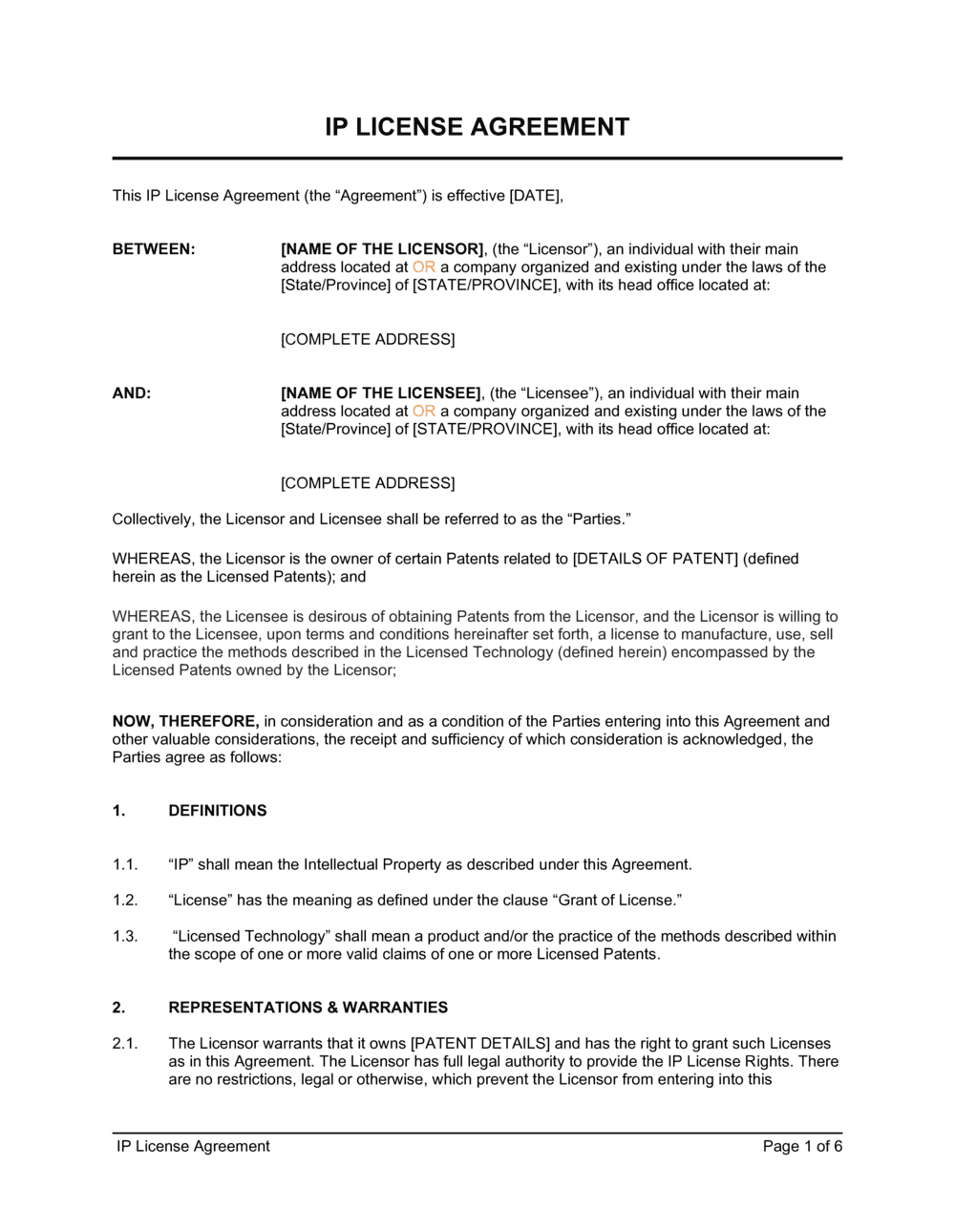
IP License Agreement Template

Free Word download β€’ Edit online β€’ Save & share with Drive β€’ Export to PDF

6 pagesβ€’25–35 min to fillβ€’Difficulty: Complexβ€’Signature requiredβ€’Legal review recommended
Learn more ↓
FreeIP License Agreement Template

At a glance

What it is
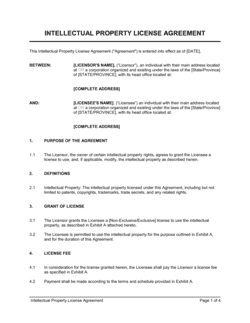
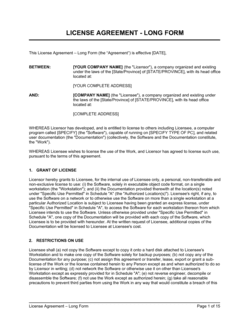
An IP License Agreement is a legally binding contract in which an intellectual property owner (licensor) grants another party (licensee) the right to use, reproduce, distribute, or commercialize specified IP β€” such as patents, trademarks, software, or copyrighted works β€” under defined conditions. This free Word download covers scope, exclusivity, royalties, sublicensing rights, warranties, and termination in a single document you can edit online and export as PDF.
When you need it
Use it when a business or individual wants to monetize IP they own without transferring ownership, or when a company needs to legally use another party's IP in its products, services, or operations. It is required any time you want enforceable control over how your IP is used and compensated.
What's inside
Identification of the licensed IP, grant of rights and exclusivity terms, royalty structure and payment schedule, sublicensing permissions, representations and warranties, confidentiality obligations, audit rights, infringement response procedures, and termination conditions with post-termination obligations.

What is an IP License Agreement?

An IP License Agreement is a legally binding contract in which an intellectual property owner β€” the licensor β€” grants a second party β€” the licensee β€” defined rights to use, reproduce, distribute, or commercialize specified intellectual property, such as patents, trademarks, copyrighted works, or proprietary software, in exchange for royalties, fees, or other agreed consideration. The critical distinction from a sale is that a license transfers usage rights only: the licensor retains full ownership of the underlying IP throughout the term and after it ends. The agreement governs every dimension of that permission β€” what the licensee can do, where, for how long, on what financial terms, and what happens when the relationship ends.

Why You Need This Document

Operating without a signed IP license agreement exposes both parties to serious legal and financial risk. A licensor who permits use of its IP without a written agreement has no enforceable mechanism to collect royalties, restrict competitors from obtaining the same rights, or reclaim the IP if the licensee misuses it. Courts in most jurisdictions will imply a license from conduct β€” but the scope, exclusivity, and payment terms of an implied license are determined by a judge, not by you. For the licensee, operating without a formal agreement means the licensor can revoke permission at any time, leaving products pulled from market, customer commitments broken, and development investment stranded. A properly drafted IP license agreement fixes the scope of rights, locks in the financial terms, protects both parties if the IP is challenged by a third party, and creates a clear exit path when the relationship concludes. This template gives you a structured, attorney-reviewed starting point that covers every material provision β€” saving weeks of drafting time and ensuring nothing critical is left unaddressed.

Which variant fits your situation?

If your situation is…Use this template
Licensing software to end users or enterprise clientsSoftware License Agreement
Allowing a third party to use your trademark on their productsTrademark License Agreement
Granting rights to manufacture using a patented inventionPatent License Agreement
Licensing creative works such as images, music, or written contentCopyright License Agreement
Transferring full IP ownership permanently to another partyIP Assignment Agreement
Licensing IP exclusively to a single party in a defined territoryExclusive License Agreement
Sharing technology between two companies on a reciprocal basisCross-License Agreement

Common mistakes to avoid

❌ Vague identification of the licensed IP

Why it matters: If the agreement refers to 'the company's software' without specifying version, module, or registration, the parties will disagree on what is actually licensed when a dispute arises.

Fix: List every IP asset by name, registration number, and jurisdiction in a Schedule A attached to and incorporated into the agreement.

❌ No field-of-use restriction

Why it matters: Without a field-of-use limitation, an exclusive licensee may lawfully expand into markets the licensor intended to serve directly or license to others, destroying the licensor's revenue strategy.

Fix: Define the permitted field of use and territory with the same precision you would use to describe a geographic or product market in a commercial contract.

❌ Undefined 'Net Sales' in the royalty clause

Why it matters: Licensees routinely deduct freight, returns, intercompany transfers, and bundled product discounts that inflate deductions and reduce royalties owed β€” sometimes by 30–40%.

Fix: List every permitted deduction explicitly in the definition of Net Sales and include a catch-all that bars any other deductions not listed.

❌ Granting sublicensing rights without liability flow-through

Why it matters: If the licensee can sublicense freely and the sublicensee infringes or fails to pay, the licensor has no contractual claim against the sublicensee and the licensee may disclaim responsibility.

Fix: Require that any sublicense include terms at least as protective as the master agreement and state that the licensee remains jointly liable for all sublicensee obligations.

❌ No IP challenge termination right

Why it matters: If the licensee challenges the validity of the licensed patent or trademark while continuing to pay reduced royalties, the licensor may be unable to terminate β€” leaving them locked into a below-market deal during litigation.

Fix: Include an explicit termination right triggered if the licensee directly or indirectly challenges the validity or ownership of the licensed IP.

❌ Omitting post-termination use restrictions

Why it matters: Without a clear obligation to cease use and destroy or return materials, licensees sometimes continue using IP after termination, claiming the agreement was ambiguous on this point.

Fix: Add a post-termination clause requiring the licensee to certify in writing within 30 days that all use has ceased and all licensed materials have been destroyed or returned.

The 10 key clauses, explained

Grant of rights

In plain language: Defines exactly which IP is licensed, the scope of permitted uses, whether the license is exclusive or non-exclusive, and the territory in which rights apply.

Sample language
Licensor hereby grants to Licensee a [exclusive / non-exclusive], non-transferable license under [PATENT NOS. / TRADEMARK REG. NOS. / COPYRIGHT WORKS] to [USE / MAKE / SELL / REPRODUCE] the Licensed IP solely within [TERRITORY] and for the Field of Use described in Schedule A.

Common mistake: Omitting a specific field-of-use restriction. Without it, the licensee may lawfully use the IP in markets the licensor intended to reserve for itself or for other licensees.

Exclusivity and reservations

In plain language: States whether the license is exclusive, sole, or non-exclusive, and explicitly preserves any rights the licensor retains β€” including the right to use the IP itself.

Sample language
This license is exclusive within the Field of Use and Territory. Notwithstanding exclusivity, Licensor retains the right to practice the Licensed IP for its own internal research and development purposes.

Common mistake: Granting exclusivity without carving out the licensor's own right to use the IP. If the licensor later uses its own patent commercially, the licensee may claim breach.

Royalties and payment terms

In plain language: Sets out the royalty rate or fee structure, the payment calculation method, reporting frequency, and the currency in which payments are due.

Sample language
Licensee shall pay Licensor a royalty of [X]% of Net Sales, payable quarterly within [30] days following the end of each calendar quarter. 'Net Sales' means gross invoiced amounts less [returns, discounts, and taxes].

Common mistake: Failing to define 'Net Sales' with specificity. Without a clear definition, licensees often deduct expenses the licensor never intended to exclude, systematically understating royalties owed.

Milestone and upfront payments

In plain language: Specifies any lump-sum payment due at signing and any milestone-based payments triggered by defined commercial or regulatory events.

Sample language
Licensee shall pay an upfront license fee of $[AMOUNT] within [10] business days of execution. Additional milestone payments shall be due as follows: $[AMOUNT] upon [MILESTONE], $[AMOUNT] upon [MILESTONE].

Common mistake: Setting milestones that are ambiguous or outside the licensee's direct control. Disputed milestones are among the most litigated provisions in IP license agreements.

Sublicensing rights

In plain language: States whether the licensee may grant rights to third parties, and if so, under what conditions and with what approval or notification requirements.

Sample language
Licensee [may / may not] sublicense the rights granted herein without Licensor's prior written consent. Any permitted sublicense shall be on terms no less protective of Licensor's rights than those set forth in this Agreement, and Licensee shall remain liable for any sublicensee's breach.

Common mistake: Permitting sublicensing without requiring the licensee to remain responsible for sublicensee conduct. If a sublicensee infringes or fails to pay, the licensor has no direct recourse without this provision.

Intellectual property ownership and improvements

In plain language: Confirms that the licensor retains ownership of the underlying IP and addresses who owns any improvements or derivatives created by the licensee during the license term.

Sample language
Licensee acknowledges that all right, title, and interest in the Licensed IP remains with Licensor. Any improvement, modification, or derivative work created by Licensee relating to the Licensed IP shall be [owned by Licensor / jointly owned / owned by Licensee, subject to a grant-back license to Licensor].

Common mistake: Leaving improvements ownership silent. If not addressed, the licensee may own a patentable improvement and use it to block or compete with the licensor.

Representations, warranties, and disclaimers

In plain language: Sets out what each party represents as true at signing β€” including the licensor's ownership of the IP and authority to license it β€” and limits implied warranties.

Sample language
Licensor represents and warrants that it has full right and authority to grant the licenses herein and is not aware of any pending claim that the Licensed IP infringes the rights of any third party. EXCEPT AS EXPRESSLY SET FORTH HEREIN, THE LICENSED IP IS PROVIDED 'AS IS' WITHOUT WARRANTY OF ANY KIND.

Common mistake: Omitting a warranty of non-infringement entirely. If a third party later challenges the IP and the licensee faces an infringement claim, the absence of this warranty leaves the licensee without a contractual indemnification claim against the licensor.

Audit rights and record-keeping

In plain language: Grants the licensor the right to inspect the licensee's sales records and royalty calculations at reasonable intervals to verify compliance.

Sample language
Licensee shall maintain complete and accurate records of all transactions relevant to royalty calculations for [3] years. Licensor may, upon [30] days' written notice, audit such records no more than once per calendar year. Costs of audit borne by [Licensor / Licensee if underpayment exceeds X%].

Common mistake: No audit rights clause at all, or one that allows unlimited audits without notice. Without a floor and ceiling, audits become either impossible to enforce or a harassment tool.

Term and termination

In plain language: Defines the duration of the license, conditions under which either party may terminate, and the consequences of termination β€” including what the licensee must stop doing and what survives.

Sample language
This Agreement commences on the Effective Date and continues for [X] years unless earlier terminated. Either party may terminate for cause upon [30] days' written notice if the other party materially breaches and fails to cure within the notice period. Upon termination, Licensee shall cease all use of the Licensed IP and destroy or return all related materials.

Common mistake: No post-termination obligations on the licensee. Without explicit language requiring cessation of use and destruction of materials, licensees sometimes continue using licensed IP after termination.

Governing law and dispute resolution

In plain language: Specifies which jurisdiction's law governs the agreement and how disputes are resolved β€” typically arbitration or litigation in a named venue.

Sample language
This Agreement shall be governed by the laws of [STATE / COUNTRY]. Any dispute arising hereunder shall be resolved by binding arbitration administered by [AAA / ICC / LCIA] in [CITY], except that either party may seek injunctive relief in any court of competent jurisdiction to protect IP rights.

Common mistake: Choosing a governing law with no connection to where either party operates or where the IP is registered. Enforcement of judgments or arbitral awards becomes significantly harder when the forum has no nexus to the dispute.

How to fill it out

  1. 1

    Identify and describe the licensed IP precisely

    List every patent number, trademark registration, copyright work, or software component being licensed. Vague descriptions like 'our technology' create disputes about what is and is not covered.

    πŸ’‘ Attach a Schedule A that lists IP by registration number, title, and jurisdiction β€” this becomes the authoritative reference if any dispute arises.

  2. 2

    Choose exclusivity and define the field of use

    Decide whether the license is exclusive, sole, or non-exclusive, and state explicitly the field of use and territory. These two parameters determine the economic value of the license and must be unambiguous.

    πŸ’‘ If offering multiple licensees in different markets, use distinct field-of-use definitions for each β€” overlapping fields are the most common trigger for licensee disputes.

  3. 3

    Set the royalty rate and define net sales

    Enter the royalty percentage or per-unit fee, the payment frequency (quarterly is standard), and a precise definition of 'Net Sales' including which deductions are permitted.

    πŸ’‘ Industry royalty rates vary widely β€” software IP typically runs 5–15% of net revenue, while pharmaceutical patents can exceed 20%. Research comparable benchmarks before setting your rate.

  4. 4

    Specify upfront fees and milestone payments

    Enter any signing fee and list milestone payments with their triggering events defined in measurable, objective terms β€” first commercial sale, regulatory approval, or reaching a defined unit volume.

    πŸ’‘ Tie milestones to events the licensee controls directly. Milestones dependent on third-party actions (e.g., regulatory approval timelines) should include a grace period.

  5. 5

    Address sublicensing, improvements, and grant-backs

    Explicitly state whether sublicensing is permitted and under what conditions. Address who owns improvements the licensee makes to the IP, and whether a grant-back license to the licensor is required.

    πŸ’‘ If granting a grant-back license, specify whether it is exclusive or non-exclusive and royalty-bearing β€” silence on this point has generated significant litigation.

  6. 6

    Set audit rights and record-keeping requirements

    Define how long the licensee must retain royalty records (typically 3 years), how frequently audits can occur, and who bears audit costs if a material underpayment is discovered.

    πŸ’‘ A threshold of 5% underpayment shifting costs to the licensee is industry standard and incentivizes accurate reporting without making audits punitive.

  7. 7

    Define term, termination triggers, and post-termination obligations

    Set the license duration, the cure period for material breaches, immediate termination triggers (insolvency, IP challenge), and specific post-termination obligations such as ceasing use and returning materials.

    πŸ’‘ Include a license survival clause for any sublicenses granted before termination if you want those sublicensees to continue operating β€” absent this, sublicenses terminate automatically with the master license.

  8. 8

    Execute before any use of the licensed IP begins

    Both parties must sign the agreement before the licensee exercises any licensed rights. Use of IP prior to a signed agreement can create implied license arguments that undermine the written terms.

    πŸ’‘ Store the fully executed agreement alongside the IP registration documents so ownership and license status are always documented together.

Frequently asked questions

What is an IP license agreement?

An IP license agreement is a contract in which an intellectual property owner (the licensor) grants another party (the licensee) the right to use specified IP β€” such as a patent, trademark, software, or copyrighted work β€” under defined conditions, in exchange for royalties or fees. Unlike an assignment, a license does not transfer ownership; the licensor retains title to the IP throughout and after the agreement.

What types of intellectual property can be licensed?

Patents, trademarks, copyrights, trade secrets, software, databases, domain names, and know-how can all be licensed. Each type of IP has distinct legal characteristics that affect how the license is structured β€” patent licenses often include field-of-use restrictions, trademark licenses typically require quality-control provisions, and software licenses address permitted use and reverse engineering restrictions.

What is the difference between an exclusive and a non-exclusive license?

An exclusive license grants the licensee the sole right to use the IP within the defined scope β€” the licensor cannot grant the same rights to anyone else, and may not exercise those rights itself unless the agreement expressly reserves that right. A non-exclusive license allows the licensor to grant identical rights to multiple parties simultaneously. Exclusive licenses command higher royalties and upfront fees because they give the licensee a competitive advantage.

What is a reasonable royalty rate for an IP license?

Royalty rates vary significantly by industry and IP type. Software and technology licenses typically run 5–15% of net revenue; pharmaceutical and biotech patent licenses often range from 2–10% at product stage and can exceed 20% for breakthrough compounds. Trademark licenses (such as franchises) typically run 1–8% of gross sales. The Georgia-Pacific factors, a 15-factor test used in US patent litigation, provides a framework for determining a reasonable royalty when parties cannot agree.

What is the difference between an IP license agreement and an IP assignment?

A license grants the right to use IP while the licensor retains ownership β€” it is a permission, not a sale. An assignment permanently transfers full ownership of the IP to the assignee. Licensors choose licensing when they want ongoing royalty income, wish to maintain control over how the IP is used, or want to license the same IP to multiple parties. Assignment is appropriate when the seller wants a clean exit and has no further interest in the IP.

Do I need a lawyer to draft an IP license agreement?

For straightforward non-exclusive licenses involving low-value IP, a well-structured template is often sufficient as a starting point. Engaging an IP attorney is strongly recommended when the IP is central to your business model, the license is exclusive, the royalty stream is material, or the licensee operates in multiple jurisdictions. Attorney fees for a reviewed license agreement typically run $500–$2,500 depending on complexity β€” far less than the cost of an underpayment dispute or post-termination infringement claim.

Can an IP license agreement be terminated early?

Yes. Most IP license agreements include termination for cause β€” typically triggered by material breach (including non-payment of royalties), insolvency, or challenge to the licensed IP's validity β€” as well as optional termination for convenience with advance notice if the parties agree to include it. Courts in most jurisdictions will enforce a well- drafted termination clause as written, provided the triggering events are clearly defined and cure periods are reasonable.

What happens to sublicenses when a master IP license is terminated?

Under common-law default rules in most jurisdictions, sublicenses terminate automatically when the master license ends, because the sublicensor cannot grant rights it no longer holds. To protect sublicensees from this result β€” particularly in software distribution chains β€” parties often include a survival clause confirming that sublicenses granted in compliance with the master agreement survive its termination. Absent such a clause, sublicensees face immediate infringement exposure.

Is an IP license agreement enforceable across international borders?

IP rights are territorial β€” a US patent license does not automatically grant rights in Germany, and a UK trademark license does not extend to Canada. Cross-border agreements should specify the territories covered, reference the specific IP registrations in each jurisdiction, and select a governing law and dispute resolution forum with genuine connection to the parties. For broad international licenses, consider separate country- or region-specific schedules to address local statutory requirements.

How this compares to alternatives

vs IP Assignment Agreement

An IP assignment permanently transfers ownership of the intellectual property to the buyer β€” after signing, the original owner has no further rights. An IP license grants usage rights while the licensor retains ownership and can continue earning royalties. Choose a license when you want ongoing income or to license the same IP to multiple parties; choose an assignment when you want a clean exit and full consideration upfront.

vs Non-Disclosure Agreement

An NDA protects confidential information shared during negotiations or a business relationship but does not grant any right to use the information commercially. An IP license agreement is the document that actually grants those usage rights. In most IP transactions, an NDA is signed first to allow due diligence, followed by the license agreement to formalize the commercial relationship.

vs Software License Agreement

A software license agreement is a specialized form of IP license focused on software products β€” covering permitted installations, user counts, reverse-engineering restrictions, and SLA terms. A general IP license agreement covers a broader range of IP types including patents, trademarks, and copyrights. Use the software-specific template when licensing a software product; use the general IP license when the subject matter spans multiple IP categories or involves non-software IP.

vs Joint Venture Agreement

A joint venture agreement creates a shared business entity or collaboration between two parties, often including cross-licensing of IP as one component. An IP license agreement is a standalone commercial contract governing only the IP usage rights. If the parties intend to collaborate on developing new IP together, a joint venture or co-development agreement is more appropriate than a simple license.

Industry-specific considerations

Technology / SaaS

Source code escrow provisions, API rate limits, SLA references, and restrictions on reverse engineering are standard additions for software IP licenses.

Pharmaceuticals and biotech

Regulatory milestone payments tied to FDA or EMA approval stages, sublicensing to distribution partners, and diligence obligations requiring the licensee to actively commercialize the IP.

Consumer goods and retail

Trademark quality-control provisions requiring licensor approval of product samples, labeling standards, and minimum sales guarantees to maintain exclusivity.

Media and entertainment

Copyright licenses covering specific formats (streaming, print, broadcast), territory splits by language or region, and moral rights waivers in jurisdictions that recognize them.

Manufacturing

Patent licenses covering manufacturing processes often include field-of-use limits by end product category, output-based royalties, and most-favored-licensee pricing clauses.

Professional Services

Consulting and advisory firms licensing proprietary methodologies or assessment tools typically require confidentiality around the methodology and limit the number of permitted users per license.

Jurisdictional notes

United States

US patent and copyright licenses are governed by federal law (35 U.S.C. for patents, 17 U.S.C. for copyright), while trademark licenses and trade secret protections involve a mix of federal and state law. Courts in some states β€” notably Delaware and New York β€” are preferred for governing-law clauses due to their predictable commercial jurisprudence. Non-exclusive patent licensees generally cannot sue for infringement without the patentee joining the suit, which should be addressed in the agreement.

Canada

Canadian IP rights are governed federally under the Patent Act, Trade-marks Act, and Copyright Act, but contractual disputes are subject to provincial common law (or Quebec civil law). Quebec contracts should be available in French for Quebec-based licensees under the Charter of the French Language. Copyright moral rights in Canada cannot be assigned but can be waived β€” a waiver clause is important for content licenses.

United Kingdom

UK IP licenses are governed by the Patents Act 1977, Trade Marks Act 1994, and Copyright, Designs and Patents Act 1988. Exclusive patent licensees in the UK have statutory standing to sue for infringement in their own name, unlike in the US. Post-Brexit, separate provisions are required for rights in the EU versus Great Britain, as EU trademark and design registrations no longer extend to the UK.

European Union

EU technology transfer agreements are subject to the Technology Transfer Block Exemption Regulation (TTBER), which sets safe harbors and restrictions on certain license terms β€” including limitations on passive sales, price-fixing, and territorial protections that may restrict competition. GDPR considerations apply when licensed software or databases process personal data. Unitary Patent protection (effective 2023) allows a single patent license to cover most EU member states, simplifying cross-border arrangements.

Template vs lawyer β€” what fits your deal?

PathBest forCostTime
Use the templateNon-exclusive licenses for relatively straightforward IP such as logos, content, or non-core software toolsFree30–60 minutes
Template + legal reviewExclusive licenses, material royalty streams, cross-border arrangements, or IP central to the business model$500–$2,5003–7 days
Custom draftedComplex multi-patent licenses, pharmaceutical or biotech commercialization deals, or licenses with significant milestone and equity components$3,000–$15,000+2–6 weeks

Glossary

Licensor
The party who owns the intellectual property and grants permission to another party to use it under defined terms.
Licensee
The party receiving the right to use the licensor's intellectual property, subject to the agreement's conditions.
Exclusive License
A grant of rights that prevents the licensor from licensing the same IP to any other party within the defined scope, territory, or field of use.
Non-Exclusive License
A grant of rights that permits the licensor to simultaneously license the same IP to multiple parties.
Royalty
Ongoing compensation paid by the licensee to the licensor, typically calculated as a percentage of net sales or a fixed fee per unit or use.
Field of Use
A contractual restriction limiting how and in what markets the licensee may exercise the licensed rights β€” for example, 'commercial automotive applications only'.
Sublicensing
The licensee's right to grant some or all of its licensed rights to a third party, which must be explicitly permitted in the agreement.
Milestone Payment
A lump-sum payment triggered when the licensee achieves a defined commercial or development milestone, such as first commercial sale or regulatory approval.
Upfront Fee
A one-time payment made by the licensee at signing, sometimes called a signing fee or license initiation fee, separate from ongoing royalties.
Audit Rights
A contractual provision allowing the licensor to inspect the licensee's sales records and royalty calculations, typically with reasonable notice and frequency limits.
IP Assignment
A permanent transfer of IP ownership from one party to another β€” distinct from licensing, which grants rights while the licensor retains ownership.
Termination for Cause
The right to end the agreement immediately upon specified breaches, such as non-payment of royalties, insolvency, or challenge to the licensor's IP ownership.

Part of your Business Operating System

This document is one of 3,000+ business & legal templates included in Business in a Box.

  • Fill-in-the-blanks β€” ready in minutes
  • 100% customizable Word document
  • Compatible with all office suites
  • Export to PDF and share electronically

Create your document in 3 simple steps.

From template to signed document β€” all inside one Business Operating System.
1
Download or open template

Access over 3,000+ business and legal templates for any business task, project or initiative.

2
Edit and fill in the blanks with AI

Customize your ready-made business document template and save it in the cloud.

3
Save, Share, Send, Sign

Share your files and folders with your team. Create a space of seamless collaboration.

Save time, save money, and create top-quality documents.

β˜…β˜…β˜…β˜…β˜…

"Fantastic value! I'm not sure how I'd do without it. It's worth its weight in gold and paid back for itself many times."

Managing Director Β· Mall Farm
Robert Whalley
Managing Director, Mall Farm Proprietary Limited
β˜…β˜…β˜…β˜…β˜…

"I have been using Business in a Box for years. It has been the most useful source of templates I have encountered. I recommend it to anyone."

Business Owner Β· 4+ years
Dr Michael John Freestone
Business Owner
β˜…β˜…β˜…β˜…β˜…

"It has been a life saver so many times I have lost count. Business in a Box has saved me so much time and as you know, time is money."

Owner Β· Upstate Web
David G. Moore Jr.
Owner, Upstate Web

Run your business with a system β€” not scattered tools

Stop downloading documents. Start operating with clarity. Business in a Box gives you the Business Operating System used by over 250,000 companies worldwide to structure, run, and grow their business.

Free Forever PlanΒ Β·Β No credit card required