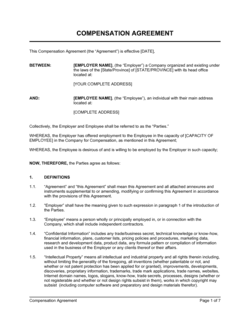
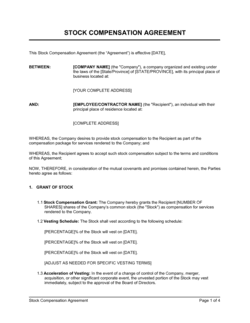
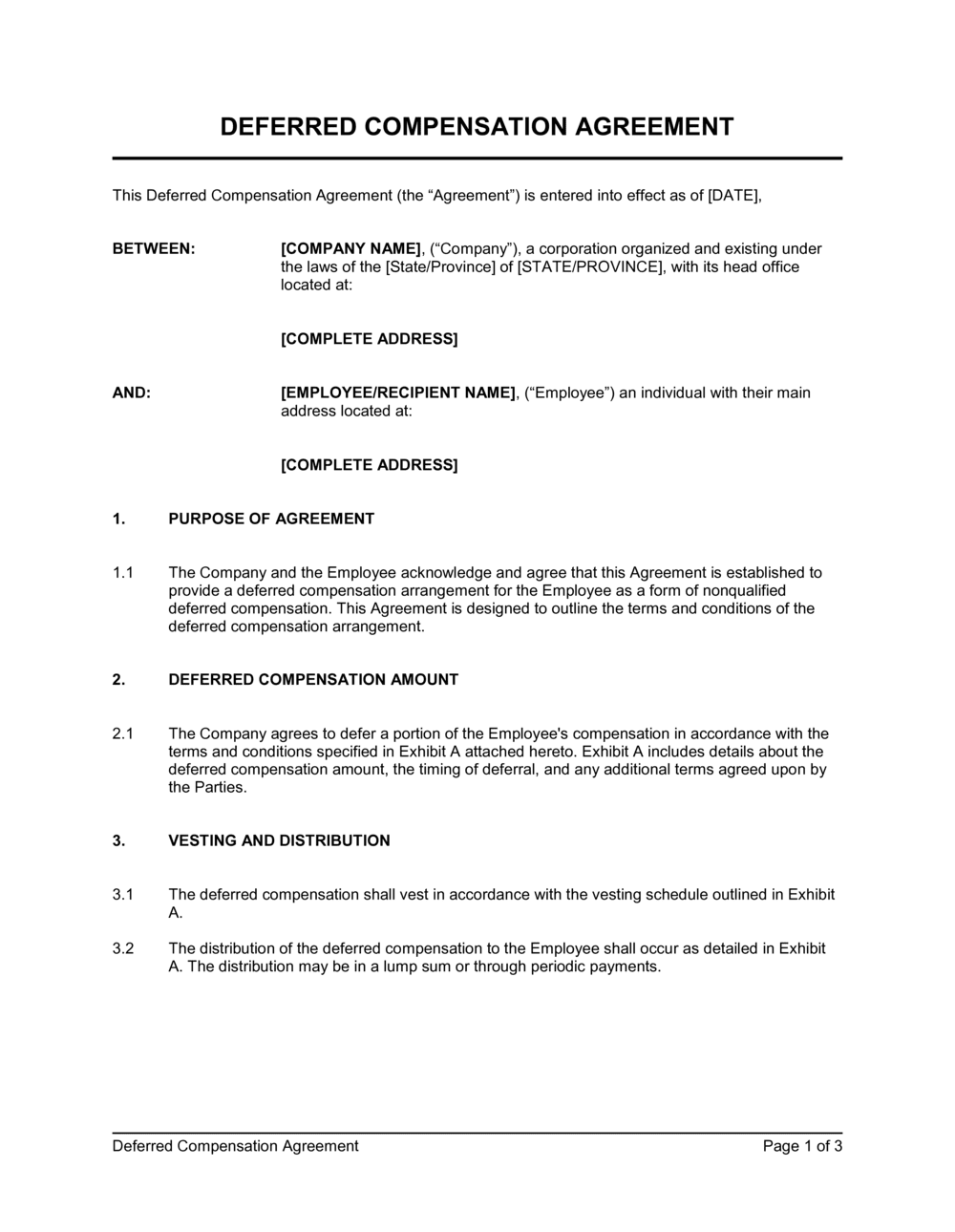
Deferred Compensation Agreement Template

Free Word download • Edit online • Save & share with Drive • Export to PDF

3 pages25–30 min to fillDifficulty: StandardSignature requiredLegal review recommended
Learn more ↓
FreeDeferred Compensation Agreement Template

At a glance

What it is
A Deferred Compensation Agreement is a legally binding contract between an employer and an employee — typically an executive or key employee — under which a portion of earned compensation is set aside and paid out at a future date rather than when earned. This free Word download gives you a structured, attorney-reviewed starting point covering deferral elections, vesting schedules, payout triggers, forfeiture conditions, and tax compliance language you can edit online and export as PDF.
When you need it
Use it when offering a senior hire or existing executive a supplemental retention incentive tied to future performance or tenure, when structuring a bonus deferral program for key employees, or when replacing informal compensation promises with an enforceable written agreement.
What's inside
Deferral amount and election mechanics, vesting schedule, permissible distribution triggers, forfeiture and clawback provisions, funding and rabbi-trust arrangements, tax compliance language referencing IRC Section 409A, change-of-control treatment, and governing law.

What is a Deferred Compensation Agreement?

A Deferred Compensation Agreement is a legally binding contract between an employer and an employee — typically an executive, senior manager, or other key person — under which a portion of earned compensation is withheld from current payment and paid out at a specified future date or upon a defined triggering event. Unlike a qualified retirement plan such as a 401(k), a nonqualified deferred compensation (NQDC) arrangement is not subject to ERISA's coverage and funding rules, giving employers the flexibility to offer it selectively and structure it around retention or performance objectives. In the United States, virtually all such arrangements must comply with IRC Section 409A, which governs election timing, permissible distribution triggers, and payout mechanics with strict penalties for noncompliance — making precise drafting essential.

Why You Need This Document

Without a written deferred compensation agreement, a verbal or email-based promise to pay a future bonus or deferred salary is nearly impossible to enforce and creates immediate legal and tax exposure for both parties. The employee has no documented right to the deferred amount and no defined payout terms to rely on; the employer has no vesting or forfeiture conditions to protect against early departure. From a tax perspective, an undocumented or improperly structured arrangement can be treated as constructively received — meaning the employee owes income tax on the full amount immediately, with no deferral benefit realized at all. A properly executed agreement defines every material term — deferral amount, vesting conditions, permissible distribution events, forfeiture triggers, and Section 409A compliance language — in a single enforceable document that protects both the employer's retention objectives and the employee's expectation of future payment.

Which variant fits your situation?

If your situation is…Use this template
Deferring a portion of annual salary or bonus for a senior executiveDeferred Compensation Agreement (Executive)
Retaining a key non-executive employee with a future bonus promiseRetention Bonus Agreement
Providing equity-linked deferred compensation tied to company valuePhantom Stock Agreement
Granting stock options as part of a deferred compensation structureStock Option Agreement
Tying deferred payouts to a defined performance metricPerformance Bonus Agreement
Supplementing a qualified 401(k) plan for highly compensated employeesSERP (Supplemental Executive Retirement Plan) Agreement
Documenting a salary continuation arrangement for a departing executiveExecutive Separation Agreement

Common mistakes to avoid

❌ Making or accepting a deferral election after compensation is earned

Why it matters: Under IRC Section 409A, an election made after the right to the compensation has vested causes immediate income inclusion, a 20% excise tax, and interest penalties on the entire deferred amount — regardless of when it is actually paid.

Fix: Execute the deferral election before the start of the plan year in which the compensation will be earned. For performance bonuses, confirm whether the 18-month performance-period exception applies before using a later election date.

❌ Adding a discretionary payout trigger outside the six Section 409A events

Why it matters: Any distribution event not listed in Section 409A — such as 'at the employer's discretion' or 'upon a liquidity event' that does not meet the regulatory definition of a change in control — causes the entire plan balance to become immediately taxable with penalties.

Fix: Limit distribution triggers strictly to the six statutory events and ensure each is defined using the Section 409A treasury regulation language, not informal business definitions.

❌ Failing to include a 409A savings and compliance clause

Why it matters: Without an explicit savings clause, courts and the IRS cannot use interpretive flexibility to cure inadvertent technical violations — the agreement is judged on its literal terms.

Fix: Include a clause stating the agreement is intended to comply with IRC Section 409A and shall be interpreted consistently with that intent, with any ambiguous provision construed to avoid noncompliance.

❌ Omitting creditor-subordination language when using a rabbi trust

Why it matters: A rabbi trust without proper creditor-subordination language may be treated as a funded secular trust, causing immediate income inclusion for the employee — defeating the purpose of the deferral entirely.

Fix: Follow IRS Revenue Procedure 92-64 model trust language and include an explicit provision that trust assets remain subject to the claims of the employer's general creditors in insolvency or bankruptcy.

❌ Using a vesting schedule so short it does not constitute a substantial risk of forfeiture

Why it matters: If the IRS determines there is no genuine forfeiture risk — for example, a 30-day cliff vest — the deferred compensation may be treated as constructively received and taxable in the year it was earned.

Fix: Set a vesting schedule of at least 12 months tied to continued employment, and preferably 24–60 months for material amounts. Ensure forfeiture conditions are real, not cosmetic.

❌ Failing to coordinate the agreement with existing employment contract terms

Why it matters: Conflicting termination provisions between an employment contract and a deferred compensation agreement — particularly around what constitutes 'cause' or 'good reason' — create competing interpretations that employees and their counsel exploit in separation disputes.

Fix: Cross-reference and harmonize defined terms between the employment contract and the deferred compensation agreement before execution. Use identical definitions of 'cause,' 'good reason,' and 'change in control' across both documents.

The 10 key clauses, explained

Parties, purpose, and effective date

In plain language: Identifies the employer and employee by legal name, states the purpose of the agreement, and sets the date from which the arrangement is effective.

Sample language
This Deferred Compensation Agreement ('Agreement') is entered into as of [DATE] by and between [EMPLOYER LEGAL NAME], a [STATE] [ENTITY TYPE] ('Company'), and [EMPLOYEE FULL NAME] ('Executive').

Common mistake: Using a trade name instead of the registered legal entity name — if the employer entity doesn't match payroll and corporate records, enforcing a clawback or forfeiture becomes legally complicated.

Deferral amount and election

In plain language: Specifies how much compensation is deferred — a fixed dollar amount, a percentage of salary or bonus, or an amount elected annually by the employee — and requires the election to be made before the compensation is earned.

Sample language
Executive elects to defer [X]% of Base Salary and [Y]% of Annual Bonus each Plan Year. Such election must be submitted no later than [December 31] of the year preceding the Plan Year to which it relates.

Common mistake: Allowing an election after compensation has already been earned. Under IRC Section 409A, a post-earning election causes immediate income inclusion and the 20% excise tax — the entire deferred amount becomes taxable in the year of the violation.

Deferred compensation account

In plain language: Establishes a bookkeeping account in the employee's name that tracks deferred amounts, any notional earnings or investment credits, and distributions — without requiring the employer to set aside actual funds.

Sample language
The Company shall establish and maintain a Deferred Compensation Account for Executive, which shall be credited with the Deferral Amount as of [the last day of each pay period / the date the Bonus would otherwise have been paid] and adjusted to reflect Notional Earnings at the rate of [INDEX / FIXED RATE OF X%] per annum.

Common mistake: Promising specific investment returns in the bookkeeping account without carving out market-rate variability. Guaranteeing a fixed return above a de minimis rate can transform the arrangement into a funded plan subject to ERISA.

Vesting schedule

In plain language: States when the employee's right to receive the deferred compensation becomes nonforfeitable — using cliff vesting, graded vesting, or immediate vesting depending on the retention objective.

Sample language
Executive shall vest in the Deferred Compensation Account as follows: 33% on the first anniversary of the Effective Date, 33% on the second anniversary, and 34% on the third anniversary, provided Executive remains continuously employed by the Company on each such date.

Common mistake: Using a vesting schedule that is too short to serve as a meaningful retention tool, or too long to be legally defensible as linked to a substantial risk of forfeiture — three to five years is the typical enforced range.

Permissible distribution events and timing

In plain language: Lists the specific triggering events that allow payment of the deferred compensation and the timing and form of each payout — critical for IRC Section 409A compliance.

Sample language
Distribution shall be made upon the earliest of: (a) Executive's separation from service, subject to the six-month delay for Specified Employees; (b) Executive's death or Disability; (c) a Change in Control; or (d) [DATE], in each case in a lump sum / [X] annual installments.

Common mistake: Adding discretionary payout triggers beyond the six permitted Section 409A distribution events — for example, allowing the employer to accelerate payment 'at its discretion.' This voids Section 409A compliance and triggers the excise tax.

Forfeiture and clawback

In plain language: Defines the conditions under which unvested or even vested deferred compensation is forfeited or clawed back — typically tied to termination for cause, breach of restrictive covenants, or financial restatement.

Sample language
Executive shall forfeit all unvested amounts upon termination for Cause. In the event of a material restatement of Company financial results, the Company may recoup any vested amounts paid within the preceding [24] months to the extent attributable to the restated period.

Common mistake: Omitting a clawback clause entirely or failing to align it with the employer's Dodd-Frank clawback policy for public companies — listed companies are required to maintain and enforce a clawback policy under SEC Rule 10D-1.

Funding and rabbi trust

In plain language: States whether the employer will fund its obligation informally through a rabbi trust or remain unfunded, and — if a trust is used — clarifies that assets remain subject to the employer's creditors in insolvency.

Sample language
The Company may, in its discretion, establish a rabbi trust to hold assets intended to satisfy its obligations under this Agreement. Any such trust assets shall remain subject to the claims of the Company's general creditors in the event of insolvency or bankruptcy.

Common mistake: Promising the employee that trust assets are fully protected from creditor claims. A secular trust with true asset protection converts the arrangement into a funded plan subject to immediate income inclusion.

Change-in-control treatment

In plain language: Specifies whether a change of control accelerates vesting, triggers distribution, or has no effect — and defines what constitutes a qualifying change-of-control event.

Sample language
Upon a Change in Control, all unvested amounts shall immediately vest. Distribution following a Change in Control shall be made in a lump sum within [90] days of the event, provided such event constitutes a change in the ownership or effective control of the Company within the meaning of Treasury Regulation §1.409A-3(i)(5).

Common mistake: Defining 'change in control' more broadly than the Section 409A regulatory definition — a payout trigger that does not qualify under the treasury regulation exposes the payment to excise taxes even if the intent was legitimate.

Tax withholding and compliance

In plain language: Confirms that all deferred amounts remain subject to applicable payroll and income tax withholding at the time of distribution, and that the agreement is intended to comply with IRC Section 409A.

Sample language
All distributions under this Agreement shall be subject to withholding for federal, state, and local income and employment taxes. This Agreement is intended to comply with IRC Section 409A and shall be interpreted and administered consistently therewith.

Common mistake: Failing to include a 409A savings clause. Without one, any inadvertent noncompliance cannot be cured by interpretive construction, and courts have refused to reform agreements that are silent on compliance intent.

Governing law, entire agreement, and amendment

In plain language: Identifies the controlling jurisdiction's law, confirms this document supersedes all prior compensation promises related to the deferred amount, and restricts amendments to written, signed modifications.

Sample language
This Agreement is governed by the laws of [STATE]. This Agreement constitutes the entire agreement between the parties with respect to the subject matter hereof and supersedes all prior understandings. No amendment shall be effective unless made in writing and signed by both parties, provided that any amendment that affects the time or form of payment shall comply with IRC Section 409A.

Common mistake: Allowing informal amendments by email or oral agreement — any change to payout timing or form must meet Section 409A's subsequent deferral election rules or the amendment itself triggers excise taxes.

How to fill it out

  1. 1

    Enter the legal entity names and effective date

    Use the employer's full registered corporate name and the employee's legal name as it appears on government ID. Set the effective date before any compensation subject to the agreement is earned.

    💡 Cross-reference the corporate registry to confirm the exact employer entity — a mismatch between the agreement and payroll records complicates enforcement.

  2. 2

    Define the deferral amount and election deadline

    Specify whether the deferral is a fixed dollar amount, a percentage of salary, a percentage of bonus, or an annual employee election. Set the election deadline to at least one day before the start of the plan year in which the compensation is earned.

    💡 For bonuses that are performance-based, Section 409A permits a later election deadline of up to six months before the end of the performance period — confirm the bonus qualifies before using the extended window.

  3. 3

    Set up the bookkeeping account and notional earnings rate

    Describe how the deferred account will be credited and what rate or index will be used to calculate notional investment returns. Common choices are a fixed rate (e.g., 5% per annum), a market index (e.g., S&P 500), or a menu of hypothetical investment options.

    💡 Avoid guaranteeing a fixed rate materially above the applicable federal rate — this can attract IRS scrutiny as a funded arrangement.

  4. 4

    Choose and document the vesting schedule

    Select cliff or graded vesting with a schedule tied to the retention objective. Three to five years is the most common range. Ensure the schedule creates a genuine substantial risk of forfeiture rather than a token condition.

    💡 For retention agreements with a specific project or transaction timeline, cliff vesting on the target completion date is often more motivating than annual graded vesting.

  5. 5

    Specify permissible distribution triggers and payout form

    List only the Section 409A-approved distribution events: separation from service, death, disability, change in control, unforeseeable emergency, or a fixed date or schedule. For each trigger, state whether payment is a lump sum or installments.

    💡 Installment distributions spread the income tax hit over multiple years — for large deferred balances, this is often more tax-efficient than a lump sum.

  6. 6

    Draft the forfeiture and clawback conditions

    Define termination-for-cause forfeiture and any performance-based forfeiture conditions for unvested amounts. For vested amounts, add a clawback tied to financial restatement or breach of restrictive covenants.

    💡 If the employer is a public company subject to Dodd-Frank, confirm the clawback provision aligns with the SEC Rule 10D-1 compensation recovery policy.

  7. 7

    Decide on a rabbi trust and document it

    If the employer intends to informally fund the obligation, reference the rabbi trust arrangement and include the creditor-subordination language required by IRS Revenue Procedure 92-64.

    💡 A rabbi trust improves executive confidence in the arrangement without creating a funded plan — but the employer's legal counsel should review the trust document separately.

  8. 8

    Add the 409A savings clause and execute before earnings begin

    Insert the Section 409A compliance and savings clause in the tax section, then obtain signatures from both parties before the first deferral period begins. Have counsel review before execution for any arrangement above $50,000.

    💡 Use a dated signature block for each party and retain a fully executed copy in the employee's personnel file and the company's corporate records.

Frequently asked questions

What is a deferred compensation agreement?

A deferred compensation agreement is a binding contract between an employer and an employee under which a portion of earned compensation — salary, bonus, or other remuneration — is set aside and paid at a future date rather than when earned. Most arrangements for US employees are nonqualified deferred compensation plans (NQDC) governed by IRC Section 409A. They are used to retain key employees, defer income tax to future years, and align executive incentives with long-term company performance.

What is the difference between a qualified and a nonqualified deferred compensation plan?

A qualified plan — such as a 401(k) or pension plan — meets ERISA requirements, offers immediate tax deductions for employer contributions, and must cover a broad group of employees. A nonqualified plan is not bound by ERISA coverage rules, giving employers flexibility to offer it selectively to executives or key employees, but the employer cannot deduct contributions until the employee receives the income. The tradeoff is flexibility in exchange for greater tax complexity under IRC Section 409A.

What is IRC Section 409A and why does it matter?

IRC Section 409A is the US tax code provision governing nonqualified deferred compensation. It requires deferral elections to be made before compensation is earned, limits permissible distribution events to six specific categories, and restricts subsequent changes to payout timing. Violations result in immediate income inclusion, a 20% excise tax on the deferred amount, and interest penalties — all borne by the employee. Every US deferred compensation agreement must be drafted to comply with Section 409A and its treasury regulations.

What are the permissible distribution events under Section 409A?

Section 409A permits deferred compensation to be distributed only upon one of six events: separation from service, the employee's death, the employee's disability, a change in control of the employer (as defined by treasury regulation), an unforeseeable emergency, or a fixed date or schedule specified in the agreement at the time of deferral. Any payout trigger outside these six categories — including employer discretion or a liquidity event that does not meet the regulatory definition — violates Section 409A.

Do deferred compensation agreements need to be reviewed by a lawyer?

For any material amount — generally above $25,000–$50,000 — legal review is strongly recommended. IRC Section 409A imposes strict timing, election, and distribution rules where errors cannot easily be corrected after the fact and penalties fall on the employee. A one-to-two hour review by a compensation or tax attorney typically costs $400–$800 and can prevent excise tax exposure that dwarfs the cost of advice.

What is a rabbi trust and should the employer use one?

A rabbi trust is an irrevocable grantor trust used to informally fund deferred compensation obligations. It protects deferred amounts from the employer's discretionary spending — increasing executive confidence in the arrangement — but assets remain subject to the employer's general creditors in bankruptcy. This distinction prevents the arrangement from being treated as a funded ERISA plan that would trigger immediate income inclusion. Rabbi trusts are optional but commonly used when deferred balances are large or when the executive has negotiating leverage to require one.

What happens to deferred compensation if the employer goes bankrupt?

Because nonqualified deferred compensation is an unsecured promise to pay, the employee becomes a general creditor of the employer in bankruptcy. Rabbi trust assets, while protected from the employer's day-to-day spending, are also available to satisfy general creditor claims in insolvency — the employee has no priority over other unsecured creditors. This insolvency risk is a fundamental characteristic of NQDC arrangements that executives should weigh carefully when negotiating large deferred balances.

Can a deferred compensation agreement be amended after signing?

Yes, but amendments that change the timing or form of payment must comply with Section 409A's subsequent deferral election rules — generally requiring that the amendment be made at least 12 months before the scheduled payment date and that it defer payment by at least five additional years. Amendments that do not affect payment timing (such as updating a notional earnings index) have more flexibility. Any amendment should be reviewed by a tax attorney to confirm it does not inadvertently trigger a Section 409A violation.

How is deferred compensation taxed when distributed?

Deferred compensation is taxed as ordinary income to the employee in the year of distribution, not the year it was earned. FICA (Social Security and Medicare) taxes are generally owed when the amount vests — which may be earlier than distribution. The employer must withhold federal and state income taxes at the time of payout. The tax-deferral benefit is realized when the employee is in a lower marginal rate at distribution than at the time of earning, which is common for post-retirement payouts.

How this compares to alternatives

vs Employment Contract

An employment contract governs the overall terms of the employment relationship — title, salary, duties, termination, and restrictive covenants. A deferred compensation agreement is a supplemental document that addresses only the deferral and future payout of a portion of that compensation. The two documents should cross-reference each other and use consistent defined terms, particularly for 'cause,' 'good reason,' and 'change in control.'

vs Retention Bonus Agreement

A retention bonus agreement promises a lump-sum cash payment contingent on the employee remaining employed through a specific date — it is paid in full at that point with no ongoing deferral mechanics. A deferred compensation agreement involves an ongoing deferral of earned income with vesting, notional earnings, and Section 409A distribution rules. Retention bonuses are simpler to administer; deferred compensation is more flexible for larger, multi-year arrangements.

vs Phantom Stock Agreement

A phantom stock agreement provides the economic equivalent of equity appreciation without issuing actual shares — payouts track the change in company value over time. A deferred compensation agreement defers cash compensation that has already been earned rather than creating a new value-tracking instrument. Phantom stock is better suited to companies where equity upside is the motivating factor; deferred compensation is preferable when retaining earned cash income is the goal.

vs Stock Option Agreement

A stock option agreement grants the right to purchase shares at a fixed price after a vesting period, creating value only if the share price appreciates. A deferred compensation agreement defers already-earned cash compensation with a predictable, contractually defined payout. Options carry upside and downside risk tied to company performance; deferred compensation is a more certain obligation of the employer, making it preferable for risk-averse executives or companies without a clear equity-value story.

Industry-specific considerations

Technology / SaaS

Used to retain engineering leads and product executives when cash compensation is constrained; often structured with a change-of-control trigger tied to an anticipated acquisition or IPO.

Financial Services

Heavily regulated firms use NQDC plans to supplement 401(k) limits for highly compensated employees; mandatory deferral of a portion of bonus is common practice at investment banks and asset managers.

Healthcare

Hospital systems and physician groups use deferred compensation to retain key medical directors and administrators; 457(b) and 457(f) plans are the primary vehicles for tax-exempt entities.

Professional Services

Law firms, consulting firms, and accounting practices defer a portion of partner-level compensation to fund retirement-like distributions, often structured as salary continuation tied to post-retirement non-compete obligations.

Manufacturing

Used to retain plant managers and operations executives with multi-year vesting tied to capital project milestones or long-term operational performance targets.

Retail / Hospitality

Regional and divisional executives at large retail chains often receive deferred compensation tied to multi-year same-store sales targets, with change-of-control acceleration common given frequent M&A activity in the sector.

Jurisdictional notes

United States

IRC Section 409A governs all nonqualified deferred compensation for US taxpayers, imposing strict rules on election timing, permissible distribution events, and subsequent deferrals. Violations result in a 20% excise tax plus interest on the deferred amount, borne by the employee. Public companies must also comply with SEC Rule 10D-1 clawback requirements. State income taxes apply at the time of distribution in most states; California taxes deferred compensation when the employee was a California resident during the service period, regardless of where they live at distribution.

Canada

Canada does not have a Section 409A equivalent, but deferred compensation arrangements must be structured carefully under the Income Tax Act to avoid the salary deferral arrangement (SDA) rules, which can cause immediate income inclusion if the primary purpose of the deferral is tax reduction rather than a genuine retirement or incentive objective. The six-year deferral limit under the SDA rules significantly restricts long-term deferrals for most employees. Quebec's Act Respecting Labour Standards may impose additional constraints for provincially regulated employers.

United Kingdom

UK deferred compensation arrangements are subject to the Employment Income Parts 7A and 7AA of the Income Tax (Earnings and Pensions) Act 2003, which impose a disguised remuneration charge on employer-funded arrangements held in third-party trusts. Arrangements using UK equivalents of rabbi trusts must be structured carefully to avoid an immediate income tax charge. National Insurance Contributions (NICs) are generally due when the deferred amount vests rather than when paid. The Financial Conduct Authority imposes additional deferral and clawback requirements for Material Risk Takers at regulated firms.

European Union

There is no unified EU framework for deferred compensation; each member state applies its own income tax and social security rules at vesting or distribution. France, Germany, and the Netherlands each have distinct rules on when deferred remuneration becomes taxable and whether employer contributions to trust-like vehicles are deductible. For regulated financial institutions, the EU Capital Requirements Directive (CRD V) mandates minimum deferral periods and clawback provisions for Material Risk Takers, requiring at least 40–60% of variable compensation to be deferred for a minimum of four to five years.

Template vs lawyer — what fits your deal?

PathBest forCostTime
Use the templateSmall business owners structuring a straightforward deferred bonus arrangement for one key employee in a single US stateFree30–60 minutes
Template + legal reviewAny arrangement above $50,000, executive-level hires, or employers in multiple states or jurisdictions$400–$800 for a one-to-two hour tax or compensation attorney review1–3 days
Custom draftedPublic companies, financial-services firms, or arrangements involving rabbi trusts, SERP structures, or complex vesting tied to M&A events$2,000–$8,000+2–4 weeks

Glossary

Nonqualified Deferred Compensation (NQDC)
A compensation arrangement that does not meet the requirements of a qualified retirement plan under ERISA, giving employers flexibility in design but subjecting the arrangement to IRC Section 409A compliance rules.
IRC Section 409A
The US Internal Revenue Code section governing nonqualified deferred compensation plans; noncompliance triggers immediate income recognition, a 20% excise tax, and interest penalties on the deferred amount.
Deferral Election
The employee's irrevocable written decision — made before the compensation is earned — specifying the amount to defer and the timing and form of future distribution.
Vesting Schedule
The timeline over which the employee's right to receive the deferred compensation becomes nonforfeitable, expressed as cliff vesting (100% on a single date) or graded vesting (percentage increments over multiple years).
Rabbi Trust
An irrevocable grantor trust used to informally fund deferred compensation obligations; assets are protected from the employer's discretionary spending but remain subject to claims of the employer's creditors in bankruptcy.
Substantial Risk of Forfeiture
A condition under which the employee's right to receive deferred compensation will lapse if a specified requirement — such as continued employment or a performance goal — is not met.
Permissible Distribution Event
One of the six IRC Section 409A-approved triggers for paying out deferred compensation: separation from service, disability, death, change in control, unforeseeable emergency, or a fixed time or schedule.
Change in Control
A transfer of majority ownership, merger, or asset sale that triggers accelerated vesting or distribution of deferred compensation under the terms of the agreement.
Clawback Provision
A contractual right allowing the employer to recoup previously paid or vested deferred compensation upon a specified triggering event, such as a restatement of financial results or a breach of restrictive covenants.
Specified Employee
Under IRC Section 409A, a key employee of a publicly traded company who must wait six months after separation from service before receiving any deferred compensation distribution.
SERP
A Supplemental Executive Retirement Plan — a type of nonqualified deferred compensation arrangement used to provide retirement benefits to highly compensated employees beyond qualified plan limits.

Part of your Business Operating System

This document is one of 3,000+ business & legal templates included in Business in a Box.

  • Fill-in-the-blanks — ready in minutes
  • 100% customizable Word document
  • Compatible with all office suites
  • Export to PDF and share electronically

Create your document in 3 simple steps.

From template to signed document — all inside one Business Operating System.
1
Download or open template

Access over 3,000+ business and legal templates for any business task, project or initiative.

2
Edit and fill in the blanks with AI

Customize your ready-made business document template and save it in the cloud.

3
Save, Share, Send, Sign

Share your files and folders with your team. Create a space of seamless collaboration.

Save time, save money, and create top-quality documents.

★★★★★

"Fantastic value! I'm not sure how I'd do without it. It's worth its weight in gold and paid back for itself many times."

Managing Director · Mall Farm
Robert Whalley
Managing Director, Mall Farm Proprietary Limited
★★★★★

"I have been using Business in a Box for years. It has been the most useful source of templates I have encountered. I recommend it to anyone."

Business Owner · 4+ years
Dr Michael John Freestone
Business Owner
★★★★★

"It has been a life saver so many times I have lost count. Business in a Box has saved me so much time and as you know, time is money."

Owner · Upstate Web
David G. Moore Jr.
Owner, Upstate Web

Run your business with a system — not scattered tools

Stop downloading documents. Start operating with clarity. Business in a Box gives you the Business Operating System used by over 250,000 companies worldwide to structure, run, and grow their business.

Start free · No credit card required