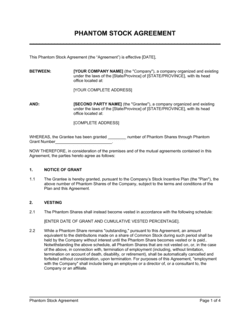
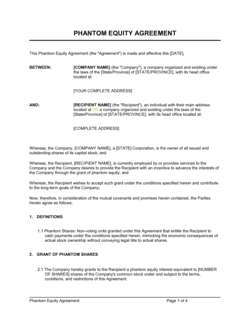
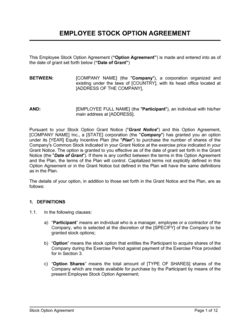
Phantom Stock Plan Template

Free Word download β€’ Edit online β€’ Save & share with Drive β€’ Export to PDF

14 pagesβ€’30–40 min to fillβ€’Difficulty: Complex
Learn more ↓
FreePhantom Stock Plan Template

At a glance

What it is
A Phantom Stock Plan is a written company policy that grants employees a cash bonus tied to the value of company stock β€” without issuing actual shares or ownership rights. This free Word download gives you a structured, editable template covering unit grants, vesting schedules, valuation methodology, payout triggers, and forfeiture terms, which you can export as PDF and share with participants or your board.
When you need it
Use it when you want to align employee incentives with company performance and long-term value creation, but cannot or do not want to issue real equity β€” common in private companies, family-owned businesses, S-Corps, and LLCs with complex operating agreements.
What's inside
Plan purpose and eligibility criteria, phantom unit grant mechanics, vesting schedule and acceleration triggers, valuation methodology, payout events and calculation, tax treatment disclosures, forfeiture and clawback provisions, plan administration, and amendment procedures.

What is a Phantom Stock Plan?

A Phantom Stock Plan is a written company policy that grants selected employees a cash award linked to the value of company stock β€” without issuing actual shares, diluting the cap table, or conveying any ownership rights. Participants receive notional units that track share value over time; when a defined payout event occurs β€” typically a sale, IPO, or separation from service β€” they receive a cash payment equal to the appreciation or full per-unit value of their vested units. The plan is governed entirely by contract rather than corporate securities law, making it one of the most flexible long-term incentive tools available to private companies.

Why You Need This Document

Without a written phantom stock plan, any verbal or email-based promise of equity-linked compensation is unenforceable and creates open-ended liability with no defined payout formula, vesting conditions, or forfeiture terms. Employees who believe they have been promised a stake in the business will claim it on departure β€” and without a governing document, the company has no basis to dispute the amount or timing. Beyond internal disputes, an undocumented phantom arrangement that constitutes nonqualified deferred compensation under Section 409A exposes every participant to immediate income inclusion and a 20% excise tax, often years before any cash changes hands. A properly structured phantom stock plan closes both gaps: it gives participants a clear, quantified incentive they can trust, and it gives the company enforceable vesting, forfeiture, and clawback rights that protect against departure and misconduct. This template gives you the complete structure to implement a defensible plan in hours rather than weeks.

Which variant fits your situation?

If your situation is…Use this template
Rewarding employees based purely on appreciation in company valueStock Appreciation Rights (SAR) Plan
Granting actual shares to employees with restrictions on transferRestricted Stock Agreement
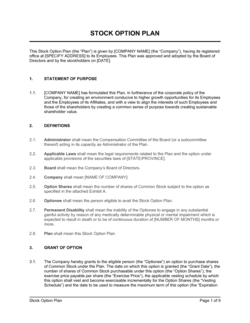
Providing employees with the option to purchase real equity at a set priceStock Option Plan (ISO / NSO)
Deferring executive compensation to a future date or triggering eventDeferred Compensation Plan
Allocating profit interests in an LLC to key employeesProfit Interest Plan
Distributing a portion of annual profits as a cash bonusProfit Sharing Plan
Documenting the overall equity structure for all stakeholdersEquity Incentive Plan

Common mistakes to avoid

❌ Skipping the 409A valuation before granting units

Why it matters: Without a defensible fair market value on the grant date, the IRS may treat the entire phantom stock award as immediately taxable income plus a 20% excise tax β€” a significant financial hit for participants.

Fix: Commission an independent 409A appraisal before issuing any grants and refresh it at least annually or whenever a material event changes company value.

❌ Omitting Section 409A compliance language

Why it matters: Any plan that qualifies as nonqualified deferred compensation without conforming 409A language exposes every participant to immediate income inclusion and penalty taxes, regardless of whether they have received any cash.

Fix: Include a standard 409A compliance clause stating the plan's intent to comply and directing that ambiguities be resolved in favor of compliance.

❌ Using vague or undefined payout triggers

Why it matters: Terms like 'a significant corporate transaction' or 'a sale of the business' invite disputes about whether a specific deal qualifies, delaying or preventing participant payouts and creating litigation risk.

Fix: Define every payout trigger with precise legal language β€” reference specific transaction types, ownership percentage thresholds, or asset sale amounts that constitute a Change of Control.

❌ No clawback or forfeiture-for-cause provision

Why it matters: Without clawback rights, a participant who is terminated for misconduct retains their full phantom stock payout, leaving the company with no recovery mechanism even when the termination was directly tied to the misconduct.

Fix: Include a clawback clause with a defined lookback period and a specific list of triggering events β€” at minimum, termination for cause and financial statement restatement.

❌ Failing to reserve the right to amend the plan

Why it matters: A plan with no amendment provision locks the company into its original terms indefinitely, even if tax law changes, the business model evolves, or the original formula produces unintended results.

Fix: Include a standard amendment clause allowing the board to modify the plan for any reason, with a carve-out protecting participants' already-vested rights from adverse changes without consent.

❌ Issuing phantom units without individual Grant Notices

Why it matters: Without a signed Grant Notice, there is no participant-specific record of the grant date, base value, or vesting schedule β€” turning every payout into a negotiation rather than a calculation.

Fix: Generate a Grant Notice for every participant at the time of each award and obtain written acknowledgment before the grant effective date.

The 9 key sections, explained

Plan purpose and objectives

Plan administration

Phantom unit grants

Vesting schedule and acceleration

Valuation methodology

Payout triggers and calculation

Tax treatment and Section 409A compliance

Forfeiture and clawback provisions

Amendment, termination, and no employment rights

How to fill it out

  1. 1

    Define eligibility and participant selection criteria

    Specify which roles, tenure levels, or performance bands qualify for participation. List any categories explicitly excluded β€” such as part-time or contract workers.

    πŸ’‘ Tying eligibility to a formal job grade or compensation band simplifies annual review and reduces perception of favoritism.

  2. 2

    Set the base unit value and grant date

    Enter the per-unit value on the grant date, derived from your most recent 409A appraisal, board-approved formula, or audited financials. Record this value in each participant's Grant Notice.

    πŸ’‘ Obtain a 409A valuation before issuing the first grants β€” not after. Retroactive valuations are harder to defend to the IRS and take longer to complete.

  3. 3

    Choose and document the vesting structure

    Select cliff or graded vesting and enter the specific schedule β€” percentages and anniversary dates. Add acceleration clauses for change of control and, optionally, termination without cause.

    πŸ’‘ A four-year graded schedule with a one-year cliff (25% / 25% / 25% / 25%) mirrors standard equity vesting and is familiar to most senior hires.

  4. 4

    Define the valuation methodology

    Choose one primary method β€” independent appraisal, formula (e.g., revenue or EBITDA multiple), or transaction price β€” and document it in the plan. Note the frequency of revaluation.

    πŸ’‘ For companies expecting a sale within three years, an EBITDA multiple formula tied to the expected deal multiple keeps payouts predictable for both sides.

  5. 5

    Specify payout triggers and payment timing

    List every event that causes vested units to pay out β€” liquidity event, IPO, death, disability, or separation β€” and set the payment window (e.g., within 30 days of the trigger).

    πŸ’‘ Avoid open-ended payment timing. Section 409A generally requires payment within 90 days of a qualifying trigger β€” missing the window can disqualify the plan.

  6. 6

    Add the 409A compliance and tax withholding language

    Insert the standard Section 409A compliance clause verbatim and confirm that all payouts will be subject to applicable federal, state, and local income and employment tax withholding.

    πŸ’‘ If the plan pays out over multiple years or allows participant-elected deferral, have a benefits attorney confirm the payment schedule satisfies 409A's fixed-schedule requirements.

  7. 7

    Complete forfeiture, clawback, and termination provisions

    Define what constitutes 'Cause' for forfeiture, set the clawback lookback period (typically 12–24 months), and state the board's right to amend or terminate the plan with participant protections.

    πŸ’‘ Cross-reference your employment contracts' definition of 'Cause' to ensure consistency β€” conflicting definitions create disputes on termination.

  8. 8

    Issue Grant Notices to each participant

    Generate a Grant Notice for each participant recording their name, grant date, number of units, base value, and vesting schedule. Obtain the participant's signature acknowledging the plan terms.

    πŸ’‘ Store signed Grant Notices alongside the master plan document. They are the primary evidence of each participant's entitlement in the event of a dispute.

Frequently asked questions

What is a phantom stock plan?

A phantom stock plan is a company policy that grants selected employees a cash bonus tied to the value of company stock β€” without issuing actual shares or ownership rights. Participants receive notional units that mirror share value; when a defined payout event occurs, they receive cash equal to the appreciation or full value of those units. It is commonly used by private companies that want to align employee incentives with company growth without diluting existing shareholders.

How does phantom stock differ from real stock options?

Real stock options give employees the right to purchase actual shares at a set price β€” conveying genuine equity ownership with voting rights and capital gains treatment on sale. Phantom stock pays a cash equivalent of share value without any actual ownership, voting rights, or shares changing hands. Phantom stock payouts are taxed as ordinary income; gains on real equity may qualify for long-term capital gains rates. Private companies often prefer phantom stock because it avoids adding shareholders to the cap table and requires no SEC registration.

Who should use a phantom stock plan?

Phantom stock plans are most useful for private companies β€” including S-Corps, LLCs, family businesses, and private equity-backed firms β€” that want to retain and motivate key employees with performance-linked compensation without issuing real equity. They are also common ahead of anticipated liquidity events, where the company wants to reward long-tenured employees at the time of sale without restructuring the cap table.

What are the tax implications of a phantom stock plan?

Phantom stock payouts are taxed as ordinary income to the participant in the year of receipt β€” not as capital gains β€” and are subject to federal, state, and local income tax plus FICA withholding. The company typically receives a corresponding tax deduction in the same year. Plans must comply with Section 409A of the Internal Revenue Code; noncompliance triggers immediate income inclusion and a 20% excise tax for participants, in addition to interest charges.

What is Section 409A and why does it matter for phantom stock plans?

Section 409A is a US tax code provision that governs nonqualified deferred compensation arrangements, which typically include phantom stock plans. It imposes strict requirements on when elections must be made, when deferrals must be paid, and what events constitute qualifying payment triggers. A plan that fails to comply does not void the arrangement β€” instead, all amounts deferred under the plan become immediately taxable to the participant plus a 20% excise tax. Including explicit 409A compliance language and structuring payout triggers carefully are the two most critical plan design steps.

Do participants have any voting or ownership rights under a phantom stock plan?

No. Participants in a phantom stock plan hold notional units β€” a contractual right to a future cash payment β€” not actual shares. They have no voting rights, no dividend rights (unless the plan specifically includes dividend equivalents), no ownership interest in the company, and no rights as shareholders. The company's cap table and ownership structure remain entirely unchanged.

When do phantom stock participants get paid out?

Payout timing is defined by the plan's payout triggers, which typically include a change of control, an initial public offering, a participant's separation from service after full vesting, or a fixed plan termination date. Section 409A requires that payment occur within 90 days of a qualifying trigger in most cases. Plans that allow participants to elect their own payout timing must comply with 409A's advance election rules.

Can a company cancel or amend a phantom stock plan after granting units?

Yes, if the plan includes a properly drafted amendment and termination clause β€” which it should. However, amendments that materially reduce the value of already-vested units typically require participant consent to be enforceable. Complete plan termination is generally permitted under 409A, but any associated accelerated payout must follow specific IRS procedures to avoid disqualification. A company should never amend or terminate the plan without reviewing the 409A implications first.

Does a phantom stock plan need to be filed with the SEC or any regulator?

Generally, no. Phantom stock plans do not issue actual securities and typically fall outside SEC registration requirements under Rule 701 and Regulation D. However, the plan should be reviewed by legal counsel to confirm it does not inadvertently constitute a security in the applicable jurisdiction. IRS Form W-2 reporting is required for each participant in the year payouts are made, and the company must handle payroll tax withholding at payout.

How this compares to alternatives

vs Stock Option Plan

A stock option plan gives employees the right to purchase real shares at a fixed price, conveying actual ownership with potential capital gains tax treatment. A phantom stock plan pays a cash equivalent with no share issuance, no cap table impact, and ordinary income tax treatment. Phantom stock is simpler to administer for private companies and avoids shareholder agreements and buy-sell mechanics.

vs Restricted Stock Unit (RSU) Plan

RSUs settle in actual shares upon vesting, making participants real shareholders with capital gains potential. Phantom units settle in cash, leaving ownership unchanged. RSUs are common at public companies and late-stage startups; phantom stock suits closely held private companies where actual share issuance is impractical or undesirable.

vs Profit Sharing Plan

A profit sharing plan distributes a percentage of annual profits as a cash bonus β€” paid each year, regardless of company value appreciation. A phantom stock plan is a long-term value-creation vehicle with payouts tied to enterprise value at a future event. Profit sharing rewards short-term results; phantom stock rewards sustained value growth.

vs Deferred Compensation Plan

A deferred compensation plan lets employees defer receipt of salary or bonus to a future date for tax planning purposes β€” the amount deferred is fixed. A phantom stock plan creates new value-linked compensation that grows or shrinks with company performance. Both are subject to Section 409A, but their purpose and payout calculation differ fundamentally.

Industry-specific considerations

Private equity-backed businesses

Phantom plans are structured to pay out at the PE firm's exit event, aligning management team incentives with the fund's hold-period timeline and return targets.

Family-owned businesses

Phantom stock rewards non-family executives with value participation without transferring ownership or voting control to outside parties.

Technology and SaaS

Pre-IPO SaaS companies use phantom plans to retain engineers and sales leaders when real equity pools are exhausted or dilution is a concern ahead of a funding round.

Professional services

Law firms, accounting firms, and consulting practices use phantom equity to bridge the gap between associate and partner tracks without admitting participants into the partnership.

Template vs pro β€” what fits your needs?

PathBest forCostTime
Use the templatePrivate company founders and HR teams designing a straightforward phantom plan for up to 20 participantsFree2–4 hours
Template + professional reviewCompanies with complex vesting structures, multiple grant classes, or a near-term liquidity event anticipated within 18 months$1,000–$3,000 for employment or benefits attorney review1–2 weeks
Custom draftedPrivate equity-backed businesses, plans covering 50+ participants, or companies with multi-jurisdiction tax exposure$5,000–$15,000+ for full custom drafting by a compensation attorney3–6 weeks

Glossary

Phantom Stock Unit
A notional unit credited to a participant that mirrors the economic value of one share of company stock without conveying actual ownership.
Vesting Schedule
The timeline and conditions under which a participant earns the right to receive the value of their phantom units β€” typically cliff or graded over 3–5 years.
Cliff Vesting
A vesting structure in which 100% of granted units vest on a single date β€” for example, all units vest after three years of continuous employment.
Graded Vesting
A vesting structure in which units vest incrementally over time β€” for example, 25% per year over four years.
Payout Trigger
A defined event that causes the company to pay out the cash value of vested phantom units β€” commonly a liquidity event, IPO, or separation from service.
Liquidity Event
A transaction that converts company equity into cash or publicly traded securities β€” typically an acquisition, merger, or initial public offering.
409A Valuation
An independent appraisal of a private company's fair market value per share, required by the IRS under Section 409A of the Internal Revenue Code to avoid punitive tax treatment.
Section 409A
US tax code provision governing nonqualified deferred compensation plans, including phantom stock; noncompliance triggers immediate income recognition plus a 20% excise tax on the participant.
Clawback Provision
A plan term requiring participants to return previously paid phantom stock proceeds if specific conditions are met β€” such as termination for cause or a financial restatement.
Forfeiture
The loss of unvested phantom units when a participant's employment ends before the applicable vesting date or condition is satisfied.
Appreciation-Only Phantom Stock
A phantom stock variant that pays only the increase in value above the grant-date unit price, equivalent in economics to a stock appreciation right.
Full-Value Phantom Stock
A phantom stock variant that pays the full per-unit value at the payout trigger, not just the appreciation β€” analogous to a restricted stock unit.

Part of your Business Operating System

This document is one of 3,000+ business & legal templates included in Business in a Box.

  • Fill-in-the-blanks β€” ready in minutes
  • 100% customizable Word document
  • Compatible with all office suites
  • Export to PDF and share electronically

Create your document in 3 simple steps.

From template to signed document β€” all inside one Business Operating System.
1
Download or open template

Access over 3,000+ business and legal templates for any business task, project or initiative.

2
Edit and fill in the blanks with AI

Customize your ready-made business document template and save it in the cloud.

3
Save, Share, Send, Sign

Share your files and folders with your team. Create a space of seamless collaboration.

Save time, save money, and create top-quality documents.

β˜…β˜…β˜…β˜…β˜…

"Fantastic value! I'm not sure how I'd do without it. It's worth its weight in gold and paid back for itself many times."

Managing Director Β· Mall Farm
Robert Whalley
Managing Director, Mall Farm Proprietary Limited
β˜…β˜…β˜…β˜…β˜…

"I have been using Business in a Box for years. It has been the most useful source of templates I have encountered. I recommend it to anyone."

Business Owner Β· 4+ years
Dr Michael John Freestone
Business Owner
β˜…β˜…β˜…β˜…β˜…

"It has been a life saver so many times I have lost count. Business in a Box has saved me so much time and as you know, time is money."

Owner Β· Upstate Web
David G. Moore Jr.
Owner, Upstate Web

Run your business with a system β€” not scattered tools

Stop downloading documents. Start operating with clarity. Business in a Box gives you the Business Operating System used by over 250,000 companies worldwide to structure, run, and grow their business.

Free Forever PlanΒ Β·Β No credit card required