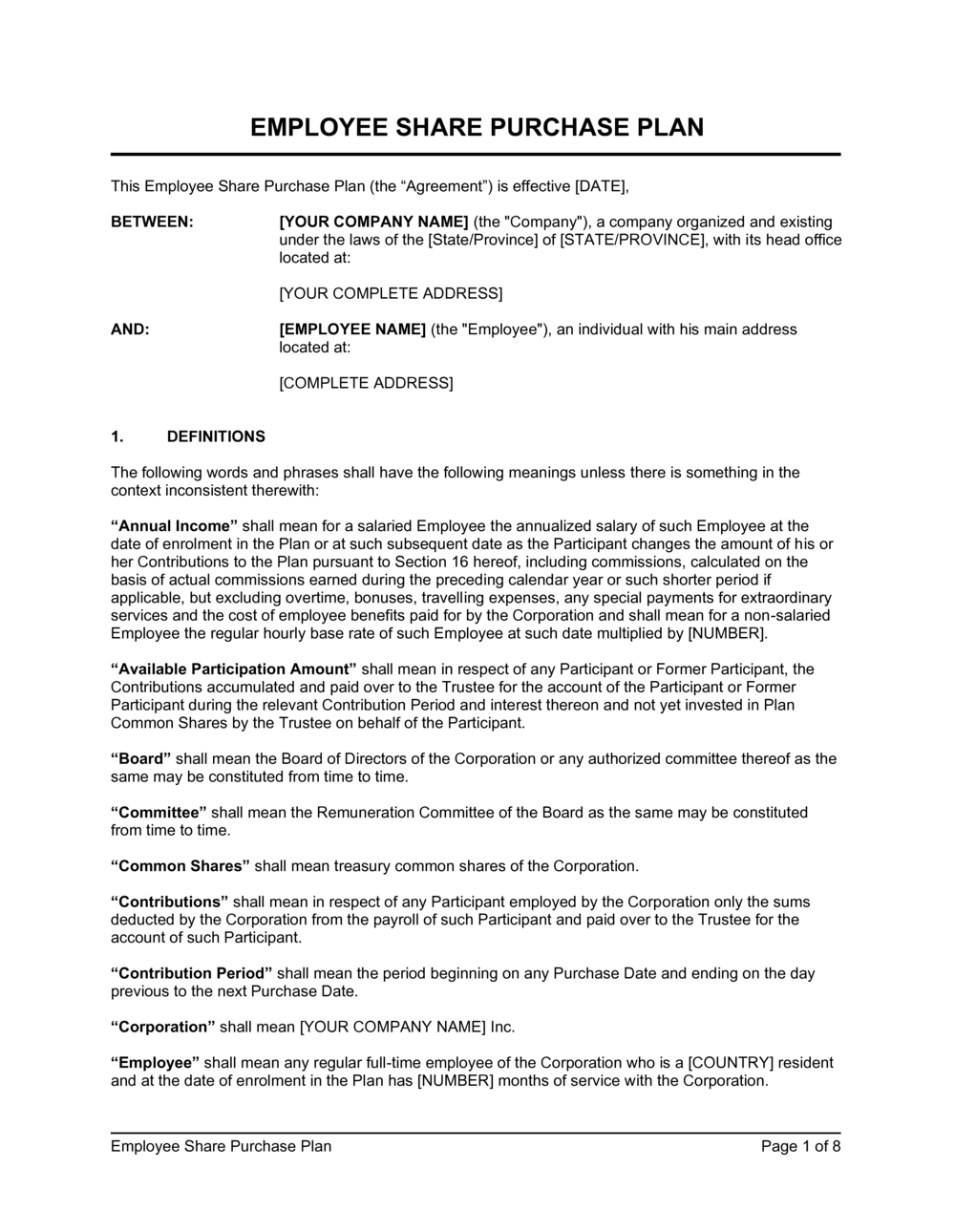
Employee Share Purchase Plan Template

Free Word download β€’ Edit online β€’ Save & share with Drive β€’ Export to PDF

8 pagesβ€’25–35 min to fillβ€’Difficulty: Complex
Learn more ↓
FreeEmployee Share Purchase Plan Template

At a glance

What it is
An Employee Share Purchase Plan (ESPP) is a formal company policy document that outlines the terms under which employees may purchase company shares, typically at a discount from market price, through payroll deductions over a defined offering period. This free Word download gives you a structured, ready-to-edit template covering eligibility, enrollment windows, contribution limits, purchase mechanics, and tax considerations β€” exportable as PDF for distribution to employees and HR teams.
When you need it
Use it when launching or formalizing an equity participation program for employees β€” whether as a retention tool, a performance incentive, or as part of a broader compensation strategy ahead of an IPO, acquisition, or growth phase.
What's inside
Plan purpose and eligibility criteria, offering period structure and enrollment procedures, contribution limits and payroll deduction mechanics, share purchase price and discount formula, account administration and record-keeping, withdrawal and termination provisions, and tax treatment overview for participants.

What is an Employee Share Purchase Plan?

An Employee Share Purchase Plan (ESPP) is a formal company policy document that defines the terms under which employees may purchase company shares β€” typically at a discount from market price β€” through systematic payroll deductions over a series of defined offering periods. The plan specifies who is eligible, how contributions are collected and held, how the purchase price is calculated, and what happens when employees withdraw, leave the company, or when the plan is amended or terminated. Unlike equity granted at no cost, an ESPP requires employees to invest their own earnings, creating a direct financial alignment between their personal wealth and the company's share performance.

Why You Need This Document

Without a written ESPP, a company that informally offers employees the ability to buy shares operates without defined rules β€” leaving eligibility, pricing, and withdrawal mechanics open to interpretation and dispute. Employees cannot make informed financial decisions about contributing to a program whose terms are not documented, and the company cannot demonstrate regulatory compliance or board authorization if the plan is ever audited, reviewed in due diligence, or challenged by a participant. A clearly drafted ESPP protects both sides: it gives employees a transparent understanding of what they are enrolled in and what their money buys, and it gives the company a defensible, board-approved framework that survives headcount changes, M&A activity, and regulatory scrutiny. This template gives you the complete operational structure to launch or formalize an ESPP in hours rather than weeks.

Which variant fits your situation?

If your situation is…Use this template
Public company offering shares at a discount under Section 423 (US)Qualified ESPP (Section 423 Plan)
Private company granting employees the right to purchase shares at a fixed priceEmployee Share Option Plan
Granting restricted shares that vest over time rather than purchasedRestricted Stock Unit (RSU) Agreement
Allocating shares to employees based on company performance targetsProfit Sharing Plan
Offering a simple ownership stake to a key employee or co-founderShareholders Agreement
Documenting deferred share awards for executive-level retentionExecutive Equity Incentive Plan
Setting up an employee-owned trust structure for broader participationEmployee Ownership Trust Deed

Common mistakes to avoid

❌ No board approval documented in the plan

Why it matters: An ESPP without a documented board resolution has no corporate authority. Auditors, regulators, and acquirers will flag the gap, and the plan's validity can be challenged.

Fix: Add the board resolution date and reference number to the plan header and retain the signed resolution minutes alongside the plan document.

❌ Leaving purchase dates and enrollment deadlines vague

Why it matters: Employees make financial decisions β€” adjusting budgets, timing share sales β€” based on specific dates. Vague language creates disputes and undermines trust in the program.

Fix: State exact calendar dates for every offering period start, enrollment deadline, and purchase date. If dates shift year to year, state the formula (e.g., last business day of June).

❌ Omitting the contribution cap required by applicable law

Why it matters: For Section 423-qualified plans in the US, contributions that result in purchases exceeding $25,000 in fair market value per year disqualify the plan from preferential tax treatment.

Fix: Include an explicit dollar cap aligned to the applicable statutory limit and program your payroll system to enforce it automatically each offering period.

❌ Providing definitive tax advice in the plan document

Why it matters: Tax outcomes for ESPP participants vary by jurisdiction, holding period, and individual tax situation. Stating specific outcomes as fact exposes the company to liability if the outcome differs.

Fix: Summarize the framework β€” qualifying vs. disqualifying disposition β€” and include a clear disclaimer directing each participant to consult their own tax advisor.

❌ Naming a specific individual rather than a role as plan administrator

Why it matters: When that individual leaves the company, the document becomes ambiguous about who holds administrative authority, creating operational gaps and potential compliance failures.

Fix: Reference the role (e.g., 'the Head of HR or their designee') rather than a person's name throughout the plan document.

❌ No participant consent carve-out for adverse amendments

Why it matters: Reducing the discount rate, shortening offering periods, or restricting eligibility mid-cycle without a consent requirement can be challenged as a breach of plan terms by affected participants.

Fix: Include explicit language stating that amendments materially adverse to participants with active contributions require either participant consent or immediate contribution refund before taking effect.

The 9 key sections, explained

Plan purpose and objectives

Eligibility requirements

Offering periods and purchase dates

Contribution limits and payroll deductions

Share purchase price and discount

Account administration and record-keeping

Withdrawal and mid-period termination

Tax treatment and participant obligations

Plan amendment and termination

How to fill it out

  1. 1

    Define the plan purpose and secure board approval

    State the business rationale for the plan and record the board resolution date. The opening section should reference the resolution so the document has documented corporate authority.

    πŸ’‘ Include the board resolution number or date in the plan header β€” auditors and regulators ask for it as the first item in any ESPP review.

  2. 2

    Set eligibility criteria appropriate to your workforce

    Choose a minimum service period (typically 3–6 months), confirm which employment categories qualify, and note any statutory exclusions such as 5%-or-more shareholders.

    πŸ’‘ A 3-month minimum is the lowest that meaningfully reduces churn-driven admin; for companies with high seasonal turnover, 6 months is more practical.

  3. 3

    Define offering period length and purchase dates

    Choose 3-, 6-, or 12-month offering periods and set specific start and end dates aligned to your payroll calendar. Document the enrollment deadline for each period.

    πŸ’‘ Align purchase dates with your payroll cycle end dates to simplify the deduction-to-purchase reconciliation for your finance team.

  4. 4

    Set contribution limits and payroll deduction mechanics

    Define the minimum and maximum contribution percentage, whether employees can change elections mid-period, and how deductions are processed by payroll.

    πŸ’‘ Cap contributions at 10% of salary unless your workforce specifically requests higher β€” most employees contribute 3–5% in practice, and a lower cap simplifies payroll administration.

  5. 5

    Calculate the purchase price and decide on a lookback provision

    Set the discount percentage (15% is standard for Section 423-qualified plans) and decide whether to include a lookback provision. Document the exact formula used to calculate the purchase price.

    πŸ’‘ The lookback provision significantly increases employee benefit in volatile markets β€” factor the additional dilution cost into your modeling before committing to it.

  6. 6

    Specify account administration and share delivery

    Name the plan administrator by role, identify the brokerage or share registry used, and state how quickly shares are delivered post-purchase.

    πŸ’‘ Confirm with your broker that they can receive and allocate shares within your stated delivery window before finalizing the document.

  7. 7

    Draft withdrawal, termination, and amendment provisions

    Specify what happens when an employee withdraws, leaves the company, or is terminated, and state the company's right to amend or terminate the plan with appropriate notice.

    πŸ’‘ A minimum 15-business-day refund timeline on withdrawal is realistic for most payroll teams β€” shorter windows create operational risk.

  8. 8

    Add tax treatment summary and participant disclosures

    Summarize qualifying and disqualifying disposition rules, state the forms the company will issue (e.g., Form 3922 in the US), and direct participants to seek independent tax advice.

    πŸ’‘ Have your legal or tax counsel approve the tax section language specifically β€” this is the section most likely to need jurisdiction-specific adjustment.

Frequently asked questions

What is an Employee Share Purchase Plan?

An Employee Share Purchase Plan (ESPP) is a company-sponsored program that allows employees to purchase company shares, typically at a discount from the current market price, using accumulated payroll deductions over a defined offering period. ESPPs are used to give employees a financial stake in the company's performance, serving as both a retention tool and a component of total compensation. The plan document governs eligibility, contribution limits, pricing, and the mechanics of share delivery.

What is the difference between an ESPP and a stock option plan?

An ESPP allows employees to purchase shares at a discount using their own contributions β€” the employee spends real money and receives shares immediately on the purchase date. A stock option plan grants the right to buy shares at a fixed price in the future, with no upfront employee cost until the option is exercised. ESPPs are generally simpler to administer and have a more immediate, tangible benefit for participants, while options typically involve a vesting schedule and a longer time horizon before value is realized.

Who is eligible to participate in an ESPP?

Eligibility criteria vary by company, but most plans require a minimum period of continuous service β€” typically 3 to 6 months β€” and restrict participation to active employees in qualifying employment categories. In the US, Section 423-qualified plans must exclude employees who own 5% or more of the company's voting shares. Part-time and temporary employees may be excluded depending on the plan rules and applicable employment law in the jurisdiction.

What is a lookback provision in an ESPP?

A lookback provision sets the purchase price as a discount off the lower of the share price at the beginning or end of the offering period, rather than just the price at the purchase date. This means employees benefit when the share price rises over the period β€” they purchase at a discount to the lower starting price β€” but are not penalized if the price falls, since the discount applies to the lower end-of-period price. The lookback provision is the most employee-favorable feature an ESPP can include and significantly increases participation rates.

How are ESPP contributions handled if an employee leaves the company?

In most plans, when an employee resigns, is terminated, or takes unpaid leave beyond a defined threshold, their participation ends immediately and all accumulated contributions are refunded without interest. The employee does not receive shares for the partial period. Some plans allow employees on approved leave to continue participating; the plan document should specify which leave types qualify and for how long.

Do employees pay tax on ESPP discounts?

Yes, but the timing and rate depend on when shares are sold and which jurisdiction applies. In the US, for Section 423-qualified plans, a qualifying disposition β€” holding shares for at least 2 years from the grant date and 1 year from the purchase date β€” results in a portion of the gain taxed as ordinary income and the remainder as long-term capital gains. A disqualifying disposition (selling earlier) results in the discount being taxed as ordinary income in the year of sale. Tax rules differ significantly outside the US, and participants should consult a tax advisor in their own jurisdiction.

How often can employees change their contribution rate?

Most plan documents allow contribution rate changes once per offering period, typically during a defined window before the next period begins. Some plans permit mid-period reductions to zero (effectively a withdrawal) but not increases. The frequency and mechanics are set by the plan rules and should be clearly documented to avoid participant disputes and payroll processing complications.

Can a private company have an ESPP?

Yes, though the mechanics differ from public company plans. Private company ESPPs cannot reference a market share price, so the purchase price is typically set by the most recent board-approved valuation (such as a 409A valuation in the US) or a formula tied to book value or EBITDA. Liquidity for participants is limited until an exit event such as an IPO or acquisition, which should be disclosed clearly in the plan document. Private company plans are generally simpler in structure and less regulated than Section 423 public-company plans.

What happens to an ESPP during a merger or acquisition?

The plan document should specify what happens if the company is acquired or undergoes a change of control. Common outcomes include an accelerated purchase date using accumulated contributions before the deal closes, conversion of the plan into an equivalent plan of the acquiring company, or plan termination with a full contribution refund. Without this language, the treatment of outstanding contributions during an M&A transaction is ambiguous and can delay deal closing.

How this compares to alternatives

vs Stock Option Plan

A stock option plan grants employees the right to buy shares at a fixed strike price in the future, with no upfront cost until exercise. An ESPP requires employees to contribute their own salary and receive shares at the end of each offering period. ESPPs provide immediate, guaranteed value through the purchase discount; options provide potentially larger upside but only if the share price appreciates above the strike price.

vs Profit Sharing Plan

A profit sharing plan distributes a portion of company profits to employees as cash or deferred compensation, based on a formula tied to earnings. An ESPP requires employees to invest their own money to purchase shares. Profit sharing is employer-funded and tied to company results; an ESPP is employee-funded and tied to share price performance. Companies often use both in combination.

vs Shareholders Agreement

A shareholders agreement governs the rights and obligations of existing shareholders β€” voting rights, transfer restrictions, drag-along and tag-along provisions. An ESPP is an operational plan governing how employees become shareholders in the first place. The ESPP creates participants; the shareholders agreement governs their ongoing rights once they hold shares.

vs Employee Handbook

An employee handbook is a general HR policy document covering a broad range of workplace policies and procedures. An ESPP is a standalone legal and operational plan document with specific financial, tax, and administrative mechanics. The handbook may reference the ESPP as an available benefit, but the plan document itself governs all program details and participant rights.

Industry-specific considerations

Technology / SaaS

ESPPs are a standard component of total compensation packages used to compete with equity-rich rivals and retain engineers in high-churn roles.

Financial services

Regulated firms use ESPPs to align employee incentives with shareholder interests, with enhanced disclosure requirements and blackout period rules tied to insider trading policies.

Retail and consumer goods

Large retail employers use broad-based ESPPs to deepen engagement across hourly and salaried workforces, with simplified enrollment to support high employee volumes.

Manufacturing

ESPPs in manufacturing settings often coordinate with profit-sharing programs to give plant-level employees visibility into company-wide performance.

Template vs pro β€” what fits your needs?

PathBest forCostTime
Use the templatePrivate companies and small employers launching a basic share purchase scheme for the first timeFree2–4 hours to complete
Template + professional reviewCompanies preparing for growth-stage fundraising, an IPO, or operating in multiple jurisdictions$500–$2,000 for legal or HR counsel review3–5 business days
Custom draftedPublicly traded companies, Section 423-qualified plans, or plans involving complex tax structuring across multiple countries$3,000–$10,000+3–6 weeks

Glossary

Offering Period
The defined window β€” typically 3, 6, or 12 months β€” during which payroll deductions accumulate before shares are purchased on the purchase date.
Purchase Date
The specific date at the end of an offering period on which accumulated contributions are used to buy shares at the plan's stated discount price.
Enrollment Window
The limited period before an offering period begins during which eligible employees must elect to participate and set their contribution percentage.
Lookback Provision
A plan feature that sets the purchase price as a discount off the lower of the share price at the start or end of the offering period, maximizing participant benefit.
Contribution Limit
The maximum percentage of salary or fixed dollar amount an employee may contribute per offering period, often capped at 10–15% of compensation or a statutory ceiling.
Qualifying Disposition
A share sale that meets the required holding periods β€” typically 2 years from grant date and 1 year from purchase date β€” entitling the participant to favorable tax treatment.
Disqualifying Disposition
A share sale that occurs before the required holding periods are met, resulting in ordinary income tax treatment on the discount received.
Payroll Deduction
The mechanism by which employee contributions to the plan are deducted automatically from each paycheck and held in a plan account until the purchase date.
Plan Administrator
The person or entity β€” typically HR or a third-party brokerage β€” responsible for managing enrollment, deductions, share purchases, and participant accounts.
Withdrawal
An employee's election to stop contributing and exit the plan mid-period, usually resulting in a refund of accumulated deductions without interest.

Part of your Business Operating System

This document is one of 3,000+ business & legal templates included in Business in a Box.

  • Fill-in-the-blanks β€” ready in minutes
  • 100% customizable Word document
  • Compatible with all office suites
  • Export to PDF and share electronically

Create your document in 3 simple steps.

From template to signed document β€” all inside one Business Operating System.
1
Download or open template

Access over 3,000+ business and legal templates for any business task, project or initiative.

2
Edit and fill in the blanks with AI

Customize your ready-made business document template and save it in the cloud.

3
Save, Share, Send, Sign

Share your files and folders with your team. Create a space of seamless collaboration.

Save time, save money, and create top-quality documents.

β˜…β˜…β˜…β˜…β˜…

"Fantastic value! I'm not sure how I'd do without it. It's worth its weight in gold and paid back for itself many times."

Managing Director Β· Mall Farm
Robert Whalley
Managing Director, Mall Farm Proprietary Limited
β˜…β˜…β˜…β˜…β˜…

"I have been using Business in a Box for years. It has been the most useful source of templates I have encountered. I recommend it to anyone."

Business Owner Β· 4+ years
Dr Michael John Freestone
Business Owner
β˜…β˜…β˜…β˜…β˜…

"It has been a life saver so many times I have lost count. Business in a Box has saved me so much time and as you know, time is money."

Owner Β· Upstate Web
David G. Moore Jr.
Owner, Upstate Web

Run your business with a system β€” not scattered tools

Stop downloading documents. Start operating with clarity. Business in a Box gives you the Business Operating System used by over 250,000 companies worldwide to structure, run, and grow their business.

Free Forever PlanΒ Β·Β No credit card required