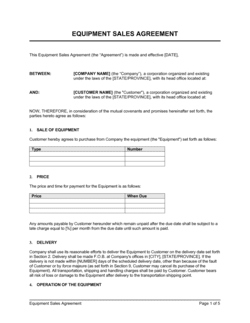
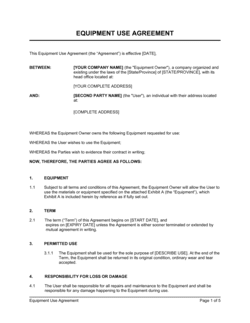
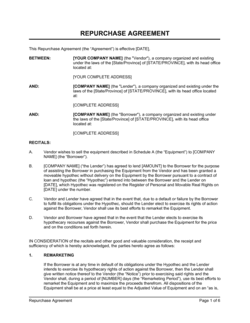
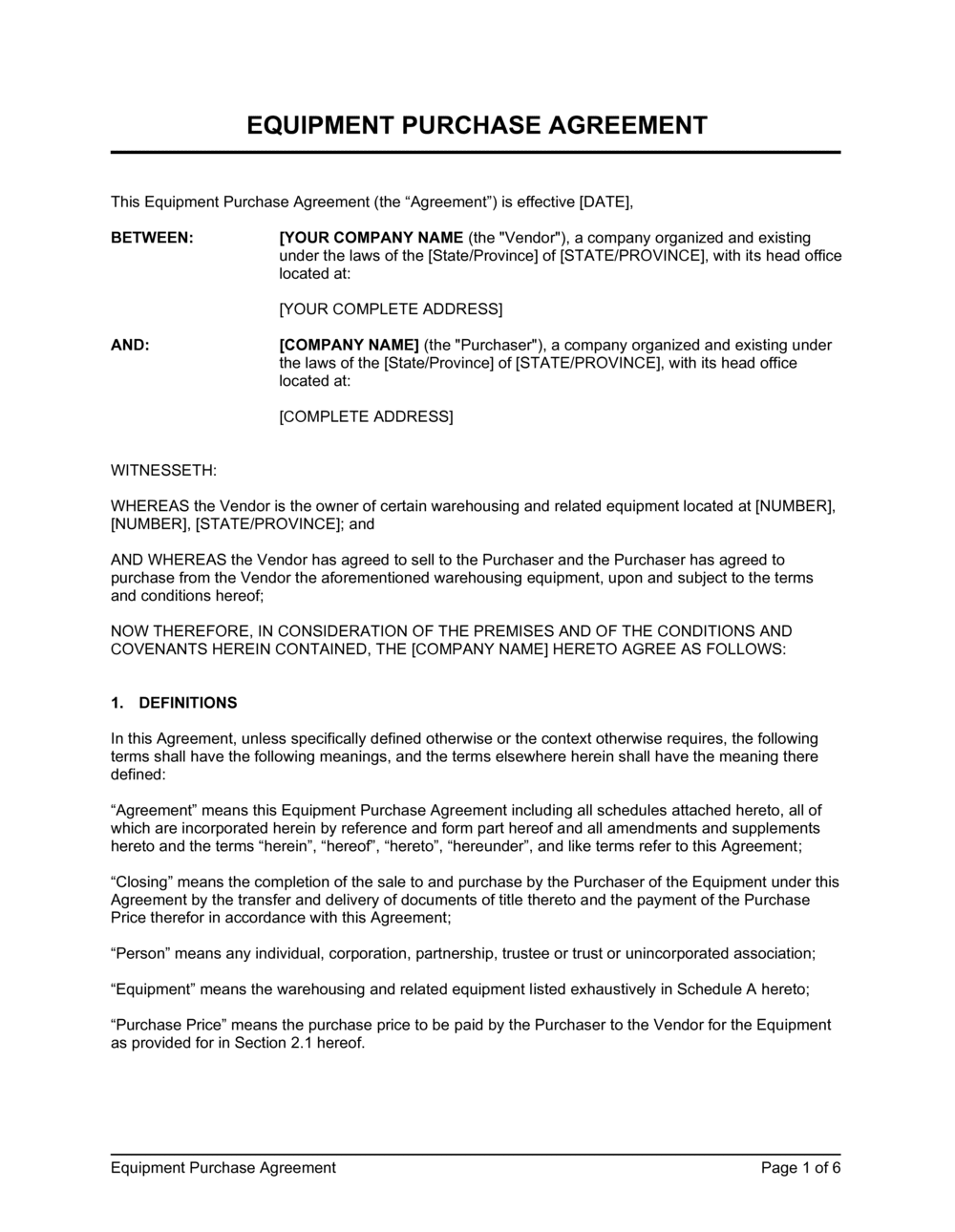
Equipment Purchase Agreement Template

Free Word download • Edit online • Save & share with Drive • Export to PDF

6 pages25–35 min to fillDifficulty: ComplexSignature requiredLegal review recommended
Learn more ↓
FreeEquipment Purchase Agreement Template

At a glance

What it is
An Equipment Purchase Agreement is a legally binding contract between a buyer and a seller that governs the acquisition of equipment — covering the full description of the item, purchase price, payment terms, delivery logistics, installation, warranties, operator training, and the point at which risk of loss transfers from seller to buyer. This free Word download gives you a complete, editable starting point you can customize and export as PDF for signature.
When you need it
Use it any time you are buying or selling a significant piece of equipment — manufacturing machinery, medical devices, construction equipment, technology hardware, or commercial vehicles — where the value, complexity, or operational dependencies justify a written contract rather than a purchase order alone.
What's inside
Equipment description and specifications, purchase price and payment schedule, delivery terms and inspection rights, installation and commissioning obligations, express warranties and limitation of liability, operator training requirements, acceptance criteria, and risk and title transfer provisions.

What is an Equipment Purchase Agreement?

An Equipment Purchase Agreement is a legally binding contract between a buyer and a seller that governs the acquisition of a specific piece of equipment — from manufacturing machinery and medical devices to construction equipment and commercial technology hardware. It goes beyond a simple purchase order by documenting the full specification of what is being sold, the total purchase price and payment schedule, delivery logistics and inspection rights, installation and commissioning responsibilities, measurable acceptance criteria, express warranties, and the precise moment at which risk of loss and legal title transfer from seller to buyer. In most jurisdictions, the sale of goods is governed by default statutory rules — such as the UCC in the United States — that apply automatically where the written contract is silent, making a comprehensive written agreement the only reliable way to ensure both parties are bound to the terms they actually negotiated.

Why You Need This Document

Without a written equipment purchase agreement, both buyers and sellers are exposed to disputes that are expensive to resolve and easy to avoid. Buyers who rely on a purchase order and verbal assurances have no contractual basis to reject equipment that arrives damaged, fails performance testing, or lacks promised features — and no leverage to withhold final payment while defects are remedied. Sellers who ship without a signed contract face unlimited consequential-damage claims if the equipment underperforms in a critical production environment. The risk-of-loss and title-transfer gap — where the buyer bears financial exposure to damage on equipment they do not yet legally own — regularly produces insurance coverage disputes that dwarf the original purchase price. A properly drafted equipment purchase agreement closes every one of these gaps: it locks in the specification, ties the final payment to acceptance rather than delivery, caps liability, and gives both parties a clear, enforceable roadmap from order to commissioning. This template gives you that framework in minutes, with the structure to customize it to the specific complexity of your transaction.

Which variant fits your situation?

If your situation is…Use this template
Buying new equipment directly from a manufacturerEquipment Purchase Agreement
Acquiring equipment in stages with milestone-based paymentsEquipment Purchase Agreement with Installment Payments
Renting equipment for a fixed term rather than buyingEquipment Rental Agreement
Leasing equipment with an option to purchase at end of termEquipment Lease Agreement
Buying used or refurbished equipment sold as-isAs-Is Equipment Bill of Sale
Purchasing equipment alongside an ongoing maintenance contractEquipment Maintenance Agreement
Procuring equipment as part of a larger vendor supply arrangementSupply Agreement

Common mistakes to avoid

❌ Linking final payment to delivery rather than acceptance

Why it matters: If the equipment arrives damaged or non-functional, the seller can argue full payment is contractually due before the buyer has any opportunity to confirm performance. Recovering overpayment through litigation is slow and expensive.

Fix: Structure the contract so the final payment tranche — at minimum 10–20% of the purchase price — is released only after the equipment passes defined acceptance tests.

❌ No written acceptance criteria

Why it matters: Without measurable benchmarks, 'acceptance' defaults to delivery or first use, eliminating the buyer's contractual basis to reject non-performing equipment or withhold final payment.

Fix: Attach an Exhibit B listing specific, quantified performance thresholds — throughput, accuracy, uptime — that the equipment must achieve for acceptance to occur.

❌ Omitting the risk-of-loss and title-transfer distinction

Why it matters: When risk passes at delivery but title passes at full payment, the buyer bears the financial cost of damage to equipment they do not yet legally own — and their insurance policy may not cover it.

Fix: State risk-of-loss and title-transfer timing separately, and confirm with your insurer that your policy covers the equipment from the point risk transfers to you.

❌ No limitation-of-liability clause

Why it matters: Without a cap, a seller faces unbounded consequential damages — lost production, business interruption, downstream losses — that can exceed the contract value many times over if the equipment fails in a critical process.

Fix: Include a mutual limitation-of-liability clause capping aggregate damages at the purchase price and expressly excluding consequential, incidental, and punitive damages.

❌ Accepting a vague delivery date like 'approximately 8 weeks'

Why it matters: Approximate timelines give the seller unlimited flexibility to delay without breaching the contract, while the buyer incurs real costs — idle facilities, delayed production, staff standing by — for every week of overrun.

Fix: State a specific calendar date as the delivery deadline and include a remedy (price reduction or right to cancel) for each week of delay beyond an agreed grace period.

❌ No training clause for complex or specialized equipment

Why it matters: When untrained operators use machinery incorrectly, the resulting damage or injury generates costly disputes about whether the seller's warranty still applies and who bears liability.

Fix: Include a training clause specifying the number of hours, the topics covered, and the number of personnel the seller will train — and make training completion a condition of final acceptance.

The 10 key clauses, explained

Equipment description and specifications

In plain language: Precisely identifies the equipment being sold — make, model, serial number, configuration, and any technical specifications — so there is no ambiguity about what is being purchased.

Sample language
Seller agrees to sell and Buyer agrees to purchase the following equipment: [MAKE / MODEL], Serial No. [SERIAL NUMBER], configured as described in Exhibit A ('Equipment'). In the event of any conflict between this Agreement and Exhibit A, Exhibit A controls.

Common mistake: Referencing only a model name without attaching a specification sheet. When the delivered equipment differs in configuration or software version, the buyer has no written basis to reject it.

Purchase price and payment terms

In plain language: States the total contract price, the payment schedule (deposit, progress payments, and balance on acceptance), the accepted payment methods, and any late-payment interest.

Sample language
The total purchase price is $[AMOUNT] ('Purchase Price'). Buyer shall pay: (a) a deposit of $[AMOUNT] on execution; (b) $[AMOUNT] upon delivery; and (c) the remaining balance of $[AMOUNT] within [NUMBER] days of acceptance. Overdue amounts accrue interest at [RATE]% per month.

Common mistake: Linking the final payment to 'delivery' rather than 'acceptance.' If the equipment arrives but fails testing, the seller can argue full payment is due before the buyer has confirmed it works.

Delivery terms and inspection

In plain language: Specifies the delivery date or window, the delivery location, the applicable Incoterm (e.g., FOB Destination), and the buyer's right to inspect and reject nonconforming equipment.

Sample language
Seller shall deliver the Equipment to [DELIVERY ADDRESS] on or before [DATE], [FOB DESTINATION / FOB ORIGIN]. Buyer shall have [NUMBER] business days after delivery to inspect the Equipment and notify Seller in writing of any nonconformance.

Common mistake: Setting no inspection window after delivery. Without a defined period, buyers in some jurisdictions must raise defects 'within a reasonable time' — a vague standard that sellers can dispute.

Installation and commissioning

In plain language: Allocates responsibility for on-site installation, defines who bears the cost, and sets the timeline and conditions under which the seller will commission the equipment to operational status.

Sample language
Seller shall install and commission the Equipment at Buyer's facility located at [ADDRESS] within [NUMBER] days of delivery. Installation includes [SCOPE — electrical connections, calibration, test run]. Buyer shall provide [UTILITIES / ACCESS / SITE PREPARATION] at no cost to Seller.

Common mistake: Leaving installation responsibility undefined. When a piece of equipment requires specialized setup and neither party has confirmed ownership of that obligation, cost disputes and delays are almost guaranteed.

Acceptance criteria and testing

In plain language: Defines the specific performance benchmarks the equipment must meet for the buyer to formally accept it, the testing procedure, and what happens if it fails — including a cure period and rejection rights.

Sample language
Acceptance shall occur when the Equipment passes the acceptance tests described in Exhibit B ('Acceptance Criteria'). If the Equipment fails, Seller shall have [NUMBER] days to remedy the deficiency. If the Equipment fails a second test, Buyer may reject the Equipment and receive a full refund.

Common mistake: Defining acceptance as 'delivery of the equipment' rather than passage of performance tests. This eliminates the buyer's contractual right to reject equipment that arrives but does not perform.

Warranties

In plain language: Sets out the seller's express warranty — typically covering defects in materials and workmanship for a defined period — and states whether implied warranties are disclaimed.

Sample language
Seller warrants that the Equipment shall be free from defects in materials and workmanship for a period of [NUMBER] months from the date of acceptance ('Warranty Period'). SELLER DISCLAIMS ALL OTHER WARRANTIES, EXPRESS OR IMPLIED, INCLUDING IMPLIED WARRANTIES OF MERCHANTABILITY AND FITNESS FOR A PARTICULAR PURPOSE.

Common mistake: Accepting a manufacturer's standard warranty by reference without confirming its duration, coverage scope, and on-site repair vs. return-to-depot terms — which vary widely across equipment categories.

Risk of loss and title transfer

In plain language: Specifies the exact point at which the risk of accidental damage or loss passes from seller to buyer, and separately when legal title transfers — these are often different moments.

Sample language
Risk of loss shall pass to Buyer upon [DELIVERY / ACCEPTANCE]. Title to the Equipment shall transfer to Buyer upon receipt of the full Purchase Price. Until title transfers, Seller retains a purchase-money security interest in the Equipment.

Common mistake: Conflating title transfer with risk of loss. If risk passes at delivery but title passes at final payment, the buyer bears the cost of damage to equipment they do not yet legally own — which is typically uninsured.

Training

In plain language: Requires the seller to provide operator training to the buyer's designated personnel, specifying the number of hours, location, and what the training covers.

Sample language
Seller shall provide up to [NUMBER] hours of on-site operator training for up to [NUMBER] of Buyer's personnel within [NUMBER] days of acceptance. Training shall cover safe operation, routine maintenance, and basic troubleshooting of the Equipment.

Common mistake: Omitting a training clause entirely for complex equipment. When untrained operators use machinery incorrectly and cause damage or injury, disputes over who bears responsibility become costly and fact-intensive.

Limitation of liability

In plain language: Caps the maximum damages recoverable under the contract and excludes consequential, incidental, and punitive damages — protecting both parties from disproportionate exposure.

Sample language
In no event shall either party be liable for indirect, incidental, consequential, or punitive damages arising out of this Agreement. Each party's aggregate liability shall not exceed the Purchase Price paid by Buyer under this Agreement.

Common mistake: Omitting the consequential-damages exclusion. Without it, a seller can face claims for lost production, business interruption, or downstream losses that dwarf the contract value.

Governing law and dispute resolution

In plain language: Specifies which jurisdiction's law governs the contract and the mechanism for resolving disputes — arbitration, mediation, or litigation — and the venue.

Sample language
This Agreement shall be governed by the laws of [STATE / PROVINCE / COUNTRY], without regard to conflict-of-law principles. Any dispute shall be resolved by binding arbitration administered by [AAA / JAMS / ICC] in [CITY], except that either party may seek injunctive relief in any court of competent jurisdiction.

Common mistake: Choosing the seller's home jurisdiction without negotiation. Buyers who accept a governing-law clause in a distant jurisdiction face prohibitive costs if a warranty or acceptance dispute arises.

How to fill it out

  1. 1

    Identify both parties and their legal entities

    Enter the full registered legal names and addresses of both the buyer and the seller. Confirm the entity type (corporation, LLC, sole proprietor) and the authorized signatory for each side.

    💡 Verify the seller's legal name against their corporate registration before signing — mismatched names on a warranty claim or dispute create procedural delays.

  2. 2

    Describe the equipment precisely and attach a specification exhibit

    Complete the equipment description block with make, model, serial number, and configuration. Attach a separate Exhibit A with the full technical specification sheet from the manufacturer.

    💡 If the equipment is custom-built or modified, include a detailed scope-of-supply list in Exhibit A rather than relying on a brochure.

  3. 3

    Set the purchase price and payment schedule

    Enter the total contract price, then structure the payment schedule around key milestones — typically a deposit at signing, a progress payment at delivery, and the balance at acceptance. Include late-payment interest.

    💡 Tie the largest payment tranche to acceptance, not delivery — this preserves your leverage to require remediation if the equipment fails testing.

  4. 4

    Define delivery terms and the inspection window

    Select the applicable Incoterm or delivery point, enter the delivery date and location, and set a specific number of business days for the buyer to inspect and raise nonconformance issues in writing.

    💡 Five to ten business days is a standard inspection window for most commercial equipment — narrow it only if the equipment is simple and easily evaluated on delivery.

  5. 5

    Specify installation, commissioning, and training obligations

    Confirm which party is responsible for installation and at whose cost, set the commissioning timeline, and enter the number of training hours and the scope of instruction the seller will provide.

    💡 If the buyer's facility requires special preparation (dedicated power circuits, concrete foundations, climate control), document those requirements in the contract to avoid delay claims.

  6. 6

    Draft acceptance criteria and attach as Exhibit B

    Define specific, measurable performance benchmarks the equipment must meet to be accepted — throughput rates, accuracy tolerances, uptime targets, or output quality standards. Attach them as Exhibit B.

    💡 Avoid subjective acceptance criteria like 'satisfactory performance' — they invite disputes. Quantify every benchmark with a unit and threshold.

  7. 7

    Confirm warranty terms and any disclaimer language

    Enter the warranty period start date (use acceptance, not delivery), the coverage scope, and whether the warranty is on-site or depot-return. Confirm the disclaimer of implied warranties is in bold or capitalized text as required in many jurisdictions.

    💡 Ask the seller for the manufacturer's warranty certificate before signing — if it conflicts with the contract warranty, the contract controls, but you need to know the gap.

  8. 8

    Select governing law, sign before delivery, and retain executed copies

    Choose the governing jurisdiction, confirm arbitration or litigation preference, and ensure both parties sign before any equipment is shipped. Store fully executed copies — with all exhibits — in a secure document system.

    💡 Use Business in a Box eSign to timestamp execution and create an audit trail for the signed date, which matters for warranty period calculations.

Frequently asked questions

What is an equipment purchase agreement?

An equipment purchase agreement is a legally binding contract between a buyer and a seller that documents the terms under which equipment changes hands — covering the full description and specifications of the item, total purchase price, payment schedule, delivery logistics, installation and commissioning obligations, acceptance criteria, warranties, and the point at which risk and title transfer from seller to buyer. It replaces a simple purchase order when the value, complexity, or operational dependencies of the equipment justify enforceable written terms.

When should I use an equipment purchase agreement instead of a purchase order?

Use a formal agreement whenever the equipment requires installation, commissioning, or operator training; when the purchase price exceeds roughly $5,000; when acceptance depends on the equipment meeting measurable performance criteria; or when the seller's standard warranty terms need to be modified. A purchase order works for commodity items with no setup requirements, but it typically lacks the warranty, acceptance, risk-of-loss, and liability provisions that protect both parties in a significant equipment transaction.

Who bears the risk of loss during shipment?

Risk of loss during transit depends on the agreed delivery term — typically expressed as an Incoterm such as FOB Origin or FOB Destination. Under FOB Origin, risk transfers to the buyer when the seller hands the equipment to the carrier. Under FOB Destination, risk remains with the seller until the equipment arrives at the buyer's facility. The contract should state this clearly, and the buyer should confirm their insurance covers the equipment from the moment risk transfers to them.

What acceptance criteria should I include?

Acceptance criteria should be specific and measurable — production throughput (units per hour), dimensional tolerances, error rates, uptime percentages, or output quality standards, depending on the equipment type. Avoid subjective language like 'satisfactory performance' or 'meets expectations.' Attach acceptance criteria as a separate exhibit and specify what happens — a cure period, a price reduction, or a right to reject — if the equipment fails testing on first or second attempt.

What warranties should an equipment purchase agreement include?

At minimum, the agreement should include an express warranty covering defects in materials and workmanship for a defined period — typically 12 to 24 months from acceptance — along with a clear statement of whether the warranty is serviced on-site or requires return to a depot. The agreement should also address what happens during the warranty period if the equipment is out of service for repairs, such as extending the warranty term by the downtime period. Any disclaimer of implied warranties should be in bold or capitalized text to be enforceable in most US states.

Is an equipment purchase agreement enforceable if it is not notarized?

In most jurisdictions, an equipment purchase agreement does not require notarization to be enforceable. A signed written contract with clear terms, dated signatures from authorized representatives of both parties, and adequate consideration is generally sufficient. Notarization may be required for equipment that must be registered with a government authority — such as certain vehicles, aircraft, or marine vessels — but commercial equipment transactions rarely require it.

What happens if the equipment is damaged after delivery but before acceptance?

This depends on how the agreement allocates risk of loss. If risk passes at delivery, the buyer bears the cost of post-delivery damage even before formal acceptance — meaning the buyer must repair or replace the equipment and still owes the seller the full purchase price. If risk passes at acceptance, the seller bears the cost of damage that occurs between delivery and the completion of acceptance testing. Buyers should negotiate for risk to pass at acceptance and confirm their insurance coverage accordingly.

Can I cancel an equipment purchase agreement after signing?

Cancellation rights after signing depend on what the agreement expressly provides. Most commercial equipment contracts allow cancellation only for specific causes — late delivery beyond an agreed grace period, failure to pass acceptance testing after a cure period, or material breach. Cancellation without a contractual basis typically triggers a damages claim by the other party. To preserve flexibility, negotiate a termination-for-convenience clause with a defined cancellation fee, or include specific milestone-based termination rights.

Do I need a lawyer to draft or review an equipment purchase agreement?

For standard equipment purchases below $50,000 with straightforward delivery and warranty terms, a high-quality template is typically sufficient. Engaging a lawyer is advisable when the transaction exceeds $100,000, the equipment involves complex installation or integration into existing systems, the seller is located in a different country, or the warranty and acceptance terms require significant negotiation. A targeted one-to-two hour review typically costs $300–$600 and is worthwhile for any transaction where equipment failure would materially disrupt operations.

How this compares to alternatives

vs Equipment Lease Agreement

An equipment lease agreement grants the lessee the right to use equipment for a defined period in exchange for periodic payments, without transferring ownership. An equipment purchase agreement transfers title and ownership to the buyer upon completion of payment. Use a lease when preserving capital or when the equipment need is temporary; use a purchase agreement when long-term ownership and full control of the asset are the goal.

vs Equipment Rental Agreement

An equipment rental agreement is a short-term arrangement for temporary use of equipment, typically at a daily or weekly rate, with the equipment returning to the owner at the end. A purchase agreement is a permanent transfer of ownership. Rental agreements are appropriate for project-specific or infrequent use; purchase agreements are appropriate when the equipment will be in continuous operation.

vs Supply Agreement

A supply agreement governs an ongoing relationship for the repeated purchase of goods or materials over time, typically at agreed pricing tiers and delivery schedules. An equipment purchase agreement is a one-time transaction for a specific item. Use a supply agreement when procuring consumables, components, or inventory in volume; use a purchase agreement for a discrete capital equipment acquisition.

vs Equipment Maintenance Agreement

An equipment maintenance agreement covers the ongoing servicing, repair, and upkeep of equipment after it has been acquired. An equipment purchase agreement governs the transaction that transfers ownership. The two documents are often used together — the purchase agreement includes a post-warranty maintenance clause or references a separate maintenance agreement that takes effect after the warranty period expires.

Industry-specific considerations

Manufacturing

Acceptance criteria tied to production throughput and defect rates; installation integrated with existing production line dependencies; warranty uptime guarantees to protect shift schedules.

Construction

Delivery tied to project mobilization dates; equipment condition assessed before remote-site deployment; resale or transfer provisions relevant to project-end disposition.

Healthcare

FDA or regulatory compliance conditions precedent to acceptance; operator training tied to credentialing requirements; service contracts and parts availability critical to warranty value.

Technology and Data Centers

Performance benchmarks include latency, throughput, and uptime SLAs; integration testing with existing infrastructure as part of acceptance; data security obligations during installation and commissioning.

Jurisdictional notes

United States

Article 2 of the Uniform Commercial Code governs the sale of goods in all US states and fills gaps in written equipment contracts — including default rules for risk of loss, implied warranties, and rejection rights. Implied warranties of merchantability and fitness for a particular purpose apply automatically unless expressly disclaimed in conspicuous language. Non-compete and limitation-of-liability clauses are generally enforceable, though some states impose restrictions on consequential-damages waivers in consumer transactions.

Canada

The Sale of Goods Acts in each province (modeled on the UK Sale of Goods Act) imply warranties of merchantability and fitness that cannot be excluded in consumer transactions and require careful drafting in commercial ones. Quebec's Civil Code applies different rules from common-law provinces — equipment contracts with Quebec parties should reference Quebec civil law explicitly. Personal Property Security Acts (PPSAs) in each province govern the seller's retention of a security interest until title transfers, and registration may be required to perfect that interest against third parties.

United Kingdom

The Sale of Goods Act 1979 and the Supply of Goods and Services Act 1982 imply statutory terms — satisfactory quality, fitness for purpose, and correspondence with description — that cannot be excluded in consumer contracts and are subject to a reasonableness test in business-to-business transactions under the Unfair Contract Terms Act 1977. Risk of loss follows delivery unless otherwise agreed. The Consumer Rights Act 2015 applies if the buyer is a consumer rather than a business, imposing additional protections that override contract terms.

European Union

The UN Convention on Contracts for the International Sale of Goods (CISG) applies automatically to cross-border equipment transactions between EU member states and other contracting states unless expressly excluded. EU product liability directives impose strict liability on manufacturers for defective equipment that causes damage, regardless of contractual disclaimers. VAT treatment on equipment sales varies by member state and transaction structure; cross-border intra-EU sales require careful VAT and customs documentation.

Template vs lawyer — what fits your deal?

PathBest forCostTime
Use the templateStandard domestic equipment purchases under $50,000 with straightforward delivery, warranty, and payment termsFree30–60 minutes
Template + legal reviewTransactions between $50,000 and $250,000, cross-border purchases, or equipment requiring complex installation and acceptance testing$300–$6002–5 business days
Custom draftedHigh-value capital equipment above $250,000, heavily regulated industries (healthcare, aerospace, utilities), or multi-jurisdiction transactions with international sellers$1,500–$5,000+1–3 weeks

Glossary

Purchase Price
The total agreed amount the buyer will pay the seller for the equipment, excluding any separately stated taxes, shipping, or installation fees.
Risk of Loss
The point at which financial responsibility for damage or destruction of the equipment transfers from the seller to the buyer — typically upon delivery or acceptance.
Title Transfer
The legal moment at which ownership of the equipment passes from the seller to the buyer, often tied to full payment or a specified delivery milestone.
Acceptance Testing
A defined process by which the buyer verifies that delivered equipment meets the agreed specifications before formally accepting it and releasing final payment.
Express Warranty
A specific written promise by the seller about the equipment's condition, performance, or fitness — as opposed to implied warranties that arise automatically by law.
Limitation of Liability
A clause capping the maximum damages either party can recover under the contract, typically expressed as a multiple of the purchase price or a fixed dollar amount.
Incoterms
Internationally standardized trade terms (e.g., FOB, CIF, DDP) that define which party bears cost and risk during transportation of goods from seller to buyer.
FOB (Free on Board)
A shipping term specifying the point at which the seller's responsibility ends and the buyer's begins — FOB Origin means risk transfers when the seller ships; FOB Destination means risk transfers when the buyer receives.
Force Majeure
A clause excusing a party's non-performance when extraordinary events beyond their control — natural disasters, strikes, or government actions — prevent fulfillment of the contract.
UCC (Uniform Commercial Code)
A standardized set of US commercial laws governing the sale of goods, including equipment, that fills gaps in written contracts and sets default rules for title, warranty, and risk.
Commissioning
The process of installing, configuring, and testing equipment on-site to confirm it operates as specified before the buyer formally accepts delivery.

Part of your Business Operating System

This document is one of 3,000+ business & legal templates included in Business in a Box.

  • Fill-in-the-blanks — ready in minutes
  • 100% customizable Word document
  • Compatible with all office suites
  • Export to PDF and share electronically

Create your document in 3 simple steps.

From template to signed document — all inside one Business Operating System.
1
Download or open template

Access over 3,000+ business and legal templates for any business task, project or initiative.

2
Edit and fill in the blanks with AI

Customize your ready-made business document template and save it in the cloud.

3
Save, Share, Send, Sign

Share your files and folders with your team. Create a space of seamless collaboration.

Save time, save money, and create top-quality documents.

★★★★★

"Fantastic value! I'm not sure how I'd do without it. It's worth its weight in gold and paid back for itself many times."

Managing Director · Mall Farm
Robert Whalley
Managing Director, Mall Farm Proprietary Limited
★★★★★

"I have been using Business in a Box for years. It has been the most useful source of templates I have encountered. I recommend it to anyone."

Business Owner · 4+ years
Dr Michael John Freestone
Business Owner
★★★★★

"It has been a life saver so many times I have lost count. Business in a Box has saved me so much time and as you know, time is money."

Owner · Upstate Web
David G. Moore Jr.
Owner, Upstate Web

Run your business with a system — not scattered tools

Stop downloading documents. Start operating with clarity. Business in a Box gives you the Business Operating System used by over 250,000 companies worldwide to structure, run, and grow their business.

Free Forever Plan · No credit card required